
Year: 2018

04 Oct 2018

Walgreens takes a minority stake in Birchbox, which will now come to its stores

Walgreens has entered into a strategic partnership with beauty-in-a-box startup Birchbox, which will involve building Birchbox experiences inside Walgreens’ stores so customers can shop and try new brands. The deal also sees Walgreens acquiring a minority equity interest in Birchbox, the companies said.

The deal follows a change to Birchbox’s ownership structure reported earlier this year where Birchbox investor Viking Global took a majority stake in the New York-based beauty company. The deal wiped out Birchbox’s other VC investors’ stakes, including Accel Partners and First Round Capital, Recode had noted at the time. Those VCs walked away with nothing.

Birchbox had previously raised almost $90 million from VCs, and was once valued at nearly $500 million, but had struggled with growth and profitability, forcing it to make changes to its cap table after failing to find a buyer.

Despite having become a brand name in the space it helped to define – subscription box startups – Birchbox has been facing competition from IpsyGlossybox, Sephora and Allure Magazine. Even Target and Amazon do their own beauty boxes now. The company continues to report “over 2.5 million” active users – the same number it had in May.

The Walgreens deal will help Birchbox reach new customers by allowing it to establish an expanded brick-and-mortar presence.

Meanwhile, Walgreens benefits by bringing popular beauty brands under its roof, potentially attracting new customers to its stores – store which generally feature “drugstore beauty brands” like Covergirl, Maybelline, Revlon and others.

“This is an exciting time for beauty at Walgreens,” said Richard Ashworth, President of Operations at Walgreens, in a statement about the deal. “Our customers want to shop the most sought-after brands in a welcoming and accessible environment, and the addition of Birchbox to our growing beauty offering is a big step in delivering on our promise to differentiate and elevate the beauty experience at Walgreens. This collaboration will help enable Walgreens to continue to strengthen our beauty offering and build our prestige portfolio,” he added.

Walgreens says it will dedicate space in its stores to Birchbox experiences that feature its branding, which will include curated assortments of full-sized skincare, hair and makeup products from over 40 brands. Participating brands include Sand & Sky, Wander Beauty, Beachwaver, RMS beauty, Huxley, Davroe, Acure, IPKN, Embryolisse, Winky Lux and ARROW.

This rollout will begin in 11 stores across major U.S. cities. Six stores in Chicago, L.A., NYC, and Minneapolis will launch Birchbox experiences this December, followed by five stores in Chicago, Dallas, L.A. and Miami in early 2019.

At pilot stores, Birchbox will also offer subscriptions to its monthly delivery service of samples, and a “Build Your Own Birchbox” experience like it has at its own flagship stores in New York and Paris.

Embracing digital-first consumer brands is something all big players like to do these days. Target, for example, now stocks Casper mattresses, and just added two more digital-first brands to its in-store assortment with Quip toothbrushes and Native deodorant. Amazon dedicates a whole section of its site to startups, called Amazon Launchpad.

Walgreens, however, has been marketing itself more recently not as a place that embraces digital-first, modern brands and is looking forward into the future, but instead as place with a very long history. Its ad campaigns touted that it’s been “trusted since 1901,” and focused on the consistency of its experience over time.

Birchbox declined to share additional details about the deal.
 

04 Oct 2018

The Node.js and JavaScript foundations want to merge

There are currently two main open source foundations that focus on JavaScript: the JavaScript (JS) Foundation, which was founded in 2016, and the Node.js Foundation, which launched in 2015. The JS Foundation’s mission is to shepherd the ecosystem around the language while Node.js obviously focuses on the Node.js technology for using JavaScript server-side with the help of Google’s V8 engine and growing that ecosystem. Now, these two foundations want to merge.

This is not a done deal and the two organizations plan to take get feedback from their respective communities, starting with an in-person Q&A at the upcoming Node+JS Interactive conference, as well as online.

“Joining forces will not change the technical independence or autonomy for Node.js or any of the 28 JS Foundation projects such as Appium, ESLint, or jQuery,” the two organizations write in today’s announcement. “JavaScript is a versatile programming language that has expanded far beyond its role as a backbone of the web, entering new environments such as IoT, native apps, DevOps, and protocols. As the ecosystem continues to evolve — moving from browsers to servers, desktop applications to embedded devices — increased collaboration in the JavaScript ecosystem is more important than ever to sustain continued and healthy growth.”

And indeed, that increased collaboration across the ecosystem is what seems to be at the core of this move. “The Foundation leaders and key technical stakeholders believe that a tighter alignment of communities will expand the scope of the current Foundations and enable greater support for Node.js and a broader range of JavaScript projects,” noted Mike Dolan, Vice President of Strategic Programs at the Linux Foundation, in today’s announcement.

The ultimate goals of the merger are to “enhance operational excellence,” to increase collaboration and to increase the collaboration across JavaScript ecosystems and to create a single organization that can become the home for any JavaScript project.

If this merger happens, then it’ll surely help both groups already sit underneath the umbrella of the Linux Foundation, which should make the transition relatively easy, assuming the community agrees. There is also some overlap between the two groups’ members, though probably less than you’d expect. While IBM is a platinum member of both, for example, Google is a platinum member of the Node.JS foundation but doesn’t sponsor the JS Foundation. Similarly, Samsung is a top-level sponsor of the JS Foundation but is nowhere to be found on the Node.JS Foundations’ site. It’s probably no surprise then, that one of the stated goals of the merger is also “streamlined member engagement.”


04 Oct 2018

GitHub gets a new and improved Jira Software Cloud integration

Atlassian’s Jira has become a standard for managing large software projects in many companies. Many of those same companies also use GitHub as their source code repository and, unsurprisingly, there has long been an official way to integrate the two. That old way, however, was often slow, limited in its capabilities and unable to cope with the large code bases that many enterprises now manage on GitHub .

Almost as if to prove that GitHub remains committed to an open ecosystem, even after the Microsoft acquisition, the company today announced a new and improved integration between the two products.

“Working with Atlassian on the Jira integration was really important for us,” GitHub’s director of ecosystem engineering Kyle Daigle told me ahead of the announcement. “Because we want to make sure that our developer customers are getting the best experience of our open platform that they can have, regardless of what tools they use.”

So a couple of months ago, the team decided to build its own Jira integration from the ground up, and it’s committed to maintaining and improving it over time. As Daigle noted, the improvements here include better performance and a better user experience.

The new integration now also makes it easier to view all the pull requests, commits and branches from GitHub that are associated with a Jira issue, search for issues based on information from GitHub and see the status of the development work right in Jira, too. And because changes in GitHub trigger an update to Jira, too, that data should remain up to date at all times.

The old Jira integration over the so-called Jira DVCS connector will be deprecated and GitHub will start prompting existing users to do the upgrade over the next few weeks. The new integration is now a GitHub app, so that also comes with all of the security features the platform has to offer.

04 Oct 2018

Social intelligence platforms Brandwatch and Crimson Hexagon tp merge

Brandwatch — the UK-HQ’d social intelligence company which raised $65M from European VCs Nauta Capital, Highland Europe and Partech — is to merge with another leading player in the space, Crimson Hexagon. The merger, expected to close in Q4, will (say the companies) create a business with around $100M in recurring annual revenues. The merged entity will simply be called Brandwatch.

The idea is to create new, artificial intelligence-driven products to help brands understand consumer behaviour, especially via social media.

In a statement Giles Palmer, Founder and CEO of Brandwatch, said: “In this digitally connected world, our vision is to transform how organizations understand their consumers through products that bring structure and meaning to the public voices of billions of people. This merger allows us to accelerate towards that vision and move beyond social listening to innovate at the cross section of brand, market and consumer intelligence.”

Palmer will become CEO of the merged entity, backed by a leadership drawing from executives on both sides (names, roles not yet formally announced). The combined board also will be made up of investors from both sides.

Chris Bingham, Chief Technology Officer at Crimson Hexagon said: “I am very excited to know that our 11 year investment in AI and Machine Learning is so valued by Brandwatch, and that it will be at the very core of our new integrated platform.”

The products both companies offer will eventually be merged but for now the products they offer will continue to be supported and operate independently “for an extended period.”

Brandwatch counts Unilever, Walmart and Dell as clients. The company has made two acquisitions to date: PeerIndex (2013) and BuzzSumo (2017) as a standalone content marketing platform. It has offices in Brighton UK, New York, San Francisco, Berlin, Stuttgart, Paris, Singapore and soon Sydney.

04 Oct 2018

See you in Vancouver tonight

We’ve finalized the Vancouver micro meetup tonight. We’ll be holding it at Hootsuite HQ on 5, East 8th Ave at 7pm on October 4. Extra special thanks to the folks at Hootsuite for helping out.

You must RSVP here so we know how many are attending. I’ve already picked ten companies to pitch so if you haven’t been notified please come and support your friends.

Since there will be no booze at the event we’ll have an extra special drinkathon at 9pm at a bar of your choosing. I’m open to suggestions.

N.B. – Yes, I know that’s not Vancouver. Just wanted to see if you were paying attention.

04 Oct 2018

A new Nintendo Switch is reportedly arriving next year

Nintendo’s been known to upgrade consoles with some regularity. It’s an easy way to keep audiences engaged over the long life of a system. Released in March 2017, the Switch certainly seems due for an update.

Sure, the hybrid console has been a runaway success for Nintendo, but after a year and a half, sales plateau, and some revamped hardware could be exactly the shot in the arm the device needs. According to a new report for The Wall Street Journal citing suppliers and other anonymous sources, Nintendo has a new version of the console in the works for later next year.

Details are still pretty thin — apparently Nintendo itself hasn’t figured out precisely what such an update would entail. A new screen is understandably pretty high up on the wish of upgrades to the console. After all, the current display was something of an afterthought for a console primarily designed to be plugged into a home entertainment system.

Price is still an important factor here, however. As such, a high-end OLED is probably out of the question. That said, there are still plenty of affordable options that can be pilfered from the smartphone space.

Timing-wise, the new Switch is expected to arrive “as soon as summer.” Nintendo, naturally, isn’t commenting.

04 Oct 2018

Justice Department files criminal charges against seven Russian spies for Fancy Bear cyberattacks

U.S. prosecutors have charged seven suspects accused of working for the Russian GRU, the country’s military intelligence unit.

The Justice Department’s National Security Division alleged the seven hackers were part of “a conspiracy to use computer hacking to obtain non-public, health information about athletes and others in the files of anti-doping agencies in multiple countries, and release of stolen information selectively and sometimes misleadingly.”

Prosecutors accused the seven Russian residents — charged with several counts of computer fraud and abuse and money laundering — of hacking into the World Anti-Doping Agency and several media outlets, among others. The U.S. also accuses the hackers of carrying out a massive disinformation campaign in the run-up to the 2016 presidential election — including stealing documents believed to be the Democratic National Committee.

The suspects named as GRU officers are Aleksei Sergeyevich Morenets, 41, Evgenii Mikhaylovich, Serebriakov, 37, Ivan Sergeyevich Yermakov, 32, Artem Andreyevich Malyshev, 30, and Dmitriy Sergeyevich Badin, 27, who were each assigned to Military Unit 26165, and Oleg Mikhaylovich Sotnikov, 46, and Alexey Valerevich Minin, 46.

The indictment accused the hackers of “often using fictitious personas and proxy servers,” and said they “researched victims, sent spearphishing emails, and compiled, used, and monitored malware command and control servers.”

Among the victims were a nuclear energy company

“As part of its influence and disinformation efforts, the Fancy Bears’ Hack Team engaged in a concerted effort to draw media attention to the leaks through a proactive outreach campaign,” prosecutors said. (Fancy Bear is also widely known as APT28.) “The conspirators exchanged e-mails and private messages with approximately 186 reporters in an apparent attempt to amplify the exposure and effect of their message.”

The government said that the hacking efforts were part of a Russian government campaign set on “muddying or altering perceptions of the truth.”

“The actions of these seven hackers, all working as officials for the Russian government, were criminal, retaliatory, and damaging to innocent victims and the United States’ economy, as well as to world organizations,” said FBI director Christopher Wray. Their actions extended beyond borders, but so did the FBI’s investigation.

Three of the named Russians were also charged earlier this year as part of Special Counsel Robert Mueller’s probe into Russian interference in the 2016 election.

Although it’s not the first time that Russia has been linked or suspected of carrying out cyberattacks and spreading disinformation, the U.S. and U.K. have not until today officially accused the Kremlin of its role in these attacks.

The charges were filed hours after the U.K. and Dutch authorities found evidence that Russia had targeted the Organization for the Prohibition of Chemical Weapons in The Hague in April. The OPCW was investigating the poisoning of ex-Russian spy Sergei Skripal, who is living in the U.K. in exile.

U.K. Foreign Secretary Jeremy Hunt said the government was weighing up further sanctions against Russia, which it blamed for the attack.

04 Oct 2018

Circle Invest lets you buy cryptocurrency collections

With Circle Invest, Circle has been trying to make it as easy as possible to get started with cryptocurrency trading. And the company wants to go one step further with collections of multiple tokens.

When it first launched, Circle Invest was pretty straightforward. You could download an app, sign up and buy Bitcoin, Bitcoin Cash, Ethereum, Ethereum Classic and Litecoin in just a few taps.

But the company then started adding more coins. And if you’re new to the cryptocurrency industry, it’s hard to understand the difference between Ethereum and Ethereum Classic if you weren’t looking at the market when the fork happened.

That’s why Circle introduced a feature called “buy the market”. In one tap, you can buy all the coins on Circle Invest, weighted depending on their respective market capitalization. For instance, the total market capitalization of Bitcoin is much higher than the market cap of Monero. So you’ll end up with a lot of bitcoins.

30 percent of Circle Invest users are using this feature. People who buy this package probably don’t invest as much as users who build their own portfolio, so it might not be 30 percent of Circle Invest’s transaction volume.

Coinbase recently introduced a similar feature called bundles. In just a few taps, you can purchase all the coins on Coinbase. Of course, both Coinbase and Circle Invest provide a limited selection of coins. But it’s clear that they both want to list more assets in the future.

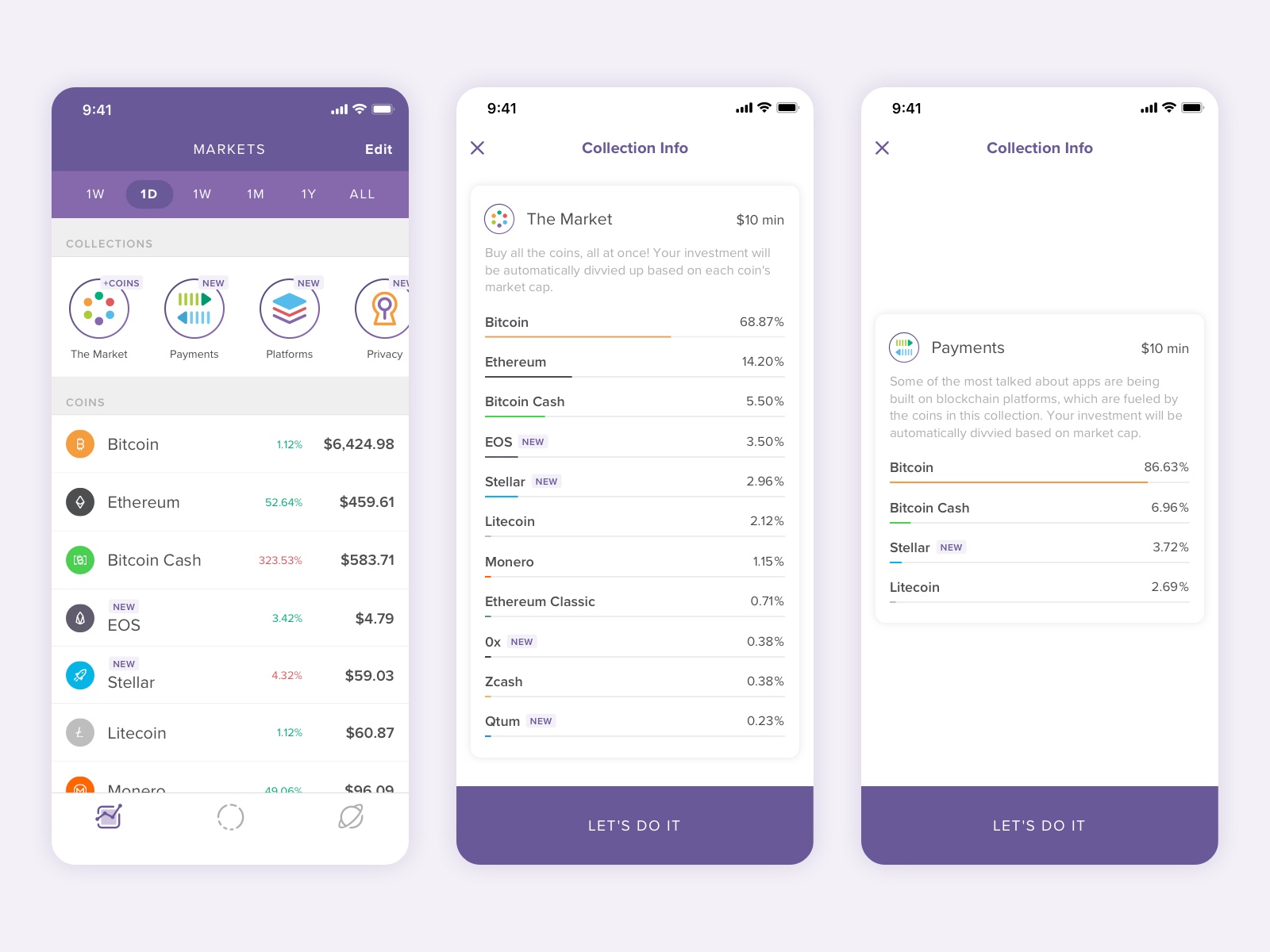
With collections, you can buy a subset of the tokens available on Circle Invest. There are three packages for now — Platforms, Payments and Privacy. For instance, you’ll find Bitcoin, Bitcoin Cash, Stellar and Litecoin in the Payments collection. Once again, collections are weighted by market cap.

04 Oct 2018

ZipRecruiter picks up $156M, now at a $1B valuation, for its AI-based job-finding marketplace

Recruitment websites are some of the oldest and most established residents of the internet, but if you’ve ever used them to find jobs or fill vacancies, you know that there is a lot of room for improvement in how they work. Now, a startup that is out to do just that by applying artificial intelligence to the task has raised a large round of capital to grow its business, both in terms of adding new technology and also expanding more internationally.

ZipRecruiter, a startup based out of LA that has built a marketplace for employers to post open positions, and — by way of AI — help job-seekers to connect to openings that best match their skills and interests, has raised $156 million in a Series B round of funding, at a valuation I understand from sources to be in the region of $1 billion.

This latest round is being led by Wellington Management Company and returning investor IVP, along with participation from unnamed existing investors. ZipRecruiter has in total now raised $219 million, with its previous round, $63 million led by IVP in 2014, being its first significant outside funding.

This latest money comes at a time when ZipRecruiter has already made a lot of headway in the job-seeking market. Ian Siegel, the co-founder and CEO, said that over 100,000 businesses, and 10 million job seekers, are using ZipRecruiter for their recruitment needs: Siegel estimates that ZipRecruiter is already accounting for about 10 percent of activity in the U.S. recruitment market, with over 5.6 million jobs listed on its app as I type this.

“Everything’s gone really well,” he said. (I find he’s a little prone to understatement, which maybe isn’t a bad thing in the sometimes-overheated world of tech startups.)

The company’s basic services revolve around two distinct areas. It provides listings for job openings on its own platform (which is primarily accessed by way of its mobile apps), and it disseminates jobs across a plethora of other sites — it works with the likes of newer entrants like Facebook, as well as more established players like LinkedIn. While the disseminating service hits potentially tens of thousands of sites and has its own benefits (although Siegel describes it as “posting and praying”), it’s the mobile app and the direct service that he believes is where the company has what he calls its “secret sauce”, a big data analytics exercise for matching candidates to roles.

“As soon as you post a job as an employer, we search through 10 million active job applicants  to find the best matches,” he said. “This is not Boolean matching but deep learning that uses 64 different dimensions of information.”

This includes details like what other employers a person has shown interested in, how many times people have searched for openings for specific jobs (a measure of interest), and also how a particular candidate’s profile matches with those that an employer has shown interest in before.

Siegel says that this is not just an exercise in bringing the most impressive candidates to the top of the pile, again and again, and serving less qualified candidates uninteresting prospects, but it’s also not a silver bullet and might drive home some hard truths for those looking for their dream job.

“There are more jobs that need to be filled than there are unemployed in the US today,” he said. “There is a job for everyone, but that doesn’t mean everyone will get one.”

That brings ZipRecruiter to one way that it will likely develop in the years ahead.

“We’re really focused right now on continuing to improve the quality of the matching that our system is making, and optimising the mobile experience.” But in addition to that, he sees an opportunity in also helping candidates figure out why they are not matching well with the jobs they might aspire to have. “We are really good at helping you see jobs you’re likely to get, but what about jobs you aspire to that may not naturally make you a match? In the not too distant future, we will be able to say if you add one more skill all these jobs will become available to you. The nature of the guidance will be very interesting.”

You can see how that might also apply to how ZipRecruiter could help organizations also better tailor their ads as well, to better target specific users, giving the startup an even better foothold in a market that has rapidly shifted but still remains very entrenched with players like Monster.com, Indeed and more.

“In a tight and ever-evolving labor market, businesses need effective, innovative hiring solutions now more than ever,” said Eric Liaw, General Partner at IVP in a statement. “ZipRecruiter has modernized the recruitment experience in an essential, undeniable way. Their sophisticated implementation of AI technology has established them as the foremost platform in the space, having driven millions of employment matches–they’re truly poised to be the next internet marketplace success story. The growth of the business has been phenomenal, and we are thrilled to deepen our partnership with the company as they continue to improve the lives of both job seekers and employers of all sizes.”

04 Oct 2018

Alexa’s skills can now work together, initially for bookings and printing

Amazon this morning announced a new way for customers to use Alexa’s skills – together, in combined requests. That is, you can start a request in one skill, then have it fulfilled in another. For example, the AllRecipes skill can now connect the HP skill in order to print out recipes for customers, Amazon says.

This is the first of many combined skills to come.

Skill Connections, as the developer-facing feature is called, can initially be used to take three types of actions – printing, booking a reservation, or booking a ride.

That means future skills could allow you to book a concert ticket through a skill, then connect to a taxi skill to find you a ride to the show. The idea is that customer wouldn’t have to separately invoke the different skills to complete the one task they wanted to accomplish (i.e., going to a show), or repeat information. Instead, data is passed from one skill to the next.

This isn’t the first time Alexa has tried to tie skills together in some way, but it is the first time it actually allowed two skills to talk to one another. Previously, Alexa was making game recommendations when customers exited a skill, as a means of exposing Alexa users to new content they may like. But this was more of a nudge to launch another skill, not a direct connection between the two.

Skill Connections is launching into a developer preview starting today. During this testing period, printing will be provided by a skill from HP, food reservations will be provided by OpenTable, and taxi reservations will be provided by Uber. Epson and Canon will soon provide prints services as well, Amazon notes.

The skills can also take advantage of Amazon Pay for Alexa Skills and in-skill purchasing announced earlier this year.

Developers who are accepted into the preview could do things like offer to print a game’s leaderboard using the HP skill, or book a taxi to a spot where you’ve made a reservation, Amazon also suggests. To be considered, developers first have to fill out a survey.

Developers can apply either to connect their skill to those from HP, OpenTable or Uber, or they can apply to provide services to other skills. The feature will remain in testing for now, with a public launch planned for a later, but yet unknown date.