Google has partnered with media company PRX to launch the Google Podcasts creator program. PRX, a public radio distribution marketplace, is behind shows like This American Life, Reveal and The Moth Radio Hour. The accelerator aims to remove access barriers to podcasting and to increase the diversity of the podcast industry.
“We want to dramatically change the podcasting ecosystem and support more access,” PRX CEO Kerri Hoffman said in a press release. “Training is a primary way to close the skills gap that keep many from being successful in podcasting. This is particularly true for those who are underrepresented in other forms of media. We hope to elevate more diverse voices and empower others with tools to create and share.”
The idea is to focus on empowering and training underrepresented people, offering free educational tools and showcasing their work. As part of the program, which kicks off in January, 12 teams will receive seed funding, training and mentorship. Those who are interested can apply until November 18 here.
“We are committed to lowering barriers to podcasting through education and information sharing,” Google Podcasts Product Manager Zack Reneau-Wedeen said in a press release. “As we work to bring hundreds of millions more listeners into the fold, we want to play a role in ensuring content is available for all types of global audiences. PRX has a proven track record of mentorship and education, and we couldn’t be more excited to work with them as our lead partner.”
The LOT Network has been around for a few years now. Its mission is to fight patent trolls and it does so by having all of its members commit to a pledge that ensures that whenever they sell a patent to a company that’s in the business of patent trolling, all of the members will automatically get a free license to the patent.
Current members include the likes of Google, Facebook, Amazon, Slack, GitHub, Cisco, Canon, Lenovo, Netflix, Alibaba, Crate & Barrel (yep) and most major car manufacturers, including Tesla. More than 300 organizations are now part of LOT and today, Microsoft is joining the fray.
“The way the organization works is that all of the members sign a license agreement that in essence says that they’re providing a license to each other, such that if they were ever to transfer a patent to another company, that if that company is in essentially the business of asserting patents — that’s basically what it does for business — then the rest of the members in the network would get a license for free automatically,” Microsoft’s Chief IP Counsel Erich Andersen told me. He noted that it’s a way to reduce the risk of patent assertion at a community scale.
Projects like LOT seem to have had an impact over the course of the last few years as the number of the kinds of patent lawsuits at least hasn’t increased in recent years.
Obviously, it took a while for Microsoft to join LOT. Andersen, though, noted that the company’s Azure IP Advantage already provided protection against intellectual property risks for Microsoft’s cloud customers. “One pillar of [Azure IP Advantage] was related to this,” he explained. “We basically said to our Azure customers: if we ever transfer a patent to one of these patent assertion companies, then you’ll automatically get a license from us for that patent, and you don’t need to worry about it.” Joining the LOT Network then is essentially the next step for Microsoft in that it provides similar protections not just to its own customers but anybody who signs up for the network and accepts its pledge (and startups can join for free, for example).
Andersen admits that the patent troll problem isn’t as acute today as it was only a few years ago, but he notes that it’s still a widespread issue.
By joining, Microsoft itself also gets the same kind of protections for itself. “Just as we’re giving a commitment to everybody in the LOT Network that they’ll get a license to our patents if we transfer them to a non-practicing entity [aka, a patent troll], we get the same commitment coming the other direction.”
“Maniac,” a new miniseries on Netflix, comes from an impressive creative team — it stars Emma Stone and Jonah Hill, while director Cary Joji Fukunaga also helmed the first season of “True Detective,” and creator Patrick Somerville used to write for “The Leftovers.”
And yet the series left us a bit cold. On the latest episode of the Original Content podcast, we try to figure out why.
“Maniac” seems to take place in an alternate present (or maybe it’s the past, or the future) inspired by ’80s science fiction — a world with robots and sentient AIs, where computers have an old-fashioned bulkiness and tactility, and where advertising comes in the form of an “ad buddy” who sits next to you and delivers targeted marketing spiels.
Against this backdrop, Annie Landsberg (Stone) and Owen Milgrim (Hill) sign up to test a new pharmaceutical drug, which eventually leads to extensive, shared hallucinations.
So there’s a lot going on here. For Jordan, there was a bit too much happening, seemingly at random, and often pulled from other, more immediately reading science fiction. And while Anthony was more intrigued, he’s still not fully on-board yet either.
You can listen in the player below, subscribe using Apple Podcasts or find us in your podcast player of choice. If you like the show, please let us know by leaving a review on Apple. You also can send us feedback directly. (Or suggest shows and movies for us to review!)
Farewell, Yahoo Messenger. Hello, Yahoo Together? Yep, Yahoo is returning to the messaging space today after closing its older app due to lack of use. Designed for group chats between family, friends, clubs and others, Yahoo Together tries to differentiate itself from others through its ability to organize group conversations into separate topics, similar to the IRC model, and its ability to send smart reminders about upcoming events.
The app, previously codenamed Squirrel while in beta, was built by the Communications Team at Yahoo – the same folks who previously worked on Yahoo Messenger. However, Yahoo Together was built on a new messaging platform, we understand, though it still leverages some existing technology from Yahoo Messenger.
While much of what the app offers – the ability to chat, share photos, GIFs, links, and reactions – isn’t unique to the messaging space, Yahoo hopes people will appreciate the organizational capabilities in Yahoo Together.
“In many apps, you have a set of people, and then a single thread,” explains Michael Albers, Oath VP and Head of Communications Products. (Oath also owns TechCrunch, but we were not given access to the beta version for testing, we should note. Corporate synergies, hooray!)
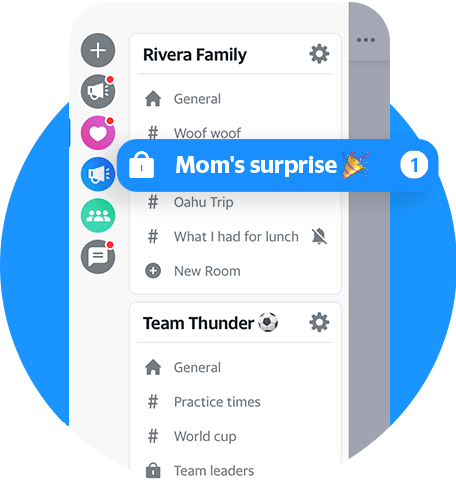
“What’s unique to Yahoo Together is that it allows you to create long running groups, but create an infinite amount of separate topics to organize conversations, and where helpful, limit access to some of those topics to a subset of the group,” he says.
This, along with support for file attachments and a more robust search interface than Messenger, makes Yahoo Together feel more like a hybrid of consumer group chat and a tool that could fit more into the productivity space, like Skype or Slack. But unlike Skype or Slack, it doesn’t have support for calls, and the topic-based chats aren’t designed the same way.
It does use the hash symbol for its side conversations, which people may recognize from Slack. But the pound sign was actually adopted for use within IRC networks decades ago to label channels, and Yahoo credits IRC for the idea, in this case.
These topic-based chats aren’t just new chat rooms you set up by adding people you know from your contacts, but rather function as subsets to a main group chat.
You don’t have to add everyone from the main group chat to the topic-based sidechat, either. This makes it easier for people to keep up with just the conversations they need to be involved in – like a surprise party for mom or dad, or those they care about – like a sports team’s practice schedule – as opposed to scrolling through long message threads.
During the beta, Albers says Yahoo Together saw five times the number of messages per day, compared with Yahoo Messenger, which the team felt was a promising metric.
Following today’s launch, the team plans to roll out more features as the app continues to evolve.
“Our focus is to create the best product for our audiences and the opportunity with consumer productivity in a group messaging context,” says Albers. “We believe this is where this app sets us apart from others in the space, by focusing on the consumer needs to engage with their communities,” he adds.
It’s unclear how much attention Yahoo Together will receive, as Yahoo previously experimented with a group money pool app, Tanda, which was shut down only months after launch. It’s also very difficult to break into the messaging space today, in a market that’s dominated by major apps like Messenger, WhatsApp, WeChat, Line, and others.
Yahoo also didn’t clarify its user acquisition strategy, when asked, beyond touting the app’s feature set as how it plans to grow its user base. It’s not clear, then, if Yahoo will target user acquisition in emerging markets like India, or if it’s hoping to actually grow a base here in the U.S.
The app is live today on iOS and Android in global markets.
China’s internet battle is rapidly reproducing itself in Southeast Asia. One new hotspot is the Philippines, where Tencent just agreed to invest in Voyager, a fintech business started by telecom firm PLDT.
The deal would bring Tencent into direct competition with arch-rival Alibaba, which entered the Philippines 18 months ago when its fintech affiliate Ant Financial invested in Mynt, a financial venture from Globe Telecom which is a competitor to Voyager.
Following a week of speculation, PLDT announced a deal today that sees Tencent and KKR pay up to $175 million for a minority stake in the Voyager business. There have been reports that PLDT is looking to sell its majority stake, for now that has been retained but the firm did say that it has options to add other investors via the creation of new shares that would reduce its total holdings to less than 50 percent. Still, it plans to retain its position as the largest shareholder whilst bringing in expertise and more capital for growth.
Fintech is rapidly becoming a key focus for startups and larger tech companies in Southeast Asia, where the internet and mobile phone ownership promises to increase digital inclusion and give the region’s collective population of more than 600 million people new ways to save and spend. Microloan startups have raised significant funds from investors this year — Philippines based SME lender First Circle just closed a $26 million investment this week, for example — and the bigger fish in the pond are eying key infrastructure plays such as mobile wallets and payment systems.
That’s where both Voyager and Mynt come into the picture.
Voyager offers a range of digital services which include a prepaid wallet, digital payment option for retails, a remittance network for sending money, a digital lending service and a loyalty and rewards program. Mynt is similar, offering payment, remittance and loans for consumers and businesses.
The Voyager deal is the biggest investment in a Philippines-based startup — though you can debate whether a telco spinout is really a “startup” — and it only goes to reiterate increased attention Southeast Asia is seeing from China, and how fintech is becoming one of the hottest verticals.
The Philippines is a particularly hot market for fintech for a number of reasons. The country’s large overseas worker base makes it the world’s third-largest remittance market — worth an estimated $28 billion — despite a sharp drop this year. While, as we wrote when covering First Circle’s news this week, SMEs account for 99.6 percent of the country’s business, 65 percent of its workforce and 35 percent of national GDP but there’s few credit options or limited data for assessment.
Fintech is seen as a key driver that enable Southeast Asia to massively increase its digital footprint and reap economic benefits. More broadly, the region’s internet economy to tipped to grow from $49.5 billion in 2017 to over $200 billion by 2025, according to a report from Google and Singapore sovereign fund Temasek.
U.S. authorities will soon have the authority to shoot down private drones if they are considered a threat — a move decried by civil liberties and rights groups.
The Senate passed the FAA Reauthorization Act on Wednesday, months after an earlier House vote in April. The bill renews funding for the Federal Aviation Administration (FAA) until 2023, and includes several provisions designed to modernize U.S aviation rule — from making commercial flights more comfortable for passengers to including new provisions to act against privately owned drones.
But critics say the new authority that gives the government the right to “disrupt,” “exercise control,” or “seize or otherwise confiscate” drones that’s deemed a “credible threat” is dangerous and doesn’t include enough safeguards.
Federal authorities would not need to first obtain a warrant, which rights groups say that authority could be easily abused, making it possible for Homeland Security and the Justice Department and its various law enforcement and immigration agencies to shoot down anyone’s drone for any justifiable reason.
Drones, or unmanned aerial vehicles, have rocketed in popularity, by amateur pilots and explorers to journalists using drones to report from the skies. But there’s also been a growing threat from hapless hobbyists accidentally crashing a drone on the grounds of the White House to so-called Islamic State terrorists using drones on the battlefield.
“These provisions give the government virtually carte blanche to surveil, seize, or even shoot a drone out of the sky — whether owned by journalists or commercial entities — with no oversight or due process,” an ACLU spokesperson told TechCrunch. “They grant new powers to the Justice Department and the Department of Homeland Security to spy on Americans without a warrant,” and they “undermine the use of drones by journalists, which have enabled reporting on critical issues like hurricane damage and protests at Standing Rock.”
“Flying of drones can raise security and privacy concerns, and there may be situations where government action is needed to mitigate these threats,” the ACLU said in a previous blog post. “But this bill is the wrong approach.”
The EFF agreed, arguing the bill endangers the First and Fourth Amendment rights of freedom of speech and the protection from warrantless device seizures.
“If lawmakers want to give the government the power to hack or destroy private drones, then Congress and the public should have the opportunity to debate how best to provide adequate oversight and limit those powers to protect our right to use drones for journalism, activism, and recreation,” the EFF said.
Other privacy groups, including the Electronic Privacy Information Center, denounced the passing of the bill without “baseline privacy safeguards.”
The bill will go to the president’s desk, where it’s expected to be signed into law.
One can only imagine what it was like to work at Uber in the years leading up to Susan Fowler’s infamous blog post. Many of the company’s leaders were said to be overly-competitive, sexist and inappropriate — “brilliant jerks,” as Arianna Huffington once said, — and its over-arching “move fast and break things” mentality hardly left room for employees to take a step back and reflect on how the company’s culture was impacting their mental health.
Andrew Chapin joined Uber in 2011 as one of its first hires in New York. He worked his way up to head of vehicle solutions and established Uber’s vehicle finance program, which helps drivers obtain and pay off car leases. He says the struggles within the company gave him severe anxiety, something he was all too familiar with from his stint as a commodities trader at Goldman Sachs.
“There were days when I was walking through lower Manhattan and thinking if I got hit by a car and was in the hospital for a week, it’d be better than going to work,” Chapin told TechCrunch.
At both Goldman and Uber, Chapin would go through rough patches but resisted therapy, in part because of the outlandish costs but mostly because of the hassle. Toward the end of his five-year Uber tenure, he realized the dire need for accessible and flexible tech-enabled tools to help workers endure stressful times, as well as the need to destigmatize the mental health issues prevalent within the tech industry and beyond.
In late 2016, he left Uber to build his own startup. Two years later, he’s ready to share what he’s been working on. Basis, an app meant to help people cope with anxiety, depression and other mental health issues through guided conversations via chat or video, is emerging from stealth today with a $3.75 million investment led by Bedrock. Wave Capital and Lightspeed Venture Partners have also participated in the round.
“Looking back at the Goldman experience of just kind of wallowing in this unpleasant situation, [Basis] would have been an outlet to talk through things and feel lighter,” Chapin said. “At the time, I bottled it up. In retrospect, if I had something to work me through the emotions I was dealing with, it would have been really helpful.”
In the app, users can schedule 45-minute phone calls with unlicensed providers for $35. Because Basis works with paraprofessionals — people trained in research-backed approaches but who don’t have the same certifications as a counseling or clinical psychologist — it’s a much cheaper alternative to paying for a therapist. The startup does not give diagnoses or write prescriptions.
Chapin built the app with co-founder and chief science officer Lindsay Trent, a former research psychologist at Stanford who’d grown tired of watching trained psychologists charge outlandish fees and was hungry for an innovative solution to today’s mental health crises.
“I saw a real gap between what we knew was effective and what people actually received,” Trent told TechCrunch. “Clinicians that are charging $300 a session are not providing optimal care. It’s very frustrating for me.”
Basis provides six pathways: Work, Social, School, Finances, Relationships and Parenting. Within each, users can get same-day access to specialists who they can opt to see on a regular basis or just once.
The idea is that Basis fits into your life much like a SoulCycle class or a call with your best friend — on your terms.
Move over Twitter, President Trump now has the power to send every phone in the land a simultaneous message — thanks to the new “presidential alert”, tested by FEMA yesterday.
What’s it for? The idea is to enable the president of the United States to warn the nation of major threats — such as a natural disaster or terrorist attack.
FEMA did already have the power to mass text US phones, via the National Wireless Emergency Alert System devised by the Bush administration in 2006, which has been used for sending alerts about national emergencies like weather events or missing children at a local level.
But now the system has been expanded to allow for the White House to compose and send its own ‘presidential alert’ to all phones in a national emergency situation.
There is no opt-out.
Repeat: No opt-out.
Fortunately Congress did limit the substance of these alerts — to “natural disasters, acts of terrorism, and other man-made disasters or threats to public safety”, further stipulating that:
Except to the extent necessary for testing the public alert and warning system, the public alert and warning system shall not be used to transmit a message that does not relate to a natural disaster, act of terrorism, or other man-made disaster or threat to public safety.
But bearing in mind the ‘rip it up’ record of the current holder of office of the president of the US, there are no copper-bottomed guarantees about how ‘threat to public safety’ might be interpreted by president Trump.
So it remains a slightly mind-bending concept that the president could, say after a 3am binge-watch of his favorite TV show, fire out an alert entirely of his framing to EVERY US PHONE.
Technology is indeed a double-edged sword.
Here are a few ideas of presidential alerts we really hope Trump won’t be sending…
an accidental photo of a body part after he couldn’t figure out how to use the system and hit send accidentally
JFrog wants to change the way we deal with software updates. Instead of large numbered updates you have to manually download, it sees a future of continuous delivery where software is delivered as binaries and updated in the background. Investors must like that vision very much because they showered the company with a $165 million Series D investment today, which the company reports pushes its valuation past the billion dollar mark.
The round was led by Insight Venture Partners, and as part of the deal Insight’s co-founder and managing director, Jeff Horing will be joining the JFrog board. Other investors joining the round included new investors and Silicon Valley Funds, Spark Capital and Geodesic Capital, as well as existing investors Battery Ventures, Sapphire Ventures, Scale Venture Partners, Dell Technologies Capital and Vintage Investment Partners. Today’s investment pushes the total invested to-date to over $226 million.
What the company has done to justify this kind of investment is offer a series of products that enable customers to deliver code in the form of binaries. That in turn allows them to deliver updates on a regular basis in the background without disturbing the user experience. In a world of continuous delivery, this approach is essential. You couldn’t deliver multiple updates a day if you had to take down your service every time you did it.
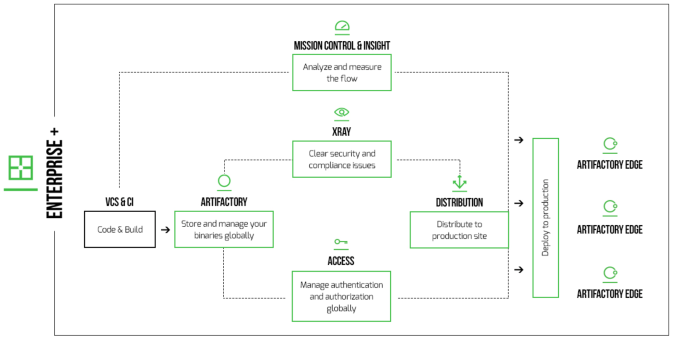
The JFrog platform is actually made up of multiple products, but the main one is JFrog Artifactory where companies can add the latest binaries (updates) and deliver them to customers in the background. It’s not unlike, GitHub, but whereas GitHub is a repository for downloading software and updates, the Artifactory is a place to deliver these updates automatically without user involvement. It also handles other DevOps functions like security, access control and distribution.
JFrog platform. Diagram: JFrog
CEO and co-founder Shlomi Ben Haim was happy to reveal that the company’s valuation had entered unicorn territory, but he wasn’t willing to share an exact number. “I don’t want to get into details, but we exceeded the billion dollar valuation. We are north of $1 billion already and we are building the company to generate the revenue to justify it,” he told TechCrunch.
He wasn’t discussing specific revenue numbers, but reports the company has a goal of a billion dollars in revenue by 2025, and he says they are working toward that. He did say they have had 500 percent revenue growth since the $50 million round in 2016, and that they tripled the number of employees to 400, while doubling the number of products they offer. They currently have 4500 customers including 70 percent of the Fortune 100.
So fair to say things are going well for the company. Ben Haim says the ultimate goal for the company is to deliver software in the background for scenarios like your operating system or your Tesla. Instead of shutting down your car or computer for the next software update, it will just happen over the air in the background. We are obviously a ways from fulfilling that vision, but investors are clearly betting on that potential.
That’s according to a report from Bloomberg which details how the Chinese government infiltrated a number of U.S. companies by sneaking tiny chips onto motherboards from Supermicro. They then became part of servers deployed by the companies giving remote operatives potential access to data. It’s a huge story that includes a comparatively small but important passage shedding light on Amazon’s China deal last November — the U.S. firm sold the physical server business to local partner Beijing Sinnet for 2 billion yuan, or around $300 million.
That transaction initially sparked reports that AWS would exit China, but Amazon later clarified it planned to continue to operate its cloud services in China. Selling the physical server business, it said, was down to the fact that “Chinese law forbids non-Chinese companies from owning or operating certain technology for the provision of cloud services.”
While it is correct that China did introduce cybersecurity laws that placed restrictions on overseas firms and appeared to give the government unprecedented access to data, the Bloomberg report claims that Amazon’s China-based servers were in fact offloaded because they were plagued with compromised servers.
A notable exception was AWS’s data centers inside China, which were filled with Supermicro-built servers, according to two people with knowledge of AWS’s operations there. Mindful of the Elemental findings, Amazon’s security team conducted its own investigation into AWS’s Beijing facilities and found altered motherboards there as well, including more sophisticated designs than they’d previously encountered. In one case, the malicious chips were thin enough that they’d been embedded between the layers of fiberglass onto which the other components were attached, according to one person who saw pictures of the chips. That generation of chips was smaller than a sharpened pencil tip, the person says.
One source at Amazon described the deal to Bloomberg as a decision to “hack off the diseased limb.”
Amazon refuted the claims, as did other U.S. companies named in the report as well as the Chinese government itself.
“It’s untrue that AWS knew about a supply chain compromise, an issue with malicious chips, or hardware modifications when acquiring Elemental. It’s also untrue that AWS knew about servers containing malicious chips or modifications in data centers based in China, or that AWS worked with the FBI to investigate or provide data about malicious hardware,” Amazon told Bloomberg in a statement.

 “In many apps, you have a set of people, and then a single thread,” explains Michael Albers, Oath VP and Head of Communications Products. (Oath also owns TechCrunch, but we were not given access to the beta version for testing, we should note. Corporate synergies, hooray!)
 These topic-based chats aren’t just new chat rooms you set up by adding people you know from your contacts, but rather function as subsets to a main group chat.