Year: 2018

04 Oct 2018

SoftBank and Toyota team up to develop services powered by self-driving vehicles

SoftBank is getting into self-driving car services after the Japanese tech giant announced a joint-venture with Toyota in its native Japan.

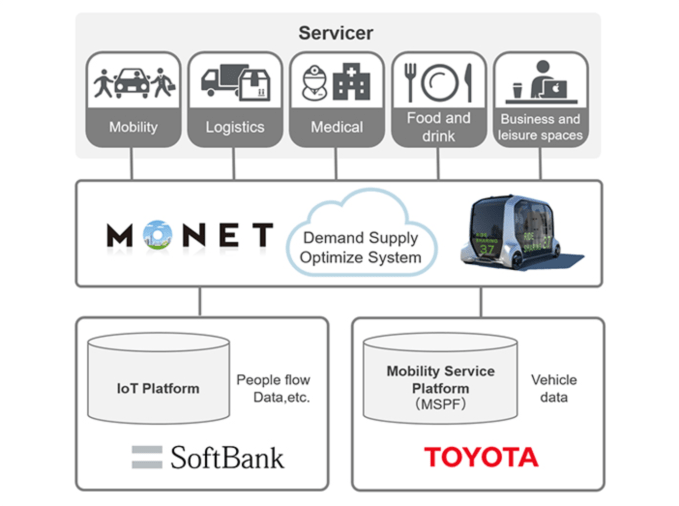
SoftBank is invested in Uber and a range of other ride-hailing startups like Didi in China and Grab in Southeast Asia, but this initiative with Toyota is not related to those deals. Instead, it is designed to combine SoftBank’s focus on internet-of-things technology and Toyota’s connected vehicle services platform to enable new types of services that run on autonomous vehicle tech.

Called MONET — after ‘mobility network’ — the joint venture will essentially assign autonomous vehicles to various different “just in time” services. That just in time caveat essentially means more than on-demand. SoftBank suggests it’ll mean that services are performed in transit. That could be food prepared as it is delivered, hospital shuttles that host medical examinations, or mobile offices, according to examples given by SoftBank.

The plan is to use Toyota’s battery-based e-Palette electric vehicles and begin a roll “by the second half of the 2020s.” SoftBank said that the business will be focused on the Japanese market with “an eye to future expansion on the global market.”

Toyota has made strong progress on self-driving vehicles, having debuted its 3.0 self-driving research car earlier this year and then, in March, created a new $2.8 billion business that’s focused on developing requisite software systems. That latter program is designed to work alongside the Toyota Research Institute which, fueled by a $1 billion grant, is pushing the firm’s autonomous tech strategy.

Toyota is also aligned with Uber on ride-hailing. The firm invested $500 million in Uber and $1 billion in Grab via deals this year.

Back in January at CES, Toyota said that it is working with Amazon, Uber, Didi, Mazda and Pizza Hut to develop an electric autonomous shuttle that can be used to deliver people or packages. The business alliances were created to focus on the development of the e-Palette.

SoftBank’s autonomous vehicle projects including a bus that it is developing in partnership with China’s Baidu.

04 Oct 2018

Fitbit may have helped catch a killer, again

Fitbit data may have helped catch one of its customer’s killers, and not for the first time.

According to numerous media reports, a 90-year-old visited his stepdaughter at her home in San Jose, Ca. earlier this month, where he says he brought her pizza and visited briefly. But according to data provided to authorities by Fitbit, data from the stepdaughter’s Fitbit Alta wristband device — which tracks one’s heart rate and the number of steps taken during the day — showed a “significant spike” in her heart rate during the man’s visit, followed by a “rapid slowing.” Eight minutes after her heart had risen so rapidly, and five minutes after her stepfather left her home, it stopped.

A concerned coworker discovered the woman at her home five days later. She had a “gaping laceration” on her neck and wounds on the top of her head, say police, who arrested the stepfather based in part on a combination of video surveillance and assistance from Fitbit, which seems to have a less contentious relationship with law enforcement than some tech companies.

Indeed, Fitbit’s newest privacy policy states that the company “may preserve or disclose information about you to comply with a law, regulation, legal process, or governmental request; to assert legal rights or defend against legal claims; or to prevent, detect, or investigate illegal activity, fraud, abuse, violations of our terms, or threats to the security of the services or the physical safety of any person.”

As the New York Times notes, if convicted, the man won’t be the first assailant whose crime may have been revealed in part by a Fitbit. Last year, a Connecticut woman’s dying moments were recorded by her Fitbit in a case that strongly suggests her husband murdered her, despite his claims that the couple was attacked in their home.

According to local media, her wristband showed that her last movements were at 10:05 a.m. the day she died, nearly an hour after her husband told police she had been killed. The man, who was discovered by first responders on the kitchen floor, still half-tied to a metal chair, later told investigators he had a pregnant girlfriend and that the pregnancy was not planned. He’s still awaiting trial.

04 Oct 2018

Jon Favreau’s new Star Wars streaming series will be called “The Mandalorian”

We’ve known for a few months now that Jon Favreau was working on a live-action Star Wars series for Disney’s upcoming (but as of yet unnamed) streaming service. But that’s about all we knew.

Until now! Favreau just dropped a few huge details out of nowhere.

In a surprise Instagram post, Favreau mentioned:

  • It’s at least tentatively called “The Mandalorian”. For the unfamiliar, Mandalorians are a group of warriors in the Star Wars universe. The most famous Mandalorians are Jango and Boba Fett, though Favreau notes that this series will focus on “another warrior.”
  • It’ll take place “after the fall of the Empire” but before the First Order shows up; in other words, after Return of the Jedi but before Force Awakens.

Alas, that’s it for now. No word on casting, or new characters, or even any concept art to be seen. Will the new series tap much of the existing universe, or will it intentionally be set far enough away so as to be mostly self contained? This new warrior — are they a bounty hunter, the gig their fellow Mandalorians are best known for? Will it finally answer, once and for all, whether Boba Fett survived the sarlacc pit in Disney’s hacked-and-slashed version of the canon? We’ll have to wait to find out.

View this post on Instagram

#starwars #TheMandalorian

A post shared by Jon Favreau (@jonfavreau) on

04 Oct 2018

Blizzard co-founder Mike Morhaime is stepping down

Blizzard — the company behind massive game titles like World of Warcraft, Overwatch, and Hearthstone — is getting new leadership.

After 27 years, Blizzard President Mike Morhaime is stepping down from the company he co-founded back in 1991 (back when it was known as Silicon and Synapse.)

J. Allen Brack, previously Senior Vice President and Executive Producer on WoW, will now lead the company. Brack has been with Blizzard since 2006.

In a letter about the transition, Brack also mentions that Blizzard co-founder (and the original lead designer of WoW) Allen Adham will be joining the company’s executive team to “oversee development of several new games.” Adham left Blizzard in 2004 shortly before WoW went live, which he later called his “biggest mistake.”

Morhaime doesn’t say much about his reason for departure, besides that he’s “decided it’s time for someone else to lead Blizzard Entertainment.” He’ll stay on with the company as a strategic advisor.

03 Oct 2018

Kia’s all-electric e-Niro is a crossover with 300 miles of range

Kia is finally sharing more details about its upcoming the all-electric crossover — the 2019 Kia e-Niro — that made its debut in Korea earlier this year. The upshot: it’s got some range.

The production version of all-electric crossover, which Kia is showing off at the Paris Motor Show this week, has a range of about 301 miles (for those who opt for the bigger battery pack) on the European WLTP combined testing cycle. The estimated EPA-range has yet to be released, but expect it to be lower at somewhere around 250ish miles in the U.S.

That 301 miles of range is one of the longer ranges in the world of EVs and it’s possible thanks to a 64 kilowatt-hour battery pack, regenerative braking and a feature that gives the driver suggestions on when to coast or brake to further optimize the system. The e-Niro with the 64 kWh battery pack is combined with a 150kW electric motor that produces 201 horsepower and 291 pound-feet of torque.

The vehicle comes standard with a smaller 39.2 kWh battery, which has a 100 kW electric motor and offers a driving range of up to 193 miles on a single charge under the WLTP cycle.

The all-electric crossover is based on the Niro hybrid and plug-in models. Kia has sold more than 200,000 of these hybrid and plug-in Niro vehicles worldwide since it was introduced in 2016.
The e-Niro is headed to Europe first. The company says the e-Niro will go on sale in select European markets at the end of the year. Kia’s U.S. website indicates the vehicle will also come to the states by the end of the year. However, we have yet to hear specifics on U.S. sales or whether the European rollout might push that date into 2019.
The e-Niro looks a lot like its gas-based counterparts and offers some of the same features including the option to add a driver assistance system with adaptive cruise control, automatic emergency braking, forward collision warning and lane-keep assist.
However, there are a few differences. The grille on the e-Niro has an integrated charging port and the front bumper has been changed to help improve the aerodynamics, and by extension, the range of the vehicle. The vehicle also has redesigned air intakes.
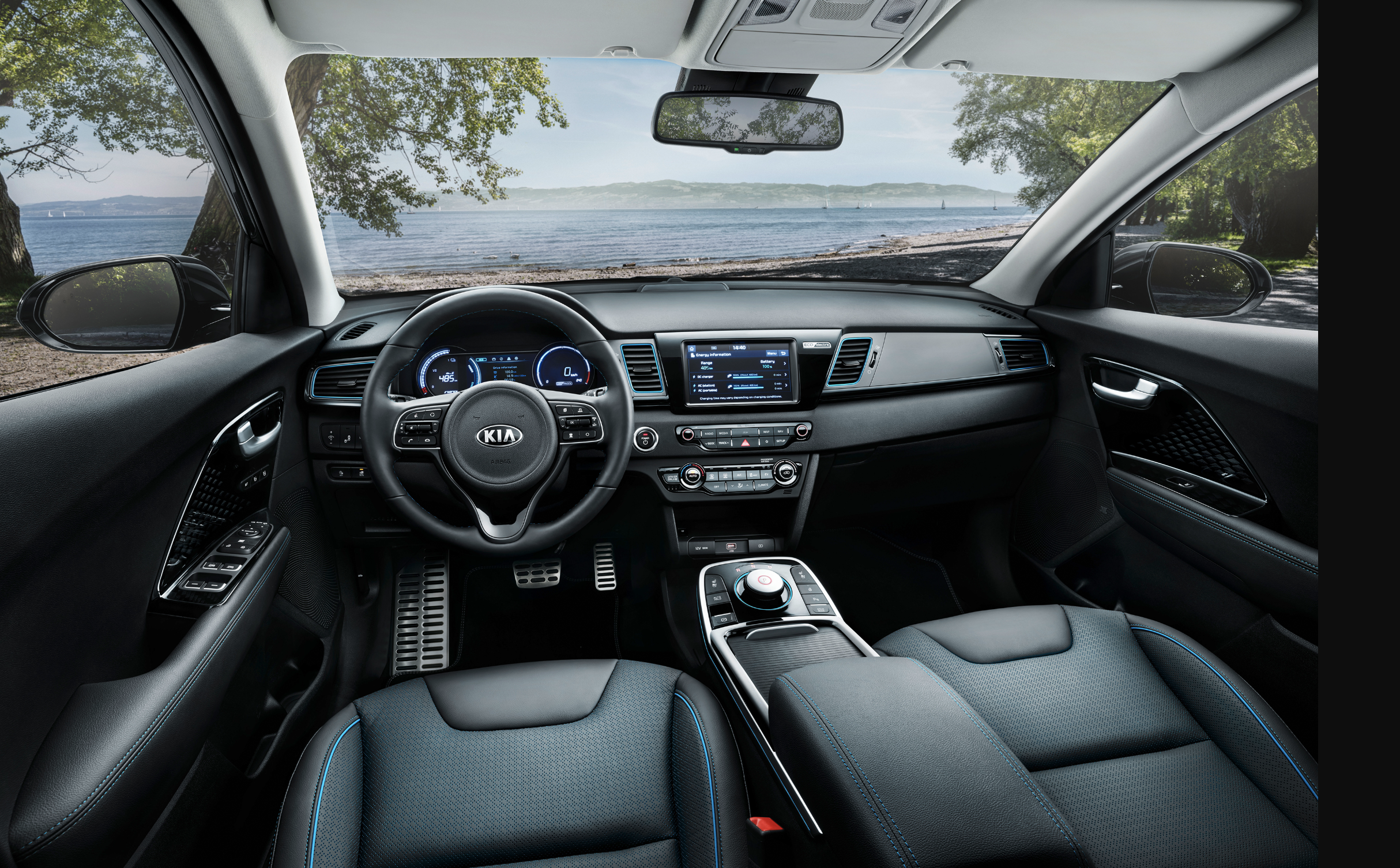
The inside is a bit different too since there’s no need for a traditional gear stick and gear linkage in a vehicle with an all-electric powertrain. Nor is there a need for a transmission tunnel, allowing engineers to create a larger storage area at the base of the central console. Kia replaced the transmission with a new ‘shift-by-wire’ rotator dial drive selector. 
kia e-niro interior paris motor show
The dial sits on a panel that extends out from the base of the central armrest. Drivers will also find buttons for the electronic parking brake, heated and ventilated seats, heated steering wheel, drive mode selector, parking sensors, and the Niro’s braking ‘Auto Hold’ function on the panel. 

The vehicle is equipped with a 7- inch touchscreen at the center of the dashboard that includes a few electric-vehicle specific features such as the ability to find nearby charging stations and monitor charge levels. Owners will be able set a departure time for their next journey, enabling the car to heat itself to a set temperature before the driver departs. There’s also a charge management function designed to extend the life of the battery.

03 Oct 2018

Kia’s all-electric e-Niro is a crossover with 300 miles of range

Kia is finally sharing more details about its upcoming the all-electric crossover — the 2019 Kia e-Niro — that made its debut in Korea earlier this year. The upshot: it’s got some range.

The production version of all-electric crossover, which Kia is showing off at the Paris Motor Show this week, has a range of about 301 miles (for those who opt for the bigger battery pack) on the European WLTP combined testing cycle. The estimated EPA-range has yet to be released, but expect it to be lower at somewhere around 250ish miles in the U.S.

That 301 miles of range is one of the longer ranges in the world of EVs and it’s possible thanks to a 64 kilowatt-hour battery pack, regenerative braking and a feature that gives the driver suggestions on when to coast or brake to further optimize the system. The e-Niro with the 64 kWh battery pack is combined with a 150kW electric motor that produces 201 horsepower and 291 pound-feet of torque.

The vehicle comes standard with a smaller 39.2 kWh battery, which has a 100 kW electric motor and offers a driving range of up to 193 miles on a single charge under the WLTP cycle.

The all-electric crossover is based on the Niro hybrid and plug-in models. Kia has sold more than 200,000 of these hybrid and plug-in Niro vehicles worldwide since it was introduced in 2016.
The e-Niro is headed to Europe first. The company says the e-Niro will go on sale in select European markets at the end of the year. Kia’s U.S. website indicates the vehicle will also come to the states by the end of the year. However, we have yet to hear specifics on U.S. sales or whether the European rollout might push that date into 2019.
The e-Niro looks a lot like its gas-based counterparts and offers some of the same features including the option to add a driver assistance system with adaptive cruise control, automatic emergency braking, forward collision warning and lane-keep assist.
However, there are a few differences. The grille on the e-Niro has an integrated charging port and the front bumper has been changed to help improve the aerodynamics, and by extension, the range of the vehicle. The vehicle also has redesigned air intakes.
The inside is a bit different too since there’s no need for a traditional gear stick and gear linkage in a vehicle with an all-electric powertrain. Nor is there a need for a transmission tunnel, allowing engineers to create a larger storage area at the base of the central console. Kia replaced the transmission with a new ‘shift-by-wire’ rotator dial drive selector. 
kia e-niro interior paris motor show
The dial sits on a panel that extends out from the base of the central armrest. Drivers will also find buttons for the electronic parking brake, heated and ventilated seats, heated steering wheel, drive mode selector, parking sensors, and the Niro’s braking ‘Auto Hold’ function on the panel. 

The vehicle is equipped with a 7- inch touchscreen at the center of the dashboard that includes a few electric-vehicle specific features such as the ability to find nearby charging stations and monitor charge levels. Owners will be able set a departure time for their next journey, enabling the car to heat itself to a set temperature before the driver departs. There’s also a charge management function designed to extend the life of the battery.

03 Oct 2018

Nintendo’s Reggie Fils-Aime on Wii U ‘stumbles’ and balancing nostalgia with reinvention

Nintendo is nearing its 130th birthday, and the company is once again in the midst of major changes as it embraces mobile platforms and online services. But Nintendo of America’s president Reggie Fils-Aime says that should come as no surprise: “We reinvent ourselves every 5 or 10 years. We have to. It’s in our DNA.”

In an interview at the GeekWire Summit in Seattle, Fils-Aime talked, in his immaculately Nintendo-promotional manner, about the company’s ups and downs over the last decade and what it took to get the Switch out the door.

“We focus on giving consumers experiences that they haven’t even thought of,” he explained. Anyone who has followed Nintendo for a few years certainly wouldn’t disagree — remember the vitality sensor? “By going down this path you create doubters. And we’ll be the first to admit that there will always be stumbles along the way.”

“The Wii had sold a hundred million units globally; the Wii U did not have that same level of success,” he admitted. That’s something of an understatement; the Wii U is widely considered something of a boondoggle, interesting but confusing and hugely outgunned by the competition when it came to what was valued by the rapidly growing mainstream gaming world.
“But in the words of one of our presidents — this is [Hiroshi] Yamauchi — when you’re doing well, don’t be excited by that high-flying performance, and when you’re doing poorly, don’t be said. Always have an even keel,” he said. Not exactly catchy, but it is good business advice. The focus should be on the horizon.

And that’s where it was, despite the painfully low sales numbers and lack of third party support. As he tells it, they just plowed ahead with new lessons under their belt.

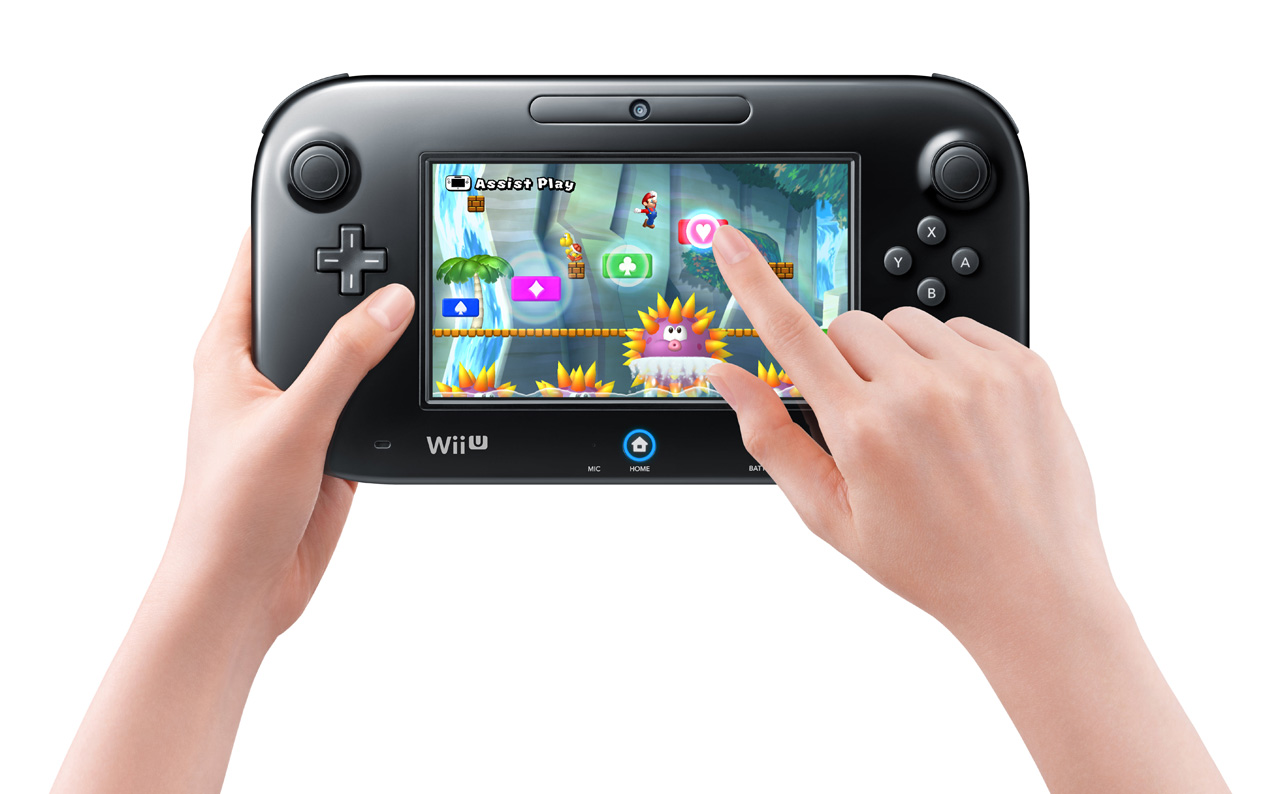
“If we had not had the Wii U, we would not have the Switch,” he said seriously. “What we heard from customers was that the proposition of a tablet on which they could experience gameplay, coupled with the ability to play games on the TV, is really compelling. Users were telling us, I want to play with this tablet, but when I get 30 feet away from the TV, it disconnects. The one point gamers all hate is the point where they have to put the controller down. So it was an important step for us to be able to deliver on this proposition.”
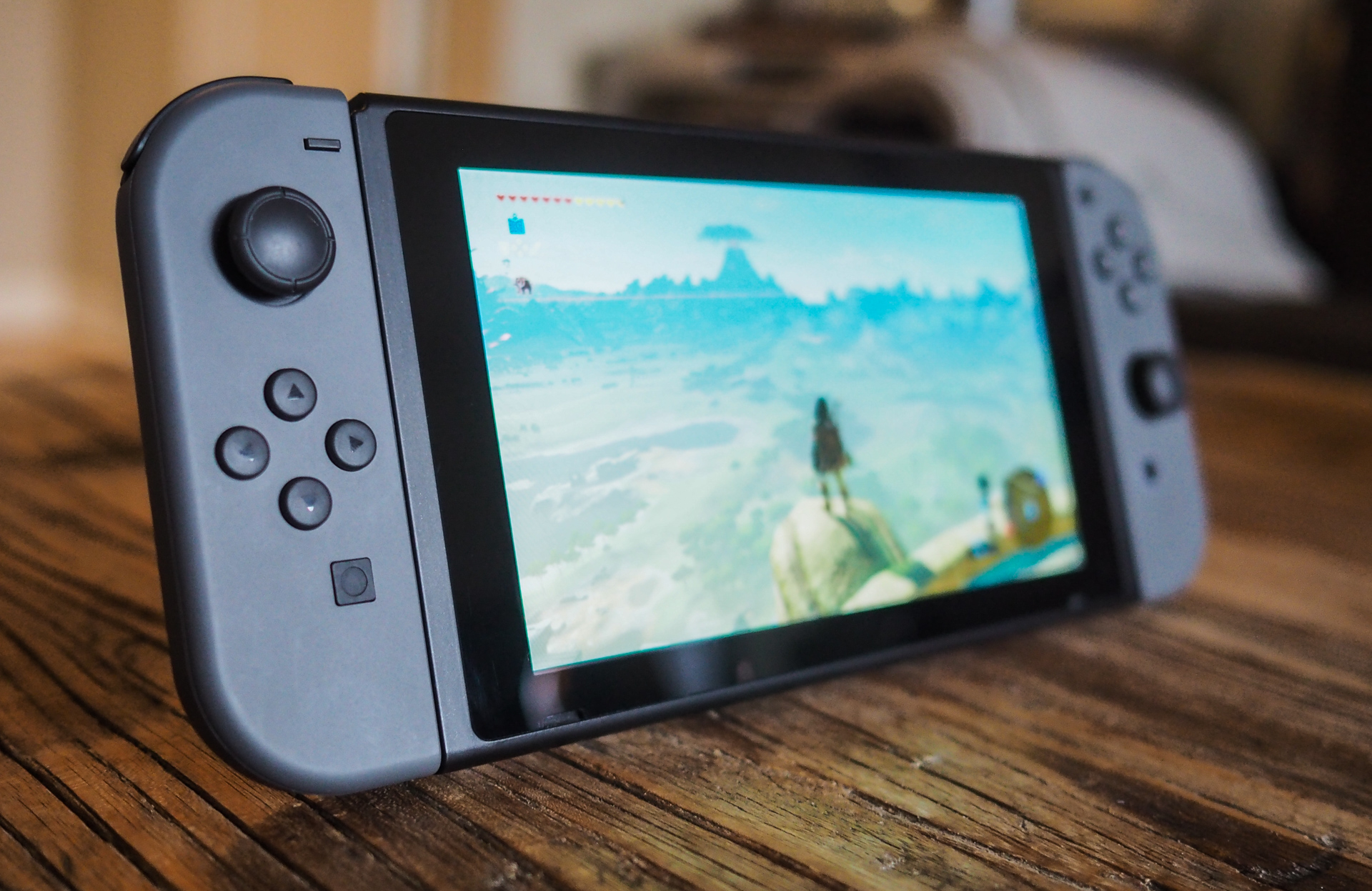
“When I first saw the embodiment of that system,” he recalled, “the hairs on the back of my neck raised up.” It was the same feeling, he said, that he had with the Wii Remote and the DS — both featuring technologies that people were highly skeptical of at first but proved versatile and compelling.

Touchscreens weren’t common when the DS came out, and motion controls weren’t common when the Wii came out, he noted. Both have since become mainstream — not entirely due to Nintendo’s success with them, of course, but it would be disingenuous to say that had nothing to do with it.

But while the company can rightly be said to be taking risks in some ways, in other ways it is uniquely stuck in the past. Its most successful franchises are well past a quarter of a century old.

As Fils-Aime sees it, however, this is exactly how it should be. Mario and Link are characters the way Mickey Mouse or even someone like Robin Hood are characters. New franchises like Splatoon can be established and cared for, but the traditional ones (though no one mentioned Metroid, predictably and unfortunately) should be recycled and brought to new platforms and generations.

Nowadays that includes mobile games, where Nintendo has been taking tentative steps in recent years.

Nintendo’s latest has been criticized for its unvarnished quest for players’ money.

“We see our mobile initiatives as a way to bring our intellectual properties and our gameplay experiences to a larger population than the tens or hundred million consumers that own a dedicated gaming system,” he said. “With Super Mario Run, we literally have hundreds of millions of consumers experiencing Mario, consumers in places where we don’t even distribute our gaming systems. Then maybe they buy that Super Mario t-shirt, they may eat that Super Mario cereal, they may buy a Nintendo Switch.” (Presumably imported.)

Here Fils-Aime’s comments rang a bit hollow, however. Nintendo’s mobile strategy has leaned hard on the “gacha” style game that massively incentivizes in-app purchases of virtual currencies and grinding levels to unlock new characters randomly in loot box style. This seems so far from Nintendo’s core mission of entertainment and so close to the current industry method of cash extraction that it’s hard to believe it’s what the company really wanted to create.

It does, as Fils-Aime said was the goal, allow them to be “effective” on platforms and marketplaces they don’t themselves own, and it does drive their “overall business agenda.” But it seems as though the company is still trying to figure out how to truly bring its games to mobile. Perhaps the upcoming Mario Kart game will be a better option, but it could very easily go the other way as well.


03 Oct 2018

The new version of Wi-Fi is called Wi-Fi 6 because rules don’t matter

The Wi-Fi Alliance, the working group that has long offered such euphonious, IEEE-defined names for Wi-Fi protocols such as 802.11ab and 802.11n, has finally decided enough was enough with the numbers and letters and such. Their decision? The next Wi-Fi version will be Wi-Fi 6 — and sucks to your ass-mar if you don’t like it.

“For nearly two decades, Wi-Fi users have had to sort through technical naming conventions to determine if their devices support the latest Wi-Fi,” said Wi-Fi Alliance CEO Edgar Figueroa in a release. “Wi-Fi Alliance is excited to introduce Wi-Fi 6, and present a new naming scheme to help industry and Wi-Fi users easily understand the Wi-Fi generation supported by their device or connection.”

Wi-Fi 6 is actually 802.11ax, an improvement on 802.11ac. The ostensible data rate for Wi-Fi 6 is, according to Wikipedia, “37% higher than IEEE 802.11ac, the new amendment is expected to achieve a 4× increase to user throughput due to more efficient spectrum utilization.” It runs eight 5 GHz streams and four 2.4 GHz streams.

In addition to 6 we will now all call 802.11ac Wi-Fi 5 and 802.11n will be called Wi-Fi 4. Devices will be officially certified by generation and the first Wi-Fi 6 devices will arrive in 2019. We would encourage you to stop using the 802.11 nomenclature well before the deadline, ensuring a swift and effortless transition into Wi-Fi chaos.

03 Oct 2018

Weed in space is going to be a thing now

Scientists interested in cannabis as a subject for pharmaceutical studies may find an unlikely new home for their research into the plant, its byproducts and biochemistry aboard the International Space Station.

Yes, weed is going to space thanks to the work of a small Lexington, Ky.-based startup called Space Tango.

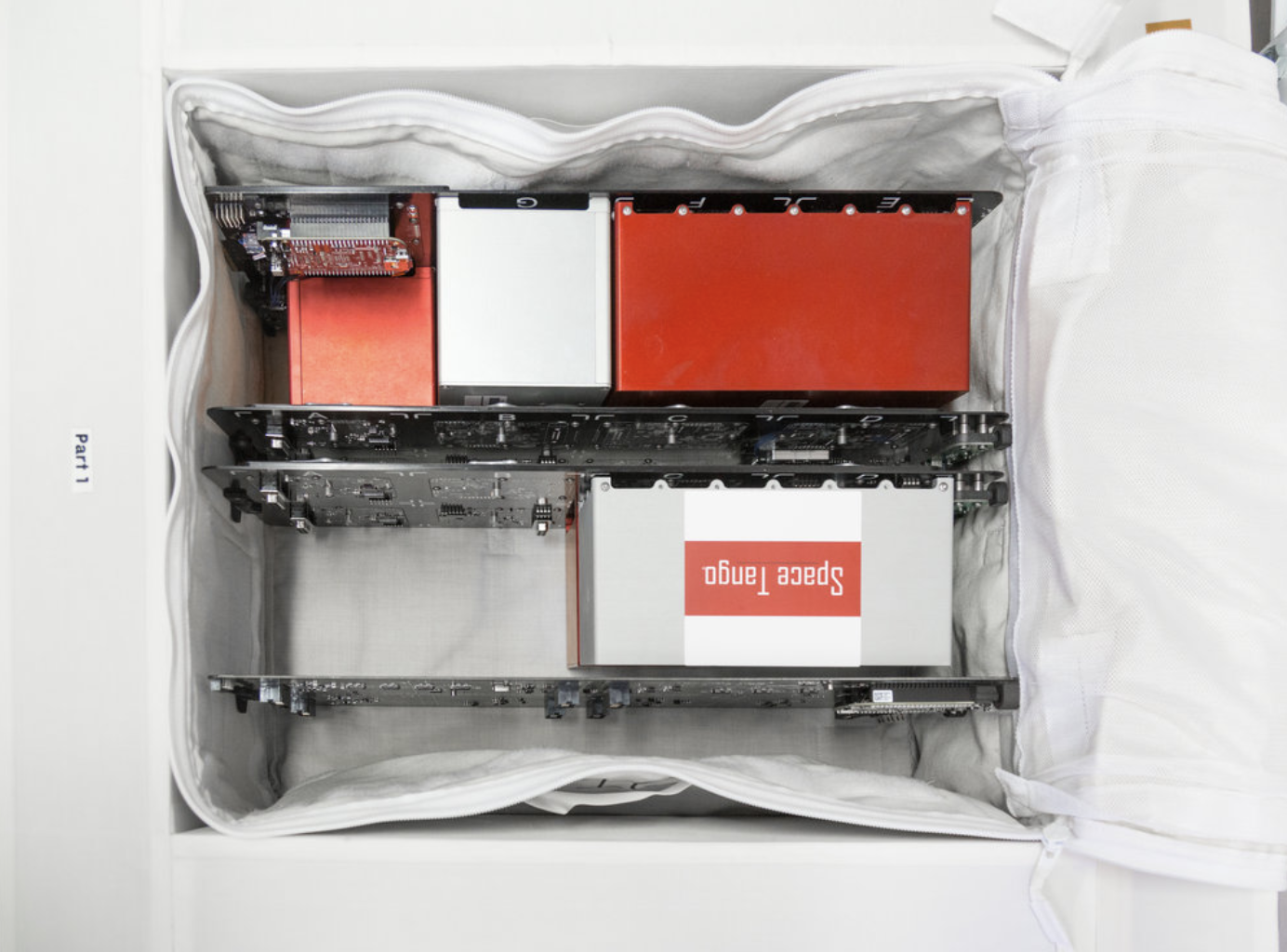
The company makes a “clean room” laboratory in a microwave-sized box. Because space is tight on the International Space Station, companies that want to conduct experiments in microgravity have to do more with less. And Space Tango gives them a small environment in which to perform tests and monitor the results.

Using Space Tango’s “CubeLab” modules, which slot into the larger TangoLab containers, companies like Anheuser-Busch can send barley up to the space station to observe how the crop could be cultivated in environments approaching zero gravity.

Now, Space Tango is taking its own steps to develop experiments on how the zero gravity environment could affect cannabis cultivation.

Alongside two Kentucky hemp and cannabis cultivation and retail companies, Atalo Holdings, which provides hemp genetics, and Anavii Market, an online retailer of hemp-derived cannabidiol (CBD) therapeutics, Space Tango has set up its own subsidiary to research how microgravity can be used to better cultivate particular strands of hemp for medical compounds.

“For all entrepreneurial companies in this new space area everyone is trying to hone in [sic] on what is the actual business,” said co-founder and chairman Kris Kimel of Space Tango, in an interview. “We’re trying to figure out here what’s the business now… For us, the model is looking at low earth orbit to actually develop and design applications for life on earth.”

Kimel said the company now has two micro-laboratories installed on the International Space Station and has payloads launching to the space station for corporate and university customers about six times a year.

In its early stages, the company is mainly operating on existing income. “We’re able to meet our operating expenses off of revenue,” says Kimel. “Which is great for a company that is not just three years old.”

As it looks to create these kinds of joint ventures with other companies, Kimel said that additional revenue could come from a profit-sharing agreement rather than just straight contracts for services. The new subsidiaries enhance what the company sees as its broader mission, Kimel said.

“Each time a new type of physics platform has been successfully harnessed such as electromagnetism, it has led to the exponential growth of new knowledge, benefits to humankind and capital formation,” said  Kimel, in a statement. “Using microgravity, we envision a future where many of the next breakthroughs in healthcare, plant biology and technology may well occur off the planet Earth.”

Industrialized hemp production and research and development into the crop was enabled four years ago with the passage of the 2014 U.S. Farm Bill. It was the first time in 70 years that new rules were enacted to promote research into applications for the hemp plant as fiber, food or medicine.

By taking the plants to space, Space Tango hopes to study whether the growth of certain strains can be better controlled in the absence of gravitational stresses on the plant’s development.

“When plants are ‘stressed,’ they pull from a genetic reservoir to produce compounds that allow them to adapt and survive,” said Dr. Joe Chappell, a member of the Space Tango Science Advisory Team who specializes in drug development and design. “Understanding how plants react in an environment where the traditional stress of gravity is removed can provide new insights into how adaptations come about and how researchers might take advantage of such changes for the discovery of new characteristics, traits, biomedical applications and efficacy.”

Founded by former NASA engineer Twyman Clements and Kimel, who was serving as the president of the nonprofit Kentucky Science and Technology Corp., Space Tango was spun up to be the for-profit arm that would commercialize experiments in space as a service for large businesses that wanted to take advantage of the unique properties of manufacturing in microgravity.

There have been few commercially viable products that have come from microgravity research or production, in part because it’s expensive to bring products from space to earth.

That’s why Space Tango has focused on drug discovery and pharmaceuticals and why the company is spinning up its independent subsidiary that will focus exclusively on cannabis. Pharmaceutical compounds are lightweight and can be profitable in production without enormous volumes.

“That’s why biomedicine is attractive,” Kimel said. “You’re dealing with products that are incredibly high value and incredibly low weight.”

03 Oct 2018

N26 is launching its bank in the UK

Nearly a year after German fintech startup N26 announced that it would launch its service in the U.K., the company is launching in the U.K. N26 is already quite popular in the Eurozone, with more than 1.5 million customers. In this new market, it will face tough competition from existing players, such as Revolut, Monzo, Starling and many others.

N26 is going to roll out its product in multiple phases. Some lucky few will be able to open an account right away. The startup will then go through its waiting list — 50,000 people already left their email addresses to express interest. After that, anybody will be able to download the app and sign up.

This might sound like a convoluted process, but N26 expects a full public launch in just a few weeks. So it should be quite quick if everything goes as planned.

So what can you expect exactly? British customers will get all the basic N26 stuff with one killer feature — U.K. account numbers and sort codes. This way, customers will be able to receive payments and share banking information with their utility providers just like they would with a regular Barclays or Lloyds account.

When you open an N26 account, you get a true bank account and a MasterCard. Basic accounts are free, and N26 has a proper banking license — your deposits up to €100,000 are guaranteed by the European deposit guarantee scheme. You can then send and receive money and pay with your card. Sending money to other N26 users is instantaneous (they call it MoneyBeam).

N26 recently launched Spaces, a new feature that lets you create sub accounts and put some money aside. It’s still limited, but the company plans to add more features.

Your MasterCard works like any other challenger bank. Every time you use it, you receive a push notification. You can set payment and withdrawal limits, lock your card if you lose it and reset your PIN code. N26 will also bring Black and Metal plans to the U.K.

How does it compare to Revolut?

Let’s be honest, the elephant in the room is Revolut . The company has hundreds of thousands (if not over a million) customers in the U.K. N26 lets you do many of the things you can already do with your Revolut account.

So let me point out a few differences. As I noted, N26 has a banking license and U.K. banking information. N26 cards work in Apple Pay and Google Pay.

When it comes to international payments, N26 lets you pay with your card anywhere in the world without any additional fee. The company uses MasterCard’s conversion rates. Revolut first converts the money with its forex feature and then lets you spend your money.

There are an infinite number of forum posts about the exchange rates you’ll get. Sometimes Revolut is cheaper, sometimes N26 is cheaper. It mostly depends on the day of the week (Revolut conversion rates are more expensive on the weekend) and the currency. Unless you plan to spend tens of thousands of GBP during your vacation, you won’t see a huge difference on your bank statement.

Revolut also has many more features than N26. You can insure your phone, buy bitcoins, buy travel insurance, create virtual cards and more. It’s clear that N26 and Revolut have two different styles.

Revolut has a bigger user base than N26. But it’s always been a bit hard to compare them, as N26 wasn’t available in the U.K. Of course, they will both say there are tens of millions of people relying on old banks — multiple challenger banks can grow at the same time if they capture market share from those aging players. Still, the battle between N26 and Revolut is on.