An updated version of the Twitter mobile app will allow users to gain more control over their data usage – similar to how the Twitter Lite app designed for emerging markets works. Now, instead of having to download a separate app in order to limit data consumption or manually adjust various settings, users will be able to turn on a new ‘Data Saver’ option available in Twitter’s Settings.
Until today, Twitter offered Data Saver in Twitter for Windows, Twitter Lite, and its mobile website. Some users may have also seen the Data Saver option on iOS or Android, as well as on Twitter’s desktop website, because of a test Twitter had underway.
That desktop web test had also included moving other elements and features around, like putting Trends underneath the “Who To Follow” suggestions, for example, or making “Night Mode” a more visible option.
But with the launch today, the Data Saver feature is broadly available to all iOS and Android users, a company spokesperson confirmed.
To take advantage of Data Saver, you’ll visit the Data Usage settings in the iOS or Android mobile app and toggle the option on or off. When enabled, images will load in lower quality and videos won’t autoplay. If you’re browsing Twitter and want to see an image appear in higher quality, you can tap on the three-top menu and pick “Load High Quality” to change the setting on that particular piece of content.
The updated version includes a few other tweaks as well, including a change to make it easier to manage who’s in your group chats, plus VoiceOver improvements in polls, and better labels for some types of Twitter ads, according to the app’s update text in the App Store.
For those who really need to conserve, however, Twitter Lite is still the better option. While Data Saver will consume less data when turned on, Twitter Lite takes up less space on your phone, too.
The new Twitter app is live now, but the features themselves may still be rolling out at this time.
Twitter tells us its @TwitterSupport account will tweet the news later today as Data Saver rolls out to everyone.
In 2015, the San Francisco-based education platform MasterClass was founded to provide everyone access to “genius,” whether it be in filmmaking, directing, book writing, cooking, tennis, basketball, comedy, acting, screenwriting, photography — even producing electronic music. Toward that end, MasterClass, which is now selling a $180 all-you-can-eat yearly subscription to 80 percent of its customers, currently offers hours of instructional insights from Martin Scorsese, Ron Howard, James Patterson, Gordon Ramsay, Serena Williams, Steph Curry, Judd Apatow, Helen Mirren, Aaron Sorkin and Annie Leibovitz, among many experts in their respective fields.
Now, backed by $80 million in fresh funding that it closed on earlier this month, the fast-ballooning company is looking to expand on ways to attract new people to its platform, and two of those new areas center on business and politics. So said co-founder and CEO David Rogier at an industry event in San Francisco last week hosted by this editor. More specifically, he said to expect classes on how to run for office and how to govern with the next year, which is perhaps unsurprising given that a record number of people are running for Congress this year, including record numbers of women.
In fact, Rogier — who has taken some of MasterClass’s storytelling workshops — took attendees behind the scenes to share quite a bit about MasterClass, including how it is consumed by users, how it approaches marketing spend and why he thinks it’s five to eight times stickier than online education platforms that promise users credentials of one kind or another.
He was interviewed by Sarah McBride of Bloomberg; excerpts of their chat follow. You can also see video of their conversation below.
On which class Rogier might recommend to someone new, to give them a flavor of what MasterClass offers:
We did a class with Hans Zimmer, a film composer who has composed songs for every single film you’ve ever seen. I’d never heard of Hans Zimmer before [he signed on to do a MasterClass]. I’m also not very good with beats and rhythm. But he starts the class by saying, ‘Every time you play a note, it asks a question — then answers it.’ And I was like, what kind of crap is that? And then he plays it on the keyboard, and I was like, holy shit, and [the class] has changed the way that I hear music.
On how MasterClass decides on who to invite to the platform:
We do lots of work to figure out who people want to learn from. It’s a combination of: who is among the best in the world, and who is somebody who [customers] think they can actually learn from?
I maybe shouldn’t say this out loud, but one of the people who people love but they don’t want to learn from is Will Smith. I love him as an actor; I think he’s really great. But even though he has the most fans on Facebook and the world, people don’t want to learn from him, when you ask them, because they say he’s tall and handsome and charismatic and funny. Like, I can’t be those things!
[Meanwhile] I think of Steph Curry. I think I can be Steph Curry. Steph Curry is 6′ 1″, 180 pounds . . . obviously I can’t be Steph Curry [laughs], but there’s something about feeling that I can learn from somebody.
How Rogier and his team lined up talent for the MasterClass platform in its earliest days:
It probably took us a year [to line up the early talent]. I mean, we cold-emailed and cold-called everybody who we could.
I remember we wanted a class from James Patterson. James Patterson is the best-selling author in the world, and I cold-emailed everybody I could — his speaking agent, his [primary] agent, his PR person. The only response I got was from a guy who claimed to be his speaking agent. I got so excited. Me and my co-founder Aaron [Rasmussen] go and prepare a pitch. We pitch him. And the guy says, ‘Sorry, James isn’t interested.’ I was really heartbroken. It was the first hot lead we’d had in a long time. And then I’m walking down the street in Los Angeles, and I get a call from a number I don’t recognize, and I say, ‘Hey, this is David.’ And this guy goes, ‘Hi, I’m Jim Patterson.’ And I’m like, ‘The author?’ He’s like, ‘Yes.’ And I’m like, ‘I’m very surprised to hear from you.’ He’s like, ‘I’m a surprising guy.’ [Laughs.] And he said, ‘If the timing works, I’d love to teach.’ And I was like, ‘Sir, I’m pretty confused right now, because I thought I just got a no.’ And he asked who I’d spoken to, and he was like, ‘I don’t know who the f*ck that person is.’
On how MasterClass compensates its all-star instructors:
It’s a mix of structure, but we want to make a deal where they share in the upside. It’s a mix of either a fee or a back-end [royalty].
Why some of MasterClass’s courses may seem similar but are distinct, in his view:
With Martin Scorsese, we were talking to him about what does he want to teach and how, and he’s like, ‘The only way to learn film is to watch film.’ So I think it’s a total of eight hours where you are sitting with Martin Scorsese as he breaks down film. Compare that to Ron Howard, who did a classroom on directing and who’s like, ‘The last thing you want to do is watch film. What you have to do is actually make film.’
On the evolving revenue model of MasterClass, which used to center around charging $90 per class:
By the end of last year, it started being expensive to take our classes, and a big part of what our goal is to make it possible for anybody in the world to learn from the absolute best. So we did lots of testing, and what we rolled out was, for $180 a year, you get access to everything, and that has just blown up. That’s now over 80 percent of our revenue, and we raised [that] $80 million [Series D round] off that success.
Rogier on the classes whose popularity has most surprised him:
I’m not surprised that a cooking class from Chef [Gordon] Ramsay does well, or that Steph Curry’s class does well. I’m surprised by some other folks. We have a class from a guy by the name of Deadmau5 . . . and that class is phenomenal. And it’s like a total surprise. He is [an electronic music producer] and for those who don’t know, he wears an actual mouse helmet because he’s afraid of people.
He literally can’t play music, so when he writes songs, he drags the notes on the screen until he hears the sound he likes. I mean, that’s a crazy way to write a song! But his classes on how to write the tracks do really well. Another we just launched, Chris Hadfield, the former commander of the International Space Station, [who teaches about space exploration] — he’s much less well-known but that’s also doing great. So the ones I’m surprised by are the ones that are lesser-known.
On how much of the classes are actually consumed, start to finish (and why):
The average MOOC sees 4 percent of people finish a class. Our rate are five to eight times that.
I really think online social education is stuck where it was when we were all in school when, if you actually want to make great compelling education, it should be just as engaging as watching a movie. We actually bring aboard a lot of filmmakers to help us make the class, beside educators, so as a result, we see much higher rates [regarding] how people engage.
But one of the most interesting things for us is that, because it’s not for school credit, you actually follow what you’re interested in. And so as a result of that — and this is a crazy stat — but roughly one-third of the people who start with the Steph Curry class on basketball end up taking a class on screenwriting. All of us have things were care truly, deeply in, but there are also things that you just want to know a bit about.
Users want that breadth . . .[In fact] we’re also going to go into business and how to run for office and how to actually govern. Over the next year, there will be lots of new categories.
Rogier on what MasterClass has learned about its customers’ consumption habits (whether they are viewing on their phones, in extended sittings, etc.):
Before we launched the $180 yearly subscription, it was: you watch it and you take notes. [The new model] has totally changed how people consume [MasterClass]. Oftentimes, they’re still at home in front of a big screen or the iPad. Also, they usually [view] it in chunks. So they sit down for half an hour and consume; they then come back and consume more. [Last] people seem to consume one class at a time. You go through as much as you’re going to go through with Chef Ramsay before [moving on].
On when MasterClass began spending on marketing and where:
My rule around paid marketing is to only spend it if you’re going to make money off it. It just happens to be that on social and on the web, it’s a great market for us, because we can target people who like photography. And you know, especially early on, this wasn’t a thing that you searched for you. You never searched for the idea: ‘Can I take a photo class from Annie Leibovitz.” But [online] has been a really effective channel for us.
On MasterClass’s target audience:
It’s a tricky question because we don’t really see trends across age or gender. How we talk about internally is, before the subscription, a big chunk of [our customers] were actually pros. It was, I’m a professional in that category and I want to get better for my job. The second group was, I love this as a passion. What we’ve seen now since launching this all-access pass is a new group of people that people just love to learn and believes that, if I learn, my life will be better.
On the heels of Tinder’s launch of a Bumble-like feature in India, which allows women to initiative the conversations, Bumble is today formally announcing its plans for an expansion into India. The company says it has been building up a local team in the region over the past nine months and defining its strategy. The app will be available later this fall, with marketing spend focused on major metropolitan regions.
Given that it’s already October, Bumble’s Indian arrival is only a matter of weeks at this point. While Bumble won’t commit to an exact launch date, it would say that the launch is planned for sometime before the end of the year.
The Indian market is a critical one, given the sizable population of over 1.3 billion and their rapid adoption of mobile devices. It’s been a battleground for device makers, like Apple, Samsung and Chinese brands, and bumped the U.S. to become the world’s second largest smartphone market last fall. All major tech companies are addressing the market as well, with “lite” versions of apps designed to save data, and otherIndia-specificofferings.
In the dating space, it’s been more challenging for apps like Tinder and others, because of India’s traditional approach to dating and courtships, which in the past has involved concerns around parental acceptance, class differences and pre-arranged marriages. But India is changing. The country’s Supreme Court has been overturning colonial-era laws, and recently decriminalized same-sex relations and adultery, for example.
That’s paved the way for a number of dating apps including an extramarital affairs app Gleeden, matchmaking app Wingman, and LGBTQ dating app Grindr, The Economic Times reported.
Tinder, meanwhile, has established itself in the country to become the highest-grossing Android app, according to App Annie data.
For Bumble’s Indian launch, the company is partnering with actor, philanthropist and entrepreneur Priyanka Chopra (who also recently became engaged to Nick Jonas.) Chopra had worked with Bumble on the launch of Bumble Bizz, its business networking feature, which arrived last October.
“It’s rare to see a brand with this level of reach and relevance maintain a commitment to their values and mission in a manner that has global impact,” said Chopra, in a statement about her involvement in the Indian launch. “I’ve always believed that investing in women is key to social transformation and economic growth, and in working with Whitney and her team over the past year, I’m inspired by the real, positive change Bumble is creating and I’m proud to have the opportunity to contribute to this movement as a partner,” she added.
The Indian version of Bumble will be available in both Hinglish and Hindi for iOS and Android and will include yet-to-be-announced security features, beyond the photo verification and profile moderation offered today.
The move to launch in India comes at a time when Bumble and Tinder are head-to-head in a bitter rivalry. Bumble is now suing Tinder parent Match Group over fraudulently obtaining trade secrets, and Match is suing Bumble over patent infringement. The two companies have been unable to work out these differences and are headed to court.
Talkdesk, the provider of cloud-based contact center software, has raised $100 million in new funding from Viking Global Investors, a Connecticut-based hedge fund, and existing investor DFJ.
The round values the company at north of $1 billion, Talkdesk co-founder and chief executive officer Tiago Paiva confirmed to TechCrunch, but he declined to disclose the exact figure.
The company, which uses artificial intelligence and machine learning to improve customer service, targets mid-market and enterprise businesses, counting IBM, Dropbox, Stitch Fix and Farfetch as customers.
“Imagine a company has a million customers and they want to reach out for support, what Talkdesk does is allow the customer to connect with a company in the best way possible,” Paiva told TechCrunch. “If you call into Farfetch, they will be using Talkdesk so they can see what products you’ve bought, what your tastes are, what you’ve complained about before. It gives them the history of everything so they can take care of your problem faster.”
Founded in Portugal in 2011, Talkdesk has offices in San Francisco and Lisbon. With the latest investment, it plans to expand to the U.K., as well as double down on its investment in AI. The company has previously raised about $24 million in equity funding, including a $15 million round in mid-2015. It also was a Startup Battlefield contestant at TechCrunch Disrupt NY in 2012.
“Today’s digital-first customers expect immediate and personalized answers, yet the majority of companies have not yet adopted a flexible, cloud-native platform to enable this level of agility and service,” DFJ partner Josh Stein said in a statement. “We believe that 2019 will be the year that cloud-based contact centers become the rule, not the exception.”
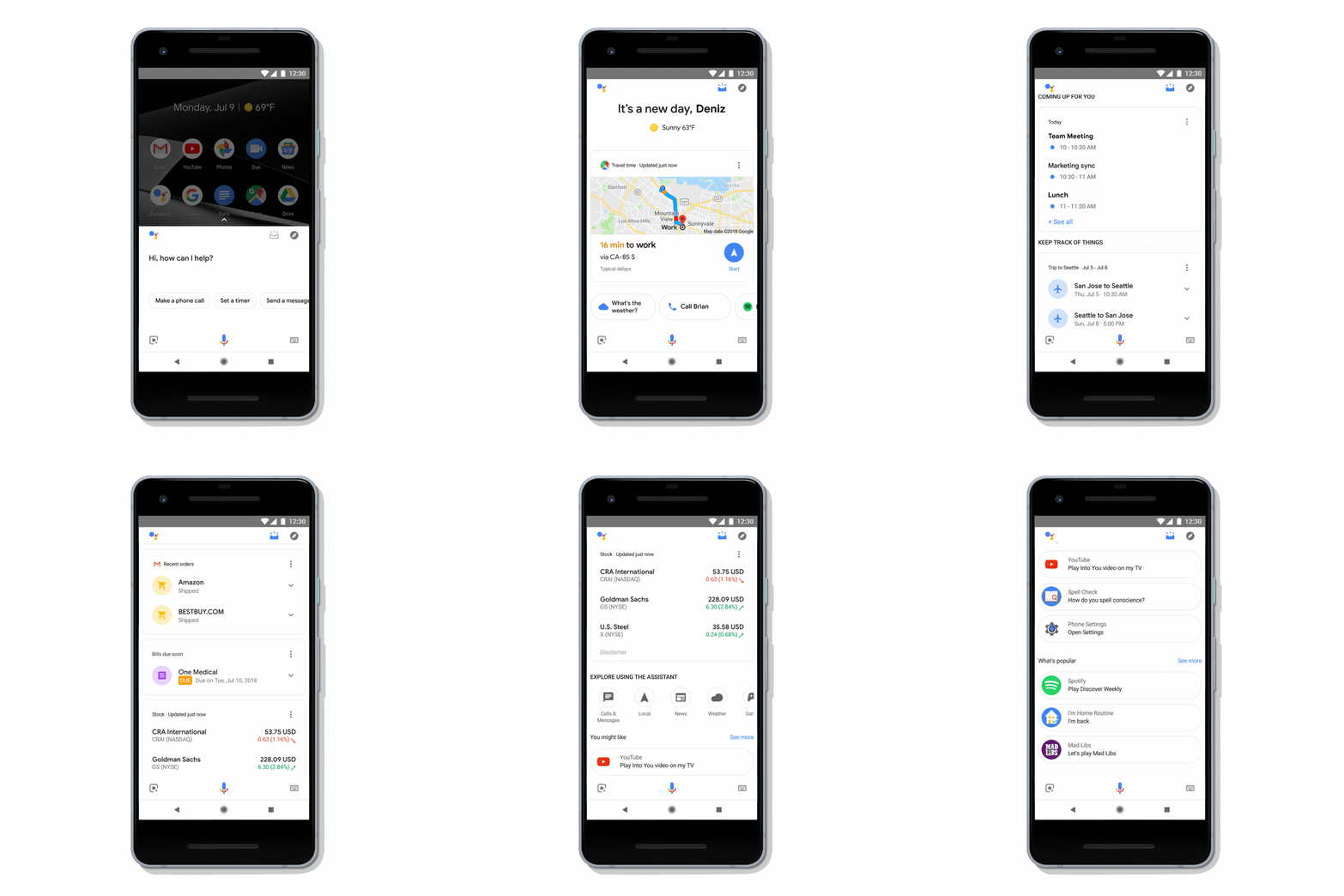
Google today is launching a major visual redesign of its Assistant experience on phones. While the original vision of the Assistant focused mostly on voice, half of all interactions with the Assistant actually include touch. So with this redesign, Google acknowledges that and brings more and larger visuals to the Assistant experience.
If you’ve used one of the recent crop of Assistant-enabled smart displays, then some of what’s new here may look familiar. You now get controls and sliders to manage your smart home devices, for example. Those include sliders to dim your lights and buttons to turn them on or off. There also are controls for managing the volume of your speakers.Even in cases where the Assistant already offered visual feedback — say when you ask for the weather — the team has now also redesigned those results and brought them more in line with what users are already seeing on smart displays from the likes of Lenovo and LG. On the phone, though, that experience still feels a bit more pared down than on those larger displays.
With this redesign, which is going live on both Android and in the iOS app today, Google is also bringing a little bit more of the much-missed Google Now experience back to the phone. While you could already bring up a list of upcoming appointments, commute info, recent orders and other information about your day from the Assistant, that feature was hidden behind a rather odd icon that many users surely ignored. Now, after you’ve long-pressed the home button on your Android phone, you can swipe up to get that same experience. I’m not sure that’s more discoverable than previously, but Google is saving you a tap.
In addition to the visual redesign of the Assistant, Google also today announced a number of new features for developers. Unsurprisingly, one part of this announcement focuses on allowing developers to build their own visual Assistant experiences. Google calls these “rich responses” and provides developers with a set of pre-made visual components that they can easily use to extend their Assistant actions. And because nothing is complete with GIFs, they can now use GIFs in their Assistant apps, too.
But in addition to these new options for creating more visual experiences, Google is also making it a bit easier for developers to take their users money.
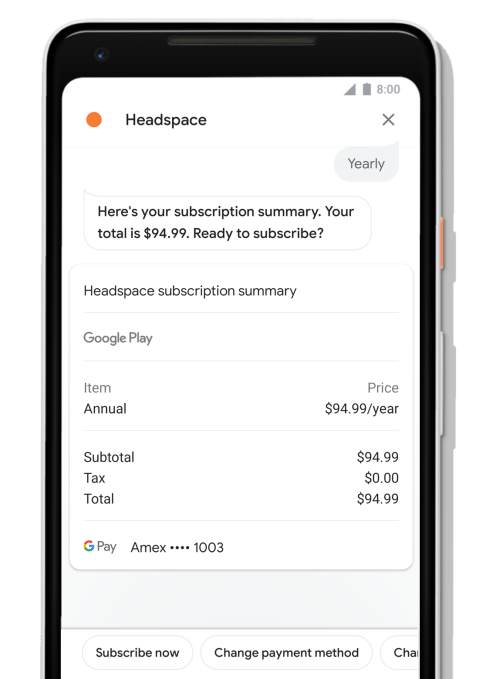
While they could already sell physical goods through their Assistant actions, starting today, they’ll also be able to sell digital goods. Those can be one-time purchases for a new level in a game or recurring subscriptions. Headspace, which has long offered a very basic Assistant experience, now lets you sign up for subscriptions right from the Assistant on your phone, for example.
Selling digital goods directly in the Assistant is one thing, but that sale has to sync across different applications, too, so Google today is also launching a new sign-in service for the Assistant that allows developers to log in and link their accounts.
“In the past, account linking could be a frustrating experience for your users; having to manually type a username and password — or worse, create a new account — breaks the natural conversational flow,” the company explains. “With Google Sign-In, users can now create a new account with just a tap or confirmation through their voice. Most users can even link to their existing accounts with your service using their verified email address.”
Starbucks has already integrated this feature into its Assistant experience to give users access to their rewards account. Adding the new Sign-In for the Assistant has almost doubled its conversion rate.
Apple’s CEO Tim Cook has today been announced as the keynote speaker at a European data protection conference taking place in Brussels later this month — at a time when US lawmakers are asking tech giants outright if they’ll support “EU-like” privacy rules to shield US consumers from platform power.
For a week this month Europe’s data protection commissioners will gather to discuss the bloc’s shiny new privacy framework, GDPR, and what comes after it. They will also gather to listen to Cook talking on the theme of data ethics.
Just this week, in an interview on US television, he couched privacy as “one of the most important issues of the 21st century” — describing it as a human right, and saying he supported “some level” of regulation, even as he professed himself “not a pro-regulation kind of person”.
Privacy is too important to keep being screwed with — or screwed over — was his clear subtext.
In a few weeks’ time Cook will literally stand alongside the architects of Europe’s GDPR, talking up privacy and ethics at the center of a Union whose founding charter grants its citizens data protection as a fundamental right.
While Apple might so far have fallen just shy of calling for a full copypaste of GDPR-level data protections into US law, there’s perhaps an element of strategic caution at play that’s moderating its plain-text political messaging.
Because the company’s actions from all other angles show Apple consistently defending privacy rights in a big data ethics fight that’s pitting Europe against a small number of powerful US adtech giants whose ‘best’ argument in defence of the unethical stuff they’re doing is they need to ‘keep up with China’ — a country that neither respects human rights nor privacy…
These same self-interested adtech giants are now, of course, hard at work lobbying US lawmakers that big data is a tenet of tech faith — when it really doesn’t have to be that way.
Privacy-respecting data-based innovations are both possible and available. The father of the World Wide Web thinks so — and is now doing a startup to make it so. And Apple’s business is an incredible testament to the power of putting people in control of technology, not vice-versa.
Nor can they comfortably stand on a public podium and discuss what does and does not produce “a result that’s great for society”, as Cook can. They have to invent their own ludicrous measures — like ‘relevant ads’.
Frankly speaking, if that’s your price for giving up on human rights you really are selling out.
So it’s left to Apple to send out the privacy bat-signal.
Let’s just hope the lawmakers are watching. Because the lobbyists are busy whispering.
We’ve just wrapped up Startup Battlefield MENA in Beirut, Lebanon. Throughout the day, 15 companies pitched their ideas, demonstrated their technology and answered questions.
We took the feedback from all our expert judges and chose five teams to compete in the finals. Then after another round of pitches and Q&A, our finals judges selected a winner and a runner-up.
The winner of the Startup Battlefield MENA is taking home $25,000 (equity-free) and has also won a trip to Disrupt San Francisco 2019. Plus, both the winner and runner-up received some tasty Lebanese treats.
Here’s the winner:
BuildInk
Real estate construction firms are struggling to keep up with the fast-moving pace of technological advancements. BuildInk is offering a solution for those firms, via a scalable and mobile-friendly robot concrete 3D printer and signature concrete mixture. The company says 3D printing will not only open the space for unlimited architectural designs, but also reduce the overall construction cost.
Here’s the runner-up:
Synkers
Synkers is a mobile platform that connects students with highly qualified peer tutors on-the-spot. The company says it utilizes adaptive and personalized learning to enable a seamless cross-border transfer of knowledge, and to make education accessible to all.
And here are the other finalists:
Naturansa
Naturansa produces high-quality protein from edible insects, grown through pre-consumer food waste decomposition. The company says it has built scalable technology that produces insects year-round, which then get converted into a protein powder. It’s currently targeting the pet food market, but ultimately plans to move into human consumption.
Pure Harvest
Pure Harvest Smart Farms is a sustainable agriculture company focused on the production of greenhouse fruits and vegetables in the extreme climates of the Arab Gulf region, using world-leading greenhouse growing technologies. The company seeks to pioneer year-round production of affordable, premium quality fresh produce.
Seez
Seez is a mobile app that reduces the time people spend searching for a car from 17 hours down to a few seconds. By fully automating your search, Seez uses its AI chatbot, Cesar, to scan all sites, identify the seller, and even negotiate the price down for you. This way you will see all cars for sale in your country and the final price of each car.
Though some of the biggest names in tech are wholly focused on getting consumers to strap into VR, there has been an increasing amount of movement in companies adopting virtual reality to help train employees.
STRIVR, one of the VR training startups leading this movement, announced today that they’ve pulled in $16 million in a new round led by GreatPoint Ventures. The company has raised $21 million to date.
The startup, which initially began as a project to help the Stanford football team train in VR, has made some major strides with big partnerships of late; they partnered with Walmart last year to train employees going through their worker training centers.
The company’s training products are largely based around interactive 360-based video, which in addition to being easier to produce and experience, are also less hardware intensive and can be used on lower-end systems, like Facebook’s $199 Oculus Go.
A few weeks ago, the startup announced that Walmart would be sending 17,000 Oculus Go headsets across thousands of stores loaded up with training materials from STRIVR . CEO Derek Belch tells me that the company now has 27 Fortune 500 customers that encompass “pretty much every industry.”
“We’ve really been thinking about how we build the team and strategically go after scale for the last several months,” Belch told TechCrunch in an interview. “That’s what this new capital with GreatPoint is about, more hiring and other operational things associated with bringing more people on to take on more customers.”
The patent system is broken — there are too many ways to list here, really. The problems surrounding prior art are certainly among them, and a team of high profile companies and organizations are joining forces to address some of the these with the Prior Art Archive.
The database is a collaboration between MIT’s Media Lab, Google, Cisco and the United States Patent and Trademark Office, which certainly has the most to gain here. Using the MIT-hosted archive, patent applicants can find easily accessible examples of prior art and other technical information for reference.
“The patent examination process should stop patents from being issued on old or obvious technology,” MIT writes. “Unfortunately, just because technology is old doesn’t mean it is easy for a patent examiner to find. Particularly in the computer field, much prior art is in the form of old manuals, documentation, web sites, etc. that have, until now, not been readily searchable.”
Google also has a blog post detailing its own work with the archive, which mostly revolves around search. The company is also implementing AI and ML technologies to help bolster searches. “To this end,” the company writes, “we’ve recently created an open ecosystem, the Google Patents Public Datasets, to make large datasets available for empirical public policy, economics, and machine learning research.”
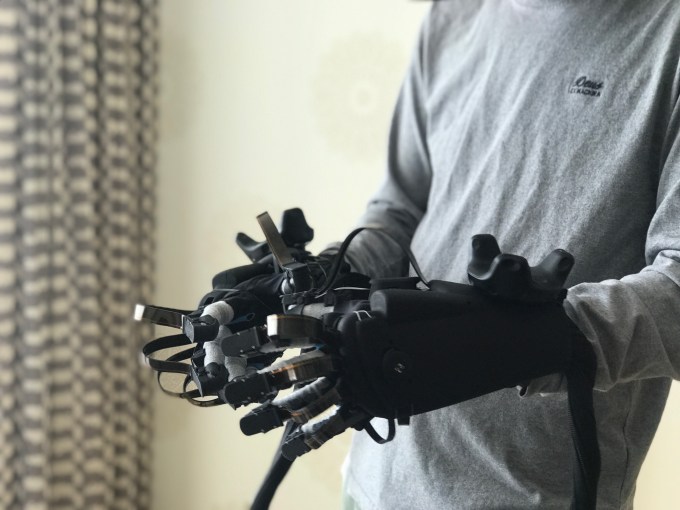
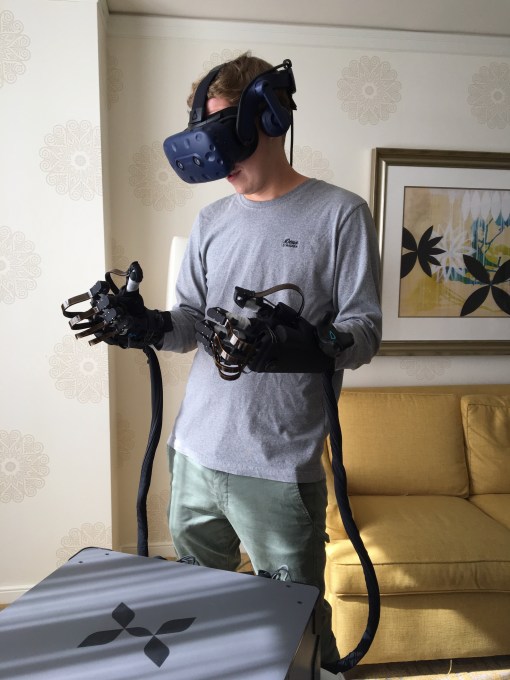
I haven’t seen a virtual reality glove system that also includes a suitcase-sized pneumatic box accessory before, but then again there aren’t too many VR peripherals that have delivered quite the depth of immersion that the HaptX system did.
Today, HaptX announced the release of their Gloves development kit that will allow its users to feel pressure and resistance in their virtual reality interactions all while delivering smooth hand-tracking. The company, whose backers include Chinese gaming company NetEase and ex-Twitter CEO Dick Costolo, wants virtual reality experiences to be more than just what people are seeing, they want to drive big improvements to the quality of their physical interactions as well. I had a chance to don the latest HaptX gloves and look like a real VR monster while playing through a demo that highlights some of their device’s capabilities.
The big highlight of the system is the pressure sensitivity it offers, meaning that you can roughly tell what an object feels like when you grab it because little air bubbles are building out the shape of the object inside the gloves. This is the reason there’s a suitcase-sized box filled with pneumatic actuators, which the company says has been rapidly shrinking and will be much smaller by the time the product exits the dev kit phase. Alongside the pressure offered by the 130 feedback points, there’s also a bit of an exoskeleton around your hands designed give your fingers some resistance as you try to close them on solid objects.
To account for the bulkiness of the system and all of the hand-tracking occlusion that would occur as a result, HaptX isn’t using IR cameras to map where your hands are like a system from Leap Motion may. Instead, the startup is using magnetic planar tracking to track the movement and position of your fingers and joints. It’s the same kind of tracking tech used in the Magic Leap remote, but it’s a bit more of a stress test here given just how much is being tracked. The system held up well enough teamed with some Vive trackers to estimate the positions of my arms themselves in VR.
Actually playing around with this was a bizarre sensation, I felt like a mech monster, even when they tossed me into a demo simulation that had me cutting wheat in a barnyard scene and picking up a little fox.
The system definitely worked best with more subtle feedback. When grabbing something absolutely solid like a small rock, I was far less tricked by the glove system than when I was feeling virtual rain hitting the gloves and delivering tapping sensations on my hand at the same rate. Feeling a spider jump on to my hand and all of its legs move across my palm was honestly one of the least pleasant things I’ve experienced in VR and left my spine crawling while I flicked the digital spider off of my very disturbed real body.
It’s all engaging, but who on earth needs something like this?
I found myself wondering that even as we discussed enterprise solutions. HaptX sees their expensive glove system as a peripheral that makes good on a lot of the failed promises of other systems and as something that has some real promise in the prototyping phase for manufacturing or in making workplace training highly realistic. I have tried several other VR gloves and this is definitely the most complete solution, even if it is likely the most bulky and most expensive solution as well — though the company isn’t releasing pricing details on its system yet. If a company is interested in bringing hands into a VR experience and just wants the best possible solution out there regardless of price or complexity, this is probably what they would want to buy.
This isn’t remotely a consumer solution and seems to definitely be a fringe enterprise product in its current iteration but as virtual reality systems begin becoming more commonplace in workplace settings, it’s not unreasonable that these companies are going to want input methods to become more realistic and shift away from controllers towards VR gloves that can translate what people have been trained in more directly.



 Even in cases where the Assistant already offered visual feedback — say when you ask for the weather — the team has now also redesigned those results and brought them more in line with what users are already seeing on smart displays from the likes of