Year: 2018

03 Oct 2018

Upwork pops more than 50 percent in Nasdaq debut

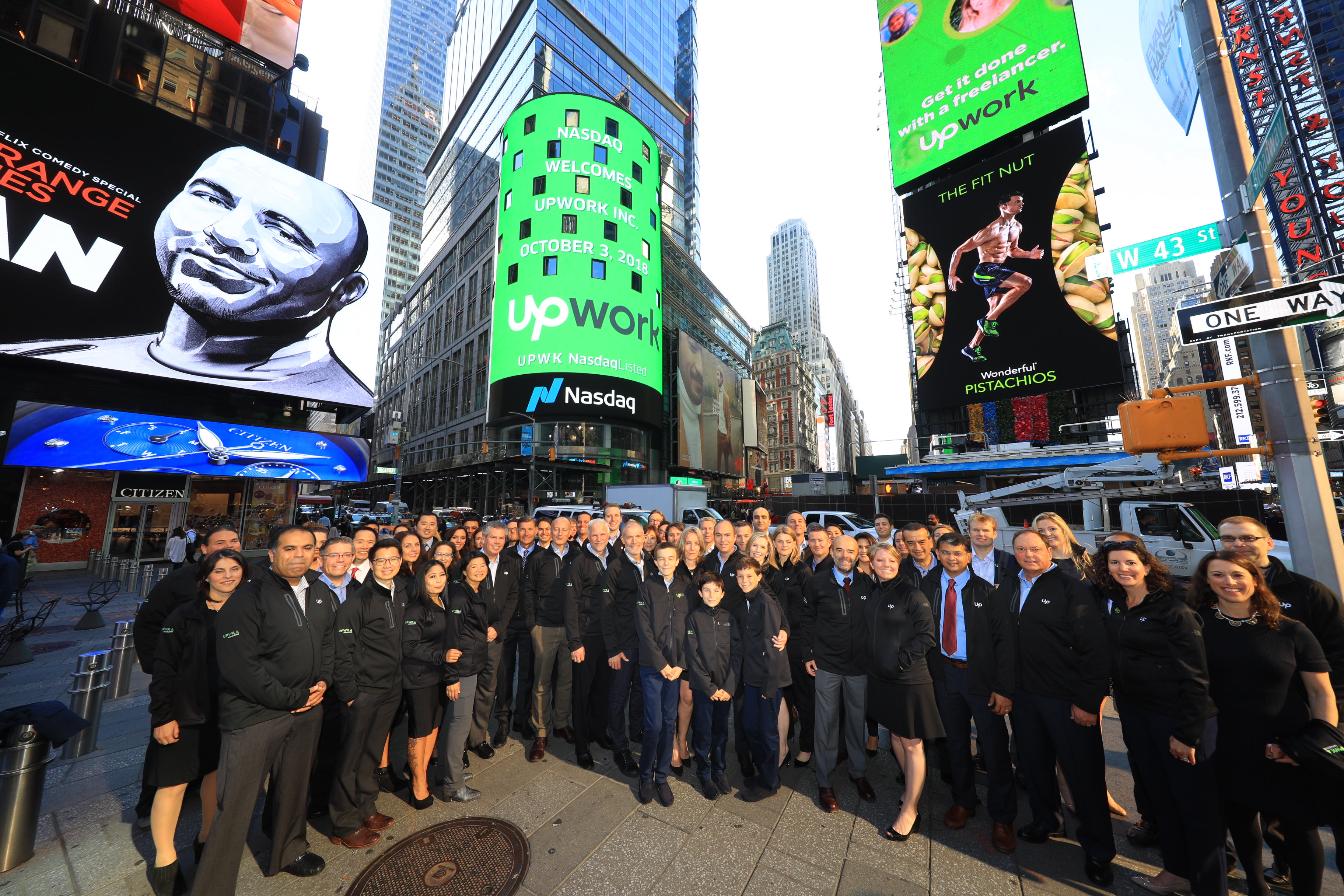
Upwork, the rebranded merger of oDesk and Elance, debuted on Nasdaq this morning, after dropping its S-1 about four weeks ago. Shares opened at $23.00, which represents a 53% jump — shares were priced at $15 before the opening bell by investors, a significant uptick from the company’s revised projection of $12 to $14, which was already an increase from its original $10 to $12 target. The stock trades under the ticker UPWK, and the company will fundraise approximately $102 million of new cash for its balance sheet ($187 million total with existing shareholders).

Shares are still currently up 40% compared to their original price.

I talked with Upwork CEO Stephane Kasriel this morning about the IPO road show, in which he said he took approximately 160 meetings with investors. Investors were engaged on the “combination of the strengths of the business and the strengths of the mission,“ and he was clearly excited about the engagement the offering received.

Upwork, whose antecedent companies go back almost two decades, is a positive cash flow business, albeit one growing top line revenue only about 27.6% year over year. Kasriel said that the company should be able to “compound at that rate for decades” due to the growing number of workers who freelance around the world in order to have flexible work arrangements. “When you think about which jobs are being created in the global economy, in most countries it is these knowledge jobs,” he said.

Upwork CEO Stephane Kasriel (Photo from Upwork)

In addition, “When you really take a long term view, what really matters is to be good stewards of capital,” Kasriel noted, and said that the company was very focused on areas like sales and marketing ROI. His goal is to continue to grow the company with limited dilution to shareholders, a message that apparently has been well-received.

As for Kasriel himself, he becomes a public company CEO. He was elevated to the CEO role in 2015 from SVP of Engineering – a somewhat unusual path, even in tech-obsessed Silicon Valley. He emphasized that “we are a tech company,” and noted that every day is a learning experience. “I was just on CNBC, and for introverts, what really scares me is to be on live broadcast TV,” he said.

A huge part of Upwork’s business today is focused on the enterprise, particularly complex workflows that require multiple types of talent. The company’s platform not only handles talent management, but the long array of tasks to manage people: HR, legal, procurement, information security, and others.

According to the company, it will host $1.5 billion worth of gross sales value across two million unique projects. The company estimates that its products are used by 30% of the Fortune 500.

Upwork, which has offices in Mountain View, San Francisco, and Chicago, has 1,500 employees – and as is to be expected – roughly 1,100 of them are freelancers. Kasriel said, “We use our own product, which we call drinking our own champagne.”

Among the major VC investors behind the company are Benchmark, which owned 15%, Sigma Partners, which owned 14.2%, and Globespan, T. Rowe Price, and FirstMark. The company is offering 6,818,181 new shares as well as 5,658,512 shares from existing shareholders. Citigroup, Jefferies, and RBC jointly led the book.

Now that the company has debuted, Upwork wants to refocus once again on its business following weeks of talking to investors. “We need to build this company for the ages,” Kasriel noted, and said that his message to employees was to “focus on the mission.”

03 Oct 2018

Meet the woman leading Accel’s consumer growth investments

As it approaches its 35th year in the venture capital business, Accel is staying true to its promise to continue passing the torch to the younger generation of investors.

This week, the firm brought on Maya Noeth as a principal leading its consumer growth investing efforts. Accel typically promotes from within; Noeth is its first outside hire since Amit Kumar and Nate Niparko joined over two years ago.

Noeth has an impressive track record. She’s spent the last nine years at TCV, most recently as a vice president of its B2C group, where she invested in Facebook, LinkedIn, Netflix and Spotify, as well as Airbnb, Rent The Runway, Rover and VICE Media.

At Accel, she’ll be writing checks sized between $30 million and $100 million in growth-stage startups focused on digital and social media, subscription e-commerce, gaming and vertical marketing. Noeth and the rest of Accel’s growth team are pulling capital out of the firm’s fourth flagship growth fund, which closed on $1.5 billion in 2016. 

In a conversation with TechCrunch, Noeth explained what she’s looking for in a B2C company.

“At a high-level, whenever I meet a new company, I’m interested in how big and attractive the market size is, who the team leading it is — execution is one of the most important attributes of a business — does the businesses have a great product that is differentiated with great competitive moats, what is the revenue model, what is the financial profile and is it really good unit economics?”

As a new mom, Noeth says she is especially interested in identifying companies in the kids-focused digital media sector.

“I think a lot of people are scratching their heads wondering what is there beyond YouTube Kids,” she said. “There is potential for really disruptive businesses to take over.”

Before joining TCV in late 2009 at the age of 23, Noeth began her career at Morgan Stanley as an investment banking analyst specializing in the technology, media and telecom vertical.

Accel invests in companies at all stages, counting Spotify, Jet and Etsy among its investments. The firm’s recent exits include cybersecurity company Tenable’s summer IPO, Flipkart’s momentous sale to Walmart and Amazon’s nearly $1 billion purchase of PillPack, an online pharmacy startup Accel first backed in 2014.

Accel currently has 11 partners and five principals in the U.S. writing checks. According to PitchBook, it has $10.8 billion of assets under management.

03 Oct 2018

Iron Ox opens its first fully autonomous farm

For the last two and a half years, Iron Ox has been working on perfecting its agricultural robots to tend its indoor farms. After first testing its systems on a small scale, the company is opening its first fully autonomous production farm, with plans to start selling its produce soon.

The farm is currently growing a number of leafy greens, including romaine, butterhead and kale, in addition to basil, cilantro and chives.  The robots that are tending these plants are Angus, a 1000-pound machine that can lift and move the large hydroponic boxes that the produce is growing in, and Iron Ox’s robotic arm for harvesting the produce.

As Iron Ox co-founder and CEO Brandon Alexander told me, the current setup can produce about 26,000 plants per year and is equivalent to a one-acre outdoor farm — though this one is obviously indoors and far more densely packed.

Alexander noted that he and his co-founder Jon Binney decided to get into indoor farming after working at a number of other robotics companies — for Alexander, that includes a stint at Google X — where the focus was often more on building cool technologies and not on how those robots could be used. “We’d seen lots of novelty robotics stuff and wanted to avoid that,” he told me. And while the founding team considered getting into warehouse logistics or drones, they eventually settled on farming because, as Alexander tells it, they didn’t just want to build a good business but also one that would create social good.

Today, the vast majority of the kinds of leafy greens (the kind of produce that Iron Ox focuses on) in the U.S. is grown in California and Arizona — especially during the winter months when it’s colder in the rest of the country. That means a romaine lettuce that’s sold on the East Coast in January has often traveled more than 2,000 miles to get there. “That’s why we switched to indoors,” Alexander said. “We can decentralize the farm.”

It also helps that an indoor hydroponic farm can achieve 30 times the yield of an outdoor farm over the course of a year, yet uses far less space.

To get to this point where Iron Ox can operate an autonomous farm, though, took plenty of work and engineering chops. The hardest challenge, Alexander told me, was to get the robotic arm to look at the plants through its stereo cameras and then plan the pickup operation to harvest the produce, which isn’t always uniform. And to run this operation autonomously, it obviously has to do so reliably.

Angus, the larger robot that picks up the 800-pound pallets the produce is grown in and brings them to the robotic arm, also took some time to get right. You don’t want to move those pallets to quickly, after all, or you’ll have plenty of water to mop up.

All of that, including the system that monitors the plants, their growth, the sensors that watch over them and the hydroponics system, is then controlled from a cloud-based service that tells the robots when it’s time to harvest and what operations to perform. The robots themselves, though, then perform those tasks autonomously.

One thing that came as something of a surprise to the team, though, was that running an indoor farm solely with LED lighting still results in electricity bills that are simply too expensive to make the operation profitable. So going forward, Iron Ox is actually betting on more traditional greenhouses that are augmented by high-efficiency LED lighting.

That means the team can’t build these autonomous farms right in the city, though, because you can’t exactly stack a number of greenhouses on top of each other. But as Alexander noted, even if you have to be 20 miles outside of the city, that’s still far better than shipping produce to a supermarket that is thousands of miles away.

As Alexander stressed, the team spent a lot of time talking to both existing farmers and chefs to figure out what they needed. Farmers, it turned out, were mostly complaining about their inability to find labor. And that’s no surprise. The labor shortage in the agricultural industry is starting to become a major issue for farmers, especially in states like California. As for the chefs, what they were mostly looking for was quality, of course, but also predictability and consistent quality.

The plan now is to start selling the produce from the first farm and the scale to more and larger locations over time. Iron Ox also now has the money to do so, given that it has raised over $5 million in total, including a $3 million round it announced earlier this year.

03 Oct 2018

FEMA is about to send a ‘Presidential Alert’ to millions of U.S. phones

In a few hours, millions of Americans will get a test emergency “Presidential Alert” message sent to their phone — a simulation in case the president ever needs to reach to entire country in a national emergency.

At 2:18pm ET, the Federal Emergency Management Agency will send a short alert, saying: “THIS IS A TEST of the National Wireless Emergency Alert System. No action is needed.” A few minutes later, televisions and radio broadcasts will briefly suspend and a similar message will run.

The test was originally scheduled for mid-September but was delayed until Wednesday after Hurricane Florence hit the east coast.

This will be the first time the government has conducted a nationwide test of the Wireless Emergency Alert (WEA) system, according to a FEMA advisory.

Emergency warnings used to be confined to television and radio broadcasts, sounding out that familiar terrifying high-pitch tone. But as consumers moved away from televisions and radio to mobile devices that are always with us, the government began working on a system to get emergency alerts in our hands.

Since it was devised in 2006 under the Bush administration, the Wireless Emergency Alert (WEA) has slowly rolled out across the U.S. to form a new state-of-the-art emergency alert system. Like the legacy system, the WEA is designed to alert Americans to bad weather and missing children at a local level directly to your phone.

But now FEMA wants to test a third alert — the presidential alert — which will send a message to every switched-on phone with cell service across the U.S. at the same time.

This won’t be a text message sent to your phone, experts say. Instead of sending text messages that would flood the networks, the alerts are sent directly over the cellular network.

Although today is a test, any future presidential alert can be sent solely at the discretion of the president and can be issued for any reason. And, unlike other alerts, Americans cannot opt-out of receiving a presidential alert.

Some have expressed concern that the system could be abused for political reasons. Others worry that the system could be hacked.

Tom Crane, an expert in emergency management at Everbridge, a critical communications provider, told TechCrunch that the WEA has “extra safeguards” in place before sending an alert. An authorized user has to enter a complex password that has two elements — a private key and a keystore password — which are unique for each alerting authority.

“It’s not as easy as ‘someone left their computer unattended so i’m going to send a Wireless Emergency Alert’,” he said.

The emergency alert system is far from perfect. Earlier this year, panic spread on Hawaii after an erroneous alert warned residents of a “ballistic missile threat inbound.” The message said, “this is not a drill.” The false warning was amid the height of tensions between the US and North Korea, which at the time was regularly test-firing rockets used for its nuclear missile program.

03 Oct 2018

Product Hunt Radio: The evolution of Y Combinator, and counter-intuitive advice for founders

In this episode of Product Hunt Radio, I’m visiting Y Combinator’s San Francisco headquarters to talk to two of the people who are integral to Y Combinator — Kat Manalac and Michael Seibel.

Michael is CEO of Y Combinator’s accelerator program. He has been through YC himself a couple of times — first in 2007, as co-founder and CEO of Justin.tv — and again in 2012 as co-founder and CEO of Socialcam. Justin.tv later became Twitch and sold to Amazon, and Socialcam was sold to Autodesk.

Kat is a partner at Y Combinator and one of the people who convinced us to apply to join the program back in 2014. She has been at YC for five years, where she focuses on founder outreach, helping companies perfect their pitches, and much more. Prior to joining YC, she was chief of staff to Reddit founder Alexis Ohanian and also worked on brand and strategy at WIRED.

In this episode we talk about:

  • The evolution of Y Combinator — it’s changed a ton since Product Hunt went through the program four years ago. They’ve been working on several programs for founders — things that Michael wishes existed when he went through the program.
  • Michael and Kat’s advice for founders, including counter-intuitive tips they’ve learned after working with literally thousands of startups.
  • A key mistake that trips up new founders when pitching their company, as well as advice for founders seeking a technical co-founder.
  • How YC has scaled the organization as a 50-person company with its 4,000 (and growing) alumni.

Of course, we also chat about some of their favorite products, including a virtual assistant that will do anything, a $1,500 smart mirror that will get you fit, and a beverage that will get you high.

We’ll be back next week so be sure to subscribe on Apple Podcasts, Google Podcasts, Spotify, Breaker, Overcast, or wherever you listen to your favorite podcasts.

03 Oct 2018

Facebook adds A.I. to Marketplace for categorization, price suggestions and soon, visual search

Facebook is celebrating the two-year anniversary of its Craigslist competitor, Facebook Marketplace, with the launch of new features powered by A.I. Specifically, the social network says it’s adding price range suggestions and auto-categorization features to make selling easier, and it says it’s testing camera features that would use A.I. to make product recommendations.

Automating price suggestions and categorization, however, is not unique to Facebook – eBay earlier this year introduced a feature in its mobile app that will fill out your listings for you, using technologies like structured data and predictive analytics. Letgo can also make generalized price suggestions.

In Facebook’s case, the company says it will be able to categorize items based on the photo and description, then suggest a price range (e.g. $50-$75) for sellers to choose from. According to the company, when this autosuggest feature is enabled, sellers are less likely to abandon their listings, it has learned. (9% of sellers abandoned listings before the feature was enabled, it noted.)

AI in Marketplace

Posted by Facebook on Tuesday, October 2, 2018

Facebook also highlighted some of the other ways it uses A.I. – to automatically enhance the lighting of images uploaded by sellers, for instance, and for detecting and removing inappropriate content.

And while not A.I.-based, the company additionally noted its new buyer and seller ratings where people can rate their experience and leave feedback.

Further down the road, things may get more interesting. Facebook lightly teases its plans to turn Marketplace into more of a discovery tool for finding things you want to buy using your smartphone camera. For example, the company writes in a blog post, you could point your camera at something you like – such as your friend’s cool headphones – snap a photo, and then Marketplace would search across its listings for similar items.

This sort of visual search tech is also common among competitors, including eBay again, plus Pinterest and even Google. Facebook, then, is playing a bit of catch-up for the time being.

Further down the road, Facebook’s plans for Marketplace put it more directly up against Pinterest. It says it envisions using A.I. in the future to help people with home design – like, by uploading a photo of their living room, then getting suggestions about furniture to buy. Home design and inspiration, of course, is the bread-and-butter of sites like Pinterest, Houzz and others, including newcomer Hutch.

That said, even if it’s lacking in some features today, Facebook Marketplace is not one to be counted out. Thanks to Facebook’s size and scale (and the annoying way it continuously red badged the Marketplace icon, forcing users to keep tapping it), the company says its buy-and-sell platform has grown to be used by more than one out of every three people in the U.S. on a monthly basis.


03 Oct 2018

Palo Alto Networks to acquire RedLock for $173 M to beef up cloud security

Palo Alto Networks launched in 2005 in the age of firewalls. As we all know by now, the enterprise expanded beyond the cozy confines of a firewall long ago and vendors like Palo Alto have moved to securing data in the cloud now too. To that end, the company announced its intent to pay $173 million for RedLock today, an early-stage startup that helps companies make sure their cloud instances are locked down and secure.

The cloud vendors take responsibility for securing their own infrastructure, and for the most part the major vendors have done a decent job. What they can’t do is save their customers from themselves and that’s where a company like RedLock comes in.

As we’ve seen time and again, data has been exposed in cloud storage services like Amazon S3, not through any fault of Amazon itself, but because a faulty configuration has left the data exposed to the open internet. RedLock watches configurations like this and warns companies when something looks amiss.

When company emerged from stealth just a year ago, Varun Badhwar, company founder and CEO told TechCrunch that this is part of Amazon’s shared responsibility model. “They have diagrams where they have responsibility to secure physical infrastructure, but ultimately it’s the customer’s responsibility to secure the content, applications and firewall settings,” Badhwar told TechCrunch last year.

Badhwar speaking in a video interview about the acquisition says they have been focused on helping developers build cloud applications safely and securely, whether that’s Amazon Web Services, Microsoft Azure or Google Cloud Platform. “We think about [RedLock] as guardrails or as bumper lanes in a bowling alley and just not letting somebody get that gutter ball and from a security standpoint, just making sure we don’t deviate from the best practices,” he explained.

“We built a technology platform that’s entirely cloud-based and very quick time to value since customers can just turn it on through API’s, and we love to shine the light and show our customers how to safely move into public cloud,” he added.

He believes that customers will benefit from RedLock’s compliance capabilities being combined with Palo Alto’s analytics capabilities to provide a more complete cloud security solution. It will also fit nicely with Evident.io, a cloud infrastructure security startup, the company acquired in March for $300 million.

RedLock launched in 2015 and has raised $12 million.

03 Oct 2018

In a quest to centralize all your media, Plex now includes web series

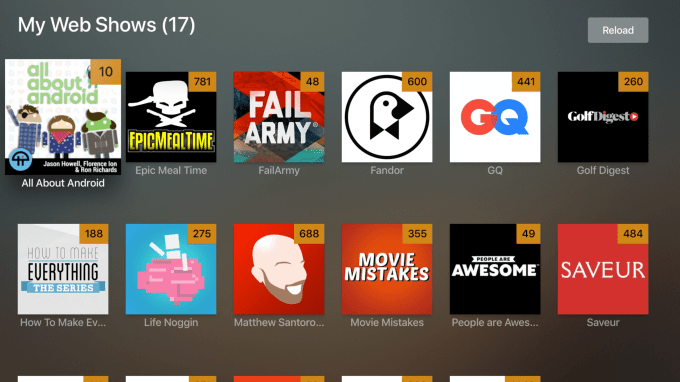
At CES, media software maker Plex said it would this year add support for podcasts, web series and other digital media to its platform. It then rolled out podcasts this May, and now it’s introducing its own curated collection of web series. The company today is launching Plex Web Shows in beta, which will offer unlimited, on-demand streaming of online shows from brands like GQ, Saveur, Epicurious, Pitchfork, Condé Nast, The New Yorker, Fandor, Vanity Fair, and others.

The shows will span a range of interests, including food, home and garden, science, technology, entertainment and pop culture, says Plex. In addition shows from the big-name brand partners, which also include Bonnier, TWiT, Ovation and more, there will also be a handful of shows from indie creators, like Epic Meal Time, ASAPscience, Household Hacker, People are Awesome, and The Pet Collective. 

Plex tells us that there will be over 19,000 episodes across 67 shows at launch, with more on the way.

Some partners and Plex have revenue share agreements in place, the company also says, based on ad sales that Plex manages. The details are undisclosed.

Plex got its start as software for organizing users’ home media collections of video, music, and photos, but has in recent months been shifting its focus to address the needs of cord cutters instead. It launched tools for watching live TV through an antenna, and recording shows and movies to a DVR.

It’s also recently said it’s shutting down other features, like support for streaming content from Plex Cloud as well as Plex’s directory of plugins, in order to better focus on its new ambitions.

Along the way, Plex has also rolled out other features designed for media consumption including not only podcast, but also the addition of a news hub within its app, thanks its acquisition of streaming news startup, Watchup.

With the launch of Web Shows, Plex is again finding a way to give its users something to watch without having to make the sort of difficult content deals that other live TV streaming services today do – like Sling TV, PlayStation Vue, or YouTube TV, for example.

“We really care about each user’s personal media experience, and want to be ‘the’ platform for the media that matters most to them,” Plex CEO Keith Valory tells TechCrunch. “This started with helping people with their own personal media libraries, and then we added over-the-air television, news, podcasts, and now web shows. Sources for quality digital content continues to explode, but the user experience for discovering and accessing it all has never been worse. It’s chaos,” he continues.

“This is the problem we are solving. We’re working hard to make tons of great content available in one beautiful app, and giving our users the tools to customize their own experience to include only the content that matters to them,” Valory adds.

Access to Web Shows is available across devices through the Plex app, where there’s now a new icon for “Web Shows.” From here, you’ll see the familiar “On Deck” section – those you’re following – as well as personalized recommendations, trending episodes, and links to view all the available web shows and a list of you’re subscribed to.

You can also browse shows by category – like “Arts & Entertainment,” “Computers & Electronics,” “Science,” etc. Or find those that were “Recently Played” or are “New” to Plex.

Each episode will display information like the show’s length, synopsis, publish date and title, and will let you play, pause, mark as watched/unwatched, and add to your queue.

The launch of Web Shows is another step Plex is making towards its new goal of becoming a platform for all your media – not just your home collection, but everything that streams, too – like podcast, web series and TV. (All it’s missing now is a Roku-like interface for jumping into your favorite on-demand streaming apps. That’s been on its long-term roadmap, however.)

Web Shows will be free to all of Plex’s now 19 million registered users, not just Plex Pass subscribers. The feature is live on iOS, Android, Android TV, and Apple TV.

03 Oct 2018

Brandless is launching a pop-up shop in NYC

Brandless is only a little over a year old, but the ecommerce platform is already working on IRL channels to market to and connect with its customers.

From October 24 to November 4, Brandless will be hosting a pop-up shop within the Milk Building in NYC, at 459 W. 14th Street. This is Brandless’ second pop-up shop — in May, Brandless launched a pop-up in LA.

Brandless sells more than 350 items through its website, all of which are meant to be ‘better for you’. This includes vegan, non-GMO, and/or organic snacks, fair-trade coffee, clean beauty products, and 100 percent organic toilet paper.

While the company has succeeded in making these products relatively affordable — everything is $3 — there is a disconnect between the way customers experience these products online. The pop-up shop (which Brandless is calling Pop-up with Purpose) is built around taste and trial, with tasting flight menus, a snack wall, a fair-trade coffee bar, and a clean beauty lounge. The pop-up will also showcase all of Brandless’s products, including a few items which have yet to ship.

But this place isn’t meant to feel like a grocery store or pharmacy. CEO Tina Sharkey hopes that the Brandless pop up creates a space for communities to discuss these products.

Sharkey says that there was plenty to learn from the LA-based pop-up. First and foremost, people want to taste and try the products without any frills. In LA, the Brandless team used its own products to create fancy meals to serve to customers. At the end of the day, however, those customers wanted to try individual ingredients, like organic olive oil.

Brandless believes, above all, that these pop-ups can serve as a way to connect with customers, and give them a way to experience the products, rather than focusing on sales or conversions.

That said, Brandless saw a double-digit percentage lift in traffic to the site in the area surrounding the LA pop-up shop.

As Brandless starts to experiment with offline locations, it’s worth noting that Sharkey insists that Brandless products will never appear on shelves in non-Brandless retail stores. But she didn’t rule out the idea of creating a permanent Brandless retail store, adding that this is still early days and that pop-up shops give the company a chance to figure out what works for customers.

Sharkey says the company’s greatest challenge is “we can’t go fast enough.”

03 Oct 2018

GoodTime raises $5 million to bring artificial intelligence into the interview process

GoodTime, the algorithmically enhanced interview process management platform, has raised $5 million in a new round of funding led by Bullpen Capital.

The company uses natural language processing to link interview candidates with the right interviewers inside an organization. The idea is to make the hiring process run more smoothly for large organizations and give overworked human resources staffers a new organizational tool in their toolbox to build better staffing processes.

To do this Ahryun Moon, Jasper Sone and Peter Lee, the co-founders of GoodTime, have built a tool that uses the calendar as its organizing principle. The idea is that the sooner interviews can be booked with the right people, the better it is for an organization.

Staffing is about more than just setting up an interview, though, so GoodTime also factors in relevant information about both an applicant and an interviewer including data like gender, ethnicity, and relevant university and previous work-history information.

Recruiting coordinators can manage the entire process and make it as frictionless as possible for companies — and in this competitive hiring environment, companies may run the risk of losing out if they can’t pull the trigger on a potential applicant quickly enough.

It’s a problem that GoodTime’s chief executive, Moon, knows all too well. As a former recruiting coordinator at Mulesoft, Airbnb and Dropbox, Moon is well-versed in the problems of recruiting professionals.

She even managed to convince her former employers at Airbnb and Dropbox to adopt the new platform. Those companies have seen their applicants confirm interviews within three hours by using the platform and seen their time-to-hire rates reduced by 40%, according to a statement from the company.

GoodTime, which was seed funded last year with a $2 million investment from Walden Ventures and Big Basin Capital, managed to attract the education and staffing focused investment GSV Accelerate, and Array.vc to its latest round. GoodTime is also a graduate of the Alchemist Accelerator program. 

Based in San Francisco, GoodTime currently has 18 employees on staff and has reached profitability on the strength of its existing customers.