Year: 2018

03 Oct 2018

Honda commits $2.75 billion in partnership with GM’s Cruise

Honda will commit $2.75 billion as part of an agreement with GM and its self-driving technology subsidiary Cruise to develop and produce a new kind of autonomous vehicle.

As part of the agreement, Honda will invest $2 billion over the next 12 years into the effort. Honda is also making a direct equity investment of $750 million into Cruise, which pushes the company’s valuation up to $14.6 billion.

This new vehicle, described by GM president Dan Ammann as the “next evolution in the future of transportation,” will be produced at high volume for global deployment.

Cruise founder and CEO Kyle Vogt didn’t elaborate what this next-generation autonomous vehicle might look like. But during a call with TechCrunch on Wednesday he used words like “innovative,” “space-efficient” “and multi-purpose.”

“When you have the chance to design a vehicle from the ground up, we’re not limited to thinking from the perspective of, ok there’s an autonomous vehicle that looks and feels like an existing vehicle, what can we do with it?” Vogt said. “It lets us invert the problem and think from first principles of what we can do with a vehicle that’s built from scratch.”

In other words, don’t expect it to look like a Chevy Bolt, or any other “car-like” vehicle.

The three companies plan to “explore global opportunities for commercial deployment of the Cruise network.”

“This is the logical next step in General Motors and Honda’s relationship, given our joint work on electric vehicles, and our close integration with Cruise,” GM Chairman and CEO Mary Barra said in a statement. “Together, we can provide Cruise with the world’s best design, engineering and manufacturing expertise, and global reach to establish them as the leader in autonomous vehicle technology — while they move to deploy self-driving vehicles at scale.”

The milestone agreement follows the giant $2.25 billion investment made by Softbank’s vision fund in May.

03 Oct 2018

Amazon intros new Fire TV Stick 4K and Alexa Voice Remote

You’d be forgiven if you thought Amazon was finished announcing new hardware after last month’s massive Echo event. The retail giant has at least a few more announcements up its sleeve, starting with updates to the Fire TV line. The new TV Stick 4K and refreshed Alexa Voice Remote are up for pre-order today.

At $50, the revamped Fire TV Stick 4K features a new quad core processor, promising faster streaming and quick loading. The updated TV dongle also adds Dolby Vision and Dolby Atmos and features access to 500K movies/TV episodes, an array of apps and an Alexa voice interface via remote or nearby Echo.

The news follows Roku’s recent move to bring down the cost of its 4K-ready streamers, with its new $40 and up Premiere line of players.

There’s also a new Alexa Voice Remote on the block. The new peripheral sounds like much more of a universal remote than its predecessor. The device sports Bluetooth and multi-directional infrared, letting users control TVs, AV equipment and cable boxes, among others.

There are buttons for power, volume and mute, but the voice is really the thing here, naturally. It’s compatible with just about all of Amazon’s Fire products. It ships as part of the $40 Fire TV Stick 4K package, or comes bundled with the Fire TV Cube for $120. You also can buy it solo for $30.

The Fire TV Stick 4K starts shipping on Halloween in the U.S. and Canada. It will arrive in the U.K., Germany and India in November and Japan before end of year.

03 Oct 2018

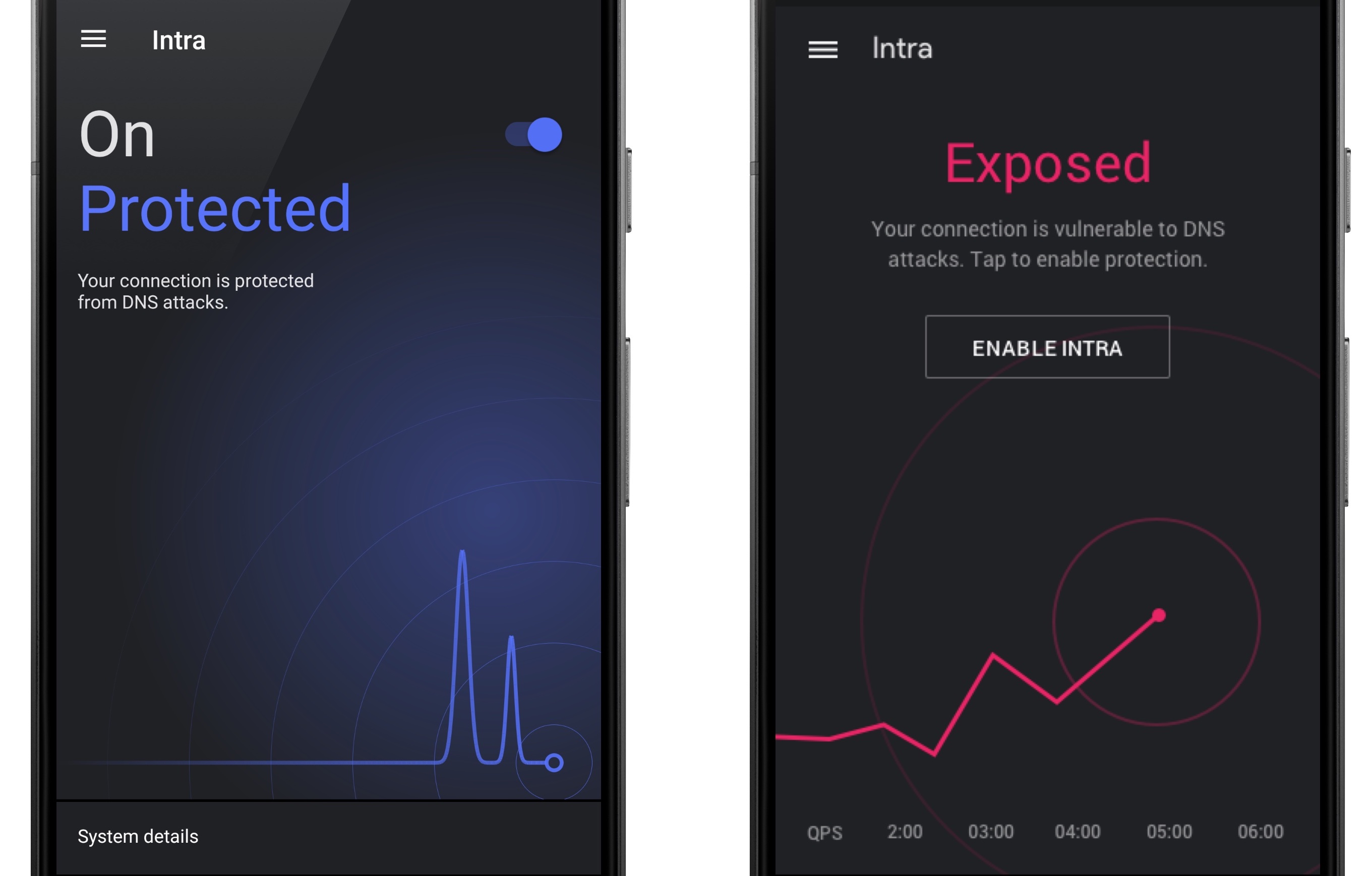
Google’s cyber unit Jigsaw introduces Intra, a new security app dedicated to busting censorship

Jigsaw, the division owned by Google parent Alphabet, has revealed Intra, a new app aimed at protecting users from state-sponsored censorship.

Intra is a new app that aims to prevent DNS manipulation attacks. Whenever you visit a website, the easy-to-remember web address is converted to a less-than-memorable IP address — often over an unsecured connection. That makes it easy for oppressive governments — like Turkey, which has used this technique before — to intercept web addresses requests and either kill them in their tracks to stop sites from loading, or redirect to a fake site.

By passing all your browsing queries and app traffic through an encrypted connection to a trusted Domain Name Server, Intra says it ensures you can use your app without meddling or get to the right site without interference.

“Intra is dead simple to use. Just download the app and turn it on,” Jigsaw said. “That’s it.”

Jigsaw has already seen some successes in parts of the world where internet access is restricted or monitored. The government in Venezuela reportedly used DNS manipulation to prevent citizens from accessing news sites and social networks.

The app uses Google’s own trusted DNS server by default, but users can also funnel their browsing requests through Cloudflare, which also hosts its own publicly accessible secure DNS server, or any other secure DNS server.

Admittedly, that requires a bit of trust for Google and Cloudflare — or any third party. A Jigsaw spokesperson told TechCrunch that Intra’s use of Google’s DNS is covered by its privacy policy, and Cloudflare also has its own.

Jigsaw said it will bake the app into Android Pie, which already allows already allows encrypted DNS connections. But Jigsaw is also making the app available for users in parts of the world with weaker economies that make upgrading from older devices near-impossible so they can benefit from the security features.

It’s the latest piece in the security and privacy puzzle that Jigsaw is trying to solve.

The little-known Alphabet division is focused on preventing censorship, threats of online harassment and countering violent extremism. The incubator focuses on empowering free speech and expression by providing tools and services that make online safer for higher-risk targets.

Jigsaw has also invested its time on several other anti-censorship apps, including Project Shield, which protects sites against distributed denial-of-service attacks, as well as Outline, which gives reporters and activists a virtual private network that funnels data through a secure channel.

03 Oct 2018

Here are the companies that pitched in Startup Battlefield MENA

Today in lovely Beirut, Lebanon TechCrunch held its first Startup Battlefield in the country. Over 700 people watched the show on site, which featured speakers from throughout the Middle East and 15 startups competing in Startup Battlefield.

A winner will be chosen at the end of the day and they will walk away with a $25,000 prize. As of this post’s publication, a winner has not been picked.

What follows, is each company’s Startup Battlefield pitch in the order that they appeared on stage.

[Please note: Videos will be added to this list as they become available]

Startup Battlefield Competition – Flight #1

BuildInk

Real estate construction firms nowadays are struggling to keep up with the fast-moving pace of technological advancements in order to fulfill the market constantly changing demands. Buildink is offering a revolutionary solution for construction firms, via a scalable and mobile friendly Cable Robot Concrete 3D printer and Signature Concrete Mixture. Concrete 3D printing will not only open the space for unlimited architectural designs, it will also reduce the overall construction cost.

Harmonica

Harmonics is the leading marriage making app in MENA that not only match singles but also help them build healthy relationships. Launched in Cairo with a unique matching algorithm of one match at a time, powered by a strong team of phycologists, managed to reach a 100,000 user base in only few months.

Material Solved

MaterialSolved is a data visualization software for chemical/nano compounds. MaterialSolved helps scientists and scientific illustrators create complex scientific 3D models, static illustrations, and animations in an efficient way. Unlike general purpose graphics and visualization software, we use a new model that merges several algorithms to achieve significant time and cost reduction and make many visual representations possible.

MoneyFellows

MoneyFellows enables access to interest free credit and helps savers to easily reach their saving goals. We do this by digitizing the traditional ROSCA model (Rotating Savings and Credit Association).
How it works:
1- Group of people joins together to contribute a fixed monthly installment into a common pot.
2- Every month one of the users takes the whole pot as a payout.
3- Circle ends when all circle participants gets his/her payout once.
4- Circle is then usually repeated with the same group of people over again.”

Neotic AI

Neotic.ai created auto-traders for financial markets, giving the opportunity for everyone to use advanced technology to get higher returns on their savings. In other words, Neotic users can find ready to use, plug and play, live tested, AI powered trading strategies and deploy them directly on the broker account without writing any single line of code.

03 Oct 2018

Europe is drawing fresh battle lines around the ethics of big data

It’s been just over four months since Europe’s tough new privacy framework came into force. You might believe that little of substance has changed for big tech’s data-hungry smooth operators since then — beyond firing out a wave of privacy policy update spam, and putting up a fresh cluster of consent pop-ups that are just as aggressively keen for your data.

But don’t be fooled. This is the calm before the storm, according to the European Union’s data protection supervisor, Giovanni Buttarelli, who says the law is being systematically flouted on a number of fronts right now — and that enforcement is coming.

“I’m expecting, before the end of the year, concrete results,” he tells TechCrunch, sounding angry on every consumer’s behalf.

Though he chalks up some early wins for the General Data Protection Regulation (GDPR) too, suggesting its 72 hour breach notification requirement is already bearing fruit.

He also points to geopolitical pull, with privacy regulation rising up the political agenda outside Europe — describing, for example, California’s recently passed privacy law, which is not at all popular with tech giants, as having “a lot of similarities to GDPR”; as well as noting “a new appetite for a federal law” in the U.S.

Yet he’s also already looking beyond GDPR — to the wider question of how European regulation needs to keep evolving to respond to platform power and its impacts on people.

Next May, on the anniversary of GDPR coming into force, Buttarelli says he will publish a manifesto for a next-generation framework that envisages active collaboration between Europe’s privacy overseers and antitrust regulators. Which will probably send a shiver down the tech giant spine.

Notably, the Commission’s antitrust chief, Margrethe Vestager — who has shown an appetite to take on big tech, and has so far fined Google twice ($2.7BN for Google Shopping and staggering $5BN for Android), and who is continuing to probe its business on a number of fronts while simultaneously eyeing other platforms’ use of data — is scheduled to give a keynote at an annual privacy commissioners’ conference that Buttarelli is co-hosting in Brussels later this month.

Her presence hints at the potential of joint-working across historically separate regulatory silos that have nonetheless been showing increasingly overlapping concerns of late.

See, for example, Germany’s Federal Cartel Office accusing Facebook of using its size to strong-arm users into handing over data. And the French Competition Authority probing the online ad market — aka Facebook and Google — and identifying a raft of problematic behaviors. Last year the Italian Competition Authority also opened a sector inquiry into big data.

Traditional competition law theories of harm would need to be reworked to accommodate data-based anticompetitive conduct — essentially the idea that data holdings can bestow an unfair competitive advantage if they cannot be matched. Which clearly isn’t the easiest stinging jellyfish to nail to the wall. But Europe’s antitrust regulators are paying increasing mind to big data; looking actively at whether and even how data advantages are exclusionary or exploitative.

In recent years, Vestager has been very public with her concerns about dominant tech platforms and the big data they accrue as a consequence, saying, for example in 2016, that: “If a company’s use of data is so bad for competition that it outweighs the benefits, we may have to step in to restore a level playing field.”

Buttarelli’s belief is that EU privacy regulators will be co-opted into that wider antitrust fight by “supporting and feeding” competition investigations in the future. A future that can be glimpsed right now, with the EC’s antitrust lens swinging around to zoom in on what Amazon is doing with merchant data.

“Europe would like to speak with one voice, not only within data protection but by approaching this issue of digital dividend, monopolies in a better way — not per sectors,” Buttarelli tells TechCrunch. 

“Monopolies are quite recent. And therefore once again, as it was the case with social networks, we have been surprised,” he adds, when asked whether the law can hope to keep pace. “And therefore the legal framework has been implemented in a way to do our best but it’s not in my view robust enough to consider all the relevant implications… So there is space for different solutions. But first joint enforcement and better co-operation is key.”

From a regulatory point of view, competition law is hampered by the length of time investigations take. A characteristic of the careful work required to probe and prove out competitive harms that’s nonetheless especially problematic set against the blistering pace of technological innovation and disruption. The law here is very much the polar opposite of ‘move fast and break things’.

But on the privacy front at least, there will be no 12 year wait for the first GDPR enforcements, as Buttarelli notes was the case when Europe’s competition rules were originally set down in 1957’s Treaty of Rome.

He says the newly formed European Data Protection Board (EDPB), which is in charge of applying GDPR consistently across the bloc, is fixed on delivering results “much more quickly”. And so the first enforcements are penciled in for around half a year after GDPR ‘Day 1’.

“I think that people are right to feel more impassioned about enforcement,” he says. “We see awareness and major problems with how the data is treated — which are systemic. There is also a question with regard to the business model, not only compliance culture.

“I’m expecting concrete first results, in terms of implementation, before the end of this year.”

“No blackmailing”

Tens of thousands of consumers have already filed complaints under Europe’s new privacy regime. The GDPR updates the EU’s longstanding data protection rules, bringing proper enforcement for the first time in the form of much larger fines for violations — to prevent privacy being the bit of the law companies felt they could safely ignore.

The EDPB tells us that more than 42,230 complaints have been lodged across the bloc since the regulation began applying, on May 25. The board is made up of the heads of EU Member State’s national data protection agencies, with Buttarelli serving as its current secretariat.

“I did not appreciate the tsunami of legalistic notices landing on the account of millions of users, written in an obscure language, and many of them were entirely useless, and in a borderline even with spamming, to ask for unnecessary agreements with a new privacy policy,” he tells us. “Which, in a few cases, appear to be in full breach of the GDPR — not only in terms of spirit.”

He also professes himself “not surprised” about Facebook’s latest security debacle — describing the massive new data breach the company revealed on Friday as “business as usual” for the tech giant. And indeed for “all the tech giants” — none of whom he believes are making adequate investments in security.

“In terms of security there are much less investments than expected,” he also says of Facebook specifically. “Lot of investments about profiling people, about creating clusters, but much less in preserving the [security] of communications. GDPR is a driver for a change — even with regard to security.”

Asked what systematic violations of the framework he’s seen so far, from his pan-EU oversight position, Buttarelli highlights instances where service operators are relying on consent as their legal basis to collect user data — saying this must allow for a free choice.

Or “no blackmailing”, as he puts it.

Facebook, for example, does not offer any of its users, even its users in Europe, the option to opt out of targeted advertising. Yet it leans on user consent, gathered via dark pattern consent flows of its own design, to sanction its harvesting of personal data — claiming people can just stop using its service if they don’t agree to its ads.

It also claims to be GDPR compliant.

It’s pretty easy to see the disconnect between those two positions.

WASHINGTON, DC – APRIL 11: Facebook co-founder, Chairman and CEO Mark Zuckerberg prepares to testify before the House Energy and Commerce Committee in the Rayburn House Office Building on Capitol Hill April 11, 2018 in Washington, DC. This is the second day of testimony before Congress by Zuckerberg, 33, after it was reported that 87 million Facebook users had their personal information harvested by Cambridge Analytica, a British political consulting firm linked to the Trump campaign. (Photo by Chip Somodevilla/Getty Images)

“In cases in which it is indispensable to build on consent it should be much more than in the past based on exhaustive information; much more details, written in a comprehensive and simple language, accessible to an average user, and it should be really freely given — so no blackmailing,” says Buttarelli, not mentioning any specific tech firms by name as he reels off this list. “It should be really freely revoked, and without expecting that the contract is terminated because of this.

“This is not respectful of at least the spirit of the GDPR and, in a few cases, even of the legal framework.”

His remarks — which chime with what we’ve heard before from privacy experts — suggest the first wave of complaints filed by veteran European data protection campaigner and lawyer, Max Schrems, via his consumer focused data protection non-profit noyb, will bear fruit. And could force tech giants to offer a genuine opt-out of profiling.

The first noyb complaints target so-called ‘forced consent‘, arguing that Facebook; Facebook-owned Instagram; Facebook-owned WhatsApp; and Google’s Android are operating non-compliant consent flows in order to keep processing Europeans’ personal data because they do not offer the aforementioned ‘free choice’ opt-out of data collection.

Schrems also contends that this behavior is additionally problematic because dominant tech giants are gaining an unfair advantage over small businesses — which simply cannot throw their weight around in the same way to get what they want. So that’s another spark being thrown in on the competition front.

Discussing GDPR enforcement generally, Buttarelli confirms he expects to see financial penalties not just investigatory outcomes before the year is out — so once DPAs have worked through the first phase of implementation (and got on top of their rising case loads).

Of course it will be up to local data protection agencies to issue any fines. But the EDPB and Buttarelli are the glue between Europe’s (currently) 28 national data protection agencies — playing a highly influential co-ordinating and steering role to ensure the regulation gets consistently applied.

He doesn’t say exactly where be thinks the first penalties will fall but notes a smorgasbord of issues that are being commonly complained about, saying: “Now we have an obvious trend and even a peak, in terms of complaints; different violations focusing particularly, but not only, on social media; big data breaches; rights like right of access to information held; right to erasure.”

He illustrates his conviction of incoming fines by pointing to the recent example of the ICO’s interim report into Cambridge Analytica’s misuse of Facebook data, in July — when the UK agency said it intended to fine Facebook the maximum possible (just £500k, because the breach took place before GDPR).

A similarly concluded data misuse investigation under GDPR would almost certainly result in much larger fines because the regulation allows for penalties of up to 4% of a company’s annual global turnover. (So in Facebook’s case the maximum suddenly balloons into the billions.)

The GDPR’s article 83 sets out general conditions for calculating fines — saying penalties should be “effective, proportionate and dissuasive”; and they must take into account factors such as whether an infringement was intentional or negligent; the categories of personal data affected; and how co-operative the data controller is as the data supervisor investigates.

For the security breach Facebook disclosed last week the EU’s regulatory oversight process will involve an assessment of how negligent the company was; what response steps it took when it discovered the breach, including how it communicated with data protection authorities and users; and how comprehensively it co-operatives with the DPC’s investigation. (In a not-so-great sign for Facebook the Irish DPC has already criticized its breach notification for lacking detail).

As well as evaluating a data controller’s security measures against GDPR standards, EU regulators can “prescribe additional safeguards”, as Buttarelli puts it. Which means enforcement is much more than just a financial penalty; organizations can be required to change their processes and priorities too.

And that’s why Schrems’ forced consent complaints are so interesting.

Because a fine, even a large one, can be viewed by a company as revenue-heavy as Facebook as just another business cost to suck up as it keeps on truckin’. But GDPR’s follow on enforcement prescriptions could force privacy law breakers to actively reshape their business practices to continue doing business in Europe.

And if the privacy problem with Facebook is that it’s forcing people-tracking ads on everyone, the solution is surely a version of Facebook that does not require users to accept privacy intrusive advertising to use it.

So GDPR could force the social network behemoth to revise its entire business model.

Which would make even a $1.63BN fine the company could face as a result of Friday’s security breach pale into insignificance.

Accelerating ethics

There’s a wrinkle here though. Buttarelli does not sound convinced that GDPR alone will be remedy enough to fix all privacy hostile business models that EU regulators are seeing. Hence his comment about a “question with regard to the business model”.

And also why he’s looking ahead and talking about the need to evolve the regulatory landscape — to enable joint working between traditionally discrete areas of law. 

“We need structural remedies to make the digital market fairer for people,” he says. “And therefore this is we’ve been successful in persuading our colleagues of the Board to adopt a position on the intersection of consumer protection, competition rules and data protection. None of the independent regulators’ three areas, not speaking about audio-visual deltas, can succeed in their sort of old fashioned approach.

“We need more interaction, we need more synergies, we need to look to the future of these sectoral legislations.”

People are targeted with content to make them behave in a certain way. To predict but also to react. This is not the kind of democracy we deserve. Giovanni Buttarelli, European Data Protection Supervisor

The challenge posed by the web’s currently dominant privacy-hostile business models is also why, in a parallel track, Europe’s data protection supervisor is actively pushing to accelerate innovation and debate around data ethics — to support efforts to steer markets and business models in, well, a more humanitarian direction.

When we talk he highlights that Sir Tim Berners-Lee will be keynoting at the same European privacy conference where Vestager will appear at — which has an overarching discussion frame of “Debating Ethics: Dignity and Respect in Data Driven Life” as its theme.

Accelerating innovation to support the development of more ethical business models is also clearly the Commission’s underlying hope and aim.

Berners-Lee, the creator of the World Wide Web, has been increasingly strident in his criticism of how commercial interests have come to dominate the Internet by exploiting people’s personal data, including warning earlier this year that platform power is crushing the web as a force for good.

He has also just left his academic day job to focus on commercializing the pro-privacy, decentralized web platform he’s been building at MIT for years — via a new startup, called Inrupt.

Doubtless he’ll be telling the conference all about that.

“We are focusing on the solutions for the future,” says Buttarelli on ethics. “There is a lot of discussion about people becoming owners of their data, and ‘personal data’, and we call that personal because there’s something to be respected, not traded. And on the contrary we see a lot of inequality in the tech world, and we believe that the legal framework can be of an help. But will not give all the relevant answers to identify what is legally and technically feasible but morally untenable.”

Also just announced as another keynote speaker at the same conference later this month: Apple’s CEO Tim Cook.

In a statement on Cook’s addition to the line-up, Buttarelli writes: “We are delighted that Tim has agreed to speak at the International Conference of Data Protection and Privacy Commissioners. Tim has been a strong voice in the debate around privacy, as the leader of a company which has taken a clear privacy position, we look forward to hearing his perspective. He joins an already superb line up of keynote speakers and panellists who want to be part of a discussion about technology serving humankind.”

So Europe’s big fight to rule the damaging impacts of big data just got another big gun behind it.

Apple CEO Tim Cook looks on during a visit of the shopfitting company Dula that delivers tables for Apple stores worldwide in Vreden, western Germany, on February 7, 2017. (Photo: BERND THISSEN/AFP/Getty Images)


“Question is [how do] we go beyond the simple requirements of confidentiality, security, of data,” Buttarelli continues. “Europe after such a successful step [with GDPR] is now going beyond the lawful and fair accumulation of personal data — we are identifying a new way of assessing market power when the services delivered to individuals are not mediated by a binary. And although competition law is still a powerful instrument for regulation — it was invented to stop companies getting so big — but I think together with our efforts on ethics we would like now Europe to talk about the future of the current dominant business models.

“I’m… concerned about how these companies, in compliance with GDPR in a few cases, may collect as much data as they can. In a few cases openly, in other secretly. They can constantly monitor what people are doing online. They categorize excessively people. They profile them in a way which cannot be contested. So we have in our democracies a lot of national laws in an anti-discrimination mode but now people are to be discriminated depending on how they behave online. So people are targeted with content to make them behave in a certain way. To predict but also to react. This is not the kind of democracy we deserve. This is not our idea.”


03 Oct 2018

Anti-spam service Truecaller is now a messaging app too

Truecaller, the app that helps screen spam calls and messages, is becoming a chat app as it continues to develop into a social service.

The company announced today that it is introducing a chat feature to its Android and iOS apps, although it is already live for Android beta users.

The move follows Truecaller’s recent foray into payments. That’s a localized push in India — Truecaller’s largest market based on users — based on the acquisition of startup Chillr in June. Beyond adding person-to-person payments through that deal, Truecaller is preparing to allow third-parties to integrate their services into its app. In that context, adding chat makes a lot of sense.

The feature could actually be quite handy for Android users. A Truecaller representative explained to TechCrunch that it will work much like Apple’s iMessage — messages sent between Truecaller users will be handled in the app for free, while messages sent to non-users will go over as SMS, which is supported by the app.

Truecaller also said its move to add messaging will help combat “fake news,” an issue that has plagued WhatsApp in India. The company said it’ll rely on its community to vet and report links, with plans to add AI and machine learning to the process.

While it is doubtless correct that Truecaller has a strong community — the information used to identify spam SMS and phone numbers inside the app comes from community reporting — but the proposed solution isn’t really any different to what Facebook and WhatsApp have talked up. Truecaller won’t have dedicated fact-checkers either. It’s strategy may work within smaller circles, but if the app gains a lot of traction it remains to be seen how it’ll manage the false information problem.

The messaging feature is global, but it promises to make the biggest impact in India, where it highlights how a number of different companies are converging on messaging and payments from very different starting points.

WhatsApp, which claims 200 million users in India, is moving from chat to payments; payment specialist Paytm added chat earlier last year and it just enabled SMS; while Truecaller came from spam detection into payments and now chat.

While it is smaller than WhatsApp and Paytm, Truecaller still boasts an impressive 100 million daily users. The company has said before that 60 percent of its registered users are in India, although it isn’t clear how many of those are active. With chat, Truecaller will hope to grow that number further still before it opens its platform to third parties. That could happen before the end of this year, or in early next year, the company told TechCrunch.

03 Oct 2018

Hopper raises $100M more for its AI-based travel app, now valued at $780M

Hopper — a mobile-only travel booking app cofounded by a former Expedia executive in Montreal, Canada that uses artificial intelligence to help you search for and book hotels and flights — has gained a little elevation of its own today. The startup has raised another $100 million in funding, money that it plans to use to build out its AI algorithms and expand deeper into international markets. Hopper has now passed 30 million installs and 75 million trips planned, and says it’s on track to make nearly $1 billion in sales this year.

Sources very close to the company say Hopper’s valuation with this round is also flying: it’s now close to 1 billion Canadian dollars ($780 million in US dollars). As a point of comparison, Hopper was valued at US$300 million in its last round, in late 2016, and it has raised C$184 million (US$235 million) to date. Throughout that time, it’s been a consistent presence in the top-10 travel apps in the US, according to stats from App Annie.

Frederic Lalonde, CEO and co-founder of Hopper, said in an interview that the company is not profitable at the moment because it reinvests all its returns in fuelling its growth.

This latest growth round, a Series D, was led by previous investor Omers, along with other repeat backers Caisse de dépôt et placement du Québec (CDPQ), Accomplice, Brightspark Ventures, Investissement Québec, BDC Capital IT Venture Fund. Is also included a notable new investor, Citi Ventures.

There are a sea of travel apps in the market today that help people search for and book trips, from old standbys like Expedia/Travelocity and Booking.com, through to newer upstarts like Airbnb and smaller startups that have been snapped up by bigger players (such as Hipmunk, now owned by SAP/Concur, and Kayak, acquired by Booking.com/Priceline for $1.8 billion).

Hopper has carved out a distinct place for itself by building an AI framework that not only helps people find good deals, but also discover trips they may have not known that they specifically wanted to take.

AI is used to build profiles of users and their interests, which Hopper starts to build after someone downloads the app and opens it for the first time and starts to use it. From that, Hopper asks to send push notifications, and when users respond to those, this helps shape their profiles further.

“We’re able to capture our users’ intent in an unprecedented way in the industry because users start watching their trips four to five months in advance of departure,” said Lalonde in an emailed interview (and pictured here with his cofounder Joost Ouwerkerk). “During that period, we build a relationship through an ongoing conversation about their trip, which primarily takes place via push notifications. User intent is key to our ability to implement further algorithms based on AI.”

Added to this are some classic AI methods: Hopper, Lalonde said, learns more about its users by building lookalike profiles of anonymised data of people who have similar preferences to you. “It’s similar to how Netflix will recommend a show to you based on what other viewers like you are watching,” he said. “What once was done by a human travel agent is now done through a machine that gets smarter each time an action is (or is not) taken.”

AI, as you probably know, is a term that is thrown around a lot today, but it has a very direct relationship to how Hopper has grown its business. Lalonde said that 25 percent of Hopper’s bookings are the result of AI — in other words, users are booking trips they didn’t explicitly search for but the app knew to suggest. “Conversion rates on AI-based recommendation notifications are 2.6 times higher than ones for which the users explicitly searched,” Lalonde added.

Hopper is designated an OTA — not a metasearch provider or aggregator — so the booking takes place right in the app, rather than passing you on to another site. This means that the company makes money via commissions on those bookings. Lalonde said that 52 percent of its airline bookings are for international, long-haul flights — which translates to more isbeing spent per booking than for domestic flights, and typically not last-minute bookings. “We’re a very complimentary channel for airline and hotel partners given our users are shopping far in advance on mobile so we aren’t competing with their websites,” he said.

Going forward, Hopper will likely integrate more forms of travel that fit the profile of its user base. It has already started to do that with airlines, adding 47 low-cost carriers in Europe in the last year, which the company said has boost sales by 154 percent in the region compared to a year ago.

Still, Lalonde would not comment specifically on whether the company might ever try to add Airbnb or any other private-home platform to give people that option.

“Nearly 70% of Hopper bookers are Millennials so alternate accommodations is something we may be interested in exploring,” he said. “However, we’re currently entirely focused on scaling our hotel markets and supply since accommodations is still a very new category for us.” I think that this is something to watch, though: the more a company like Hopper intersects with a company like Airbnb in terms of user base and the kinds of services it provides, we might start to see them either work together more, or potentially see one gobble up the other in an ongoing consolidation effort. (I’ll also point out that Airbnb — which is valued now at over $31 billion and is on track for an IPO — is looking for more ways to connect to users beyond simply when they are looking for a place to stay.)

Nor, it seems, does Hopper have plans for ever expanding to old school web.

“Our core strengths are due to the fact that we’re mobile-only so we have no plans to offer a web product,” Lalonde said. Indeed, as laptop usage has declined, smartphones have only grown in their ubiquity. “As the world continues to shift from the web to mobile, and in-app in particular — estimates place online mobile minutes anywhere between 70-90 percent worldwide; 92 percent of all mobile time is spent in-app — we believe Hopper is in a unique position to become the go-to way to book travel,” he added.

Despite all that growth, we’re still in a relatively early and small stage of the market. Travel is currently a $1.3 trillion industry, online accounts for $662 billion of that, and mobile is a $264 billion part of it. For Hopper’s investors, they’re betting that the third of these will eventually be the dominant platform for the wider business, and that Hopper with the early groundwork that’s it’s laid has a shot at being a very big player within that.

“Mobile travel is growing 20 percent year over year. By continuing to innovate on mobile and ultimately change the way consumers plan and book travel, we believe Hopper has a tremendous opportunity globally,” said Damien Steel, Managing Partner at OMERS Ventures, in a statement. “We’re proud to continue supporting Hopper as the company further establishes itself as the leader in mobile travel booking.”


03 Oct 2018

Go-Jek is close to launching a ride-hailing service in Singapore

Indonesia’s ride-sharing startup Go-Jek plans to land in Singapore, its arch-rival Grab’s HQ, as soon as this month as its regional expansion program gains speed, TechCrunch has come to understand.

Go-Jek has grown to become a $5 billion business that’s backed by the likes of Google and Tencent without venturing out of Indonesia, where it original motorbike taxi-hailing app has fanned out to cover cars, on-demand services, payments and more. But it decided to expand in Southeast Asia following Uber’s exit from the region in March, landing first in Vietnam and then Thailand, where it has recruited drivers and is close to commencing its service.

Singapore — a far smaller market but one that’s hugely symbolic — is on its radar and Go-Jek plans to introduce a service in the country before the end of October, a source with knowledge of the plans told TechCrunch.

Exactly what that’ll look like isn’t clear. Unlike Indonesia, Vietnam and Thailand, Singapore doesn’t allow motorbike taxis so the company will be launching cars right off the bat. Go-Jek remains in discussions with ComfortDelGro, Singapore’s largest taxi operator which previously had an agreement with Uber, but it may also launch its own private car service to rival Grab directly.

Go-Jek is currently in discussions with investors with a view to raising $2 billion to finance the next stage of its expansion.

Grab was founded in Malaysia but it has since moved its headquarters to Singapore where it is registered as a business. The company was recently valued at $11 billion following the completion of a $2 billion financing round.

Consumers have complained about a lack of options following Uber’s exit and Singapore’s regulators fined Uber and Grab over its “anti-competitive” merger deal, but Grab co-founder Hooi Ling Tan has maintained there’s plenty of competition. Certainly, her statement will ring truer when Go-Jek cars are driving around on Grab’s front lawn.

03 Oct 2018

It wasn’t just you, Instagram was down for about an hour but it’s back now

Instagram just got a new CEO this week after the fairly controversial exit of its founding duo and it is underfire for a major security issue. The last thing it needed is an outage — but that’s exactly what happened today.

Between the hours of midnight and 1am at Facebook HQ, issues preventing the service from working on both the web and its apps, according to Down Detector. We here at TechCrunch were unable to access it in parts of Europe and Asia, and the issue appeared to impact many beyond those countries and, potentially, all users.

Facebook acknowledged the issue with a statement just before the service came back online:

“We’re aware that some users are having trouble accessing their Instagram accounts. We’re working to resolve the issue as quickly as possible,” a spokesperson told TechCrunch.

With over one billion users worldwide, even just an hour is a pretty huge incident for the service.

You’d be forgiven for being worried. Facebook just suffered a huge hack which impacted at least 50 million accounts although, so far, the company has said it didn’t spread to Instagram, WhatsApp or services that use the Facebook login system.

We’ve reached out to Facebook and Instagram to see if there are more details on what happened.

In the meantime, here are some tweets:

03 Oct 2018

It wasn’t just you, Instagram was down for about an hour but it’s back now

Instagram just got a new CEO this week after the fairly controversial exit of its founding duo and it is underfire for a major security issue. The last thing it needed is an outage — but that’s exactly what happened today.

Between the hours of midnight and 1am at Facebook HQ, issues preventing the service from working on both the web and its apps, according to Down Detector. We here at TechCrunch were unable to access it in parts of Europe and Asia, and the issue appeared to impact many beyond those countries and, potentially, all users.

Facebook acknowledged the issue with a statement just before the service came back online:

“We’re aware that some users are having trouble accessing their Instagram accounts. We’re working to resolve the issue as quickly as possible,” a spokesperson told TechCrunch.

With over one billion users worldwide, even just an hour is a pretty huge incident for the service.

You’d be forgiven for being worried. Facebook just suffered a huge hack which impacted at least 50 million accounts although, so far, the company has said it didn’t spread to Instagram, WhatsApp or services that use the Facebook login system.

We’ve reached out to Facebook and Instagram to see if there are more details on what happened.

In the meantime, here are some tweets: