Year: 2018

17 Jul 2018

Dialpad dials up $50M Series D led by Iconiq

Dialpad announced a $50 million Series D investment today, giving the company plenty of capital to keep expanding its business communications platform.

The round was led by Iconiq Capital with help from existing investors Andreessen Horowitz, Amasia, Scale Ventures, Section 32 and Work-Bench. With today’s round, the company has now raised $120 million.

As technology like artificial intelligence and internet of things advances, it’s giving the company an opportunity to expand its platform. Dialpad products include UberConference conferencing software and VoiceAI for voice transcription applications.

The company is competing in a crowded market that includes giants like Google and Cisco and a host of smaller companies like GoToMeeting (owned by LogMeIn), Zoom and BlueJeans. All of these companies are working to provide cloud-based meeting and communications services.

Increasingly, that involves artificial intelligence like natural language processing (NLP) to provide on the fly transcription services. While none of these services is perfect yet, they are growing increasingly accurate.

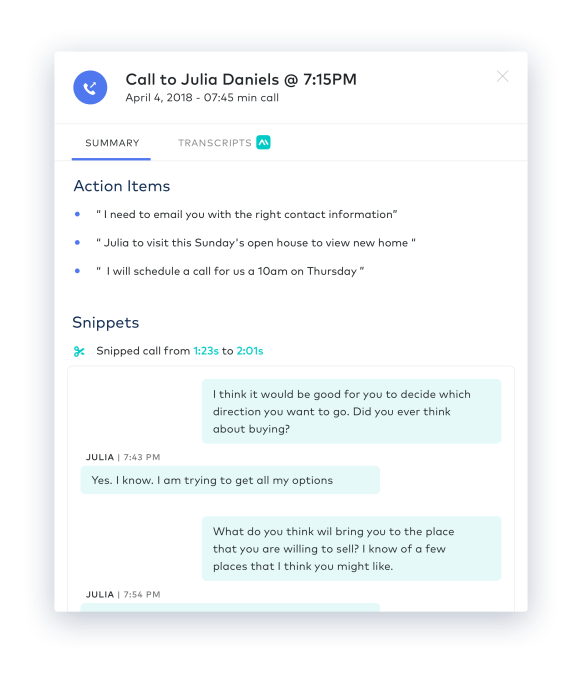
VoiceAI was launched shortly after Dialpad acquired TalkIQ in May to take this idea a step further by applying sentiment analysis and analytics to voice transcripts. The company plans to use the cash infusion to continue investing in artificial intelligence on the Dialpad platform.

Post call transcript generated by VoiceAI. Screenshot: Dialpad

CEO Craig Walker certainly sees the potential of artificial intelligence for the company moving forward. “Smart CIOs know AI isn’t just another trendy tech tool, it’s the future of work. By arming sales and support teams, and frankly everybody in the organization, with VoiceAI’s real-time artificial intelligence and insights, businesses can dramatically improve customer satisfaction and ultimately their bottom line,” Walker said in a statement.

Dialpad is also working with voice-driven devices like the Amazon Alexa and it announced Alexa integration with Dialpad in April. This allows Alexa users to make calls by saying something like, “Alexa, call Liz Green with Dialpad” and the Echo will make the phone call on your behalf using Dialpad software.

According to the company website, it has over 50,000 customers including WeWork, Stitch Fix, Uber and Reddit. The company says it has added over 10,000 new customers since its last funding round in September, 2017.

17 Jul 2018

It’s official: Brexit campaign broke the law — with social media’s help

The UK’s Electoral Commission has published the results of a near nine-month-long investigation into Brexit referendum spending and has found that the official Vote Leave campaign broke the law by breaching election campaign spending limits.

Vote Leave broke the law including by channeling money to a Canadian data firm, AggregateIQ, to use for targeting political advertising on Facebook’s platform, via undeclared joint working with another Brexit campaign, BeLeave, it found.

Aggregate IQ remains the subject of a separate joint investigation by privacy watchdogs in Canada and British Columbia.

The Electoral Commission’s investigation found evidence that BeLeave spent more than £675,000 with AggregateIQ under a common arrangement with Vote Leave. Yet the two campaigns had failed to disclose on their referendum spending returns that they had a common plan.

As the designated lead leave campaign, Vote Leave had a £7M spending limit under UK law. But via its joint spending with BeLeave the Commission determined it actually spent £7,449,079 — exceeding the legal spending limit by almost half a million pounds.

The June 2016 referendum in the UK resulted in a narrow 52:48 majority for the UK to leave the European Union. Two years on from the vote, the government has yet to agree a coherent policy strategy to move forward in negotiations with the EU, leaving businesses to suck up ongoing uncertainty and society and citizens to remain riven and divided.

Meanwhile, Facebook — whose platform played a key role in distributing referendum messaging — booked revenue of around $40.7BN in 2017 alone, reporting a full year profit of almost $16BN.

Back in May, long-time leave supporter and MEP, Nigel Farage, told CEO Mark Zuckerberg to his face in the European Parliament that without “Facebook and other forms of social media there is no way that Brexit or Trump or the Italian elections could ever possibly have happened”.

The Electoral Commission’s investigation focused on funding and spending, and mainly concerned five payments made to Aggregate IQ in June 2016 — payments made for campaign services for the EU Referendum — by the three Brexit campaigns it investigated (the third being: Veterans for Britain).

Veterans for Britain’s spending return included a donation of £100,000 that was reported as a cash donation received and accepted on 20 May 2016. But the Commission found this was in fact a payment by Vote Leave to Aggregate IQ for services provided to Veterans for Britain in the final days of the EU Referendum campaign. The date was also incorrectly reported: It was actually paid by Vote Leave on 29 June 2016.

Despite the donation to a third Brexit campaign by the official Vote Leave campaign being for services provided by Aggregate IQ, which was also simultaneously providing services to Vote Leave, the Commission did not deem it to constitute joint working, writing: “[T]he evidence we have seen does not support the concern that the services were provided to Veterans for Britain as joint working with Vote Leave.”

It was, however, found to constitute an inaccurate donation report — another offense under the UK’s Political Parties, Elections and Referendums Act 2000.

The report details multiple issues with spending returns across the three campaigns. And the Commission has issued a series of fines to the three Brexit campaigns.

It has also referred two individuals — Vote Leave’s David Alan Halsall and BeLeave’s Darren Grimes — to the UK’s Metropolitan Police Service, which has the power to instigate a criminal investigation.

Early last year the Commission decided not to fully investigate Vote Leave’s spending but by October it says new information had emerged — which suggested “a pattern of action by Vote Leave” — so it revisited the assessment and reopened an investigation in November.

Its report also makes it clear that Vote Leave failed to co-operate with its investigation — including by failing to produce requested information and documents; by failing to provide representatives for interview; by ignoring deadlines to respond to formal investigation notices; and by objecting to the fact of the investigation, including suggesting it would judicially review the opening of the investigation.

Judging by the Commission’s account, Vote Leave seemingly did everything it could to try to thwart and delay the investigation — which is only reporting now, two years on from the Brexit vote and with mere months of negotiating time left before the end of the formal Article 50 exit notification process.

What’s crystal clear from this report is that following money and data trails takes time and painstaking investigation, which — given that, y’know, democracy is at stake — heavily bolsters the case for far more stringent regulations and transparency mechanisms to prevent powerful social media platforms from quietly absorbing politically motivated money and messaging without recognizing any responsibility to disclose the transactions, let alone carry out due diligence on who or what may be funding the political spending.

The political ad transparency measures that Facebook has announced so far come far too late for Brexit — or indeed, for the 2016 US presidential election when its platform carried and amplifiedKremlin funded divisive messaging which reached the eyeballs of hundreds of millions of US voters.

Last week the UK’s information commissioner, Elizabeth Denham, criticized Facebook for transparency and control failures relating to political ads on its platform, and also announced its intention to fine Facebook the maximum possible for breaches of UK data protection law relating to the Cambridge Analytica scandal, after it emerged that information on as many as 87 million Facebook users was extracted from its platform and passed to a controversial UK political consultancy without most people’s knowledge or consent.

She also published a series of policy recommendations around digital political campaigning — calling for an ethical pause on the use of personal data for political ad targeting, and warning that a troubling lack of transparency about how people’s data is being used risks undermining public trust in democracy

“Without a high level of transparency – and therefore trust amongst citizens that their data is being used appropriately – we are at risk of developing a system of voter surveillance by default,” she warned.

The Cambridge Analytica Facebook scandal is linked to the Brexit referendum via AggregateIQ — which was also a contractor for Cambridge Analytica, and also handled Facebook user information which the former company had improperly obtained, after paying a Cambridge University academic to use a quiz app to harvest people’s data and use it to create psychometric profiles for ad targeting.

The Electoral Commission says it was approached by Facebook during the Brexit campaign spending investigation with “some information about how Aggregate IQ used its services during the EU Referendum campaign”.

We’ve reached out to Facebook for comment on the report and will update this story with any response.

The Commission states that evidence from Facebook indicates that AggregateIQ used “identical target lists for Vote Leave and BeLeave ads”, although at least in one instance the BeLeave ads “were not run”.

It writes:

BeLeave’s ability to procure services from Aggregate IQ only resulted from the actions of Vote Leave, in providing those donations and arranging a separate donor for BeLeave. While BeLeave may have contributed its own design style and input, the services provided by Aggregate IQ to BeLeave used Vote Leave messaging, at the behest of BeLeave’s campaign director. It also appears to have had the benefit of Vote Leave data and/or data it obtained via online resources set up and provided to it by Vote Leave to target and distribute its campaign material. This is shown by evidence from Facebook that Aggregate IQ used identical target lists for Vote Leave and BeLeave ads, although the BeLeave ads were not run.

“We also asked for copies of the adverts Aggregate IQ placed for BeLeave, and for details of the reports he received from Aggregate IQ on their use. Mr Grimes replied to our questions,” it further notes in the report.

At the height of the referendum campaign — at a crucial moment when Vote Leave had reached its official spending limit — officials from the official leave campaign persuaded BeLeave’s only other donor, an individual called Anthony Clake, to allow it to funnel a donation from him directly to Aggregate IQ, who Vote Leave campaign director Dominic Cummins dubbed a bunch of “social media ninjas”.

The Commission writes:

On 11 June 2016 Mr Cummings wrote to Mr Clake saying that Vote Leave had all the money it could spend, and suggesting the following: “However, there is another organisation that could spend your money. Would you be willing to spend the 100k to some social media ninjas who could usefully spend it on behalf of this organisation? I am very confident it would be well spent in the final crucial 5 days. Obviously it would be entirely legal. (sic)”

Mr Clake asked about this organisation. Mr Cummings replied as follows: “the social media ninjas are based in canada – they are extremely good. You would send your money directly to them. the organisation that would legally register the donation is a permitted participant called BeLeave, a “young people’s organisation”. happy to talk it through on the phone though in principle nothing is required from you but to wire money to a bank account if you’re happy to take my word for it. (sic)

Mr Clake then emailed Mr Grimes to offer a donation to BeLeave. He specified that this donation would made “via the AIQ account.”

And while the Commission says it found evidence that Grimes and others from BeLeave had “significant input into the look and design of the BeLeave adverts produced by Aggregate IQ”, it also determined that Vote Leave messaging was “influential in their strategy and design” — hence its determination of a common plan between the two campaigns. Aggregate IQ was the vehicle used by Vote Leave to breech its campaign spending cap.

Providing examples of the collaboration it found between the two campaigns, the Commission quotes internal BeLeave correspondence — including an instruction from Grimes to: “Copy and paste lines from Vote Leave’s briefing room in a BeLeave voice”.

It writes:

On 15 June 2016 Mr Grimes told other BeLeave Board members and Aggregate IQ that BeLeave’s ads needed to be: “an effective way of pushing our more liberal and progressive message to an audience which is perhaps not as receptive to Vote Leave’s messaging.”

On 17 June 2016 Mr Grimes told other BeLeave Board members: “So as soon as we can go live. Advertising should be back on tomorrow and normal operating as of Sunday. I’d like to make sure we have loads of scheduled tweets and Facebook status. Post all of those blogs including Shahmirs [aka Shahmir Sami; who became a BeLeave whistleblower], use favstar to check out and repost our best performing tweets. Copy and paste lines from Vote Leave’s briefing room in a BeLeave voice”


17 Jul 2018

Travel giant Booking invests $500M in Chinese ride-hailing firm Didi Chuxing

Didi Chuxing, China’s largest ride-hailing company, has pulled in some strategic capital after Booking Holdings invested $500 million into its business.

The deal will see Booking Holdings — which was formerly known as Priceline — work closely with Didi to offer its on-demand car services through its Booking.com apps via an integration. Likewise, Didi customers will have the option to book hotels through Booking.com and its sister site Agoda.

The deal isn’t about money. Didi has said publicly that it has multiple billions of US dollars on its balance sheet, thanks to a gigantic $4 billion funding round that closed at the end of 2017 and a history of raising big in recent years.

Instead, the tie-in helps on a strategic level.

Besides Booking.com and Agoda, Booking also operates Kayak, Priceline.com, Rentacars.com and OpenTable, all of which makes it a powerful ally for Didi. That’s particularly important since the Chinese firm is in global expansion mode, having launched services in Mexico, Australia and Taiwan this year. Beyond those three, it acquired local ride-hailing company 99 in Brazil and announced plans to roll into Japan.

Beyond boosting a brand and consumer touchpoints, linking up with travel companies makes sense as ride-hailing goes from simply ride-hailing to become a de facto platform for travel between both longer haul (flights) and short distance (public transport) trips. That explains why Didi has doubled down on dock-less bikes and other transportation modes.

“Building on its leadership and expertise in the global online travel market, Booking is championing a digital revolution of travel experience. We look forward to seamlessly connecting every segment of the journey and improving everyone’s traveling experience through more collaborative innovation with the Booking brands on product, technology and market development,” said Stephen Zhu, VP of strategy for Didi, in a statement.

17 Jul 2018

Mention Me, the referral marketing platform, raises $7M led by Eight Roads Ventures

Mention Me, the London-headquartered referral marketing platform, has raised $7 million in further funding. The round is led by Eight Roads Ventures and is the first time the five and a half year old company has raised venture capital, having only ever done a small angel round in 2015.

That’s noteworthy given the company’s two founders: Andy Cockburn and Tim Boughton, who met at Homeaway where they were U.K. MD and European CTO respectively before its $3 billion IPO on the Nasdaq.

Counting over 300 customers — including FarFetch, Ovo Energy, Ted Baker and ZipCar — Mention Me offers a marketing platform to make it easy and effective for companies to conduct referral marketing. The platform supports referral programs in 16 languages, but its biggest draw is the ability to A/B test, iterate and measure campaigns so that they work best for the cohort they target.

Another feature that stands out is Mention Me’s refer by name functionality. This sees the marketing platform let you refer customers simply by having enter your full name into the referral box instead of relying on a unique referral code or URL. This, Mention Me co-founder Cockburn says, is designed to mimic the way referrals are naturally made in conversation with friends i.e. ‘go to this store and mention my name’.

“Most businesses are sitting on a huge asset: the trust and good will of their customers,” he says. “If those customers are out telling their friends about the brand and how they feel about it, it should become the most valuable marketing channel the business has. A channel that brings in the best friends of your best customers is close to the holy grail of marketing. And some of the biggest successes of recent years – Uber, AirbnB, Dropbox – have realised this to great effect”.

However, the challenge, argues Cockburn, is that it’s not as easy as just putting a share button on a site. That’s because human psychology kicks in.

“When a brand asks us to share we start to evaluate the impact of that action on our friendships? Will I look good in front of my friend for sharing it? Will they judge me negatively for sharing? The way we solve this problem is by putting all of our resources – our technology and team – to focussing on solving the psychological challenge”.

This includes understanding that people aren’t all the same, hence Mention Me offers segmentation and A/B testing by cohort so that brands can work out which offers and messaging resonate with different customer groups.

“We let people share in the most natural way, in real world conversations, by telling friends to just go to the site and give their name, to make sharing feel natural. And we have a team of referral experts that actively works in partnership with clients to help them solve this challenge,” says Cockburn.

That partnership is reflected in Mention Me’s revenue model, too. Instead of charging a monthly subscription as most SaaS do, after an initial set-up fee, the company gets paid by referral, in the form of commission on a new customer’s first order. This makes it similar to affiliate marketing in the sense that the interests of Mention Me and its customers are aligned.

Meanwhile, the Mention Me founder believes that as marketing continues to evolve over the next five years, trust will be at the heart of its evolution. And when you get trust right, all of the dynamics of a business become easier.

“Customers come to you without you needing to sell to them, they’re generally happier and they stick around longer,” he says. “Over the next couple of years we’ll be building out a Trust Marketing platform to help businesses grow, manage, measure and harness trust. Our ultimate goal is to change how the world does marketing”.

17 Jul 2018

Online learning platform Unacademy gets $21M Series C from Sequoia India, SAIF and Nexus

Unacademy founders Roman Saini, Gaurav Munjal and Hemesh Singh

Bangalore-based Unacademy will add more educators to its online learning platform, which claims to be India’s largest, after closing a $21 million Series C. The funding comes from Sequoia India, SAIF Partners and Nexus Venture Partners, with participation from Blume Ventures (all four firms are returning from Unacademy’s Series B last year).

Originally a YouTube channel created in 2010 by Gaurav Munjal, Unacademy was officially launched as a startup in 2015 by founders Munjal, Roman Saini and Hemesh Singh. It has now raised $38.6 million in total.

While Unacademy offers a wide range of courses, its most popular offerings include preparation for important exams in India. Its platform includes two apps: one that lets educators create lessons and another that allows users to access them. Unacademy says it has 10,000 registered educators and three million users. Last month, the startup claims 3,000 educators were active on the platform and lessons were watched more than 40 million times.

Many lessons are available for free, though last year Unacademy launched a paid service called Plus that gives users access to features like private discussion forums and live video classes for a per-course fee. Unacademy claims it has achieved six times growth in monthly revenue since launching Plus. The premium classes also help it differentiate from other online learning platforms like Mrunal, a popular site that provides free test preparation for Indian students.

In addition to bringing on more teachers, Unacademy will use its new funding to expand key categories like pre-med, the Graduate Aptitude Test in Engineering (GATE) and the Common Admission Test (CAT), which are required by many post-graduate programs.

In a media statement, SAIF partner Alok Goel said “Unacademy has demonstrated tremendous progress towards their goal of delivering personalized learning by connecting great quality educators and students on their platform. The company has diversified across several new domains and has achieved amazing word of mouth among learners.”

17 Jul 2018

ClassPass is headed to Asia via an imminent launch in Singapore

U.S fitness startup ClassPass is headed to Asia after it announced plans to go live in Singapore, its first city in the continent.

Four-year-old ClassPass allows its users to book fitness classes and packages across a multitude of gyms. The company claims to work with more than 10,000 fitness partners across over 50 cities globally. That’s mostly in the U.S. but it has also forayed into Canada, the UK and Australia and now it is seeking out additional growth opportunities.

The move into Asia has been expected for some time after ClassPass hired a head of international in May. The company told TechCrunch at the time that it would soon arrive in three countries in Asia and Singapore, which has many similarities to the West in terms of economics and culture, is a logical pick as the starting point. Added to that, the country’s sovereign fund, Temasek, led ClassPass’s $70 million Series C funding round last year so you could say that is an extra factor.

The identity of the other two cities remains unclear at this point, but you’d imagine that Hong Kong will be one of them.

ClassPass hasn’t given a specific date for its launch other than it will come to Singapore “in the lead-up to National Day” — that’s August 9. In the meantime, it has opened up a Singapore waitlist which can be found here.

The U.S. startup was the first to pioneer the fitness subscription model but it already has competition in Singapore and other parts of Asia. Singapore’s own GuavaPass operates in 12 countries across Asia and the Middle East, having previously raised $5 million, while another rival called KFit is present in four cities in Southeast Asia.

Actually, the case of KFit shows that fitness subscription is challenging in Asia. KFit raised more than $15 million from investors and scaled to over a dozen cities before it pivoted its business to Groupon-like group deals in a strategy that included the actual purchase of Groupon businesses in Southeast Asia.

The KFit business still operates but it has been scaled back significantly in response to a tough business landscape. ClassPass itself has experienced similar setbacks — including price hikes and a management reshuffle — while it is said to have seen its valuation decline for that Series C round.

With all those factors in mind, it’ll be interesting to see how ClassPass fairs when it does touch down in Asia. 

17 Jul 2018

Coinbase reportedly gets approval from U.S. regulators to start listing tokenized securities

Coinbase shared big news Monday that federal regulators are allowing the popular cryptocurrency exchange to proceed with plans to sell cryptocurrency tokens that are deemed securities.

Last month, Coinbase acquired Keystone Capital, a California-based FINRA-registered broker-dealer that operates as an alternative trading system. With the announcement, the SF-based cryptocurrency exchange disclosed that it would still need to get regulatory approval to operate under the Keystone licenses.

Today, the Securities and Exchange Commission and Financial Industry Regulatory Authority gave Coinbase just that, Bloomberg reported, approving that deal alongside the acquisitions of Venovate Marketplace and Digital Wealth.

Today’s news opens up the scope of Coinbase’s ambitions to the billions of dollars that have been raised in initial coin offerings over the past several months. With permission to trade tokenized securities, Coinbase users could soon have the ability to move beyond the limited cryptocurrency options currently available to be traded on the site’s central exchange which currently just lists Bitcoin, Bitcoin Cash, Ethereum and Litecoin.

The company announced last week that it was exploring adding five new tokens to its exchange, including Cardano, Basic Attention Token, Stellar Lumens, Zcash and 0x. In a blog post, the company specified that the announcement did not necessarily deem that these tokens were not securities and that classification might vary by jurisdiction.

17 Jul 2018

Aiming to make billboard advertising more programmatic, Adquick raises $2.1 million

Alexis Ohanian, the co-founder of Initialized Capital and an investor in Adquick, a new service that’s looking to bring billboard advertising into the internet age, bought his last billboard ad just this year.

For several years, the Reddit founder had turned to outdoor advertising as a tool to troll politicians and advocate for various positions (and celebrate his famous wife). The last political billboard, in 2012, was to protest the Stop Online Piracy Act.

It was also the impetus for his investment in Adquick. “I’d seen pitches from a number of competitors that were all just static websites on top of the single business,” says Ohanian.

What he was looking for, and what he eventually found in Adquick was a company that had managed to map all of the billboard advertising options available in the U.S. and was offering would-be advertisers a way to digitally distribute their ads and book inventory.

“For us the reason why it was such an exciting initial investment was because we saw the opportunity and the talent of the team,” Ohanian says.

Matthew O’Connor, Adquick’s chief executive previously worked at Instacart and it was there that he and his team first learned about dragging traditional businesses into the online world.

“This team had come out of Instacart… they came well recommended by the founders over there,”Ohanian said. “Working with them now I’ve just gotten more and more impressed.”

So impressed, that Ohanian doubled down on his firm’s initial investment into the company with a new $2.1 million round.

There’s an undoubtable opportunity in outdoor advertising. O’Connor estimates that it’s a $33 billion global market with $8 billion spent on outdoor ads in the U.S. alone.

“They are aggregating from hundreds of vendors across the U.S. and they’re making it easy for companies to sell those ads and manage that inventory and bringing a ton of transparency to a system that is mostly phone calls and emails,” Ohanian said. 

Bringing those efficiencies to an old industry can only help what’s been the only non-digital ad channel to actually grow in the U.S. “It’s the oldest channel in the world that’s about to undergo a resurgence,” O’Connor says.

“It’s the last frontier of advertising,” says O’Connor. “This is a real world channel that can have a lot of tailwinds if we can bring these great modern technologies to it which is what we’re doing.”

16 Jul 2018

This fan-made Uncharted movie starring Nathan Fillion proves video game movies don’t have to be awful

It’s not exactly a controversial statement: Movies based on video games are, generally, bad. See Assassins Creed. Or that weird mess that was Mortal Kombat: Annihilation. Or that Super Mario movie where Bowser (renamed “President Koopa” for some reason) was basically just a dude with bad hair for half the movie.

Turns out, as this live action fan film based on Naughty Dog’s Uncharted suggests, they can be done right.

This fan-made short is about as unofficial as can be, as noted by a disclaimer that pops up on screen right off the bat.

And yet, it does a better job of capturing the feel of its source material than pretty much any game-based movie before it.

And it stars Nathan Fillion! Captain friggin’ Reynolds himself! Fans have been saying for ages that Nathan Fillion would make for one helluva Nathan Drake, and it seems like the hive mind really nailed that casting.

Is it silly? Sure. Will people who’ve never played the Uncharted series understand what’s going on? Maybe not. But it feels like Uncharted, down to a scene in which I half expected to be asked to mash some invisible X button to ensure Nathan’s punch connected.

Would it work as a feature-length movie? It’s hard to say. But if they found a way to release something like this episodically, I’d tune in. Alas, no word yet on any future plans from the team involved.

16 Jul 2018

Putin proposes a joint cybersecurity group with the US to investigate Russian election meddling

Over the course of Monday’s controversial Helsinki summit, Russian President Vladimir Putin pushed an agenda that would ostensibly see the U.S. and Russia working side by side as allies. The two countries make stranger bedfellows than ever as just days prior, Trump’s own Department of Justice indicted 12 Russian intelligence officials for the infamous 2016 Democratic National Committee hack.

Nonetheless, the Russian president revived talks of a joint group between the U.S. and Russia dedicated to cybersecurity matters. For anyone with the security interests of the U.S. at heart, such a proposal, which Trump endorsed in a tweet one year ago, would truly be a worst case scenario outcome of the puzzlingly cozy relationship between the two world leaders.

“Once again, President Trump mentioned the issue of the so-called interference of Russia [during] the American elections and I had to reiterate things I said several times…,” Putin said in Helsinki.

“Any specific material, if such things arise, we are ready to analyze together. For instance, we can analyze them through the joint working group on cyber security, the establishment of which we discussed during our previous contacts.”

Putin added that Russia favors “continued cooperation in counter-terrorism and maintaining cyber security.”

“The most recent example is their operational cooperation within the recently concluded World Football Cup,” Putin said. “In general, the contacts among the special services should be put to a system-wide basis should be brought to a systemic framework. I reminded President Trump about the suggestion to re-establish the working group on anti-terrorism.”

After a loud bipartisan rebuke followed Trump’s proposal of an “impenetrable [cybersecurity] unit” with Russia last year, the U.S. president walked his comments back a few steps, suggesting that they were hypothetical. Whether it ever materializes or not, the whole idea a somewhat stunning departure from national security norms and one that would be broadly decried as letting the fox into the henhouse given that evidence establishing Russia as a cyber adversary of the U.S., both currently and historically, is plentiful.

In 2017, the U.S. intelligence community issued such an assertion in no uncertain terms:

“Russian efforts to influence the 2016 US presidential election represent the most recent expression of Moscow’s longstanding desire to undermine the US-led liberal democratic order, but these activities demonstrated a significant escalation in directness, level of activity, and scope of effort compared to previous operations.”

The report notes that this information is sourced broadly, stating that “insights into Russian efforts—including specific cyber operations—and Russian views of key US players derive from multiple corroborating sources.”

CrowdStrike, the security firm involved in investigating the 2016 DNC hack uncontroversially included Russia on a list of “notable nation-state adversaries” of the U.S. alongside China, North Korea and Iran.

Just days ago, U.S. Director of National Intelligence Dan Coats just cautioned that “warning lights are blinking red again” when it comes to attacks on federal, state and local U.S. entities. Coats named Russia, China, Iran and North Korea as cyber aggressors against the U.S., adding that “Russia has been the most aggressive foreign actor, no question.”

It’s unclear what, if anything the U.S. would stand to gain from such an arrangement, though it would stand to lose quite a bit, given the likelihood that Russia’s interest in influencing U.S. elections is ongoing. Putin’s comments in Helsinki indicate the the spirit of such an effort lives on, misguided as it may be.