Year: 2018

03 May 2018

Xiaomi officially files for Hong Kong IPO to raise a reported $10 billion

Xiaomi’s much-speculated IPO process has kicked off officially after the Chinese smartphone giant filed to go public on the Hong Kong Stock Exchange.

The first draft of its filing does not include proposed financial details of its listing, but the South China Morning Post reports that the company is shooting to raise $10 billion at a valuation of $100 billion. Beyond the year’s largest IPO, it would make Xiaomi China’s third largest technology company based on market cap.

Xiaomi operates differently to most companies in that beyond selling smartphones and smart devices, it operates its own retail business and internet services such as payments and streaming. That strategy — which CEO Lei Jun calls a “triathlon” — is focused on services for growth since Xiaomi has capped its maximum net profit for hardware at five percent.

The financials are impressive on paper.

The company booked sales of 114.6 billion RMB ($18 billion) in 2017, up from 68.4 billion RMB in 2016 and 66.8 billion in 2015.

Xiaomi posted a 43.9 billion RMB ($6.9 billion) loss in 2017 on account of issuing preferred shares to investors (54 billion RMB) but the growth story is healthy. Operating profit jumped to 12.2 billion RMB ($1.92 billion), up more than three-fold on the previous year.

Smartphones continue to represent the bulk of sales at 70 percent, with smart devices pulling in 20 percent more and services responsible for the remainder.

China is, as you’d expect, the primary revenue market but Xiaomi is increasingly less dependent on its homeland. For 2017 sales, China represented 72 percent, but it had been 94 percent and 87 percent, respectively, in 2015 and 2016. India is Xiaomi’s most successful overseas venture, having built the business to the number one smartphone firm based on market share, and Xiaomi is pledging to double down on other global areas.

Interestingly there’s no mention of expanding phone sales to the U.S., but Xiaomi has pledged to put 30 percent of its IPO towards growing its presence in Southeast Asia, Europe, Russia “other regions.” Currently, it said it sells products in 74 countries, that does include the U.S. where Xiaomi sells accessories and non-phone items.

Another 30 percent is earmarked for R&D and product development, while a further 30 percent will be invested in Xiaomi’s internet of things and smart product ecosystem. The remaining 10 percent is down for working capital.

Xiaomi isn’t disclosing the exact percentage stakes that its major investors hold, but CEO Lei Jun is believed to be one of the most significant shareholders. The IPO could make him China’s richest man, according to reports which suggest he controls a stake of over 75 percent.

02 May 2018

Elon Musk offers more detail about Tesla’s ridesharing network

On Tesla’s Q1 2018 earnings call today, Tesla CEO Elon Musk shed some light on the company’s ambitions to launch an autonomous-vehicle ridesharing network. The short answer is that, from a technical standpoint, Tesla will be ready by the end of next year, Musk said. It’s not yet clear, however, when Tesla would actually launch the network.

The longer answer involves discussion about regulation and the need to have full autonomy in place. That is, Level 4 or Level 5 autonomy that doesn’t require human intervention.

On the call, Musk described a world in which people share their cars, offering them as either a Lyft, an Uber or something like a Lyft/Uber-Airbnb combo “where you can own your car and have 100 percent usage of your car,” Musk said, and specify that it’s available to anyone who wants to use it while you’re not using it.

“This is the obvious thing that’s going to happen,” Musk said.

But in order to get that in place, he said, Tesla needs to solve for autonomy. Tesla also needs a software platform to manage the ridesharing network. As of right now, Musk said the cars Tesla is currently producing are totally capable of full autonomy, give or take a couple of computer updates pertaining to things like processing power and whatnot.

“I think we’re really well-positioned,” Musk said, for having “ultimately millions of shared, autonomous electric vehicles.”

In March, analyst Gene Munster said there’s a more than 50 percent chance Tesla will start operating its ridesharing fleet by 2023. That could add anywhere from $2 billion to $6 billion in revenue for Tesla, according to Munster.

Here are some other takeaways from the call:

  • Tesla will likely start producing the Model Y in early 2020. Musk says it will be a “manufacturing revolution.”
  • Tesla will begin publishing Autopilot safety statistics on a quarterly basis.
  • Tesla doesn’t plan to replace Jim Keller, the VP of Autopilot who left in April for Intel.
02 May 2018

Columbus Collaboratory’s Jeff Schmidt talks about the future of security

In this episode of Technotopia I talk to Jeff Schmidt of the Columbus Collaboratory. He is well-versed in the future of security and our conversation ranged from the rise of the midwest to the future of cyberattacks.

The Columbus Collaboratory is a unique think tank dedicated to building security and system solutions for major clients. It’s a sort of Delta Force for major corporations headquartered in Columbus, and Schmidt has a lot to say about the value of a good security plan.

Technotopia is a podcast by John Biggs about a better future. You can subscribe in Stitcher, RSS or iTunes and listen the MP3 here.

02 May 2018

Facebook tool warns developers of phishing attacks dangling lookalike domains

Phishing seems like a problem that will be here for the long haul, so I welcome any tools to combat it with open arms. Today Facebook announced one: a service for domain owners or concerned users that watches for sketchy versions of web addresses that might indicate a phishing attempt in the offing.

The developer only needs to specify the domain name they care about and our tool will take care of the rest,” explained Facebook security engineer David Huang. “For example, if you subscribe to phishing alerts for a legitimate domain ‘facebook.com,’ we’ll alert you when we detect a potential phishing domain like ‘facebook.com.evil.com’ and other malicious variations as we see them.”

Hosting your phishing website as a subdomain of evil.com seems like kind of a giveaway. But there are subtler ways to fool people. If someone wanted to make you think that an email was coming from this website, for instance, they might register something like techcrunch-support.com or techcrunch.official.site and send it from there.

Hi Peter.

Small variations in spelling work, too: would you notice that an email came from techcruhch.com or techcrunoh.com if you were on your phone, walking down the street and trying not to be hit by people riding electric scooters? I think not. Back in the day even CrouchGear might have worked.

And lookalike characters that render differently inline are a strange new threat: whɑtsɑpp.com has an alpha (or something) instead of an a, and helpfully renders as xn—whtspp-cxcc.com. Look, I didn’t design the system. I just use it.

The tool looks for all these variations in domains it encounters by watching the stream of certificates being issued to new domains. “We have been using these logs to monitor certificates issued for domains owned by Facebook and have created tools to help developers take advantage of the same approach,” reads the Facebook blog post. Nice of them!

Developers can sign up here and submit domains they’d like to monitor. Facebook won’t do anything but alert you that it detected something weird, so if there’s a false positive you don’t need to worry about getting kicked off your domain. On the other hand, if scammers are setting up shop at a doppelgänger web address, you’ll have to do the legwork yourself to get it shut down and warn your own users to be on the lookout.

02 May 2018

Fitbit beats revenue expectations slightly, but tracker sales are still down

Fitbit scored a small coup on earnings this week, ever so slightly beating revenue expectations for the quarter. The company pulled in $247.9 million, up over Wall Street’s expected $247.3 million. Of course, that’s still a notable drop from this time last year, when the company pulled in $298.9 million.

The numbers are down as the overall fitness tracking category has declined, and the company sold 2.2 million devices in the quarter, missing analyst expectations of 2.33 million. Fitbit has adjusted its second quarter revenue expectation, accordingly. “We expect results to be impacted by the reduced demand by the channel for trackers, partially offset by an increase in smartwatch revenue, driven primarily by Versa sales,” the company wrote in a release announcing earnings. “We expect smartwatches to grow as a percentage of revenue, but our overall mix to continue to be skewed towards trackers.”

That’s in line with the company’s overall strategy over the past year, which saw a marked shift into the world of smartwatches — a rare overall bright light in the fitness wearable space, thanks in large part to the success of the Apple Watch. Fitbit has invested a good chunk of change in acquisitions, resulting in the release of the Ionic and Versa. And given the devices’ higher per unit price, the company ultimately has to sell fewer to maintain revenue. 

The release mostly glosses over the existence of the Ionic, save for a mention of the fact that the device was announced in the past year — and that it helped reduce “development hours by around 45-percent on the Versa.” That makes perfect sense, of course — the hard work of incorporating all of its recent acquisitions and distilling all of those learnings into a hardware and software offering were mostly accomplished with the Ionic.

The point of all of that being that now Fitbit knows how to make a smartwatch, so doing so in the future should be less resource-intensive, moving forward. That will likely come in handy as the company seems poised to invest more and more of its resources into its growing healthcare sector.

Fitbit stock jumped recently, courtesy of its announced partnership with Google, which will help make health info tracked on its devices more easily accessible by doctors. There is, of course, plenty of money to be made in the healthcare sector, but Fitbit is going to have a bit of an uphill battle getting providers to take its offerings more seriously as medical devices.

“We continued to deepen our relationship with our users, investing in software and services that deliver on our promise of helping people achieve better health outcomes,” CEO James Park said in a release tied to the earnings. “To this end, we closed the acquisition of Twine Health and, most recently announced a long-term collaboration with Google that will accelerate innovation in digital health and wearables.” 

02 May 2018

China could beat America in AR/VR long-term

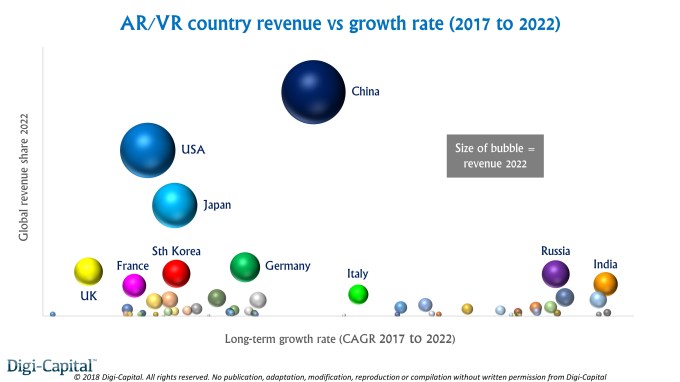
America delivered more AR/VR revenue than China last year, but Chinese growth in the next five years could see it dominate AR/VR long-term — and not by a small margin. With the potential to take more than $1 of every $5 spent on AR/VR globally by 2022, the natural advantages of the Chinese AR/VR market are a golden opportunity (or threat) for domestic and international players. Combine China with other major countries in the region, and Asia could deliver around half of AR/VR global revenue in five years’ time. Western companies might need to adopt a “we try harder” approach to compete at the same level.
Since 2015 we’ve said that ubiquitous AR could dominate focused VR long-term. While the two markets might merge into unified “XR” (or some other acronym) one day, they could have very different dynamics for the foreseeable future. AR (mobile AR, smart glasses) could approach 3.5 billion installed base and $85 billion to $90 billion revenue by 2022, while VR (console, PC, mobile, standalone) might deliver 50 to 60 million installed base and $10 billion to $15 billion revenue in the same time frame(Note: Digi-Capital’s base case is that even with 900 million installed base for ARKit/ARCore by the end of this year, AR/VR revenue will only start to scale in 2019.)

To understand what’s happening across the 55 major AR/VR countries and regions, let’s start with VR.

America might win the battle for VR
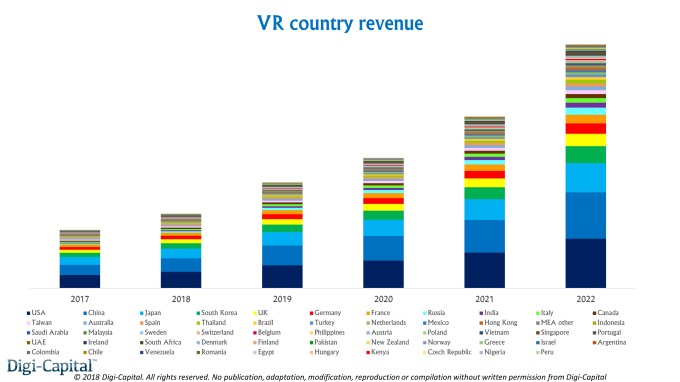
VR’s smaller installed base, lower mobility and exclusive immersion (i.e. limited plurality) focuses it on entertainment use cases and revenue streams. Entertainment (games, location-based entertainment, video) could take two-thirds of VR sector revenue long-term, with hardware taking just over a quarter due to limited unit sales and price competition.

The VR market’s country dynamics have much in common with the wider video games market. The U.S. has a significant installed base of Sony’s VR capable games consoles (banned in China until recently) and high-end VR-capable PCs. It also has highly profitable core gamer economics, which could give it an advantage if premium standalone VR (neither PC nor mobile tethered) hits its stride in a few years. While China has a much larger mobile installed base, mobile/standalone VR’s trajectory took a fundamental hit last year, following the launch of mass-market mobile AR. Combined with lower ARPU for mobile/standalone VR, China is at a relative disadvantage to the West on a per user basis.

The U.S. could take around one-fifth of global VR revenue by 2022, making it slightly larger than China. But while the U.S. could win the VR battle, it might be a small victory. Combining China with other countries in the region (particularly Japan and South Korea), Asia could deliver just under half of global VR revenue in five years — over twice North America. Europe (led by the U.K., Germany, France) could also deliver, but the European region combined might only be slightly larger than either the U.S. or China individually.

China could win the war with AR
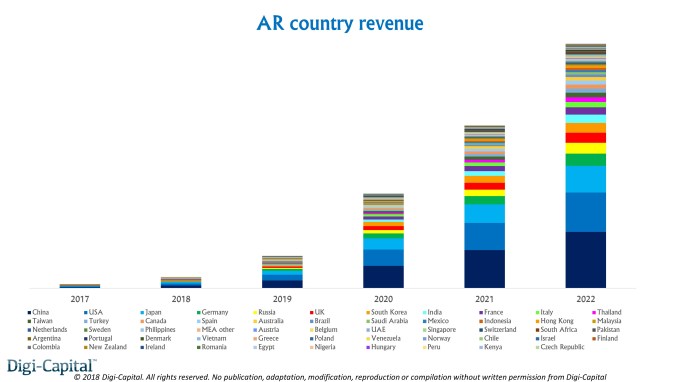
The dynamics of AR look very different. An installed base in the billions is coming for mobile AR. If and when Apple launches smartphone-tethered smart glasses (we’ve been forecasting 2020 for a while now), that market could grow from hundreds of thousands to tens of millions installed base in five years. Because of this distribution potential, a Cambrian explosion of new use cases and business cases is beginning to emerge. E-commerce sales (goods & services, not IAP), hardware sales, ad spend, app store (non-games and games), enterprise and location-based entertainment hold significant promise for AR long-term.

So where VR looks like a subset of the games market, AR’s long-term dynamics could be more like mobile. That’s where China’s natural advantages give it the edge over every other country on the planet (including the U.S.).

Chinese ARCore could have an installed base approaching ARKit’s scale globally long-term. Add to that ARKit itself in China, plus domestic Chinese mobile AR from Tencent, Alibaba and others, and a clearer picture of Chinese scale emerges. Then from 2020, smartphone-tethered smart glasses could become premium peripherals to Apple and others’ phones, again leveraging China’s inherent mobile strength. This could see China dominate global mobile AR and smart glasses’ installed bases long-term.

Then there’s China’s market dynamics, business models and economics to consider:

What does all this mean for AR?

E-commerce could be the largest AR business model, where China (particularly Alibaba) might dominate. Smart glasses hardware sales could come next, with premium Chinese iPhone users core to Apple’s potential long-term smart glasses dominance (whether they call them iGlasses or not). Tencent is in prime position for the third-largest business model of AR advertising, which explains its  battles with Alibaba (although Facebook Camera Effects could generate more revenue internationally). And that’s not to mention Chinese iOS and Android AR app store revenues (both non-games and games), enterprise AR and location-based AR entertainment at scale.

Combining China’s impending AR installed base, business models and economics, and it could see nearly one-quarter of all AR revenues globally by 2022. This is almost half again what the U.S. might produce in a similar time frame. Merging all the country data for a regional view, and Asia could take more than half, Europe less than one-quarter and North America less than one-fifth of global AR revenues.

It’s a small world after all

Installed bases, use cases and economics are great levelers in tech markets, and so it is for AR/VR. While the U.S. might win VR, China could dominate much larger AR. So whoever wins AR also wins AR/VR globally — right now that looks like China by a country mile.

This is not to say that the U.S. and other western countries can’t do very well from AR/VR long-term (indeed, we forecast that they should). However Asia, China in particular, is critical to the future of the market. Global players need to find a way to compete, or risk being left behind. While Apple could do well as always, for everyone else it’s all to play for.


02 May 2018

Nintendo’s new president aims to build a billion-dollar mobile gaming business

It’s a time of optimism and transition at Nintendo, where brisk sales of the Switch have bolstered its bottom line and new leadership signals a fresh approach to the market. Shuntaro Furukawa, the new president, told the Nikkei that one of his plans is to pursue mobile gaming with more vigor, aiming to build it into a billion-dollar business.

Furukawa is taking over from Tatsumi Kimishima, who took the helm temporarily after the tragic and sudden death of the beloved Satoru Iwata in 2015. He’s only 46, and clearly as a member of the younger generation has a different outlook on mobile, which the company completely avoided until very recently.

“The idea that something will emerge that transforms into something big, in the same manner as game consoles, is the defining motive of the Nintendo business,” he told the Nikkei. “From what I can see, smartphone games are the ones I want to expand the most.”

He said he envisions the smartphone side of the game company to become a 100 billion yen business — short of a billion at the present exchange rate, but why not round up? The company did a trillion yen in sales last year, so it’s not like we’re going to run out of zeroes.

The company’s tentative forays into the field have been a mixed success. Pokémon GO was, of course, a worldwide phenomenon, but widely criticized for half-baked gameplay and other issues. Mario Run was a perfectly fun game, but many mobile players balked at its high up-front price. Then Fire Emblem: Heroes has proven popular and a financial success — but its reliance on “loot box” mechanics and in-game microtransactions soured the experience for many.

A new game and franchise, Dragalia Lost, is coming this summer.

Clearly Nintendo is still finding its feet in this relatively unfamiliar territory, though long practice with the DS (in many ways very like a smartphone) means that mobile gaming, if not a core competency, is at least core-adjacent. And popular franchises like Advance Wars and Professor Layton are great matches for mobile.

No one should expect a smartphone equivalent to sprawling, beautiful games like Breath of the Wild, but Nintendo has handheld fun in its blood, and there’s no reason to think they won’t nail it after a few tries.

02 May 2018

Tesla beats expectations with $3.4 billion in revenue

Tesla reported its Q1 2018 earnings today, posting adjusted losses of $3.35 per share with revenues on $3.4 billion. This is beat, as analysts expected Tesla to report a loss of $3.48 a share with revenues of $3.22 billion.

Tesla ended Q1 with $2.7 billion in cash. In September 2017, Tesla stock hit a record high of $389.61 a share. At market close today, Tesla was trading at $301.15. In after-hours, Tesla is trading around $305.

Tesla also provided some updates to its Model 3 production, noting it hit 2,270 cars produced per week for three straight weeks in April.

“Even at this stage of the ramp, Model 3 is already on the cusp of becoming the best-selling mid-sized premium sedan in the US, and our deliveries continue to increase,” Tesla CEO Elon Musk and CFO Deepak Ahuja wrote in a letter to investors. “Consumers have clearly shown that electric vehicles are simply more desirable when priced on par with their internal combustion engine competitors while offering better technology, performance and user experience.”

Analysts, regulators and customers alike have been paying close attention to Tesla over the past few months. In March, a Tesla owner died following a car crash that involved the Model X’s Autopilot mode.

In April, after cooperating with the National Transportation Safety Board for the investigation, the NTSB removed Tesla as a party. That’s because the NTSB was unhappy with the way Tesla released information pertaining to the crash to the public.

“The NTSB took this action because Tesla violated the party agreement by releasing investigative information before it was vetted and confirmed by the NTSB,” the NTSB wrote in a press release. “Such releases of incomplete information often lead to speculation and incorrect assumptions about the probable cause of a crash, which does a disservice to the investigative process and the traveling public.”

Meanwhile, Musk admitted to over-automouting the production of Model 3 cars. That admission came following Bernstein analysts Max Warburton and Toni Sacconaghi arguing Tesla was overusing automation in the final production of Model 3 assembly.

In April, Tesla said it was able to double the weekly Model 3 production rate over Q1 “by rapidly addressing production and supply chain bottlenecks, including several short factory shutdowns to upgrade equipment.” Though, Tesla did miss its first quarter production target of 2,500 cars per week. By the end of Q2, Tesla is targeting a Model S production rate of 5,000 cars per week.

Just as Tesla did in Q1, it plans to take planned downtime as part of its Model 3 production process. Prior to the downtime in April, Tesla said it had hit a record of producing 4,750 Model 3 vehicles in two weeks.

Once Tesla hits its ideal production rate of 5,000 Model 3 cars per week, the plan is to increase that goal to 10,000 Model 3 cars produced per week.

Developing…

02 May 2018

Spotify misses on revenue in first earnings report with 170M users

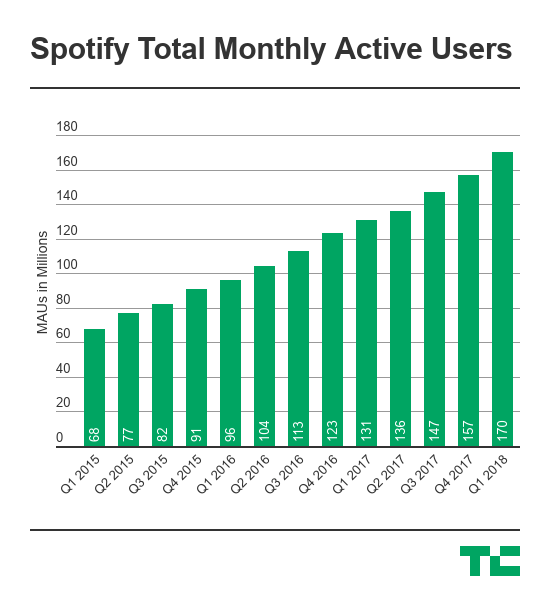
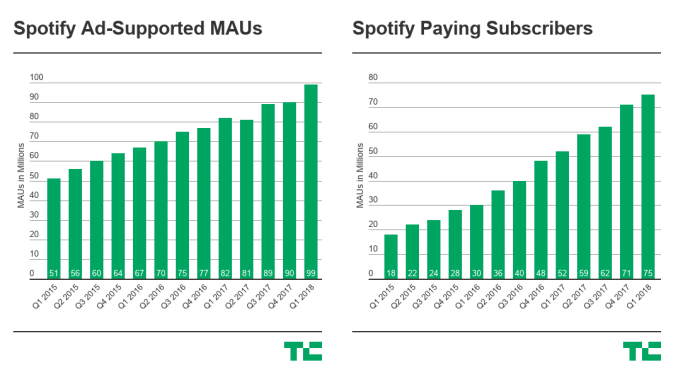
In Spotify’s first ever earnings report, the streaming music came up short, pulling in $1.36 billion revenue in Q1 2018. That’s compared to $1.4 billion in revenue and an adjusted EPS loss of $0.34. Spotify hit 170 million monthly active users, up 6.9 percent from 159 million in Q4 2017 and 99 million ad-supported users. It also hit 75 million Premium Subscribers, up 30 percent year-over-year, and 75 million paid subscribers, up 5.6 percent from 71 million in Q4 and up 45 percent YoY.

Interestingly, the MAU account seems to indicate that 5 million of Spotify’s 75 million subscribers pay but don’t listen.


Spotify’s results were in line with the guidance it gave yet Wall Street was still disappointed. Spotify shares promptly fell over 8 percent in after-hours trading to around $156, beneath its IPO pop a month ago but still above its $149 day one closing price and $132 IPO pricing.

Spotify’s Gross Margin was 24.9 percent in Q1, over the top of its guidance range of 23-24 percent. Its operating loss was $48.9 million, and its has $1.91 billion in cash and cash equivalents at the end of Q1.

As for Q2 guidance, Spotify expects 175 to 180 million MAU, 79 to 83 million paid subscribers, and $1.3 to $1.55 billion in revenue, excluding the impoact of foreign exchange rates. It’s planning an operating loss of $71 million to $167 million, in part due to a $35 million to $42 million expense related to its direct listing debut on the public markets.

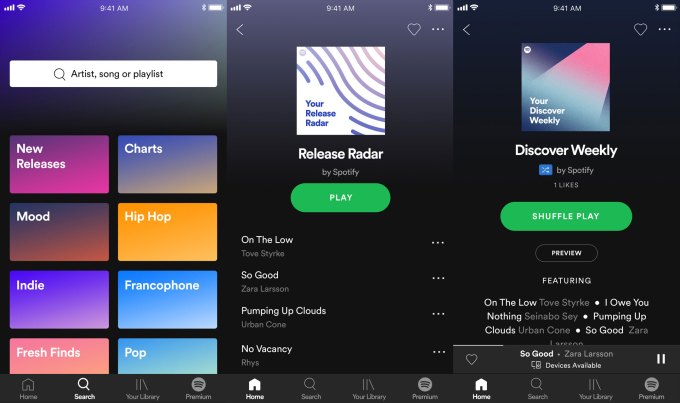
Spotify is hoping to boost paid subscriber numbers by first luring more users to its free ad-supported service. Last month it unveiled a revamped free tier that lets users listen to songs on-demand on particular Spotify-controlled playlists instead of only being able to play in shuffle mode. The idea is that once users get a taste of on-demand listening, they’ll pay to upgrade so they can listen to whatever they want across the whole catalog.

That strategy could not only boost subscriber numbers, but also give Spotify more leverage over the record labels. More than 30 percent of all Spotify listening now happens on its owned playlists. That gives it the power to choose what will become a hit, and in turn means record labels need to play nice. This could help Spotify secure more exclusive content and a better bargaining position in royalty negotiations.

02 May 2018

BuzzFeed built its own editing tool for short, meme-y videos

Although the “pivot to video” has been notoriously challenging for most publishers, they can’t exactly give up on video. In fact, BuzzFeed has been ramping up production with a new editing tool called Vidder.

Vidder was created Senior Product Designer Elaine Dunlap and Senior Software Engineer Joseph Bergen. Dunlap recalled talking to Bergen more than a year ago and pointing out that while BuzzFeed is known for building its own publishing tools, “there wasn’t really the same opinionated software solution” for creating videos.

So they decided to build a video editing product that could be used by anyone, not just experienced producers and editors. Dunlap said the initial goal was to “demystify video production.”

“We basically started out with this hypothesis that if we gave a very simple tool to these editors who are constantly creating very funny, interesting things, they would really be able to fly,” Bergen added.

Fast forward to 2018 and BuzzFeed says Vidder is being used by 40 or 50 team members to create 200 videos each month, with 800 videos created in all since October. Almost none of BuzzFeed’s Vidder users are full-time video producers, and most of them had little to no experience with professional video editing software.

Vidder

For example, Kayla Yandoli was a member of BuzzFeed’s social team (she’s since transferred to the video) when she created this compilation of “shady” insults from The Golden Girls last fall. With 1.1 million shares, it was one of Vidder’s early success stories, and Yandoli estimated that it only took her only an hour and a half to edit.

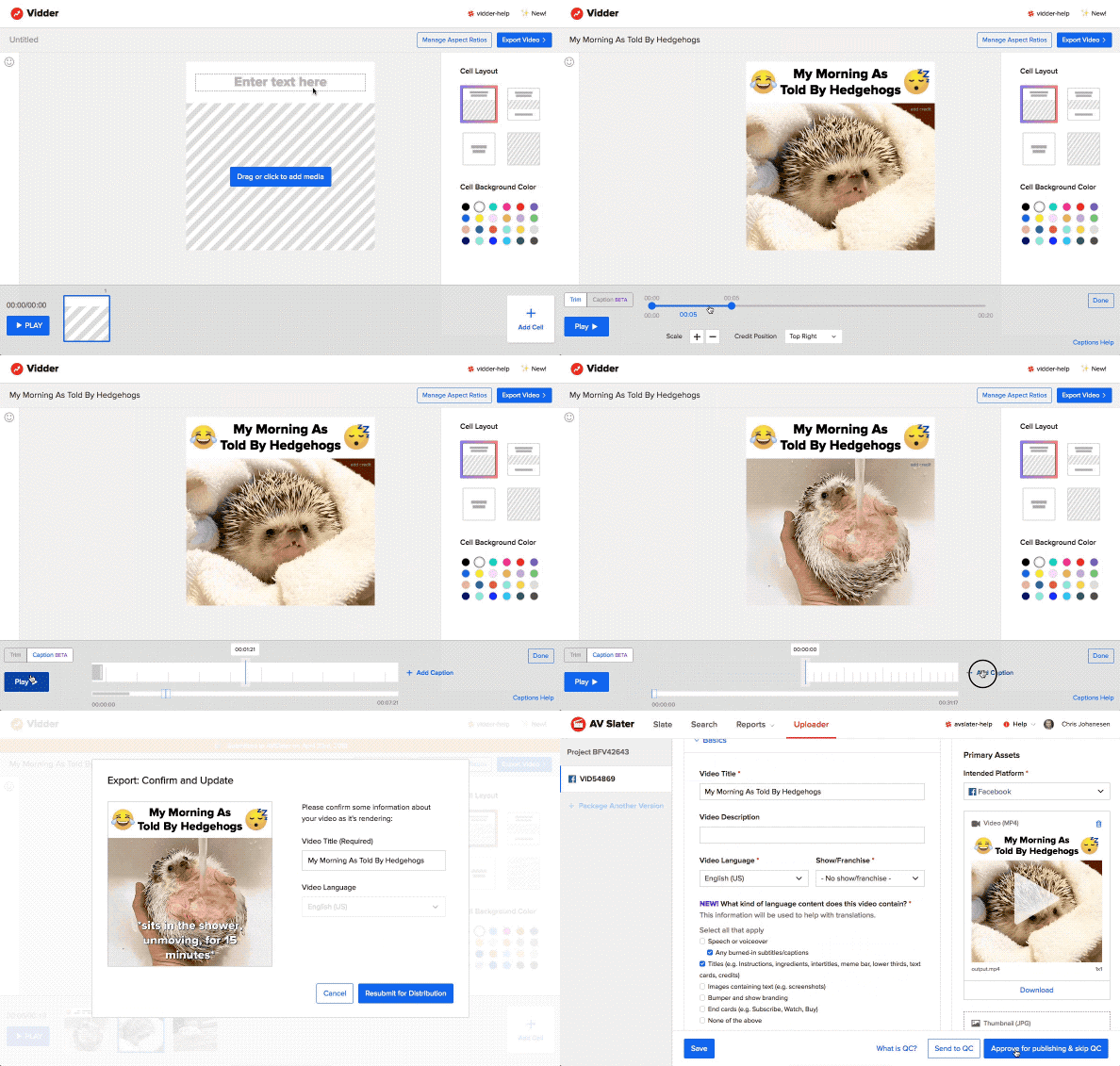
We moved even faster when the Vidder team demonstrated the product for me last week. We started with a basic template, then customized it by uploading one or two video clips, typing in captions and subtitles, adding emojis, and we had a perfectly serviceable video ready to go in just a few minutes.

The experience had very little in common with the hours I’ve spent fiddling with timelines in FinalCut. It also benefits from being entirely web-based, with no software download needed.

The key to Vidder is simplicity. As Product Manager Chris Johanesen put it, “We’re not trying to recreate Adobe Premiere.” There are teams at BuzzFeed creating more in-depth, highly produced videos, and Vidder isn’t built for them. Instead, it might be used by an editor like Yandoli who wants to quickly translate a regular BuzzFeed post into a video for Facebook or Instagram.

“There was a really big boom with Facebook videos around pop culture, animals, babies and stuff,” Yandoli recalled. “People on my team were interested in creating videos, but everyone couldn’t download Premiere. We were yearning to just find an accessible tool so that we could create things for our social platforms.”

Vidder

And while you might think that Vidder has become less relevant with recent Facebook algorithm changes, Johanesen said the tool allows BuzzFeed to continue experimenting.

“Ever since the big Facebook algorithm changes that happened, our social strategy is less about longer videos and more about making things that will engage communities and conversations,” Johanesen said. “Vidder has helped teams move a little bit faster than might have been possible with other tools. I don’t know that we’ve cracked it, but it’s helping us make progress.”

BuzzFeed is also using Vidder to adapt videos for different platforms, like creating a shorter video for Instagram or compiling several short videos into a longer cut for YouTube. The tool is also being used by international teams who might quickly create a localized version when they see that a BuzzFeed U.S. video is doing well. In fact, BuzzFeed says one international editor was able to “clone” eight Vidder videos in an hour.

Usage is spreading beyond social media teams, with the sales team potentially using it to create “BuzzCuts” for advertisers.  And of course Johanesen and his team are going to continue working on the product — for example, they have plans connect it to a library of licensed content.