Year: 2018

27 Apr 2018

DocuSign CEO: ‘we’re becoming a verb,’ company up 37% following public debut

DocuSign CEO Dan Springer was all smiles at the Nasdaq on Friday, following the company’s public debut.

And he had a lot to be happy about. After pricing the IPO at a better-than-expected $29, the company raised $629 million. Then DocuSign finished its first day of trading at $39.73, up 37% in its debut.

Springer, who took over DocuSign just last year, spoke with TechCrunch in a video interview about the direction of the company. “We’ve figured out a way to help businesses really transform the way they operate,” he said about document-signing business. The goal is to “make their life more simple.”

But when asked about the competitive landscape which includes Adobe Sign and HelloSign, Springer was confident that DocuSign is well-positioned to remain the market leader. “We’re becoming a verb,” he said. Springer believes that DocuSign has convinced large enterprises that it is the most secure platform.

Yet the IPO was a long-time coming. The company was formed in 2003 and raised over $500 million over the years from Sigma Partners, Ignition Partners, Frazier Technology Partners, Bain Capital Ventures and Kleiner Perkins, amongst others. It is not uncommon for a venture-backed company to take a decade to go public, but 15 years is atypical, for those that ever reach this coveted milestone.

Dell Technologies Capital president Scott Darling, who sits on the board of DocuSign, said that now was the time to go public because he believes the company “is well positioned to continue aggressively pursuing the $25 billion e-signature market and further revolutionizing how business agreements are handled in the digital age.”

Sales are growing, but it is not yet profitable. DocuSign brought in $518.5 million in revenue for its fiscal year ending in 2018. This is an increase from $381.5 million last year and $250.5 million the year before. Losses for this year were $52.3 million, reduced from $115.4 million last year and, $122.6 million for 2016.

Springer says DocuSign won’t be in the red for much longer. The company is “on that fantastic path to GAAP profitability.” He believes that international expansion is a big opportunity for growth.

27 Apr 2018

Apple is reportedly building an insane ’16K’ VR headset

Apple has long been rumored to be working on a pair of augmented reality glasses, but a report today suggests that they’re looking to compete with Google, Microsoft and Facebook in the virtual reality space as well.

CNET reports that Apple has its eye set on the 2020 release of a wireless headset that combines AR and VR technologies. The report also gives specific details for the project internally referred to as T288. Namely, sources told CNET that the headset will have an 8K display for each eye and will connect wirelessly to a dedicated “box.”

Vrvana’s Totem headset

A lot of the general assumptions many in the market had been operating under was that Apple might “skip” entertainment-focused VR altogether in favor of approaching the lifestyle-focused AR technologies that put a digital layer between users and the real world.

I’m fairly skeptical that they would combine these two initiatives as this report suggests, I find it more likely that the “AR” described to CNET is closer to the “mixed reality” technologies that Microsoft has implemented into its VR headsets, basically tech that can take in more environmental information to influence the in-headset VR experience. This is in line with what Vrvana was working on before Apple acquired them last year. For Apple to truly merge AR and VR at the resolutions detailed, they would likely need a fairly bulky design that I would be surprised to see them pursue with an AR product.

The technologies that allow for 8k images per eye would likely have to be microLEDs and, at that resolution, they’d be prohibitively expensive right now and almost mind-bogglingly power-hungry. Even testing twin 8K displays currently would take multiple high-end GPUs tethered together. The report suggests that this would be a wireless and connect to an external system running an Apple-designed chip. Streaming dual 8K feeds wirelessly would also undoubtedly pose a daunting challenge though rendering technologies enabled by eye-tracking could reduce the streaming load considerably.

Magic Leap’s lightwear

Two years is far away so perhaps Apple is banking on their own ability to minimize costs on the display-front here. Bloomberg recently reported that the Cupertino company has opened a secret manufacturing facility for the display type which have a keen use case in head-mounted displays where tight pixel densities matter more due to the lenses as well as the physical distance from your eyes.

The report states that this device is slated for 2020, though things could of course change in the meantime.

VR seems to be continuing to improve at a steady pace, and while the hype powering its initial boom has largely died off, the tech giants that can afford to nurture the industry have continued to do so. Facebook’s efforts with Oculus have become quite polished in some regards (though there are still plenty of limitations to speak of), and it appears that Apple is recognizing that there’s too much to lose out on if things take off.

27 Apr 2018

Facebook shrinks fake news after warnings backfire

Tell someone not to do something and sometimes they just want to do it more. That’s what happened when Facebook put red flags on debunked fake news. Users who wanted to believe the false stories had their fevers ignited and they actually shared the hoaxes more. That led Facebook to ditch the incendiary red flags in favor of showing Related Articles with more level-headed perspectives from trusted news sources.

But now it’s got two more tactics to reduce the spread of misinformation, which Facebook detailed at its Fighting Abuse @Scale event in San Francisco. Facebook’s director of News Feed integrity Michael McNally and data scientist Lauren Bose held a talk discussing all the ways it intervenes. The company is trying to walk a fine line between censorship and sensibility.

These red warning labels actually backfired and made some users more likely to share, so Facebook switched to showing Related Articles

First, rather than call more attention to fake news, Facebook wants to make it easier to miss these stories while scrolling. When Facebook’s third-party fact-checkers verify an article is inaccurate, Facebook will shrink the size of the link post in the News Feed. “We reduce the visual prominence of feed stories that are fact-checked false,” a Facebook spokesperson confirmed to me.

As you can see below in the image on the left, confirmed-to-be-false news stories on mobile show up with their headline and image rolled into a single smaller row of space. Below, a Related Articles box shows “Fact-Checker”-labeled stories debunking the original link. Meanwhile on the right, a real news article’s image appears about 10 times larger, and its headline gets its own space.


Second, Facebook is now using machine learning to look at newly published articles and scan them for signs of falsehood. Combined with other signals like user reports, Facebook can use high falsehood prediction scores from the machine learning systems to prioritize articles in its queue for fact-checkers. That way, the fact-checkers can spend their time reviewing articles that are already qualified to probably be wrong.

“We use machine learning to help predict things that might be more likely to be false news, to help prioritize material we send to fact-checkers (given the large volume of potential material),” a spokesperson from Facebook confirmed. The social network now works with 20 fact-checkers in several countries around the world, but it’s still trying to find more to partner with. In the meantime, the machine learning will ensure their time is used efficiently.

Bose and McNally also walked the audience through Facebook’s “ecosystem” approach that fights fake news at every step of its development:

  • Account Creation – If accounts are created using fake identities or networks of bad actors, they’re removed.
  • Asset Creation – Facebook looks for similarities to shut down clusters of fraudulently created Pages and inhibit the domains they’re connected to.
  • Ad Policies – Malicious Pages and domains that exhibit signatures of wrong use lose the ability to buy or host ads, which deters them from growing their audience or monetizing it.
  • False Content Creation – Facebook applies machine learning to text and images to find patterns that indicate risk.
  • Distribution – To limit the spread of false news, Facebook works with fact-checkers. If they debunk an article, its size shrinks, Related Articles are appended and Facebook downranks the stories in News Feed.

Together, by chipping away at each phase, Facebook says it can reduce the spread of a false news story by 80 percent. Facebook needs to prove it has a handle on false news before more big elections in the U.S. and around the world arrive. There’s a lot of work to do, but Facebook has committed to hiring enough engineers and content moderators to attack the problem. And with conferences like Fighting Abuse @Scale, it can share its best practices with other tech companies so Silicon Valley can put up a united front against election interference.

27 Apr 2018

DNA analysis site that led to the Golden State Killer issues a privacy warning to users

As more details emerge about the arrest of the man suspected to be the Golden State Killer, it’s clear that one of the most infamous unsolved cases of all time was cracked using a popular free online genealogy database.

The site, known as GEDmatch, is a popular resource for people who have obtained their own DNA through readily available consumer testing services and want to fill in missing portions of their family tree to conduct further analyses. Compared to a polished service like 23andMe, GEDmatch is an open platform lacking the same privacy and legal restrictions that govern user data on more mainstream platforms.

To home in on their suspect, investigators used an intact DNA sample taken at the time of a 1980 Ventura County murder linked to the serial killer. The team uploaded data from the sample into GEDmatch and were able to identify distant relatives of the suspect — a critical breakthrough that soon led to the arrest of Joseph James DeAngelo, 72.

Given the high-stakes nature of DNA data and the popularity of voluntary online DNA databases, the case immediately raised a number of flags for data privacy advocates.

On Friday, GEDmatch confirmed on its landing page for logged-in users that law enforcement sifted through its DNA database in the case:

To correct a BIG misunderstanding, we do not show any person’s DNA on GEDmatch. We only show manipulations of data such as DNA [matches].

We understand that the GEDmatch database was used to help identify the Golden State Killer. Although we were not approached by law enforcement or anyone else about this case or about the DNA, it has always been GEDmatch’s policy to inform users that the database could be used for other uses, as set forth in the Site Policy

While the database was created for genealogical research, it is important that GEDmatch participants understand the possible uses of their DNA, including identification of relatives that have committed crimes or were victims of crimes.

If you are concerned about non-genealogical uses of your DNA, you should not upload your DNA to the database and/or you should remove DNA that has already been uploaded. To delete your registration contact gedmatch@gmail.com.

Though an initial misunderstanding raised suspicion that law enforcement used a major player in consumer genetic testing like 23andMe or Ancestry DNA in the Golden State Killer development, investigators instead leveraged another voluntary DNA database with no such hoops to jump through. Both 23andMe and Ancestry require law enforcement to create a legal request in the form of a search warrant or a court order before accessing any specific genetic or personal information.

23andMe explains its policies toward forensics in a special page dedicated to its relationship with law enforcement:

Use of the 23andMe Personal Genetic Service for casework and other criminal investigations falls outside the scope of our services intended use.

Therefore, it is a violation of our TOS for law enforcement officials to submit samples on behalf of a prisoner or someone in state custody who has been charged with a crime.

While the revelation that investigators have apprehended a suspect in the long-cold case is good news, the incident is reigniting justifiable concerns around consumer DNA testing.

In an interview with The New York Times, Paul Holes, the Contra Costa county investigator who helped crack the case, marveled at the power of GEDmatch. “I was blown away with what it could do,” Holes said.

27 Apr 2018

This soft robotic arm is straight out of Big Hero 6 (it’s even from Disney)

The charming robot at the heart of Disney’s Big Hero 6, Baymax, isn’t exactly realistic, but its puffy bod is an (admittedly aspirational) example of the growing field of soft robotics. And now Disney itself has produced a soft robot arm that seems like it could be a prototype from the movie.

Created by Disney Research roboticists, the arm seems clearly inspired by Baymax, from the overstuffed style and delicate sausage fingers to the internal projector that can show status or information to nearby people.

“Where physical human-robot interaction is expected, robots should be compliant and reactive to avoid human injury and hardware damage,” the researchers write in the paper describing the system. “Our goal is the realization of a robot arm and hand system which can physically interact with humans and gently manipulate objects.”

The mechanical parts of the arm are ordinary enough — it has an elbow and wrist and can move around the way many other robot arms do, using the same servos and such.

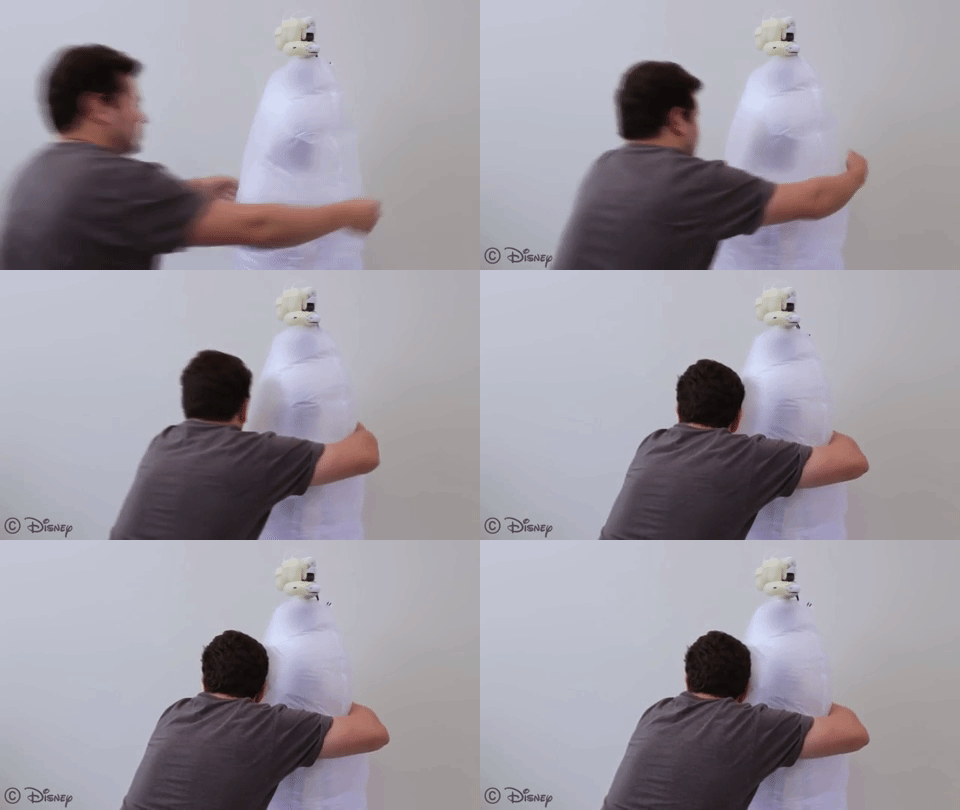
But around the joints are what look like big pillows, which the researchers call “force sensing modules.” They’re filled with air and can detect pressure on them. This has the dual effect of protecting the servos from humans and vice versa, while also allowing natural tactile interactions.

“Distributing individual modules over the various links of a robot provides contact force sensing over a large area of the robot and allows for the implementation of spatially aware, engaging physical human-robot interactions,” they write. “The independent sensing areas also allow a human to communicate with the robot or guide its motions through touch.”

Like hugging, as one of the researchers demonstrates:

Presumably in this case the robot (also presuming the rest of the robot) would understand that it is being hugged, and reciprocate or otherwise respond.

The fingers are also soft and filled with air; they’re created in a 3D printer that can lay down both rigid and flexible materials. Pressure sensors within each inflatable finger let the robot know whether, for example, one fingertip is pressing too hard or bearing all the weight, signaling it to adjust its grip.

This is still very much a prototype; the sensors can’t detect the direction of a force yet, and the materials and construction aren’t airtight by design, meaning they have to be continuously pumped full. But it still shows what they want it to show: that a traditional “hard” robot can be retrofitted into a soft one with a bit of ingenuity. We’re still a long way from Baymax, but it’s a more science than fiction now.

27 Apr 2018

T-Mobile is reportedly much closer to a merger deal with Sprint

It looks like a potential merger deal between T-Mobile and Sprint, two of the major telecom companies in the U.S., is getting closer and now has set valuation terms, according to a report by Bloomberg.

The deal could be announced as soon as Sunday, according to a report by CNBC. The proposed tie-up of the two companies was called off in November last year, but now that deal appears to be coming closer, with T-Mobile’s backer valuing Sprint at around $24 billion, according to Bloomberg. As part of the deal, Deutsche Telekom AG will get a 69% voting interest on a 42% stake in the company, according to that report. (Both reports, however, disagree on the valuation — with CNBC citing a $26 billion valuation.)

This deal seems to have been a long time coming, and consolidates two of the four major telecom providers in the U.S. into one larger entity. That could, in theory, offer it some more flexibility as they expand into 5G networks. Still, a deal of this scale could still fall apart and would be subject to regulation — with significant international ownership of both companies (Softbank for Sprint, and Deutsche Telekom for T-Mobile).

Sprint shares fell more than 8% in extended trading to under $6, while T-Mobile shares were largely unchanged. Shares of Sprint were up around 8% on the day up to $6.50 in early trading.

A representative from Sprint declined to comment. A representative from T-Mobile did not immediately respond to a request for comment.

27 Apr 2018

Essential’s first handset is coming to more markets

It’s hard launching a phone company — something Essential was pretty candid about from the start. Andy Rubin’s latest endeavor got off to something of a slow start, according to outside accounts, but today the well-funded hardware startup is getting ready to add a whole bunch of new markets to its online store.

On Twitter today, the company announced a handful of key additions to its coverage map, including Canada, France, Japan and the U.K. As Engadget notes, availability in some of those markets already exists, but not through the company’s own shop, most notably Canada, where users can pick up the handset via Amazon or Telus.

There are also some country-specific caveats here. Those can be found through the company’s Terms of Service, which notes that the handset is now also available in Germany.

It’s been a slow roll out for the company, but understandably so. It’s not easy starting this kind of endeavor from scratch, even with the $300 million in funding the company managed to drum up. Essential spent its first year primarily focused on its home market, delivering Amazon and Best Buy availability, along with a Sprint deal.

Building distribution channels this time out should ease some of the burden of launching when the time comes to deliver version 2.0.

27 Apr 2018

Why the tech industry should care about the farm bill, which is being drafted right now

For some food stamp recipients, 2018 could shape up to be a particularly aggravating year, including for one of the only startups trying to find ways to innovate on the ways that food stamps are delivered and managed.

It’s not something that’s talked about much in tech circles, but perhaps it should be, given that 42 million Americans rely on the more than 50-year-old, anti-hunger program behind the stamps — called the Supplemental Nutrition Assistance Program, or SNAP — for basic food assistance.

What’s the problem? It’s twofold essentially. First, let’s take a look at the farm bill, which subsidizes SNAP.

The farm bill, which got its start in 1933 as part of FDR’s New Deal legislation, expires and is updated and passed anew by Congress every five years, after which the sitting U.S. president signs it into law. The last bill was signed in February of 2014, so Congress is working on the next version now. But things aren’t looking very promising for SNAP recipients. Already, the first draft of the House Republicans’ farm bill, which passed through one committee, looks to cut $20 billion from the program over the next 10 years, potentially cutting off two million people in the process.

The cuts will be debated on the House floor beginning early next month, meaning it’s far from clear what happens from here. While Republicans argue they want to promote self-sufficiency (the cuts are expected to come via tightened work requirements), poverty experts see the proposal as chipping away at the already shrinking safety net for America’s most vulnerable. As an article about the bill in Vox notes, half of the 42 million people who are living below the poverty line and relying on SNAP for food assistance are children.

By now you might be wondering what startups have to do with any of this. Stick with us.

Propel, a four-year-old, Brooklyn-based company, makes software for low-income individuals. Its founder, Jimmy Chen, is a former Facebook manager who knows about need; he receive a full scholarship to Stanford based on it. (Chen’s family came to the U.S. from China was he was four.)

Propel is a for-profit enterprise. It has raised $5.2 million in outside funding, including from Andreessen Horowitz, the Omidyar Network, and the Center for Financial Services Innovation. It makes money through marketing. For example, though its app primarily helps food stamp recipients check their balances (something they’ve historically had to keep track of themselves or by calling an 800 number), Propel’s features also include coupons and notices about job opportunities, and it receives referrals fees from both food companies and employers for these services.

Still, the 11-person outfit remains rare in its focus on improving a public sector service, which is perhaps why more than 1 million people — or roughly 5 percent of SNAP participants — now actively use its technology. Indeed, the company’s app, which also enables users to create shopping lists (which helps with their budgeting), has grown its user base fourfold over the last eight months alone, largely via families telling other families.

Alas, Propel is newly in the crosshairs of a much bigger company that worries Propel is encroaching on its territory. Big government contractor Conduent — which runs the food stamp networks in roughly of all U.S. states — and which manages the database that Propel’s app relies on to help people check their accounts, keeps finding ways to cut off Propel’s access. It’s hamstringing Propel’s users in the process, some recently told the New York Times. (One young mother of two sons said she lost access to the time-saving app for a month.)

Conduent says it’s just protecting itself. In emailed replies to questions from the Times, Conduent said that Propel’s smartphone was launched “without the knowledge, input or consent from Conduent.” It further accused Propel of creating a “capacity ambush,” owing to its data requests. It said its measures were aimed to preventing the “unauthorized access to data — from Propel or any other unauthorized user.”

Chen calls it a misunderstanding. “We saw an opportunity for [the food stamp program] to be part of a modern financial product, to create digital tools that can reduce the stigma of poverty that people were experiencing at the cash register,” including by “creating a plastic card that they just swipe at the register” — like the rest of us.

Propel has taken a “fairly conservative approach to data” he adds. Because Propel is dealing with highly sensitive information, it doesn’t run data in the background of anyone’s phone, retrieving information only when someone opens the app, which he says users do seven times a month, on average.

Most important, says Chen, Propel isn’t trying to replace Conduent or any of a small number of other electronic benefit transfer (EBT) processors that make money via contracts with states. “We’re a direct-to-consumer software play that makes no money from the government and is not looking to [secure] government contracts. Instead of trying to displace them, we’re trying to work with them, and we think we can do it in a way that’s productive for all parties.”

Which takes us back to that farm bill.

If Conduent can’t be persuaded to see Propel’s side of the story, the startup — and others trying to help low-income Americans — may have no recourse, not unless Congress helps them. In fact, part of why the farm bill is reauthorized on a regular basis owes to changes in modern tech.

While lawmakers fight to see how much of its budget they can cut, they might take into consideration stories like Propel’s, too. Maybe they think a government contractor should be able to stamp out a company like Propel. We hope they do not. If they want to see more startups innovate on behalf of low-income Americans, they need to protect the companies doing the innovating.


27 Apr 2018

Here’s how SF wants to regulate electric scooters

The San Francisco Municipal Transportation Agency is gearing up to present its proposal for electric scooter permitting. This comes after the SF Board of Supervisors approved an ordinance for the SFMTA to create a permitting process to better regulate the plethora of electric scooters from Bird, Lime and Spin.

The SFMTA’s proposal lays out a 24-month pilot program, which would grant up to five permits and 500 scooters per permit. As part of the program, electric scooter companies would need to provide user education and insurance, share its detailed trip data with the city, have a privacy policy that protects user data, offer a low-income plan and operate in a to-be-approved service area.

That means the city would allow no more than 2,500 electric scooters on the streets at any one time. In order to receive a permit, each company would need to first pay an application fee of $5,000 and show how they would ensure safe use and proper storage of scooters.

“The SFMTA supports innovative solutions that have the potential to complement our existing transportation network,” the proposal states. “Powered Scooter Share Programs introduce a new transportation option that may be convenient for users making short trips or as a “last mile” solution when paired with public transit. Furthermore, if Powered Scooter Share users replace trips they would otherwise have taken by automobile, they have the potential to reduce traffic congestion, parking demand, and carbon emissions. SFMTA staff have received numerous emails from Powered Scooter Share Program users expressing their support for these programs.”

The SFMTA’s proposal also describes how the city has received numerous complaints from residents pertaining to electric scooters. The complaints cover improper parking that blocks sidewalks and access to doors, as well as someone tripping over a scooter that was left on a sidewalk.

“This is of particular concern to members of the public who travel in a wheelchair or who have visual impairments, and have greater difficulty seeing and avoiding (or moving) Powered Scooter Share Scooters blocking their path,” the proposal states. “The SFMTA has been informed of one instance in which a person with a visual impairment fell after tripping on a scooter, as well as a report of a person breaking a toe after tripping on a Powered Scooter Share scooter.”

As of earlier this week, the San Francisco Department of Public Works had impounded 319 scooters, resulting in impoundment fees of $5,774 for Bird, Lime and Spin. As part of the proposed permitting process, companies would need to pay $10,000 for a “public property repair and maintenance endowment” in the event the city incurs additional costs due to the damaging of public property or needing to store improperly parked scooters.

The SFMTA Board of Directors is holding a public hearing next week to consider implementing this permit process.

27 Apr 2018

EcoFlow raises $4M from unconventional investors to grow its mobile power business

EcoFlow, a Chinese hardware firm developed by former JDI engineers that sells portable power stations, has pulled in a Series A round of over $4 million ahead of the imminent launch of new products and an international sales expansion.

The Shenzhen-based company has taken an interesting route. Founded in 2016, the startup burst on to the scene when it launched its River product in an Indiegogo campaign that pulled in $1 million. Today, River is available in the U.S. where it is sold via Home Depot, Camping World, Amazon, HSN and the EcoFlow website for $699 upwards.

That’s pretty impressive progress for a young company, and CEO and co-founder Eli Harris told TechCrunch in an interview that relationships with key partners are at the core of that. In particular, EcoFlow has raised strategic investment from supply chain partners rather than traditional VC and that is the case again. This new $4 million came courtesy of battery makers Guangzhou Penghui Energy and SCUD Group, industrial design tooling factory ESID, and supply chain-focused firms Delian Capital and Chunjia Assets.

Names that aren’t known in Silicon Valley, for sure, but the key is what they bring to the table.

“Our investors are almost entirely vertically integrated with every component in our supply chain,” Harris said. “That gives us access to these top-tier manufacturers that no startups could enjoy and help us get direct access to vendors at large companies.”

Aside from reaching quality components and getting a good price, relationships with these component makers help EcoFlow with its cash flow — always a challenge puzzle piece for hardware startups. Harris explained that the relationships allow his company to delay paying for components rather than having to pay upfront — before product is sold and revenue comes in — which optimizes the books and means the capital can be put to work on R&D, sales and marketing and more.

The River itself is touted as industry-leading portable power. Aside from an aesthetic nice design, the li-ion-based device has a total output of 500 watts, weighs just 11 pounds and features two quick-charge USB ports, two USB type C ports, two standard USB ports, two AC outlets, two DC outlets and one 12V car port.

Now EcoFlow is doubling down with plans to launch two new products before the end of this year. Harris isn’t providing specific details right now, but he said the company is looking to take advantage of its promising growth.

“We think we are around 18 months ahead of the market in terms of engineering capabilities. Most experienced battery players are going after electronic vehicles and industrial opportunities, while smaller players have issues getting to manufactures, talent and money to build portable energy solutions,” he said.

While $699 may make the product a luxury for some — despite a $100 discount right now — Harris said that the price is likely to decrease going forward as technology develops.

“Batteries are expensive products but we will see costs come down with the expansion of the EV market, so we’ll be trending in the right direction. But people who understand the tech don’t think it is an expensive product,” Harris explained.

“A lot of the tech we use now will be utilized in future products so that’ll mean lower development costs as we leverage existing IP. We’re also exploring using second life batteries since cells are one of the biggest expenses of the product,” he added.

Working with those battery makers that it also counts as investors could help on that second-life battery push, which could cut the costs to one-fourth of what EcoFlow pays now.

While tactically selected investors are a boon for many reasons, Harris admitted that they do require educating of the investor-investee relationship as it is unconventional in their space. But, he said, increasingly large component and manufacturing firms are keen to do startup investments to help get new ideas, open relationships in the U.S. and explore other new areas of focus.

“A lot of the manufacturing industry players have been stuck in that OEM wheelhouse and there’s more competition now. The previous models of just churning out product might not be sustainable, and margins are thinner,” he said.

Most immediately, EcoFlow is looking to expand sales beyond the U.S and Canada with plans to move into Europe later this year. It also plans to raise a “significant” funding round before 2018 is out as the two new products hit the market.