Year: 2018

27 Apr 2018

Facebook drops fundraising fees for personal causes

Despite Facebook being under fire for everything pertaining to Cambridge Analytica, the company still hopes to be able to do some good. Today, Facebook is dropping its platform fees pertaining to fundraisers for personal causes.

That means Facebook is getting rid of the 4.3 percent platform fee in the u.S. and the 6.2 percent fee in Canada. Those fees were charged to cover a review process for and vetting for each fundraiser. Now, Facebook says it will absorb the costs associated with those safety and protection measures.

“We’re continuously learning and this was something we wanted to do to help people maximize the benefits,” Facebook Head of Product for Social Good Asha Sharma told me over the phone.

To be clear, there will, however, still be fees for payment processing and taxes. In the U.S. and Canada, payment processing fees are 2.6 percent plus $0.30.Facebook is also unveiling two new features for its fundraising tool.

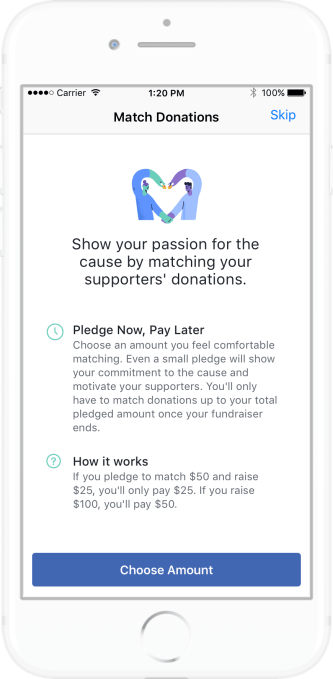
The first is the ability for people to match donations for non-profit fundraisers and the second is the expansion of categories for personal causes. Now, in addition to raising money for things like vet bills, personal emergencies and whatnot, people can also raise money for travel (community trips or for medical needs), family-related causes (adoption, etc), religious events and volunteer supplies.


Facebook isn’t yet sharing specific dollar amounts raised pertaining to fundraisers, but says its tool has helped over 750,000 non-profits collect donations. All Sharma would say about personal causes is that “we’re seeing activity across all of these categories, which is why we have them.”

27 Apr 2018

Nintendo is releasing a mobile RPG this summer

The maker of Shadowverse and Granblue Fantasy is teaming up with Nintendo for a new mobile RPG. Called Dragalia Lost, the Japanese-style action RPG will be a free-to-play game though likely loaded with Loot Box-style mechanics that will result in a financial windfall for Nintendo and developer Cygames.

The trailer doesn’t reveal many details about the game’s story. I assume from the title that someone called Dragalia is lost and a team of unlikely heros will have to fight monsters along their journey to find this Dragalia. I guess.

Nintendo turned to Cygames to make this new title instead of retooling Zelda or Xenoblade for the mobile screen. The game reportedly use Cygame’s system that randomly unlocks characters and upgrades. It’s like loot boxes but not called loot boxes. This is how the game will make money as players are encouraged to pay to buy more unlocks.

As part of the deal, Nintendo is acquiring 5-percent of Cygrames. Nintendo also has a stake in mobile phone platform maker DeNA, which also holds 25-percent of Cygrames showing how Nintendo is slowing spreading throughout the mobile game world.

27 Apr 2018

UK surveillance regime dealt another blow in court

The UK government has suffered yet another defeat in the courts over a surveillance regime that critics have dubbed a ‘Snooper’s charter’.

Today the UK High Court agreed with several aspects of digital and civil rights group Liberty’s crowdfunded legal challenge to a portion of the UK’s 2016 Investigatory Powers Act that gives the state the power to mandate that communications companies and service providers collect and retain web activity logs, comms metadata and location information on all their users for a full 12 months.

The provision for a blanket retention of citizens’ digital data — which can be accessed by a wide range of public bodies for all sorts of purposes — has always been controversial. Though the government contends that retention is necessary for law enforcement and national security purposes.

Liberty’s challenge to this section of the IP Act included the fact the retained metadata could be accessed by dozens of public bodies without independent authorization by a court of independent agency; that the bar for accessing the data was merely “crime-fighting” rather than for “serious crime”; and also that the data could be accessed — using other powers in the IP Act — for various non-crime purposes, including collecting taxes and fines; and for regulating financial services.

Ministers have been given until November 1 to amend the aspects of the legislation that have been judged unlawful by the High Court — which means the government will need to change the law to require prior review by a court or independent administrative body to access the data; and — in the context of crime-fighting — to only allow access for purposes related to combatting “serious crime”.

The court did not affirm one of Liberty’s other contentions, however — declining to find that Part 4 was unlawful on the grounds that it constituted “general and indiscriminate” retention of data. (Though EU jurisprudence would likely have reached a different conclusion.)

The Home Office has seized on that aspect of the ruling in its response statement — writing that “the Court found that our current data retention regime is neither general nor indiscriminate”, and quoting from a portion of the judgement where the judges say: “We do not think it could possibly be said that the legislation requires, or even permits, a general and indiscriminate retention of communications data.”

“We have already committed to bring forward amendments to our regime for Parliament to debate and vote on, along with the communications data code of practice, and will do so in line with the Court’s timetable,” the Home Office adds, confirming it will comply with the court’s timeline for reworking the legislation.

Liberty said it asked the High Court to refer questions of EU law to Europe’s top court – including the question of whether EU privacy laws apply to retention orders issued for national security purposes and whether retained data must be kept within the EU so it can be protected by EU privacy and data protection rules. But says the Court did not refer those questions because they are already set to be decided in another case pending before the CJEU.

Commenting in a statement, Martha Spurrier, director of Liberty, said: “Police and security agencies need tools to tackle serious crime in the digital age — but creating the most intrusive surveillance regime of any democracy in the world is unlawful, unnecessary and ineffective.

“Spying on everyone’s internet histories and email, text and phone records with no suspicion of serious criminal activity and no basic protections for our rights undermines everything that’s central to our democracy and freedom — our privacy, free press, free speech, protest rights, protections for journalists’ sources and whistleblowers, and legal and patient confidentiality. It also puts our most sensitive personal information at huge risk from criminal hackers and foreign spies.”

It’s unclear whether the government or any public bodies have actually made use of the powers since the law was passed at the end of 2016. A European Court of Justice (CJEU) ruling in December of the same year — asserting that general and indiscriminate retention of comms data is illegal — clearly dealt a major blow to its ambitions for the freshly inked legislation.

Since then the government has been trying to come up with amendment proposals to plaster over the unlawful cracks in its surveillance regime.

Liberty says the government had also conceded, prior to today’s ruling, that non-crime portions of part 4 of the IP Act contained the same flaws it’s been proposing to amend elsewhere but that it asked the court to be given a further year to keep applying it — a request the judges denied, granting half a year instead.

At the start of this year the UK Appeals Court demolished the IP Act’s predecessor — 2014’s DRIPA, which was the ’emergency’ surveillance stop-gap the government put in place to give it time to draft the full Snooper’s charter — judging that DRIPA’s bulk collection and retention of citizens’ Internet activity and phone records had been unlawful.

There’s some pretty clear legal guidance here, certainly in EU courts, yet the majority of UK politicians on both sides of the bench appear unable to see it.

Albeit, at least where ministers are concerned, the government’s M.O. looks very much like an attempt to try to legislate as close to the limit of the law as the courts will subsequently allow, leaving the taxpayer and the rights concerned public to foot the legal bills.

Liberty is launching the second phase of its crowdfunding campaign today to finance the next round of its legal fight against other portions of the sweeping surveillance powers — including challenging bulk hacking powers; bulk interceptions of communications data; and the linking of personal data via massive ‘bulk personal datasets’.

“The Court has done what the government failed to do and protected these vital values — but today’s ruling focuses on just one part of a law that is rotten to the core,” added Spurrier. “It still lets the state hack our computers, tablets and phones, hoover up information about who we speak to, where we go, and what we look at online, and collect profiles of individual people even without any suspicion of criminality. Liberty’s challenge to these powers will continue.”

This report was updated after the Home Office sent us their response

27 Apr 2018

Here’s when Ford will stop making most of its cars

Over coming years Ford intends to stop selling most of its cars in North America. This plan would leave just the Mustang and upcoming Focus Active as the only traditional car it sells while crossovers, SUVs and trucks make up the rest of its lineup. The news was abruptly revealed in Ford’s latest quarterly financial release and left many questions and here’s the answer to at least one of them.

The Focus, Taurus and Fiesta will be the first to go. Ford will end production on the Focus in May 2018, the Taurus in March 2019 and the Fiesta in May 2019. The mid-size Fusion will stick around a bit longer.

As for the upcoming Focus Active, as of right now, the vehicle will be assembled in China and imported to the United States.

Ford’s CEO laid out a cost reduction plan in late 2017. This plan calls for Ford to cut operating costs by $14 billion. The culling of sedans and small cars saves Ford around $5 billion.

“We’re going to feed the healthy parts of our business and deal decisively with the areas that destroy value,” Hackett said. “It’s been easy to identify what’s wrong and what we need to do about it. The hand-wringing maybe that has been around in our business is gone. We’re starting to understand what we need to do and making clear decisions there.”

The company’s financials are seemingly improving, too. Revenue increased 7 percent to $42 billion over 2017 levels with Ford making $1.7 billion in the first quarter of 2018, an increase of 9 percent.

“Everything is on the table,” said Bob Shanks, Ford chief financial officer. “We can exit products [and] markets. We will do that. That work has really gained traction. We have looked at every single part of the business. It’s a very complex endeavor. We are determined to turn this business around right throughout the whole company. There’s more work that’s underway.”

It’s likely jobs will be lost from the reduction of cars but most production lines will also be retooled for new vehicles. Ford is going all in on crossovers and SUVs, which will have to be built somewhere.

27 Apr 2018

Equity podcast: Everyone beats earnings, racing to $1 trillion and Square goes shopping

Hello and welcome back to Equity, TechCrunch’s venture capital-focused podcast where we unpack the numbers behind the headlines.

Today Katie Roof and I were joined by James Hardiman, a partner at Data Collective (DCVC). If you want to tell him how he did, he’s on Twitter here.

It was good to have Hardiman on board as there was an ocean of news to swim through. Indeed, we are in the middle of earnings season, companies can’t stop from buying one another and the IPO window is stuck wide open.

So we decided to just do everything. Here’s how it broke down.

Earnings

Facebook’s earnings had two purposes. First, the company showed the world that its run of financial feats is not at an end. The company beat on top and bottom lines and kept growing around the world. That second result is our second point: The company is not taking material slings and arrows — at least in terms of lost users — from its recent privacy scandals.

Staying on the social side of tech, Twitter’s earnings were strong as well. The company also beat on top and bottom lines, turning in GAAP profit and some modest user growth. For Twitter, which has spent much of its time as a public company in the public penalty box, has seen its share price more than double from lows.

And then a few more of the big three, which we tried to hit quickly:

It’s a lot of numbers. But now at least you know.

$1 trillion?

All the above sums to an interesting question regarding value. Those companies we just touched on (with the exception of Twitter) are in the running to be the company that first reaches an inflation-unadjusted market cap of $1 trillion.

Which might be the first to make the grade? We had some ideas.

Square-Weebly

Next up we tackled the Square-Weebly deal, in which the public payments company bought the private website-builder corp for hundreds of millions of dollars. The downside is that the company was worth more than $100 million more the last time the private markets valued it.

But, exactly who won out isn’t clear, and it’s not hard to see why VCs made the bet. There are two Weebly competitors in the Unicorn Club!

IPOs

And finally, the thing nearest and dearest to our hearts: public offerings.

This week Ceridian went public, shooting 42 percent higher in its first day of trading. That’s good. But, as we discuss, the total deal might not be super hot for the company’s owners.

(Note: Never feel bad for private equity.)

All that and DocuSign and Smartsheet are probably trading by the time you read this.

Stay cool!

Equity drops every Friday at 6:00 am PT, so subscribe to us on Apple PodcastsOvercast, Pocket Casts, Downcast and all the casts.

27 Apr 2018

France’s BlaBlaCar acquires carpool startup Less in ongoing ridesharing consolidation

The ongoing trend of consolidation in the world of ridesharing continues apace, with the latest development coming out of Europe. BlaBlaCar, the French carpooling platform, is acquiring Less, a young carpooling platform based in Paris and focusing only on urban rides, paying drivers on a per-kilometer rate to incentivize them.

The financial terms are not being disclosed but BlaBlaCar is picking up all of the company’s assets — it mentions skills and IP in app creation and distribution, big data analytics and in-car embedded systems — and employees (around 20 in all).

Less was less than mature. Co-founded by the founder of adtech firm Criteo, Jean-Baptiste Rudelle, it had launched a beta of its service only five months ago, in December 2017 (and it was founded about 18 months ago altogether).

Two salient facts of the ride-sharing industry are that it’s generally a very capital-intensive business — market leader Uber has raised $21 billion, for context — and it is built on economies of scale, and those two forces have been leading to a lot of movement, with the bigger fish snapping up the more promising of the smaller fish, and many more startups going belly up. Less threw in the towel so quickly, in part, because it didn’t see itself able to hit the right growth targets to survive.

“Less is conscious of the challenges of creating a scalable marketplace in the mobility space, and anticipating consolidation within the market, the team wanted to combine its forces with an established industry player”, said Rudelle, the CEO of Less, in a statement to TechCrunch.

BlaBlaCar has made seven other acquisitions in its own efforts to position itself as a Big Fish, including its closest competitor, Carpooling.

Less is not disclosing how many users it had, but BlaBlaCar itself now has around 60 million users in 22 countries.

BlaBlaCar has raised about $335 million in funding to date from investors that include Accel and Insight Venture Partners; and it was last valued at $1.6 billion when it raised $200 million back in 2015 (when it had only 20 million users). Less had raised $19 million from investors that included Index Ventures (who had also been one of Criteo’s early and consistent backers).

What the acquisition of Less will do potentially is help BlaBlaCar build out its short-distance urban mobility play. The bigger company got its start originally by focusing on long-distance rides, although last year it expanded into city rides with BlaBlaLines.

BlaBlaLines has been building out its service with riders paying drivers directly, in cash, while Less’s model is based on a per-kilometer fee — currently €0.10/km — in the city of Paris, the only place Less had launched. It’s reasonable to expect that one outcome of this deal will be BlaBlaLines taking on a similar pricing model.

“We are delighted to welcome an innovative and talented team that is just as passionate about carpooling as we are,” said Nicolas Brusson, co-founder and CEO of BlaBlaCar, in a statement. “Today’s acquisition takes place at a period of real innovation at BlaBlaCar, following the roll-out of BlaBlaLines across France, and the development of a new algorithm that increases the granularity of our long-distance service.”

27 Apr 2018

Bangladesh’s version of Go-Jek raises over $10M in a round led by Go-Jek

$4.5 billion-valued ride-sharing startup Go-Jek may be busy in Southeast Asia, where it is aiming to step into the gap following Uber’s exit, but that isn’t stopping it from looking at opportunities elsewhere in the world.

Over in Bangladesh, motorbike-taxi hailing service Pathao has announced that it raised a “pre-Series A” investment led by Go-Jek. The Indonesian firm first invested in Pathao last year, and it is leading this new deal which includes participation from existing backers Openspace Ventures — which just rebranded from NSI Ventures and is an early Go-Jek backer — Osiris Group and Battery Road Digital Holdings.

The round is undisclosed, but TechCrunch understands from a source that it is more than $10 million. The startup did confirm that its valuation is over $100 million.

CEO Hussain Elius told TechCrunch in an interview that Pathao plans to use the capital to expand to new cities, and continue to build out additional services. The company began offering motorbike taxis on-demand and a logistics service, and it branched out into food delivery this year. Now, Elius said, it is developing a mobile wallet app that he hopes can encourage adoption of digital payments among Bangladesh’s population of over 160 million. That could unlock the door for a move into other verticals in the future.

When you look at the ride-hailing space and the way that companies have used investment to grow their reach — in particular China Didi’s which has invested companies in the U.S., Latin America, India, Europe, the Middle East and Southeast Asia — it’s inevitable to think that Go-Jek’s investment might lead to future opportunities for the company to expand into South Asia.

Not so, says Elius.

“Go-Jek is an inspiration, [but] we are an independent business and not Go-Jek. [Our] market is very different; there are certain things we are doing which they are not. For example, bike financing is something we are exploring.

“They help us learning, but we don’t share any tech; that’s built in-house,” he added with some pride.

Pathao has plenty in common with Go-Jek. The company began in 2015 initially as a courier service latching on to the growth in e-commerce. It expanded to bike taxis — which was seen as a risk, since they aren’t as popular as in places like Indonesia, Thailand and Vietnam — and then into cars last year. The move appears to be paying off. Today Pathao claims 50,000 bikes and a team of 500 employees who cover its 22 cities. It said it handles a million rides and “over hundred thousand deliveries” each month.

Elius said the firm plans to broaden its coverage of Bangladesh and also look to expand into neighboring countries soon, although he isn’t giving away details at this point. One thing for sure is that they will avoid markets where Go-Jek is present, he said. That seems like a smart strategy.

27 Apr 2018

Maverick, a social network for young women, launches with $2.7M in funding

While Bumble BFF and Hey! Vina help adult women find new friends, there isn’t a social network dedicated to young women.

But Brooke Chaffin and Catherine Connors are looking to change that with the introduction of Maverick, a social network that connects young girls with female mentors to express their creativity in a safe space.

Here’s how it works:

When a new user signs up, they can browse through various challenges set forth by Catalysts, inspiring role models selected specifically by the founders to inspire the younger demographic on the network. These challenges include things like making their own super hero, creating their own dance number or choosing a mantra.

Users, usually between the ages of 10 and 20, can post their response to a challenge via photo or a 30-second video and browse the responses of others. Interestingly, Maverick has done away with ‘likes’ and instead offers points for various types of engagement, like posting a response to a challenge, posting a comment, or giving someone a badge.

For now, there are four badges on the platform (unique, creative, unstoppable, and daring) and the company has plans to add more badges as it grows.

But Maverick isn’t just an app. The company also plans on holding a series of one-day live events across the country, highlighting young women emerging on the platform in categories like STEAM, entrepreneurship, comedy and music.

In fact, the first live event goes down tomorrow in Los Angeles, featuring “Founding Mavericks” or role models such as Chloe & Halle Baily, Brooklyn and Bailey McKnight, Daunnette Reyome, Laurie Hernandez and Ruby Karp.

For now, Maverick is a free app focused on growing its user base. But the founders see an opportunity to turn Maverick into a utility, not unlike LinkedIn, offering a subscription for premium features. And it makes sense that LinkedIn would serve as inspiration for Chaffin and Connors, as LinkedIn CEO Jeff Weiner is one of Maverick’s investors.

The company has raised $2.7 million in seed funding led by Matt Robinson of Heroic Ventures, with participatino from Susan Lyne and Nisha Dua of BBG Ventures as well as Jeff Weiner.

Here’s what co-founder and Chief Content Officer Catherine Connors had to say:

The research on girls’ social development has shown us the same thing for decades. During early adolescence, the majority of girls stop raising their hands, participating in sports and extra-curricular activities, taking risks, and stepping into leadership roles. In short, they stop believing in themselves. And it’s not because we don’t tell them that they should believe in themselves — it’s that they don’t get enough real opportunity to prove to themselves that they can.

Founders Chaffin and Connors met during their tenure at the Walt Disney Company and kept coming back to the idea of empowering girls through a new social network, and so Maverick was born.

The network is designed with a progression loop not unlike that of a game, where Mavericks can progress toward becoming a Catalyst and inspiring other young women.

The app launches out of beta today.

27 Apr 2018

DocuSign raises $629 million after pricing IPO

DocuSign priced its IPO Thursday evening at $29 per share, netting the company $629 million.

It was a better price than the e-signature company had been expecting. The initially proposed price range was $24 to $26 and then that was raised to $26 to $28.

The price gives the company a valuation of $4.4 billion on the eve of its public debut, above the $3 billion the company had raised for its last private round.

The IPO has been a long-time coming. Founded in 2003, DocuSign had raised over $500 million over the course of 15 years.

The company brought in $518.5 million in revenue for its fiscal year ending in 2018. This is up from $381.5 million last year and $250.5 million the year before. Losses for this year were $52.3 million, down from $115.4 million last year and, $122.6 million for 2016.

“We have a history of operating losses and may not achieve or sustain profitability in the future,” the company warned in the requisite “risk factors” section of the prospectus.

The filing reveals that Sigma Partners is the largest shareholder, owning 12.9% of the company. Ignition Partners owns 11.7% and Frazier Technology Ventures owns 7.2%.

DocuSign, competes HelloSign and Adobe Sign, among others, but has managed to sign up many of the largest enterprises. T-Mobile, Salesforce, Morgan Stanley and Bank of America are amongst its clients. It has a tiered business model, with companies paying more for added services.

HelloSign COO Whitney Bouck said that “this space is changing the way business is done at its foundation — we are finally realizing the future of digital business and exactly how much more profitable it can be by removing the friction caused by outdated technology and processes.” But she said that DocuSign should be wary of competitive “more nimble vendors that can provide more innovative, faster, and more user-friendly solutions at a cheaper price.”

DocuSign has gone through several management changes over the years.  Dan Springer took over as CEO in early 2017, after running Responsys, which went public and then was later bought by Oracle for $1.5 billion. Chairman Keith Krach had been running the company since 2011. He was previously CEO of Ariba, which was acquired by SAP for $4.3 billion.

27 Apr 2018

Women alleging sexual assault by Uber drivers asked to be freed from forced arbitration

A group of women alleging sexual violence from Uber drivers have sent an open letter to the company’s board, asking to be released from the mandatory arbitration clause in the Uber app’s terms of service. The letter was posted on the website of Wigdor LLP, a New York law firm that filed a class action lawsuit against Uber last year on behalf of women who said they were assaulted or raped by Uber drivers and blame the company’s background check procedures.

“Uber’s message to the public are: ‘we help improve access to transportation, and make streets safer’ [and] ‘We do the right thing, period,’” read part of the letter, which was signed by fourteen women. “Secret arbitration is the opposite of transparency. Forcing female riders, as a condition of using Uber’s app, to pursue claims of sexual assault and rape in secret arbitration proceedings does not ‘make streets safer.’ Silencing our stories deprives customers and potential investors from the knowledge that our horrific experiences are part of a widespread problem at Uber.”

They added “when we created Uber accounts, we believed Uber’s promise to provide a ‘safe ride.’ We trusted a company operating in the space of transportation for hire to mean what it says, and we never thought that Uber would perpetuate physical violence against women. But this is exactly what Uber is doing and what is has been doing for years.”

Once a relatively obscure legal issue, mandatory arbitration agreements are now under scrutiny by activists who say they force victims of harassment and discrimination into silence. Opponents of mandatory arbitration say that the closed hearings, which include non-disclosure clauses and are often performed by a third-party arbitrator paid by the company itself, prevent victims from taking further action even as social movements like #MeToo continue to gain ground.

Many companies require employees to sign mandatory arbitration agreements as a condition of employment. According to the Economic Policy Institute, the number of non-union, private sector employees covered by mandatory arbitration clauses has increased dramatically since the early 2000s.

Wigdor LLP noted that some companies, like Microsoft, are ending forced arbitration clauses, especially for sexual harassment, while a bipartisan bill has been introduced in the United States Congress that would end forced arbitration of sexual harassment cases in workplaces, and called on Uber to follow suit.

In an exchange last month with former Uber engineer Susan Fowler on Twitter, Dara Khosrowshahi, who succeeded Travis Kalanick as Uber’s chief executive officer last August, signaled that he is willing to consider ending forced arbitration. “I will take it seriously, but we have to take all of our constituents into consideration,” he wrote.

Fowler, whose blog post detailing sexual harassment at the company led to an internal investigation and contributed to the resignation of Kalanick, is now backing a new bill in California that would forbid companies from forcing employees to enter mandatory arbitration agreements in response to sexual harassment and other workplace discrimination complaints.

TechCrunch has contacted Uber for comment.