Year: 2018

23 Apr 2018

Twitch’s creators and developers gain a new revenue stream with launch of Bits in Extensions

Twitch’s Bits, a virtual good that allows fans to cheer on their favorite streamers, have been one of the ways Twitch creators could make money from their channels while also recognizing and rewarding their top fans. Today, the game streaming site is expanding the power of those Bits, by allowing them to now be used to with Twitch’s Extensions.

Extensions, launched in August 2017, let streamers customize their channel with add-ons like polls, leaderboards, tickers, game history, and more. There are now over 150 of these add-ons – some of which are mobile-friendly – and over 2,000 developers signed up to create them.
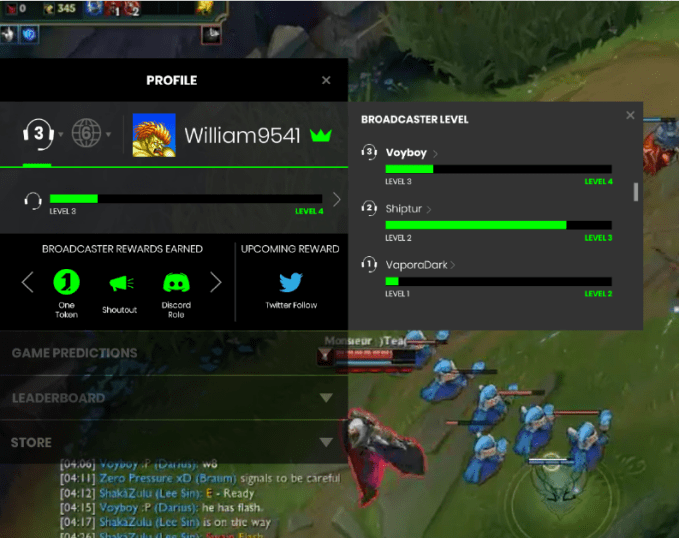
Starting today, developers can customize their Extensions with interactive experiences they can charge for, using Bits. That is, viewers will be able to pay to take advantage of these new experiences, with a portion of the revenue being returned to the Extension’s developer.

At launch, Twitch says 80 percent of the revenue share associated with Bits in Extensions will go to the creator – as they’re the ones driving traffic to the Extension through their channel. The remaining 20 percent of the revenue will then go to the Extension developer.

Extensions with Bits will be available to every Twitch Affiliate and Partner with a Bits-enabled channel.

Several Extensions have already enabled Bits, Twitch says.

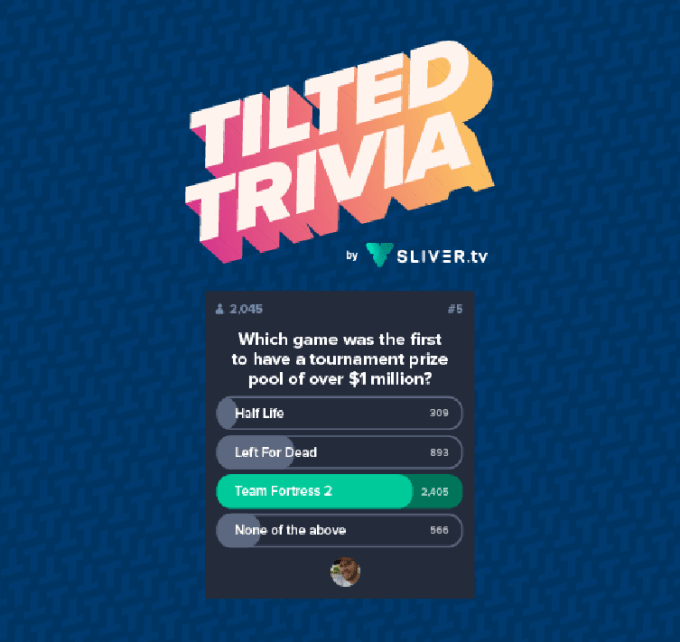
In Tilted Trivia by Sliver.tv, viewers can test their video game knowledge across a number of top titles, like Fortnite, League of Legends, Counter-Strike: Global Offensive, PlayerUnknown’s Battlegrounds, Overwatch, Grand Theft Auto V, and Hearthstone.
OneView by Esports One will let viewers predict when things will happen in League of Legends; Bit Arcade will offer arcade classics that can be played while watching a game; Poll by iPowow lets viewers guide what the streamer does next; and Rock Paper Bits by Maestro lets streamers start an impromptu Rock Paper Scissors tournament.

Other Bits-enabled Extensions will include those offering a priority queue for joining a creator’s game, virtual throwable items, plus the ability to post on-screen messages, take part in special polls or trigger sound alerts, among other things.

Dozens of Extensions will be available from developers including ​Altoar​, ​Casperr, ​CygnusCross​, Daniil Kubatko​, Doborog Games, Evolution Gaming, gnatbuoy, Hellcat, Inthegame, Martin Beierling​, ​Master Network​, Meastoso​, ​Mobalytics​, ​MoneyMatches​, ​​Porcupine​, ​Pretzel Tech​, ​Purity Dev​, ​Run It Up, Seravy​, ​Stream Decker​,​ Streamlabs​, tallcode​, ​tetsuo286, vAudience, VoidTeam Studios, and Zippers & Henry Liao​.

Twitch had promised at last year’s developer conference TwitchCon, that Extensions would soon be able to be monetized. But it’s taken a little longer to deliver than it had said.

Still, the addition is notable because it opens up another revenue stream for creators and developers alike, which could attract more game streamers to its site, thus boosting its own bottom line. Twitch’s revenue has been growing year-over-year, with payouts to Partners more than doubling in 2017. Cheering with Bits has also proved popular since its introduction, generating more than $12 million in its first 10 months.

The hope is that Bits for Extensions will now follow that same path.

“Our mission at Twitch is to help our community make a living on our service doing what they love, and that includes both content creators and developers,” said Jeffrey Chow, Product Manager of Extensions at Twitch, in a statement about the launch. “We built Extensions to best serve what Twitch is best known for: community interactions. By enabling revenue generation from Extensions, developers can make more of them, which ultimately opens up more interactive possibilities and monetization methods for content creators.”

Bits in Extensions are live now from the Extensions Manager dashboard, where they’ll be labeled with the “In-Extensions Bits” tag.
23 Apr 2018

Facebook’s new authorization process for political ads goes live in the U.S.

Earlier this month – and before Facebook CEO Mark Zuckerberg testified before Congress – the company announced a series of changes to how it would handle political advertisements running on its platform in the future. It had said that people who wanted to buy a political ad – including ads about political “issues” –  would have to reveal their identities and location and be verified, before the ads could run. Information about the advertiser would also display to Facebook users.

Today, Facebook is announcing the authorization process for U.S. political ads is live.

Facebook had first said in October that political advertisers would have to verify their identity and location for election-related ads. But in April, it expanded that requirement to include any “issue ads” – meaning those on political topics being debated across the country, not just those tied to an election.

Facebook said it would work with third parties to identify the issues. These ads would then also be labeled as “Political Ads,” and display the “paid for by” information to end users.

According to today’s announcement, Facebook will now begin to verify the identity and the residential mailing address of advertisers who want to run political ads. Those advertisers will also have to disclose who’s paying for the ads as part of this authorization process.

This verification process is currently only open in the U.S. and will require Page admins and ad account admins submit their government-issued ID to Facebook along with their residential mailing address.

The government ID can either be a U.S. passport or U.S. driver’s license, a FAQ explains. Facebook will also ask for the last four digits of admins’ Social Security Number. The photo ID will then be approved or denied in a matter of minutes, though anyone declined based on the quality of the uploaded images won’t be prevented from trying again.

The address, however, will be verified by mailing a letter with a unique access code that only the admin’s Facebook account can use. The letter may take up to 10 days to arrive, Facebook notes.

Along with the verification portion, Page admins will also have to fill in who paid for the ad in the “disclaimer” section. This has to include the organization(s) or person’s name(s) who funded it.

This information will also be reviewed prior to approval, but Facebook isn’t going to fact check this field, it seems.

Instead, the company simply says: “We’ll review each disclaimer to make sure it adheres to our advertising policies. You can edit your disclaimers at any time, but after each edit, your disclaimer will need to be reviewed again, so it won’t be immediately available to use.”

The FAQ later states that disclaimers must comply with “any applicable law,” but again says that Facebook only reviews them against its ad policies.

“It’s your responsibility as the advertiser to independently assess and ensure that your ads are in compliance with all applicable election and advertising laws and regulations,” the documentation reads.

Along with the launch of the new authorization procedures, Facebook has released a Blueprint training course to guide advertisers through the steps required, and has published an FAQ to answer advertisers’ questions.

Of course, these procedures which will only net the more scrupulous advertisers willing to play by the rules. That’s why Facebook had said before that it plans to use A.I. technology to help sniff out those advertisers who should have submitted to verification, but did not. The company is also asking people to report suspicious ads using the “Report Ad” button.

Facebook has been under heavy scrutiny because of how its platform was corrupted by Russian trolls on a mission to sway the 2016 election. The Justice Department charged 13 Russians and three companies with election interference earlier this year, and Facebook has removed hundreds of accounts associated with disinformation campaigns.

While tougher rules around ads may help, they alone won’t solve the problem.

It’s likely that those determined to skirt the rules will find their own workarounds. Plus, ads are only one of many issues in terms of those who want to use Facebook for propaganda and misinformation. On other fronts, Facebook is dealing with fake news – including everything from biased stories to those that are outright lies, intending to influence public opinion. And of course there’s the Cambridge Analytica scandal, which led to intense questioning of Facebook’s data privacy practices in the wake of revelations that millions of Facebook users had their information improperly accessed.

Facebook says the political ads authorization process is gradually rolling out, so it may not be available to all advertisers at this time. Currently, users can only set up and manage authorizations from a desktop computer from the Authorizations tab in a Facebook Page’s Settings.

23 Apr 2018

Facebook’s new authorization process for political ads goes live in the U.S.

Earlier this month – and before Facebook CEO Mark Zuckerberg testified before Congress – the company announced a series of changes to how it would handle political advertisements running on its platform in the future. It had said that people who wanted to buy a political ad – including ads about political “issues” –  would have to reveal their identities and location and be verified, before the ads could run. Information about the advertiser would also display to Facebook users.

Today, Facebook is announcing the authorization process for U.S. political ads is live.

Facebook had first said in October that political advertisers would have to verify their identity and location for election-related ads. But in April, it expanded that requirement to include any “issue ads” – meaning those on political topics being debated across the country, not just those tied to an election.

Facebook said it would work with third parties to identify the issues. These ads would then also be labeled as “Political Ads,” and display the “paid for by” information to end users.

According to today’s announcement, Facebook will now begin to verify the identity and the residential mailing address of advertisers who want to run political ads. Those advertisers will also have to disclose who’s paying for the ads as part of this authorization process.

This verification process is currently only open in the U.S. and will require Page admins and ad account admins submit their government-issued ID to Facebook along with their residential mailing address.

The government ID can either be a U.S. passport or U.S. driver’s license, a FAQ explains. Facebook will also ask for the last four digits of admins’ Social Security Number. The photo ID will then be approved or denied in a matter of minutes, though anyone declined based on the quality of the uploaded images won’t be prevented from trying again.

The address, however, will be verified by mailing a letter with a unique access code that only the admin’s Facebook account can use. The letter may take up to 10 days to arrive, Facebook notes.

Along with the verification portion, Page admins will also have to fill in who paid for the ad in the “disclaimer” section. This has to include the organization(s) or person’s name(s) who funded it.

This information will also be reviewed prior to approval, but Facebook isn’t going to fact check this field, it seems.

Instead, the company simply says: “We’ll review each disclaimer to make sure it adheres to our advertising policies. You can edit your disclaimers at any time, but after each edit, your disclaimer will need to be reviewed again, so it won’t be immediately available to use.”

The FAQ later states that disclaimers must comply with “any applicable law,” but again says that Facebook only reviews them against its ad policies.

“It’s your responsibility as the advertiser to independently assess and ensure that your ads are in compliance with all applicable election and advertising laws and regulations,” the documentation reads.

Along with the launch of the new authorization procedures, Facebook has released a Blueprint training course to guide advertisers through the steps required, and has published an FAQ to answer advertisers’ questions.

Of course, these procedures which will only net the more scrupulous advertisers willing to play by the rules. That’s why Facebook had said before that it plans to use A.I. technology to help sniff out those advertisers who should have submitted to verification, but did not. The company is also asking people to report suspicious ads using the “Report Ad” button.

Facebook has been under heavy scrutiny because of how its platform was corrupted by Russian trolls on a mission to sway the 2016 election. The Justice Department charged 13 Russians and three companies with election interference earlier this year, and Facebook has removed hundreds of accounts associated with disinformation campaigns.

While tougher rules around ads may help, they alone won’t solve the problem.

It’s likely that those determined to skirt the rules will find their own workarounds. Plus, ads are only one of many issues in terms of those who want to use Facebook for propaganda and misinformation. On other fronts, Facebook is dealing with fake news – including everything from biased stories to those that are outright lies, intending to influence public opinion. And of course there’s the Cambridge Analytica scandal, which led to intense questioning of Facebook’s data privacy practices in the wake of revelations that millions of Facebook users had their information improperly accessed.

Facebook says the political ads authorization process is gradually rolling out, so it may not be available to all advertisers at this time. Currently, users can only set up and manage authorizations from a desktop computer from the Authorizations tab in a Facebook Page’s Settings.

23 Apr 2018

Chariot will start providing transportation data to SF

Chariot, the commuter shuttle provider owned by Ford, has received a private transit program permit to operate more safely and ideally have less of an impact on public transit in San Francisco.

As part of the program, Chariot cannot make stops in crosswalks, traffic lanes and Muni stops. Instead, Chariot must load and unload passengers in legal curb spaces, which includes white passenger loading zones and yellow commercial loading zones.

To be clear, this program is different from the SFMTA’s agreement with companies pertaining to employer-provided shuttles. In the program with corporate shuttles, companies pay to use Muni bus zones.

Chariot must ensure new routes complement, rather than replicate pre-existing Muni routes, as well as provide San Francisco with GPS and ridership data in order to enable the city to better understand the company’s impact.

Chariot is the only private transit provider that applied for and received a permit. What prompted the permitting program were complaints from the public pertaining to stopping in unsafe locations, traveling on restricted streets and a lack of accessibility for people with disabilities.

While the SFMTA was reviewing Chariot’s application, the two worked together to move more than 100 of Chariot’s stops from illegal locations to safer loading places. As part of a condition of the permit, Chariot must identify safe and legal alternatives for the remaining nine percent of the company’s roughly 204 locations by the end of August.

Back in October, Chariot was forced to temporarily halt rides in San Francisco after the company failed to pass an inspection by the California Public Utilities Commission.

I’ve reached out to Chariot and the SFMTA. I’ll update this story if I hear more.

23 Apr 2018

Chariot will start providing transportation data to SF

Chariot, the commuter shuttle provider owned by Ford, has received a private transit program permit to operate more safely and ideally have less of an impact on public transit in San Francisco.

As part of the program, Chariot cannot make stops in crosswalks, traffic lanes and Muni stops. Instead, Chariot must load and unload passengers in legal curb spaces, which includes white passenger loading zones and yellow commercial loading zones.

To be clear, this program is different from the SFMTA’s agreement with companies pertaining to employer-provided shuttles. In the program with corporate shuttles, companies pay to use Muni bus zones.

Chariot must ensure new routes complement, rather than replicate pre-existing Muni routes, as well as provide San Francisco with GPS and ridership data in order to enable the city to better understand the company’s impact.

Chariot is the only private transit provider that applied for and received a permit. What prompted the permitting program were complaints from the public pertaining to stopping in unsafe locations, traveling on restricted streets and a lack of accessibility for people with disabilities.

While the SFMTA was reviewing Chariot’s application, the two worked together to move more than 100 of Chariot’s stops from illegal locations to safer loading places. As part of a condition of the permit, Chariot must identify safe and legal alternatives for the remaining nine percent of the company’s roughly 204 locations by the end of August.

Back in October, Chariot was forced to temporarily halt rides in San Francisco after the company failed to pass an inspection by the California Public Utilities Commission.

I’ve reached out to Chariot and the SFMTA. I’ll update this story if I hear more.

23 Apr 2018

A university is giving scholarships to top Fortnite players

A Midwestern university wants to recruit the nation’s best Fortnite players for its varsity esports team, and it’s throwing out the dough to bring on some quality talent.

Ashland University in Ohio will embrace the feverishly popular battle royale title into its competitive esports program which it will officially launch this fall. Fortnite will join the team’s current competitive title teams League of Legends, Overwatch, Counter-Strike: Global Offensive and Rocket League. Interested gamers can hit up this form to apply to the program.

“Fortnite appeals to both the core and casual gaming audience,” the school’s esports head coach Josh Buchanan said in a release. “We’re excited to provide this platform for gamers who want to showcase their skills in a more competitive space. Fortnite facilitates an environment that allows players to get creative, innovate and show off their mastery of their skills.”

Admission in the school’s undergraduate program with room and board on the Ashland campus goes for $31,284 full-price so the $4,000 scholarship offers a nice incentive, but this is probably best for people who have other reasons to go to Ashland University in Ohio as well.

The embrace the title has already received from the gaming community is pretty notable. It’s one of the most-streamed titles on gaming sites and there are millions of people playing concurrently.

23 Apr 2018

A university is giving scholarships to top Fortnite players

A Midwestern university wants to recruit the nation’s best Fortnite players for its varsity esports team, and it’s throwing out the dough to bring on some quality talent.

Ashland University in Ohio will embrace the feverishly popular battle royale title into its competitive esports program which it will officially launch this fall. Fortnite will join the team’s current competitive title teams League of Legends, Overwatch, Counter-Strike: Global Offensive and Rocket League. Interested gamers can hit up this form to apply to the program.

“Fortnite appeals to both the core and casual gaming audience,” the school’s esports head coach Josh Buchanan said in a release. “We’re excited to provide this platform for gamers who want to showcase their skills in a more competitive space. Fortnite facilitates an environment that allows players to get creative, innovate and show off their mastery of their skills.”

Admission in the school’s undergraduate program with room and board on the Ashland campus goes for $31,284 full-price so the $4,000 scholarship offers a nice incentive, but this is probably best for people who have other reasons to go to Ashland University in Ohio as well.

The embrace the title has already received from the gaming community is pretty notable. It’s one of the most-streamed titles on gaming sites and there are millions of people playing concurrently.

23 Apr 2018

Google beats expectations again with $31.15B in revenue

Alphabet, Google’s parent company, reported another pretty solid beat this afternoon for its first quarter as it more or less has continued to keep its business growing substantially — and is growing even faster than it was a year ago today.

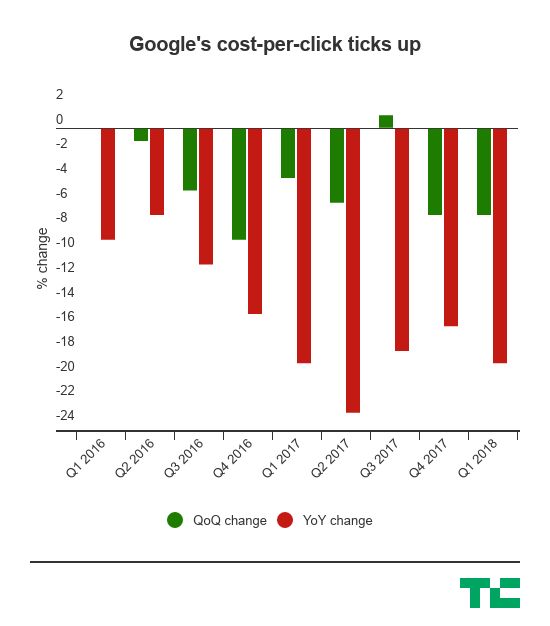
Google said its revenue grew 26% year-over-year to $31.16 billion in the first quarter this year. In the first quarter last year, Google said its revenue had grown 22% between Q1 of 2016 and Q1 of 2017. All this is a little convoluted, but the end result is that Google is actually growing faster than it was just a year ago despite the continued trend of a decline in its cost-per-click — a rough way of saying how valuable an ad is — as more and more web browsing shifts to mobile devices. Last year, Google said it recorded $24.75 billion in the first quarter.

Once again, Alphabet’s “other bets” — its fringe projects like autonomous vehicles and balloons — showed some additional health as that revenue grew while the losses shrank. That’s a good sign as it looks to explore options beyond search, but in the end it still represents a tiny fraction of Google’s overall business. This was also the first quarter that Google is reporting its results following a settlement with Uber, where it received a slice of the company as it ended a spat between its Waymo self-driving division and Uber.

Here’s the final scorecard:

  • Revenue: $31.16 billion, compared to $30.36 billion Wall Street estimates and up 26% year-over-year.
  • Earnings: $9.93 per share adjusted, compared to $9.28 per share from Wall Street
  • Other Revenues: $4.35 billion, up from $3.27 billion in Q1 last year
  • Other Bets: $150 million, up from $132 million in Q1 2017
  • Other Bets losses: $571 million, down from $703 million in the first quarter last year
  • TAC as a % of Revenue: 24%
  • Effective tax rate: 11%, down from 20% in Q1 2017

In the end, it’s a beat compared to what Wall Street wanted, and it’s getting a very Google-y response. Investors were looking for earnings of $9.35 per share on $30.36 billion in revenue. Google’s stock is up around 2% in extended trading, which for Google is adding more than $10 billion in value as it races alongside Microsoft and Amazon to chase Apple as the most valuable company in the world by market cap. Google jumped as much as 5% in extended trading, though it’s flattened out

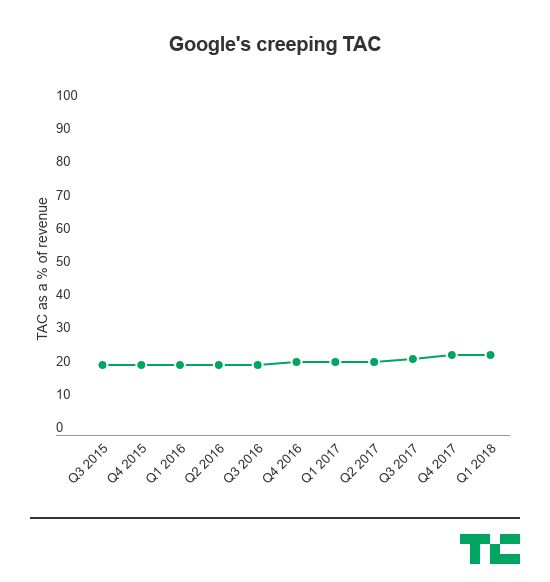
Google’s traffic acquisition cost, or TAC, appears to also remain stable as a percentage of its revenue. This is a little bit of a sticking point for observers for the company and a potential negative signal for investors as more and more web browsing shifts to mobile. It’s ticked up very slowly over the past several years, but is now sitting at around 24% of its total revenue.

Google, at its core, is an advertising company that is going to make money off its billions of users across all of its properties. But as everything goes to mobile devices, the actual value of those ads is going to drop off over time simply because mobile browsing has a different set of behaviors. Google’s business has always been to offset that cost-per-click with a growing number of impressions — and, indeed, it seems like the status quo is sticking around for this one.

While Google’s advertising business continues to chug along, that diversification of revenue streams is going to be increasingly important for the company as a hedge against any potential threats to its advertising income. Already there is some chaos when it comes to what’s happening with user data following a massive scandal where information on as many as 87 million Facebook users ended up with a political research firm, Cambridge Analytica. That backlash centered around user privacy may end up tapping Google, which dominates most of how information travels across the web with Gmail and Search among its other products.

But that still comes at a pretty significant cost. It’s made major investments into tools like Google Cloud (or GCP), but tucked into the earnings report is a line item that shows its “purchases of property and equipment” more than doubled year-over-year to around $7.3 billion, up from $2.5 billion in the first quarter this year. Of course this can encompass a ton of things, but Google still has to actually buy servers if it’s going to run a cloud platform that can compete with AWS or Microsoft’s Azure.

All that feeds into its “other income” stream, which grew from $3.2 billion in Q1 last year to $4.35 billion in the first quarter this year. Amazon’s cloud business is already more than a $10 billion business annually, and that first-mover advantage has served it well as it began a huge shift to how businesses operate on cloud servers. But it also exposed a massive business opportunity for Google, which continues to invest in that.

23 Apr 2018

Google beats expectations again with $31.15B in revenue

Alphabet, Google’s parent company, reported another pretty solid beat this afternoon for its first quarter as it more or less has continued to keep its business growing substantially — and is growing even faster than it was a year ago today.

Google said its revenue grew 26% year-over-year to $31.16 billion in the first quarter this year. In the first quarter last year, Google said its revenue had grown 22% between Q1 of 2016 and Q1 of 2017. All this is a little convoluted, but the end result is that Google is actually growing faster than it was just a year ago despite the continued trend of a decline in its cost-per-click — a rough way of saying how valuable an ad is — as more and more web browsing shifts to mobile devices. Last year, Google said it recorded $24.75 billion in the first quarter.

Once again, Alphabet’s “other bets” — its fringe projects like autonomous vehicles and balloons — showed some additional health as that revenue grew while the losses shrank. That’s a good sign as it looks to explore options beyond search, but in the end it still represents a tiny fraction of Google’s overall business. This was also the first quarter that Google is reporting its results following a settlement with Uber, where it received a slice of the company as it ended a spat between its Waymo self-driving division and Uber.

Here’s the final scorecard:

  • Revenue: $31.16 billion, compared to $30.36 billion Wall Street estimates and up 26% year-over-year.
  • Earnings: $9.93 per share adjusted, compared to $9.28 per share from Wall Street
  • Other Revenues: $4.35 billion, up from $3.27 billion in Q1 last year
  • Other Bets: $150 million, up from $132 million in Q1 2017
  • Other Bets losses: $571 million, down from $703 million in the first quarter last year
  • TAC as a % of Revenue: 24%
  • Effective tax rate: 11%, down from 20% in Q1 2017

In the end, it’s a beat compared to what Wall Street wanted, and it’s getting a very Google-y response. Investors were looking for earnings of $9.35 per share on $30.36 billion in revenue. Google’s stock is up around 2% in extended trading, which for Google is adding more than $10 billion in value as it races alongside Microsoft and Amazon to chase Apple as the most valuable company in the world by market cap. Google jumped as much as 5% in extended trading, though it’s flattened out

Google’s traffic acquisition cost, or TAC, appears to also remain stable as a percentage of its revenue. This is a little bit of a sticking point for observers for the company and a potential negative signal for investors as more and more web browsing shifts to mobile. It’s ticked up very slowly over the past several years, but is now sitting at around 24% of its total revenue.

Google, at its core, is an advertising company that is going to make money off its billions of users across all of its properties. But as everything goes to mobile devices, the actual value of those ads is going to drop off over time simply because mobile browsing has a different set of behaviors. Google’s business has always been to offset that cost-per-click with a growing number of impressions — and, indeed, it seems like the status quo is sticking around for this one.

While Google’s advertising business continues to chug along, that diversification of revenue streams is going to be increasingly important for the company as a hedge against any potential threats to its advertising income. Already there is some chaos when it comes to what’s happening with user data following a massive scandal where information on as many as 87 million Facebook users ended up with a political research firm, Cambridge Analytica. That backlash centered around user privacy may end up tapping Google, which dominates most of how information travels across the web with Gmail and Search among its other products.

But that still comes at a pretty significant cost. It’s made major investments into tools like Google Cloud (or GCP), but tucked into the earnings report is a line item that shows its “purchases of property and equipment” more than doubled year-over-year to around $7.3 billion, up from $2.5 billion in the first quarter this year. Of course this can encompass a ton of things, but Google still has to actually buy servers if it’s going to run a cloud platform that can compete with AWS or Microsoft’s Azure.

All that feeds into its “other income” stream, which grew from $3.2 billion in Q1 last year to $4.35 billion in the first quarter this year. Amazon’s cloud business is already more than a $10 billion business annually, and that first-mover advantage has served it well as it began a huge shift to how businesses operate on cloud servers. But it also exposed a massive business opportunity for Google, which continues to invest in that.

23 Apr 2018

Huge numbers of job postings in China specify ‘men only’ or dictate women’s appearance

Gender discrimination may be a hot-button issue here in the U.S., but we don’t have a monopoly on the practice by a long shot. A new report from Human Rights Watch highlights widespread and blatant discrimination in Chinese job descriptions, despite its ostensibly being illegal there. In fact, the highest incidence rates were found in government jobs.

The report looked at 36,000 job descriptions posted in the last few years, including 2017 and 2018 listings for civil service and government jobs. The authors note that their work was conducted under increasing hostility and suppression of the topic by Chinese authorities, meaning no cooperation (but perhaps some interference) was expected.

Thousands of the listings included such language as “men only,” “suitable for men,” or the like, for example “need to work overtime frequently, high intensity work, only men need apply.” In the civil service category, this happened in as frequently as one in five listings, with no corresponding “women only” language except in a single 2018 job. In the Ministry of Public Security, more than half the jobs required the applicant be male.

When women are permitted or requested to apply, they are subject to gendered requirements: be married with kids, for instance. But more common are appearance-based demands: to be a train conductor, a woman must be between 5’1″ and 5’6″, weigh less than 143 pounds, and have “normal facial features, no tattoos, no obvious scars on face, neck or arms, good skin tone, no incurable skin conditions.”

Women lucky enough to already be employed in major companies like Baidu and Tencent are used as lures for male applicants: these “goddesses” are presented as potential matches, as in this Alibaba ad: “They are the goddesses in Alibaba employees’ heart—smart and competent at work and charming and alluring in life. They are independent but not proud, sensitive but not melodramatic. They want to be your coworkers. Do you want to be theirs?”

Of course we shouldn’t throw rocks, at the risk of shattering our own glass house of sexism and other discriminatory practices over here, but it is worth being reminded that this is a worldwide and deeply seated phenomenon.

You can read the full report, “Only Men Need Apply,” here. Its recommendations, though the Chinese authorities seem unlikely to heed them, are to modernize laws relating to discrimination and enforce the ones that exist. China is in fact party to some international agreements to guarantee its citizens certain rights and quash discrimination when it is detected, so that may work as leverage.