Year: 2018

23 Apr 2018

Deliv now offers same-day delivery for Shopify retailers

Deliv, which partners with retailers like Macy’s, Best Buy and Petsmart to offer same-day delivery, is enabling Shopify retailers to offer scheduled, same-day delivery to customers.

This is thanks to a partnership with Zapiet, a store pickup and local delivery plug-in for Shopify. Zapiet helps Shopify retailers manage store inventories and configure the confines of the deliveries. This greater expansion into small businesses comes a couple of months after Deliv launched DeIiv RX for same-day delivery of prescriptions.

“Part of our business model is we are an assets-free logistics company,” Deliv CEO Daphne Carmeli told TechCrunch. “When it comes to storage, the retailers are one place of where storage is.”

For the retailers without storage of their own, Deliv partners with third parties like on-demand fulfillment startup Darkstore and others. When it comes to actual deliveries, Deliv relies on 1099 contractors. Across all of its 35 markets, Deliv has a network of tens of thousands of delivery drivers on board.

“If you think about us in the world of driving, think of us as the airport shuttle versus the taxi,” Carmeli said. “By definition, if we’re focused on scheduled deliveries, our focus and technology is about adding as many stops to our routes as possible.”

This comes shortly after UberRUSH announced it would be shutting down nationwide.

“It wasn’t a surprise to us,” Carmeli said. “Moving people and moving packages are entirely different and requires very different things.”
23 Apr 2018

Glowforge opens public orders for its desktop 3D laser cutter

Hardware startup Glowforge, which makes a desktop laser cutter and engraver for home or office use, has finally opened up sales to the general public.

The maker-targeted device, which can ‘print’ (read: engrave/laser cut) a variety of materials including leather, wood, acrylic, glass, and even the metal surface of a Macbook, starts at $2,495 for the entry level machine, rising to a full $5,995 for the pro model — which is billed as faster, able to print larger items, and capable of running for longer periods.

With a starter price-tag of $2.5k Glowforge is clearly not for everyone. Though arguably it does offer more creative bang for your buck than, say, the equally expensive Skydio face-tracking selfie drone. But horses for courses, and all that.

The Seattle-based startup has also topped up with $10M more in VC funding, according GeekWire, from existing investors True Ventures and Foundry Group — who also backed its $22M Series B, in mid 2016, and an earlier $9M Series A.

Glowforge has raised just over $60M at this point, according to Crunchbase, including pulling in almost $30M in pre-sales via a crowdfunding campaign back in 2015. We first covered the hardware startup ahead of that, when it announced its Series A.

Safe to say, it’s been a long journey to turn the founders’ novel idea and prototype into a market-ready and robust laser cutter — and get that into all its backers’ hands.

It’s also clearly been a frustrating process at times. But Glowforge now at least appears confident it can fulfill orders in a timely fashion — it’s offering a May 3 shipping date to new buyers (within the US).

That said, it does not look like all original backers have had their device shipped though.

According to founder Dan Shapiro’s comments to GeekWire, there are some backers who still haven’t got their device — for a few different reasons. “There’s some folks who haven’t replied, asked us not to send it yet, or live in a country that’s awaiting regulatory approval,” he told it.

A quasi-optional air filter component for the Glowforge — which costs an additional $995 — also isn’t shipping until November. (A note on the website says the machine can be used without it, though in that case it warns the placement of the machine “needs a window or 4″ dryer hose”.)


23 Apr 2018

Canary’s cameras get person-detecting AI improvements

False positives are hands-down the worst part of my home security camera. At some point, the thing started sending me video snippets every time my rabbit eats a piece of arugula. Which is fine for, like, a day and then almost immediately annoying.

After rolling out a version of AI-based person detection earlier this year, Canary’s upping that offering some key refinements. Among other additions is the ability to filter captures based on people moving or all motion. That way you don’t get a ping every time, say, a light casts a shadow on the wall.

A nice addition, though the tech itself can probably still use a bit of improvement. I’ve been using an original Canary in my house and it occasionally mistakes said rabbit for a human. I mean, she’s smart for a rabbit, but aside from chewing some wood work and seasonal shedding, isn’t likely to cause much mayhem in my apartment.

Even with the occasional false positives, however, that’s still a lot fewer notifications if you have pets around the house. If a wild pack of raccoons breaks into your home and wrecks the place, however, you’re in for a rude awakening.

The new feature rolls out to Android and iOS users on Thursday.

23 Apr 2018

43% of music revenues came from streaming last year

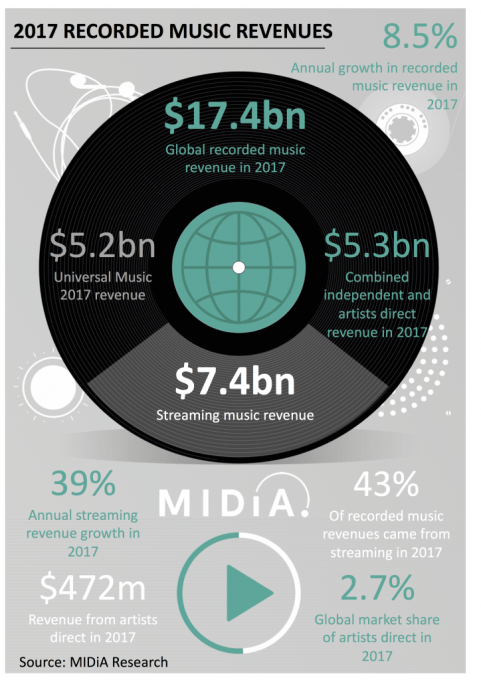
Streaming services and their subscription revenue has saved the music business, according to a new music industry report, which notes that 2017 was the third consecutive year of revenue growth – again, thanks to digital music consumption. Global recorded music revenues reached $17.4 billion in 2017, up from $16 billion in 2016 – an annual growth rate of 8. percent. Streaming revenues in particular have contributed to this growth, and were up 39 percent year-over-year to reach $7.4 billion, or 43 percent of all revenues.

That offset some of the declines from legacy formats, like downloads and physical albums, which fell by $783 million.

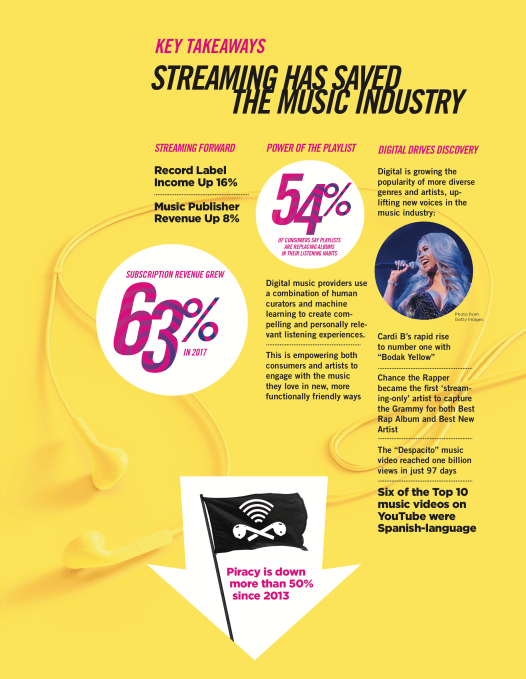
In the U.S., digital revenue last year grew 15 percent to $6.5 billion, up from $5.65 billion the year before. A good-sized portion of those revenues came from streaming music subscriptions, which grew 63 percent from $2.5 billion in 2016 to $4 billion in 2017.

The U.S. has also become the most important streaming market worldwide, accounting for 40 percent of total global  recorded music revenues. Thanks to the innovation and diversity of music services available in the U.S., the report predicts than the number of paid music subscribers will reach 90.1 million by 2025 – nearly double today’s number of $49.1 million.

The report comes from MIDiA Research, a media and technology analysis company, in partnership with digital media association, DiMA.

In addition to digital’s ability to grow revenues, the changes in how people are consuming music have had other impacts as well.

For starters, the ease of using streaming services has led to an over 50 percent decline in music piracy since 2013, and has driven discovery of more diverse genres and artists, the report claims. It offered a couple of key examples of this, including how Chance the Rapper became the first “streaming-only” artist to win a Grammy, and how six out of the top ten music videos on YouTube were Spanish-language – with hits like “Despacito” reaching a billion views in 97 days.

Another big change in the new streaming landscape, is how powerful playlists have become. 54 percent of consumers now say that playlists are replacing albums in their listening habits.

The $1.4 billion of revenue growth the industry has seen year-over-year puts the global total just below 2008 levels ($17.7 billion), the report also said. That means the decline seen over some of the last decade has been reversed – the industry is back in growth mode.

23 Apr 2018

Apple is offering free battery replacement for some MacBook Pro units

Apple is offering free battery replacements for some 13-inch MacBook Pro (without Touch Bar) laptops that may have a faulty component.

The company announced recently that a limited number of these devices have a component that may fail, which would case the original built-in battery to expand. While Apple says this isn’t a safety issue, it wants to solve the problem as quickly as possible with free battery replacements.

The models that might be affected were manufactured between October 2016 and October 2017.

Think your MacBook Pro might be eligible?

Apple has set up a website for the replacement program where users can input their device’s serial number to check for eligibility. 

This isn’t the first time Apple has offered a battery replacement. In fact, Apple famously found itself in hot water last year when users learned that the company was slowing down older iPhones in an attempt to save power on older batteries. The company responded by offering $29 battery replacement in iPhones.

23 Apr 2018

Mobile guru Amol Sarva talks about the future of work

Amol Sarva has done some amazing stuff. The founder of Virgin Mobile, Sarva went on to create the Peek email device created back when cheap, ubiquitous mobile devices were nowhere to be found. Now he runs Knotel, a unique workspace aimed at up and coming startups.

In this episode of Technotopia I asked Sarva about his thoughts on work, interaction, and the future of offices. In his vision we are all working together remotely using tools that could allow us to all directly interact simply by using our brains. It’s an odd – and cool – idea and he’s a fun interview subject.

Technotopia is a podcast by John Biggs about a better future. You can subscribe in Stitcher, RSS, or iTunes and listen the MP3 here.

23 Apr 2018

Netflix looks to raise $1.5 billion in debt financing

In the span of 20 years, Netflix has gone from a (super convenient) Blockbuster knockoff to one of the most powerful players in media. Partially, that’s credited to Netflix’s technology, bringing streaming content to the mainstream. But Netflix’s success is also owed in part to its willingness to invest in its content library.

Netflix continues that investment today with the announcement that it will raise another $1.5 billion in debt.

From the official statement:

Netflix intends to use the net proceeds from this offering for general corporate purposes, which may
include content acquisitions, production and development, capital expenditures, investments, working
capital and potential acquisitions and strategic transactions.

While that might sound vague, Netflix is most certainly going to invest this capital in original content, as it has with earlier debt capital.

In fact, this is not a new strategy from Netflix. The company has raised many billions in debt to accelerate its push into original content.

The announcement comes shortly after a stellar Q1 earnings report, with 7.41 million new streaming subscribers, outperforming estimates and handily beating out last year’s growth of 4.95 million new subscribers. In total, Netflix now has 125 million subscribers across the globe.

23 Apr 2018

This is Volkswagen’s ludicrous electric Pikes Peak racer

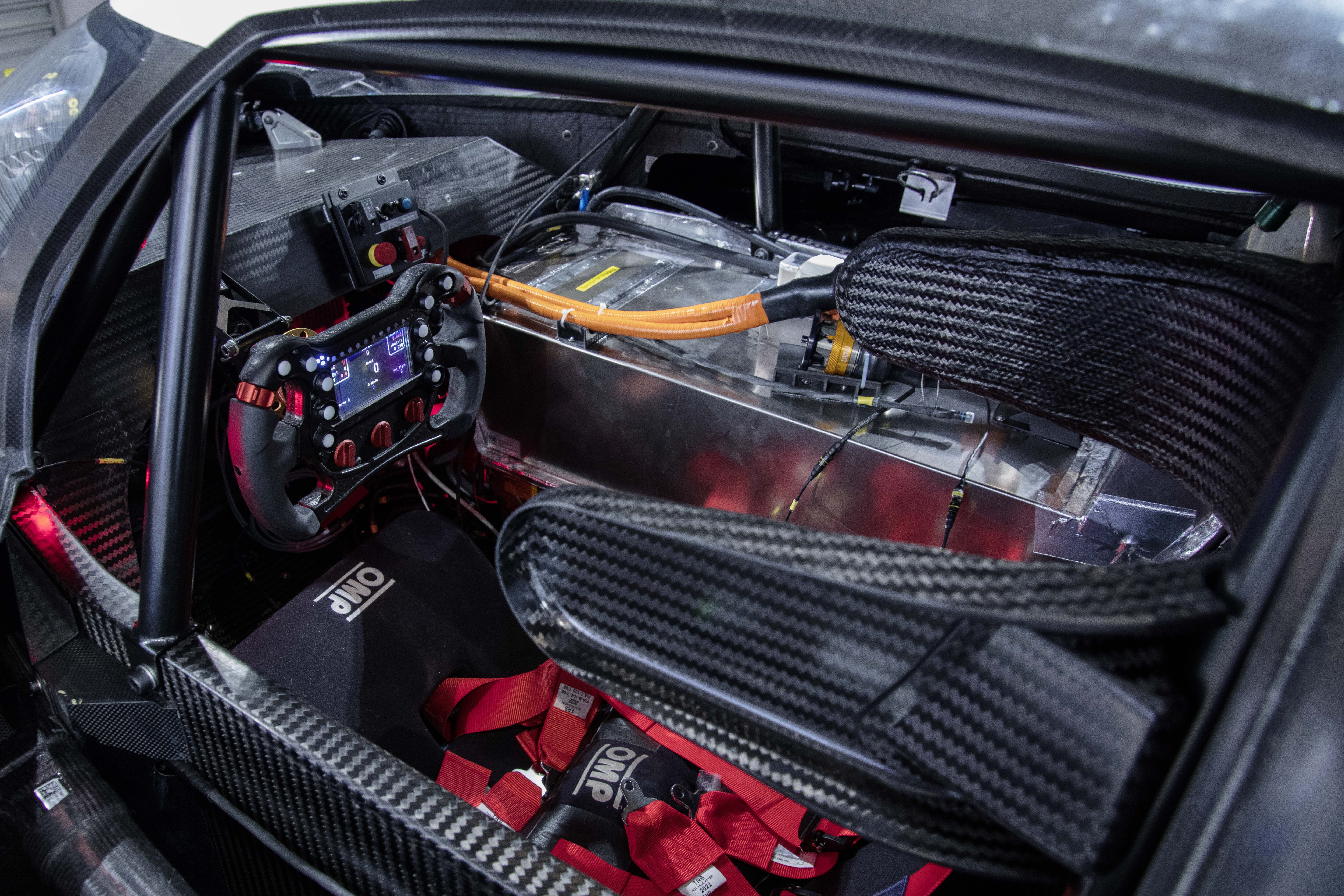
Volkswagen is entering the yearly race up Pikes Peak with a lightweight custom racer. Called the I.D R Pikes Peak, two electric engines are good for 680 hp and 479 lb-ft of torque. The whole package weighs less then 2,500 lbs and VW says the vehicle is good for a 0-60 time of 2.25 seconds. That makes this car faster off line than a Formula 1 or Formula E car — and just slightly faster than a Model S launching in Ludicrous mode.

VW says the racer was developed as an exercise in balancing weight and electrical energy capacity. This racer uses lithium-ion batteries and the dual electric motors act as generators during breaking, allowing the vehicle to recapture lost energy and feed it back into the batteries.

The Pikes Peak race has long been used as test bed for vehicle manufacturers. The race is a tough 4,720 vertical-foot climb up a winding path with 156 corners. A modified Peugeot 208 set the current record in 2013 of 8 minutes and thirteen seconds yet in 2016 a custom electric vehicle from Latvia came close to the record with a time of 8:57.118. The driver, Rhys Millen, says the run could have been up to 30 seconds quicker but half of the vehicle’s powertrain failed halfway through the climb. This car, a eO PP100, had 1,190 kilowatts (1,600 hp) torque 2520 Nm, with a weight of 1200 kg.

Volkswagen’s attempt is to best the electric record with a vehicle significantly less powerful and twice as heavy.

As for the comparison against the Tesla Model S, while the 0-60 speeds are similar on paper (2.25 seconds verse 2.3 seconds), it’s not fair to compare the two in real world testing. In order to get the Tesla to hit 60 mph in 2.3 seconds, which is possible, specific conditions have to be meet and it can only hit that speed off the line. The vehicle’s software also limits the amount of time the Model S is able to launch at this speed. Meanwhile, the VW racer is likely able to accelerate at such velocity coming off corners again and again — racing tires help, too.

Often, if racing up a mountain or around a road track, the ability to recover from dips in speed is where races are won, and with 156 corners, there are plenty of opportunities for Volkswagen to recover from dips.

23 Apr 2018

Amazon is reportedly working on a home robot

For Amazon’s latest hardware trick, the company has apparently been working on a home robot under the codename, “Vesta.” That nugget comes via Bloomberg sources, who report that the online retail giant expects to start trialing the device in employee homes this year, with plans to launch it to consumers as early as 2019.

The project has apparently been in the works for a number of years, but things are finally starting to take off, as the company lists openings for a number of gigs in and around robotics, with titles like “Software Engineer, Robotics.” No word on precisely what such a robot would do, and Amazon, naturally, isn’t commenting.

The home market has been a tough one of the robotics industry to crack — a feat not really accomplished by any devices, beyond the Roomba and derivative cleaning robots. A number of assistant robots have bubbled up over the years, essentially adding moving parts to a smart speaker category. Certainly Alexa functionality is a given for whatever Amazon might be working on — even the Roomba has added that feature in the last year.

Other companies like Sphero spinoff, Misty Robotics, are hoping to bring more advanced functionality to the market, though they’ve given themselves what equates to a 10 year runway. But while the industry appears bullish about the future of robots in the home, it may well take a tech giant like Amazon to really crack the code as it did a few years back with the Echo.

Jeff Bezos, of course, is a well-known friend to robots. He’s been seen around town with the likes of SpotMini recently, and before that, the company acquired Kiva Systems to form Amazon Robotics. That department, however, has been primarily focused on fulling Amazon’s own shipping and logistics requirements with industrial warehouse robots.

Vesta, on the other hand, is said to be the product of Lab126 — the Amazon R&D center that gave the world the Echo and a bevy of Fire devices.

23 Apr 2018

Formlabs scores another $30 million in funding

Formlabs announced this morning that it’s raised another $30 million in a Series C lead by Tyche Partners. This latest round puts the Somerville, Massachusetts-based 3D printing company’s total funding north to $85 million. It’s a rare success story in the world of desktop 3D printing, where most of the company’s competitors failed to weather the industry’s own hype bubble.

The company says it’s using the funding to build more product, and to help meeting growing demand abroad — particularly in Asia. China and Japan are both growing markets for Formlabs, particularly the former, where 3D printing is playing a more central role in manufacturing. In fact, China has recently become the second largest market for 3D printing technology

“This fundraising is a milestone for the company,” CEO Maxim Lobovsky told TechCrunch, “but at this point, a more important milestone will be to continue accelerating profitability and growing revenue at a very fast rate. More than the money, this investment represents an opportunity to increase our presence in China, the world’s largest manufacturer.”

I can personally vouch for the fact that Formlabs’ devices are the desktop 3D printer I see consistently in the maker spaces and product labs I visit. The company was one of the first to move beyond the standard FDM technology you see on most of these machines toward the much more detailed SLA tech. Prior to this, it was exclusively the realm of large, expensive industrial machinery.

Last year, the company expanded its offerings, dipping its toes into 3D printing for manufacturing, along with additional desktop machines.