
Year: 2018

20 Apr 2018

Nintendo Labo review

I’m here to tell you first-hand: Nintendo Labo is no joke. I’m a grown-up human person, who has spent many hours of his life building things: office furniture, websites, a model of the Batmobile from the 1989 Tim Burton movie. In the fourth grade, I attempted to build Mission Santa Barbara out of sugar cubes. It didn’t go great, but the point (I’m told) is that I tried.

We’re talking multiple decades of building things. Following instructions, backtracking, trying again. I’m sure there are all sorts of valuable lessons I learned along the way; self-discipline, patience, teamwork, why sugar is not a structurally sound building material. But event with all of that building under my wisened belt, Nintendo Labo is no walk in the park.

It’s literal child’s play. It says right there, on the box, “6+.” I’ve been six-plus for — let’s just say… a while now. And yet, it took me around two hours this morning to build a cardboard piano. Now I’ve got a table full of scraps, a small paper cut on my ring finger and a surprise sense of accomplishment. Oh, and the piano is pretty cool, too.

Labo is one of the most fascinating products to come across my desk in recent memory. It’s unique, bizarre and as frustrating as it is fun. In other words, it’s uniquely Nintendo — not so much out-of-the-box thinking as it is the actual box. It’s a product that’s built entirely around the premise of making kids sit still, follow instructions and fold the heck out of some cardboard. And, strangely, it totally works.

Hook, line and sinker
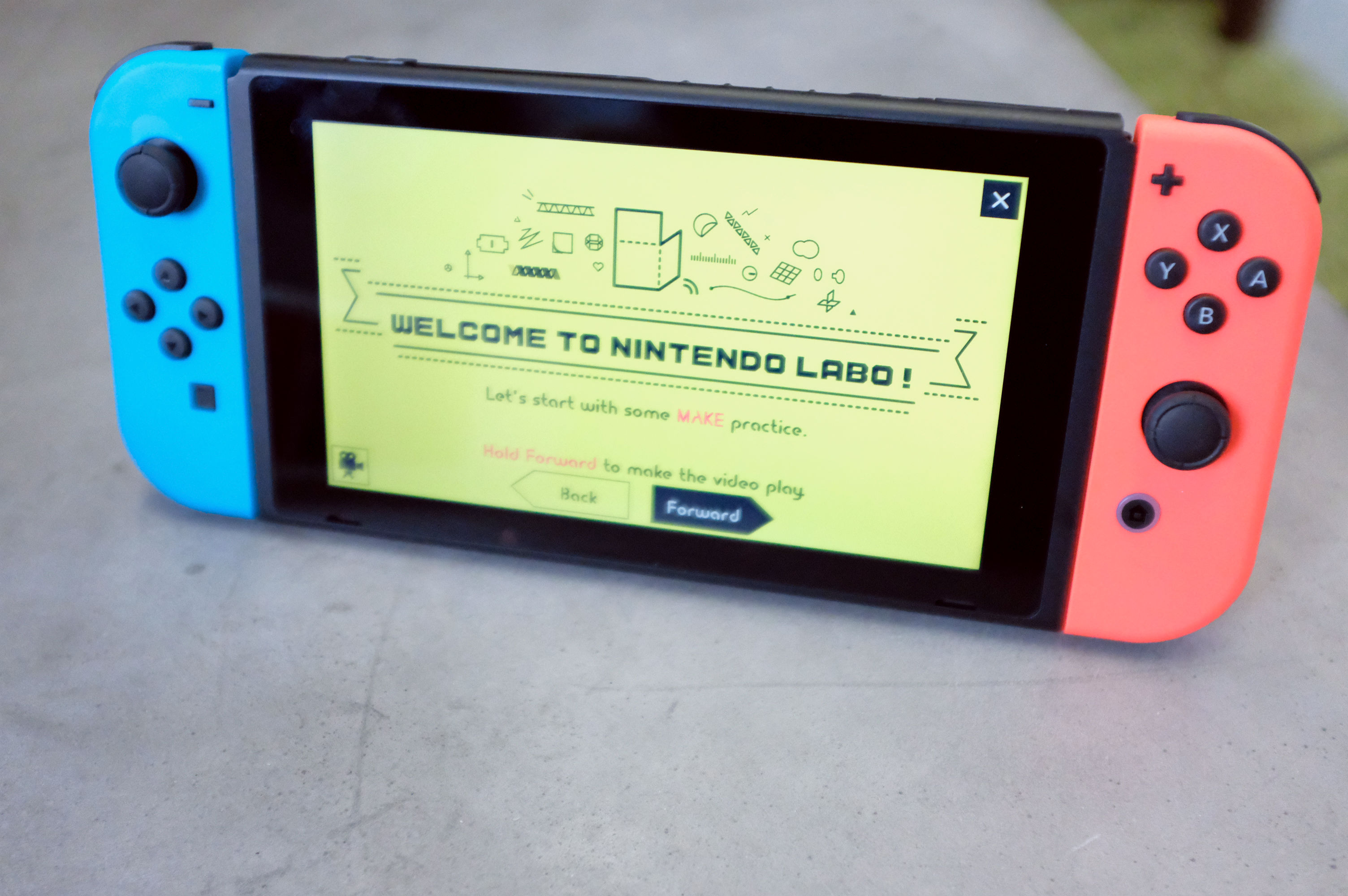
I wouldn’t have been my first choice to review Labo, but I was uniquely qualified, if only for the half a day I spent getting walked through the construction kit with a room full of brightly dressed and infectiously enthusiastic Nintendo employees. That experience served as the foundation for our hands on, as we were broken up into small teams and walked through a pair of increasingly complex projects.

We started with the race cars, the box’s introductory project, which is really as much about getting you used to the strange world of Labo. But even that small starter is a glimpse of the cleverness contained throughout, as the cardboard-wrapped Joy-Cons use their own haptic feedback to propel forward, as you control its speed via the touchscreen. Because there are a pair of Joy-Cons for every Switch, you can use them to race against one another.
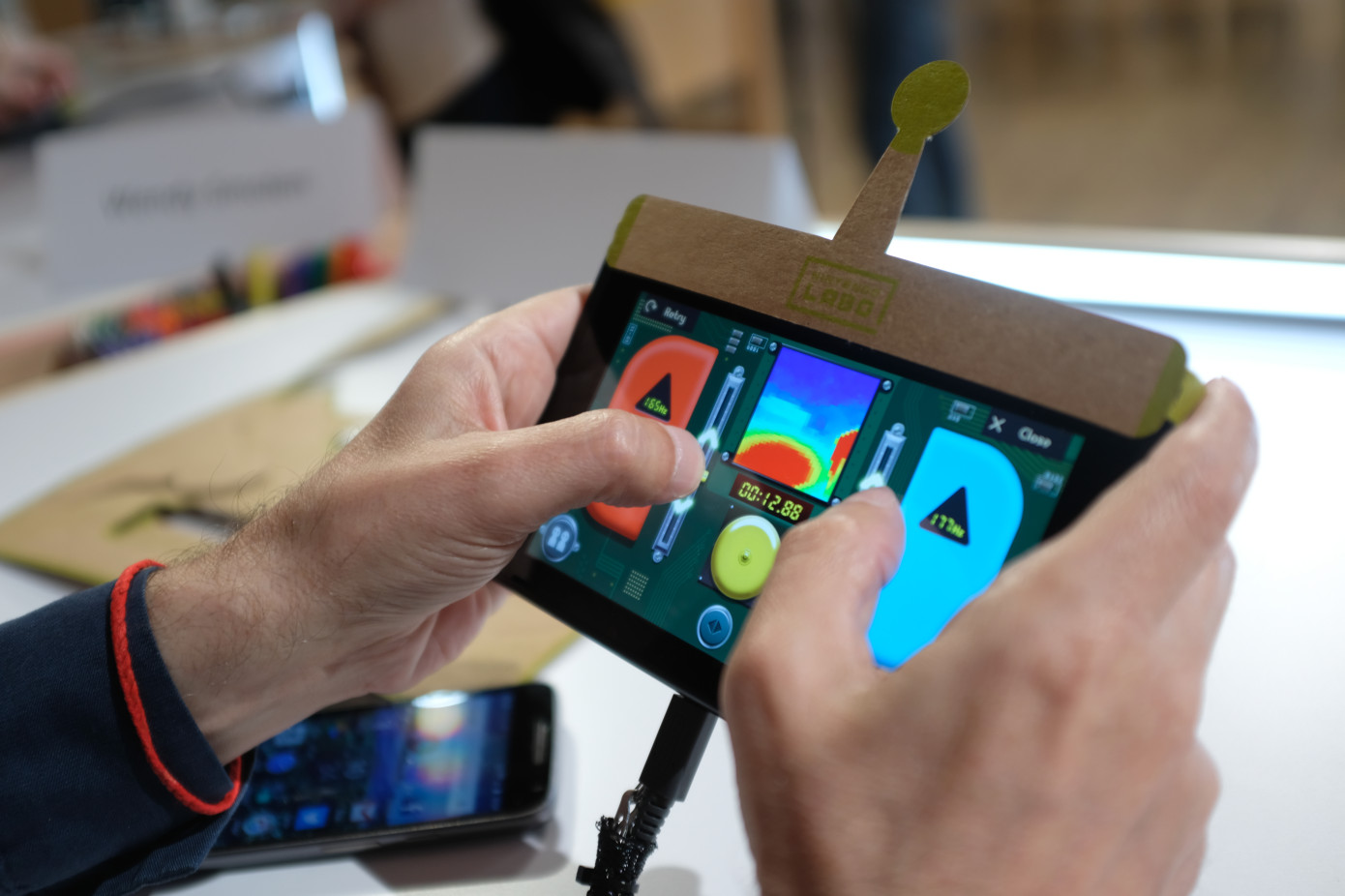
The second hands-on project felt like a considerable step up. Nintendo puts the fishing rod’s build time at one-and-a-half to two-and-a-half hours, versus the cars’ 20 minutes total. In other words, find a comfortable spot, maybe put on some music and make sure you’re hydrated. When it’s done, however, you get a working reel with a string and a rod that vibrates when you catch a fish on screen. Pretty neat.

Having accomplished those in a well-supervised room full of Nintendo employees a few weeks back, I naturally took on the most complex project of the bunch.

Keys to the kingdom
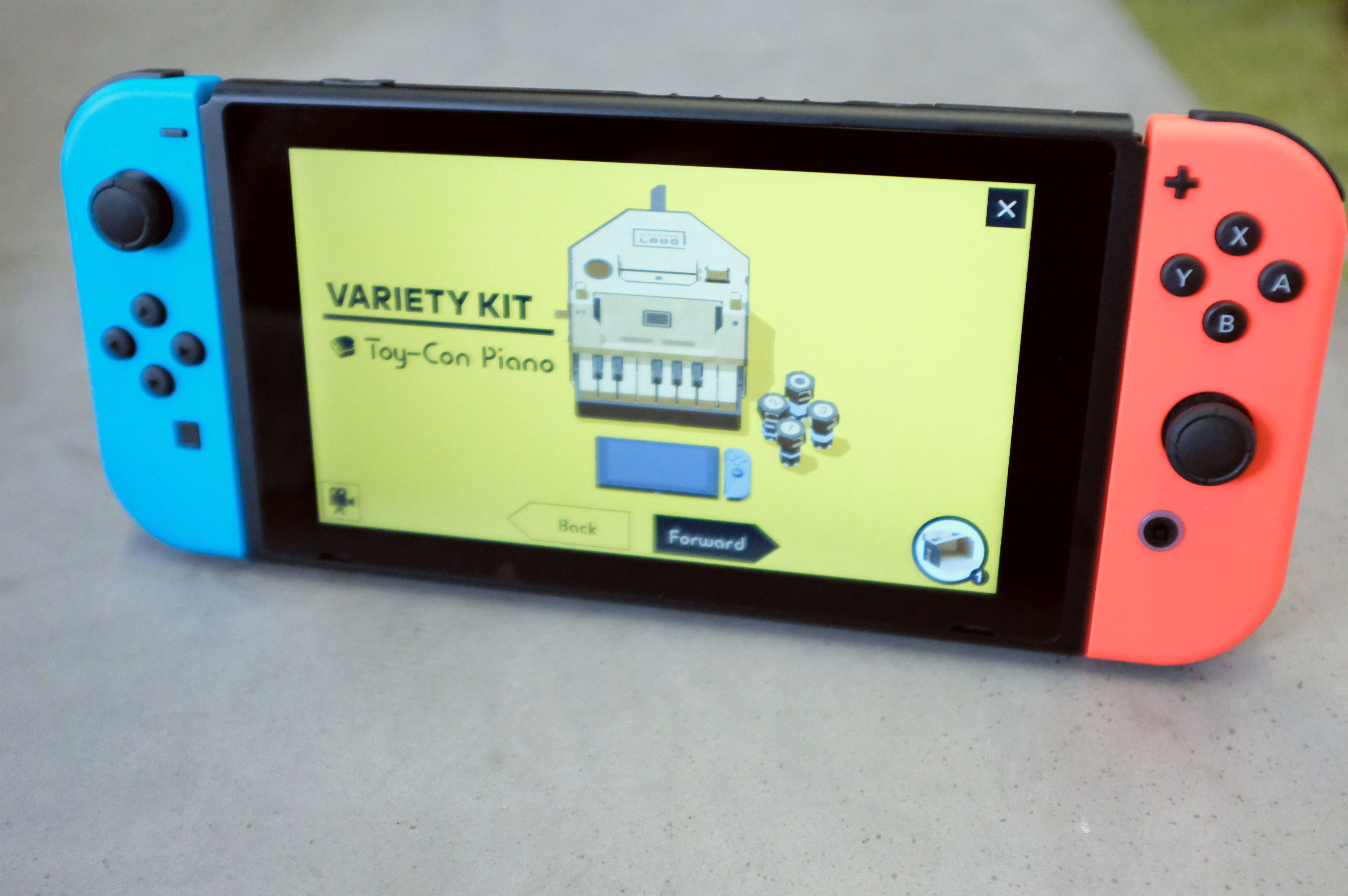
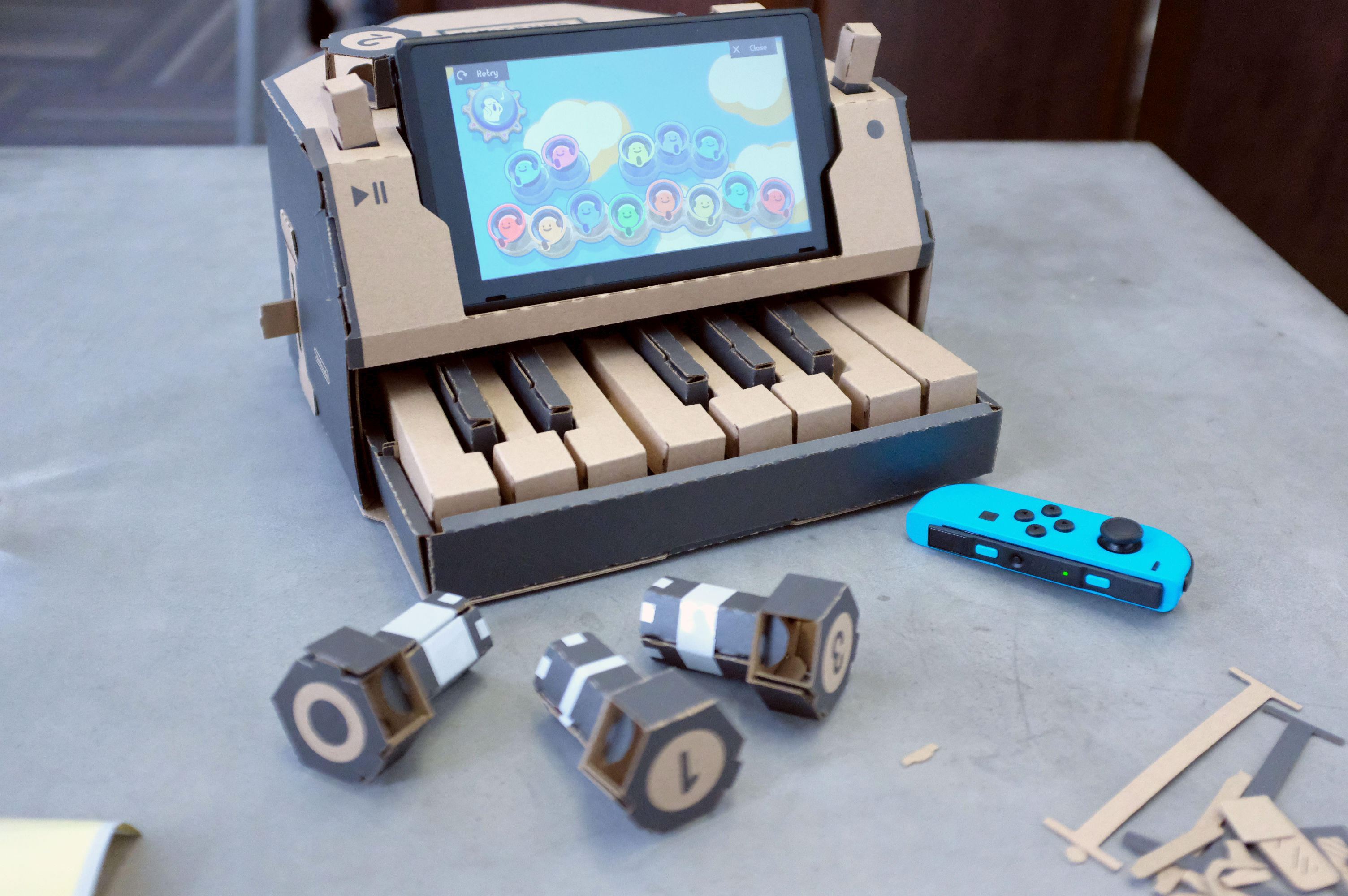
The piano should take two-and-a-half to three-and-a-half hours, by Nintendo’s estimates. I built the thing in about two hours — an accomplishment of sorts for a grown-up person who was supposed to be working. Even so, it reflects just how large of a time sink these projects are. That’s certainly good news for parents looking for the ideal project for a rainy day. It’s a clever little play that leverages a video game system to get them to do something other than play video games. Neat trick, Nintendo.
The primary set is a big, flat and heavy box with 28 cardboard sheets, comprising six different projects. There’s a plastic bag inside, too, containing a random assortment of knick knacks — rubber bands, reflective stickers, washers — all of which will come in handy down the road. There’s no real instruction booklet, because the Switch is going to do all of the heavy lifting there.

The screen walks you through the process of building, one patient step a time. The touchscreen instructions are superior to paper in a number of ways, including a number of animated videos showing off the motions of properly working components, and the ability to pivot the camera angles to get a full 360-degree view of the build. You can rewind if you need to back up, or fast-forward when things get repetitive — like they did with the piano’s 13 keys.

Cardbored?

Don’t go too fast, though. The kit tosses some curve balls at you — as in the case of some tabs that are folded inward, to double as springs. That, however, is the one constant. Folding. So, so much folding. Honestly, it gets pretty tedious on the longer projects. The instructions actually make light of this fact, from time to time, with little quips about the repetition. It also recommends stepping away before a particularly grueling section — probably the right move for both your sanity and health.

Once you get into the rhythm, however, it’s strangely meditative. Tap, fold. Tap, fold. Tap, fold. Tap, fold. Tap, fold. Tap, fold. Tap, fold. Tap, fold. Tap, fold. Tap, fold. Tap, fold. Tap, fold. Tap, fold. Tap, fold. Tap, fold. Tap, fold. Tap, fold. Tap, fold. Tap, fold. Tap, fold. Tap, fold. Tap, fold. Tap, fold. Tap, fold. Tap, fold. Tap, fold. Tap, fold. Tap, fold. Tap, fold. Tap, fold. Tap, fold. Tap, fold. Tap, fold. Tap, fold. Tap, fold. Tap, fold. Tap, fold. Tap, fold. Tap, fold. Tap, fold. Tap, fold. Tap, fold. Tap, fold. Tap, fold. Tap, fold. Tap, fold. Tap, fold. Tap, fold. Tap, fold. Tap, fold. Tap, fold. Tap, fold. Tap, fold. Tap, fold. Tap, fold. Tap, fold. Tap, fold. Tap, fold. Tap, fold. Tap, fold. Tap, fold. Tap, fold.

Congratulations, you’ve completely 1/6 steps.

I’d say it’s not the destination, it’s the journey, but honestly, it’s really about the destination here. The most satisfying part in all of this was how seemingly abstract shapes lock into place and create a fully formed object. These little kits are truly remarkable feats of engineering in their own right, and in the case of the piano, it’s incredible satisfying to see the object completed — and actually get to play the keys, recognizing the role each individual piece plays in the whole creation.

There are so many smart touches here, from the incorporation of the Joy-Cons, to the use of reflective tape, which triggers the Switch’s built in cameras. It’s that functionality that makes the piano keys play notes through the Switch itself. It also triggers the arms and legs on the robot through a set of pulleys.

It’s equally relieving the moment you realize you did everything right. Though I still had a few instances where I found myself having to backtrack multiple steps, because I’d missed a fold or turned something the wrong way. Also, as the instructions note, folding is at the heart of the project. A bad or incomplete fold can lead to heartbreak at the end. So fold, children. Fold like your lives depend on it.

Building stories
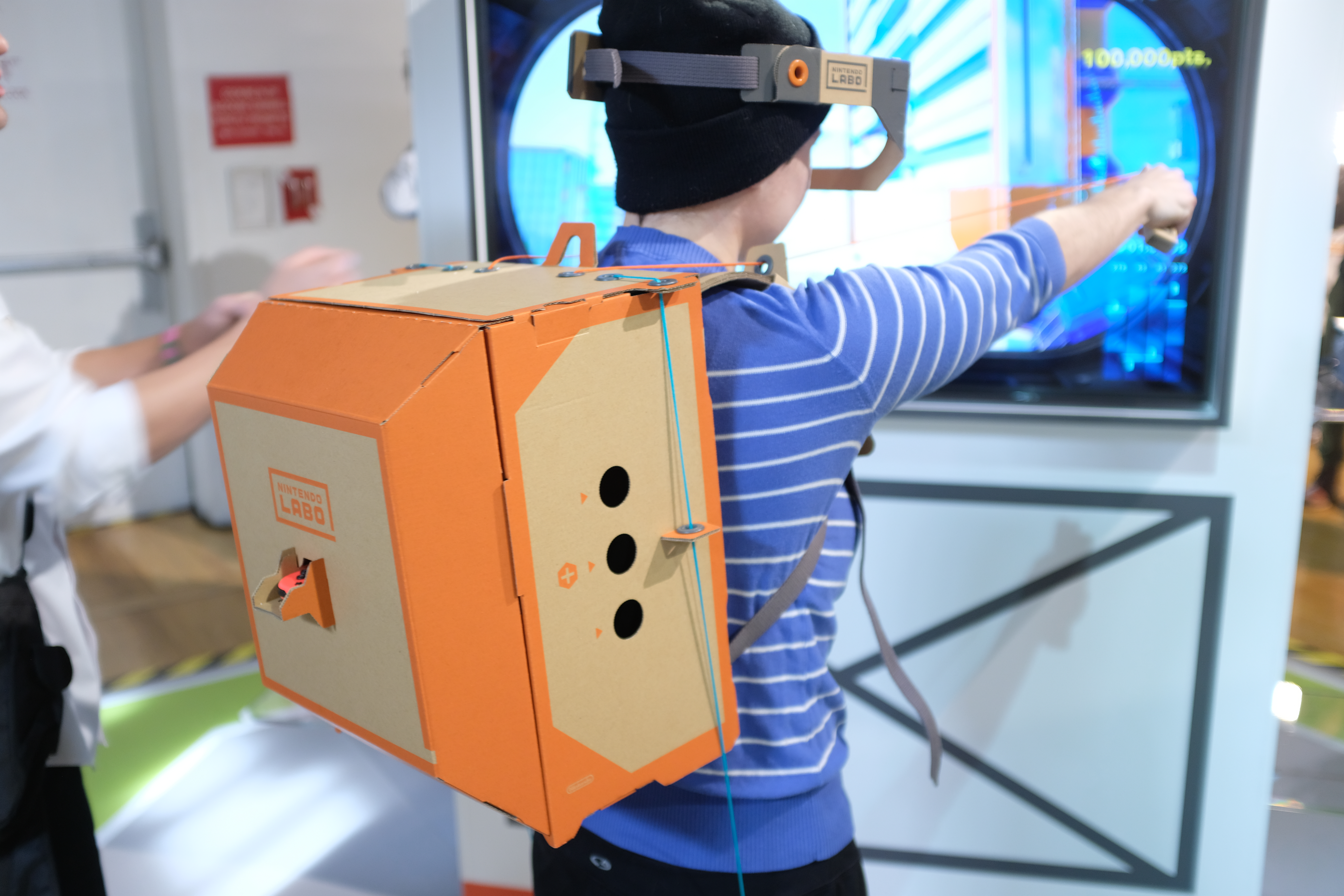
Companies that make coding toys will usually tell you the same thing: it ultimately doesn’t matter that they’re not built in some universal programming language, so long as they teach the fundamentals. The jury is still out on all that, as far as I’m concerned, but I think there’s a lot to be said for a product that’s capable of fostering curiosity and love in some bigger idea. That, I think, is the biggest appeal of Labo. It encourages kids to step outside the console for a minute and build something with their hands.

Does building a Labo piano or fishing rod make you any more qualified to create the real thing? Not really, but it does help foster a genuine interest in the way things work. A maker friend of mine recently related a story to me about how she got into the culture. Her parents came home one day and she had disassembled and reassembled a computer, in order to install a component. From then on, she told me, they came to her for computer help.

Every maker has a story like that — a first step that often involves tearing down a computer or clock or toaster, piece by piece. Labo potentially affords the ability to explore that path without destroying some antique clock in the process. (Though, if it’s successful with your kids, I’d keep a close eye on your piano, if you have one at home.) Parental guidance is also recommended for the more complex projects, making for a great opportunity to bond with kids through creation with a side of frustration. And when you’re done, you’ve got a lovely object that looks like it stepped out of the panels of Calvin & Hobbes.

If your kids don’t have the passion to build — they’ll also learn that lesson pretty quickly. Many kids simply won’t have the patience to sit still and fold for hours on end. It’s also worth pointing out that the objects, when finished, are fragile. They are cardboard, after all. Water is their mortal enemy, and rowdy kids are a close second — pieces can easily rip or tear, even accidentally during the building process. Thankfully, the company has started selling pieces individually.

Of course, $70 isn’t an insignificant amount to pay to find all of that out. And by just about any measure, it’s a pretty steep premium for what amounts to a cardboard box full of cardboard. And, of course, that doesn’t factor in the price of the Switch itself.

But what the kit does afford is continual discovery. From there, kids can graduate to the massive Robot Kit (saving that one for a rainy weekend), which runs $80 and features a complex pulley system and a fun little game where you’re a mech trampling some poor, defenseless city. Even more compelling (and significantly less expensive), however, is Toy-Con Garage.

Built into both packs, the portal lets kids remix and hack creations, offering a breaking down of the technologies involved. If there’s a gateway to the wonderful world of making in this box, it’s this. The pre-determined kits are as much a lesson in following instructions as they are building. Toy-Con Garage, on the other hand, opens the door to true creativity.

Labo is the most bizarre, creative and uniquely Nintendo product since the Switch itself. It’s not for every kid — that much is certain. And the $70 fee will make it cost prohibitive for many parents. But those who take to it will do so like ducks to water — and hopefully won’t get that cardboard wet in the process.
20 Apr 2018

Pivotal Software closed up 5% following IPO, raised $555 million

Stock market investors showed lukewarm enthusiasm for Pivotal Software’s debut on Friday. After pricing the IPO at $15, the company closed the day at $15.73.

Although it didn’t “pop” for new investors, pricing at the midpoint of its proposed range allowed Pivotal to raise $555 million. Its public company market cap exceeded $3 billion.

The enterprise cloud computing company has been majority-owned by Dell, which came about after its merger with EMC in 2016. It was spun off from Dell, EMC and VMware in April 2013.

After that, it raised $1.7 billion in funding from Microsoft, Ford and General Electric.

Here’s how it describes its business in the S-1 filing:

Pivotal looks to “provide a leading cloud-native platform that makes software development and IT operations a strategic advantage for our customers. Our cloud-native platform, Pivotal  Cloud Foundry (‘PCF’), accelerates and streamlines software development by reducing the complexity of building, deploying and operating new cloud-native applications and modernizing legacy applications.”

According to the filing, Pivotal brought in $509.4 million in revenue for its fiscal year ending in February. This is up from $416.3 million in revenue for 2017 and $280.9 million in revenue the year before.

The company is still losing a lot of money, however. Losses for fiscal 2018 stood at $163.5 million, improved from the than the negative $232.5 million seen in 2017 and $282.5 million in 2016.

“We have incurred substantial losses and may not be able to generate sufficient revenue to achieve and sustain profitability,” the company warned in the requisite “risk factors” section of its IPO filing.

Pivotal also acknowledged that it faces competition from “legacy application infrastructure and middleware form vendors” like IBM and Oracle. The company says it additionally competes with “open-source based offerings supported by vendors” like RedHat. Pivotal also faces challenges from SAP Cloud Platform, Amazon Web Services and Microsoft Azure.

The company says it believes it will stand out from the pack because of its strong security and easy-to-use platform. Pivotal also claims to have strong brand awareness and a good reputation. It has 118 U.S. patents and 73 pending and is betting that it will remain innovative.

Morgan Stanley and Goldman Sachs served as lead underwriters. Davis Polk and Fenwick & West worked as counsel.

The company listed on the New York Stock Exchange under the ticker “PVTL.”

It has been an active spring for tech IPOs, after a slow winter. Dropbox, Spotify and Zuora are amongst the companies that have gone public in recent weeks. DocuSign, Smartsheet, Carbon Black and Pluralsight are all expected to debut within the next month.

20 Apr 2018

Founder of cryptocurrency debit card faces new fraud charges for $32 million ICO scheme

The U.S. government is following through on its promise to crack down on initial coin offering scams. On Friday, the SEC announced charges against Raymond Trapani, the third co-founder of Centra Tech Inc., which raised $32 million for a cryptocurrency debit card last year through a flashy ICO endorsed by DJ Khaled and boxer Floyd Mayweather. The company’s other two co-founders, Sam Sharma and Robert Farkas were charged and arrested earlier this month.

“We allege that the Centra co-founders went to great lengths to create the false impression that they had developed a viable, cutting-edge technology,” the SEC’s Cyber Unit Chief Robert A. Cohen said of the ICO . “Investors should exercise caution about investments in digital assets, especially when they are marketed with claims that seem too good to be true.”

The SEC calls Trapani the “mastermind” of the fraudulent ICO scheme, which lured investors with claims of major credit card partnerships, misrepresentations about the company’s product, fake founder biographies and price manipulation of its Centra tokens (CTR).

According to SEC documents, these particular ICO fraud artists were caught red-handed:

“Text messages among the defendants reveal their fraudulent intent. After receiving a cease-and-desist letter from a major bank directing him to remove any reference to the bank from Centra’s marketing materials, Sharma texted to Farkas and Trapani: “[w]e gotta get that s[***] removed everywhere and blame freelancers lol.” And, while trying to get the CTR Tokens listed on an exchange using phony credentials, Trapani texted Sharma to “cook me up” a false document, prompting Sharma to reply, “Don’t text me that s[***] lol. Delete.”

The U.S. Attorney’s Office for the Southern District of New York also unsealed criminal securities and wire fraud charges against Trapani, who was arrested Friday morning. Trapani faces one count of conspiracy to commit securities fraud, one count of conspiracy to commit wire fraud, one count of securities fraud and one count of wire fraud. Three out of the four charges carry a maximum sentence of 20 years,

“As alleged, Raymond Trapani conspired with his co-defendants to lure investors with false claims about their product and about relationships they had with credible financial institutions,” Deputy U.S. Attorney Robert Khuzami said of the criminal charges.

“While investing in virtual currencies is legal, lying to deceive investors is not.”

20 Apr 2018

German Supreme Court dismisses Axel Springer lawsuit, says ad blocking is legal

Germany’s Supreme Court dismissed a lawsuit yesterday from Axel Springer against Eyeo, the company behind AdBlock Plus.

The European publishing giant (which acquired Business Insider in 2015) argued that ad blocking, as well as the business model where advertisers pay to be added to circumvent the white list, violated Germany’s competition law. Axel Springer won a partial victory in 2016, when a lower court ruled that it shouldn’t have to pay for white listing.

However, the Supreme Court has now overturned that decision. In the process, it declared that ad-blocking and Eyeo’s white list are both legal. (German speakers can read the court’s press release.)

After the ruling, Eyeo sent me the following statement from Ben Williams, its head of operations and communications:

Today, we are extremely pleased with the ruling from Germany’s Supreme Court in favor of Adblock Plus/eyeo and against the German media publishing company Axel Springer. This ruling confirms — just as the regional courts in Munich and Hamburg stated previously — that people have the right in Germany to block ads. This case had already been tried in the Cologne Regional Court, then in the Regional Court of Appeals, also in Cologne — with similar results. It also confirms that Adblock Plus can use a whitelist to allow certain acceptable ads through. Today’s Supreme Court decision puts an end to Axel Springer’s claim that they be treated differently for the whitelisting portion of Adblock Plus’ business model.

Axel Springer, meanwhile, described ad blocking as “an attack on the heart of the free media” and said it would appeal to the country’s Constitutional Court.

20 Apr 2018

YouTube ads for hundreds of brands still running on extremist and white nationalist channels

It’s been more than a year since YouTube promised to improve controls over what content advertisers would find their ads in front of; eight months since it promised to demonetize “hateful” videos; two months since it said it would downgrade offensive channels; and yet CNN reports that ads from hundreds of major brands are still appearing as pre-rolls for actual Nazis.

The ongoing failure to police billions of hours of content isn’t exactly baffling — this is a difficult problem to solve — but it is disappointing that YouTube seems to have repeatedly erred on the side of monetization.

As with previous reports, CNN’s article shows that ads were running on channels that, if YouTube’s content rules are to be believed, should have been demonetized and demoted instantly: Nazis, pedophiles, extremists of the right, left, and everywhere in between. Maybe even Logan Paul.

And the system appears to be working in strange ways: one screenshot shows a video by a self-avowed Nazi, entitled “David Duke on Harvey Weinstein exposing Jewish domination. Black/White genetic differences.” Below it a YouTube warning states that “certain features have been disabled for this video,” including comments and sharing, because of “content that may be inappropriate or offensive to some audiences.”

A cheerful ad from Nissan is running ahead of this enlightening piece of media, and CNN notes that ads also ran on it coming from the Friends of Zion Museum and the Jewish National Fund! Ads from the Toy Association ran on the channel of a guy who argued for the decriminalization of pedophilia!

I can’t really add anything to this. It’s so absurd I can barely believe it myself. Remember, this is after the company supposedly spent a year (at the very least) working to prevent this exact thing from happening. I left the headline in the present tense because I’m so certain that it’s still going on.

The responsibility really is YouTube’s, and if it can’t live up to its own promises, companies are going to leave it behind rather than face viral videos of their logo smoothly fading into a swastika on the wall of some sad basement-dwelling bigot. “Subway — eat fresh! And now, some guy’s thoughts on genocide.”

Some of the other brands that had ads run against offensive content: Amazon, Adidas, Cisco, Hilton, Hershey, LinkedIn, Mozilla, Netflix, Nordstrom, The Washington Post, The New York Times, 20th Century Fox Film, Under Armour, The Centers for Disease Control, Department of Transportation, Customs and Border Protection, Veterans Affairs the US Coast Guard Academy.

I’ve asked YouTube for comment on how this happened — or rather, how it never stopped happening.

20 Apr 2018

Startup ecosystem report: China is rising while the U.S. is waning

Startups are a gamble, but it’s possible to better understand why some thrive and many more die by looking at the ecosystems in which they operate. Such is the mission of eight-year-old Startup Genome, comprised of a group of researchers and entrepreneurs who, every year, interview thousands of founders and investors around the world to get a better handle on what’s changing in the regions where they operate, and what remains stubbornly the same.

The larger objective is to figure out how to help more startups succeed, and the outfit — which this year surveyed 10,000 founders with the help of partners like Crunchbase and Dealroom — produced some data that should perhaps concern those in the U.S. To wit, China looks positioned to overtake U.S. dominance when it comes to numerous tech sectors. Consider: In 2014, just 14 percent of so-called unicorns were based in China. Between the start of last year through today, that percentage has shot up to 35 percent, while in the U.S., the number of homegrown unicorns has fallen from 61 percent to 41 percent of the overall global number.

You could argue that investors are simply assigning China-based startups overly lofty valuations, as happened here in the U.S., and we partly believe that to be true. But China is also clearly “in it to win it,” based on a look at patents, with four times as many AI-related applications and three times as many crypto- and blockchain-related patents registered in China last year. With so much of the tech industry now focused on deep tech, it’s worth noting. In fact, as much as we loathed the January Financial Times column penned by famed VC Michael Moritz, who suggested that U.S. companies follow China’s lead, his underlying call to arms was probably, gulp, prescient in its own way.

What else should startups know? According to Startup Genome’s findings, in addition to the rise of AI, blockchain and robotics manufacturing, there are clearly declining sub sectors, too, including, least surprisingly, ad tech, which has seen a roughly 35 percent drop in funding over the last five years. No doubt that ties directly to the growing dominance of Facebook and Google, which accounted for 73 percent of all U.S. digital advertising last year, according to the equity research firm Pivotal.

That doesn’t mean ad tech startups are cooked, notes the study’s authors. Rather, declining sub-sectors are often “mature” but can be revived by new technologies. In this case, while funding for adtech has dropped, virtual reality and augmented reality could well inject some new growth into the industry at some point. Maybe.

Either way, to us, the most interesting facets of this report — and it really is worth poring over — are the connections it’s able to make by talking with so many people around the world. It addresses, for example, how Stockholm, a relatively small startup ecosystem, is able to produce sizable startups at a meaningful rate, versus Chicago, whose ecosystem is ostensibly three times bigger. (The answer: Stockholm’s startup founders are apparently better connected to the world’s top seven ecosystems.)

Also quite interesting is the report’s findings about women founders, who build more relationships with regional founders and are more locally connected than their male counterparts — except with investors. That’s bad news for both women founders and investors, as local connectedness is associated with better startup performance.

To read the report in full, click over here. You have to fork over your email address, but with 240 pages filled with fascinating nuggets and other useful information, you’ll likely find it well worth it.

20 Apr 2018

Twitter banned Russian security firm Kaspersky Lab from buying ads

The U.S. government isn’t the only one feeling skittish about Kaspersky Lab. On Friday, the Russian security firm’s founder Eugene Kaspersky confronted Twitter’s apparent ban on advertising from the company, a decision it quietly issued in January.

“In a short letter from an unnamed Twitter employee, we were told that our company ‘operates using a business model that inherently conflicts with acceptable Twitter Ads business practices,'” Kaspersky wrote.

“One thing I can say for sure is this: we haven’t violated any written – or unwritten – rules, and our business model is quite simply the same template business model that’s used throughout the whole cybersecurity industry: We provide users with products and services, and they pay us for them.”

He noted that the company has spent around than €75,000 ($93,000 USD) to promote its content on Twitter in 2017.

Kaspersky called for Twitter CEO Jack Dorsey to specify the motivation behind the ban after failing to respond to an official February 6 letter from his company.

“More than two months have passed since then, and the only reply we received from Twitter was the copy of the same boilerplate text. Accordingly, I’m forced to rely on another (less subtle but nevertheless oft and loudly declared) principle of Twitter’s – speaking truth to power – to share details of the matter with interested users and to publicly ask that you, dear Twitter executives, kindly be specific as to the reasoning behind this ban; fully explain the decision to switch off our advertising capability, and to reveal what other cybersecurity companies need to do in order to avoid similar situations.”

In a statement about the incident, Twitter reiterated that Kaspersky Lab’s business model “inherently conflicts with acceptable Twitter Ads business practices.” In a statement to CyberScoop, Twitter pointed to the late 2017 Department of Homeland Security directive to eliminate Kaspersky software from Executive Branch systems due to the company’s relationship with Russian intelligence.

“The Department is concerned about the ties between certain Kaspersky officials and Russian intelligence and other government agencies, and requirements under Russian law that allow Russian intelligence agencies to request or compel assistance from Kaspersky and to intercept communications transiting Russian networks,” DHS asserted in the directive at the time.

20 Apr 2018

SF supervisor doesn’t want you riding electric scooters on sidewalks

For those of you keeping track of the scooter saga in San Francisco, Supervisor Aaron Peskin has filed a resolution in opposition of California State Assembly bill 2989.

The bill, authored by Assembly Member Heath Flora and sponsored by electric scooter startup Bird, seeks to increase the speed limit of electric scooters from 15 to 20 mph, increase the wattage to 250 to 750, let people ride them on sidewalks and only require minors to wear helmets.

San Francisco’s Board of Supervisors and the Municipal Transportation Agency are actively creating a permitting process to better regulate scooters. The intent is to ensure “sensible, regulatory frameworks,” Peskin said earlier this week.

In legislative meetings earlier this week, members of the public and supervisors expressed concerns pertaining to people operating scooters on sidewalks, as well as people riding them without helmets. This bill, introduced back in February, would essentially enable the opposite of what San Francisco envisions.

“While San Francisco policymakers pursue common sense regulation of standup electronic scooters to enhance the public benefit of this new shared mobility technology and to reduce potential harm to the public, state legislators seek to eliminate elements of the Vehicle Code that exist to protect the health and safety of members of the public including users of standup electric scooters,” Peskin wrote in his resolution.

I’ve reached out to Bird and will update this story when I hear back.

20 Apr 2018

ZTE says export ban will ‘severely impact’ its survival

It’s been a hell of a week for ZTE. News Monday that it was being hit with a seven-year export ban sent the company scrambling. The Chinese handset maker suspended its earnings report and reportedly sent its lawyers to meet with Google to see if anything could be worked out about a punishment that could hamper its ability to utilize Android and various key services.

Four days after we first reached out, ZTE has finally offered us an official reaction to the news. And it’s a doozy. The six-paragraph official statement from corporate mulls over the punishment and reasserts ZTE’s compliance to international law, which it “regard[s] as the foundation and bottom-line of the company’s operation.”

ZTE adds that it invested “over $50 million in its export control compliance program and is planning to invest more resources in 2018.” So, why did the company get dinged by the U.S. Department of Commerce for failure to significantly reprimand staff after pleading guilty to violating sanctions on Iran and North Korea?

The company contends that the U.S. Bureau of Industry and Security “ignored” its “diligent work” and progress it has made in complying with the law, calling the punishment, “unfair.” Seven years is certainly severe, given that U.S.-based companies make north of a quarter of the components used in the company’s handsets, according to estimates.

That, coupled with U.S.-based software makers, Google included, put the company in an extremely tight spot moving forward, and will likely require a complete rethink of ZTE’s business model, if upheld.

“The Denial Order will not only severely impact the survival and development of ZTE,” the company says, “but will also cause damages to all partners of ZTE including a large number of U.S. companies.” ZTE adds that it will continue to fight the ruling, taking “judicial measures,” if necessary.

The punishment comes as ZTE finds itself targeted by the U.S. government over spying charges, alongside fellow Chinese handset maker, Huawei.


20 Apr 2018

Twitter is down again for some

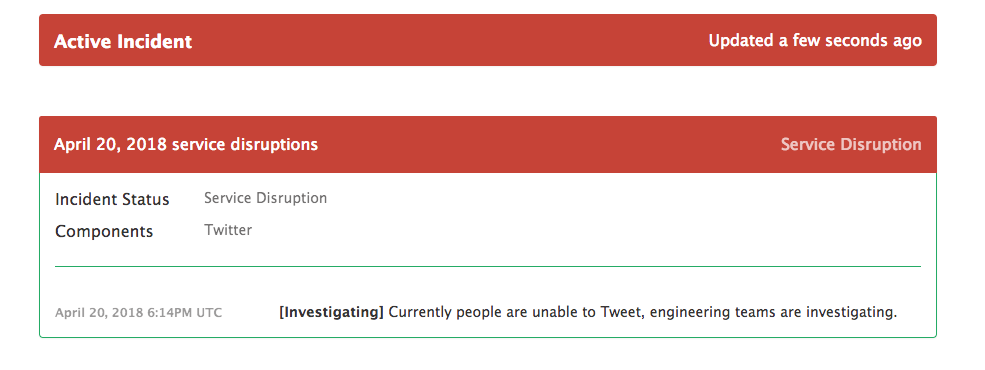
Rough week to be in Twitter support. Three days after the site experienced downtime across the globe, the site was hit by another outage. Status.io’s service site is currently listing a “active incident,” leaving many users unable to tweet. In other cases, the site isn’t loading at all, instead serving up internal server errors or messages stating that the service is “over capacity.”

Here in the States, at least, the issue doesn’t appear to be quite as widespread as Tuesday’s incident. We’ve reached out to Twitter for comment and will update as soon as we hear more.