Year: 2018

20 Apr 2018

iOS 11’s new App Store boosts downloads by 800% for featured apps

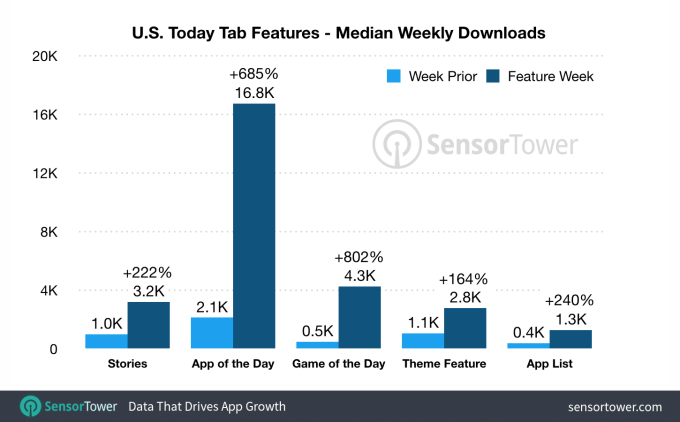
When Apple launched its new App Store in iOS 11 back in September, it aimed to offer app developers better exposure, as well as a better app discovery experience for consumers. A new study from Sensor Tower out today takes a look at how well that’s been working in the months since. According to its findings, getting a featured spot on the new App Store can increase downloads by as much as 800 percent, with the “App of the Day” or “Game of the Day” spots offering the most impact.

The app store intelligence firm examined data from September 2017 to present day to come to its conclusions, it says.

During this time, median U.S. iPhone downloads for apps that snagged the “Game of the Day” spot increased by 802 percent for the week following the feature, compared to the week prior to being featured.

“App of the Day” apps saw a boost of 685 percent.

Being featured in other ways — like in one of the new App Store Stories or in an App List — also drove downloads higher, by 222 percent and 240 percent, respectively.
The numbers seem to indicate that Apple is achieving the results it wanted with the release of its redesigned App Store.

Over the years, Apple’s app marketplace had grown so large that finding new apps had become challenging. And developers sometimes found ways to bump their apps higher in the top charts for exposure, leaving iPhone owners wondering if a new app was really that popular, or if it was some sort of paid promotion.

The iOS 11 App Store, on the other hand, has taken more of an editorial viewpoint to its app recommendations. While the top charts haven’t gone away, the focus these days is on what Apple thinks is best — not the wisdom of the masses. Apple has applied its editorial eye to things like timely round-ups of apps; curated, thematic collections; as well as articles about apps and interviews with developers. Apple also picks an app and game to feature daily, so the App Store always has fresh content and a reason for users to return.

The end result is something that’s more akin to a publication about apps, instead of a just an app marketplace.

What’s most interesting, then, in Sensor Tower’s report, are what sort of app publishers Apple has chosen to feature.

Apple had touted the App Store changes would be a way to give smaller developers more exposure. But if you’ve popped into the App Store from time to time, you may have noticed that big publishers — not indies — were having their apps featured.
In fact, an early report about the App Store revamp criticized Apple for giving big publishers too much attention. It said that apps from brands like Starbucks and CBS, or game makers like EA and Glu, weren’t exactly hurting for downloads.

But Apple’s favoring of big publishers is only true to a point, says Sensor Tower.

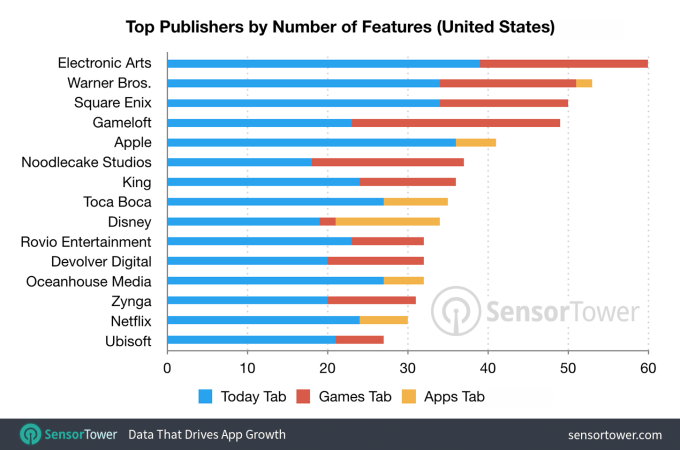
It found that 13 of the top 15 featured publishers (by number of features) had at least one million U.S. iPhone downloads since the launch of the new App Store last September. It’s not surprising that Apple wants to highlight these publishers. Many of them, and particularly the game publishers, have multiple popular apps. So when their apps get an update or they have a new release, consumers pay attention.

Apple, of course, wants to capitalize on that consumer interest because it shares in the revenue app publishers generate through things like paid downloads, in-app purchases and subscriptions.
However, Apple isn’t only giving the limelight to large publishers, says Sensor Tower.

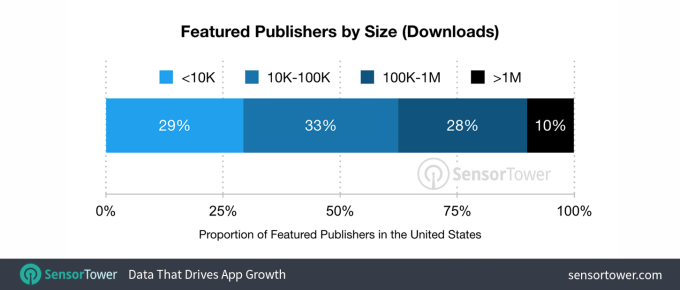
It also found that 29 percent of the apps it has featured since the launch of the revamped App Store were from publishers who had fewer than 10,000 downloads during that time.

“While it’s clearly the case that big publishers are more likely to receive the largest number of features, small publishers still very much have their chance to benefit from a feature on the App Store,” said Sensor Tower’s Mobile Insights Analyst, Jonathan Briskman.

Though Sensor Tower’s published report focused only on the iOS App Store, it’s worth noting how it compares with Google Play.

Getting a featured spot on Google’s app store isn’t as impactful, the firm tells TechCrunch. The largest week-over-week increase to the median it saw there was only around 200 percent.

Image credits, all: Sensor Tower 
20 Apr 2018

Watch how Steven Spielberg framed ‘Ready Player One’ shots in VR

Despite plenty of skepticism over early trailers and the source material itself, Steven Spielberg’s Ready Player One has been doing very well at the box office. En mi opinion, it made a lot of quality shifts from the book that made it a quality popcorn flick that wasn’t too nerdishly pretentious.

A lot of people in the virtual reality industry had sky-high expectations for the movie to drive people to buying VR headsets, and while that probably isn’t happening, the movie has given an opportunity to a lot of these insiders to showcase how far the technology has come. Today, HTC released a video showing how VR was used in the production of Ready Player One by the actors and the man himself, Steven Spielberg.

The video offers a healthy chunk of heavy-handed PR for Vive. Nevertheless, what’s cool about the video is what it showcases about how acting has changed because of visual effects and how technology platforms can equal the playing field a bit by getting creatives deeper inside visual worlds to deliver edits with a more precise set of tools. As the actors were clad in mo-cap suits, VR offered them a chance to orient themselves.

For Spielberg, himself, VR offered an opportunity to move freely through rough digital environments and frame shots while in full view of the 3D designs. Tech tools like the in-VR editors for game engines that Unity and Epic Games have built have done wonders for game developers wanting to peer inside game worlds, but they also have plenty to offer in more of a view-only sense where non-technical folk can explore details and pipe off commands for what they want a scene or model or environment to look like.

20 Apr 2018

RealSelf, a community for cosmetic treatments, raises $40 million

RealSelf, an online community where people can ask questions, share their experiences and connect with doctors providing cosmetic treatments, has raised $40 million in new funding — its first round of financing since the $2 million raised in 2008, two years after its founding. The round was led by Elephant, a VC firm co-founded by Warby Parker co-founder Andy Hunt.

Hunt will also join RealSelf’s board of directors with the close of this round.

RealSelf offers one of the largest online communities for those who want to learn more about cosmetic procedures, including plastic surgery and other non-surgical treatments, like Botox injections. It’s the sort of thing people don’t necessarily want to talk about openly on social networks, but RealSelf has found a way to get people to socialize around the topic. Its users — anonymously — post reviews, have discussions, ask questions and even detail their progress in post-op photos series.

Reading through someone’s experiences not only gives people better insight into what a procedure is like, it also provides an emotional support system for those who are recovering.

The idea for the company came from Expedia alum Tom Seery, following a discussion he had with his wife about how hard it was to get the true story about which cosmetic treatments are actually worth the cost and show results. RealSelf’s goal is to bring more transparency to a market where customers before had been sold on promises and hype, often by doctors who would gloss over the downsides — like months spent in painful recovery — or the potential bad outcomes from riskier procedures.

Since its launch, RealSelf has grown to include more than 2 million anonymous patient reviews, ratings and photos regarding hundreds of different aesthetic procedures.

And demand for this sort of information continues to grow, along with the overall market.

Last year, for example, there were more than 17.5 million surgical and non-surgical cosmetic treatments performed in the U.S., up from 13.1 million procedures in 2010, the company notes. Much of that growth comes from minimally invasive, non-surgical treatments, which outpaced surgeries nearly eight to one.

With more people looking for information about these procedures online, RealSelf has seen its visitor counts climb. Last year, nearly 94 million people visited the site from more than 100 countries — a metric that’s up more than 270 percent since 2013; 40 percent of those visitors were from outside the U.S.

In addition to helping users network and review their own treatments, RealSelf also allows doctors to answer users’ questions, create profiles, share their own before-and-after’s and offer consultations to those who contact them.

The company makes money by offering these doctors a way to target their potential customers, and has been profitable for years as a result.

Every month, RealSelf facilitates around 500,000 connections between consumers and doctors, the company says.

The funding will allow RealSelf to add fuel to its fire, says its founder.

“Our investors bring incredible experience and insight in building household name brands and businesses for the long-term. I am thrilled to have Elephant and our other new investors join our roster and welcome Andy to our board,” said Seery, in an announcement about the round. “We’ve bootstrapped RealSelf into a market leading position that helps millions learn about cosmetic treatments and connect with doctors. Now is our time to step on the gas. We are doubling down to grow awareness, drive innovation and extend our global reach to help anyone considering cosmetic treatments make more confident decisions,” he added.

The company, which already has more than 200 employees, plans to hire “significantly” this year, and double its office space in Seattle’s Pioneer Square neighborhood in June. It has also just brought on its first CMO, Tanja Omeze, previously the head of marketing for the Amazon Video Store, and who has led marketing at Weight Watchers, Verizon Wireless and Scholastic.

“Tom and the team at RealSelf have done an amazing job building a trusted marketplace where consumers and medical experts come together to share information and connect,” said RealSelf’s new board member, Hunt. “Historically, we have invested in companies that provide consumers with transparency in complex markets. RealSelf has built the leading platform allowing consumers to find detailed information, share stories and make better, safer decisions about extremely personal aesthetics choices,” he said.

20 Apr 2018

Facebook has auto-enrolled users into a facial recognition test in Europe

Facebook users in Europe are reporting the company has begun testing its controversial facial recognition technology in the region.

Jimmy Nsubuga, a journalist at Metro, is among several European Facebook users who have said they’ve been notified by the company they are in its test bucket.

The company has previously said an opt-in option for facial recognition will be pushed out to all European users next month. It’s hoping to convince Europeans to voluntarily allow it to expand its use of the privacy-hostile tech — which was turned off in the bloc after regulatory pressure, back in 2012, when Facebook was using it for features such as automatically tagging users in photo uploads.

Under impending changes to its T&Cs — ostensibly to comply with the EU’s incoming GDPR data protection standard — the company has crafted a manipulative consent flow that tries to sell people on giving it their data; including filling in its own facial recognition blanks by convincing Europeans to agree to it grabbing and using their biometric data after all. 

Notably Facebook is not offering a voluntary opt-in to Europeans who find themselves in its facial recognition test bucket. Rather users are being automatically turned into its lab rats — and have to actively delve into the settings to say no.

In a notification to affected users, the company writes [emphasis ours]: “You control face recognition. This setting is on, but you can turn it off at any time, which applies to features we may add later.”

Not only is the tech turned on, but users who click through to the settings to try and turn it off will also find Facebook attempting to dissuade them from doing that — with manipulative examples of how the tech can “protect” them.

As another Facebook user who found herself enrolled in the test — journalist Jennifer Baker — points out, what it’s doing here is incredibly disingenuous because it’s using fear to try to manipulate people’s choices.

Under the EU’s incoming data protection framework Facebook will not be able to automatically opt users into facial recognition — it will have to convince people to switch the tech on themselves.

But the experiment it’s running here (without gaining individuals’ upfront consent) looks very much like a form of A/B testing — to see which of its disingenuous examples is best able to convince people to accept the highly privacy-hostile technology by voluntarily switching it on.

But given that Facebook controls the entire consent flow, and can rely on big data insights gleaned from its own platform (of 2BN+ users), this is not even remotely a fair fight.

Consent is being manipulated, not freely given. This is big data-powered mass manipulation of human decisions — i.e. until the ‘right’ answer (for Facebook’s business) is ‘selected’ by the user.

Data protection experts we spoke to earlier this week do not believe Facebook’s approach to consent will be legal under GDPR. Legal challenges are certain at this point.

But legal challenges also take time. And in the meanwhile Facebook users will be being manipulated into agreeing with things that align with the company’s data-harvesting business interests — and handing over their sensitive personal information without understanding the full implications.

It’s also not clear how many Facebook users are being auto-enrolled into this facial recognition test — we’ve put questions to it and will update this post with any reply.

Last month Facebook said it would be rolling out “a limited test of some of the additional choices we’ll ask people to make as part of GDPR”.

It also said it was “starting by asking only a small percentage of people so that we can be sure everything is working properly”, and further claimed: “[T]he changes we’re testing will let people choose whether to enable facial recognition, which has previously been unavailable in the EU.”

Facebook’s wording in those statements is very interesting — with no number put on how many people will be made into test subjects (though it is very clearly trying to play the experiment down; “limited test”, “small”) — so we simply don’t know how many Europeans are having their facial data processed by Facebook right now, without their upfront consent.

Nor do we know where in Europe all these test subjects are located. But it’s pretty likely the test contravenes even current EU data protection laws. (GDPR applies from May 25.)

Facebook’s description of its testing plan last month was also disingenuous as it implied users would get to choose to enable facial recognition. In fact, it’s just switching it on — saddling test subjects with the effort of opting out.

The company was likely hoping the test would not attract too much attention — given how much GDPR news is flowing through its PR channels, and how much attention the topic is generally sucking up — and we can see why now because it’s essentially reversed its 2012 decision to switch off facial recognition in Europe (made after the feature attracted so much blow-back), to grab as much data as it can while it can.

Millions of Europeans could be having their fundamental rights trampled on here, yet again. We just don’t know what the company actually means by “small”. (The EU has ~500M inhabitants — even 1%, a “small percentage”, of that would involve millions of people… )

Once again Facebook isn’t telling how many people it’s experimenting on.

20 Apr 2018

AT&T CEO says a new $15-per-month, sports-free streaming service is launching in a few weeks

AT&T CEO Randall Stephenson revealed on Thursday the carrier’s plans to launch another live TV service called “AT&T Watch,” which would offer a cheap, $15-per-month bundle of channels for customers, and be provided to AT&T Wireless subscribers for free. At this price point, the service would be one of the lowest on the market – less than Sling TV’s entry-level, $20-per-month package, and just a bit less than Philo’s low-cost, sports-free offering, priced at $16 per month.

Stephenson, who’s in court defending the proposed $85 billion merger with Time Warner against antitrust claims, announced the service on the witness stand. He held up the soon-to-arrive AT&T Watch as a rebuttal of sorts to the Justice Department’s point about the company’s continually climbing prices for its DirecTV satellite service, according to a report from Variety.

The Justice Department is concerned that, if the merger goes through, AT&T will then raise prices on Time Warner’s Turner networks, like TNT, TBS and CNN in a way that would hurt other pay TV providers.

Few other details were offered regarding AT&T Watch, beyond its price point – which is due to the fact that it will also be sports-free offering, like Philo.

But AT&T’s advantage over competitors is the distribution provided by its AT&T Wireless business. Although its existing streaming service DirecTV Now is one of the newest on the market, it has already reached number two in terms of subscribers, falling behind Sling TV.

Beyond its lack of sports, the channel lineup for AT&T Watch was not discussed, nor was an exact launch date.

Stephenson said the company hoped to launch it in the next few weeks.

20 Apr 2018

This robot can build your Ikea furniture

There are two kinds of people in the world: those who hate building Ikea furniture and madmen. Now, thanks to Ikeabot, the madmen can be replaced.

Ikeabot is a project built at Control Robotics Intelligence (CRI) group at NTU in Singapore. The team began by teaching robots to insert pins and manipulate Ikea parts and then, slowly, began to figure out how to pit the robots against the furniture. The results, if you’ve ever fought with someone trying to put together a Billy, are heartening.

From Spectrum:

The assembly process from CRI is not quite that autonomous; “although all the steps were automatically planned and controlled, their sequence was hard-coded through a considerable engineering effort.” The researchers mention that they can “envision such a sequence being automatically determined from the assembly manual, through natural-language interaction with a human supervisor or, ultimately, from an image of the chair,” although we feel like they should have a chat with Ross Knepper, whose IkeaBot seemed to do just fine without any of that stuff.

In other words the robots are semi-autonomous but never get frustrated and can use basic heuristics to figure out next steps. The robots can now essentially assemble chairs in about 20 minutes, a feat that I doubt many of us can emulate. You can watch the finished dance here, in all its robotic glory.

The best part? Even robots get frustrated and fling parts around:

I, for one, welcome our Ikea chair manufacturing robotic overlords.

20 Apr 2018

Equity podcast: Coinbase buys a startup, Discord’s a unicorn and Netflix soars

Hello and welcome back to Equity, TechCrunch’s venture capital-focused podcast where we unpack the numbers behind the headlines.

This week TechCrunch’s Katie Roof and Crunchbase News’s Alex Wilhelm sat down with Science Inc’s Michael Jones to dig through the latest in the world of technology and money. And goddamn was there some stuff to get through.

On our even-more-stuffed-than-usual agenda this week we first dug into the Coinbase-Earn.com deal, and how it came to be. This raised the question of dividends (which somehow Alphabet still doesn’t have to pay, bringing a new high watermark to the concept of corporate adolescence) and venture firms bringing together two of their own deals under one roof.

Scooting along we turned to Netflix’s staggering earnings run, including its share price rally that has been nigh-parabolic. That took us into MoviePass, whose parent company you have not heard of, and seems to be in potentially serious financial trouble.

After that we jumped into Discord, a popular gaming chat service that is raising another $50 million at a $1.65 billion post-money valuation. That’s a hell of a lot of new money, and a hell of a lot of new market cap. (At this point we also started talking about League of Legends. I am sorry.)

Finally, back on theme, we poured over the DocuSign IPO pricing range that it just dropped, and the Pluralsight S-1, which brought up many fun questions.

All that and we had a few laughs. Hit play, and we’ll chat you all next week!

Equity drops every Friday at 6:00 am PT, so subscribe to us on Apple PodcastsOvercast, Pocket Casts, Downcast and all the casts.

20 Apr 2018

Twitter doesn’t care that someone is building a bot army in Southeast Asia

Facebook’s lack of attention to how third parties are using its service to reach users ended up with CEO Mark Zuckerberg taking questions from Congressional committees. With that in mind, you’d think that others in the social media space might be more attentive than usual to potentially malicious actors on their platforms.

Twitter, however, is turning the other way and insisting all is normal in Southeast Asia, despite the emergence of thousands of bot-like accounts that have followed prominent users in the region en masse over the past month.

Scores of reporters and Twitter users with large followers — yours truly included — have noticed swarms of accounts with generic names, no profile photo, no bio and no tweets have followed them over the past month.

These accounts might be evidence of a new ‘bot farm’ — the creation of large numbers of accounts for sale or usage on-demand which Twitter has cracked down on — or the groundwork for more nefarious activities, it’s too early to tell.

In what appears to be the first regional Twitter bot campaign, a flood of suspicious new followers has been reported by users across Southeast Asia and beyond, including Thailand, Myanmar Cambodia, Hong Kong, China, Taiwan, Sri Lanka among other places.

While it is true that the new accounts have done nothing yet, the fact that a large number of newly-created accounts have popped up out of nowhere with the aim of following the region’s most influential voices should be enough to concern Twitter. Especially since this is Southeast Asia, a region where Facebook is beset with controversies — from its role inciting ethnic hatred in Myanmar, to allegedly assisting censors in Vietnam, witnessing users jailed for violating lese majeste in Thailand, and aiding the election of controversial Philippines leader Duterte.

Then there are governments themselves. Vietnam has pledged to build a cyber army to combat “wrongful views,” while other regimes in Southeast Asia have clamped down on social media users.

Despite that, Twitter isn’t commenting.

The U.S. company issued a no comment to TechCrunch when we asked for further information about this rush of new accounts, and what action Twitter will take.

A source close to the company suggested that the sudden accumulation of new followers is “a pretty standard sign-up, or onboarding, issue” that is down to new accounts selecting to follow the suggested accounts that Twitter proposes during the new account creation process.

Twitter is more than 10 years old, and since this is the first example of this happening in Southeast Asia that explanation already seems inadequate at face value. More generally, the dismissive approach seems particularly naive. Twitter should be looking into the issue more closely, even if for now the apparent bot army isn’t being put to use yet.

Facebook is considered to be the internet by many in Southeast Asia, and the social network is considerably more popular than Twitter in the region, but there remains a cause for concern here.

“If we’ve learned anything from the Facebook scandal, it’s that what can at first seem innocuous can be leveraged to quite insidious and invasive effect down the line,” Francis Wade, who recently published a book on violence in Myanmar, told the Financial Times this week. “That makes Twitter’s casual dismissal of concerns around this all the more unsettling.”

20 Apr 2018

Musiio uses AI to help the music industry curate tracks more efficiently

A former streaming industry exec and an AI specialist walk into a bar, they leave starting an AI company for the music industry.

That’s not exactly how Singapore-based startup Musiio was formed, but it’s close enough and the outcome is the same.

Co-founders Hazel Savage, formerly of Pandora and Shazam, and Swedish data scientist Aron Pettersson connected at Entrepreneur First in Singapore. The program began in London as a way to help likeminded tech connect with the potential to start projects, so it does mirror the serendipity of meeting new friends in a bar.

“We’d probably never have met each other if we hadn’t gone to EF,” Savage told TechCrunch in an interview.

Brit Savage was looking for new ideas after work brought her and her husband to Singapore, and after crunching through some problems that need fixing, the duo settled on an AI service that helps music platforms tackle content and curation.

Push for personalization

Personalization has been the big push for music streaming giants. The initial face of the streaming revolution was based on giving users instant access to millions of songs in a single place, removing the pain of downloads and paying per song. Now that streaming is established, the puck has moved to smarter solutions that help music streamers shift through those tens of millions of songs to find music they like, or better yet discover new tracks they’ll love.

Spotify has moved on this in a major way. Aside from consumer products such as Discovery Weekly, a playlist that pulls in a weekly selection of music tailored to a user, it has invested considerable resources in making its product smarter. That’s including acquisitions such as music intelligence company Echo Nest for $100 million, and smaller AI startup Niland which helps make recommendations and search results smarter. Spotify has also ramped up its internal hires, too.

While Spotify, which recently went public in an unconventional listing, might be the most visible company in need of smarts for music, it is not the only one by far. And we’re not even talking about direct rivals like Pandora, Apple Music, Google and co. Others involved in the less visible — but hugely lucrative — parts of the industry who also need help pouring through millions of tracks include labels, who filter through talent on a daily basis, and agencies that pick out music for brands, advertising, media, etc.

Musiio co-founders Hazel Savage and Aron Pettersson

Not just streaming smarts

That’s the focus for Musiio, which is aiming to use AI to help those without the spending power of Spotify to automate or partially-automate a lot of the heavy lifting when it comes to scouring through music.

“Musiio won’t replace the need to have people listening to music,” Savage told TechCrunch. “But we can delete the inefficiencies.”

The AI uses a combination of deep learning and feature extraction, the latter of which Musiio said allows it to identify and understand patterns and features of a track. The training is focused on the audio itself, rather than stats and data from third-parties which some services use to categorize tracks. Pettersson runs the AI. For what it’s worth, he cut his teeth with an algorithm for the Swedish stock market that netted him a 28 percent annual return for eight years.

As an example of Musiio’s AI potential, Savage points to previous roles where she has observed music curators assigned piles of music as high as 1,300 tracks each day.

“That’s more than a day’s work!” she said. “It probably takes four days to tackle and then you are three days behind. Plus, the average person loses the ability to be efficient after about the first 20 tracks.”

Musiio wants to help take the burden by using AI to pick out the ‘best’ tracks, thus cutting the list of tracks to listen to down significantly.

“Our systems can listen to 1,000 tracks inside four hours, after which we can give a smaller selection. For labels, that can help them be more efficient, increase hit rate and spend more time with artists helping to develop them,” Savage said.

“Artists and repertoire (A&R) divisions have billion-dollar budgets, for every artist they spend maybe $2 million on development. We think we give them a better guarantee of success using AI, and [from early conversations with labels] they are very interested,” she added.

Free Music Archive

Musiio said it is developing solutions for a number of undisclosed clients, but one public name it is talking up is Free Music Archive (FMA), a Creative Commons-like free music site developed by independent U.S. radio station WFMU. The site offers up legal audio downloads that are particularly popular with filmmakers, non-profits, podcasters and remixers.

The site has over 120,000 tracks each of which is hand-selected, but with just one part-time developer the curation side is lacking. That’s where Musiio is hoping to help make a difference. The startup has begun working with FMA to develop AI-based playlists in a project that doesn’t generate revenue but is “a lovely example of what the tech can do,” so says Savage.

“Not only are we backfilling the Echo Nest partnership [after Spotify closed the service following its acquisition] but the lead track in the inaugural playlist (Kurt Vile, ‘I Wanted Everything’) had received 3,000 plays when we found it, after eight years in the database. Two days later after being playlisted by our AI, it had 6,000 plays. We are pretty excited that AI can have that kind of impact,” she explained.

The Vile track is now closing on 10,000 plays two weeks after the playlist was published.

For now, the playlists are created and held within Savage’s FMA account but Musiio confirmed that it is considering the potential to develop a dashboard that would allow listeners themselves to use the AI to develop playlists. That’s already part of what is building for other clients.

Funding-wise, Musiio has taken SG$75,000 ($57,000) as part of its involvement in Entrepreneur First. The startup will be part of the EF demo day in July, but Savage said it has already begun to have conversations with investors with a view to raising a seed round of funding.

20 Apr 2018

Google changes its messaging strategy again: Goodbye to Allo, double down on RCS

Google’s long-and-winding road to figuring out messaging is taking yet another change of direction after the company called time on Allo, its newest chat app launch, in order to double down on its vision to enable an enhanced version of SMS.

The company told The Verge that it is “pausing” work on Allo, which was only launched as recently as September 2016, in order to put its resources into the adoption RCS (Rich Communication Services), a messaging standard that has the potential to tie together SMS and other chat apps. RCS isn’t new, and Google has been pushing it for some time, but now the company is rebranding it as “Chat” and putting all its efforts into getting operators on board.

The new strategy will see almost the entire Allo team switch to Android Messages, according to The Verge.

In case you didn’t hear about it before, RCS is essentially a technology that allows basic ‘SMS’ messaging to be standardized across devices. In the same way that iMessage lets Apple device owners chat for free using data instead of paid-for SMS, RCS could allow free chats across different networks on Android or other devices. RCS can be integrated into chat apps, which is something Google has already done with Android Messages, but the tipping point is working with others, and that means operators.

Unlike Apple, RCS is designed to work with carriers who can develop their own messaging apps that work with the protocol and connect to other apps, which could include chat apps. Essentially, it gives them a chance to take part in the messaging boom, rather than be cut out as WhatsApp, Messenger, iMessage and others take over. They don’t make money from consumers, but they do get to keep their brand and they can look to get revenue from business services.

But this approach requires operators themselves to implement the technology. That’s no easy thing since carriers don’t exactly trust tech companies — WhatsApp alone has massively eaten into its SMS and call revenues — and they don’t like working with each other, too.

Google said more than 55 operators worldwide have been recruited to support Chat, but it isn’t clear exactly when they might roll it out. Microsoft is among the OEM supporters, which raises the possibility it could bring support to Windows 10, but the company was non-committal when The Verge pressed it on that possibility.

Google has tried many things on messaging, but it has largely failed because it doesn’t have a ramp to users. WhatsApp benefitted from being a first mover — all the other early leaders in Western markets are nowhere to be seen today — and Facebook Messenger is built on top of the world’s most popular social network.

Both of those services have over one billion active users, Allo never got to 50 million. Google search doesn’t have that contact, and the company’s previous efforts didn’t capture market share. (Hangouts was promising but it has pivoted into a tool for enterprises.)

That left Google with two options, take on carriers directly with an iMessage-style service that’s built into Android, or work with them.

It chose the second option. It is far messier with so many different parties involved, but it is also apparently a principled approach.

“We can’t do it without these [carrier and OEM] partners. We don’t believe in taking the approach that Apple does. We are fundamentally an open ecosystem. We believe in working with partners. We believe in working with our OEMs to be able to deliver a great experience,” Anil Sabharwal, the Google executive leading Chat, told The Verge.

Sabharwal refused to be drawn on a timeframe for operators rolling out Chat apps.

“By the end of this year, we’ll be in a really great state, and by mid-next year, we’ll be in a place where a large percentage of users [will have] this experience,” he said, explaining that uptake could be quicker in Europe or Latin America than the U.S.. “This is not a three-to-five-year play. Our goal is to get this level of quality messaging to our users on Android within the next couple of years.”

We shall see. But at least there won’t be yet more Google messaging apps launching, so there’s that.