Year: 2018

19 Apr 2018

3D printing marketplace Shapeways raises a $30 million Series E

Investors, it seems, aren’t entirely soured on the world of 3D printing. The technology is still making progress in the enterprise sector, and Shapeways is certainly continuing to make a case for it in the world of online marketplaces. This morning, the New York-based company announced the closing of a $30 million Series E. 

The round, led by  Lux Capital, puts its total funding north of $100 million. That’s no small chunk of change, particularly as 3D printing has lost much of its luster in the consumer world over the past several years. But the company has been a bit of a quiet success in 3D printing, selling the technology as a service along with an Etsy-like online marketplace, rather than attempting to convince early adopters to spend $500-$1,000 on a desktop machine.

After a long search, the company appointed Gregory Kress its new CEO, back in February. At the time, he explained his vision of playing a stronger role in the world of hardware prototyping/startup incubation. “We can help them to market it and develop and sustain a small business,” said Kress. “I see Shapeways shifting from delivering one niche of that customer experience to truly helping our creators from almost a platform perspective and allowing us to become a one-stop shop.”

Now flush with extra cash, Shapeways is going to take that expansion further. “The capital will be used to accelerate company growth and launch additional services to support Shapeways’ overall vision to become the complete end-to-end platform helping creators ‘design, make, and sell,’ regardless of 3D modeling experience,” the company writes in a press release tied to the funding announcement.

That starts with the introduction of the new Design With Shapeways tool, which is designed to walk creators through the 3D printing process, starting with a 3D file, 2D drawing, or even just an idea. The new Spring & Wonder line, meanwhile, offers a hands-on approach to creating personalized jewelry through the service.

19 Apr 2018

Jaquet Droz is shipping its mechanical signing machine

Watchmaker Jaquet Droz announced its Signing Machine – a mechanical device that will sign your name for you using a series of miniature gears and springs – in 2014. Four years later, the company is ready to ship their miraculous contraction just in time for you to ink the deal you’ve made with Cybereus, lord of the digital underworld.

This exquisitely baroque gadget is essentially a little cartridge full of clockwork. You wind it up, stick a pencil in its tiny retractable claw, and let it go. The gears and levers recreate your signature with a series of flowing strokes generated by the movement of the gears.

Droz, a 18th century watchmaker and automaton manufacturer, was famous for his miraculous contraptions including a Draughtsman and Writer, two human-shaped robots that could draw and write, along with his beautiful singing birds that used tiny pipes and bellows to recreate birdsong.

The Signing Machine is activated after you enter your four digit code into the the device and each unit is individually decorated for the owner.

How much does this bit of titanium jimcrackery cost? It starts at $367,500 and goes up depending on your signature. Too much? Just remember: making deals with the cryptodemons of the digital underworld isn’t cheap. You’ll need something like this oddly tactical piece of metal to truly widen their hooded, red-shining eyes.

19 Apr 2018

MoviePass’s parent company is getting crushed after offering new stock

Helios and Matheson Analytics is looking to push additional capital into its prime and wildly popular asset, MoviePass, by raising money in a new stock sale that appears to be giving Wall Street fits.

Looking to raise additional capital, Helios and Matheson said it would sell up to $150 million in a stock sale that essentially seems geared to fund MoviePass’s expansion. Helios and Matheson is the largest shareholder of MoviePass, which is an increasingly popular service for going to watch movies. MoviePass’s parent company saw a sharp decline in its stock price today, with its value dropping around 40% as a result of the announcement.

“Helios and Matheson may use the net proceeds from this offering to increase the Company’s ownership stake in MoviePass or to support the operations of MoviePass and MoviePass Ventures; to satisfy a portion or all of any amounts payable in connection with previously issued convertible notes; and for general corporate purposes and transaction expenses,” the company said in the release. “The Company may also use the proceeds to make other acquisitions.”

Helios and Matheson recorded a net loss of around $150 million in 2017 (attributed to its acquisition of the majority stake in MoviePass). The company acquired a majority stake in MoviePass toward the end of last year. At the end of 2017, the company had around $25 million in cash and cash equivalents, according to their last annual report.

MoviePass allows users to spend around $10 per month to get one ticket to a movie every day, albeit with some strings attached. But it offers a way for theaters to fill seats and still acquire revenue from concessions and other products while allowing viewers to actually get in the door without paying a steep ticket price that might come with that movie.

19 Apr 2018

Eventbrite acquires Spanish ticketing platform Ticketea

Eventbrite has been shopping again in Europe — announcing today that it’s picked up Spanish ticketing firm, Ticketea. Terms of the deal have not been disclosed.

The Madrid-based events discovery and ticketing platform lets people find and book tickets for a variety of live experiences — including festivals, concerts and performing arts shows. It focuses on Spanish speaking countries and small and mid-sized event organizers.

Eventbrite said the acquisition will help expand its global footprint in music events, including via the Arenal Sound, Viña Rock, Low Festival, and Dreambeach festivals.

It also flagged Ticketea’s “robust ecosystem of third-party integrations” — selling tickets for prominent entertainment events and brands, such as The Billy Elliot Musical, Cirque du Soleil, and Museo Nacional del Prado — as another attraction.

In a statement on the acquisition Julia Hartz, CEO and co-founder of Eventbrite, lauded Ticketea’s approach to solving the event industry’s challenges — saying its “robust discovery platform” was of interest, along with the company’s “strong leadership position” in the southern European market (not just Spain).

“There is incredible synergy between our two companies from a business, platform, and brand perspective,” added Hartz. “We’re thrilled to welcome their talented team, who shares our core mission of bringing people together through live experiences, to the Eventbrite family.”

Javier Andres, co-founder and CEO of Ticketea, is joining Eventbrite as country director for Spain and Portugal.

“We have been building a significant market presence in Spain for nearly a decade. It’s exciting to be recognized by the global leader in event technology as they invest more heavily in our growing market,” he said in a supporting statement.

“We look forward to extending the impact of both our team and technology far beyond country borders, to the more than 180 countries and territories where their powerful platform gives rise to millions of events today.”

According to Crunchbase Ticketea has raised just $5.7M since being founded, all the way back in 2009, so its investors — which include Madrid-based VC firm Seaya Ventures — are likely to be patting themselves on the back about a nice little return on their investment.

Ticketea is not the only European ticket firm that Eventbrite has bagged in recent years. Last year the billion-dollar event-management platform also acquired Ticketscript, a ticketing startup based out of Amsterdam.

In 2017 it also splurged on US-based Nivite, and Ticketfly — picking the latter up from Pandora, and shelling out $200M.

19 Apr 2018

Rylo brings some new software tricks to their not-a-360 camera

Rylo wants people to use 360 cameras to capture everything around them, then use software to determine what exactly they want after the fact. Today, the startup is adding a new feature to the app, a new feature to the camera and a new camera effect to keep things interesting on the company’s 360 camera that’s not really a 360 camera.

When it comes to functioning like an action camera, there are a few things 360 cams really aren’t suited for. For instance, when you’ve chest-mounted the camera, you can fairly expect that about half of its footage is not going to come out very well. For such situations, Rylo is building a 180-degree mode for its camera. The company said that mode will offer “increased resolution and better image quality.”

180-degree video has earned a few headlines since YouTube introduced a VR180 mode last year with the goal of making an immersive format that did more without forcing creators to reinvent all of the workflows. While Rylo’s single lens take will not be able to do so in 3D, the company’s focus is still more on punching out a traditional letterbox format rather than building content ripe for viewings on VR headsets.

For the camera’s timelapse mode, Rylo is also going to be adding a cool new “motion blur” effect that seems pretty apt for creating the perfect montage.

Another feature coming to the Rylo will be bluetooth remote capture. This is a fairly expected feature for a 360 camera, and will allow you to start and stop recording from your app over bluetooth. What’s more useful is that users will also be able to switch modes so they can switch to snapping photos or dive into the new 180 mode without physically tapping on the camera itself.

These aren’t the biggest feature upgrades in the world, but count them as continued refinements to one of more interesting spherical cameras out there. These updates go live today on the company’s Android and iOS apps.

19 Apr 2018

eBay’s mobile app can now fill out your listings for you

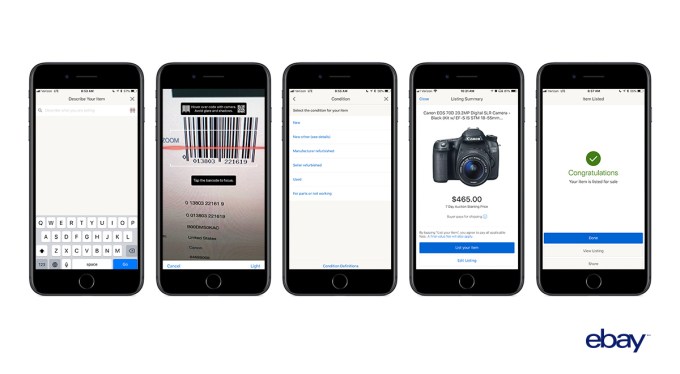
Ebay is rolling out an app update designed to make it easier to list items for sale on its online marketplace. Instead of filling out detailed forms on your mobile phone’s small screen, you can now scan the barcode on the item in question or type a description, choose the item’s condition, then click “list your item” to make the listing go live on eBay’s site.

After scanning or entering the description, eBay’s app will do a one-to-one match to its catalog to help to fill in the necessary information for that product. It will also offer sellers a pre-populated stock photo, eBay’s price recommendation, and its shipping recommendations,

The change is meant to reduce the number of steps it takes to list to a matter of seconds. And if the process is less cumbersome, eBay hopes more people will choose to sell on eBay as opposed to the growing number of resale apps like OfferUp or LetGo, which are currently ranking higher than eBay on Apple’s App Store.

Facebook’s Marketplace has also likely had some impact on eBay’s sales, especially in terms of local sales.

Despite the increased competition, eBay is still seeing more than 13.4 million listings added to its site every week from the eBay mobile app alone.


The app’s newfound ability to quickly list the item uses technology like structured data and predictive analytics to pre-populate listings with the information required, instead of relying on sellers to type it in themselves.

This use of technology is something the company believes is a competitive advantage over newcomers to the space, in addition to its ability to provide access to millions of shoppers around the world.

“At eBay, we’re dedicated to delivering a seamless and efficient selling experience for both first-time and seasoned sellers alike,” says Kelly Vincent, eBay’s VP of Consumer Selling Product & Engineering, in a statement about the app’s revamp.

“This latest update continues to leverage eBay’s structured data, which helps catalogue the 1.1+ billion items on the platform, to instantaneously populate product details, pricing and shipping information in the listing flow. Not only does the catalogue facilitate a superior listing experience, it enables buyers to easily find the great deals offered by our sellers,” she added.

Vincent also noted that eBay’s use of structured data and other new technology will make its way to other products and features this year, but didn’t say what those may be. However, the focus for now seems to be enabling sellers.

Ebay’s updated app with the barcode scanning feature for listings is rolling out now on both iOS and Android.

19 Apr 2018

Oculus implements its own GDPR-compliant privacy controls

While Facebook is still struggling to regain user trust following a data fiasco that ultimately brought Zuckerberg to testify in front of Congress, the company still has plenty to do to ready itself for GDPR and appease EU lawmakers. This includes making sure that everything is up to snuff at its virtual reality company, Oculus .

The VR company announced today that it will begin rolling out changes, including a user-facing Privacy Center, an updated Terms of Service with a Code of Conduct to ensure that VR users operate in a safe environment.

The Oculus “My Privacy Center” feature will launch next month on May 20, and will allow users to take a look at the data that Oculus has on them while managing preferences. Users notably won’t be able to see anonymized data that Oculus collects, which includes the in-VR movements that users make with their headsets and controllers. Data also not available for download includes stuff that’s only stored on your device and data like your credit card info that they keep stored securely.

The Code of Conduct forbids users from accessing or promoting sexually explicit content, using hateful or racially offensive language, promoting illegal activities, or harassing other users. Here’s the full thing:

  • You may not use or promote sexually explicit, abusive or obscene content.

  • You may not use or promote language or content that would qualify as hateful or racially offensive. We don’t allow content that attacks people based on race, ethnicity, nationality, religious affiliation, sexual orientation, sex, gender, gender identity, diseases or disability.

  • You may not harass, bully, threaten other users, or encourage other users to do so.

  • You may not encourage, celebrate or promote real-world violence.

  • You may not encourage or promote illegal activity.

  • You may not impersonate an Oculus employee, partner, representative, other real person or encourage other users to do so.

Today, the company posted a blog seeking to answer a few questions ahead of launching the new ToS tomorrow.

On the user privacy front, few things have made Oculus users more antsy than the belief that the company was using the rich data it gathered, including data related to how users physically moved their bodes while inside VR, to help Facebook target advertisements to users. In the company’s blog post discussing these changes, they deny this outright early-on.

We don’t share data with Facebook that would allow third parties to target advertisements based on your use of the Oculus Platform.

While this hardly stresses a long-term commitment to carrying this out, for the time being, advertisers won’t get data related to user’s VR habits while they’re using Oculus platforms. This may not necessarily be the case with VR efforts built wholly beneath the Facebook platform like their social app Spaces.

How and why Oculus collects this movement data in the first place was also addressed, with the company stressing that this data is now de-identified and can not be associated with user accounts.

We collect the necessary movement and environment data required to deliver an immersive VR experience that is safe, comfortable, and seamless across apps. This could include the gestures you make with controllers or changes in your orientation, as well as the Guardian play space boundaries you provide us with. For example, in an app that lets you view 360° videos, the app needs to know which direction you’re facing in order to ensure the best possible viewing experience. Once this data is processed for its express purpose (ie: to make the app work), it’s de-identified in our systems and not associated with your account.

While the value of Facebook’s user data has been abundantly clear, Oculus is far more focused on ensuring that people actually start using VR in the first place, rather than quickly building out a virtual reality ads business. As such, their updated Terms of Service is likely to be less controversial than what’s found in Facebook’s implementation of GDPR-compliant policies.

Nevertheless, for a parent company that has repeatedly had to put to rest that it’s not listening to users via their device’s microphones, a platform ripe for dystopia like VR is undoubtedly going to gather more user paranoia as it grows in popularity, and thus more need for the company to transparently communicate what data it does and does not collect. And while it’s easy to see why certain permissions might be needed for an app to function, the important thing is ensuring that parties with access aren’t abusing their access.

The company’s “My Privacy Center” sounds like a government-mandated step in the right direction, but as always, it’s best to be skeptical and see where it moves from here.


19 Apr 2018

mParticle hires Adobe’s John Sedlak as chief revenue officer

mParticle, which helps companies like Airbnb and Spotify manage their customer data, has hired four new executives — including John Sedlak, most recently a vice president at Adobe, who’s joining the company as chief revenue officer.

In addition, Kiran Hebbar (formerly CFO of Social Tables) is joining as chief financial officer, Will Rogers (previously an engineer at Etsy) has been named chief information security officer and Aurélie Pols (who worked as data governance and privacy advocate at Krux Digital) is the new data protection officer.

Sedlak told me that in his roles at Adobe and Oracle (which he joined through the acquisition of BlueKai), he saw how the big marketing software players are trying to build comprehensive marketing clouds, often created through multiple startup acquisitions.

“They would constantly go to market and tout the benefits of the end-to-end stack, when I began to notice that there were many best-of-breed point solutions out there,” he said. “I got to see the power of standalone companies who are innovating ahead of what the big guys were doing. I’d put mParticle on that list.”

In the years since I first wrote about mParticle in 2014, a handy acronym has emerged to describe what the company does — CDP, short for customer data platform. Basically, CDPs like mParticle allow companies to unify all their first party data, creating a single view of the customer.

Sedlak contrasted mParticle’s approach with older data management platforms, which he said weren’t built to connect customer data across all their interactions on different devices.

“They were originally built to ingest first party cookie data coupled with third party data,” he said. “They never fully contemplated the notion of a true cross-device world and I think [co-founders Michael Katz and Andrew Katz] knew that in 2013 and said, ‘You know we’re going to start solving for that now.'”

As for what hiring Sedlak will do for the company, he said one of his goals is to bring on even bigger customers: “I think mParticle can drive incremental or discrete value … to Fortune 50 marketers who I personally have done business with in the past, where I see an opportunity for us to significantly augment their current investments in the marketing cloud platforms.”

CEO Michael Katz, meanwhile, pointed out that that two of these hires are focused on security. With the recent Facebook scandals discussions and Europe’s adoption of GDPR protections, there’s “a really healthy conversation around the importance of data control and governance,” and he said these hires will help mParticle build the tools that allow businesses to “put customer privacy and data security at the forefront of their business practice.”

19 Apr 2018

Motorola introduces four new phones

Motorola’s phones aren’t always the flashiest, but there sure are a lot of them. And today, there are even more. The Lenovo-owned brand is launching not one, but four new handsets for your budget-phone-buying pleasure.

The new handsets were launched at an event in São Paulo, Brazil. We, sadly, were not there. Instead, we played around with the things at an event in New York City, where it’s currently 40 degrees in mid-April. No one ever said this job would be easy — or involve getting a tan.

The Moto E5 handsets are the flashiest of the bunch. There’s no set price on the handsets yet, but they’ll probably warrant a higher premium than the other new devices. The difference in build quality is immediately apparent right off the bat, thanks in no small part to the inclusion of a shiny Gorilla Glass 3 backing in blue, black or gray.

The phone comes in two sizes — 5.2-inch for the E5 Play and 6-inch on the more premium E5 Plus. The latter will only be available here in the U.S., bringing with it a beefy 5,000mAh battery and a pair of rear-facing cameras in a circular formation that will look familiar to anyone who’s picked up a Moto Z.

The dual camera configuration allows for some neat tricks, like better faux bokeh in portrait mode and the ability to create combination black and white and color images. Motorola, well, Lenovo, has also invested in a bunch of first-party camera software, including a small selection of built-in AR overlays and some Google Lens-like tricks, including the ability to scan text.

The camera setup isn’t going to win any awards, but Motorola continues to bring impressive features to its budget devices. That said, no price has been announced for either version of the E5.

We do, however, have prices for the Moto G6 and G6 Play. Those will run $249 and $199, respectively. The phones are still pretty chunky — no surprise there, given the price — though Motorola has adopted a few premium features here, including, notably, a move toward the 18:9 aspect ratio for their 5.7-inch displays. The G6, naturally, has the leg up here, at 1080p to the Play’s 780p.

The Play actually sports the larger battery of the two, at 4,000mAh to the G6’s 3,000. Both versions also support Fast Charging, though the G6 does it through USB-C, while the Play is still holding onto microUSB for dear life. All of the above also still have their headphone jacks intact. Motorola was one of the first companies to drop it on its premium Z line, but the company is smartly keeping the port around on its budget devices.

All of the above will be available later this season at “major carriers” in the U.S. and Canada. Surely it won’t be 40 degrees by then.

19 Apr 2018

PlayVS wants every high school to have an eSports team

Nearly 200 colleges and universities across the U.S. and Canada are actively recruiting for esports scholarships. But unlike other sports, there is currently no real infrastructure for high school esports.

PlayVS, a Science-backed startup out of Los Angeles, is looking to change that.

Founded by Delane Parnell, PlayVS has signed an exclusive contract with the National Federation of State High School Associations (NHFS) to provide support in building the infrastructure for high school esports, allowing students to play esports on behalf of their school all the way to the state championship level.

Most of us have participated in high school sports in some way, but many of us aren’t aware of all the moving parts going on behind the scenes. The NFHS, essentially the NCAA of high school sports and activities, handles those moving parts for more than 90 percent of schools in the U.S. across almost every sport.

From writing the rules to referees to building out the districts and conferences to organizing the state playoff tournaments, the NFHS has almost 100 years of experience across hundreds of sports and activities handling organization.

But esports represents a new challenge for the governing body, requiring more technical infrastructure than established sports.

That’s where PlayVS comes in. The company has built a website that handles league organization, scheduling, leaderboards and more. Plus, PlayVS has existing relationships with the game publishers, letting the platform pull stats in real-time from each high school match.

There will be two seasons each year, with students organizing their own teams at their school for a variety of games. High school teams go to the PlayVS website to see their schedule and log on for their game (which is played on the publisher client).

Eight season matches will be played online, with the top teams competing in a LAN tournament in front of a live spectator audience organized by PlayVS.

PlayVS is also partnering with NFHS Network, a live streaming platform for high school sports, to broadcast some of the games to spectators.

As it stands now, colleges and esports organizations have to rely on relationships with publishers and tournament results to get a clear view of the top young talent. But there are surely many players slipping through the cracks.

With the new high school esports league powered by PlayVS, colleges and esports orgs will be able to use the PlayVS platform to see real-time stats and player profiles. Plus, the PlayVS site allows coaches and recruiters to request an introduction to the student’s parents and/or coach to start talking scholarships.

To start, the high school esports leagues will be PC only games in three genres: Multiplayer Online Battle Arena, Fighting and Sports games.

The first season will start in the fall.