Year: 2018

19 Apr 2018

Intel abandons Vaunt smart glasses project

It might just be time for Intel admit that’s not great at this whole wearables thing. A few months after their flashy online debut, the Vaunt smart glasses are dead, the chipmaker has confirmed. Some things, it seems, are just too beautiful to live — or receive sufficient investment from their parent company.

The news originally surfaced via a report from The Information, which also notes that this reportedly marks the final nail in the long, drawn out of death of the company’s New Devices Group.

The department appears to have been struggling for a while now — in late 2016, the group was hit with layoffs, and ultimately some key projects in its hardware pipeline, including the latest Basis fitness tracker. This latest move is likely to result in “some layoffs” to the 200 person team, according to the source.

The company confirmed the end of Vaunt (codenamed Superlight) in a statement offered to TechCrunch.

“Intel is continuously working on new technologies and experiences. Not all of these develop into a product we choose to take to market,” Intel writes. “The Superlight project is a great example where Intel developed truly differentiated, consumer augmented reality glasses. We are going to take a disciplined approach as we keep inventing and exploring new technologies, which will sometimes require tough choices when market dynamics don’t support further investment.” 

It is, indeed, a tough call to make. Intel’s been pretty open about its failure to sufficiently embrace mobile the first time around, losing significant marketshare to companies like Qualcomm. Intel has certainly made its share of investments in hopes of owning a share of wearable tech, but none have really paid off, and with the category plateauing a bit over the past year, it’s probably a good time to cut its losses.

The Vaunt seemed promising, but the online glimpse we got of the product of one didn’t appear to be fully thought out. Of course, companies experiment with hardware prototypes all the time — but most of these things never see the light of day.

19 Apr 2018

Open Mineral plans to disrupt commodities trading with blockchain

Commodity trading is a very old industry which focuses on raw materials, like lead or copper, that are worth hundreds of billions. These materials are constantly moving from producers to consumers in a global market worth about $80bn, but it often lacks efficiency and transparency. Meanwhile, intermediaries make a lot of money just by acting as the middlemen. That’s where blockchain could, in theory, be applied, but introducing great transparency.

Open Mineral, a physical commodities trading platform, has now closed an investment round ($2.25 million) to do just that.

The idea is to increase the efficiency of the market for base and precious metal raw materials using blockchain. Its digital platform, Open Mineral Exchange, will bring together sellers and buyers, mining and metals companies, allowing them to transact directly and securely, without intermediaries. It will also digitize and streamline the complicated and paper-heavy process.

These newer trading platforms for physical commodities have been appearing in the last couple of years. Tradecloud, for example, addresses the refined metal market, while Metalshub focuses on ferroalloys. None of the current platforms use blockchain.
The Open Mineral model will rely on a success-based fee which will depend on the value/chemical composition of the material and the volume transacted. The platform currently focuses on zinc, lead, copper, gold and silver concentrate markets, but could expand into other concentrates in the future.
Open Mineral became the first startup to join Thomson Reuters Incubator based in Zug, which is famously spinning out blockchain startups. Investors include Goldcorp, Canadian gold mining company, and Xploration Capital.
The company is founded by Boris Eykher and Ilya Chernilovskiy. Before co-founding Open Mineral, Eykher and Chernilovskiy both worked at Glencore, the largest commodity trading house in the world. The company is headquartered in Baar, Switzerland with operations in Beijing, Lima, and Moscow.

19 Apr 2018

Lyft invests millions of dollars to offset its effect on climate change

Lyft, recognizing the impact of its ride-hailing platform on the environment, is making a “multi-million” dollar investment in carbon offsets. Within the first year of this effort, Lyft says it expects to be able to offset about one million metric tons of carbon.

“The stark reality is that transportation is one of the largest sources of greenhouse gas emissions,” Lyft co-founders Logan Green and John Zimmer wrote in a blog post. “As a growing part of the transportation ecosystem, we are holding ourselves accountable to being part of the solution.”

Lyft is doing this in partnership with 3Degrees. In general, some carbon offset solutions entail capturing and destroying methane from landfills and animal manure, as well as sustainable forestry that absorbs carbon from forests. Lyft, however, is specifically putting its money toward reducing greenhouse gas emissions from an automotive parts manufacturing process in Michigan, hydrodec oil recycling in Ohio and other projects.

For a lot of people, Lyft, Uber and other ride-hailing companies effectively act as stand-ins for public transport, biking or even walking. In New York City, the volume of people using Lyft, Uber and other ride-hailing apps tripled to 500,000 rides per day since 2015, according to a 2016 report from Schaller Consulting. That increased trip volume and mileage resulted in the addition of about 550 million pounds of greenhouse gas emissions. That’s the equivalent of energy consumption emissions from more than 26,000 homes in one year.

Until autonomous ride-hailing networks hit the mainstream, more rides means more miles driven, which means a greater carbon footprint.

19 Apr 2018

TheWaveVR wraps $6M Series A to fuel its immersive, social VR music app

Music and visual art creation VR startup TheWaveVR just wrapped a $6 million Series A round and when all was said and done, it seemed appropriate for the team to actually sign the term sheet with their lead investor inside virtual reality.

The round, led by RRE Ventures, brings the startup’s total funding to $10 million. Upfront Ventures, KPCB, Greycroft VR Gaming Tracker Fund and The VR Fund also participated in the raise.

The whole gist of the startup is that it’s one big futuristic music festival that never sleeps inside virtual reality. DJs can craft a set on stage and users can teleport around a giant “outdoor” venue while watching light shows that blow up the sky night-after-night.

The Austin-based company had a huge opportunity recently at SXSW where it hosted one of the largest promo events for Stephen Spielberg’s Ready Player One film, a massive virtual reality concert straight out of the movie, filled with Warner Brothers IP and featuring a live DJ set led by the film’s star, Tye Sheridan.

At a time when many VR startups are still trying to live up to the sky-high expectations that films like Ready Player One have set, TheWaveVR remains one of the few that takes on those expectations and still manages to dazzle, delivering an experience that feel distinctly futuristic while drenching users in souped-up visuals that intertwine the emotion and connectedness of social VR with music that’s actively being created within the app.

The challenge for the startup will likely be growing their product in a way that stays true to the core mission while chasing a larger presence inside an already-tight, niche community. The company’s “Wave Builder” feature allows users to bring in 3D models, animations and made-in-VR content to create visual experiences that can accompany the musical performances inside the app.

“We spent last year nailing down the format for these fully interactive concerts and proved people love our experience; this year we’re focused on how that content gets created and shared,” CEO Adam Arrigo said in a release.

The team is maintaining a lean existence as it aims to keep enough cash on hand to weather another few years in the growth phase of VR. While the startup’s seed round came at a time where a host of virtual reality companies were seeming to get funded every other day, slower-than-expected headset sales have made investor cash a bit harder to come by in 2018.

Arrigo seems optimistic that the timelines are finally starting to grow more solid, and that already-announced standalone products from companies like Oculus and HTC will begin to broaden appeal and shape VR into something more friendly and accessible.

In the meantime, it’s business as usual, which for TheWaveVR means hanging out with flying cats and raving to EDM light shows.

19 Apr 2018

See you next week in New York

I’ll be helping build a larger meetup focused on pre-ICO companies in New York on April 23 and I’d love to see you there. It will be held at Knotel on April 23 at 7pm and will feature a pitch-off with eight startups  and two panels with some yet-unnamed stars in the space. Let’s get together and talk about the hottest – and most controversial – topic in investing.

I’d love to see you there, so please sign up here. Early bird tickets are sold out and the regular tickets are going fast.

The event will be held at 551 Fifth Avenue on the 9th Floor and you can sign up to pitch here. This is still an experimental format and industry so let’s see how it works.

19 Apr 2018

Amazon’s new ‘Alexa Blueprints’ let anyone create custom Alexa skills and responses

Amazon this morning is introducing “Alexa Blueprints,” a new way for any Alexa owner to create their own customized Alexa skills or responses, without needing to know how to code. The idea is to allow Alexa owners to create their own voice apps, like a trivia game or bedtime stories, or teach Alexa to respond to questions with answers they design – like “Who’s the best mom in the world?,” for example.

You could also create a skill that includes helpful information for the babysitter, which could be triggered by the command, “Alexa, open My Sitter,” Amazon suggests.

“Alexa Skill Blueprints is an entirely new way for you to teach Alexa personalized skills just for you and your family,” explained Steve Rabuchin, Vice President, Amazon Alexa, in a statement about the launch. “You don’t need experience building skills or coding to get started—my family created our own jokes skill in a matter of minutes, and it’s been a blast to interact with Alexa in a totally new and personal way.”

To build your own skill or custom Alexa response, users will visit the website blueprints.amazon.com and select a template.

At launch, there are over 20 templates across categories like Fun & Games, At Home, Storyteller, and Learning & Knowledge.

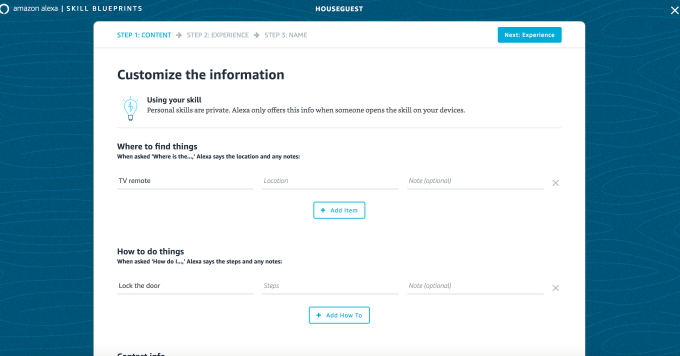
The templates are designed so you can just fill in the bits and pieces that make them personalized to your needs. You won’t need to go through a series of complicated steps, and no technical knowledge is required. The templates are even pre-filled and work as is, if you just want to try them out before making your own.

After you’ve filled in your own content, you name it and publish with a click. This makes the skill or response available to all Alexa-enabled devices associated with your own Amazon account. But it’s not available to the public or the Alexa Skills Store.

Families with Echo devices, in particular, seem to be a heavy focus for Alexa Blueprints. Kids have readily taken to Alexa, and today there are nearly 500 public Alexa skills built for kids alone. Families also often have private jokes and bedtime rituals where Alexa could come in – offering to “tell a Dad joke” or “start Anna’s story,” for instance. Plus, Alexa is designed as a home companion – controlling smart devices, playing music, setting timers, and offering information like news and weather, among other things.

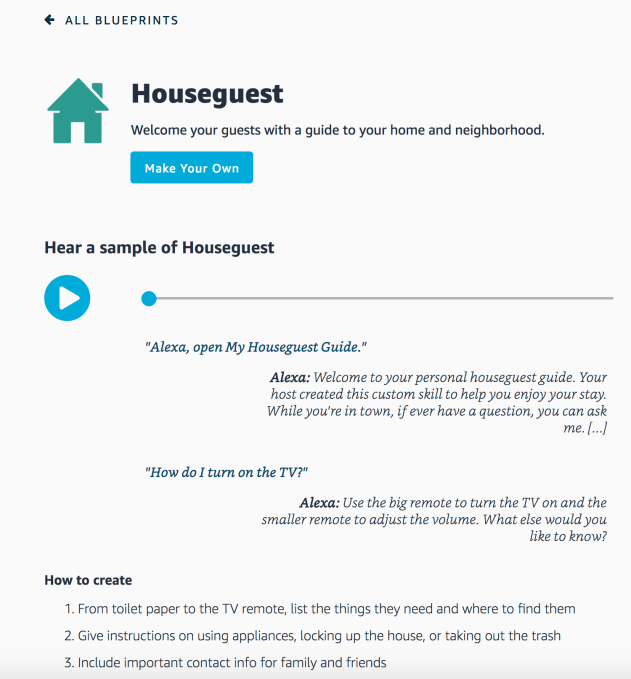
But families aren’t the only ones would could take advantage of Alexa Blueprints. College students could use the flash cards custom skill when studying, while a group of friends or roommates could design their own trivia games. And Airbnb owners could set up a skill for their houseguests.

After you’ve created the custom skill, it will be available in the Skills You’ve Made webpage on the Blueprints site. You’ll also be able to enable, disable and delete your skills.

The feature could give Amazon an edge in selling its Echo speakers to consumers, as it’s now the only platform offering this level of customization – Apple’s HomePod is really designed for music lovers, and doesn’t support third-party apps. Google Home also doesn’t offer this type of customization.

All three are competing to be the voice assistant people use in their home, but Alexa so far is leading by a wide margin – it still has roughly 70 percent of the smart speaker market.

Alexa Blueprints are available today in the U.S. only.

The full list of Alexa Blueprints available at launch is below:

At Home

  • Custom Q&A: Customize responses to your questions
  • Houseguest: Make your guests feel at home with quick access to important info
  • Babysitter: Help your sitter find things, remember steps and get important info
  • Pet Sitter: Help your pet sitter care for your favorite animal

Fun & Games

  • Family Jokes: Create a list of your favorite jokes for when you need a laugh
  • Trivia: Create your own multiple choice trivia game on any topic
  • Inspirations: Curate a list of your favorite inspirational quotes
  • Family Trivia: Play together and brush up on family history
  • Bachelorette Party: Play to find out how well the bride’s friends know her
  • Birthday Trivia: Play to see who knows the birthday girl or boy best
  • Burns: Roast your friends and family with lighthearted burns
  • Compliments: Flatter your favorites with a list of custom compliments
  • Double Trouble: Find out which couple knows each other best with this customizable game
  • First Letter: Play a game of categories starting with a certain letter

Storyteller

  • Adventure: Write an adventure story where your child is the hero
  • Fairy Tale: Customize an interactive prince and princess-themed tale
  • Sci-Fi: Create an interactive story with a far-out theme
  • Fable: Create a short narrative with a moral of the story

Learning & Knowledge

  • Flash Cards: Study, test yourself, and master any subject by voice
  • Facts: Keep a list of facts on your favorite topic, all in one place
  • Quiz: Challenge yourself and others with a customizable quiz
19 Apr 2018

Uber denies its CTO met with Cambridge Analytica

Uber has denied that its sitting CTO, Thuan Pham, met with Cambridge Analytica — the controversial political consultancy at the center of a Facebook user data misuse scandal.

But it has not been able to confirm that no meetings between anyone else on its payroll and Cambridge Analytica took place.

“I’m not sure who they think they met with, but I can confirm our CTO never met with them and we don’t have a relationship with them,” an Uber spokeswoman told us.

Giving evidence to the UK parliament earlier this week, former Cambridge Analytica staffer, Brittany Kaiser, had claimed that CA executives met with the Uber CTO in the past two years. Although she did not explicitly name Pham — just citing the CTO job title.

The DCMS committee is running an enquiry into disinformation online.

Asked by the committee whether she had ever come across Uber data being used for any of the political campaigns that CA worked on, Kaiser replied “no”.

However she qualified her answer, adding: “Although Cambridge Analytica definitely had meetings with the CTO of Uber in California — about 1.5 to 2 years ago. 

“I don’t believe anything came of that but a conversation was had,” she also said.

The committee did not query her on the intent of the meetings with Uber — although later she was asked if she’d had any contacts with other “big data companies”, including Google.

Responding on that Kaiser confirmed she had had contacts with “Microsoft, Google and a few other companies of that nature, and Facebook” — though she said this was only in a standard business capacity, noting that CA was a client “purchasing digital advertising space through them”.

On Facebook she added: “They had two different political teams in the United States — so they had their Republican team and their Democrat team, who usually inhabited separate offices on separate floors. My consultants in Washington DC would work closely with the Republican team on how we would use their tools to the best benefit for our clients.”

Last month the committee also asked another ex-CA employee, whistleblower Chris Wylie, whether the company had access to Uber data — apparently concerned that a 2016 Uber data breach, affecting 57 million riders and drivers (which the company only disclosed in November last year) could have been another data source for CA.

“To my knowledge Cambridge Analytica has not used Uber data,” responded Wylie.

Uber told Congress last year that one of the hackers behind the 2016 breach was located in Canada — and that this hacker had first contacted it in November 2016 to demand a six-figure payment for the breached data.

Also located in Canada: Aggregate IQ, a data firm that has been linked to CA — which Wylie has described as the Canadian affiliate of CA’s parent entity, SCL — and which has been credited with playing a major role in the UK’s brexit referendum, receiving £3.5M from leave campaign groups in the run up to the 2016 referendum. (AIQ has denied it has ever been a part of Cambridge Analytica or SCL.)

The question of where this small Canadian firm obtained data on UK citizens to carry out microtargeted political advertising has been another line of enquiry pursued by the committee.

“[W]here did [AggregateIQ] get the data?” asked Wylie last month in his evidence session, discussing AIQ’s involvement in the UK’s Brexit campaign. “How do you create a massive targeting operation in a country that AIQ had not previously worked in in two months? It baffles me as to how that could happen in such a short amount of time.

“That is a good question. It is unfortunate that AIQ hides behind jurisdictional barriers and does not come here and answer those questions. But it is something that hopefully can be looked at as to how did it actually work.”

Wylie has also alleged that AIQ “worked on projects that involved hacked material and kompromat” as well as distributing “violent videos of people being bled to death to intimidate voters”.

“This is the company that played an incredibly pivotal role in politics here. Something that I would strongly recommend to the Committee is that they not only push the authorities here, but give them the support that they need in order to investigate this company and what they were doing in Brexit,” he added.


19 Apr 2018

Uber denies its CTO met with Cambridge Analytica

Uber has denied that its sitting CTO, Thuan Pham, met with Cambridge Analytica — the controversial political consultancy at the center of a Facebook user data misuse scandal.

But it has not been able to confirm that no meetings between anyone else on its payroll and Cambridge Analytica took place.

“I’m not sure who they think they met with, but I can confirm our CTO never met with them and we don’t have a relationship with them,” an Uber spokeswoman told us.

Giving evidence to the UK parliament earlier this week, former Cambridge Analytica staffer, Brittany Kaiser, had claimed that CA executives met with the Uber CTO in the past two years. Although she did not explicitly name Pham — just citing the CTO job title.

The DCMS committee is running an enquiry into disinformation online.

Asked by the committee whether she had ever come across Uber data being used for any of the political campaigns that CA worked on, Kaiser replied “no”.

However she qualified her answer, adding: “Although Cambridge Analytica definitely had meetings with the CTO of Uber in California — about 1.5 to 2 years ago. 

“I don’t believe anything came of that but a conversation was had,” she also said.

The committee did not query her on the intent of the meetings with Uber — although later she was asked if she’d had any contacts with other “big data companies”, including Google.

Responding on that Kaiser confirmed she had had contacts with “Microsoft, Google and a few other companies of that nature, and Facebook” — though she said this was only in a standard business capacity, noting that CA was a client “purchasing digital advertising space through them”.

On Facebook she added: “They had two different political teams in the United States — so they had their Republican team and their Democrat team, who usually inhabited separate offices on separate floors. My consultants in Washington DC would work closely with the Republican team on how we would use their tools to the best benefit for our clients.”

Last month the committee also asked another ex-CA employee, whistleblower Chris Wylie, whether the company had access to Uber data — apparently concerned that a 2016 Uber data breach, affecting 57 million riders and drivers (which the company only disclosed in November last year) could have been another data source for CA.

“To my knowledge Cambridge Analytica has not used Uber data,” responded Wylie.

Uber told Congress last year that one of the hackers behind the 2016 breach was located in Canada — and that this hacker had first contacted it in November 2016 to demand a six-figure payment for the breached data.

Also located in Canada: Aggregate IQ, a data firm that has been linked to CA — which Wylie has described as the Canadian affiliate of CA’s parent entity, SCL — and which has been credited with playing a major role in the UK’s brexit referendum, receiving £3.5M from leave campaign groups in the run up to the 2016 referendum. (AIQ has denied it has ever been a part of Cambridge Analytica or SCL.)

The question of where this small Canadian firm obtained data on UK citizens to carry out microtargeted political advertising has been another line of enquiry pursued by the committee.

“[W]here did [AggregateIQ] get the data?” asked Wylie last month in his evidence session, discussing AIQ’s involvement in the UK’s Brexit campaign. “How do you create a massive targeting operation in a country that AIQ had not previously worked in in two months? It baffles me as to how that could happen in such a short amount of time.

“That is a good question. It is unfortunate that AIQ hides behind jurisdictional barriers and does not come here and answer those questions. But it is something that hopefully can be looked at as to how did it actually work.”

Wylie has also alleged that AIQ “worked on projects that involved hacked material and kompromat” as well as distributing “violent videos of people being bled to death to intimidate voters”.

“This is the company that played an incredibly pivotal role in politics here. Something that I would strongly recommend to the Committee is that they not only push the authorities here, but give them the support that they need in order to investigate this company and what they were doing in Brexit,” he added.

19 Apr 2018

Qualcomm extends NXP deal deadline following concern from Chinese government

The ongoing saga continues. Qualcomm has once again postponed the deadline for completing its proposed acquisition of NXP following concerns voiced by the Ministry of Commerce in China.

The deal was first announced in October 2016 and things seemed to be progressing when Qualcomm raised its offer this past January to take the value of the deal from $38 billion to $44 billion. The company sought to close the transaction by April 25, but that has now been extended to July 26 as Qualcomm has been forced to refile for approval in China.

The deal is critical for Qualcomm in order to diversify its business beyond mobile and its traditional licensing model, and NXP has been identified as a must-buy thanks to its strong footprint in automotive and other growth segments.

Yet despite approval from the Federal Trade Commission, which Qualcomm pointed out has now been renewed, things could get a little complicated given the ongoing trade war between the U.S. and China.

Over the past month, President Trump announced trade tariffs on about $60 billion of Chinese goods, a sizeable chunk of which are the within the high-tech industry.

Deals-wise, the Trump administration countered Alibaba’s attempt to buy MoneyGram for $1.2 billion (despite Jack Ma cozying up to Trump ahead of time) and it also shot down Broadcom’s efforts to acquire Qualcomm on account of national security, with Qualcomm itself keen on chopping the deal.

The U.S. has also made strong moves against Chinese equipment makers, again in the name of security. Huawei has reluctantly backed off the U.S. market after losing out on previously arranged carrier deals, while this week the government banned U.S. companies from selling components to ZTE.

All of this activity raises the possibility that China may use the Qualcomm-NXP deal to strike back. Comments from the Chinese ministry —  reported by the FT — doesn’t exactly pour cold water on that scenario.

“This deal has a wide influence, and may have a negative impact on market competition,” a ministry spokesman said, adding that “an initial investigation shows Qualcomm’s plan cannot easily solve the problems relating to market competition.”

Qualcomm has suffered problems in China before. Two years ago it was fined nearly $1 billion for alleged anti-competitive practices. The company has since signed deals with a range of Chinese phone makers that include Xiaomi, Lenovo, Oppo and Vivo, but this time it needs the government’s full buy-in.

This issue isn’t new but Qualcomm’s move to refile shows it is very real. TechCrunch’s Danny Crichton explored China’s role in Qualcomm-NXP last month, ultimately concluding that the deal may well be passed but with concessions that further China’s own semiconductor ambitions:

Ultimately, I predict the NXP transaction to be approved. For all of the trade negotiations and complex strategies going on here, China needs to be seen as a place open to doing business, now more than ever as its trade practices are placed in the spotlight. However, that doesn’t mean it won’t exact serious concessions from Qualcomm, which could further erode the company’s revenues and standing in China.

It’s going to be a pivotal couple of months for Qualcomm.

19 Apr 2018

Qualcomm extends NXP deal deadline following concern from Chinese government

The ongoing saga continues. Qualcomm has once again postponed the deadline for completing its proposed acquisition of NXP following concerns voiced by the Ministry of Commerce in China.

The deal was first announced in October 2016 and things seemed to be progressing when Qualcomm raised its offer this past January to take the value of the deal from $38 billion to $44 billion. The company sought to close the transaction by April 25, but that has now been extended to July 26 as Qualcomm has been forced to refile for approval in China.

The deal is critical for Qualcomm in order to diversify its business beyond mobile and its traditional licensing model, and NXP has been identified as a must-buy thanks to its strong footprint in automotive and other growth segments.

Yet despite approval from the Federal Trade Commission, which Qualcomm pointed out has now been renewed, things could get a little complicated given the ongoing trade war between the U.S. and China.

Over the past month, President Trump announced trade tariffs on about $60 billion of Chinese goods, a sizeable chunk of which are the within the high-tech industry.

Deals-wise, the Trump administration countered Alibaba’s attempt to buy MoneyGram for $1.2 billion (despite Jack Ma cozying up to Trump ahead of time) and it also shot down Broadcom’s efforts to acquire Qualcomm on account of national security, with Qualcomm itself keen on chopping the deal.

The U.S. has also made strong moves against Chinese equipment makers, again in the name of security. Huawei has reluctantly backed off the U.S. market after losing out on previously arranged carrier deals, while this week the government banned U.S. companies from selling components to ZTE.

All of this activity raises the possibility that China may use the Qualcomm-NXP deal to strike back. Comments from the Chinese ministry —  reported by the FT — doesn’t exactly pour cold water on that scenario.

“This deal has a wide influence, and may have a negative impact on market competition,” a ministry spokesman said, adding that “an initial investigation shows Qualcomm’s plan cannot easily solve the problems relating to market competition.”

Qualcomm has suffered problems in China before. Two years ago it was fined nearly $1 billion for alleged anti-competitive practices. The company has since signed deals with a range of Chinese phone makers that include Xiaomi, Lenovo, Oppo and Vivo, but this time it needs the government’s full buy-in.

This issue isn’t new but Qualcomm’s move to refile shows it is very real. TechCrunch’s Danny Crichton explored China’s role in Qualcomm-NXP last month, ultimately concluding that the deal may well be passed but with concessions that further China’s own semiconductor ambitions:

Ultimately, I predict the NXP transaction to be approved. For all of the trade negotiations and complex strategies going on here, China needs to be seen as a place open to doing business, now more than ever as its trade practices are placed in the spotlight. However, that doesn’t mean it won’t exact serious concessions from Qualcomm, which could further erode the company’s revenues and standing in China.

It’s going to be a pivotal couple of months for Qualcomm.