
Year: 2018

19 Apr 2018

Report: Smartphone usage set to overtake time spent watching TV in China

2018 is the year that smartphone usage eclipses time spent watching TV in China and it’s all down to the growth of digital video platforms, according to a new report from eMarketer.

You’d be forgiven for thinking that this had already happened in China, which happens to be the world’s largest smartphone market, but eMarketer forecasts that the momentous moment is about to arrive.

According to the report, the average adult in China is set to spend 2 hours and 39 minutes per day on a mobile device this year, up 11.1 percent on 2017. Watching TV, meanwhile, is set to fall by two percent to reach 2 hours 32 minutes daily.

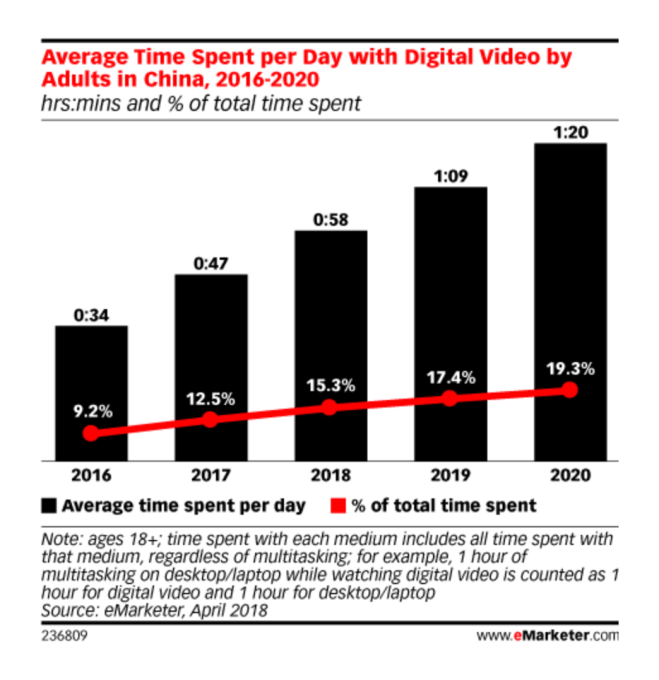
eMarketer said that the growth of digital video services is “a key driver” in this change. The company forecasts that online video time per day will leap 26 percent year-on-year to reach 58 minutes per adult on average. It is further predicting that by 2020 China’s adult population will spend one-third of their time online watching videos.
The signs have been pointing to digital media’s charge in China for some time, with the country’s top firms putting considerable cash behind the leading players.

Alibaba acquired Youku Tudou in a 2015 deal that valued the YouTube-like service at $4.6 billion, while rival Tencent has its own ‘Tencent Video’ service and Baidu — the third part of China’s traditional tech power trio — incubated video service iQiyi before taking it public in a U.S. IPO that raised $1.5 billion earlier this year. All three of these streaming platforms combine user-generated video with produced series, some of which comes from Netflix.

Beyond those three, there are also vertical focused video services which include animation platform Bilibili (which just went public in the U.S.), live-video platforms such as Tencent-backed Kuaishou, and Chushou, which focuses on e-sports and landed investment from Google earlier this year.

Video may be the key driver, but it is far from the only reason that keeps Chinese people glued to their phones. Chat app WeChat is the stickest of all mobile apps in China. It claims to have over 900 million active users who send 38 billion messages and over 205 million phone calls via the app each day.

WeChat also includes offline payments which are another major use for smartphones in China. Alongside WeChat Pay, Alibaba’s Alipay claims over 520 million users who use its service instead of cards or cash when paying for goods.

Ant Financial, Alipay’s parent company, is being tipped to raise $9 billion in new funding at a valuation that could reach as high as $150 billion.
Hat tip @sirsteven

19 Apr 2018

Report: Smartphone usage set to overtake time spent watching TV in China

2018 is the year that smartphone usage eclipses time spent watching TV in China and it’s all down to the growth of digital video platforms, according to a new report from eMarketer.

You’d be forgiven for thinking that this had already happened in China, which happens to be the world’s largest smartphone market, but eMarketer forecasts that the momentous moment is about to arrive.

According to the report, the average adult in China is set to spend 2 hours and 39 minutes per day on a mobile device this year, up 11.1 percent on 2017. Watching TV, meanwhile, is set to fall by two percent to reach 2 hours 32 minutes daily.

eMarketer said that the growth of digital video services is “a key driver” in this change. The company forecasts that online video time per day will leap 26 percent year-on-year to reach 58 minutes per adult on average. It is further predicting that by 2020 China’s adult population will spend one-third of their time online watching videos.

The signs have been pointing to digital media’s charge in China for some time, with the country’s top firms putting considerable cash behind the leading players.

Alibaba acquired Youku Tudou in a 2015 deal that valued the YouTube-like service at $4.6 billion, while rival Tencent has its own ‘Tencent Video’ service and Baidu — the third part of China’s traditional tech power trio — incubated video service iQiyi before taking it public in a U.S. IPO that raised $1.5 billion earlier this year. All three of these streaming platforms combine user-generated video with produced series, some of which comes from Netflix.

Beyond those three, there are also vertical focused video services which include animation platform Bilibili (which just went public in the U.S.), live-video platforms such as Tencent-backed Kuaishou, and Chushou, which focuses on e-sports and landed investment from Google earlier this year.

Video may be the key driver, but it is far from the only reason that keeps Chinese people glued to their phones. Chat app WeChat is the stickest of all mobile apps in China. It claims to have over 900 million active users who send 38 billion messages and over 205 million phone calls via the app each day.

WeChat also includes offline payments which are another major use for smartphones in China. Alongside WeChat Pay, Alibaba’s Alipay claims over 520 million users who use its service instead of cards or cash when paying for goods.

Ant Financial, Alipay’s parent company, is being tipped to raise $9 billion in new funding at a valuation that could reach as high as $150 billion.

Hat tip @sirsteven

19 Apr 2018

Facebook moves to shrink its legal liabilities under GDPR

Facebook has another change in the works to respond to the European Union’s beefed up data protection framework — and this one looks intended to shrink its legal liabilities under GDPR, and at scale.

Late yesterday Reuters reported on a change incoming to Facebook’s T&Cs that it said will be pushed out next month — meaning all non-EU international are switched from having their data processed by Facebook Ireland to Facebook USA.

With this shift, Facebook will ensure that the privacy protections afforded by the EU’s incoming General Data Protection Regulation (GDPR) — which applies from May 25 — will not cover the ~1.5BN+ international Facebook users who aren’t EU citizens (but current have their data processed in the EU, by Facebook Ireland).

The U.S. does not have a comparable data protection framework to GDPR. While the incoming EU framework substantially strengthens penalties for data protection violations, making the move a pretty logical one for Facebook’s lawyers thinking about how it can shrink its GDPR liabilities.

Reuters says Facebook confirmed the impending update to the T&Cs of non-EU international users, though the company played down the significance — repeating its claim that it will be making the same privacy “controls and settings” available everywhere. (Though, as experts have pointed out, this does not mean the same GDPR principles will be applied by Facebook everywhere.)

Critics have couched the T&Cs shift as regressive — arguing it’s a reduction in the level of privacy protection that would otherwise have applied for international users, thanks to GDPR. Although whether these EU privacy rights would really have been enforceable for non-Europeans is questionable.

At the time of writing Facebook had not responded to a request for comment on the change. Update: It’s now sent us the following statement — attributed to deputy chief global privacy officer, Stephen Deadman: “The GDPR and EU consumer law set out specific rules for terms and data policies which we have incorporated for EU users.  We have been clear that we are offering everyone who uses Facebook the same privacy protections, controls and settings, no matter where they live. These updates do not change that.” 

The company’s generally argument is that the EU law takes a prescriptive approach — which can make certain elements irrelevant for international users outside the bloc. It also claims it’s working on being more responsive to regional norms and local frameworks. (Which will presumably be music to the New Zealand privacy commissioner‘s ears, for one…)

According to Reuters the T&Cs shift will affect more than 70 per cent of Facebook’s 2BN+ users. As of December, Facebook had 239M users in the US and Canada; 370M in Europe; and 1.52BN users elsewhere.

The news agency also reports that Microsoft -owned LinkedIn is one of several other multinational companies planning to make the same data processing shift for international users — with LinkedIn’s new terms set to take effect on May 8, moving non-Europeans to contracts with the U.S.-based LinkedIn Corp.

In a statement to Reuters about the change LinkedIn also played it down, saying: “We’ve simply streamlined the contract location to ensure all members understand the LinkedIn entity responsible for their personal data.”

One interesting question is whether these sorts of data processing shifts could encourage regulators in international regions outside the EU to push for a similarly extraterritorial scope for their local privacy laws — or face their citizens’ data falling between the jurisdiction cracks via processing arrangements designed to shrink companies’ legal liabilities.

Another interesting question is how Facebook (or any other multinationals making the same shift) can be entirely sure it’s not risking violating any of its EU users’ fundamental rights — i.e. if it accidentally misclassifies an individual as an non-EU international users and processes their data via Facebook USA.

Keeping data processing processes properly segmented can be difficult. As can definitively identifying a user’s legal jurisdiction based on their location (if that’s even available). So while Facebook’s contract change for international users looks largely intended to shrink its legal liabilities under GDPR, it’s possible the change will open up another front for individuals to pursue strategic litigation in the coming months.

19 Apr 2018

Netflix launches 30-second preview videos on mobile

Netflix is introducing its own take on Snapchat and Instagram stories after it began to roll out 30-second preview videos for mobile viewers.

The previews look much like Stories because the thumbnails are circular and the content plays with virtual videos, so there’s no need to move your phone to the side. Added to that, they play like a slideshow, allowing users to swipe or tap to skip to the next video without returning to the main screen. Shows that appeal can be stored for later viewing with a button that adds them to your list.

The feature is hitting the Netflix iOS app from today, and the company said it will be “coming soon” to Android.

The launch is long-awaited. Netflix began offering previews on the web and via its TV app, and the company said the new feature will help those who tune in via their phone to find more content to watch.

“Years of testing has made it clear that video previews help our members browse less and discover new content more quickly. With the launch of mobile previews, we are bringing a video browse experience to your mobile phone in a fun and mobile-optimized way,” the company explained in a blog post.

Netflix is on a run of late, with the company closing in on a $150 billion market cap thanks to growing subscriber numbers.

The company added 7.41 million new subscribers in the first quarter of 2018 — around two million of which were U.S.-based — and it has forecast an additional 6.2 million more joining in the next quarter. That means the company has nearly 119 million customers, as its huge international expansion from two years ago begins to kick in.

The company also continues to see some pretty strong streaming revenue growth. Total sales hit $3.6 billion in Q1, up around 43 percent year-on-year.

19 Apr 2018

Genetics testing startup Prenetics buys UK’s DNAFit to move into consumer services

Prenetics, a Hong Kong-based startup that offers genetic testing services for patients, is expanding outside of Asia and into the consumer space after it acquired London-based company DNAFit.

The deal — which a source told TechCrunch is worth $10 million — not only sees Prenetics enter new geographies, but also expand the scope of its services. Prenetics, which includes Chinese e-commerce giant Alibaba among its backers, works directly with insurance firms and physicians who use its testing service for their customers and patients, but DNAFit goes straight to consumers themselves.

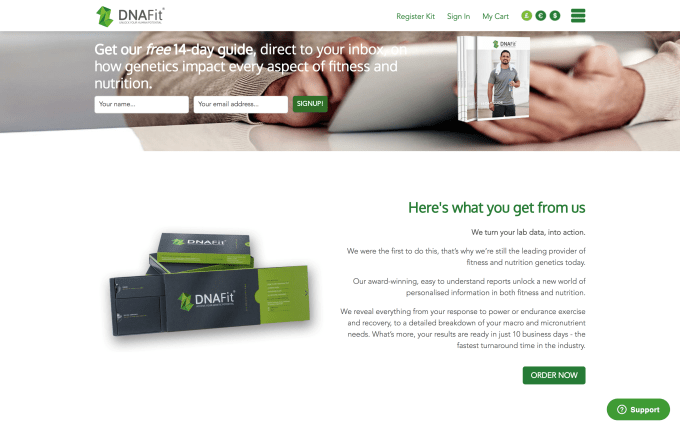
Five-year-old DNAFit sells a test that profiles an individual’s DNA to help them to figure out the fitness and nutrition setup that is best suited to them. DNAFit’s kits — which cost up to £249 ($350) and take 10 days for results — are sold online and via employee packages.

The company said it has sold its product to “several hundred thousand” people. High-profile backers include Olympic gold medal-winning British athlete Greg Rutherford, who said the results helped him make “clear, informed decisions” on his training regime.

Prenetics has been considering global expansion options for some time, and this acquisition gets its foot in the door in new markets while also tackling the consumer health market, too.

“We definitely plan on investing and growing our reach in Europe for the DNAFit business. In addition, Prenetics International will be focused on a B2B with insurers and for corporates,” Prenetics CEO Danny Yeung told TechCrunch via email.

“At the same time, DNAFit is a partner for [fitness company] Helix in the U.S., thus we plan on investing further on customer acquisition and growing our reach in the U.S.,” Yeung added. “We are extremely excited at the potential to bring DNA testing to a global market, making an impact on the lives of many.”

Also in the U.S., an offer for 23andMe customers allows them to use their results and pay $79 for DNAFit.

The deal sees DNAFit CEO Avi Lasarow becomes CEO of Prenetics International, a newly formed business unit, with Yeung CEO of parent company Prenetics Group. DNAFit itself will continue to run under its existing brand, both companies confirmed.

This marks the first piece of acquisition for Prenetics, which last year closed a $40 million Series B funding round led by Beyond Ventures and Alibaba Hong Kong Entrepreneurs Fund. Yeung told us at the time that a portion of that capital would be reserved for meaningful acquisitions as the startup aims to go beyond its early focus on China, Hong Kong and Southeast Asia. At the time of that funding, which happened in October, Yeung said Prenetics had processed 200,000 DNA samples.

Prenetics started out as ‘Multigene’ in 2009 when it span out from Hong Kong’s City University. Yeung joined the firm as CEO in 2014, after leaving Groupon following its acquisition of his Hong Kong startup uBuyiBuy, and it has been in startup mode since then. Prenetics has raised over $52 million from investors which, aside from Alibaba, include 500 Startups, Venturra Capital and Chinese insurance giant Ping An.

19 Apr 2018

Facebook has a new job posting calling for chip designers

Facebook has posted a job opening looking for an expert in ASIC and FPGA, two custom silicon designs that companies can gear toward specific use cases — particularly in machine learning and artificial intelligence.

There’s been a lot of speculation in the valley as to what Facebook’s interpretation of custom silicon might be, especially as it looks to optimize its machine learning tools — something that CEO Mark Zuckerberg referred to as a potential solution for identifying misinformation on Facebook using AI. The whispers of Facebook’s customized hardware range depending on who you talk to, but generally center around operating on the massive graph Facebook possesses around personal data. Most in the industry speculate that it’s being optimized for Caffe2, an AI infrastructure deployed at Facebook, that would help it tackle those kinds of complex problems.

FPGA is designed to be a more flexible and modular design, which is being championed by Intel as a way to offer the ability to adapt to a changing machine learning-driven landscape. The downside that’s commonly cited when referring to FPGA is that it is a niche piece of hardware that is complex to calibrate and modify, as well as expensive, making it less of a cover-all solution for machine learning projects. ASIC is similarly a customized piece of silicon that a company can gear toward something specific, like mining cryptocurrency.

Facebook’s director of AI research tweeted about the job posting this morning, noting that he previously worked in chip design:

While the whispers grow louder and louder about Facebook’s potential hardware efforts, this does seem to serve as at least another partial data point that the company is looking to dive deep into custom hardware to deal with its AI problems. That would mostly exist on the server side, though Facebook is looking into other devices like a smart speaker. Given the immense amount of data Facebook has, it would make sense that the company would look into customized hardware rather than use off-the-shelf components like those from Nvidia.

(The wildest rumor we’ve heard about Facebook’s approach is that it’s a diurnal system, flipping between machine training and inference depending on the time of day and whether people are, well, asleep in that region.)

Most of the other large players have found themselves looking into their own customized hardware. Google has its TPU for its own operations, while Amazon is also reportedly working on chips for both training and inference. Apple, too, is reportedly working on its own silicon, which could potentially rip Intel out of its line of computers. Microsoft is also diving into FPGA as a potential approach for machine learning problems.

Still, that it’s looking into ASIC and FPGA does seem to be just that — dipping toes into the water for FPGA and ASIC. Nvidia has a lot of control over the AI space with its GPU technology, which it can optimize for popular AI frameworks like TensorFlow. And there are also a large number of very well-funded startups exploring customized AI hardware, including Cerebras Systems, SambaNova Systems, Mythic, and Graphcore (and that isn’t even getting into the large amount of activity coming out of China). So there are, to be sure, a lot of different interpretations as to what this looks like.

One significant problem Facebook may face is that this job opening may just sit up in perpetuity. Another common criticism of FPGA as a solution is that it is hard to find developers that specialize in FPGA. While these kinds of problems are becoming much more interesting, it’s not clear if this is more of an experiment than Facebook’s full all-in on custom hardware for its operations.

But nonetheless, this seems like more confirmation of Facebook’s custom hardware ambitions, and another piece of validation that Facebook’s data set is becoming so increasingly large that if it hopes to tackle complex AI problems like misinformation, it’s going to have to figure out how to create some kind of specialized hardware to actually deal with it.

A representative from Facebook did not yet return a request for comment.

19 Apr 2018

TaskRabbit CEO posts statement as its app returns following a cybersecurity breach

After taking them down to investigate what it called a “cybersecurity incident,” TaskRabbit’s website and app are back online. The Ikea-owned platform for on-demand labor also posted an update from its chief executive officer Stacy Brown-Philpot about the incident.

“While our investigation is ongoing, preliminary evidence shows that an unauthorized user gained access to our systems. As a result, certain personally identifiable information may have been compromised,” she wrote.

While Brown-Philpot said that an outside forensics team is currently working to identify what information was compromised and will notify all affected users, she urged the platform’s customers and providers, called “taskers,” to monitor online accounts for suspicious activity and change passwords if they used the same login information on other services.

TaskRabbit will add several new security measures because of the incident. Brown-Philpot said they are working on ways to make their login process more secure, reduce the amount of data retained about customers and taskers and “enhance overall network cyber threat detection technology.”

The company will continue posting updates to a dedicated page on its website, which also includes a FAQ for taskers who were unable to complete jobs while the app was offline. TaskRabbit says people who were forced to reschedule or cancel tasks will be compensated.

19 Apr 2018

ZTE postpones earnings report after being slapped with U.S. exports ban

ZTE will postpone the release of its quarterly earnings report after the United States government banned American companies from selling goods to the Chinese telecom and smartphone maker. In a filing with the Hong Kong stock exchange, ZTE said that its earnings report, originally set to be released on Thursday, is now delayed to an undetermined date.

About a year ago, ZTE pleaded guilty to violating U.S. sanctions against Iran and North Korea. Its deal with the U.S. government included penalties and fines totaling more than a billion dollars, but allowed it to continue doing business with U.S. suppliers.

On Monday, however, the U.S. Department of Commerce announced that ZTE had failed to follow the agreement’s terms. It accused the company of making false statements and failing to punish employees and senior management. As a result, the Department of Commerce slapped ZTE with a seven-year export restriction.

This is a huge blow to ZTE, which sources a significant portion of its most important components, including processors, from U.S. companies like Qualcomm . It also means ZTE may lose access to software licensed from Google, including Android.

This is the latest in ZTE’s string of entanglements with the U.S. government. Despite holding fourth place in the U.S. smartphone market share, after Samsung, Apple and LG, ZTE is under scrutiny by U.S. intelligence agencies, which believe that it and fellow Chinese smartphone maker Huawei may pose security concerns.

19 Apr 2018

California OSHA is looking into injury reports at Tesla

After a report by Reveal suggested that Tesla was underreporting workplace injuries at its Fremont plant, Tesla responded with a blog post calling the report “completely false” and pinning it all up as a “calculated disinformation campaign.”

Now California’s Division of Occupational Safety and Health (otherwise known as Cal/OSHA) is looking into things at the factory.

As first noted by Bloomberg, the agency won’t give specifics on why it’s looking into Tesla — but in a comment sent our way, they start off by mentioning the aforementioned report.

Here’s the statement sent to us by Cal/OSHA spokesperson Erika Monterroza:

Cal/OSHA takes seriously reports of workplace hazards and allegations of employers’ underreporting recordable work-related injuries and illnesses on the Log 300. Cal/OSHA currently has an open inspection at Tesla. While we do not disclose details of open inspections, Cal/OSHA’s inspections typically include a review of the employer’s Log 300, as well as a review to ensure that serious injuries are reported directly to Cal/OSHA within eight hours as required by law. Cal/OSHA’s regulations define a serious injury or illness as one that requires employee hospitalization for more than 24 hours for other than medical observation, or in which a part of the body is lost or permanent disfigurement occurs.

The “Log 300” mentioned here is part of the Occupational Safety and Health Act, which requires employers with ten or more full time employees to report any serious workplace-related injury or illness, keeping said records for five years.

In a statement to Jalopnik regarding the investigation, Tesla notes that “Cal-OSHA is required to investigate any claims that are made, regardless of whether they have merit or are baseless (as we believe these are),” but that they’d be providing their “full cooperation”

We’ve reached out to Tesla for additional comment, but the company had not responded at the time of publishing. We’ll update this post if we hear back.

19 Apr 2018

DARPA’s Launch Challenge offers $10M prize for short-notice, rapid-turnaround rocketry

Getting to space is already tough, but getting there on short notice and then doing it again a couple weeks later? That’s a big ask. Nevertheless, DARPA is asking it as part of its Launch Challenge, announced today at the 34th Space Symposium in Colorado. Teams must take a payload to space with only days to prepare, then do it again soon after — if they want to win the $10M grand prize.

The idea is to nurture small space companies under what DARPA envisions as the future of launch conditions in both commercial and military situations. The ability to adapt to rapidly changing circumstances or fail gracefully if not will be critical in the launch ecosystem of the near future.

Here’s how it will go down. First, teams will have to pre-qualify to show they have the chops to execute this kind of task via a written explanation of their capabilities and the acquisition of a license to launch. Qualifying teams will be rewarded with $400,000 each.

Once a set of teams is established (applications close in December), DARPA will bide its time… and then spring the launches on them sometime in the second half of 2019.

How big is the payload? Does it need to be powered? Cooled? Does it need or provide data? All this will be a mystery until mere weeks before launch. For comparison, most launches are planned for years and only finalized months before the day. DARPA will, however, provide an “example orbit” earlier in 2019 so you have a general idea of what to expect.

Teams won’t even know where they’re launching from until just before. “Competitors should assume any current or future FAA-licensed spaceport may be used. Launch site services are planned to be austere — primarily a concrete pad with bolt-down fixtures and generator or shore power.” Basically, be ready to rough it.

Any team that successfully inserts the payload to the correct low-earth orbit will receive $2 million. But they won’t be able to rest on their laurels: the next launch, with similarly mysterious conditions, will take place within two weeks of the first.

Teams that get their second payload into orbit correctly qualify for the grand prize — they’ll be ranked by “mass, time, and accuracy.” First place takes home $10M, second place $9M, and third place $8M. Not bad.

More information will be available come May 23, when DARPA will host a meeting and Q&A. In the meantime, you can read the contest rules summary here (PDF), and if you happen to be a rocket scientist or the head of a commercial space outfit, you can register for the challenge here.