Year: 2018

18 Apr 2018

UK’s Open Cosmos raises $7M Series A to democratize satellites

As you can probably imagine, launching satellites is a complicated business. To get into the game, companies must often go to the biggest players, like NASA. It puts the opportunity for small companies to participate in the benefits of satellite usage completely out of reach. Until recently. Mini or nano-satellites are proliferating, and so are the startups producing them. But even in this newer scenario, there are many moving parts, from manufacturing to launching, to the systems that might capture the data you want.

But an innovative startup thinks it has the solution: create a turnkey, end-to-end system that is a one-stop-shop. That company is the U.K.’s Open Cosmos.

It’s now raised $7 million in a Series A funding round as part of its mission to make satellites more affordable and more accessible to everyone. The round was led by BGF Ventures, with participation from LocalGlobe, Entrepreneur First, TransferWise co-founder Taavet Hinrikus and Microsoft’s former head of corporate strategy, Charlie Songhurst.

Founded by aerospace engineer Rafael Jordà Siquier (pictured), the company plans to democratize satellites in the same way that computers became easier to use in the 1980s. It plans to manufacture 30 satellites a year and provide a full, end-to-end service.

He said: “The space industry is ripe for the same disruption. We believe that our end-to-end service based on smaller, more affordable, more accessible satellites, will enable new applications to emerge.”

Currently, to put a satellite into space you must have millions in funding, wait for years and assemble many providers. But Open Cosmos is offering entire missions that start from £500,000 ($700,000) and can be delivered in less than a year. Once satellites are in orbit, Open Cosmos takes full control of them. Data collected by the satellite will be sent to the customer.

The company’s satellites, which range from 4kg to 30kg, follow a standardized modular design that makes it easy to integrate sensors; the idea being that space agencies and large or small companies can test new technologies, carry out research or provide services to their own customers.

It’s now signed a $2 million “Pioneer” contract with the European Space Agency and will be providing an entire mission (satellite, launch procurement and operations) to demonstrate in orbit an innovative telecommunications transceiver.

Wendy Tan White, BGF Ventures advisor, said: “Rafael is an exceptional entrepreneur. We are excited and confident that Raf and his team are going to revolutionize the satellite industry in the coming years and we look forward to seeing what kind of applications entrepreneurs can build when they have relatively cheap access to satellite data and an easily accessible operations stack.”

Located in Oxford, England, the company has a team of 22, which it now intends to scale up.

18 Apr 2018

Solar project lending startup Wunder Capital raises $112 million as renewable energy shines

As renewable energy continues to gobble up more and more of the new energy capacity coming online, the solar project lending company Wunder Capital has raised $112 million in primarily debt financing to boost its business.

The 90 percent debt and 10 percent equity commitment came from the multi-strategy investment firm Cyrus Investments, which has backed renewable energy projects for years through its investment in RePower Group.

“The debt component is going to blow out the lending opportunity,” says Wunder chief executive Bryan Birsic.

Wunder chose to consolidate the debt and equity round with a single lead investor to simplify the negotiation process on both sides of the table, Birsic said. “Since Cyrus is an equity holder in the company we can come to better terms,” on debt facilities and repayment, he said. 

Wunder lends money to commercial solar energy development projects throughout the U.S. and its business has been buoyed by a flood of demand for new solar energy projects coming online.

Since its launch in 2016, the company has financed more than 180 projects throughout the U.S., which are generating somewhere in the range of 50 megawatts (or enough electricity to power roughly 32,500 homes).

The Boulder, Colo.-based company makes money in three ways: It charges closing fees, a servicing fee and annual interest rate on the debt it provides — typically Wunder will pull in between 4 percent and 5 percent off of each loan it provides to a project.

And business… for renewable energy… is booming.

For instance, the industry appears to have shaken off concerns over price increases stemming from the tariffs imposed on solar panels as part of broad punitive measures President Trump has taken against China (which supplies most of the world’s solar panels).

“It was really pleasant to see that folks were less reactionary and more responsive to the data,” says Birsic. The headlines, Birsic explains, were worse than the reality for the industry. The headlines in January predicted a 30 percent tariff on solar panels, but banks thought those increases would ultimately result in a 3 percent price increase for residential solar installations and a 4 percent price increase for commercial solar.

Those price increases would only bring costs in line with what they were at the end of 2017, since over the course of the year prices on installations declined 10 percent, Birsic says.

“We’re very cool with the economics as it existed in 2017,” he said. 


18 Apr 2018

Another day, another $50 million ICO exit scam

Savedroid, a German company that purportedly raised $50 million in ICO and direct funding, has exited with a bang. The site is currently displaying the above image and the founder — one Dr. Yassin Hankir — has posted a tweet thanking investors and saying “Over and out.”

A reverse image search found Hankir’s photo on CCN notes is popular with scam ICOs. It ran for a number of months and was clearly well-managed as the group was able to open an office and appear at multiple events.

One Reddit user visit SaveDroid’s offices and recorded this desolate scene:

Still another wrote: “The CEO on their twitter feed posted this several times ‘contribute now to participate in our #Airdrop and become a #Crypto Millionaire.’ Not about technology, its all about GIVE US MONEY AND WE WILL MAKE YOU A MILLIONAIRE. Anyone who fell for this despite all the warning signs can blame no one but themselves.”

The beer Hankir is holding in that image is Egyptian, and one can assume that the backdrop is easily recognizable and designed to throw pursuers off the trail… for good reason.

18 Apr 2018

Login With Facebook data hijacked by JavaScript trackers

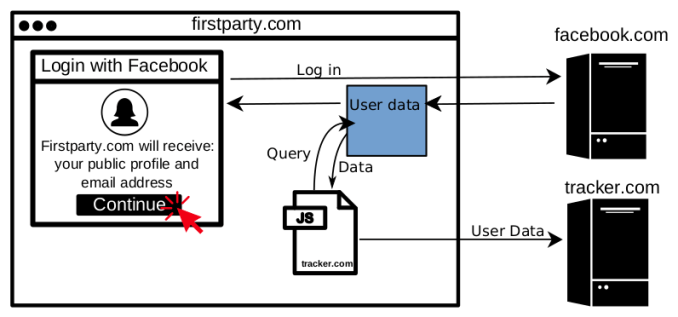
Facebook confirms to TechCrunch that it’s investigating a security research report that shows Facebook user data can be grabbed by third-party JavaScript trackers embedded on websites using Login With Facebook. The exploit lets these trackers gather a user’s data including name, email address, age range, gender, locale, and profile photo depending on what users originally provided to the website. It’s unclear what these trackers do with the data, but many of their parent companies including Tealium, AudienceStream, Lytics, and ProPS sell publisher monetization services based on collected user data.

The abusive scripts were found on 434 of the top 1 million websites including freelancer site Fiverr.com, camera seller B&H Photo And Video, and cloud database provider MongoDB. That’s according to Steven Englehardt and his colleagues at Freedom To Tinker, which is hosted by Princeton’s Center For Information Technology Policy.

Meanwhile, concert site BandsInTown was found to be passing Login With Facebook user data to embedded scripts on sites that install its Amplified advertising product. An invisible BandsInTown iframe would load on these sites, pulling in user data that was then accessible to embedded scripts. That let any malicious site using BandsInTown learn the identity of visitors. BandsInTown has now fixed this vulnerability.

TechCrunch is still awaiting a formal statement from Facebook beyond “We will look into this and get back to you.” After TechCrunch brough the issue to MongoDB’s attention this morning, it investigated and just provided this statement “We were unaware that a third-party technology was using a tracking script that collects parts of Facebook user data. We have identified the source of the script and shut it down.” Fiverr and BandsInTown did not respond before press time.


The discovery of these data security flaws comes at a vulnerable time for Facebook. The company is trying to recover from the Cambridge Analytica scandal, CEO Mark Zuckerberg just testified before congress, and today it unveiled privacy updates to comply with Europe’s GDPR law. But Facebook’s recent API changes designed to safeguard user data didn’t prevent these exploits. And the situation shines more light on the little-understood ways Facebook users are tracked around the Internet, not just on its site.

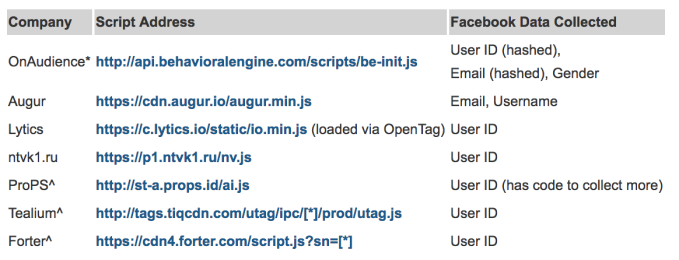
“When a user grants a website access to their social media profile, they are not only trusting that website, but also third parties embedded on that site” writes Englehardt. This chart shows that what some trackers are pulling from users. Freedom To Tinker warned OnAudience about another security issue recently, leading it to stop collecting user info.

Facebook could have identified these trackers and prevented these exploits with sufficient API auditing. It’s currently ramping up API auditing as it hunts down other developers that might have improperly shared, sold, or used data like how Dr. Aleksandr Kogan’s app’s user data ended up in the hands of Cambridge Analytica. Facebook could also change its systems to prevent developers from taking an app-specific user ID and employing it to discover that person’s permanent overarching Facebook user ID.

Revelations like this are likely to beckon a bigger data backlash. Over the years, the public had became complacent about the ways their data was exploited without consent around the web. While it’s Facebook in the hot seat, other tech giants like Google rely on user data and operate developer platforms that can be tough to police. And news publishers, desperate to earn enough from ads to survive, often fall in with sketchy ad networks and trackers.

Zuckerberg makes an easy target because the Facebook founder is still the CEO, allowing critics and regulators to blame him for the social network’s failings. But any company playing fast and loose with user data should be sweating.

18 Apr 2018

EarthNow promises real-time views of the whole planet from a new satellite constellation

A new space imaging startup called EarthNow aims to provide not just pictures of the planet on demand, but real-time video anywhere a client desires. Its ambition is matched only by its pedigree: Bill Gates, Intellectual Ventures, Airbus, SoftBank and OneWeb founder Greg Wyler are all backing the play.

Its promise is a constellation of satellites that will provide video of anywhere on Earth with latency of about a second. You won’t have to wait for a satellite to come into range, or worry about leaving range; at least one will be able to view any area at any given time, so they can pass off the monitoring task to the next satellite over if necessary.

Initially aimed at “high value enterprise and government customers,” EarthNow lists things like storm monitoring, illegal fishing vessels (or even pirates), forest fires, whale tracking, watching conflicts in real time and more. Space imaging is turning into quite a crowded field — if all these constellations actually launch, anyway.

The company is in the earliest stages right now, having just been spun out from years of work by founder and CEO Russell Hannigan at Intellectual Ventures under the Invention Science Fund. Early enough, in fact, that there’s no real timeline for prototyping or testing. But it’s not just pie in the sky.

Wyler’s OneWeb connection means EarthNow will be built on a massively upgraded version of that company’s satellite platform. Details are few and far between, but the press release promises that “Each satellite is equipped with an unprecedented amount of onboard processing power, including more CPU cores than all other commercial satellites combined.”

Presumably a large portion of that will be video processing and compression hardware, since they’ll want to minimize bandwidth and latency but don’t want to skimp on quality. Efficiency is important, too; satellites have extremely limited power, so running multiple off-the-shelf GPUs with standard compression methods probably isn’t a good idea. Real-time, continuous video from orbit (as opposed to near-real-time stills or clips) is as much a software problem as it is hardware.


Machine learning also figures in, of course: the company plans to do onboard analysis of the imagery, though to what extent isn’t clear. It really makes more sense to me to do this on the ground, but perhaps a first pass by the satellite’s hardware will help move things along.

Airbus will do its part by actually producing the satellites, in Toulouse and Florida. The release doesn’t say how many will be built, but full (and presumably redundant) Earth coverage means dozens at the least. But if they’re mass-manufactured standard goods, that should keep the price down, relatively speaking anyway.

No word on the actual amount raised by the company in January, but with the stature of the investors and the high costs involved in the industry, I can’t imagine it’s less than a few tens of millions.

Hannigan himself calls EarthNow “ambitious and unprecedented,” which could be taken as an admission of great risk, but it’s clear that the company has powerful partners and plenty of expertise; Intellectual Ventures doesn’t tend to spin something off unless it’s got something special going. Expect more specifics as the company grows, but I doubt we’ll see anything more than renders for a year or so.

18 Apr 2018

Streaming sports service fuboTV raises $75 million from AMC and others

Days after Disney-owned ESPN launched its new streaming service, ESPN+, a three-year old streaming TV service for sports fans, fuboTV, is announcing the close of $75 million in Series D funding. The round included new investor AMC Networks, and existing investors 21st Century Fox, Luminari Capital, Northzone, Sky, and the former Scripps Networks Interactive, which was recently acquired by Discovery, Inc.

FuboTV has been working to carve out a niche for itself in the streaming TV market, where a number of competitors are delivering television programming to cord cutters by way of the internet.

In terms of subscribers, that space today is led by Dish’s Sling TV and AT&T’s newer DirecTV Now. But the market has also seen a lot of newcomers over the past year or so, with launches from Hulu’s Live TV, YouTube TV, and Philo. PlayStation Vue is a competitor as well, while CBS runs its own over-the-top streaming TV service with just its content, CBS All Access.

While many streaming TV services offer some sports content in their base packages, or sell additional access through add-ons, fuboTV’s core focus has been on serving the sports fan.

The service provides access to live games from the NBA, NHL, UFC, and more soccer than other streaming providers –
including matches from Bundesliga, EPL and La Liga to Liga MX, MLS, FIFA World Cup qualifiers, UEFA
Champions League matches and more.

That access doesn’t come cheap, however. FuboTV’s basic package with 70-plus channels, Fubo Premier, is $19.99 for the first month, which then becomes $44.99 per month after.

Customers can then customize their package with other options, like a “Sports Plus,” “Adventure Plus,” or “International Sports Plus” upgrade; a DVR with 500 hours of storage instead of just 30; or the option to add a third stream.

Even though the entry-level package is more than a full subscription to a mainstream service like Sling TV or YouTube TV, fuboTV managed to reach over 100,000 paid subscribers as of September 2017, and is continuing to see double-digit growth, it says.

Since the last funding round ten months ago, the company has streamed its first MLB All Star Game, Playoffs and World Series; Tour de France; NFL regular season, playoffs and Super Bowl; college football; and the Winter Olympic Games. And it has exited beta on Apple TV, Chromecast, Roku, iOS and Android; revamped its user interface; and debuted new features like “Lookback” and “Startover.”

The lineup it offers has begun to broaden beyond sports in recent months, as well.

While it has added several new sports additions in the last ten months, it has added entertainment networks, too  – including those from its strategic investors. These include AMC, BBC AMERICA, CBS, CBS Sports Network, CBSN, Food Network, FUSION TV, HGTV, IFC, MSG, MSG+, NESN, NFL Network, Pac-12 Network, Pop, SNY, SundanceTV, The Olympic Channel, Travel Channel and WE tv.

Combined, fuboTV offers viewers over 30,000 sporting events per year, 10,000+ titles in its video-on-demand library.

In addition, fuboTV has been adding broadcast affiliates and now offers Fox in 87 percent of U.S. households, and NBC and CBS in 72 percent and 68 percent, respectively. In total, it has 257 local broadcast affiliates and owned-and-operated stations on the service.

FuboTV doesn’t just generate revenue from subscriptions, however – it also sells advertising.

The company tells TechCrunch it’s forecasting a revenue run rate of over $100 million by this time next year.

“We are very bullish from an ad perspective, even though we only launched server-side ad insertion in January,” notes fuboTV co-founder and CEO David Gandler. “One quarter in, advertising represents low single-digit percentage of our overall revenue, but it is growing quickly. As a benchmark, we are already experiencing ad revenue per subscriber above Spotify’s recently published ad revenue per user data,” he says.

With the new investment, fuboTV plans to double its office space and engineers and product team, and open a second headquarters. The funding will also be used to develop new products and content offerings, and for marketing.


Correction, 4/18/18, 4 PM ET: AMC participated and is a new investor; AMC did not lead the round. The article has been updated to reflect. 

18 Apr 2018

Ad-blocking browser Brave signs up Dow Jones as a partner

It looks like at least one major news publisher is on-board with Brave, the ad-blocking web browser founded by former Mozilla CEO Brendan Eich.

Brave Software and Dow Jones Media Group announced today they will be partnering in a deal that will bring Dow Jones content (specifically, full access to Barrons.com or a premium MarketWatch newsletter) to “a limited number of users who download the Brave browser on a first-come, first-serve basis.”

In addition, Barron’s and MarketWatch are becoming verified publishers on Brave’s Basic Attention Token (BAT) platform, a blockchain-based system that will allow consumers and eventually advertisers to pay publishers. (Brave had a hugely successful initial coin offering last year.)

And the companies said they will be working together to experiment with different ways to use blockchain technology in media and advertising.

“As global digital publishers, we believe it is important to continually explore new and emerging technologies that can be used to build quality customer experiences,” said Barron’s Senior Vice President Daniel Bernard in the announcement.

The language that the companies are using, as well as the absence of publisher’s flagship newspaper The Wall Street Journal from the deal, suggests that Dow Jones isn’t going all-in on this experiment yet.

But it’s certainly a dramatic change in tone from the way most publishers talk about ad-blockers. In fact, a group of newspapers (including the Journal) published a letter two years stating that Brave’s business model was “indistinguishable from a plan to steal our content to publish on your own website.”

Brave recently announced the launch of a referral program that rewards creators with BAT when they convince their fans to switch over to the browser. The company also said it has 2 million monthly active users.

18 Apr 2018

Whole Foods sunsets rewards ahead of Amazon Prime integration

In-store Echoes were clearly just the beginning of Whole Foods’ Amazon integration. Now that the massive online retailer owns your go-to chain for flax, kale and kombucha, it’s time to really roll it into Prime.

This week, Whole Foods alerted shoppers via an email spotted by Market Watch that it’s going to sunset both its reward program and digital coupons at the beginning of May. The company teased what’s to come by promising, “We’re Growing Something Good,” along with an Amazon logo. That “good,” however, will not including rolling over benefits into the new program. 

Details of the future integration are still sparse at the moment, and we’ve reached out to Amazon for more information. For now, however, the site’s FAQ suggests we all, “Stay tuned for additional announcements for Amazon Prime members.”

Prime has, of course, become the great connective tissue in Amazoniverse in recent years. What started as an offer of free shipping has since grown to include all of the company’s multimedia offerings, along with other Bezos-owned businesses, including The Washington Post. Prime will get you six free months of Donald Trump’s least favorite newspaper. Well, one of them, at least.

Tying Whole Foods’ rewards and coupons into Prime should prove a perfect bit of synergy for the two parties. Sign up for free shipping and get a deal on bulk chia seeds. What’s not to like? 

18 Apr 2018

A minor cryptocurrency partners with a major porn network. What could go wrong?

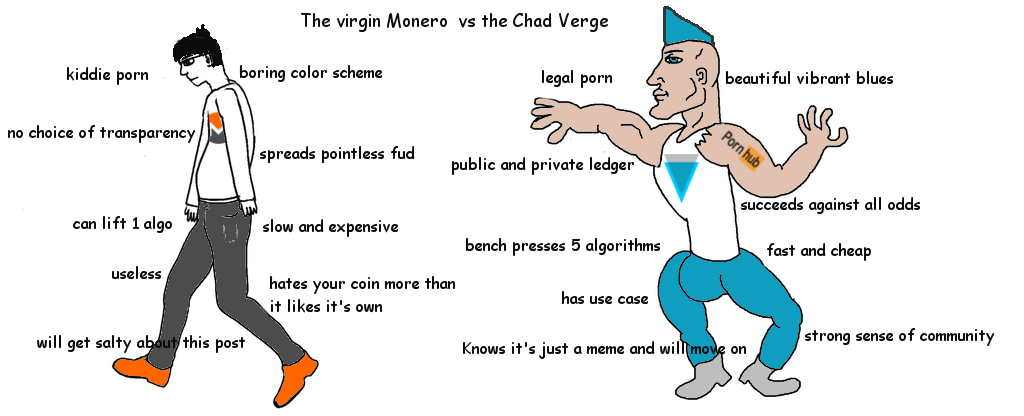
Yesterday brought some interesting news in the cryptocurrency space. In a move that is at once sleazy and ridiculous, PornHub and its tech arm MindGeek announced a partnership with the creators of VergeCoin (XVG), an anonymized cryptocurrency in the vein of Monero that is currently trading at 7 cents, down from an all-time high of about 26 cents during a recent pump.

XVG is an epitome of a coin driven by mania. Originally billed as DogecoinDark in 2014, the currency has had some ups and downs but has always displayed the “move fast and break things” mentality that gives cryptocurrencies a bad name. The product is so hapless it can’t even get their Wikipedia entry right.

The currency developers recently beseeched its rabid fans — many of whom have been waxing confused on Reddit — to raise $2 million to build a secret partnership. Weeks of speculation followed as Vergins speculated about partners, including eBay and Amazon. The price went up and down and has settled below 10 cents, placing it at position 23 on the CoinMarketCap list. It’s doing well, but not great.

Yesterday the big announcement came, as it were. I received a few emails from PornHub PR announcing a crypto partnership but they refused to announce the currency. Now that the currency is officially announced, I’m sure there are some folks who are upset they bought a load of Titcoin.

Verge has partnered with PornHub to allow users to pay with the currency. Why? And why would you want to? This is unclear. Presumably the currency allows you to pay completely anonymously but you still have to acquire Verge to pay with Verge and associating a currency with porn pretty much gives the game away as to why you’d spend it. Further, the extensive marketing efforts make PornHub look far more interesting than Verge, especially since Verge shares the same name with the Verge tech site, something that is bound to confuse average buyers. Finally, you get no real benefit from paying with Verge and, in fact, you can’t get your Verge refunded if you decide you no longer want to pay $9.99 a month for premium PR()N.

Ultimately this is better for porn than it is for cryptocurrency. PornHub gets a little bit of a media boost and cryptocurrencies — including Bitcoin, Ether and ICO tokens — look like the only source for porn. While VHS and the internet grew out of porn, cryptocurrencies are already well-established and they don’t need any more “sin” associated with them. You can also pay for a number of services with crypto, including Flirt4Free, a cam girl site associated with LiveJasmin. Given that a series of stars in big trucks will be rolling through the U.S. over the next few months promoting cryptocurrencies — that $2 million had to go somewhere — it could be positive for crypto uptake but very bad for crypto perception.

While I agree that crypto needs a shot in the arm and a sense of mission, I doubt making it easier to see naked people is quite it. I’d like to see real remittances, real real estate transactions and even real voting systems put in place. Until then, however, stunts like this do little to help.

18 Apr 2018

Indian online insurance startup Coverfox lands $22M led by World Bank’s IFC and Transamerica

Coverfox, one a handful of companies aiming to digitize insurance in India, has landed fresh funding via a $22 million Series C round that will be used to push into more rural parts of the country.

The investment is led by IFC, a sister organization of World Bank, and U.S. insurance firm Transamerica with participation from existing investors SAIF Partners, Accel and Catamaran Ventures, the fund from Infosys co-founder Narayana Murthy. The company confirmed that the round was actually close in two phases, which explains why media reports around the Transamerica investment surfaced last June.

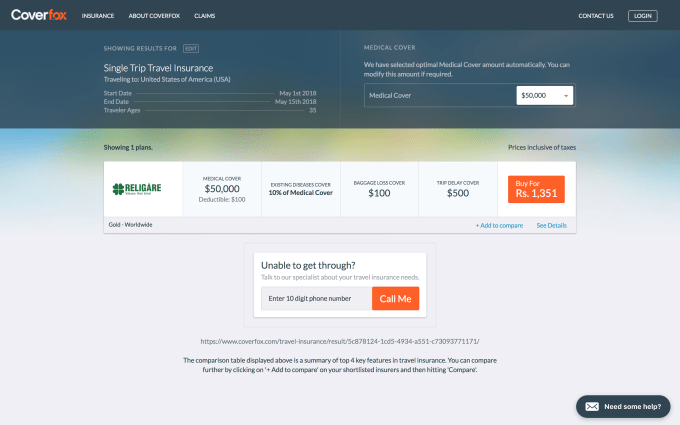
Based in Mumbai, Coverfox is a digital platform that aggregates insurance options. Currently, it works with 35 partners to offer some 150-plus packages that span health, car, bike, life and travel insurance policies in India.

Today’s announcement takes Coverfox, which was founded in 2013, to $39 million raised from investors.

Many of those same Coverfox backers have also funded digital insurance firm, Acko, which was started by Coverfox co-founder Varun Dua last year. Acko and Dua made headlines when, nearly a day to this date, the startup announced a $30 million seed investment round that came in before a product had even hit the market.

Acko got its license from the Insurance Regulatory & Development Authority of India (IRDAI) in September to go into business, and it again attracted headlines for its relationship with Amazon. The e-commerce firm was said to be in talks to invest (no deal has been announced) while Dua himself said the company was planning to develop products for the e-commerce giant, and potentially others of that scale too.

To date, though, Coverfox isn’t working with Acko, according to its CEO Premanshu Singh.

“We don’t work with Acko at all, and we don’t plan to work for next three to six months at least,” he said in an interview with TechCrunch, explaining that the company is going after larger insurance providers initially.

He also dismissed the potential for consolidation between the two despite the common investor base.

“Both entities are very different, with separate teams and different office locations. We can’t visualize anything strategic coming up,” Singh added.

Coverfox itself said it has seen “impressive momentum and scale” lately, which Singh clarified as four-fold revenue growth over the past year, although he declined to give specific figures. The company plans to double down on growth and use the new money to expand into India’s tier-two and tier-three cities where it said that insurance coverage is 35 percent lower than in urban areas, while coverage among women is lower still at 40 percent below that of men.

The company also plans to put additional capital behind its Coverdrive app for Android which is designed to equip insurance sales staff, who previously worked almost entirely offline, with digital-first materials to help grow their business using the Coverfox platform.

Coverdrive is a smart addition because it helps the company tackle the longtail of rural India without initial investment upfront. Instead, insurers use its service to boost their own business, thereby growing Coverfox sales at the same time.

Singh said Coverdrive accounts for around one-quarter of Coverfox sales. But that isn’t its only focus in tier-two and tier-three markets, where the company will roll out its own staff and focus on listing related policies.

Citing the growth of mobile data usage in rural India and a growth in digital as internet banking chips away at the bank assurance model used by most insurance brands, Singh said that rural India is better positioned for expansion than in previous years.

Coverfox isn’t yet looking at overseas options despite Singh explaining that there has been a considerable volume of inbound requests.

“It’s going to happen for sure [but] we haven’t decided where to go first,” he said.

Likewise, the model isn’t decided on either. Beyond a straight-up expansion, Coverfox could move into new markets via partnership or franchise.