Year: 2018

18 Apr 2018

ReviveMed turns drug discovery into a big data problem and raises $1.5M to solve it

What if there’s a drug that already exists that could treat a disease with no known therapies, but we just haven’t made the connection? Finding that connection by exhaustively analyzing complex biomechanics within the body — with the help of machine learning, naturally — is the goal of ReviveMed, a new biotech startup out of MIT that just raised $1.5 million in seed funding.

Around the turn of the century, genomics was the big thing. Then, as the power to investigate complex biological processes improved, proteomics became the next frontier. We may have moved on again, this time to the yet more complex field of metabolomics, which is where ReviveMed comes in.

Leila Pirhaji, ReviveMed’s founder and CEO, began work on the topic during her time as a postgrad at MIT. The problem she and her colleagues saw was the immense complexity of interactions between proteins, which are encoded in DNA and RNA, and metabolites, a class of biomolecules with even greater variety. Hidden in these innumerable interactions somewhere are clues to how and why biological processes are going wrong, and perhaps how to address that.

“The interaction of proteins and metabolites tells us exactly what’s happening in the disease,” Pirhaji told me. “But there are over 40,000 metabolites in the human body. DNA and RNA are easy to measure, but metabolites have tremendous diversity in mass. Each one requires its own experiment to detect.”
As you can imagine, the time and money that would be involved in such an extensive battery of testing have made metabolomics difficult to study. But what Pirhaji and her collaborators at MIT decided was that it was similar enough to other “big noisy data set” problems that the nascent approach of machine learning could be effective.

“Instead of doing experiments,” Pirhaji said, “why don’t we use AI and our database?” ReviveMed, which she founded along with data scientist Demarcus Briers and biotech veteran Richard Howell, is the embodiment of that proposal.

Pharmaceutical companies and research organizations already have a mess of metabolites masses, known interactions, suspected but unproven effects and disease states and outcomes. Plenty of experimentation is done, but the results are frustratingly vague owing to the inability to be sure about the metabolites themselves or what they’re doing. Most experimentation has resulted in partial understanding of a small proportion of known metabolites.

That data isn’t just a few drives’ worth of spreadsheets and charts, either. Not only does the data comprise drug-protein, protein-protein, protein-metabolite and metabolite-disease interactions, but they’re including data that’s essentially never been analyzed: “We’re looking at metabolites that no one has looked at before.”

The information is sitting in an archive somewhere, gathering dust. “We actually have to go physically pick up the mass spectrometry files,” Pirhaji said. (“They’re huge,” she added.)

Once they got the data all in one place (Pirhaji described it as “a big hairball with millions of interactions,” in a presentation in March), they developed a model to evaluate and characterize everything in it, producing the kind of insights machine learning systems are known for.
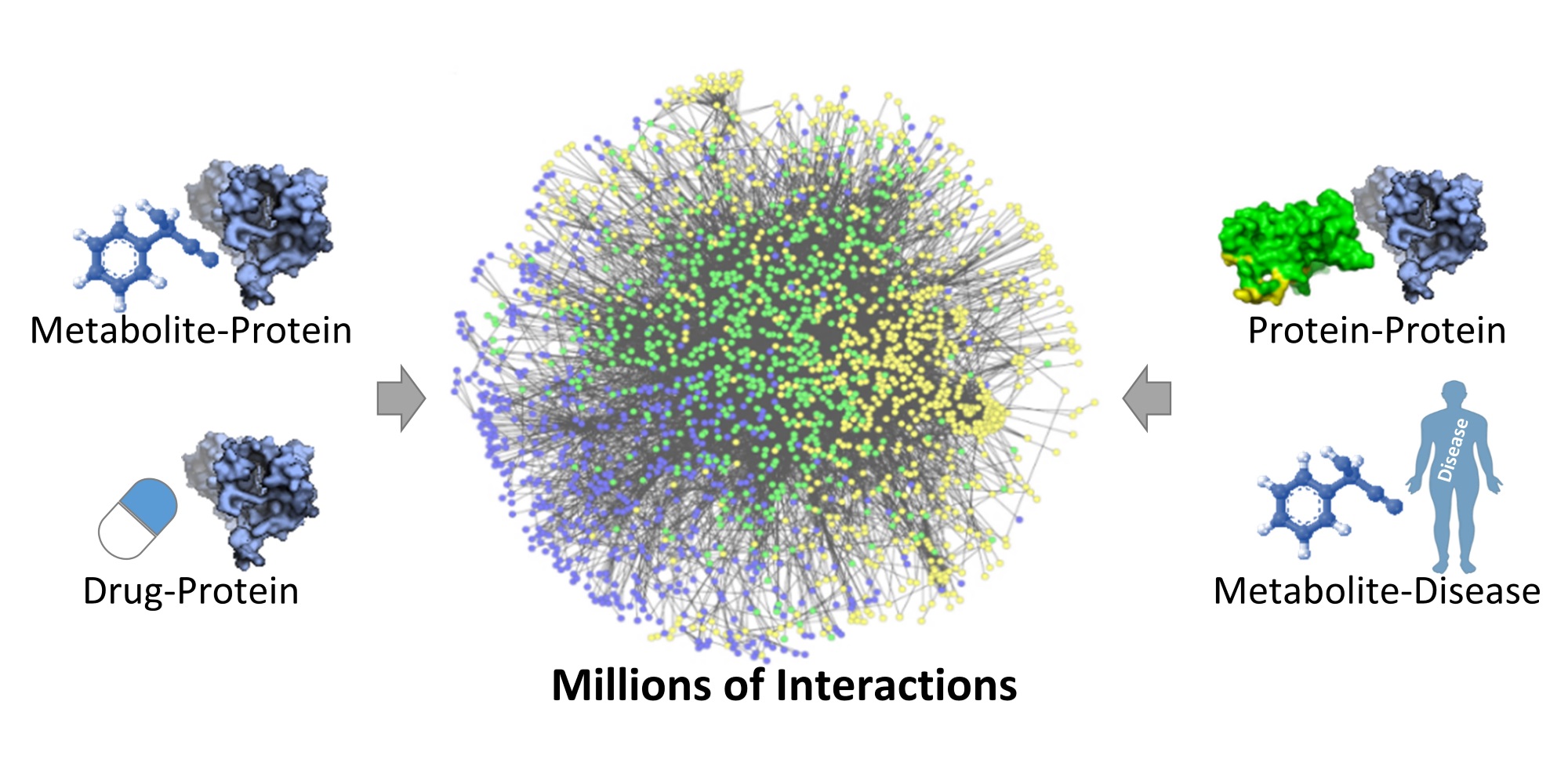
The “hairball.”

The results were more than a little promising. In a trial run, they identified new disease mechanisms for Huntington’s, new therapeutic targets (i.e. biomolecules or processes that could be affected by drugs) and existing drugs that may affect those targets.

The secret sauce, or one ingredient anyway, is the ability to distinguish metabolites with similar masses (sugars or fats with different molecular configurations but the same number and type of atoms, for instance) and correlate those metabolites with both drug and protein effects and disease outcomes. The metabolome fills in the missing piece between disease and drug without any tests establishing it directly.

At that point the drug will, of course, require real-world testing. But although ReviveMed does do some verification on its own, this is when the company would hand back the results to its clients, pharmaceutical companies, which then take the drug and its new effect to market.

In effect, the business model is offering a low-cost, high-reward R&D as a service to pharma, which can hand over reams of data it has no particular use for, potentially resulting in practical applications for drugs that already have millions invested in their testing and manufacture. What wouldn’t Pfizer pay to determine that Robitussin also prevents Alzheimer’s? That knowledge is worth billions, and ReviveMed is offering a new, powerful way to check for such things with little in the way of new investment.
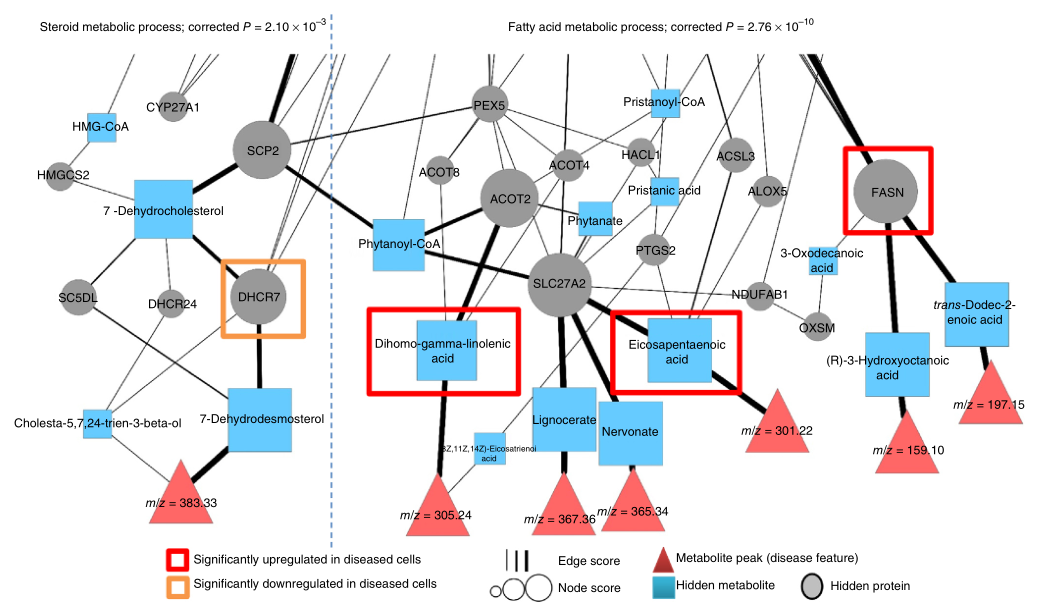
This is the kind of web of molecules and effects that the system sorts through.

ReviveMed, for its part, is being a bit more choosy than that — its focus is on untreatable diseases with a good chance that existing drugs affect them. The first target is fatty liver disease, which affects millions, causing great suffering and cost. And something like Huntington’s, in which genetic triggers and disease effects are known but not the intermediate mechanisms, is also a good candidate for which the company’s models can fill the gap.

The company isn’t reliant on Big Pharma for its data, though. The original training data was all public (though “very fragmented”) and it’s that on which the system is primarily based. “We have a patent on our process for getting this metabolome data and translating it into insights,” Pirhaji notes, although the work they did at MIT is available for anyone to access (it was published in Nature Methods, in case you were wondering).

But compared with genomics and proteomics, not much metabolomic data is public — so although ReviveMed can augment its database with data from clients, its researchers are also conducting hundreds of human tests on their own to improve the model.

The business model is a bit complicated, as well — “It’s very case by case,” Pirhaji told me. A research hospital looking to collaborate and share data while sharing any results publicly or as shared intellectual property, for instance, would not be a situation where a lot of cash would change hands. But a top-5 pharma company — two of which ReviveMed already has dealings with — that wants to keep all the results for itself and has limitless coffers would pay a higher cost.

I’m oversimplifying, but you get the idea. In many cases, however, ReviveMed will aim to be a part of any intellectual property it contributes to. And of course the data provided by the clients goes into the model and improves it, which is its own form of payment. So you can see that negotiations might get complicated. But the company already has several revenue-generating pilots in place, so even at this early stage those complications are far from insurmountable.

Lastly there’s the matter of the seed round: $1.5 million, led by Rivas Capital along with TechU, Team Builder Ventures and WorldQuant. This should allow them to hire the engineers and data scientists they need and expand in other practical ways. Placing well in a recent Google machine learning competition got them $200,000 worth of cloud computing credit, so that should keep them crunching for a while.

ReviveMed’s approach is a fundamentally modern one that wouldn’t be possible just a few years ago, such is the scale of the data involved. It may prove to be a powerful example of data-driven biotech as lucrative as it is beneficial. Even the early proof-of-concept and pilot work may provide help to millions or save lives — it’s not every day a company is founded that can say that.
18 Apr 2018

Only two weeks left to score the best pricing for Disrupt SF passes

Entrepreneurs know the stress that comes from bootstrapping a tech startup on a shoestring budget — and a frayed one at that. That’s why we’re reminding you that you can still save big bucks on passes to San Francisco Disrupt 2018, which runs from September 5-7. The Super Early Bird price offers up to $1,800 in savings, but it all disappears on May 3 — just two short weeks from now. Go get your passes right here.

Entrepreneurs also know good ROI when they see it. Disrupt attracts some of the greatest minds, movers, shakers and makers on the frontier of technology. Whether you’re looking to secure funding, find collaborators, meet a new co-founder or invest in a startup, the networking opportunities alone make Disrupt a must-attend event.

TechCrunch Disrupt is known for debuting tech innovations that change the way we live, work and play. And, in case you haven’t heard, Disrupt SF 2018 will be our biggest, most ambitious event ever. What does that mean?

Let’s start with the new venue — Moscone Center West — with three times more floor space. And we’ll need it to accommodate the more than 10,000 people attending three full days packed with the best tech programming around. We’re talking four different stages — including the Main Stage showcasing emerging tech — interactive workshops, Q&A Sessions, 12 different category tracks and more than 1,200 startups and exhibitors.

You’ll find those 1,200 pre-Series A startups exhibiting in Startup Alley, the very soul of TechCrunch Disrupt. Companies in just about every vertical you can think of will showcase their best tech, talent, products, platforms and services.

Did we mention our incredible speakers? We’ll have more announcements to come, but we’re off to an exciting start because GirlBoss Media CEO Sophia Amoruso, Carbon CEO Dr. Joseph DeSimone and Adidas CMO Eric Liedtke will be gracing the Disrupt SF stage.

Disrupt wouldn’t be Disrupt without the Startup Battlefield, the best pitch-competition platform for launching your startup to the world. Again, this year we’re going bigger and better. The grand-prize champion scores a very cool $100,000 (folks, that’s not a typo). Think your startup has what it takes to win the Disrupt Cup? You have nothing to lose and 100,000 things to gain. Apply today at our new TechCrunch Application Hub.

And for the first time ever, we’re taking the Hackathon global. Yup, now thousands of devs, hackers, coders and programmers from around the world will compete in our Virtual Hackathon. Sign up here to receive updates on how you can participate.

Disrupt San Francisco 2018 takes place September 5-7, 2018. It’s bigger, better and value-packed. Don’t miss your chance to get in at the lowest price. Buy your passes now before May 3 and save.

18 Apr 2018

Stripe debuts Radar anti-fraud AI tools for big businesses, says it has halted $4B in fraud to date

Cybersecurity continues to be a growing focus and problem in the digital world, and now Stripe is launching a new paid product that it hopes will help its customers better battle one of the bigger side-effects of data breaches: online payment fraud. Today, Stripe is announcing Radar for Fraud Teams, an expansion of its free AI-based Radar service that runs alongside Stripe’s core payments API to help identify and block fraudulent transactions.

And there are further efforts that Stripe is planning in coming months. Michael Manapat, Stripe’s engineering manager for Radar and machine learning, said the company is going to soon launch a private beta of a “dynamic authentication” that will bring in two-factor authentication and start to see Stripe’s first forays into considering how to implement biometric factors in payments. Fingerprints and other physical attributes have become increasingly popular ways to identify mobile and other users.

The initial iteration of Radar launched in October 2016, and since then, Manapat tells me that it has prevented $4 billion in fraud for its “hundreds of thousands” of customers.

Considering the wider scope of how much e-commerce is affected by fraud — one study estimates $57.8 billion in e-commerce fraud across eight major verticals in a one-year period between 2016 and 2017 — this is a decent dent, but there is a lot more work to be done. And Stripe’s position of knowing four out of every five payment card numbers globally (on account of the ubiquity of its payments API) gives it a strong position to be able to tackle it.

The new paid product comes alongside an update to the core, free product that Stripe is dubbing Radar 2.0, which Stripe claims will have more advanced machine learning built into it and can therefore up its fraud detection by some 25 percent over the previous version.

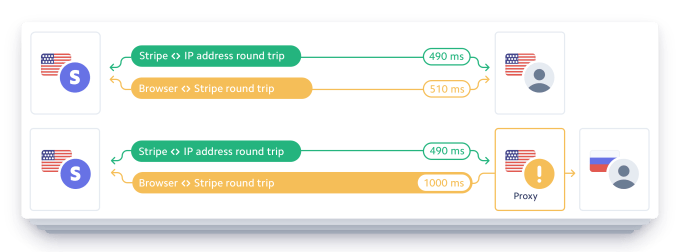
New features for the whole product (free and paid) will include being able to detect when a proxy VPN is being used (which fraudsters might use to appear like they are in one country when they are actually in another) and ingesting billions of data points to train its model, which is now being updated on a daily basis automatically — itself an improvement on the slower and more manual system that Manapat said Stripe has been using for the past couple of years.

Meanwhile, the paid product is an interesting development.

At the time of the original launch, Stripe co-founder John Collison hinted that the company would be considering a paid product down the line. Stripe has said multiple times that it’s in no rush to go public — and statement that a spokesperson reiterated this week — but it’s notable that a paid tier is a sign of how Stripe is slowly building up more monetization and revenue generation.

Stripe is valued at around $9.2 billion as of its last big round in 2016. Most recently, it quietly raised another $44 million in March of this year, according to a Form D filing and data from Pitchbook, bringing the total to just under $500 million raised.

The Teams product, aimed at businesses that are big enough to have dedicated fraud detection staff, will be priced at an additional $0.02 per transaction, on top of Stripe’s basic transaction fees of a 2.9 percent commission plus 30 cents per successful card charge in the U.S. (fees vary in other markets).

The chief advantage of taking the paid product will be that teams will be able to customise how Radar works with their own transactions.

This will include a more complete set of data for teams that review transactions, and a more granular set of tools to determine where and when sales are reviewed, for example based on usage patterns or the size of the transaction. There are already a set of flags the work to note when a card is used in frequent succession across disparate geographies; but Manapat said that newer details such as analysing the speed at which payment details are entered and purchases are made will now also factor into how it flags transactions for review.

Similarly, teams will be able to determine the value at which a transaction needs to be flagged. This is the online equivalent of when certain purchases require or waive you to enter a PIN or provide a signature to seal the deal. (And it’s interesting to see that some e-commerce operations are potentially allowing some dodgy sales to happen simply to keep up the user experience for the majority of legitimate transactions.)

Users of the paid product will also be able to now use Radar to help with their overall management of how it handles fraud. This will include being able to keep lists of attributes, names and numbers that are scrutinised, and to check against them with analytics also created by Stripe to help identify trending issues, and to plan anti-fraud activities going forward.

18 Apr 2018

GoPro launches Trade-Up program to swap old cameras for discounts

GoPro is willing to take that old digital camera stuffed in your junk drawer even if it’s a GoPro. Through a program called Trade-Up, the camera company will discount the GoPro H6 Black $50 and Fusion $100 when buyers trade in any digital camera. The company tried this last year for 60 days, but as of right now, GoPro is saying this offer does not expire.

This offer works with any digital camera including old GoPros. It clearly addresses something we noticed years ago — there’s often little reason to buy a new GoPro because their past products were so good.

GoPro tried this in 2017 for 60 days and says 12,000 customers took advantage of the program.

The service is reminiscent of what wireless carries do to encourage smartphone owners to buy new phones. It’s a clever solution though other options could net more money. Users could sell their camera on ebay or use other trade-in programs. Best Buy lets buyers trade in old cameras, too, and currently gives $60 for a GoPro Hero3+ Black and $55 for a HD Hero 960.

GoPro is in a tough position and this is clearly a plan to spur sales. The company’s stock is trading around an all-time low after a brief upswing following a report that Chinese electronic maker Xiaomi was considering buying the company. The company also recently started licensing its camera technology and trimmed its product line while introducing a new, $200 camera.


18 Apr 2018

Grasshopper, a learn-to-code app from Google’s Area 120 incubator, goes live

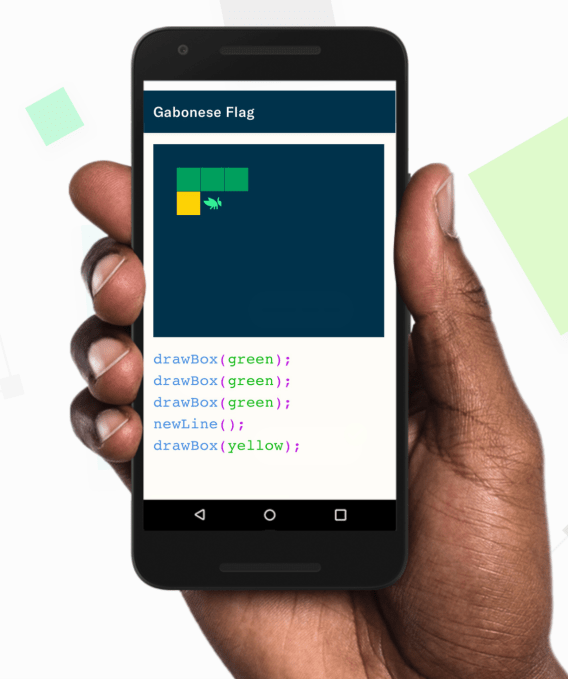
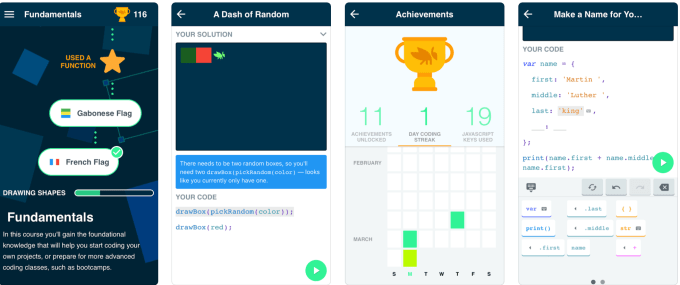
Google’s internal incubator, Area 120, is today releasing its next creation: a learn-to-code mobile app for beginners called Grasshopper. At launch, the app teaches would-be coders how to write JavaScript, via short lessons on their iPhone or Android device. The goal is to get coders proficient in the basics and core concepts, so they can take the next steps in their coding education – whether that’s taking online classes, attending a bootcamp, or playing around in Grasshopper’s own online playground where they can create interactive animations.

Like other Area 120 projects, Grasshopper was built by a small team of Googlers, who had a personal interest in working on the project.

“Coding is becoming such an essential skill, and we want to make it possible for everyone to learn even when life gets busy,” the app’s About Us page explains. “We made Grasshopper to help folks like you get into coding in a fun and easy way.”

Area 120 has now been around for just over two years, but Google’s hadn’t heavily publicized its efforts until last year, when it launched a dedicated website for the incubator. To date, Area 120 has released things like Advr, an advertising format for VR; personal stylist Tailor; emoji messenger Supersonic; a job-matching service in Bangladesh, a booking tool called Appointments; and the YouTube co-watching app UpTime.

The incubator’s goal – beyond potentially finding Google’s next breakthrough product – is to retain talented engineers who may have otherwise left the company to work on their own passion projects or startups.

Grasshopper – whose name is a tribute to early programming pioneer Grace Hopper – was already known to be one of the projects in the works at Area 120.

However, it hadn’t launched to the public until today.

The app itself offers a series of courses, beginning with “The Fundamentals,” where users learn how code works, along with various terminology like functions, variables, strings, for loops, arrays, conditionals, operators, and objects. Grasshopper then moves into two more courses where coders learn to draw shapes using the D3 library, and later create more complex functions using D3.

This curriculum will expand over the next couple of months. Grasshopper will add more content to The Fundamentals section as well as a new course.

But the team says it’s not currently focused on expanding beyond JavaScript, a language used by over 70 percent of professional developers, the site notes.

The Grasshopper app is now live on both iOS and Android, but only in English.

18 Apr 2018

Snapchat now lets advertisers sell products directly through Lenses

This week Snapchat is rolling out Shoppable AR, a new feature that makes it even easier for advertisers to sell goods through sponsored lenses. The new offering builds on top of the Sponsored Lenses the service rolled out in late-2015, which let advertisers create branded filters, bringing product placements to selfies.

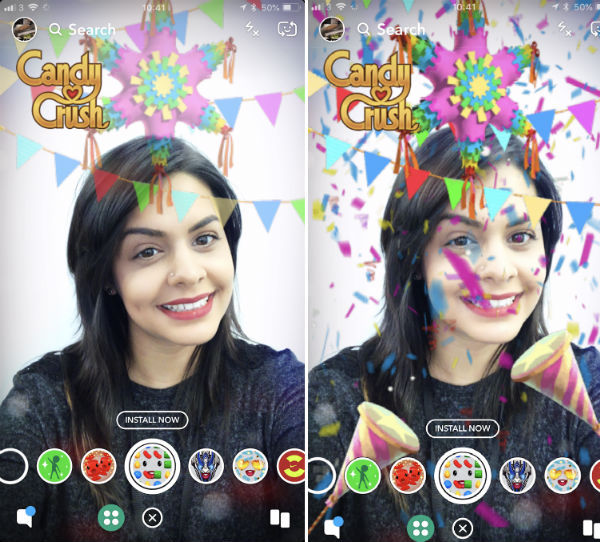
Now companies can essentially close that shopping loop, while keeping users inside the Snapchat experience. Shoppable AR makes it possible to add a button directly to a Lens, which users can tap on to visit a website where they can learn more about — or more to the point — just buy the product. Other options include a link to install an app or a “long form” video like a trailer. All of that happens directly inside the app. 

The feature is rolling out with a quartet of media partners to start. Clairol is selling an AR “beauty product trial,” Adidas is moving its Deerupt running shoes, King has an AR Candy Crush game, and STX will try to get you to watch Amy Schumer’s new comedy, I Feel Pretty.

There’s no price increase here for advertisers. The additional features will no doubt be an easy sell for those companies that have already been using Snapchat to advertise. Keeping users inside the app reduces friction of sales quite a bit, offering up ads and product sales as a more organic feature — one that doesn’t necessarily feel like advertising. For Snap, of course, the more time users spend engaged directly inside the app, the better.

According to Snap, 70 million users engage with Lenses each day. Earlier this week, the company also rolled out updates to Lens studio, which lets users create their own AR Lenses for the platform. 

18 Apr 2018

YouTube TV adds its first digital-only networks with launch of two channels from Cheddar

The first digital media networks have popped up on YouTube TV, with the addition of two new channels from the startup Cheddar. Earlier this month, Digiday had reported how YouTube’s streaming television service, YouTube TV, would soon gain new channels from a variety of digital media publishers, including Cheddar, Tastemade and The Young Turks Network. The move would help to better differentiate YouTube TV from its rivals delivering TV over the internet, while also making the service more appealing to the younger demographic YouTube TV targets – those who didn’t grow up watching traditional TV.

One of YouTube TV’s new channels is Cheddar’s flagship financial news network, and the other is Cheddar’s general news network, Cheddar Big News.

Variety was the first to spot that the new Cheddar channels had gone live.

While it hasn’t been all that common to find digital media natives streaming alongside broadcast and cable channels across the newer crop of streaming TV services, YouTube TV is not the first to add Cheddar to its lineup.

Dish-owned Sling TV had already added Cheddar’s financial news network to its streaming TV service, and will soon add Cheddar Big News, too, as will the streaming service Philo, Variety noted in its report.

On YouTube TV, Cheddar viewers will be able to watch its programming both live and on-demand.

The addition of digital media channels like Cheddar’s could help YouTube expand its lineup quickly and affordably, without having to carve out more complex deals with cable TV network owners. But the company will have to be careful in selecting those digital channels it decides to make part of its lineup. Too much digital-first content could dilute YouTube TV’s overall brand proposition – that this is a streaming “television” service on par with its competition, and not one with filler content you could watch elsewhere – like on Facebook’s video section or even YouTube proper.

Cheddar’s live streams, for example, are also available on Amazon, Spotify, Facebook, Twitter, Comcast X1, Twitch and elsewhere.

YouTube TV recently raised it pricing to $40 per month, up from $35, to be more in line with the competition.

That’s a crowded market as of late. In addition to Sling TV, YouTube TV’s rivals including PlayStation Vue, AT&T’s DirecTV Now, Hulu’s Live TV, fuboTV, CBS All Access, and Philo.

Now it has to make good on what those extra dollars are delivering to viewers.

“Cheddar’s emphasis on tech and media news coverage make it a strong fit for the millennial tech-savvy audience that also loves YouTube TV,” said Christian Oestlien, Director of Product, YouTube TV, in a statement about the launch. “From Closing Bell reports live from the floor of the NYSE stock exchange on Cheddar to headline news on Cheddar Big News, Cheddar will bring new and insightful news content to YouTube TV.”


18 Apr 2018

YouTube promises expansion of sponsorships, other monetization tools for creators

YouTube says it’s rolling out more tools to help its creators make money from their videos. The changes are meant to address creators’ complaints over YouTube’s new monetization policies announced earlier this year. Those policies were designed to make the site more advertiser-friendly following a series of controversies over video content from top creators, including videos from Logan Paul, who had filmed a suicide victim, and PewDiePie, who repeatedly used racial slurs, for example.

The company then decided to set a higher bar to join its YouTube Partner Program, which is what allows video publishers to make money through advertising. Previously, creators only needed 10,000 total views to join; they now need at least 1,000 subscribers and 4,000 hours of view time over the past year to join. This resulted in wide-scale demonetization of videos that previously relied on ads.

The company has also increased policing of video content in recent months, but its systems haven’t always been accurate.

YouTube said in February it was working on better systems for reviewing video content when a video is demonetized over its content. One such change, enacted at the time, involved the use of machine learning technology to address misclassifications of videos related to this policy. This, in turn, has reduced the number of appeals from creators who want a human review of their video content instead.

According to YouTube CEO Susan Wojcicki, the volume of appeals is down by 50 percent as a result.

Wojcicki also announced another new program related to video monetization which is launching into pilot testing with a small number of creators starting this month.

This system will allow creators to disclose, specifically, what sort of content is in their video during the upload process, as it relates to YouTube’s advertiser-friendly guidelines.

“In an ideal world, we’ll eventually get to a state where creators across the platform are able to accurately represent what’s in their videos so that their insights, combined with those of our algorithmic classifiers and human reviewers, will make the monetization process much smoother with fewer false positive demonetizations,” said Wojcicki.

Essentially, this system would rely on self-disclosure regarding content, which would then be factored in as another signal for YouTube’s monetization algorithms to consider. This was something YouTube had also said in February was in the works.

Because not all videos will be brand-safe or meet the requirements to become a YouTube Partner, YouTube now says it will also roll out alternative means of making money from videos. 

This includes an expansion of “sponsorships,” which have been in testing since last fall with a select group of creators.

Similar to Twitch subscriptions, sponsorships were introduced to the YouTube Gaming community as a way to support favorites creators through monthly subscriptions (at $4.99/mo), while also receiving various perks like custom emoji and a custom badge for live chat.

Now YouTube says “many more creators” will gain access to sponsorships in the months ahead, but it’s not yet saying how those creators will be selected, or if they’ll have to meet certain requirements, as well. It’s also unclear if YouTube will roll these out more broadly to its community, outside of gaming.

Wojcicki gave updates on various other changes YouTube has enacted in recent months. For example, she said that YouTube’s new moderation tools have led to a 75-plus percent decline in comment flags on channels, where enabled, and these will now be expanded to 10 languages. YouTube’s newer social network-inspired Community feature has also been expanded to more channels, she noted.

The company also patted itself on the back for its improved communication with the wider creator community, saying that this year it has increased replies by 600 percent and improved its reply rate by 75 percent to tweets addressed to its official handles: @TeamYouTube, @YTCreators, and @YouTube.

While that may be true, it’s notable that YouTube isn’t publicly addressing the growing number of complaints from creators who – rightly or wrongly – believe their channel has been somehow “downgraded” by YouTube’s recommendation algorithms, resulting in declining views and loss of subscribers.

This is the issue that led the disturbed individual, Nasim Najafi Aghdam, to attack YouTube’s headquarters earlier this month. Police said that Aghdam, who shot at YouTube employees before killing herself, was “upset with the policies and practices of YouTube.”

It’s obvious, then, why YouTube is likely proceeding with extreme caution when it comes to communicating its policy changes, and isn’t directly addressing complaints similar to Aghdam’s from others in the community.

But the creator backlash is still making itself known. Just read the Twitter replies or comment thread on Wojcicki’s announcement. YouTube’s smaller creators feel they’ve been unfairly punished because of the misdeeds of a few high-profile stars. They’re angry that they don’t have visibility into why their videos are seeing reduced viewership – they only know that something changed.

YouTube glosses over this by touting the successes of its bigger channels.

“Over the last year, channels earning five figures annually grew more than 35 percent, while channels earning six figures annually grew more than 40 percent,” Wojcicki said, highlighting YouTube’s growth.

In fairness, however, YouTube is in a tough place. Its site became so successful over the years, that it became impossible for it to police all the uploads manually. At first, this was the cause for celebration and the chance to put Google’s advanced engineering and technology to work. But these days, as with other sites of similar scale, the challenging of policing bad actors among billions of users, is becoming a Herculean task – and one companies are failing at, too.

YouTube’s over-reliance on algorithms and technology has allowed for a lot of awful content to see daylight – including inappropriate videos aimed a children, disturbing videos, terrorist propaganda, hate speech, fake news and conspiracy theories, unlabeled ads disguised as product reviews or as “fun” content, videos of kids that attract pedophiles, and commenting systems that allowed for harassment and trolling at scale.

To name a few.

YouTube may have woken up late to its numerous issues, but it’s not ignorant of them, at least.

“We know the last year has not been easy for many of you. But we’re committed to listening and using your feedback to help YouTube thrive,” Wojcicki said. “While we’re proud of this progress, I know we have more work to do.”

That’s putting it mildly.


18 Apr 2018

Mobile money-saving app Qapital raises $30 million to spend on growth

Qapital, one of a slew of mobile applications trying to make it easier for users to save money (and spend it more wisely), has raised $30 million in fresh financing as it expands beyond savings to offer investment advisory services.

Since its launch in the U.S. in 2015, Qapital has amassed roughly 420,000 users that have saved nearly $500 million on the platform, according to the company.

But Qapital is more than just a Digit -style savings tool these days. The company has also folded in Qapital Spending through a linked Visa Debit Card that works with money saved through the app — as well as a budgeting tool called Qapital Weekly Spending Target.

The company now has designs on the robo-investment market through Qapital Invest, a new product that Qapital expects to roll out before the end of the year.

Financing that push into investment advisory is the $30 million warchest the company just raised from big Nordic investment firms Swedbank Robur, Norron, SEB Stiftelsen and Athanase, with additional participation from the Nordic venture capital firm Northzone.

Qapital’s approach combines tools that have been rolled out into financial services verticals by startups like Digit, Acorns, Betterment, Wealthfront and Clarity Money (which was recently acquired by Goldman Sachs) .

Using certain principles of behavioral economics, Qapital tries to encourage users to save money towards goals and make better financial choices overall.

The company’s executive team even includes the renowned fintech startup whisperer Dan Ariely, who serves as chief behavioral economist for Qapital when he’s not moonlighting as the James B. Duke professor of Psychology and Behavioral Economics at Duke University, and a ​New York Times​ best-selling author.

Ariely’s theories helped shape Qapital’s “rules” and “goals” approach to money management, where users set short term and long term goals for themselves and then create spending rules to help them achieve those goals. Rules can vary from “save a dollar every time I buy a coffee” to “save $2 when anytime I use a credit or debit card”.

“Building personal banking products that people love is hard, and traditional banks to date haven’t done enough to inspire and engage their customers,” said Pär Jörgen Pärson, Chairman of the Qapital Board and General Partner of Northzone, in a statement. “Qapital understands that through building a great product that is easy to use and winning its customers’ trust, we will inspire happiness and empower people to meet their goals.”

The new capital should provide some defensibility for Qapital as the industry looks to head into a period of consolidation. 

As George Friedman, Qapital’s chief executive and co-founder noted in an email, “banks haven’t done enough to inspire and engage customers, and … banks simply can’t match the innovation speed of start-up challengers.”

With the Goldman Sachs acquisition of Clarity Money, Friedman says,”there is real demand among consumers for financial products with financial management tools built in.”


18 Apr 2018

Yahoo Mail launches new wave of updates with faster loads, photo themes, RSVPs, improved OOO

While many are on the lookout for new, big revamp of Gmail, its smaller competitor Yahoo Mail today jumped in first with its own set of updates, covering both new personalisation features and faster performance times.

The changes come about 10 months after Yahoo Mail rolled out its own major redesign, and are an extension of some of the themes that the company introduced back then. Change and iteration is the theme of the day, it seems: today, Yahoo Mail’s parent Oath (which is also TechCrunch’s owner), also announced a new president and COO, K. Guru Gowrappan, who joins from Alibaba and had in his distant past once also worked at Yahoo, as well as Quixey and Zynga…. (Additionally, Oath’s former senior director of publisher products, Simon Khalaf, has also parted ways with the company.)

Yahoo Mail has a long road ahead of it to grow its user base: the service suffered one of the biggest user data breaches in the history of the internet, affecting more than 1 billion people and impacting the price that Verizon ultimately paid by some $350 million when it acquired Yahoo last year. That, plus the general march of time, the lack of updates Yahoo Mail made over many years previously, and the swift rise of Google’s Gmail, have all served to keep the company’s growth in check. I asked for an update on active monthly users but have yet to get it, but last year the company said it had 225 million active users. As a point of comparison, Gmail today has well over 1 billion (based on a figure Google confirmed back in 2016).

Still you can say that Yahoo has been thinking ahead of the curve in some respects: last year, the company introduced a Pro version that you pay for in exchange for no advertising. Given the wave of criticism that is now hitting Facebook — and by extension all ad-based “free” services — over just what kind of information is being gathered, bartered and used relating to us, it will be interesting to see how much more the idea of paid services in lieu of ad-based free catches on.

In any case, today Yahoo Mail’s focus is on improvements to the performance of the whole Mail product. The company continues to iterate on the new Redux architecture that the company introduced when it announced its rebuild last year. Among the changes that are now in place, Yahoo says that there is now a 50 percent reduction in JavaScript exceptions; and a 20 percent reduction in overall API failures, including 20 percent when checking for new emails, 30 percent when reading email messages, and 20 percent when sending emails. Page load performance is up by 10 percent, and frame rendering by 40 percent — speeds that may not really be actively noticed by users, but will inevitably make using Yahoo Mail that much smoother.

In terms of new features, there are several areas where Yahoo Mail is adding more bells and whistles that focus on personalisation.

Yahoo Mail said that photo themes — the ability to add new backgrounds behind the actual interface of the otherwise relatively-vanilla mail service — have been one of the most consistently-requested features for the product. So building on the previous ability to change the color, now you can also add photos (illustrated above). Given the existence of Flickr in the Yahoo stable, and the way that Yahoo has been using imagery in other products like its Weather app, I’m surprised that it’s taken this long to get this one off the ground.

Another new feature is tighter and better integration with your calendar. Specifically, now Yahoo Mail will let users create and send calendar invites directly from within the mail service. This will also mean that users can now short-cut by accepting invites (or rejecting) without even opening the mail itself. Users of Gmail may know this feature well, and again it’s a welcome and needed addition to the Yahoo web mail service.

Finally, Yahoo Mail is adding some more pizzaz to your out of office responders. I can’t help but think of TV shows like The Office, which parody the boring monotony of working in offices, when I hear about improvements like these: features that make very mundane things — like OOO responders — more “fun”. Still! Having been the recipient of many a “zany” OOO note, I know that people do love to play around with these, so here’s to the crazy ones. You can now add GIFs and custom stationery to let your autoreplies stand out a little bit more.