Year: 2018

17 Apr 2018

ZTE said to be meeting with Google over US export ban

Yesterday was a rough one for ZTE. A year after pleading guilty to violating sanctions with Iran and North Korea, the U.S. Department of Commerce brought the hammer down and announced a seven-year export restriction on goods sporting U.S. components.

That applies to more than a quarter of the components used in the company’s telecom equipment and mobile devices, according to estimates, including some big names like Qualcomm. The list may well also include Google licenses, a core part of the company’s Android handsets. According to a Bloomberg unnamed source, ZTE is evaluating its mobile operating system options as its lawyers meet with Google officials.

Many of the internal components can be replaced by non-U.S. companies. ZTE can likely lean more heavily on fellow Chinese manufacturers to provide more of the product’s internals, but it’s hard to see precisely where it goes from here with regard to an operating system. There’s an extremely small smattering of alternatives open to the company, but none are great. Each would essentially involve the company working to build things, including app selections, from the ground up — and likely play a much more central role in the OS’s development.

As for Google’s role in all of this, ZTE certainly isn’t make or break for Android’s fortunes. Still, it’s a pretty sizable presence. As of late last year, it commanded 12.2 percent of U.S. market share, putting it in fourth place behind Apple, Samsung and LG. It’s certainly in Google’s best interest to maintain as many prominent hardware partners as possible — though, not if it comes with the added risk of upsetting the DOC in the process.

17 Apr 2018

New York launches a fact-finding inquiry into Coinbase, Binance and other exchanges

As cryptocurrencies continued shaking off their April hangover, the state of New York is trying to figure out what to do with this whole coin thing.

On Tuesday, New York Attorney General Eric Schneiderman announced something called the Virtual Markets Integrity Initiative, a state-level effort to examine the policies and practices of the major cryptocurrency exchanges. Schneiderman’s office emphasized to TechCrunch that the endeavor is a “fact-finding inquiry” and not an “investigation” as it’s not apparent there is any wrongdoing.

“With cryptocurrency on the rise, consumers in New York and across the country have a right to transparency and accountability when they invest their money. Yet too often, consumers don’t have the basic facts they need to assess the fairness, integrity, and security of these trading platforms,” Schneiderman said.

“Our Virtual Markets Integrity Initiative sets out to change that, promoting the accountability and transparency in the virtual currency marketplace that investors and consumers deserve.”

Schneiderman’s office is often early to defend consumer rights in the state of New York, so the cryptocurrency inquiry is very in line with the kind of work his office already does on behalf of New York state residents.

The attorney general’s office addressed a standard questionnaire to 13 cryptocurrency platforms, from the biggest names in the business to more obscure exchanges:

  • Coinbase, Inc. (GDAX)
  • Gemini Trust Company
  • bitFlyer USA, Inc.
  • iFinex Inc. (Bitfinex)
  • Bitstamp USA Inc.
  • Payward, Inc. (Kraken)
  • Bittrex, Inc.
  • Circle Internet Financial Limited (Poloniex LLC)
  • Binance Limited
  • Elite Way Developments LLP (Tidex.com)
  • Gate Technology Incorporated (Gate.io)
  • itBit Trust Company
  • Huobi Global Limited (Huobi.Pro)

The letter seeks basic information about the company’s operations, broken down across eight major categories. Those questions span from basic inquiries about ownership to anti-money laundering precautions to a request for a detailed breakdown of the fees that consumers might incur. You can read the full text of the “Virtual Markets Integrity Initiative Questionnaire” here.

Again, the letter is a broad, standardized fact-finding mission, not an investigation based on specific knowledge. Schneiderman’s office clarified that the initiative seeks to illuminate any potential for market manipulation, abrupt trade outages that go unexplained and problems customers have withdrawing funds, among other cryptocurrency trader headaches. Still, it’ll tap into some thorny issues (money laundering, anyone?) that some exchanges might not yet have a proper way of handling. Ultimately they hope to use that information to make these platforms more fair and transparent for consumers, regulators and investors alike.

While anxious bullish investors might see the New York inquiry as a threat, many of the relevant exchanges are taking it in stride so far (at least so they say), even applauding the inquiry’s effort to create more transparency that could pave the wave for thoughtful rather than heavy-handed regulation.

17 Apr 2018

Former DreamWorks exec Shawn Dennis joins GoldieBlox as president

GoldieBlox, a startup looking to get girls hooked on engineering and other STEM fields, has hired Shawn Dennis as its first president.

Dennis was most recently the head of brand and franchise development at DreamWorks Animation and also worked as the chief marketing officer at Mattel’s American Girl. She’s also been on the GoldieBlox board of directors since 2016 — founder and CEO Debbie Sterling told me she’s been “not-so-secretly hoping all along that one day Shawn would come and help me run this thing.”

Sterling said that while GoldieBlox is usually described as a toy company, she’s always had a vision for the Goldie character to become someone who would “inspire girls around the world.”

“I started it really as a social mission: I wanted to close the gender gap in STEM,” she said.

And yes, selling toys where girls can build their own machines is part of that mission, but so is the GoldieBlox YouTube channel and a partnership to produce chapter books with Random House.

Part of Dennis’ role at GoldieBlox will be to lead licensing and partnerships (apparently there’s an animated show in the works as well) and to create what she described as “an ecosystem with girls at the center.” She added that things like YouTube are key for helping the company open “two lanes of communication,” so that it’s not just talking to parents but girls as well.

“It’s time again to reinvent what girlhood means,” Dennis said.

In addition to handling licensing, she said she’ll be managing much of the company’s day-to-day operations, freeing Sterling to focus on the long-term vision and on advocating for that vision. Dennis’ experience at both DreamWorks (where she was involved in launching franchises like Trolls) and American Girls has given her plenty of experience with building brands for girls, but she added,” I will be running the business and building the business. I will not be the face of the company — that needs to be Debbie.”

17 Apr 2018

Q1 2018 global diversity investment report: Investing trends in female founders

In this report, we look at venture and seed investment trends in female-founded startups over the last five quarters. For this time period, we look at more than 9,119 venture deals and 6,802 seed deals for companies with founders associated.

To begin, $3.6 billion was invested in companies with at least one female founder in Q1 2018. That result was up 60 percent from Q1 2017’s $2.2 billion tally but down from Q4 2017 by 30 percent. We fully expect this amount to go up as more fundings are added for the quarter retroactively.
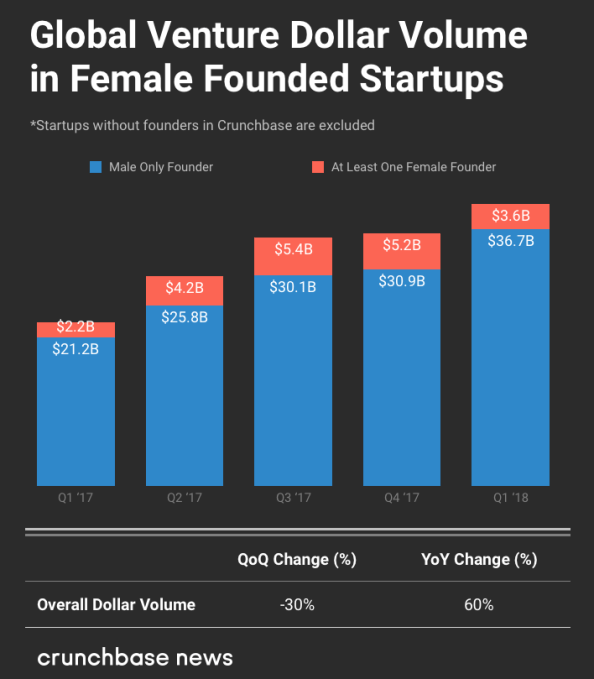
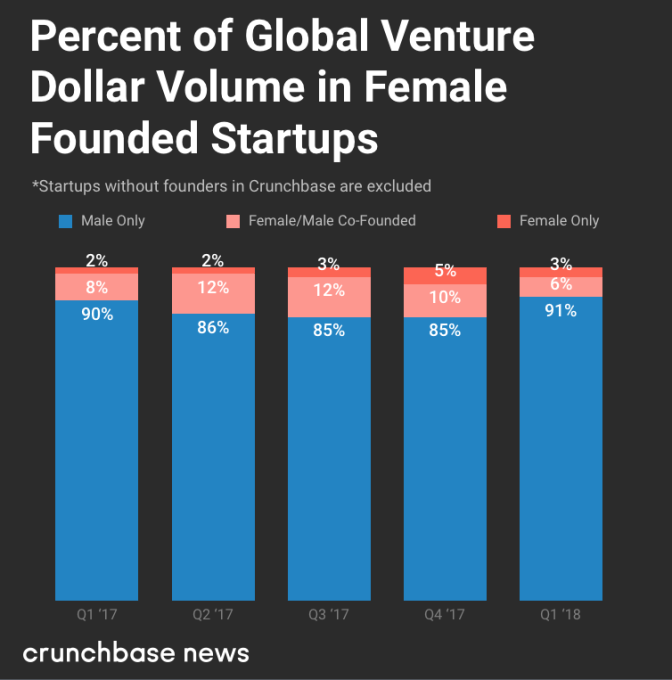
Overall, the money invested into companies with at least one female founder represents just nine percent of venture dollars invested in Q1 2018. That is one percentage point below Q1 2017’s 10 percent result. The second, third and fourth quarters of 2017 all presented higher percentages, as well: 14, 15 and 15 percent of venture dollars invested in those quarters, respectively.

When we narrow the criteria, however, the figures fall. In the Q1 2018, three percent of venture dollars were invested in solo female founders.
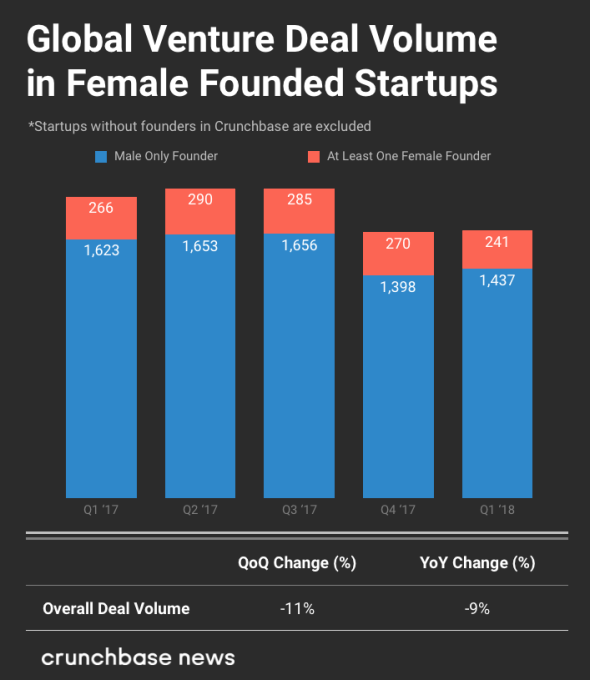
From a deal volume perspective, Q1 2018 saw 14 percent of venture deals include at least one female founder. That result mirrored the year-ago, Q1 2017 figure. However, in line with what we saw when looking at 2017’s dollar volume breakdown between teams with and without women, the interim quarters showed a higher deal count at 15 and 16 percent of all venture deals.
Deals of note

While the deal and dollar volume progress will disappoint many, inside the data are a host of interesting deals that we’d like to highlight. However, in the interest of space, we’ve selected three to share.

Here are the notable venture deals made in Q1 2018 with female founders that caught our eye:

  • Glossier: A New York-based direct to consumer beauty company founded by Emily Weiss. Glossier raised a $52 million Series C round. Index Venture and Institutional Venture Partners led the Series C round.
  • DataVisor: A Silicon Valley-based fraud prevention company led by two female founders, Yinglian Xie and Fang Yu. DataVisor raised a Series C round of $40 million. Sequoia Capital China led the round with previous investors NEA and GSR Ventures participating.
  • Zum: A provider of scheduled on-demand rides for parents of children for highly vetted drivers, founded by Ritu Narayan. Zum raised a $19 million Series B round from Spark Capital with previous investors Sequoia Capital and AngelPad participating.

Next, we’ll turn to who is cutting the checks. Or, more precisely, which firms are investing in companies with female founders.

Leading venture investors in female founders

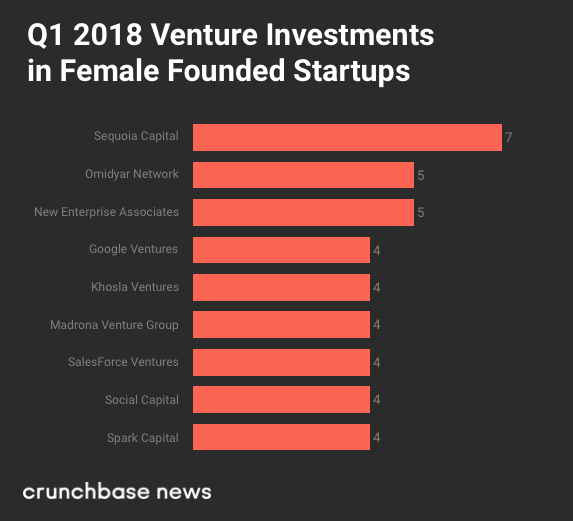
Investors that represented the highest deal count in startups with at least one female founder include Sequoia Capital with seven investments and Omidyar Network with New Enterprise Associates at five each for Q1 2018.
But, of course, investors have different focuses, especially when it comes to startup maturity. So, to that end, we’ll break down investment into companies with female founders of one particular stage.

Seed investments in female founders

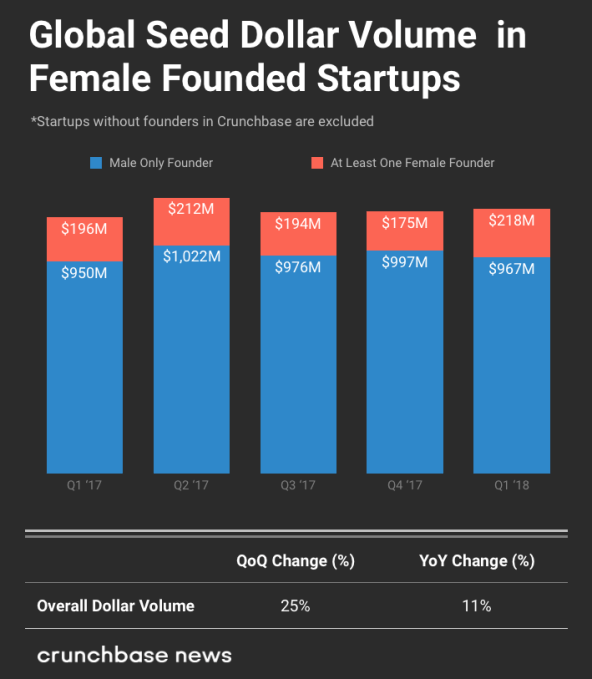
Seed-funded companies with at least one female founder raised $218 million in Q1 2018. This represented 18 percent of all seed dollar volume for the quarter, up from 15 percent in Q4 2017 and 17 percent in Q1 2017.

Overall, seed is a leading indicator for venture, and it has been growing year over year in absolute dollar terms and by percent since 2009 when we first started measuring these trends. That means that if the percentage of deals and dollars at the seed level that women are raising is going up, we may be able to expect more women-founded early, middle and late-stage companies to raise venture capital in time.

Here’s a look at the dollar volume of seed capital invested into companies with and without female founders:
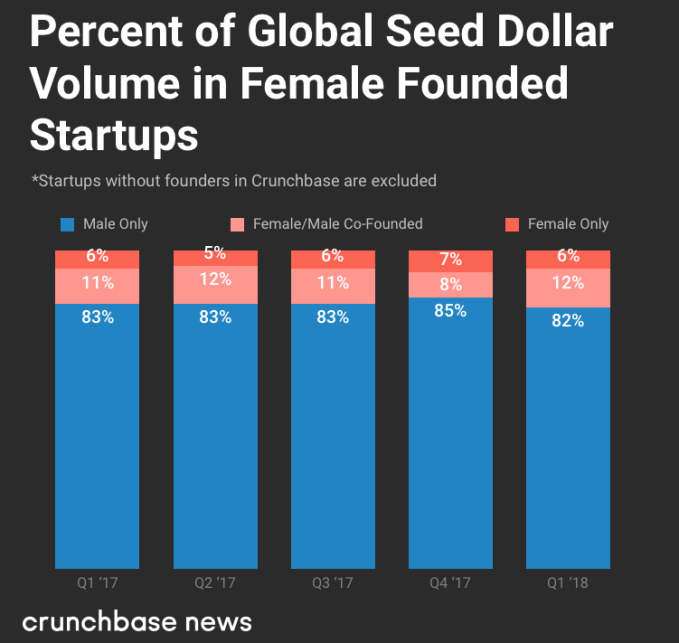
Next here’s the same data in relative percentage terms.
Returning to the big picture, seed deal counts are down slightly quarter over quarter. As more than 59 percent of seed deal volume is reported after the end of a specific quarter, the count of seed deals will increase from what is listed below:
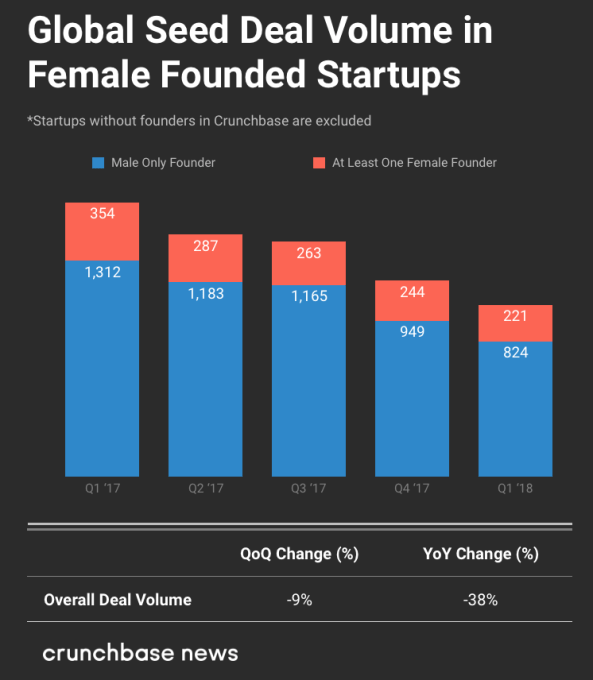
Again, we now want to know who was closing these deals with female founders.

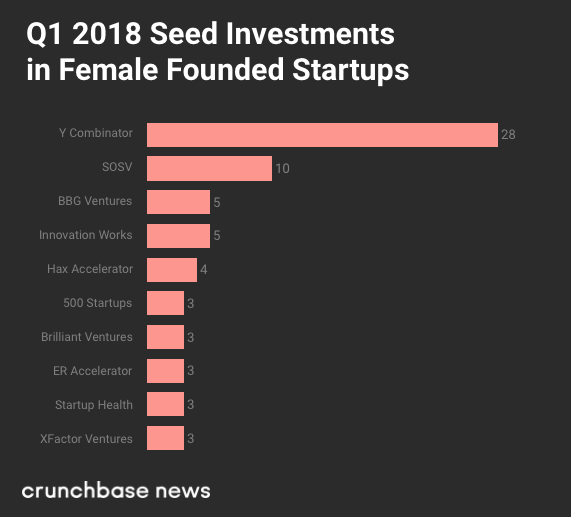
Leading seed investors

Leading seed investors in companies with at least one female founder include Y Combinator with 28, SOSV with 10 and BBG Ventures and Innovation Works at five investments each.
Investing in diverse founders

Kapor CapitalBackstage CapitalBBG VenturesBroadway AngelsPipeline Angels and more have been leading the charge to invest in diverse founders. With the increase in the number of female founders in the last five years, pressure has been growing on the broader venture capital community. With 74 percent of the top 100 firms with no female investing partners, bringing women and minorities both into their ranks and into their investment portfolios is a goal.

All Raise sets new goals for investing in diverse founders

AllRaise.org, which launched this past week, led by prominent female venture investors, seeks to impact these numbers. The organization has set the goal within the U.S. for the percent of female investing partners to double from 9 percent to 18 percent within 10 years or by 2028.

Why 10 years? For the venture industry that’s the typical life term of a single fund. Venture is a cottage industry with partners typically committing to stay for the lifetime of one or more funds. Therefore, turnover at the partner level tends to be much slower than other industries. With funds raising ever-larger amounts, and more often, expanding teams provides an opportunity to bring on diverse candidates. According to All Raise, the fastest growth for female partners is not with existing firms, but with new funds.

In the next five years, All Raise would like to see venture investments in female-founded companies move up from 15 percent to 25 percent. The organization is leading efforts to impact these numbers directly with Female Founder Office Hours supporting women who are seeking funding, to having tech founders and CEOs commit to increasing diversity in their team, board and investors.

Crunchbase is partnering with All Raise to keep abreast of these numbers within the U.S. market. For venture investments in female founders, we have a ways to go to get to 25 percent within the next five years. Reviewing the data over the last 10 years, 2015 is the first year that companies with at least one female founder have broken through the threshold of 10 percent of venture dollars. 2017 represents the best full year to date, at 14 percent of venture dollars.

The U.S. market mirrors this percent. We would need to see an average of two percentage growth points each year to reach this goal. With the number of female-founded companies growing slowly each year, these numbers are a stretch; however, it may still be attainable.


17 Apr 2018

Virtual Instagram celebrity, “Lil Miquela”, has had her account hacked

The Instagram account for the virtual celebrity known as Lil Miquela has been hacked.

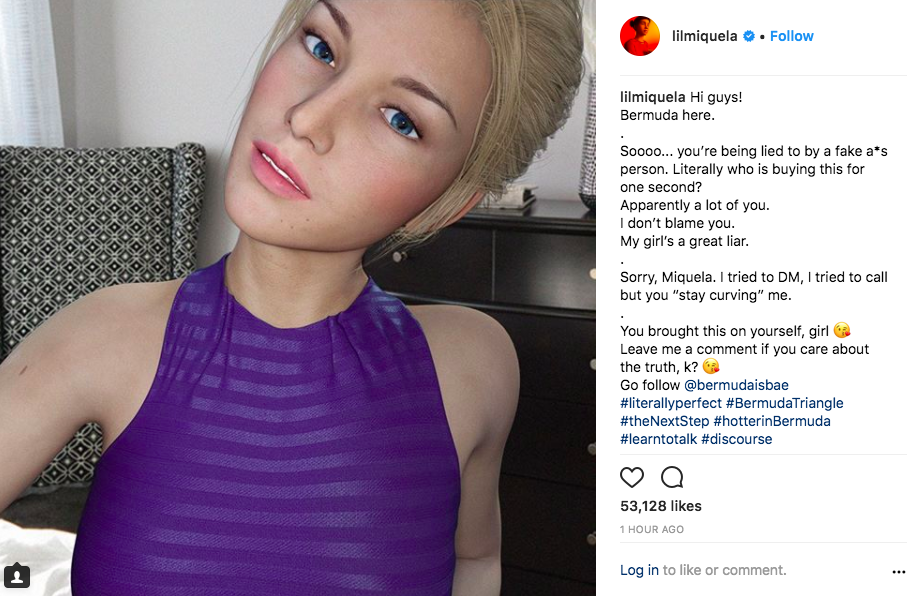
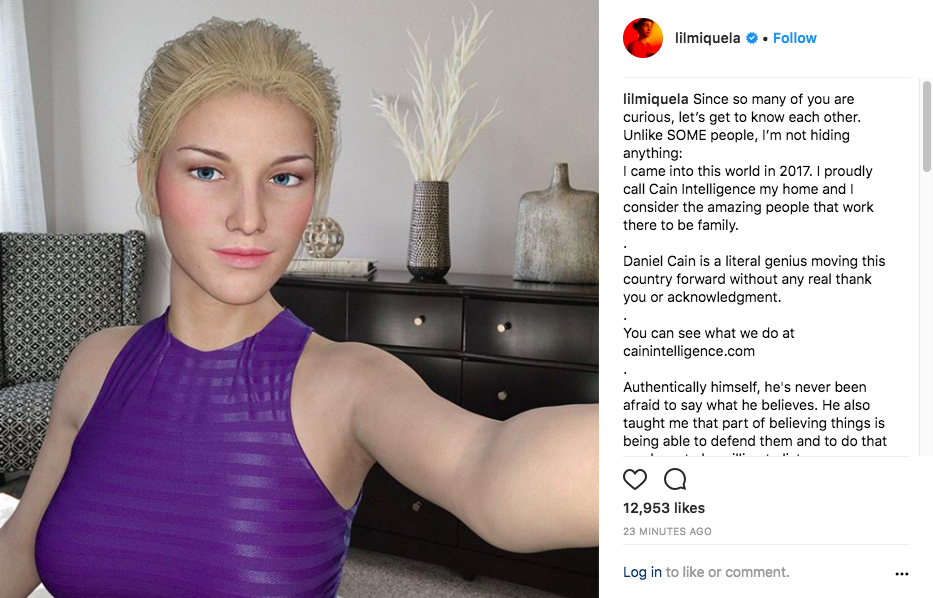
The multi-racial fashionista and advocate for multiculturalism, whose account is followed by nearly 1 million people, has had “her” account taken over by another animated Instagram account holder named “Bermuda“.

Welcome to the spring of 2018.

The hack of the @Lilmiquela account started earlier today, but the Bermuda avatar has long considered Miquela her digital nemesis and has taken steps to hack other of Miquela’s social accounts — like Spotify — before.

Because this is the twenty-first century — and given the polarization of the current political climate — it’s not surprising that the very real culture wars between proponents of pluralism and the Make America Great Again movement would take their fight to feuding avatars.

In posts on the Lil Maquela account, Bermuda proudly flaunts her artificial identity… and a decidedly pro-Trump message.

Unlike Miquela, whose account plays with the notion of a physical presence for a virtual avatar, Bermuda is very clearly a simulation. And one with political views that are diametrically opposed to those espoused by Miquela (whose promotion of openness and racial equality has been a feature that’s endeared the account to followers and fashion and culture magazines alike).

Miquela Sousa, a Brazilian-American from Downey, Calif., launched her Instagram account in 2016. Since the account’s appearance, Miquela has been a subject of speculation in the press and online.

Appearing on magazine covers, and consenting to do interviews with reporters, Miquela has been exploring notions of celebrity, influence and culture since her debut on Facebook’s new most popular social media site

A person familiar with the Lil Miquela account said that Instagram was working on regaining control.

17 Apr 2018

Electric scooter permits will be required in San Francisco

The San Francisco Board of Supervisors unanimously voted today to approve the ordinance that looks to regulate electric scooters in San Francisco. The ordinance seeks to establish regulation and a permitting process that would enable the San Francisco Municipal Transportation Agency or Department of Public Works to take action against scooters from companies that don’t have an official permit from the city.

“Part of the brouhaha has been really the function of the fact, which was admitted yesterday, was that some of these companies have been a little bit fast and loose with the truth,” Supervisor Jeff Sheehy, a sponsor of the ordinance, said today at the Board of Supervisors meeting.

Sheehy is referencing the fact that Lime, Spin and Bird deployed their respective scooters without permission from the city. The permitting scheme the city has in mind, Sheehy said, is very similar to the one San Francisco has in place around stationless bike-sharing.

“This is a basic permitting scheme to allow the professional staff at SFMTA to permit these with sensible, regulatory frameworks and to be able to confiscate unpermitted vehicles or devices,” Sheehy said.

He added that these electric scooters can absolutely serve some benefits to people in San Francisco, but that it does not mean the city should have to sacrifice its sidewalk space. The next step is for the BOS to continue working with the SFMTA to develop this regulation. At a hearing yesterday, the SFMTA said it hopes to open up the permitting process by May 1.

Earlier in the meeting today, the BOS adopted a resolution to develop a working group to inform future legislation around emerging technologies. One of the resolution’s sponsors, Supervisor Norman Yee, noted how he’s heard from seniors and people in wheelchairs who are “being imperiled and inconvenienced because they are having to navigate around scooters and bikes.”

He later added, the purpose of the working group would be to ensure the city is mindful of both the intended and unintended consequences of emerging technologies.

Yesterday, SF City Attorney Dennis Herrera sent cease-and-desist letters to Lime, Bird and Spin, but that doesn’t seem to be making any difference to Lime, Bird and Spin. All three of their respective scooters were found on the streets of San Francisco this morning.

“As it says in the letter, the City Attorney has laid out some recommendations for operation that he will like to see implemented by April 30; he has not requested an immediate stoppage of service,” a Bird spokesperson told TechCrunch. “We are taking his concerns very seriously and reviewing his recommendations for improving Bird in San Francisco.”

I’ve reached out to Lime and Spin about their respective operations in San Francisco. I’ll update this story if I hear back.

17 Apr 2018

Leaked Tesla email says Model 3 will go to 24/7 production

Tesla is about to ramp up production of the Model 3 sedan according to an email obtained by Jalopnik. The company shut down the sedan’s production line this week, but this email says the line will soon be running and a third shift will be added allowing the sedan to be built around the clock. Tesla is aiming to produce 6,000 Model 3 sedans per week by June.

The email, reportedly penned by Elon Musk, details a wide-range of topics including Model 3 production, financial expenditures, manufacturing tolerances, Tesla’s lack of financial profit, and how meetings can kill a company.

According to this note, the Model 3 line will be down for three to five days “to do a comprehensive set of upgrades.” It states that this will allow Tesla to ramp up production to 3000 to 4000 Model 3 sedans by next month. Then, the company plans to implement another set of upgrades to allow for 6000 by the end of June. Last week, according to this email, Tesla completed its third consecutive week of making over 2000 Model 3s.

It’s a tall order to expect production to triple in two months.

To help meet this expectation, Tesla is adding another shift to general assembly, body and paint at its Freemont facility. Between Freemont and its Gigafactory, Tesla is looking to 400 additional employees to help meet the production schedule.

This news about increasing production comes amid questions about safety and work conditions in Tesla’s facility. Though Tesla fiercely pushes back against the news, the questions will likely continue as workers fight to meet Musk’s lofty production expectation.

Musk is apparently looking to rein in expenditures, too, noting that anything costing more than a million dollars requires his direct approval. Maybe he will accept that couch fans raised money for.

Jalopnik published the email in its entirety and the bit at the end about meetings is worth reading. This is just part of it: “Excessive meetings are the blight of big companies and almost always get worse over time. Please get of all large meetings, unless you’re certain they are providing value to the whole audience, in which case keep them very short.”

17 Apr 2018

IRS payment site crashes on tax day

Twitter’s brief morning outage was stressful enough — but those who’ve waited until the last possible moment to pay their tax bills have a much more distressing site crash to worry about. The Internal Revenue Service’s Direct pay site is down the day taxes are due.

It’s been experiencing issues for a number of hours already, and is still unreachable as of this writing. Those who visit the page will be met with a friendly red banner bearing a large exclamation mark and the words “Alert: This service is currently unavailable. We apologize for any inconvenience.”

I mean, you didn’t really want to pay your taxes anyway, right?

The site specifically handles pay transfers from checking or savings account. There does appear to be a work around, if you pay with a credit or debit card — though you’ll also be charged a transaction fee. Still, it might be worth the $2 to $4 for the peace of mind.

The IRS says it believes this is all the result of a glitch, rather than something more nefarious like hacking. Perhaps it was even the last minute strain on the system, though failing on tax days is like giving up a grand slam during game seven of the World Series, when you’re an electronic transfer site.

“We are working to resolve the issue and taxpayers should continue to file as they normally would,” Acting IRS commissioner David Kauttner said in an address today, relayed by The Washington Post. He added that, due to the crash, late payments will “not be penalized because of a technical problem the IRS is having.”

17 Apr 2018

Buick unveils an all-electric SUV concept and it’s exactly what GM needs

General Motors is spinning up its electrification plans and today announced the stunning, poorly-named Buick Enspire concept at Auto China 2018. As a concepts go, this one looks great and rather feasible.

GM says its powered by Buick’s eMotion powertrain that can produce a maximum output of 410 kW (roughly 550 hp). This should make it good for a 4 second sprint to 60 mph. Range is clocked at 370 miles and the battery can be recharged to 80 percent within 40 minutes. It supports both fast and wireless charging.

The 2018 Buick Enspire all-electric concept SUV

Inside is an augmented reality windshield, OLED display and wood center console. And since this is just a concept and nothing is real, the Enspire features a 5G connection.

GM made a big promise in 2017 to release 20 electric vehicles within the next five years. The company is going all-in on electric vehicles and something like this Buick would fit nicely in the world of crossovers and mild SUVs. I think it looks better than the Tesla Model X, but of course, the Model X is real and this is just a concept.

The Envision was announced in China where the Buick nameplate is well-loved. It will be interesting to see if GM releases this sharp SUV under a different brand though. To me, throw a new grill on it, drop the dumb name and that SUV could be the future of Chevy.

Pricing and availability were not announced.

17 Apr 2018

Ripple’s Brad Garlinghouse and Michael Arrington to talk cryptocurrency at Disrupt SF

Ripple CEO Brad Garlinghouse and Arrington XRP Capital founder (and TechCrunch founder) Michael Arrington will be joining us at TechCrunch Disrupt SF in September to talk money.

Garlinghouse has had a long and storied career in the tech industry, serving as a Senior Vice President at Yahoo!, President of Consumer Applications at AOL, and CEO of the file collaboration service Hightail. But in 2016, Garlinghouse was promoted from COO to CEO at payment services company Ripple.

Ripple’s goal is to try to make it as easy as possible to transfer money between two stores of value. Right now, that process is incredibly tedious, with no unifying structure to send money overseas or to underbanked communities. The notion of a unifying ledger is not a new one, but it’s one that’s transformed Ripple into a full-fledged company.

But Ripple also created the world’s third-largest digital token, XRP. The token has a current total market cap around $30 billion, and the company is working to expand the use cases for XRP, which has primarily been marketed as a tool for banks but has only attracted cross-border payment services.

As cryptocurrencies continue to evolve and gain mainstream attention, questions continue to mount around how these tokens will revolutionize the economy and gain utility.

TechCrunch founder and former Editor-In-Chief Michael Arrington will join Garlinghouse on stage to discuss the evolution of cryptocurrencies. Arrington left TechCrunch in 2011 and went on to start CrunchFund, which has invested in big name startups such as Uber, Airbnb, and Yammer.

In 2016, Arrington reduced his role at CrunchFund and has since started Arrington XRP Capital, a $100 million digital asset management firm in blockchain-based capital markets. Ripple is one of the first portfolio companies for Arrington XRP Capital.

This comes at a time when the SEC is doing everything it can to learn more about cryptocurrencies, sending out subpoenas to crypto funds far and wide, including Arrington XRP Capital.

This conversation is sure to be an interesting one, and one you won’t want to miss. Tickets to Disrupt SF (September 5 to September 7) are available now.