Elon Musk, CEO of multiple companies and part of the PayPal mafia, is worth around $20 billion dollars. He doesn’t need a handout. But that didn’t stopped over 72 people from donating money on GoFundMe to buy the man a new couch.
As of publication, over $1000 was raised to gift Musk a better couch, which he said he’s been using during all-nighters while Tesla figures out its Model 3 manufacturing woes. This came to light during a CBS This Morning tour of the company’s Freemont factory.
To be honest, the couch looks horrible. Musk complained about the couch, saying last time he was in the office he slept on the floor because the couch was too narrow. I suspect that couch is about to get more use, too.
Yesterday Tesla announced it was pausing production of its Model 3 sedan.
“Our Model 3 production plan includes periods of planned downtime in both Fremont and Gigafactory 1,” a Tesla spokesperson said back in February and again yesterday to TechCrunch. “These periods are used to improve automation and systematically address bottlenecks in order to increase production rates. This is not unusual and is in fact common in production ramps like this.”
Musk points to what he calls excessive automation as part of the issue with producing the Model 3. Humans are underrated, he said.
Last August, Tesla said it expected to produce 5,000 Model 3 vehicles per week by the end of 2017. Tesla has since adjusted that number. In January, Tesla said it expects to end this quarter with a weekly rate of 2,500 Model 3 cars, with the goal to hit 5,000 per week by the end of Q2.
Tesla is known for its dedicated fanbase and they’re seemingly cheering him every step along the way. But again, Musk can buy his own damn couch. He doesn’t need your help.
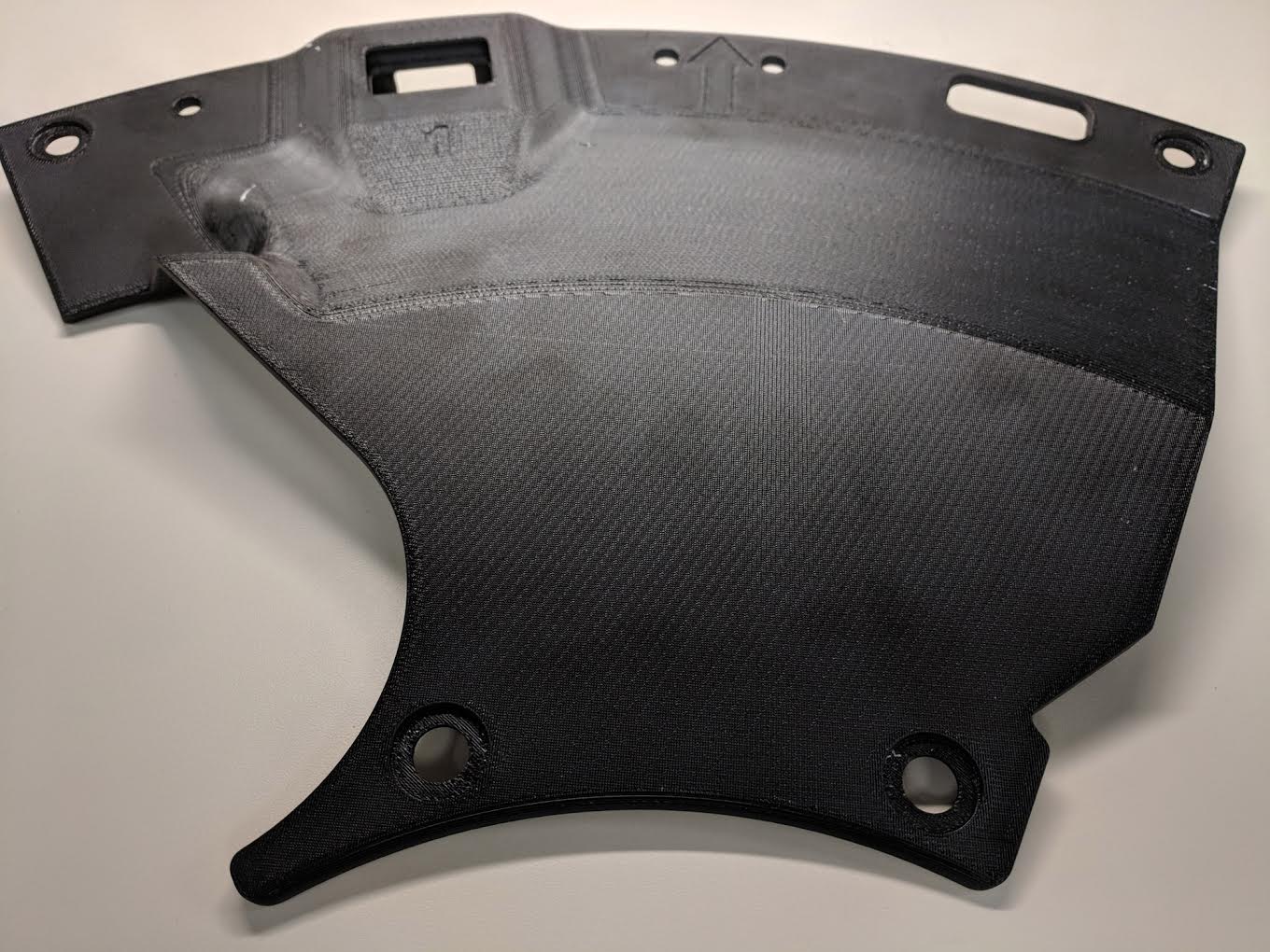
It probably goes without saying that 3D printing is going to be a mainstay for the next generation of spacecrafts. The technology has already made its way onto extra terrestrial objects, and this morning 3D printing bigwig Stratasys confirmed that it’s teaming with Lockheed Martin to create parts for the Orion.
The parts, the company is quick to explain, are more than just prototyping. More than 100 3D printed parts will make it onto that the craft, the next generation of manned NASA spacecraft, which is destined first for the moon, and later Mars. The pieces will be printed ESD Antero, a variety of thermoplastic designed to withstand the extreme heat of space travel.
“The demands of space travel require extremely high performance materials and the most rigorous manufacturing processes in the industry,” Stratasys SVP Scott Sevcik said in a release tied to the announcement. “Part integrity and repeatability are essential and must pass NASA’s demanding testing and validation process.”
An initial flight, which will include a 3D printed hatch door, will fly, uninhabited beyond the moon over the course of three weeks. Astronauts will crew the ship for a followup, which will find them traveling near the moon, for the first time since 1972 — a dozen or so years before 3D printing technology was first patented. If all goes according to plan, Orion will eventually take a human crew to Mars.
According to Parsley Health, the average adult spends 19 minutes with their physician every year. Seventy percent of the time, these short visits result in the prescription of a medication.
“According to the CDC, 70% of diseases in our country are chronic and lifestyle-driven,” said Parsley Health founder and CEO Dr. Robin Berzin. “And yet instead of addressing the root causes of health problems, medicine’s toolkit is limited to prescriptions and procedures, driving up costs while the average person gets sicker. The answer isn’t just another pill.”
Parsley Health, an annual $150 membership service, reimagines what medicine can be. The company focuses on the cause of an illness rather than simply throwing bandaids at the problem. But in order to do this, your doctor needs far more than 19 minutes of your time each year.
Today, Parsley announced the close of a $10 million Series A funding led by FirstMark Capital, with participation from Amplo, Trail Mix Ventures, Combine and The Chernin Group. Individual investors such as Dr. Mark Hyman, M.D., Director of the Cleveland Clinic Center for Functional Medicine; Nat Turner, CEO of Flatiron Health; Neil Parikh, Co-Founder of Casper; and Dave Gilboa, Co-Founder of Warby Parker also invested in the round.
As part of the financing, FirstMark Capital partner Catherine Ulrich will join the board.
Here’s how Parsley works:
When a user first signs up online, they enter in a wide range of data about themselves, from family health history to past procedures to symptoms and lifestyle. The user then schedules their first visit with their new doctor, which will last for 75 minutes, during which time the Dr. will exhaustively go through that information to download a full picture of that patient’s health.
After that visit, the user has full transparency into their medical data and the Dr.’s notes. The patient also leaves with a health plan, including lifestyle nutritional advice, and access to their own health coach. Parsley also writes prescriptions, when necessary, and refers patients to top-of-the-line specialists, if needed.
Membership includes five annual visits with their doctors (which rounds out to about four hours), as well as five sessions with their certified health coach. These coaches help patients stay on their health plan, whether it’s advice on physical exercise or getting better sleep or finding take out places and menu items near their office to eat healthier.
Throughout a patient’s membership, they have full access to their medical data and Dr.’s notes online, as well as unlimited direct messaging with their doctor. At Parsley, there is always a doctor on call to answer questions about semi-urgent issues like a UTI or a sinus infection.
All of Parsley’s doctors and health coaches are full-time employees at Parsley, and Dr. Berzin told TechCrunch that the company sees a lot of inbound from doctors who want to spend more time with patients and help solve the root of their problems.
Parsley also trains their doctors in functional medicine, which uses alternative medicine and and a holistic approach, as part of Parsley’s clinical fellowship, where they are trained in evaluating thousands of biomarkers to diagnose and treat diseases at their origin.
Parsley is not the first in the space. Forward and NextHealth Technologies also look to change the way that healthcare is provided in this country.
“When I tell people about Parsley, they say ‘wow! That’s what medicine should be’,” said Dr. Berzin. “People are really searching for something better than feeling like they’re paying more and more for healthcare. People are excited to invest in their health and wellness and to have a team that’s working to care for them.”
Parsley has clinics in San Francisco, New York and Los Angeles.
Building conversational interfaces is a hot new area for developers. Chatbots can be a way to reduce friction in websites and apps and to give customers quick answers to commonly asked questions in a conversational framework. Today, Google announced it was making Dialogflow Enterprise Edition generally available. It had previously been in Beta.
This technology came to them via the API.AI acquisition in 2016. Google wisely decided to change the name of the tool along the way, giving it a moniker that more closely matched what it actually does. The company reports that hundreds of thousands are developers are using the tool already to build conversational interfaces.
This isn’t just an all-Google tool though. It works across voice interface platforms including Google Assistant, Amazon Alexa and Facebook Messenger, giving developers a tool to develop their chat apps once and use them across several devices without having to change the underlying code in a significant way.
What’s more, with today’s release the company is providing increased functionality and making it easier to transition to the enterprise edition at the same time.
“Starting today, you can combine batch operations that would have required multiple API calls into a single API call, reducing lines of code and shortening development time. Dialogflow API V2 is also now the default for all new agents, integrating with Google Cloud Speech-to-Text, enabling agent management via API, supporting gRPC, and providing an easy transition to Enterprise Edition with no code migration,” Dan Aharon Google’s product manager for Cloud AI wrote in a company blog post announcing the tool.
The company showed off a few new customers using Dialogflow to build chat interfaces for their customers including KLM Royal Dutch Airlines, Domino’s and Ticketmaster.
The new tool, which is available today, supports over 30 languages and as a generally available enterprise product comes with a support package and service level agreement (SLA).
A court in Russia ordered a block of messaging app Telegram this week but founder Pavel Durov has shrugged off the impact of the ban 24 hours in — claiming the app hasn’t seen “a significant drop in user engagement so far”.
Russia began (trying to) block Telegram yesterday, following a court ruling in Moscow earlier this week. The state communication watchdog had filed a lawsuit to limit access to the service after Telegram refused to hand over encryption keys — and the court granted the block.
In an update posted to his Telegram channel, Durov writes: “For the last 24 hours Telegram has been under a ban by internet providers in Russia. The reason is our refusal to provide encryption keys to Russian security agencies. For us, this was an easy decision. We promised our users 100% privacy and would rather cease to exist than violate this promise.
“Despite the ban, we haven’t seen a significant drop in user engagement so far, since Russians tend to bypass the ban with VPNs and proxies. We also have been relying on third-party cloud services to remain partly available for our users there.”
Durov goes on to thank Telegram users in Russia for their support — saying the country accounts for about 7% of the app’s user base. (Last month Telegram announced passing 200M monthly active users, which suggests it has about 14M users in Russia.)
He also name-checks four U.S. tech giants — Apple, Google, Amazon and Microsoft — for, as he puts it, “not taking part in political censorship”.
Telegram moved some of its infrastructure to third-party cloud services to try to make it harder for authorities to block access to its app. But the Russian state responded by blocking millions of IP addresses belonging to Amazon Web Services and Google Cloud, apparently causing collateral damage to swathes of other digitally delivered services. (Even reportedly to some credit card terminals.)
In an attempt to ban Telegram, Russian ISPs have been required by court order to block 52.58.0.0/15, 18.196.0.0/15, 18.194.0.0/15, 35.156.0.0/14 35.192.0.0/12 – it’s like a million IPs belonging to AWS and Google Cloud. Just tried a Russia VPN, telegram still usually connects
So how long those other tech companies stand firm remains to be seen.
In some cases direct political pressure — not just the collateral damage of service disruption — appears to be being being brought to bear on them by the Russian state.
According to the Interfax news agency (via Reuters) the Russian telecoms agency has informed Amazon and Google that a “significant” number of their IP addresses are being blocked on the basis of the court ruling to block Telegram.
We’ve reached out to both to ask whether they will continue to host Telegram on their cloud services.
Reuters also reports that Russia’s state telecommunications regulator has asked Google and Apple to remove the Telegram messenger service from their app stores, citing the Interfax news agency.
We’ve also asked Apple how it intends to respond too. Last year the company bowed to state pressure in China and removed major VPN apps from its App Store — saying it was complying with a local regulation that requires VPN apps to be licensed by the government.
Russian authorities have claimed they need access to Telegram’s encryption for counter-terrorism purposes. However opponents of Vladimir Putin’s regime argue the Russian president uses claims of combating terrorism as an instrument to consolidate his own undemocratic grip on power.
Durov concludes his update about the block saying he intends to give out “millions” of dollars’ worth in Bitcoin grants this year — to “individuals and companies who run socks5 proxies and VPN” — and thus who help to bolster the resilience of Internet infrastructure against state attempts to control access.
“I am happy to donate millions of dollars this year to this cause, and hope that other people will follow. I called this Digital Resistance — a decentralized movement standing for digital freedoms and progress globally,” he adds.
The company is in the midst of a billion dollar ICO, raising money via a token sale to develop a crypto currency and blockchain platform of its own.
TechCrunch is poised to break through the huge noise surrounding blockchain with a new event. Zug, the Swiss Canton just outside of Zurich, has come to be known as “Crypto Valley” because it’s become a regulatory haven where startups are increasingly filing their Initial Coin Offerings. It’s also turned into a place where Blockchain startups are actually putting people on the ground in order to deal with the fast-moving regulatory environment. But the location matters less than the people we will be assembling to speak at our special TechCrunch Session on Blockchain there. We have some amazing people lined up, but let me fill you in first.
Our TC Sessions: Blockchain 2018 event will bring top figures in the blockchain technology world to the stage to discuss how and where blockchain technology is going to disrupt the status quo.
Among them will be Roham Gharegozlou Founder and CEO of Axiom Zen .
This award-winning venture studio specializes in emerging technology, but it’s best known for its public blockchain project, CryptoKitties. This quickly became the world’s most successful blockchain game and the first decentralized application to effectively engage a consumer audience.
CryptoKitties has been covered by Fortune, Bloomberg, and the BBC, accounting for roughly a quarter of the Ethereum network’s traffic within a week of launch. It’s effect was to introduce hundreds of thousands of new users to blockchain technology.
Prior to founding Axiom Zen, Roham served with the Rising Tide Fund based in Silicon Valley as a partner focused on seed-stage investments including AdStage, ZOZI (acquired by Peek), and Lucibel (which IPO’d on Euronext). Rising Tide has since pioneered investments in several leaders in the blockchain space including Brave and Blockstack. Before Rising Tide, he worked with Newbury Ventures, a technology-focused venture fund with success stories including ZONG (acquired by PayPal), Sentillion (acquired by Microsoft), and NextBio (acquired by Illumina) . His seed investment portfolio includes Intercom, Twenty20, and TeamPay.
In November, we told you about Farmers Business Network, a social network for farmers that invites them to share their data, pool their know-how, and bargain more effectively for better pricing from manufacturing companies. At the time, FBN, as it’s known, had just closed on $110 million in new funding in a round that brought its funding to roughly $200 million altogether.
That kind of financial backing might dissuade newcomers to the space, but a months-old startup called AgVend has just raised $1.75 million in seed funding on the premise that, well, FBN is doing it wrong. Specifically, AgVend’s pitch is that manufacturers aren’t so crazy about FBN getting between their offerings and their end users — in large part because FBN is able to secure group discounts on those users’ behalf.
AgVend is instead planning to work directly with manufacturers and retailers, selling their goods through its own site as well as helping them develop their own web shops. The idea is to “protect their channel pricing power,” explains CEO Alexander Reichert, who previously spent more than four years with Euclid Analytics, a company that helps brands monitor and understand the traffic inside their brick-and-mortar stores. AgVend is their white knight, coming to save them from getting disrupted out of business. “Why cut them out of the equation?” he asks.
Whether farmers will go along is the question. Those who’ve joined FBN can ostensibly save money on seeds, fertilizers, pesticides and more by being invited to comparison shop through FBN’s own online store. It’s not the easier sell, though. FBN charges farmers $600 per year to access its platform, which prove a hurdle to some who might try it out otherwise.
AgVend is meanwhile embracing good old-fashioned opacity. While it invites farmers to search for products at its own site based on the farmers’ needs and location, it’s only after someone has purchased something that the retailer who sold the items is revealed. The reason: retailers don’t necessarily want to put all of their pricing online and be bound to those numbers, explains Reichert.
Naturally, AgVend insists that it’s not just better for retailers and the manufacturers standing behind them. For one thing, says Reichert, AgVend’s farming customers are sometimes offered rebates. Customers are also better informed about the products they’re buying because the information is coming from the retailers and not a third party, he insists. “When a third party like FBN comes in and tries going around the retailers, the manufacturers can’t guarantee that FBN is giving the right guidance about their products.”
In the end, it’s customers will decide. But the market looks big enough to support a number of players if they figure out how to play it. According to USDA data from last year, U.S. farms spent an estimated at $346.9 billion in 2016 on farm production expenditures. That’s a lot of feed and fertilizer. It’s no wonder that founders, and the VCs who are writing them checks, see fertile ground.
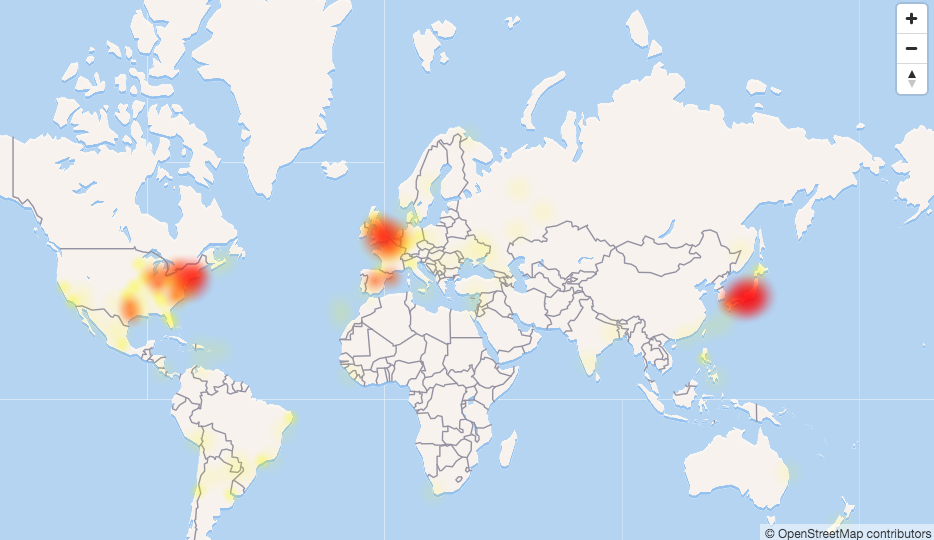
Reports of Twitter being down are coming in from across the global. The homepage and mobile app is currently down. The desktop API still works so users can connect to the service through apps like Tweetdeck and Tweetbot.
According to downdetector.com, users are experience an outage across the world. The issue appeared at 9:50 AM EDT.
Twitter has yet to comment on the outage.
Update: As of 10:35 the service appears to be coming back online around the world.
While chatbots might sound like an interesting experiment for restaurants and other small businesses, they probably can’t devote much time or money to building them. So a startup called Guestfriend is planning to make the process as fast and easy as possible.
The company has raised $5 million in seed funding from Primary Venture Partners, Techstars Ventures and betaworks. It’s led by Bo Peabody, a venture partner and entrepreneur in residence at Greycroft who also co-owns the Mezze Restaurant Group. Peabody compared the current moment to the year 2000, when “every small business woke up and said, ‘I need a website.'”
“That moment is coming for chatbots,” he predicted.
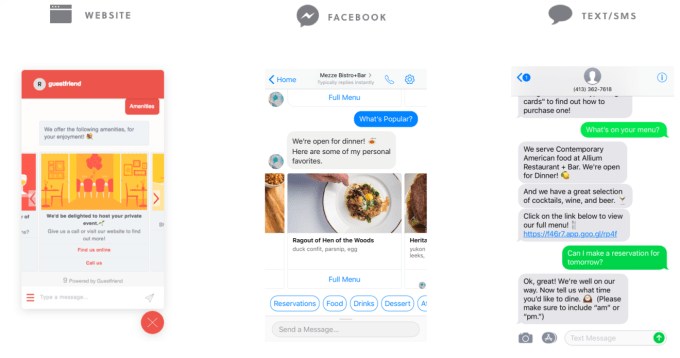
But rather than asking a restaurant owner or employee to go online and design the conversational flow of a chatbot themselves, Guestfriend can automatically create a chatbot based on information that’s already online — hours, menu, support for dietary restrictions and so on. In that sense, Peabody said, “It’s really just a website that you talk to.”
“The ah-ha moment was when I realized that building a bot for my restaurant was virtually impossible to do as a one-off, but all of the answers to almost any question are available online, mostly in structured APIs,” he said.
Peabody suggested that the real challenge was building natural language technology that could support the range of questions that someone might ask — for example, all the different ways that people might ask about the dress code. That’s one reason why it was important to target a specific industry, though he eventually plans to expand into home services, retail, spas/salons/exercise and hotels. (“It’s really the Yelp verticals.”)
Guestfriend chatbots work across platforms, including SMS, Facebook, Twitter and Google search results (via Google My Business), with plans to support speech platforms like Amazon Alexa and Google Home.
The company is actually building these chatbots without waiting for restaurants to sign up. (You can try them out on the Guestfriend website.) The idea is that publishers with restaurant listings can also incorporate them as a new way to interact with their sites.
At the same time, restaurants can come in and claim their chatbots, which will be updated accordingly on everywhere that they’re available. The restaurant can then be as hands-on or as hands-off as they want.
I brought up the fact that I often visit restaurants’ Facebook Pages in the hopes of answering more timely questions, like whether or not a restaurant is staying open despite bad weather or a holiday. Peabody suggested that as with social media or a website, the up-to-dateness of the information will depend on the restaurant — some of them might want to update every day with things like daily specials. For others, a completely automated approach might be the most appealing.
Huawei is readjusting its approach the the U.S. In an annual meeting in Shenzhen, the company asserted its commitment on existing customers and markets. It’s a shift in focus for a company that has been aggressively targeting new territories, looking to expand its position as the world’s third largest smartphone manufacturer.
It’s understandable, of course. There are some opponents not even a behemoth like Huawei is likely to overtake, the United States government chief among them. This year has been a succession of rained on parades for Huawei. At CES in January, the company had a long-awaited carrier deal pulled out from under it, just before taking the stage. That left mobile chief Richard Yu fuming in off-script remarks as the event drew to a close.
Late last month, as the company was planning to announce a new high power flagship, news got out that Best Buy was planning to phase out its Huawei stock. The timing of the two announcements led to some fairly awkward press briefings in both cases. Best Buy and AT&T’s cold feet are understandable, of course, as top U.S. intelligence agencies have repeatedly warned against buying the company’s products over spying concerns.
Huawei, for its part, is clearly positioning this as the story of a company that’s caught in the crossfires of escalating tensions between two global superpowers — a point of view that likely contains at least a kernel of truth. As rhetoric ramps up between the U.S. and China through trade tariffs and angry tweets, this whole is likely to get worse before it gets any better.
Eric Xu, who is one a trio of rotating CEOs that make up the company’s unique upper echelons, said in the meeting, “It is beyond myself to clearly explain what is going on between the two countries.”
As The Wall Street Journal notes, Huawei recently laid off five U.S.-based employees, including a senior spokesperson who repeatedly and regularly went to bat for the company. We’ve reached out to Huawei for comment, and will update as soon as we hear back.
For now, it seems like a stark contrast to Yu’s reaffirmation of the company’s commitment to the U.S., when he told the press, “We are committed to the U.S. market and to earning the trust of U.S. consumers by staying focused on delivering world-class products and innovation.”
This latest comment sounds a bit more bleak — understandably so. The U.S. is a tough market to conquer, even when the government isn’t actively working to dissuade people and agencies from buying your product.