Year: 2018

17 Apr 2018

Carvana acquires Car360 for $22M to improve its car buying platform

Carvana is already an innovative way to shop for a car and it could get better thanks to Car360. The two companies share an interest in improving the car buying experience through enhanced imagery. Car360’s approach is different from Carvana’s as it’s focused on photos shot with a mobile device. This approach could allow Carvana to accelerate and scale its operations as it currently leans on expensive DSLR rigs to capture most of its imagery.

The deal cost Carvana $6.7M in cash and issued $15.2 million in new stock putting the total acquisition price around $22 million. All 16 of Car360’s employees, including Founder Bruno Francois, CEO John Hanger and Chief Computer Vision Scientist Grant Schindler, Ph.D., will stay with Carvana. Car360 had raised $3.9M through two funding rounds including funding from Mark Cuban after the app appeared on Shark Tank.

“Carvana and Car360 both believe in the power of putting amazing technology in the hands of the customer so they can make one of the largest purchase decisions of their life with transparency and confidence,” said Ernie Garcia, founder and CEO of Carvana. “Bringing the Car360 team into the fold, we add even more entrepreneurial strength in computer vision, AR and app based photo capture. This technology unlocks a number of exciting capabilities that will further our mission to change the way people buy cars.”

Car360 uses 3D computer vision, machine learning and AR tech to improve images taken of vehicles through a smartphone.

Carvana raised $300m through 3 rounds of funding before going public in April of 2017. After an initial bust, company’s stock has doubled since its public debut and is currently trading up on the day following this news.

17 Apr 2018

Apple to launch a premium news subscription service, report says

More details are out this morning about Apple’s plans for Texture, the digital newsstand business it acquired last month. According to a new report from Bloomberg, Apple is planning to launch its own premium news subscription service in an upgraded version of the Apple News app, arriving sometime in the next year. The service will split revenues between Apple and magazine publishers, but details regarding that split were not available.

Today, however, Apple takes a 15 percent cut on subscriptions sold in the App Store.

Bloomberg also noted that around twenty Texture employees were cut post acquisition, while the remaining staff and technology is being integrated with the Apple News team.

In the past, Apple offered magazines and newspaper subscriptions through its former Newsstand app, and through Apple News, which replaced it. However, these are currently sold individually. Texture, meanwhile, operated more like a “Netflix for magazine publishing,” where readers were able to access around 200 magazines for a monthly fee of $9.99. For $14.99 per month, the subscription would include some weekly magazine titles, as well.

Before Apple, Texture was owned by Condé Nast, Hearst, Meredith, Rogers Media and KKR.

Assuming Bloomberg is correct in reporting that Texture will lead to a similar subscription-based model for magazines in Apple News, it raises some concerns. Apple notoriously likes to control news about itself, as part of maintaining its public image. This heavy-handed strategy means that Apple won’t respond to some day-to-day press inquiries, unless it’s to set the record straight on unflattering reports. It also likes to pass counterpoints along to favored reporters, at times, in order to quietly get its viewpoints some ink, without its name attached to the reporting. Years ago, it sent police to break down a reporter’s door to regain access to a lost iPhone prototype, that the news org had come to acquire.

While not all magazine publishers are focused on “news,” those who do cover tech and Apple specifically, could become uncomfortable with also relying on Apple for subscription revenues. Would any negative reporting affect their standing with the company? Would Apple kick them out of the subscription program, if news became unfavorable? For a company that so tightly protects its reputation, it’s not an outlandish concern.

In addition, publishers have already learned the downfalls associated with relying on a platform’s reach and distribution to help keep them afloat, by working with Facebook. The gave up control, only to find their content downgraded in a Facebook algorithm change. That specific scenario doesn’t translate to Apple’s News platform, of course. But publishers may find themselves unable to resist Apple’s call to participate, given its potential to pull in millions of subscribers.


17 Apr 2018

Net-a-Porter founder Natalie Massenet just launched a venture firm

In 2015, the fashion world was abuzz when Natalie Massenet, who founded the highly disruptive e-commerce fashion company Net-a-Porter, suddenly exited the scene weeks before a merger was sealed between NAP, as it is called, and Yoox, an Italy-based discount fashion e-tailer and e-commerce services company.

According to an expose written soon afterward, Massenet left because she didn’t have much say in the matter. Luxury industry giant Compagnie Financière Richemont, which acquired a majority stake in Net-a-Porter back in 2010, didn’t give her one, despite that Massenet viewed the deal as greatly undervaluing NAP. (In January, Richemont spent more than $3 billion acquiring the shares of the combined company that it didn’t already own.)

Fast forward three years and Natalie Massenet is back and in a role where she has plenty of say in a lot of things: as a venture capitalist. Indeed, today, Massenet is taking the wraps off her year-old firm, Imaginary Ventures, which she cofounded early last year with investor Nick Brown, and that just closed on $75 million in capital commitments for its debut fund.

The idea behind the vehicle is to back early-stage opportunities at the intersection of retail and technology in both Europe, where Massenet is based and the U.S., where Brown spent the last six years, working as a partner at 14W, a New York-based venture firm that focuses on consumer tech in the fashion and e-commerce sectors.

Among Brown’s deals: the shoe company Allbirds, and the eyewear company Warby Parker. Others of 14W’s many bets include Reformation, Moda Operandi, Goop, The RealReal, Maple, Lola, and Outdoor Voices.

“Nick and I have been good friends for a long time, and would spend hours discussing our shared view of the consumer retail space, and where the industry was headed,” Massenet tells us of how the two came together. “It was during an initial conversation over lunch that the idea for Imaginary started to come together: let’s build a fund focused on early-stage businesses obsessed with the consumer, and help create the global retail brands and platforms of the future.”

“At 14W,” Brown adds, “I felt that the rapid changes we were seeing in retail were only just beginning. Investors, entrepreneurs and the industry were only just beginning to understand how quickly these businesses could scale.”

Certainly, the pair isn’t wasting any time. Among their 11 companies to which the fund has already written checks is the cosmetics company Glossier; the clothing company Everlane ; and the meal kit company Daily Harvest. All three outfits are also in the portfolio of 14W, a firm that was founded in 2010 by Alex Zubillaga, a former EVP at Warner Music Group.

As for what size checks they are willing to write, they won’t say, partly because they don’t want to box themselves in, says Brown. “Most of our investments will be early to mid-stage, but we would never confine ourselves to a strict bracket given the potential for opportunities at other stages.”

As for whether, given her own experience, Massenet might well think it’s better as an investor to stay out of a startup’s way, she says she doesn’t.

“When I started Net-a-Porter, I was lucky enough to have extraordinary angel investors and mentors giving me much needed funding and advice along my journey, and it is a privilege to be able to return the favor with Imaginary and the transferable skill set I’ve developed throughout my career,” she says.

In fact, she says that she and Brown will be “very hands-on” when it comes to their portfolio companies, with an eye toward supporting a “new generation of entrepreneurs challenging the status quo across every vertical.”

If you’re curious about Imaginary’s LPs, Massenet and Brown say they come from both sides of the Atlantic and that they include billionaire mall owner Rick Caruso and Matches Fashion’s co-founders and joint chairmen Tom and Ruth Chapman.

17 Apr 2018

Resy rolls out a new suite of tools for restaurants

Resy launched in the summer of 2014 with a simple premise: If you want a premium reservation at a restaurant on short notice, you should be able to pay for it. Four years and 160 markets later, Resy has changed a lot since then.

But today, the company is about to change things up even more.

This morning, Resy has announced a brand new suite of tools for restaurants, including a new inventory management system called ResyFly.

As it stands now, restaurants have two options when it comes to inventory management for their reservations. They can choose a slot system, where diners are seated at 6pm, 8pm and 10pm, or they can opt for a flex system, where they take reservations as they’re called in and build the night’s reservations based off what comes in first.

Unfortunately, most restaurants have to choose between these two systems, as there are no inventory management systems that offer the ability to do both, according to Resy.

ResyFly uses Resy’s troves of data to determine the best way for restaurants to eliminate gaps in their inventory throughout a given night, taking into account things like date, time, weather, and even the average time spent eating at a given restaurant. The tool gives restaurants the ability to schedule different floor plans, reservation grids and hours of operation for special days like Valentines Day.

Alongside ResyFly, the company is also introducing Business Intelligence, a window into important information like KPIs, revenue, and ratings with third-party information from platforms like Foursquare layered in and integrated with POS software providers to offer real-time revenue reporting.

But sometimes you want direct feedback from the customer. To that end, Resy is launching Resy Surveys, which gives a restaurant the opportunity to send a custom survey to customers about their experience. Resy is also integrating with Upserve, giving Resy’s restaurant partners insights into their guests’ preferences and favorite dishes, as well as info on dining companions, frequency of bookings, and historical spend.

And while Resy is focused on refining the product, the company is also focused on growth. That’s why Resy has announced the launch of Resy Global Service, which lets Resy distribute inventory to partners like Airbnb. (It’s worth noting that Airbnb led Resy’s $13 million funding round in 2017.)

Finally, Resy is working on a new membership loyalty program called Resy Select, which will launch at the end of the month. Resy Select is an invite-only program that gives restaurants insights into Resy’s hungriest users, and gives those users benefits such as exclusive booking windows, priority waitlist, early access tickets to events, and other exclusive experiences like meeting the chef or touring the kitchen.

Resy books more than 1 million reservations on the platform each week. The company no longer charges users for reservations, but rather charges restaurants by feature, instead of cover, with three tiers ranging from $189/month to $899/month. That said, the company is not yet self-serve on the restaurant side, but founder and CEO Ben Leventhal said the team is thinking about introducing it in the future.

“The key challenge and key opportunity is to do everything we can to make the right choices about what we build and the order we build it in,” said Leventhal. “Our goal is to stay focused on restaurants, as a significant amount of the tech we build is built in conjunction with our restaurant partners.”

17 Apr 2018

Cambridge Analytica’s ex-CEO backs out of giving evidence to UK parliament

Alexander Nix, the former CEO of the political consultancy firm at the center of a storm about mishandled Facebook users data, has backed out of re-appearing in front of the UK parliament for a second time.

Nix had been scheduled to take questions from the DCMS committee that’s probing online misinformation tomorrow afternoon.

In a press notice today, the committee said: “The former CEO of Cambridge Analytica, Alexander Nix, is now refusing to appear before the Digital, Culture, Media and Sport Committee at a public session tomorrow, Wednesday 18th April, at 2.15pm. He cites the Information Commissioner’s Office’s ongoing investigation as a reason not to appear.”

Nix has already given evidence to the committee — in February — but last month it recalled him, saying it has fresh questions for him in light of revelations that millions of Facebook users had their data passed to CA in violation of Facebook’s policies.

It has also said it’s keen to press him on some of his previous answers, as a result of evidence it has heard since — including detailed testimony from CA whistleblower Chris Wylie late last month.

In a statement today about Nix’s refusal to appear, committee chair Damian Collins said it might issue a formal summons.

“We do not accept Mr Nix’s reason for not appearing in a public session before the Committee. We have taken advice and he is not been charged with any criminal offence and there is no active legal proceedings and we plan to raise this with the Information Commissioner when we meet her this week. There is therefore no legal reason why Mr Nix cannot appear,” he said.

“The Committee is minded to issue a formal summons for him to appear on a named day in the very near future. We’ll make a further statement about this next week.”

When Nix attending the hearing on February 27 he claimed Cambridge Analytica does not “work with Facebook data”, also telling the committee: “We do not have Facebook data”, though he said the company uses the social media platform to advertise, and also “as a means to gather data, adding: “We roll out surveys on Facebook that the public can engage with if they elect to.”

Since then Facebook has said information on as many as 87 million users of its platform could have been passed to CA, via a quiz app that was able to exploit its friends API to pull data on Facebook users’ friends. Its CEO Mark Zuckerberg has also been asked to give evidence to the committee — but has declined repeat requests to appear.

Today the committee also heard from a former CA director, Brittany Kaiser, who suggested CA had in fact been able to obtain information on far more than 87M Facebook users — by the use of a series of additional quiz apps designed to be deployed on Facebook’s platform.

She claimed viral tactics were used to harvest Facebookers’ data, naming two additional survey apps it had deployed on Facebook’s platform as a ‘sex compass’ app and a music quiz app claiming to determine your personality. She said she believed the point of the quizzes was to harvest Facebook user data.

Facebook finally suspended Cambridge Analytica from its platform last month — although the company has admitted it was made aware of the allegations linking it with a quiz app that harvested Facebook users data since at least December 2015, when the Guardian published its first article on the story.

Last month the UK’s data protection agency obtained a warrant to enter and search the offices of Cambridge Analytica — as part of an ongoing investigation into the use of data analytics for political purposes which it kicked off in May 2017.

The information commissioner said the warrant had been necessary as CA failed to meet an earlier deadline to hand over information that it had requested.

Meanwhile Nix himself was suspended as CEO by CA last month, following a Channel 4 News investigation broadcast video footage of Nix talking to an undercover reporter and appearing to suggest the firm uses a range of dubious tactics, including front companies and subcontractors to secretly engage in political campaigns.

In a statement at the time, CA said the secretly recorded comments — and “other allegations” — “do not represent the values or operations of the firm and his suspension reflects the seriousness with which we view this violation”.

It’s since been reported that Julian Wheatland, the chair of the company’s UK counterpart, SCL Group, will be taking over as CA CEO — though this has not yet been publicly confirmed. Though it has said that the acting CEO, Dr Alexander Taylor, who took over from Nix last month has returned to his former role as chief data officer.

17 Apr 2018

SpaceX to build its massive BFR in Los Angeles

The mayor of Los Angeles confirmed earlier reports that SpaceX will build its largest rocket, the BFR, at the Port of Los Angeles. The company intends to build a manufacturing facility on an 18-acre site at Berth 240 and use waterways to transport the massive rocket. SpaceX says the BFR is simply too big to be transported by roads.

Announced last September SpaceX intends for the reusable BFR to eventually replace its Falcon 9 and Falcon 9 Heavy rockets. It could eventually ferry humanity to Mars or used for point-to-point transportation on Earth.

“As announced today by Mayor Garcetti, the Port will play an increasingly important role in our mission to help make humanity multi-planetary as SpaceX begins production development of BFR — our next generation rocket and spaceship system capable of carrying crew and cargo to the Moon, Mars and beyond.” Gwynne Shotwell, SpaceX president and COO, said in a statement.

SpaceX has used the port for its west coast recovery operations since 2012. There were widespread reports that the company was looking to drastically expand its operations at the location. This announcement confirms those reports.

The Los Angeles Harbor Commission must now approve the facility. If given the green light, SpaceX says it has the potential of employing 700 people.

17 Apr 2018

Drift raises $60 million to be an Amazon for businesses

When you’re raising venture capital, it helps if you’ve had “exits.” In other words, if your company has been acquired or you’ve taken one public, investors are more inclined to take a bet on anything you do.

Boston -based serial entrepreneur David Cancel has sold not just one, but four companies.  And after a few years running product for HubSpot, he’s in the midst of building number five.

That startup, Drift, managed to raise $47 million in its first three years. Now it’s announcing another $60 million led by Sequoia Capital, with participation from existing investors CRV and General Catalyst. The valuation is undisclosed.

So what is Drift? It’s “changing the way businesses buy from businesses,” said Cancel. He wants to eventually build an alternative to Amazon to make it easier for companies to make large orders.

Currently, Drift subscribers can use chatbots to help turn web visits into sales. It has 100,000 clients including Zenefits, MongoDB, Zuora and AdRoll.

Drift “turns those conversations into customers,” Cancel explained. He said that technology is comparable to what is commonly used for customer service. It’s the “same messaging that was used for support, but used in the sales context.”

In the long-run, Cancel says he hopes Drift will expand its offerings to compete with Salesforce.

The company wouldn’t disclose revenue, but says it is ten times better compared to whatever it was in the past year. And it’s on track to grow another five times this year. This, of course, means little without hard numbers.

Yet we’re told that the new round means that Drift will have $90 million in the bank. It plans to use some of the funding to make acquisitions in voice and video technology. Drift also plans to expand its teams in both Boston and San Francisco, with new offices for both. The company presently has 130 employees.


17 Apr 2018

Node snags two top AI researchers to advance AI-fueled search tool

Node, an AI-driven search tool designed to surface the information that matters most to you, announced today that it was bringing on a couple of AI research heavy hitters. It also announced $5 million in additional funding.

For starters, the company hired Louis Mornier, one of the founders of early internet search engine, Alta Vista, and most recently the Head of the AI Lab at Airbnb. Mornier will join the startup as Chief Scientist.

The company also brought on Jeffrey Johnson as Chief Technology Officer in January. Johnson has almost 20 years of executive experience and has has over three decades of experience working on large-scale artificial intelligence systems, according to the company.

The new money comes from Recruit Strategic Partners (RSP), WndrCo, David Brewer of Aragon Capital (former founder of search engine Inktomi), Linnea Roberts of GingerBread Capital, Falmouth Ventures, and Marc Weiss of Open Field Capital.

Node CEO Falon Fatemi says the new talent isn’t simply for show. The company has brought them onboard to help advance its AI-powered discovery engine, which according to Fatemi, helps surface the relevant people you should be partnering with today.

“Fundamentally what we are talking about when we say we are ushering next generation search is an AI brain that understands the interconnections [between people and things] and surfaces personalized recommendations,” she said.

She says the use case of connecting people you should know is just a starting point for the search engine, but one that’s generated $200 million in revenue. Over time, they want to expand beyond that and use the technology to help discover other relevant data inside an organization and on the web. The two new hires should help.

“We think with this next generation release that’s coming, we will be expanding to allow any organization to leverage Node. [The technology] can be applied in any context in a company,” she said. “It’s a new way of [taking advantage of] AI, and it’s becoming a reality. Leaving opportunities to ad hoc chance is no longer acceptable and we have a great opportunity to be that platform, giving recommendations and helping find opportunities,” Fatemi explained.

The company was founded in 2014 and has raised more than $21 million.

17 Apr 2018

Target expands its ‘Drive Up’ service to 270 stores across Florida, Texas and the Southeast

Target runs are about to get a lot easier. The retailer today is officially expanding its new curbside pickup service called Drive Up to the first locations outside of its home market of Minneapolis-St. Paul, where it had been in pilot testing. With Drive Up, customers can place orders using the Target app on their phone, then drive to their local store and have their purchases brought out directly to their vehicles, minutes after arrival.

Starting today, nearly 270 stores across Florida, Texas and the southeast will now offer Drive Up to their customers, which is still on track to reach 1,000 of Target’s 1,800 stores by year-end.

In addition to Florida and Texas, some stores in Alabama, Georgia, Mississippi, Oklahoma, Louisiana, and South Carolina also now have access to Drive Up. The locations will often overlap with where Target’s Shipt delivery service is available.
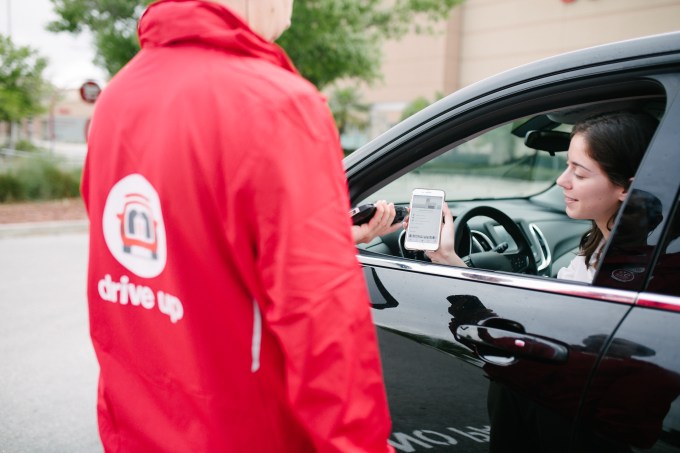
With Drive Up, Target aims to better compete with the likes of Walmart and Amazon.

Both today offer curbside pickup of groceries – the former via its online Walmart Grocery shopping service, and the latter through AmazonFresh and Whole Foods. Target, meanwhile, acquired grocery delivery service Shipt for over half a billion last year. The service has yet to roll out a grocery pickup option. (That’s something in discussion, but the near-term focus is on expanding Shipt to the majority of Target’s U.S. stores by the end of the year.)

In addition, both Amazon and Walmart offer in-store pickups and self-serve pickup experiences with Amazon Lockers and Walmart’s Pickup Towers, where available.

Target Drive Up doesn’t directly compete with either grocery pickup or self-serve. It isn’t for fresh and frozen items, but is for almost anything else – from everyday essentials to TVs to clothing to beauty to household goods and more. Consumer packaged goods can be ordered through Drive Up, too, like chips, crackers, cereal, cookies, canned goods, coffee, etc.

The assortment is similar to what’s available for delivery through Target’s next-day service, Target Restock, which equates to hundreds of thousands of SKUs. But it’s a smaller product selection compared with Target.com’s online inventory for home delivery or in-store pickup.

How Drive Up Works

Using Drive Up is pretty simple – something that reflects the fact that Target has its own in-house engineering teams developing its new e-commerce experiences. Drive Up was built by a team of eight, including four engineers, in a matter of months starting last April. By summer 2017, it was being tested internally. And by October, it had rolled out to consumers in Target’s home market.

To get started, you shop for items as usual in the Target app.

But there will now be a new option for “drive up” on the product detail screen. This screen also shows you if the item is in stock at your local store, if you can order it for in-store pickup, and how soon it could be delivered to your home.
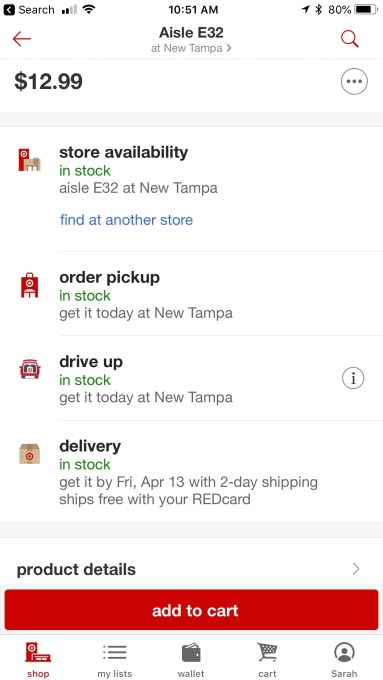
To order it for “drive up” pickup, you just tap that option to add the item to your cart. You can also move items to “drive up” from the checkout screen, if you prefer. Cartwheel discounts won’t be available on Drive Up items – you have to go in store for that.

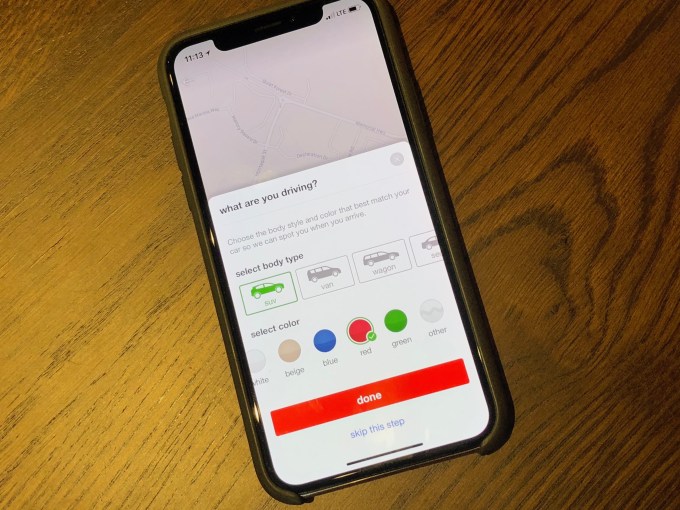
The app will also ask you for make of car (SUV, van, wagon, etc.) and color as part of the ordering experience.
After you complete the checkout, the app will inform you that your “drive up” order will be “ready within 2 hours.” But that’s just Target giving itself a buffer, it seems.

In early tests, Target was putting orders together as fast as 21 minutes, according to an analyst report from Gene Munster of Loup Ventures.
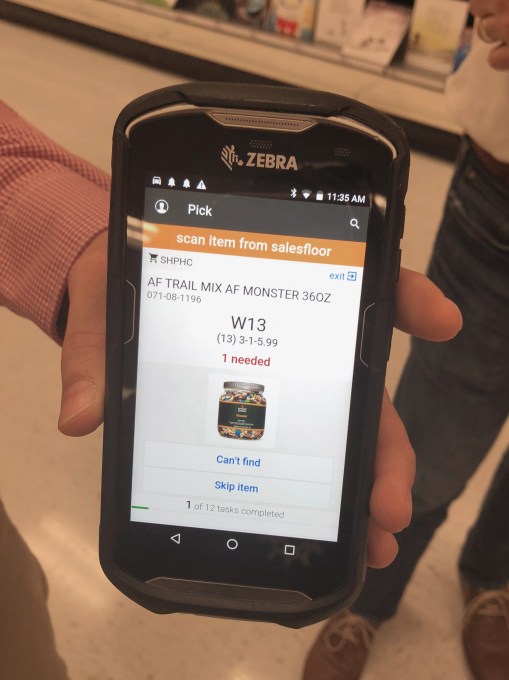
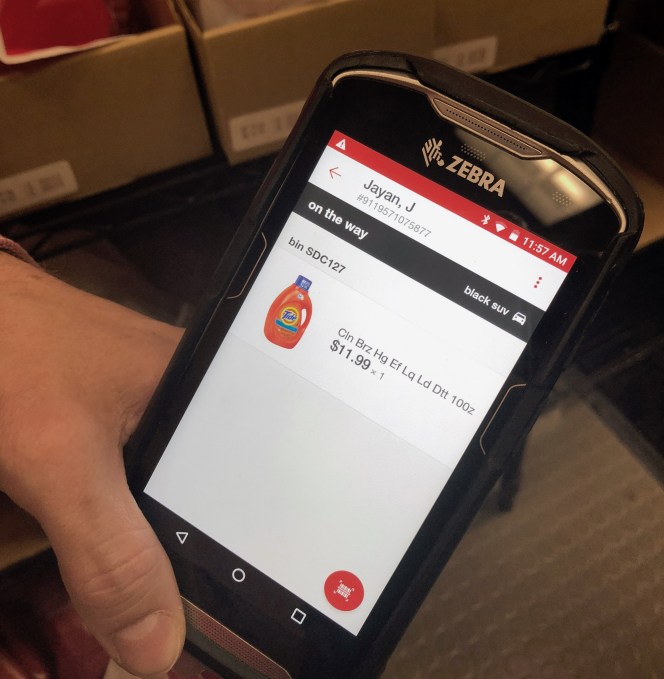
That speed comes from having trained, dedicated store staff who handle orders as soon as they come in. On their own handheld devices (Target calls the store staff’s Android-based mobile Zebra device a “MyDevice”), staff will see pending orders and customers’ ETA to the store.

The employee pulls items from store stock in the back room, as well as any other remaining items from the floor – scanning barcodes as inventory moves from stock to cart, then cart to bagged order.
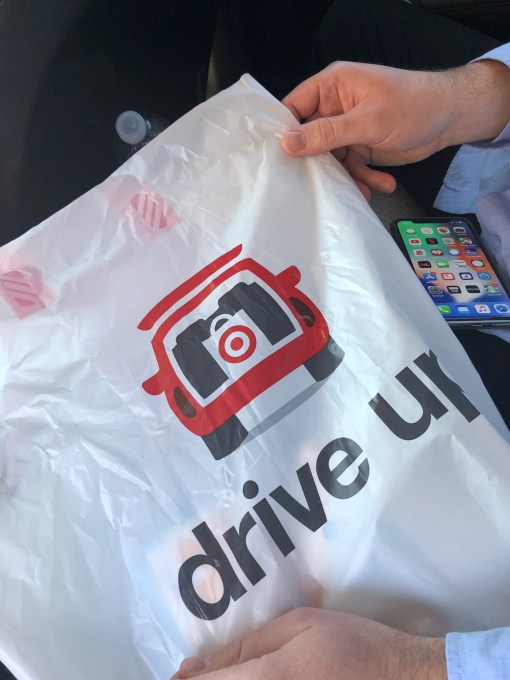
Items are currently being bagged in special “Drive Up” plastic bags, which are slightly larger and sturdier than Target’s regular bags.
These are placed in cardboard bins at the customer service desk while larger items – like TVs – would sit on the floor behind the service desk.
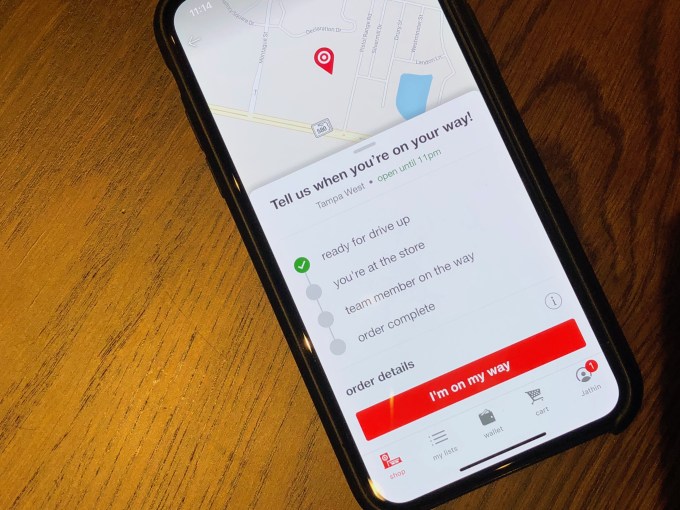
The Target mobile app will alert the customer as soon as their order is filled and ready.

The customer then hits the “I’m on my way” button in their app, which notifies Drive Up staff via an alert  – a car horn beeping twice – on their MyDevice. (The engineers added the car honk during pilot tests, because they found other types of alerts were getting missed. So if you hear a car horn inside a Target store one day, that’s probably why.)
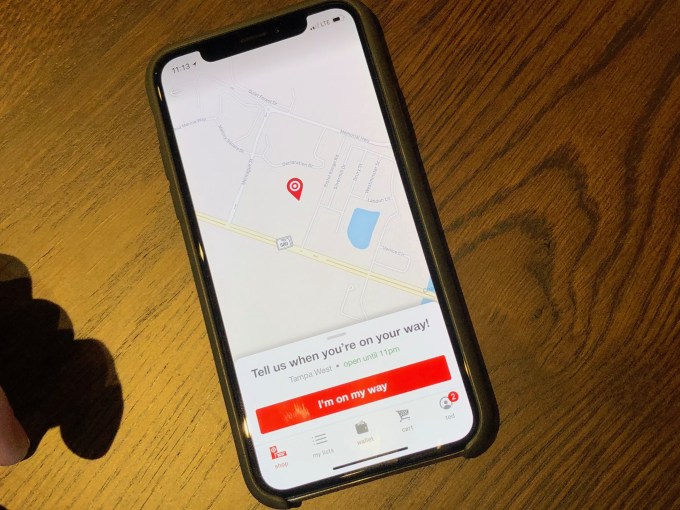
Target’s app asks customers to share their location. This allows staff to get a head’s up on the customer’s arrival, but doesn’t continue to track location after orders are complete. (However, as a nice touch for the privacy-minded, customers who don’t feel comfortable sharing their location, can choose to share their status manually instead.)
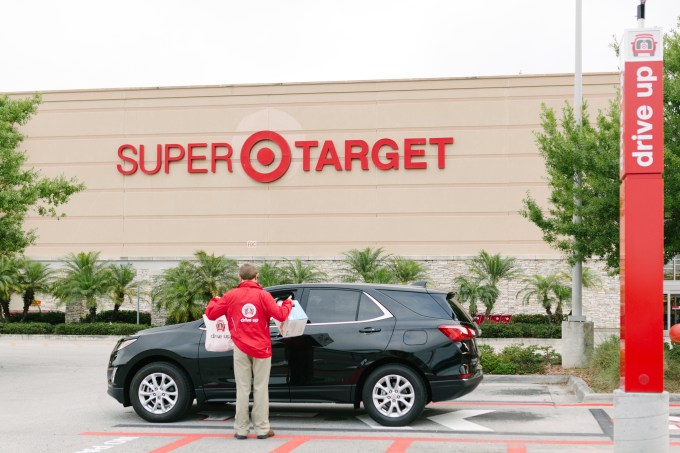
 

At arrival, customers park in one of four designated spaces next to a “Drive Up”-branded pole that’s lit up at night thanks to the solar panel at its top. They don’t have to call a phone number – Target staff knows they’ve arrived. (Yep, the car horn notification again). An employee then brings the order to customer’s car.

The wait time, during Munster’s tests, averaged an impressive 1 minute, 18 seconds. (While I tested it as well, I can’t speak to wait time as it was pre-launch, and special considerations were taking place for demo purposes. But I did find the checkout flow in the app to be easy to follow.)
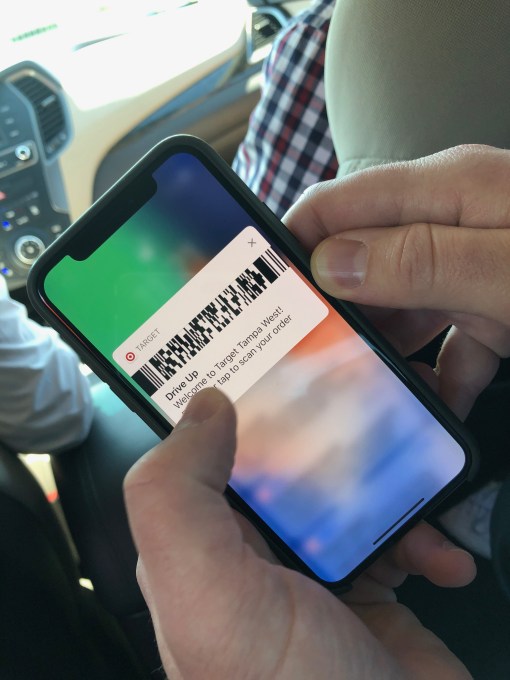
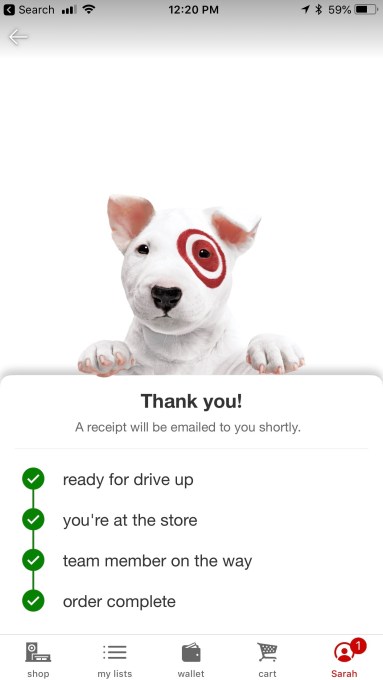
As opposed to asking for a driver’s license, the Target employee will scan a barcode in the customer’s app which confirms their identity. The customer finger signs on the employee’s device to pay and the transaction is completed with a “thank you” confirmation screen appearing in the customer’s Target app.
Drive Up’s impact on in-store sales?

While it makes sense to offer curbside pickup for competitive reasons, there is a question as to whether it will lead to a decrease in foot traffic in stores and the related impulse buys Target is famous for.

That’s not been the case so far, claims Dawn Block, Target’s SVP of Digital. While it’s too early to state this definitively, Target believes these orders will end up being additive to its bottom line.

“We find this is a slightly different trip type. It’s really more of a fill-in and a quick trip,” Block explains. “And when the guests have time and want to head into the store, we find that they’re doing that and they’ll continue to do that….We believe that it absolutely is [additive],” she says.
If that turns out to be true, Drive Up could require Target to adjust its staffing in some locations.

During pilot testing, some stores managed with their existing teams, while others required staff to work more hours or hired additional personnel. And now that customers are getting orders at their cars in under two minutes, Target’s given itself a tight baseline to maintain even as Drive Up scales.

“We will watch the staffing levels really closely and make sure that we’re continuing to deliver on the guest expectations,” Block says. “The guests love that speed and convenience. So we’re going to staff appropriately to keep that up,” she commits.

But in the broader market, Drive Up isn’t just competing against Target’s own in-store traffic – it’s competing with the idea that shoppers will still visit physical stores when they can instead push buttons on their phone and have items appear at their home only hours later.

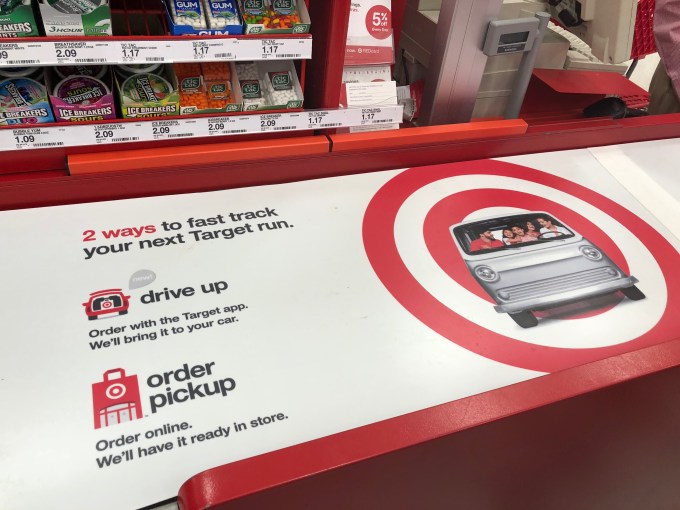
Target says it will be getting the word out about Drive Up through things like in-store signature, belt wraps (see above), and its team members.

The Drive Up service will continue to roll out across the U.S. throughout the year.

17 Apr 2018

LawGeex raises $12M for its AI-powered contract review technology

Can Artificial Intelligence replace lawyers? Perhaps sometime in the distant future, but in the meantime AI is already augmenting the work done by legal professionals as startups race to reach that ultimate goal.

One burgeoning player in the AI-powered legal tech space is Tel Aviv-based LawGeex, which has developed automated contract review technology to help companies sift through things like NDAs, supply agreements, purchase orders, and SaaS licenses, to ensure they’re aren’t any unsanctioned legal gotchas buried deep in legalise. Today, the company is announcing that it has closed $12 million in new investment.

Led by VC fund Aleph, with participation from previous backers, including Lool Ventures, the new round of funding will be used by LawGeex to further develop its product, and build a bigger presence in the U.S. where it recently opened a New York office. It brings the startup’s total funding to date to $21.5 million.

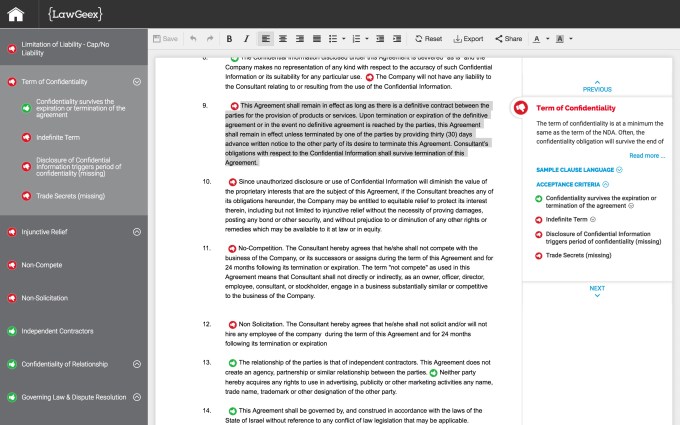
Designed to answer the question ‘Can I sign this?’ the LawGeex contract review system aims to significantly speed up and cut costs inherent with the contract approval process. The idea is that once a new contract is sent to a business, it is uploaded to LawGeex where a “first-pass review” of the contract is undertaken using the startup’s AI. This checks the contract against a company’s predefined legal policies.

“If everything looks good, we can automatically approve the contract for signing right then and there,” explains LawGeex VP Marketing Shmuli Goldberg. “If we spot any issues that need to be corrected, we escalate the contract to the legal team, and highlight the exact sentence they need to fix, and what they need to do to fix it”.

The desired outcome is that legal professionals no longer need to spend time reviewing problem-free contracts, and only spend a few minutes, instead of hours, on problematic ones. “We free up the time of whoever does that first review of the contract, be it a paralegal who takes a first look before sending issues on to a lawyer, or a contract review team who triage incoming contracts,” Goldberg says.

Put more simply, the LawGeex product operates a little like a spelling or grammar checker (see screenshot above). But instead of looking for specific keywords or language, the AI has been trained to understand technical legal language or so-called legalese. “It actively reads the contracts and “understands” the legal concepts. This means we can find and flag provisions even if they’re written in a way we’ve never seen before,” says the LawGeex VP.

To make all of this possible, over the last four years the company’s “recursive neural network”-based AI has been trained by feeding it hundreds of thousands of legal contracts, and having experienced U.S. lawyers annotate those contracts along the way. “We’ve now reached the point we can say that in certain cases, for example reviewing standard NDAs, our AI is actually more accurate than a human, as a recent study led by several academics at leading universities showed,” claims Goldberg.