Year: 2018

17 Apr 2018

Salesforce spent another $2.7 million to adjust pay gaps related to race and gender

Ensuring equal pay is an ongoing task, Salesforce has found. In the past year, Salesforce spent $2.7 million to address pay discrepancies across gender worldwide and race in the U.S.

Where Salesforce is making progress is in the number of people affected by unequal pay. Last year, Salesforce made pay adjustments (salaries and bonuses) for 11 percent of its employees compared to just 6 percent this time around.

“Our latest assessment shows that equal pay is a moving target, especially for growing companies in competitive industries,” Salesforce Chief People Officer Cindy Robbins wrote in a blog post.

Since 2015, Salesforce has spent over $8 million to address the wage gaps pertaining to race and gender.

Over the next year, Salesforce plans to hire an addition 8,000 people. That means the task at hand will be to ensure pay equity from day one. It’s not clear how Salesforce plans to do this, but Robbins said the company is “looking at ways to create a system that will standardize the process for setting salaries.”

17 Apr 2018

A16Z and Founders Fund sink $28M into IRL asset blockchain Harbor

Harbor helps businesses legally issue cryptocurrency tokens that represent ownership of real-world assets like real estate, fine art, company equity, and investment funds. This “tokenization” might sound boring, but it could be a big business that unlocks trading of illiquid property.

Harbor‘s intention to become a fundamental bridge between the offline and crypto economies has attracted a $28 million strategic round led by Founders Fund and joined by Andreessen Horowitz, Pantera Capital, and more. Following its $10 million Series A in February, Harbor has now raised over $40 million to dissolve the legal barriers to private securities tokenization.

“We think there’s going be a far greater appetite for owning real-world assets using the blockchain” than digital only cryptocurrencies, Harbor CEO Joshua Stein tells me. He expects it be like the impact “email had on snail mail”, but with value instead of content being sent back and forth. Once someone like Harbor handles the technical necessities to make transfers instant, free, and secure, people will exchange a lot more frequently.

The Harbor team

Here’s how Harbor works. Clients pay it in cash to make their tokenization of an IRL private security legal. Traditional trading of these assets can be complicated and expensive given there are often financial regulations or licensing requirements restricting who can buy and sell them. For example, foreigners or unaccredited investors without enough net worth aren’t allowed to own certain securities. The lawyers to handle these sales can be expensive, and the process can take weeks.

Normally, businesses have to be very careful about who they let buy these securities because they’re liable for a 20-year criminal sentence if they violate SEC law. With Harbor, a white list of eligible owners is established by an outside law firm that takes responsibility, and Harbor’s smart contracts refuse to process an illegal sale. Harbor effectively bakes securities law compliance like know-your-customer and anti-fraud/money-laundering into the tokens themselves so trades can happen instantaneously without legal assistance on every sale.

Harbor is hoping to launch this Regulated Token (R-Token) system with its first client this summer. The tokens are ERC-20 compatible so they can be sold on lots of cryptocurrency exchanges and stored in popular wallets. Stein stresses that investors will have to trust the underlying securities they’re buying. But they’ll get more trust in who owns something through blockchain transparency rather than some signed contract locked in a desk or vault somewhere. And they won’t have to trust who they’re selling to since the smart contracts only execute the trade if its legal.

The idea of making the way hugely valuable assets trade faster, easier, and cheaper led Harbor’s latest round to be oversubscribed. That’s even though it only came out of stealth two months ago from Craft Ventures, the fund and incubator run by PayPal mafioso David Sacks who sold Yammer to Microsoft.

Craft Ventures, Vy Capital and Valor Equity Partners joined this that included other new investors like Future Perfect Ventures, 1confirmation, Abstract Ventures, and Signia Venture Partners. Nicolas Berggruen of Berggruen Holdings, Napoleon Ta of Founders Fund, and Kyle Samani and Tushar Jain of Multicoin Capital also put in their personal money.  Sacks knew Ta, which set up Founders Fund to lead the round. Meanwhile, Stein says Harbor wanted to team up with Andreessen Horowitz partner and crypto thought leader Chris Dixon.

Harbor will have to compete with the other blockchain-for-securities startups like Polymath, which runs entirely decentralized and trustless infrastrucutre to the point that you have to hope strangers want their deposit back enough not to screw you on legal compliance, and tZERO, which is building its own full-stack compliance system. Harbor’s reliance on outside legal firms to build the smart contract white lists makes it more akin to a traditional financial player.

Harbor could make a lucrative business out of letting clients sell American securities to the Chinese market, which has shown a strong interest in crypto assets. Stein talks about “a crypto nirvana of a trustless environment” like a true Bitcoin bro. But his new A-list investors show Harbor is no pump-and-dump.

17 Apr 2018

CA also used ‘sex compass’ and other quiz apps for sucking Facebook data, says former employee

Brittney Kaiser, a former employee for Cambridge Analytica — who left the company in January and is today giving evidence in front of a UK parliament committee that’s investigating online misinformation — has suggested that data on far more Facebook users may have found its way into the consultancy’s hands than the up to 87M people Facebook has so far suggested had personal data compromised as a result of a personality quiz app running on its platform which was developed by an academic working with CA.

Another former CA employee, Chris Wylie, previously told the committee the company worked with professor Aleksandr Kogan to gather Facebook users’ data — via his thisisyourdigitallife quiz app — because Kogan had agreed to work on gathering and processing the data first, instead of negotiating commercial terms up front.

CA’s intent was to use Facebookers’ data for political microtargeting, according to evidence provided by Wylie.

In her written evidence to the committee Kaiser claims:

I should emphasise that the Kogan/GSR datasets and questionnaires were not the only Facebook-connected questionnaires and datasets which Cambridge Analytica used. I am aware in a general sense of a wide range of surveys which were done by CA or its partners, usually with a Facebook login – for example, the “sex compass” quiz. I do not know the specifics of these surveys or how the data was acquired or processed. But I believe it is almost certain that the number of Facebook users whose data was compromised through routes similar to that used by Kogan is much greater than 87 million; and that both Cambridge Analytica and other unconnected companies and campaigns were involved in these activities.

Asked to expand on this point during today’s hearing, Kaiser said Cambridge Analytica’s internal creative, psychology and data science teams worked together to design questionnaires for deploying on Facebook’s platform.

“I am aware now of what the questionnaire was that professor Kogan used, although I didn’t know about it when I joined the company. But I would see questionnaires — for example there was one called the ‘Sex Compass’ to find out what your personal preferences were privately. And then there was another one on your ‘Music Personality’,” she told the committee.

“In my pitches I used to give examples even to clients that if you go on Facebook and you see these viral personality quizzes — not all of them would have been designed by Cambridge Analytica/SCL Group or our affiliates but that these applications were designed specifically to harvest data from individuals, using Facebook as the tool.”

“I know at least of those two examples,” she added. “Therefore it can be inferred or implied that there were many additional individuals as opposed to just the ones, through Aleksandr Kogan’s test, whose data may have been compromised.”

Committee chair Damian Collins asked Kaiser whether the viral app approach to harvesting Facebook data, which CA had developed for work in the U.S., would have been used by the company in other markets too.

“That was the idea — although in Europe it’s quite difficult because of the data protection laws,” responded Kaiser.

“Well if you observe them,” quipped Collins.

“Correct,” said Kaiser.

A little later another committee member returned to the topic, asking Kaiser to confirm whether these survey apps would definitely have been able to pass Facebook data on users if they provided their Facebook login details at the end of the survey process — noting that the committee had been told by former CA CEO, Alexander Nix, that Facebook users’ personal data may not have been accessed by CA via the surveys.

“What you’re saying is that that was not the case — that actually the purpose of the survey was to gather [Facebook] information and by completing it with your Facebook login as well then CA would also get access to your data on Facebook too?”

“I believe that was the point of the quizzes in the first place, yes,” responded Kaiser.

Since the data misuse scandal blew up last month, Facebook has said it is conducting a full audit of any apps which had access to “a large amount” of information before it changed app permissions on its platform in mid 2015 to prevent developers from being able to suck out data on Facebook users’ friends.

We’ve reached out to Facebook to ask whether it can provide an estimate on the total number of users’ data that could have also been compromised by additional quiz apps running on its platform — and will update this story with any response.

Earlier this month the company confirmed that as many as 87 million Facebook users could have had information passed to Cambridge Analytica as a result of just Kogan’s app — which was downloaded around 270,000 times.

CEO Mark Zuckerberg has said the full audit process of third party apps with access to lots of user data will take some time.

Also earlier this month the company revealed that another historical feature — intended to be used for search and account recovery — had been systematically exploited by “malicious actors” to scrape public information from Facebook users’ profiles.

It warned that “most” Facebook users will have had their public info scraped by unknown entities as a result of this security loophole. The company’s platform has more than 2BN active users now, meaning that between 1BN and 2BN people will have had some of their Facebook information taken without their consent.

17 Apr 2018

France to move ministers off Telegram, WhatsApp over security fears

The French government has said it intends to move to using its own encrypted messaging service this summer, over concerns of the risks that foreign entities could spy on officials using popular encrypted apps such as Telegram and WhatsApp .

Reuters reports that ministers are concerned about the use of foreign-built encrypted apps which do not have servers in France. “We need to find a way to have an encrypted messaging service that is not encrypted by the United States or Russia,” a digital ministry spokeswoman told the news agency. “You start thinking about the potential breaches that could happen, as we saw with Facebook, so we should take the lead.”

Telegram’s founder, Pavel Durov, is Russian, though the entrepreneur lives in exile and his messaging app has just been blocked in his home country after the company refused to hand over encryption keys to the authorities.

WhatsApp, which (unlike Telegram) is end-to-end encrypted across its entire platform — using the respected and open sourced Signal Protocol — is nonetheless owned by U.S. tech giant Facebook, and developed out of the U.S. (as Signal also is).

Its parent company is currently embroiled in a major data misuse scandal after it emerged that tens of millions of Facebook users’ information was passed to a controversial political consultancy without their knowledge or consent.

The ministry spokeswoman said about 20 officials and top civil servants in the French government are testing the new messaging app, with the aim of its use becoming mandatory for the whole government by the summer.

It could also eventually be made available to all citizens, she added.

Reuters reports the spokeswoman also said a state-employed developer has designed the app, using free-to-use code available for download online (which presumably means it’s based on open source software) — although she declined to name the code being used or the messaging service.

Late last week, ZDNet also reported the French government wanted to replace its use of apps like Telegram — which president Emmanuel Macron is apparently a big fan of.

It quoted Mounir Mahjoubi, France’s secretary of state for digital, saying: “We are working on public secure messaging, which will not be dependent on private offers.”

The French government reportedly already uses some secure messaging products built by defense group and IT supplier Thales. On its website Thales lists a Citadel instant messaging smartphone app — which it describes as “trusted messaging for professionals”, saying it offers “the same recognisable functionality and usability as most consumer messaging apps” with “secure messaging services on a smartphone or computer, plus a host of related functions, including end-to-end encrypted voice calls and file sharing”.

17 Apr 2018

Edtech startup Lingumi scores £1.2M seed funding to teach pre-school kids English

Lingumi, the London and Cardiff-based edtech startup that teaches English to kids aged between 2 and 6 using an app and a range of physical products, has picked up £1.2 million in seed funding.

Leading the round is ADV, with participation from existing backers LocalGlobe, and company builder Entrepreneur First (Lingumi was part of EF’s 5th cohort, which is turning out to be quite a vintage year). A number of unnamed angel investors also took part in the round.

Founded by CEO Toby Mather and CTO Adit Trivedi after they paired up at EF in late 2015, Lingumi has built a language learning platform for pre-school kids, initially targeting the teaching of English. Described as “digital-first,” it consists of an app designed around a curriculum of daily lessons, which can then be augmented with Lingumi’s physical products, such as ‘Play Cubes’ and ‘Jumbo Word Cards’.

In a call with Mather he told me that the Lingumi product that exists today is very different to the one he and Trivedi originally pitched at EF Demo Day back in early 2016, even if the mission remains the same: to increase access to learning a second language, based on a belief that a child’s earliest years present a “magic window” to do so.

Initially, the pair had developed a concept for a connected toy that controlled a learning app but pivoted to a subscription model after families kept hitting the end of the startup’s curriculum and requested more. In July last year, Lingumi ditched the connected toy entirely and switched to a “pure digital subscription,” up selling its now much simpler physical products separately.

“We’re increasingly aware of the exceptional ability of infants to learn a second language from very early in childhood, but access to English is typically restricted to the super rich, or to children aged 7 or older, as they begin to attend school,” says Mather. “Even there, they are taught badly and infrequently. We’re building an English learning methodology that is low-cost, can be used in the earliest years, and is effective, even if the parents themselves don’t speak English”.

The Lingumi platform works best when parents or caregivers participate, too. The app delivers a single lesson per day of around 20 minutes and purposefully limits screen time, hence the range of supplementary non-digital prodicts. “Children receive everything in English, through a playful learning programme built for pre-schoolers, but we encourage and train parents in their native language to play and learn with their children,” explains the Lingumi CEO.

“Multiple studies have shown the impact of this style of co-learning on outcomes. The learning method is also unique: unlike most curriculums, which focus around ‘edutainment’ or reading and writing skills, or teach older children via live video, ours is focused on constructive, natural spoken English in the earliest years. As we develop the curriculum, we’re continually leveraging our data on each child to improve the experience and learning trajectory for them”.

To date, Lingumi claims 10,000 users and Mather says typical customers are families with one or two working parents, “usually middle or working-class, aspirational families who understand both the fun, and the educational benefit of beginning a second language with their child”. It has customers in over 40 countries, but is mainly focussed on Western Europe, Taiwan, and, increasingly, China.

In fact, Mather says China is a potentially huge market and is in part seeing the startup pilot a version of Lingumi for kindergartens that want to begin teaching English, leveraging the company’s existing learning method and content.

To that end, the company plans to use the new seed funding to further develop its “digital and physical product ecosystem,” and scale the learning platform into new markets.

17 Apr 2018

Nike’s Vaporfly Elite FlyPrint leans hard into computational design

Computational design is the hottest phrase in manufacturing and 3D printing at the moment. It’s changing the way people make all kinds of goods, and Nike used it to design and manufacture its new Vaporfly Elite FlyPrint shoe, which it’s announcing today.

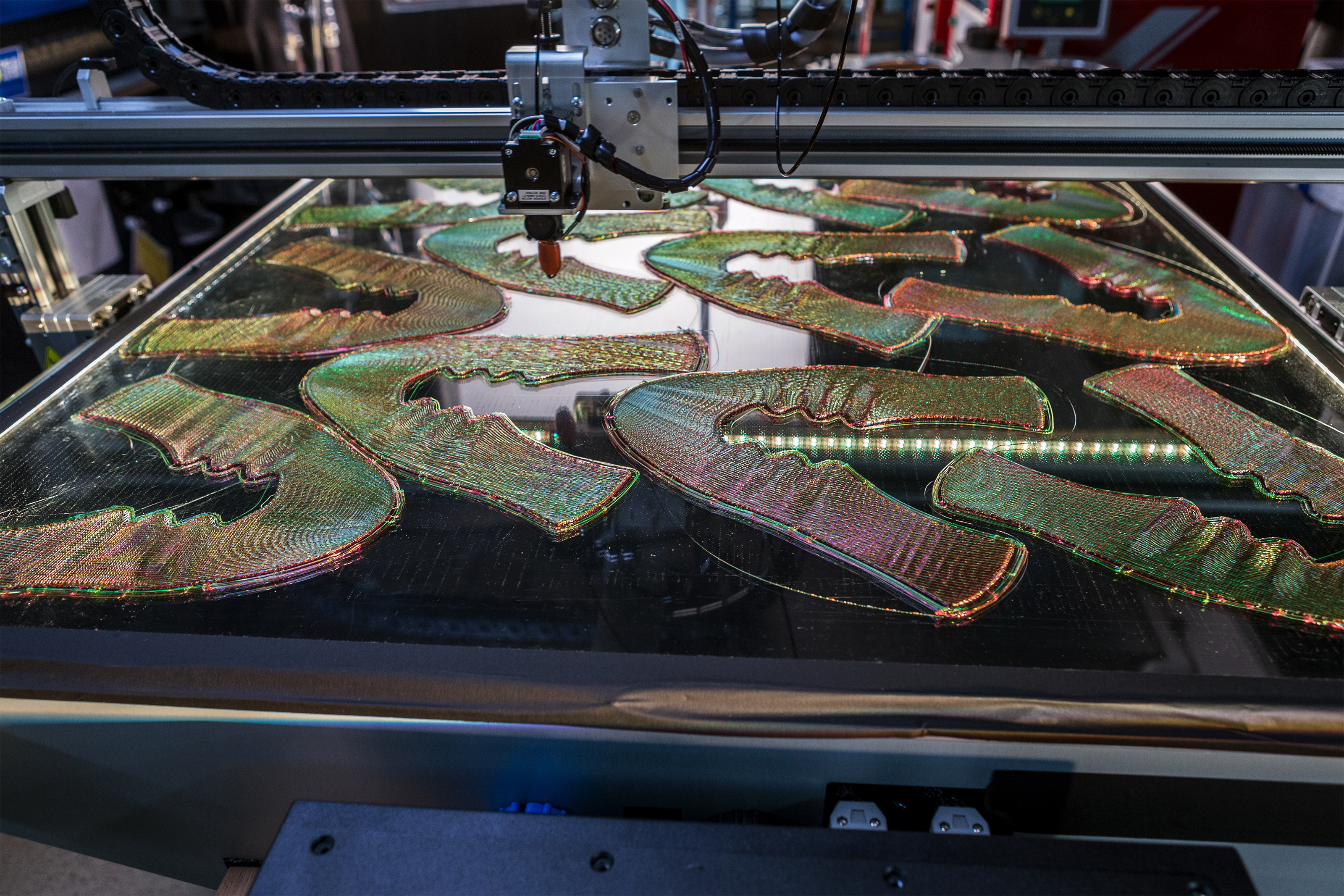
The shoe is a specialized edition of its Zoom Vaporfly Elite 4%, which was used by elite runner Eliud Kipchoge during Nike’s Breaking2 event, which resulted in the fastest marathon ever run. The special sauce in this edition is the FlyPrint upper, which is printed on the fly by a specially customized 3D printer out of a proprietary Nike polymer.

I spoke with Nike’s Brett Holts, product line manager for running footwear and Roger Chen, a senior director for Nike’s NXT Digital Innovation department, about the process and the shoe.

The material is printed out in a pattern specifically designed for a given athlete’s needs and attached to the much hyped Zoom X foam midsole from the 4% model. The process, which Nike is calling FlyPrint, has some similarities to Nike’s other famous ‘fly’ process, FlyKnit, hence the name. The printing process, says Chen, is a lot like painting the material.

The uppers I saw pre-lasting look a lot like a regular butterfly upper, with the same kind of flexibility you’re used to seeing from fabric or other polymer-based upper materials. This is not a hard-shell 3D-printed material, it’s a fabric of sorts. This is reinforced by the fact that several components of the shoe are still made of FlyKnit including the tongue and collar. Those parts are so similar in chemical composition that there is no glue needed to attach them. Instead, the FlyPrint material is bonded seamlessly with the FlyKnit, making for a one-piece design that is stronger and lighter.

The process of computer aided design in consumer products has a long history — but computational design is an evolution of this concept and has begun to gain steam lately with production-ready 3D-printing processes like Carbon’s M-series digital light synthesis printers and Desktop Metal’s Production System. The guiding force behind computational design is that you feed parameters and physical properties into a model — basically limitations and desired outcomes — and get designs that would either be impossible or incredibly time consuming for humans to produce.

In the case of the new FlyPrint upper, the constraints are the properties of the material and the forces that Kipchoge’s feet were exerting on that material. With that data, along with the chemical composition of the polymer, a computational model allowed Nike to tweak the design for support, flexibility, reinforcement or relaxation on a much more granular level than they could ever accomplish with FlyKnit.

If, for instance, Kipchoge felt that he needed more support through the arch area, the team could tweak that metric in that region, resulting in a more compact pattern of diamond-shaped lattice. In the FlyKnit world (and the world of most knit running shoes) this is done by creating various panels that reflect the properties you want from that portion of the shoe and glueing or stitching them together, adding weight and reducing strength.

Now, Nike can print a fully customized upper in one go, blending it seamlessly with FlyKnit where it makes sense for comfort.

The result of all of this is that the shoe is incredibly light. A 12 gram, or 6% reduction in weight to start. On top of that, one of Kipchoge’s big issues with the Vaporfly Elites in Berlin was water retention in the rain. The shoes started out light but water soaked into the FlyKnit and couldn’t fully make its way out. The FlyPrint upper is nearly translucent it’s so porous, which solves the drainage issue.

Chen says that Kipchoge said that it ‘felt like he was flying’ because he could feel the wind on his feet.

Another huge advantage to FlyPrint, points out Holts, is speed. Nike was able to design and construct every iteration of the shoe through to the final model in just 4 months. As a frame of reference, it typically takes 9 months to a year to get a shoe off the ground.

“We would never have been able to do that [with FlyKnit],” says Holts, “we were addressing the needs of our athlete within 24 hours.”

This day-long cycle — taking into account the Kenyan time differential — of trading feedback with Kipchoge and turning around his requested updates to fit or function was uniquely enabled by using the FlyPrint process.

Additionally, the modeling component of the process allows Nike to scale the shoe through various sizes while maintaining the appropriate ratios of material to negative space for each section.

Nike is using an established 3D printing process called fused deposition modeling, basically painting shapes onto a surface with production-ready TPU materials, but Chen says that the proprietary components of the process lie in how the printers are being driven to lay down the FlyPrint. Neither will say what printers Nike is using but note the company’s history in ‘hacking’ manufacturing tools to get the job done. As an industry note, Stratasys is one of the more established players in FDM printing.

Computational design and production ready 3D printing are changing footwear as we speak. Adidas and Carbon are focusing on the midsole in fashion and basketball, Nike is reinventing the upper for elite runners. But the real gem here might not be the speed or customization — both important advancements.

Instead, it could be the way that the design process is compressed down to mate directly with the manufacturing process. This has the potential to change not just footwear, but every kind of product made. Instead of the lengthy and costly process of injection molding or milling, product designers are, for the first time ever, able to start taking direct ownership of the production process, realizing impossible designs and goals with the use of a powerful feedback loop that includes designer, materials and process in one flow of data.

The Vaporfly Elite FlyPrint is a product for elite runners only, and a small amount of them will be available at an event in London soon, as well as on the feet of Kipchoge and other Nike runners. But there is an epochal shift in the way shoes (and other products) are made coming, and this is one of the harbingers of that shift. Pay attention.

17 Apr 2018

Taiwanese startup Kdan Mobile raises $5M Series A for its cloud-based content creation tools

Kdan Mobile founder and CEO Kenny Su

Kdan Mobile, a Taiwanese startup that makes cloud-based software for content creators, announced a $5 million Series A today, raised from investors including W.I. Harper Group, Darwin Venture Management and Accord Ventures. Founded in 2009, the Tainan City startup says its products have been downloaded more 120 million times, with about 40% of its customers located in the United States.

Its Series A takes Kdan Mobile’s total funding so far to $6.5 million. The capital will be used for product development, including blockchain-based encryption for documents and real-time collaboration features, to appeal to enterprise and education users. The company also plans to spend more on user acquisition in the U.S. and China, two of its growth markets.

Kdan Mobile’s products include Creativity 365, a software suite with a mobile animation creator and video editor, and Document 365, launched last year to attract enterprise users. The company also recently began offering new subscription plans for businesses and educational organizations and claims that its cloud platform, called Kdan Cloud, now counts over 3.5 million members.

Founder and chief executive officer Kenny Su says Kdan Mobile is seeking new partners that will allow it to establish a bigger presence in markets like Japan. One of its Series A investors, Accord Ventures, is based in Tokyo, and Kdan Mobile may start marketing to the country’s animation industry, Su tells TechCrunch. The company already has partnerships with Taiwanese mobile services provider GMobi, Jot Stylus maker Adonit and Ningbo, China-based design sharing platform LKKER.

Su says one of the ways Kdan’s products differentiate from cloud-based software by Google, Microsoft, Adobe and other major competitors is its focus on artists, designers and other creative professionals. Kdan’s products were also created to allow users to start projects on mobile devices before moving onto desktop apps. As many users of Google Docs, Office 365 or Adobe Creative Cloud have discovered, accessing them on mobile devices feels much more awkward than on desktop. Kdan Mobile, however, launched as smartphones and tablets usage was becoming widespread, and its products were created specifically for mobile.

“We are trying to fill the gap, helping users create content on mobile and then allowing them to finish it in a desktop environment, not only with our own tools, but also by exporting to other places including Adobe,” says Su.

Part of Kdan Mobile’s Series A financing will also be used to figure out how to the company can increase the use of artificial intelligence in its products. Kdan Mobile already uses machine learning algorithms to improve its software by analyzing what users upload and recommend on its content sharing platform.

In a press statement, W.I. Harper Group managing director Y.K. Chu said “We are stunned by Kdan’s leading development technology and global vision. We are glad to be part of their development plan and expect to grow with them.”

17 Apr 2018

Minds aims to decentralize the social network

Decentralization is the buzzword du jour. Everything – from our currencies to our databases – are supposed to exist, immutably, in this strange new world. And Bill Ottman wants to add our social media to the mix.

Ottman, an intense young man with a passion to fix the world, is the founder of Minds.com, a New York-based startup that has been receiving waves of new users as zealots and the the not-so-zealous have been leaving other networks. In fact, Zuckerberg’s bad news is music to Ottman’s ears.

Ottman started Minds in 2011 “with the goal of bringing a free, open source and sustainable social network to the world,” he said. He and his CTO, Mark Harding, have worked in various non-profits including Code To Inspire, a group that teaches Afghani women to code. He said his vision is to get us out from under social media’s thumb.

“We started Minds in my basement after being disillusioned by user abuse on Facebook and other big tech services. We saw spying, data mining, algorithm manipulation, and no revenue sharing,” he said. “To us, it’s inevitable that an open source social network becomes dominant, as was the case with Wikipedia and proprietary encyclopedias.”

His efforts have paid off. The team now has over 1 million registered users and over 105,000 monthly active users. They are working on a number of initiatives, including an ICO, and the site makes money through “boosting” – essentially the ability to pay to have a piece of content float higher in the feed.

The company raised $350K in 2013 and then a little over a million dollars in a Reg CF Equity Crowdfunding raise.

Unlike Facebook, Minds is built on almost radical transparency. The code is entirely open source and it includes encrypted messenger services and optional anonymity for users. The goal, ultimately, is to have the data be decentralized and any user should be able to remove his or her data. It’s also non-partisan, a fact that Ottman emphasized.

“We are not pushing a political agenda, but are more concerned with transparency, Internet freedom and giving control back to the user,” he said. “It’s a sad state of affairs when every network that cares about free speech gets lumped in with extremists.”

He was disappointed, for example, when people read that Reddit’s choice to shut down toxic sub-Reddits was a success. It wasn’t, he said. Instead, those users just flocked to other, more permissive sites. However, he doesn’t think those sites have be cesspools of hate.

“We are a community-owned social network dedicated to transparency, privacy and rewarding people for their contributions. We are called Minds because it’s meant to be a representation of the network itself,” he said. “Our mission is Internet freedom with privacy, transparency, free speech within the law and user control. Additionally, we want to provide our users with revenue opportunity and the ability to truly expand their reach and earn rewards for their contributions to the network.”

17 Apr 2018

Walmart to launch a more personalized, redesigned website in May

Walmart today is announcing a significant redesign of its website which includes a visual makeover, the introduction of new personalization elements, as well as dedicated sections for specially shopping experiences. The company had already launched a revamped Home section on its site back in February, ahead of this larger redesign, and now plans to soon do the same for its fashion category later this spring. The forthcoming fashion hub will also include a Lord & Taylor online store, as a result of the partnership announced last year.

The Walmart redesign isn’t live today, to be clear. This is just the first look, before it arrives in early May.

The most immediately visible change is to the site’s look-and-feel.
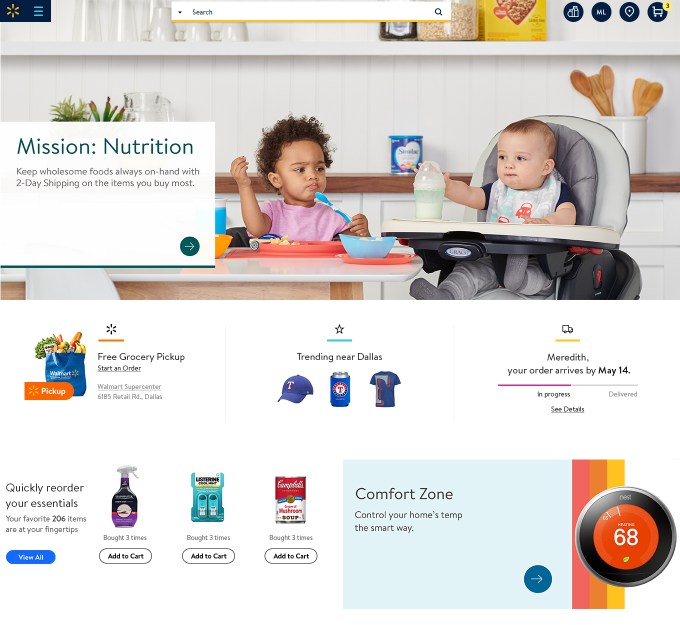
The photography used on the site will include “relatable” photos of real-life moments, says Walmart.

The pages also have a cleaner, more modern design, with pops of color from an expanded color palette, a new set of simply designed icons, rounded “add to cart” buttons, new fonts, and many other changes. Walmart says the goal was to bring more vibrancy and depth to the site.

While consumers may notice the how the site looks different, the larger changes are under the hood.

The new site will be personalized to end users, both on a regional and individual basis.

For starters, the site will showcase what items are trending in shoppers’ area. This is something you see elsewhere on e-commerce sites – like Instacart’s grocery shopping site. But it’s not that interesting to find that spaghetti sauce and La Croix are popular nearby – on a broader e-commerce site, it could be more useful.

During tests, Miami shoppers found that a top-selling item was an Ozark Trail pop-up tent, and in some parts of Illinois, shoppers saw Chicago Cubs tumblrs trending, for example.

“It just really kind of brings that [regional] flavor to life,” says Marc Lore, Walmart’s CEO of U.S. E-commerce. “You want the site to make shopping faster and easier, and when you’re showing those items that customers are trending towards, you’re actually making a faster shopping journey for them, which is ultimately the goal,” he says.
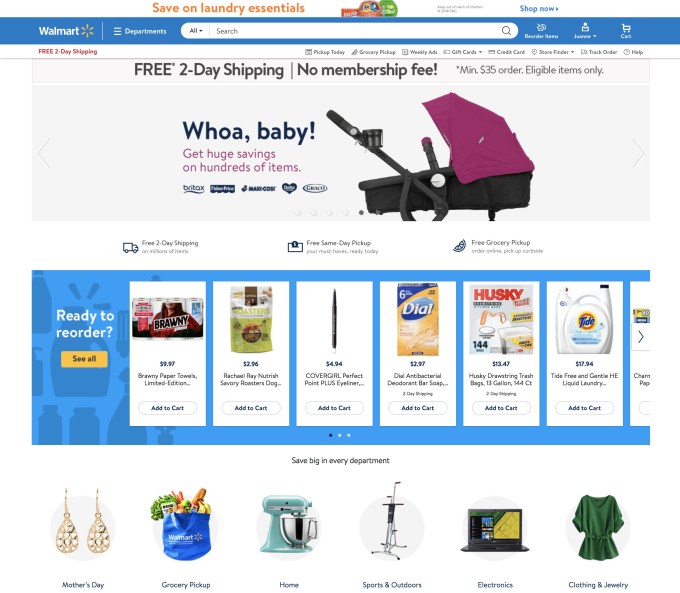
Customers will also be able to see what services are available in their area, like Walmart’s Online Grocery, along with order status features, and Easy Reorder for re-buying their favorite items. (Pictured above).

In addition, the site will recommend products based on what consumers have been browsing and buying. This is an area where Walmart could potentially outclass its rival Amazon, assuming its technology is up to par.

Amazon’s recommendation technology has fallen behind over the years, as the site seems unable to differentiate between gifts for friends and family or other one-time purchases, versus things users regularly search for, desire and buy.

In fact, a humorous tweet about exactly this problem recently went viral, leading to a stream of people responding with their own funny (or unfortunate) examples of the same thing.

Lore claims that Walmart won’t fall prey to this issue.

“The way we attack this problem is not through technology alone,” he says. “We’re able to combine technology and the merchandising elements to create a much more relevant and personalized experience.”

Walmart’s algorithms are meant to understand what categories the individual likes to shop, and then leverages merchants’ understanding of what items are new, trending or seasonal to reach the right segment of potentially interested customers.

“It’s been this fascinating partnership inside Walmart to see the tech organization and the merchant org come together,” adds Jordan Sweetnam, ‎SVP, Customer Experience & Product for Walmart E-commerce. “And based upon early customer feedback, it looks like we’re gonna see some pretty relevant results,” he says.
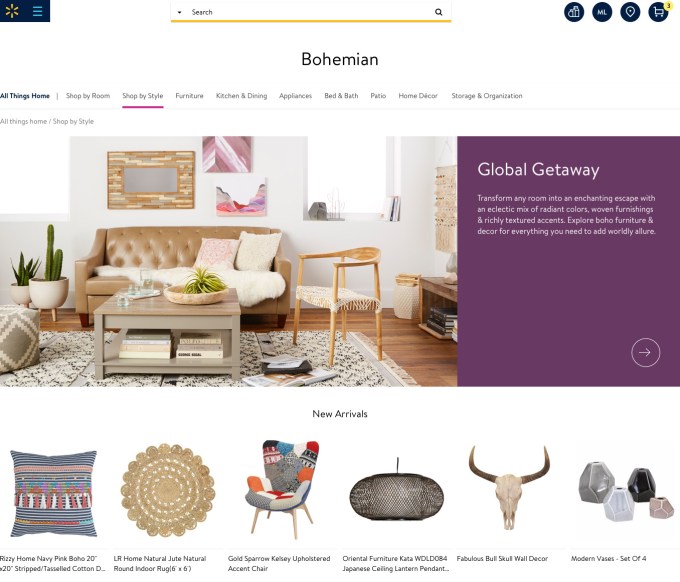
The new site will also be updated to introduce speciality shopping experiences for categories like home and fashion, which are seeing sizable growth online. The Fashion destination, which will go live after the redesign, will feature seasonal stories along with more editorial imagery as a means of differentiating the experience of buying a new outfit from buying groceries and household items.

Lord & Taylor will be a part of the new fashion destination, too, but more details about its shop will be unveiled later this spring. From what Lore says, though, it won’t feel like you’ve been redirected to a new site when browsing its shop.

The two retailers first announced their plans to team up online last year. Walmart.com was to offer its technology and reach to Lord & Taylor, while it gained the chance to upgrade its image as a low-cost – and therefore more low-end – retailer, and expand its assortment.

One goal with the site redesign is to attract similar brand deals.

“The Lord & Taylor partnership is hopefully one of many we’ll do over time,” says Lore. “A large part of attracting partners is to also have a more specialized shopping experience in that particular category.”

The redesign will begin rolling out to customers in early May.

17 Apr 2018

TaskRabbit’s app is offline while it investigates a “cybersecurity incident”

TaskRabbit, the on-demand errand service acquired by IKEA last year, announced today that has taken its website and app offline while investigating a “cybersecurity incident.” The company also said that people who use the same password on TaskRabbit as for other services should change them immediately as a precaution.

“We understand how important your personal information is and are working with an outside cybersecurity firm and law enforcement to determine the specifics,” the company said in an announcement posted to their social media profiles.

In response to questions on Twitter, TaskRabbit said tasks that can’t be completed while the app and website are down will be rescheduled.

IKEA bought TaskRabbit for an undisclosed amount last September, but the service continues to operate independently, letting people request “taskers” for help ranging from packing for a move to assembling flat-pack furniture.

TechCrunch has emailed TaskRabbit for more details about the incident.