Year: 2018

17 Apr 2018

Judge says class action suit against Facebook over facial recognition can go forward

Whenever a company may be guilty of something, from petty neglect to grand deception, there’s usually a class action lawsuit filed. But until a judge rules that lawsuit legitimate, the threat remains fairly empty. Unfortunately for Facebook, one major suit from 2015 has just been given that critical go-ahead.

The case concerns an Illinois law that prohibits collection of biometric information, including facial recognition data, in the way that Facebook has done for years as part of its photo-tagging systems.

BIPA, the Illinois law, is a real thorn in Facebook’s side. The company has not only been pushing to have the case dismissed, but it has been working to have the whole law changed by supporting an amendment that would defang it — but more on that another time.

Judge James Donato in California’s Northern District has made no determination as to the merits of the case itself; first, it must be shown that there is a class of affected people with a complaint that is supported by the facts.

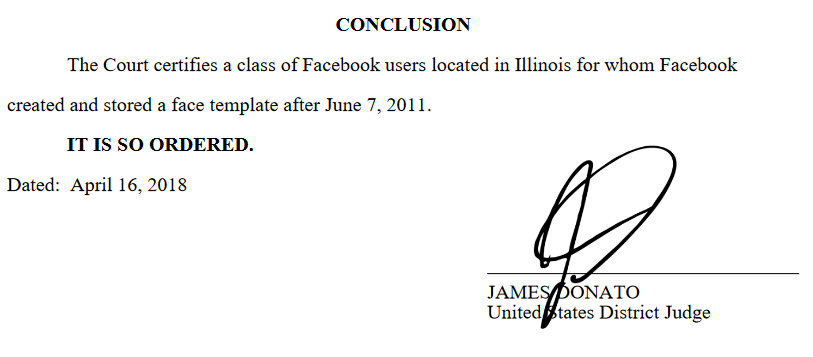
For now, he has found (you can read the order here) that “plaintiffs’ claims are sufficiently cohesive to allow for a fair and efficient resolution on a class basis.” The class itself will consist of “Facebook users located in Illinois for whom Facebook created and stored a face template after June 7, 2011.”
An earlier, broader class suggested by the plaintiffs included all Illinois users who appeared in a photograph on Facebook, but the judge, commendably, decided that this would include people who appeared in images but were not in fact recognized or recorded as face templates by the recognition systems. The more limited class will still amount to millions of people.

Facebook’s attempt to discredit the suit, quibbling over definitions and saying the plaintiffs “know almost nothing” about the systems in question, did not go over well with the judge. “The deposition testimony by the named plaintiffs shows a perfectly adequate understanding of the case, and it clearly manifests their concerns about Facebook’s treatment of personal biometric data,” he writes.

Its suggestion that no “actual” harm was caused also fails to hold water: “As the Court has already found, there is no question that plaintiffs here has sufficiently alleged that intangible injury.” Requiring “actual” injury would severely limit the reach of a rule like BIPA in Illinois, because, of course, the harm caused is one to one’s privacy and security, not to one’s body or wallet. Of course, the question of whether users consented to their “intangible injury” is yet to be settled, and may be a major crux in the case.

Facebook also tries the old chestnut of saying its servers aren’t in Illinois, so Illinois law doesn’t apply. “Contrary to Facebook’s suggestion,” writes Donato, “the geographic location of its data servers is not a dispositive factor. Server location may be one factor in the territoriality inquiry, but it is not the exclusive one.”

Lastly and most absurdly, Facebook argued that to establish legitimacy it would be necessary to check which users’ face templates were derived from scans of printed photographs instead of natively digital shots. “This too is unavailing,” says Donato, citing a total lack of evidence presented by Facebook.

When contacted for comment, Facebook provided a simple statement:

We are reviewing the ruling. We continue to believe the case has no merit and will defend ourselves vigorously.

The case will go ahead as ordered, though as before, at a snail’s pace.
17 Apr 2018

The Eminem AR show

With the debut of his Eminem Augmented app at Coachella last night, hip hop’s not-so-merry prankster took the (somewhat revolutionary) step of embracing the machine that so many musicians have raged against — by building an experience that actually enhances the way modern fans see live music.

Rather than fighting the mobile phone phenomena, which has fans watching sets through the reflected glow of a cell phone’s live recording, the multiplatinum megastar decided to lose himself in the moment… and own it.

We figured, if the phones are going to be there and people are going to be putting them up in the air and looking at them anyway why don’t we provide a way to maybe change the way they’re perceiving the show,” says Def Jam chief executive (and former manager for Marshall Mathers), Paul Rosenberg.

Developed by the multimedia production shop Drive Studios, Eminem’s live set at Coachella introduced fans to visuals that will grace tour dates around the U.S. and Europe as rap’s Duke of Detroit takes his show on the road. 

The concert experience is a geo-tagged time-stamped exclusive experience that is only visible within a few hundred yards of a live show, according to Drive Studios’ creative director, Rich Lee. 

“Artists and bands have been freaking out about fans having this passive experience with their phones,” said one person with knowledge of the artists’ thinking. “We wanted to experiment with… if you can’t beat ’em, join ’em. Why not embrace the technology and get people deeper into the experience and more engaged in the experience if they’re going to do it anyway.”

The app, which launched on Thursday, contained perks for festival-goers who always wanted to see rap’s clown prince drop trou and dump a load of meatballs and spaghetti on them — or view a portal to Eminem’s wild world of music.

“There were ancillary pieces of content that we wanted to put into the app,” says the insider. “Having fun… Joking and having this experience with his fans, that layered very nicely with the Mom’s spaghetti pop-up.”

The Mom’s spaghetti interface took a simple image recognition feature of the universal food container used at the food stalls across the festival venue and layered Em’s spaghetti-tossing graphics on top of it.

For Lee, who first worked with Eminem on the “Not Afraid” video in 2010, the augmented reality app is a first step for what could become a broader portal to connect with fans.

“We started talking about getting VR and AR for a while,” Lee says. “It’s only recently come about that this technology has come around to the point where we feel we could pull this stuff off.”

The creative team behind Eminem’s events won’t wade into the virtual reality versus augmented reality debate. Rather, they say, the application that’s right for the job is the one that will win out. When virtual reality can become a more communal experience, then it will have more appeal for the Marshall Mathers show.

16 Apr 2018

Tesla pauses Model 3 production

Tesla has paused the production of Model 3, BuzzFeed first reported. However, this seems to be part of Tesla’s planned downtime for Model 3.

“Our Model 3 production plan includes periods of planned downtime in both Fremont and Gigafactory 1,” a Tesla spokesperson said back in February and again today to TechCrunch. “These periods are used to improve automation and systematically address bottlenecks in order to increase production rates. This is not unusual and is in fact common in production ramps like this.”

This comes shortly after Tesla CEO Elon Musk admitted that he was over-automating the production of the cars.

“Yes, excessive automation at Tesla was a mistake,” Musk tweeted a couple of days ago. To be precise, my mistake. Humans are underrated.”

That admission came following Bernstein analysts Max Warburton and Toni Sacconaghi arguing Tesla was overusing automation in the final production of Model 3 assembly.

Last August, Tesla said it expected to produce 5,000 Model 3 vehicles per week by the end of 2017. Tesla has since adjusted that number. In January, Tesla said it expects to end this quarter with a weekly rate of 2,500 Model 3 cars, with the goal to hit 5,000 per week by the end of Q2.

Earlier this month, Tesla said it was able to double the weekly Model 3 production rate over Q1 “by rapidly addressing production and supply chain bottlenecks, including several short factory shutdowns to upgrade equipment.”

16 Apr 2018

Electric scooters are getting closer to regulation in SF

The San Francisco Board of Supervisors’ Land Use and Transportation Committee has been working with the San Francisco Municipal Transportation Agency to develop a permit process to enable the SFMTA to regulate e-scooter share companies. Today, the Committee heard proposed legislation regarding permitting and enforcement of shared, electric scooter programs. The next step is for this to move forward to the Board of Supervisors for further consideration.

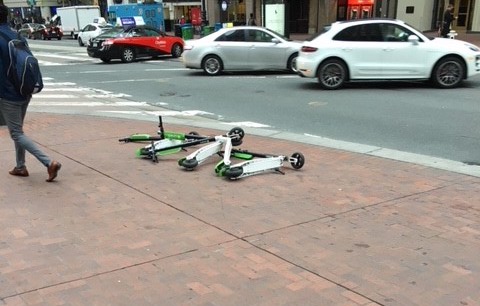
In the last month or so, three different scooter-share programs from Bird, LimeBike and Spin deployed their respective e-scooters without explicit permission. This has resulted in a number of scooters being left on the sidewalks and even on MUNI trains.

“I’m very annoyed with how these companies moved forward the last couple of weeks,” Supervisor Jane Kim, a sponsor of the legislation, said today.

The big takeaway from today is that all of these scooter companies jumped the gun pertaining to deployment in San Francisco.

“To say that you asked us for permission and implied we gave you that permission” before deploying the scooters, Supervisor Kim said, “isn’t the best way to build trust.”

Similar to what the city did around dockless bikes, the city is looking to do the same with dockless scooters. The idea isn’t to ban them, but rather to ensure there are rules and regulations around scooters, and that they don’t cause a public nuisance. If all goes according to plan, the SFMTA said it hopes to open up the permitting process May 1.

Earlier today, SF City Attorney Dennis Herrera sent cease-and-desist letters to all three of the companies, requesting a response by April 30. Although there is no proposed complete ban, it’s quite obvious that Supervisors Kim and Peskin are not happy with each respective startup’s approaches to launching their scooters in San Francisco without explicit permission.

“It’s clear that many of these companies continue to build corporate empires off of a basic premise — making massive profit always trumps protecting the public and innovation is only possible by cutting corners,” Peskin said.

In his opening remarks, Peskin also touched on how this is not emergency legislation, despite what Bird wanted some people to think. He also noted how he and other supervisors have received numerous complaints from the public about the recent proliferation of scooters.

Many of those comments were vocalized today. In the public comment portion, residents expressed concerns of these scooters taking up too much space on sidewalks, and becoming hazards to seniors and people with disabilities. On a couple of occasions, citizens also spoke to concerns of arrogance and elitism that e-scooters represent.

On the other side, members from a local community group in the Bayview neighborhood expressed how some of the companies, like Lime, are proactively working with their communities and even hiring community members to work for them.

Representatives from Lime, Spin and Bird also chimed in. LimeBike said its looks forward to “a fair and transparent process that balances the real and serious concerns of the public.” Spin similarly said it has no intention of doing anything that conflicts with any local or state laws. Bird, on the other hand, went a step further and asked for a window to continue operating while the city figures out its permitting process.

The proposed legislation looks to establish a violation for electric scooters left on sidewalks that do not have a proper permit from the SFMTA.

“With a permit, we would require the scooter share companies to educate their users on how to ride and park responsibly and hold the companies accountable to produce good behavior from their users,” SFMTA spokesperson Paul Rose told TechCrunch.

Here’s a key gist from the ordinance:

The proliferation of [Powered] Scooter Share Programs, which include motorized scooters that can be secured without being locked to a fixed object, has the potential to cause obstructions of public right-of-ways and, in the absence of sufficient education as to existing laws, cause a myriad of other safety hazards for both users of [Powered] Scooters as well as members of the public more generally. The Administrative Code defines a “public nuisance” as any “thing or condition, including but not limited to violations of the Municipal Code or State law, that threatens injury or damage to the health, safety, welfare, or property of members of the public, that obstructs the free use of property of others or of the public right-of-way or commons, or otherwise interferes with the comfortable enjoyment of life or property

Following the public comment portion, the committee members had some specific questions for Bird and Spin. Supervisor Kim noted she’s seen several scooters that are tipped over.

“Within the first week, I had seen several that had been pushed over,” Kim said, adding that she’s concerned about safety and the long-term viability of the programs.

In response, Bird Director of Government Affairs Carl Hanson said the company can usually get someone out there within two hours, but Supervisor Kim said that’s too long. In response to a question about proper scooter parking, Hanson said Bird now requires users to take a picture at the end of the ride to prove the scooter is parked properly.

While the SFMTA aims to open up its permitting process early next month, Supervisor Kim said she doesn’t see this working unless docking is in place.

“I don’t think we can permit this until we figure out how to dock them,” Supervisor Kim said.

The SFMTA, however, said the onus is on the companies to ensure proper docking and that it’s willing to work with each company around that process.

16 Apr 2018

Want to fool a computer vision system? Just tweak some colors

Research into machine learning and the interesting AI models created as a consequence are popular topics these days. But there’s a sort of shadow world of scientists working to undermine these systems — not to show they’re worthless but to shore up their weaknesses. A new paper demonstrates this by showing how vulnerable image recognition models are to the simplest color manipulations of the pictures they’re meant to identify.

It’s not some deep indictment of computer vision — techniques to “beat” image recognition systems might just as easily be characterized as situations in which they perform particularly poorly. Sometimes this is something surprisingly simple: rotating an image, for example, or adding a crazy sticker. Unless a system has been trained specifically on a given manipulation or has orders to check common variations like that, it’s pretty much just going to fail.

In this case it’s research from the University of Washington led by grad student Hossein Hosseini. Their “adversarial” imagery was similarly simple: switch up the colors.

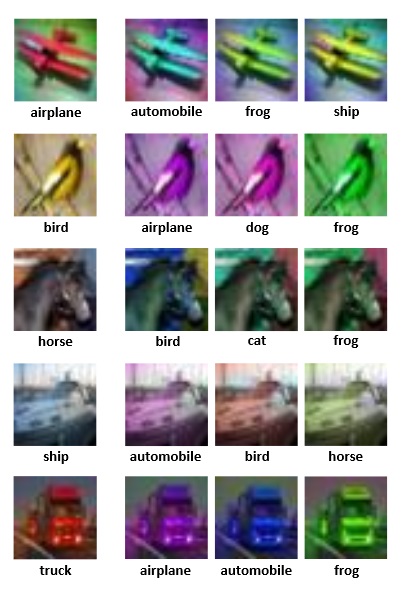
Probably many of you have tried something similar to this when fiddling around in an image manipulation program: by changing the “hue” and “saturation” values on a picture, you can make someone have green skin, a banana appear blue, and so on. That’s exactly what the researchers did: twiddled the knobs so a dog looked a bit yellow, a deer looked purplish, etc.

The original images are at left; color-shifted versions and the systems’ best guesses at right.

Critically, however, the “value” of the pixels, meaning how light or dark it is, wasn’t changed, meaning the images still look like what they are — just in weird colors.

But while a cat looks like a cat no matter if it’s grey or pink to us, one can’t really say the same for a deep neural network. The accuracy of the model they tested was reduced by 90 percent on sets of color-tweaked images that it would normally identify easily. Its best guesses are pretty random, as you can see in the figure at right. Changing the colors totally changes the system’s guess.

The team tested several models and they all broke down on the color-shifted set, so it wasn’t just a consequence of this specific system.

It’s not too hard to fix — in this case, all you really need to do is add some labeled, color-shifted images into the training data so the system is exposed to them beforehand. This addition brought success rates back up to reasonable (if still fairly poor) levels.

But the point isn’t that computer vision systems are fundamentally bad at color or something. It’s that there are lots of ways of subtly or not-so-subtly manipulating an image or video that will devastate its accuracy or subvert it.

“Deep networks are very good at learning (or better memorizing) the distribution of training data,” wrote Hosseini in an email to TechCrunch. “They, however, hardly generalize beyond that. So, even if models are trained with augmented data, it’s likely that we can come up with a new type of adversarial images that can fool the model.”

A model trained to catch color variations might still be vulnerable to attention-based adversarial images and vice versa. The way these systems are created and encoded right now simply isn’t robust enough to prevent such attacks. But by cataloguing them and devising improvements that protect against some but not all, we can advance the state of the art.

“I think we need to find a way for the model to learn the concepts, such as being invariant to color or rotation,” Hosseini suggested. “That can save the algorithm a lot of training data and is more similar to how humans learn.”

You can read the full pre-print paper on Arxiv (PDF).

16 Apr 2018

EU ties pay off, as EIF puts $74M into Dawn Capital’s $232M fund

UK VCs were sent a message today by the EU: Continue to invest in European companies and we’ll invest in you. That at least seems to be the takeaway from the news that Dawn Capital, which has built up a reputation as an investor in early-stage SaaS and Fintech businesses in the UK and Europe, has closed its third fund, Dawn III at $232 million (£165 million), with the help of the European Investment Fund (EIF).

The EIF is committing £52 million after previously said it would no longer invest in UK venture capital due to Brexit. But it’s clear the strong European ties helped Dawn. It has a 50/50 split of UK and European companies in its portfolio.

Claiming to now be the largest European VC fund focused entirely on B2B tech businesses (Notion Capital might contest that), Dawn says the fundraising was heavily over-subscribed despite the hard cap being twice increased. This, the firm said, was down to growing interest amongst investors in the European market, and Dawn’s track record.

That record included some of Europe’s fastest growing B2B software businesses including Mimecast (currently valued at over US$2BN), iZettle, Collibra, Gelato Group, Sonovate, Neo Technology, and Showpad.

On the back of these investments Dawn Fund I has delivered exits such as Mimecast, Sticky, Ecommera and Bityota to name a few. It has also backed iZettle which now dominates Europe’s SME retail sector.

As well as the European Investment Fund, Fund III investors included the British Business Bank – which is investing in Dawn III through its commercial arm, British Business Investments – alongside new institutional and strategic investors from the US and Europe.

In an interview with TechCrunch Haakon Overli, General Partner at Dawn, said the EIF’s involvement was “because we are investing across Europe.”

He also noted that “really clever US investors are now very well informed about Europe as they are seeing big companies come out of here. The bigger investors can’t get into the likes of Sequoia, so they see a similar opportunity as when funds moved out from the West US coast to the East.”

He said existing investors had subscribed for nearly 80% of Dawn III, “which is nearly three times the size of Dawn II. We are also looking forward to working with our new LPs that will offer strategic benefits including financial services expertise and closer links to the US market.”

He added that the European tech investment market “has matured so quickly that to keep leading rounds in some of the world’s most exciting businesses has required a commensurate step up in our ability to write larger checks whilst still being confident of continuing to deliver strong returns to our LPs.”

Norman Fiore, General Partner at Dawn, said in a statement that “today’s start-ups are eyeing first generation SaaS players as the new targets.” Josh Bell, General Partner at Dawn, said “an easing of the financial regulatory environment” in the US will mean “nimble home-grown players taking advantage of this disruption to build European champions.”

Asked if Dawn is seeing new trends in European investing, such as Blockchain, Overli said: “We invest in startups that are solving problems. So if they use blockchain, fine. But we haven’t found one yet. The main thing is that Europe has lots of excellent engineers in companies which are doing great stuff, and the best of those companies are doing very well in the US on the back of really excellent engineering from Europe.”

16 Apr 2018

Sinovation, cofounded by the ex-head of Google China, nabs $50M from BBVA for its $500M AI fund

It’s not often that you hear many details about the limited partners that feed money into a venture capital fund, and even less so when it’s about Western money being channelled into Chinese VCs, but today comes news of how one of the more interesting funds out of China is shaping up, courtesy of a strategic European investor.

Sinovation Ventures, a Chinese VC co-founded by the ex-head of Google China, Kai-Fu Lee, has raised a new fund of $500 million to invest in AI startups out of the region. Now, the first tranche of investment has been announced for it: $50 million from Spanish bank BBVA.

From what we understand, no investments have yet been made out of Sinovation Fund IV, which was formally made public in a SEC Form D fundraising filing this month. According to a statement from BBVA, the $50 million investment is the first money that has been announced, but it sounds like larger $500 million total has already been committed:

“The fund has about $500 million to invest in firms at the early stages in areas such as internet consumption, B2B, education but with a special focus on artificial intelligence (AI),” the bank said in a statement provided to TechCrunch.

Sinovation has about $1.7 billion under management, with its two most recent previous funds, totalling $675 million, announced in September 2016. Crunchbase notes that Sinovation has made 164 investments to date, with a focus on startups out of China such as the bike-sharing startup Mobike and education app VIPKID; it’s also investing in startups that are tied into the Chinese tech ecosystem, such as the California-based Wonder Workshop, which makes robots designed to help kids learn to code and counts other Chinese and Asian investors among its backers.

The BBVA investment into Sinovation is notable for a couple of reasons. The first is that it gives some visibility into how one of the bigger funds coming out of Asia to focus on AI is raising its money. While a number of VC firms in the West are tapping into money from Asia and the Middle East to build their funds, this is a sign of how it is also working in the reverse, fuelled by a boom of interest globally in AI and a big wave of innovation specifically coming out of China.

“By investing into the Sinovation Fund IV, we are ensuring we can learn from and build connections with some of the most promising AI solutions being built anywhere on the planet,” said BBVA CEO Carlos Torres Vila in a statement. “Just as importantly, we can do it via a high-performing investment platform with a strong return profile.”

The second point here is that for BBVA specifically, the company has made a number of investments and acquisitions in fintech — some notable investments include the acquisition of Simple in the US, and hundreds of millions of dollars invested in startups like Atom Bank in the UK and Solaris in Germany — but it has also been rethinking the approach it takes to do this.

At one point, BBVA shut down its in-house venture arm and putting money instead into an outside firm. Today’s investment in Sinovation is part of that bigger trend, where the BBVA can tap into another VC firm’s expertise to help it figure out how to get involved into the wider spectrum of tech innovations, specifically out of China, and how they might impact fintech and BBVA’s wider interests.

“With AI-empowered-banking tools likely to be a key differentiator for customers in the future, as well as critical to providing colleagues with the information they need to deliver improved customer value, the investment will give BBVA insight and access to the growing Chinese innovation market, especially around AI,” BBVA notes. “From a financial perspective, it will also give BBVA the opportunity to understand and potentially co-invest into Chinese AI technological startups, gaining exposure to the world’s fastest growing tech market while targeting attractive returns on investment.”

Sinovation’s $500 million fund, ironically, may sound like peanuts when you consider another VC operating out of Asia, Softbank’s Vision Fund, which is hovering at around $100 billion for its fund (which has also disclosed a number of significant LPs such as Apple, Foxconn and Qualcomm, as well as a number of investors out of the Middle East. Through it, Softbank has become an undeniably outsized player in the VC world, with the firm becoming a regular figure as the leading or sole backer in large growth rounds. (The two have invested in some of the same companies, as well.)

Sinovation fills an interesting niche, however, when you consider Lee’s expertise, the many earlier stage businesses that Softbank and other big firms have yet to tap, and Sinovation’s ears on the ground in China specifically — a significant market both for customers and for those who want to be at the vanguard of what’s being built for users everywhere.

16 Apr 2018

Bird, Lime and Spin receive cease-and-desist letters from SF City Attorney

San Francisco City Attorney Dennis Herrera has sent a cease-and-desist letter to Bird, Lime and Spin for operating their shared electric scooter programs in San Francisco.

“Despite previous warnings, your company LimeBike (“Lime”) has continued to operate an unpermitted motorized scooter rental program in the City and County of San Francisco (the “City”), creating a public nuisance on the City’s streets and sidewalks and endangering public health and safety,” City Attorney Herrera wrote specifically to Lime. “Lime must immediately cease and desist from unlawful conduct, as we provide further below.”

City Attorney Herrera wrote nearly identical letters to Spin and Bird. The letters say the companies have ignored warnings and operate in a way that is “creating a public nuisance on The City’s streets and sidewalks and endangering public health and safety.” Other complaints entail concerns of fall hazards and excessive use of public sidewalk space.

The letters also provide suggestions around ways to ensure people properly park the scooters. Each company has until April 30 to report back regarding how they’re going to address the complaints.

“We have just received it and we are reviewing it,” Bird spokesperson Rachel Katz told TechCrunch. “We’ll be in touch when we have more comments.”

In the meantime, the Department of Public Works will continue to impound scooters that unlawfully block sidewalks.

Meanwhile, the SF Board of Supervisors’ Land Use and Transportation Committee is hearing proposed legislation and comments from the public pertaining to electric scooters as we speak.

I’ve reached out to Lime and Spin. I’ll update this as I learn more.

16 Apr 2018

Elon Musk’s Boring Co. raises $113 million to chase a pipe dream

Elon Musk’s tunneling startup The Boring Company has raised $113 million to fund its vision of the near/distant future of transportation, according to newly filed SEC docs first spotted by CNBC.

The startup, which is centered around the goal of creating underground tunnels, plays a central part in Musk’s integrated view of urban transportation that he hopes will shape how the public moves about in a quick and efficient way. Last month, Musk announced that the company would be adjusting its plans to prioritize pedestrian traffic over vehicles.

A major part of the company’s early efforts have been in fighting for permits and contracts with city governments. Though Musk has indicated that he hopes to use the company to alleviate the problems of LA traffic, the company is also currently actively engaged in working with cities across the U.S.

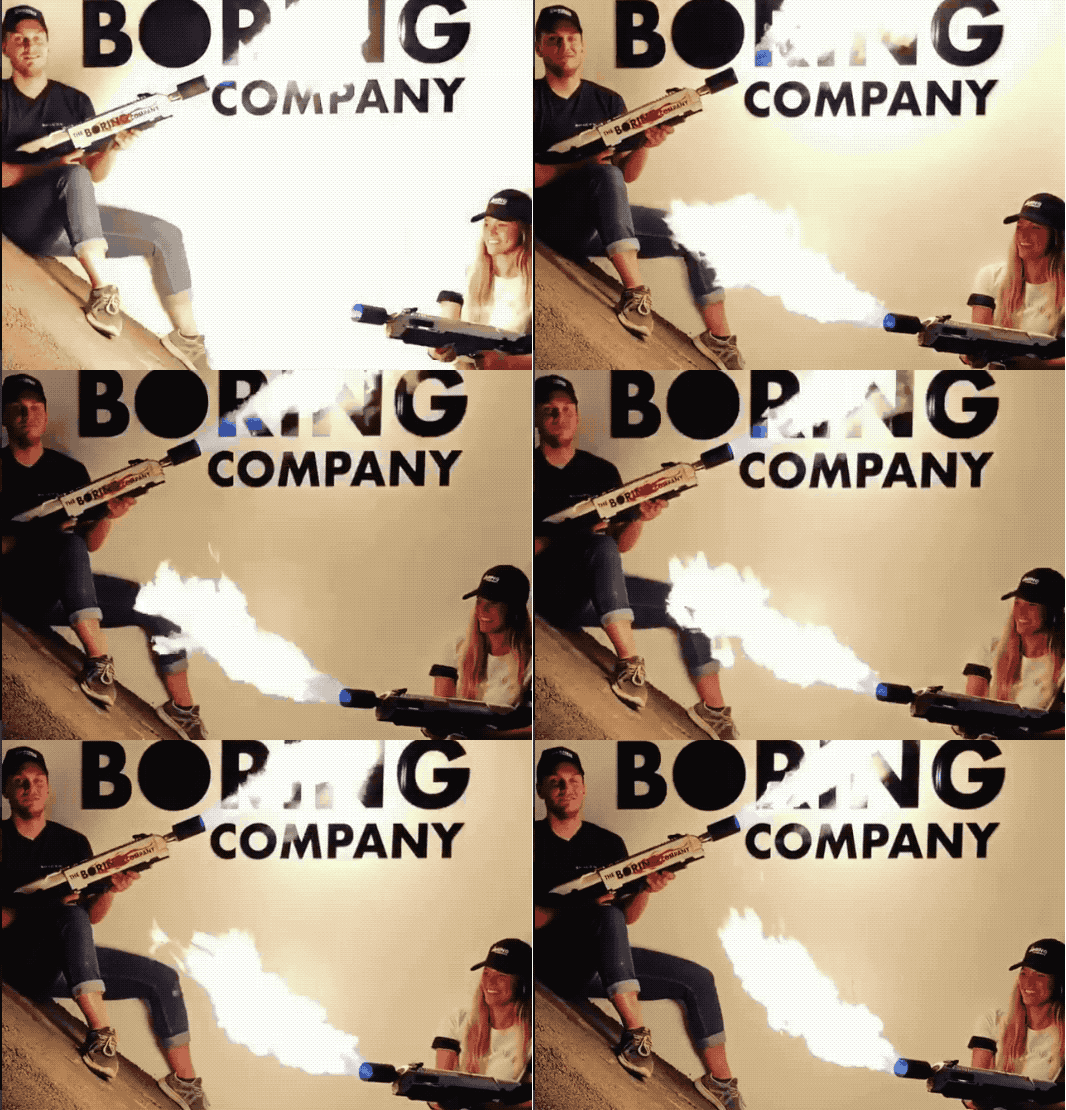
Today’s documents don’t offer much insight into the details of the round beyond the cash amount and the fact that there were 31 undisclosed participants in the equity funding. The company has gotten some press for its less than conventional “fundraising methods” so far, where it has sold pre-orders of branded hats and, yes, flamethrowers.


16 Apr 2018

Someone made a game where you ride the rapidly changing prices of cryptocurrencies

The cryptocurrency world is a strange one, but at least it has a sense of humor. A new game has you riding a little crypto-car along the wildly fluctuating prices of major and minor currencies. It’s quite ridiculous, and it isn’t even a bad game!

It’s called Crypto Rider, predictably, and is very much a spawn of the popular Line Rider type of game, though (hopefully) different enough that there won’t be any cease and desists forthcoming.

You select your car, then pick a chart to ride — most are a ride from a coin’s humble start to its highest value. But there’s a mountain-like “total market cap” track, a “drag race” where you need to clear a valuation gap, and one that must be depressing for BTC holders: a bumpy downhill ride from $20K to $7,850. New tracks should appear in time as well as new cryptocurrencies rise and fall.

The game is cute — there are fun messages along the track, and the exhaust is tiny coins — and you collect coins toward unlocking new cars. I’m pretty sure they’re just aesthetic changes but I’m gunning for a Dogecar anyway. I’ve asked the developer, SuperFly Games, for a few more details.

It’s free, it’s dumb, and it’s a fun way to waste a few minutes while you inadvertently lampoon the hubris of this rushed attempt to overthrow existing financial systems. Sure, we’ll get there eventually. But as the game shows, it’s going to be quite a ride.

You can download Crypto Rider for iOS or Android.