Year: 2018

16 Apr 2018

Utah’s Pluralsight unveils IPO filing

Pluralsight, the Utah-based education technology company, has revealed its IPO filing. 

Given the timing of the unveiling, the company is likely targeting a May public debut.

Its core business is online software development courses, helping people improve their skills in categories like IT, data and security. Businesses small and large pay Pluralsight to help train their employees. It also has offerings for individual subscribers.

In the filing, the company acknowledges that it is a competitive landscape, and names Cornerstone OnDemand, Udacity, Udemy, LinkedIn Learning as others in a comparable market. It also mentions General Assembly, which was recently acquired by Adecco for $413 million. 

This is the first glimpse we get at Pluralsight’s financials. For 2017, the company brought in $166.8 million in revenue, up from $131.8 million in 2016 and $108.4 million in 2015.

Losses are growing, however. This is partly due to a sizeable increase in sales and marketing expenditures. For 2017, the company lost $96.5 million. This is up from losses of $20.6 million in 2016 and $26.4 million in 2015.

Pluralsight has been around since 2004.  Like many startups outside of the San Francisco Bay Area, the company bootstrapped its business and didn’t raise significant outside funding until 2013. Pluralsight previously raised nearly $200 million in financing.

The largest shareholder is Insight Venture Partners, which owned 46.1% of the shares prior to the IPO, an unusually high percentage. Co-founder and CEO Aaron Skonnard owned 13.4% and investment group ICONIQ owned 8.1%.

Morgan Stanley and J.P. Morgan served as lead underwriters. Wilson Sonsini and Goodwin Procter served as counsel.

Pluralsight plans to list on the Nasdaq, under the ticker “PS.”

A provision in the JOBS Act from 2012 helped make it so that companies could file confidentially and then reveal financials and other business information just weeks before making public debuts. This helps companies avoid too much scrutiny in the months leading up to an IPO. There is also a quiet period in this time, meaning that companies are limited in what they can say publicly about their businesses.

Like most tech companies, Pluralsight chose to take advantage of this confidential filing provision. But it also announced that it filed, something that companies don’t usually do. Most choose to stay quiet about IPO plans until they make the filings public, unless reporters break the news first.

It was no surprise to those who have been following Utah’s tech scene that Pluralsight is planning to list on the stock market this year. The venture-backed “unicorn” has been a late-stage company for several years now, with a reported valuation of $1 billion as of 2014. 

After a slow first couple months, there has been a flurry of tech IPO activity in recent weeks. Dropbox, Spotify and Zuora recently debuted. Pivotal, Smartsheet and Carbon Black are amongst the companies expected to list in the coming weeks.


16 Apr 2018

Google initiative looks to preserve walkable copies of Earth’s historical sites on the web

Indiana Jones’ exclamation of, “It belongs in a museum!” is taking a trip into the digital age with a Google initiative that will save archaeological sites to the cloud.

Google’s non-profit Arts and Culture arm is partnering with another non-profit, Oakland-based CyArk, which flies drones and sets up cameras around historical sites using photogrammetry and LiDAR scanning tech to create dense models composed of thousands of photos and data points. These scans had previously not been available publicly but with the help of Google, CyArk now has opened access to a number of their scans and will be adding more.

CyArk’s mission has largely been focused on preservation of these sites. In a talk I attended earlier today, the non-profit detailed that as these historic structures they scan are threatened by natural disasters or human conflict, the data they have offers the potential for these sites to be restored with laser accuracy or at least preserved as they were for future generations to enjoy in a digital sense.

Google’s Art and Culture team has already done a lot of intensely cool work when it comes to preserving artwork across the globe in high-resolution glory. With the advent of so many methods for capturing large-scale 3D models over the past few years, it makes sense that Google would eye preservation of physical structures next. The fact that this 3D digitization arrives in the early stages of consumer VR also gives it a quality platform to be viewed on which will only get better. As opposed to 360 photos, viewers will actually be able to walk around these sites, look into crevices and peek behind objects captured spatially.

It’s actually pretty exciting and the ability to preserve culture as scaled physical locations that you could physically walk through in the future is a deeply intimate view of history that modern technology has converged on. That Google is working with non-profits is largely positive to carry this out is admirable and one can hope that they direct more resources to aid these efforts on a global scale so that more people can experience immersive history.

Today, you can check out 25 of these historic sites in 18 countries. You can view the models and environments in desktop mode as well as on PC and mobile VR headsets.

16 Apr 2018

Facebook points finger at Google and Twitter for data collection

“Other companies suck in your data too,” Facebook explained in many, many words today with a blog post detailing how it gathers information about you from around the web.

Facebook product management director David Baser wrote, “Twitter, Pinterest and LinkedIn all have similar Like and Share buttons to help people share things on their services. Google has a popular analytics service. And Amazon, Google and Twitter all offer login features. These companies — and many others — also offer advertising services. In fact, most websites and apps send the same information to multiple companies each time you visit them.” Describing how Facebook receives cookies, IP address, and browser info about users from other sites, he noted, “when you see a YouTube video on a site that’s not YouTube, it tells your browser to request the video from YouTube. YouTube then sends it to you.”

It seems Facebook is tired of being singled-out. The tacked on “them too!” statements at the end of its descriptions of opaque data collection practices might have been trying to normalize the behavior, but comes off feeling a bit petty.

The blog post also fails to answer one of the biggest lines of questioning from CEO Mark Zuckerberg’s testimonies before Congress last week. Zuckerberg was asked by Representative Ben Lujan about whether Facebook constructs “shadow profiles” of ad targeting data about non-users.

Today’s blog post merely notes that “When you visit a site or app that uses our services, we receive information even if you’re logged out or don’t have a Facebook account. This is because other apps and sites don’t know who is using Facebook. Many companies offer these types of services and, like Facebook, they also get information from the apps and sites that use them.”

Facebook has a lot more questions to answer about this practice, since most of its privacy and data controls are only accessible to users who’ve signed up.

The data privacy double-standard

That said, other tech companies have gotten off light. Whether it’s because Apple and Google aren’t CEO’d by their founders any more, or we’ve grown to see iOS and Android as such underlying platforms that they aren’t responsible for what third-party developers do, scrutiny has focused on Zuckerberg and Facebook.

The Cambridge Analytica scandal emerged from Facebook being unable to enforce its policies that prohibit developers from sharing or selling data they pull from Facebook users. Yet it’s unclear whether Apple and Google do a better job at this policing. And while Facebook let users give their friends’ names and interests to Dr. Aleksandr Kogan, who sold it to Cambridge Analytica, iOS and Android apps routinely ask you to give them your friends’ phone numbers, and we don’t see mass backlash about that.

At least not yet.

16 Apr 2018

Netflix nears a $150B market cap as its subscribers continue to balloon

Just last quarter Netflix passed a $100 billion market cap — and we might already be talking about it as a $150 billion company before too long with yet another big financial quarter that sent its stock soaring.

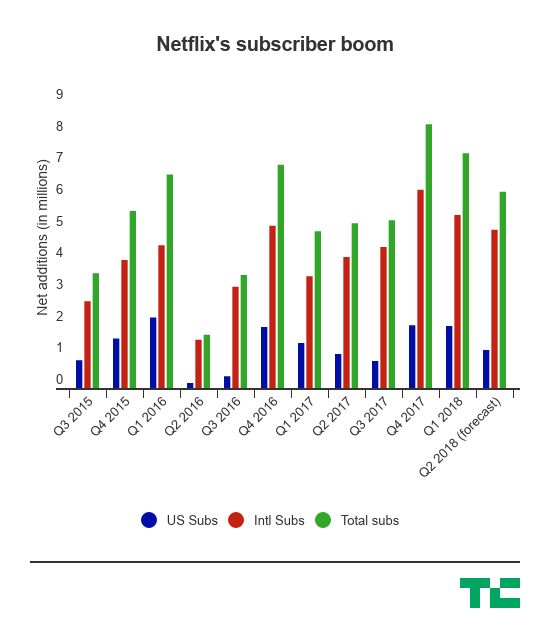
Netflix, again, beat out some expectations Wall Street held for the first quarter and provided a pretty good outlook for the next quarter as well, where it said it expected to add around 6.2 million new subscribers. In the first quarter, Netflix added 7.41 million new subscribers — around 2 million of them domestic and the rest internationally. The company continued to see some pretty strong streaming revenue growth, which was up around 43% year-over-year in the first quarter this year, to around $3.6 billion.

With all this, Netflix now has nearly 119 million paid streaming memberships — and it wasn’t all that long when Netflix finally said just over two years ago that it would begin opening up in hundreds of new countries internationally. The company’s shares are up around 6% in extended trading, sending its market cap up north of $140 billion. And all this subscriber growth, too, comes before we’re seeing a new tie-up with Comcast’s cable subscriptions that may end up driving that even more. As usual, Netflix expects to lose a ton of money and says it expects between -$3 billion to -$4 billion in free cash flow, but that’s usually not what investors are looking for.

One of the big questions Netflix still has right now is what kind of price tag it will carry as a tack-on to a Comcast subscription. Earlier this week, the companies announced that Comcast would bundle Netflix in to its cable subscriptions, offering yet another entry point for Netflix to ferret up potential consumers that haven’t quite cut the cord yet but still might be interested in Netflix’s content. Netflix normally carries a price tag of around $13.99, but the companies have not said what its price will be as part of a cable bundle yet.

Following Netflix’s last earnings report — which it, as you might expect, included some blowout subscriber numbers — the company rocketed past a market cap of $100 billion. Since then it’s only been an upward trend for Netflix, which prior to its first-quarter report was worth more than $130 billion. Despite increasing spend on original content, that subscriber number is still mostly where it gets its market value because it’s a forward predictor of its revenue.

Netflix late last year said it expected to spend between $7 billion and $8 billion on original content this year, a number that seems to periodically get an upward revision and is still a dramatic step up from 2017. The company in its report today said it expected to spend between $7.5 billion and $8 billion on original content, and expects that marketing and content spend to weight toward the second half of 2018.

But it has to continue to invest in original content because it is a way to attract new subscribers, and also because it’s content that it can more easily distribute across different geographies and itself has control of the rights and what happens to it. It relies on shows like Stranger Things or Altered Carbon to bring in new users, which then hopefully stick around and eventually help recoup the cost of those shows — and then the cycle starts anew.

16 Apr 2018

Instead of stealing instruments, musicians turn to Splice

“The percentage of Top 40 music made with our platform blows my mind” says Splice co-founder Steve Martocci. He tells me about some bedroom music producers who were “working at Olive Garden until they put sounds on Splice.” Soon they quit their jobs since they were earning enough from artists downloading those sounds to use in their songs. That led them to collaborate with famous DJ Zedd, resulting in the Billboard #12 hit “Starving”.

Splice has attracted $47 million in funding to power this all-new music economy. That might be a shock considering Martocci estimates that 95% of digital instruments and sample packs are pirated since they’re often expensive with no try-before-you-buy option. Even Kanye West got caught stealing the trendy Serum digital synthesizer.

But Splice lets artists pay $7.99 per month to download up to 100 samples they can use royalty-free to create music. That’s cheaper than it costs to listen to music on Spotify. Splice then compensates artists based on how frequently their sounds are downloaded, and has already paid out over $7 million.
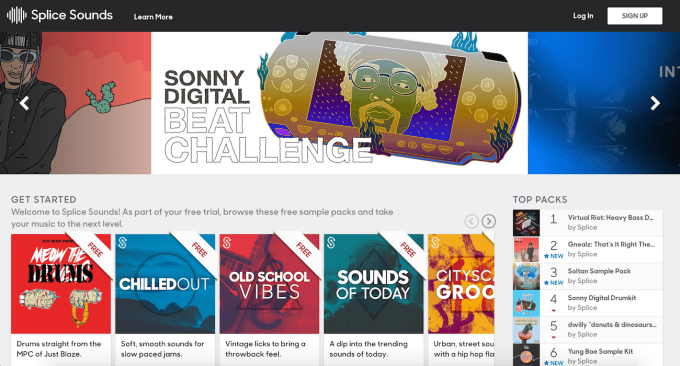
Splice Sounds is like an iTunes Store for samples

“We try to make more seats at the table in the music business” says Martocci, who previously founded messaging app GroupMe which sold to Skype for between $50 million and $80 million in 2011. “GroupMe was made to go to concerts with our friends. Music has always been my motivator, but code is my canvas. Artists come up to me and hug me because I’m changing the creative process.”
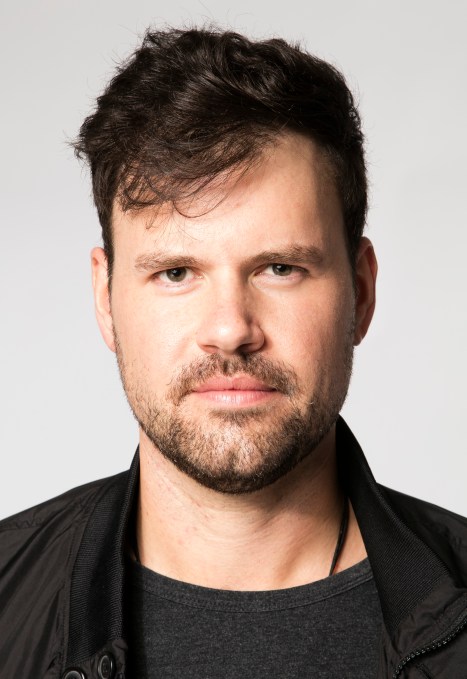
Splice co-founder Steve Martocci

But now he’s getting some big name assistance, attracted by Splice’s success in the stubborn musician community and its $35 million Series B from December. Splice has just hired former Facebook product manager Matt Pake as VP of product to lead core teams in New York, and former Secret co-founder Chrys Bader to build out a new squad in Los Angeles. [Disclosure: I knew both from before they moved out of the SF social scene]

Splice now has 100 staffers, mostly hobbyist musicians themselves, but “I don’t think I have one bay area employee” says Martocci. He wants his offices where the artists live. “Everyone has a genuine passion for music. It doesn’t feel like a tech company as much” says Bader. Martocci apparently takes feedback well, which is different because “I’ve had some pretty fucking hard people to work with in the past…” Bader notes, likely referring to disagreements with his co-founder at Secret. “I have zero tolerance for bullshit at this point in my life and there’s zero bullshit on this team.”

While the Sounds marketplace has blown up recently, pushing Splice to 1.5 million users, the startup has a grander vision for software to eat instruments. That means creating the same kind of tools that help programmers code apps, but for musicians to compose songs. Splice Studio integrates with composition software like GarageBand, Logic, and Ableton to offer cloud-synced version control.

This might sound nerdy, but it’s a lifesaver. Splice Studio automatically backs up the artist’s work-in-progress song after every single edit so they can always reverse changes and safely work with collaborators without having to nervously save manually and fret about keeping all the copies organized.
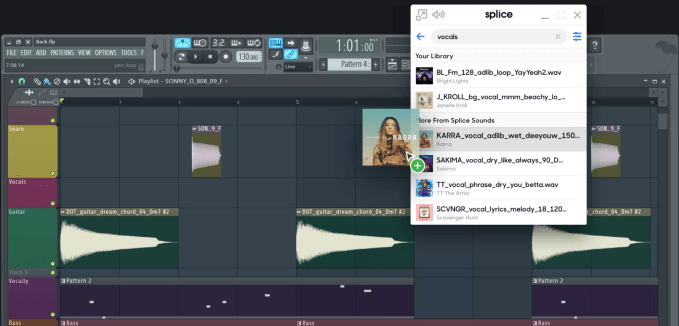
Splice saves every edit to a song-in-progress so you can experiment but always reverse changes

Since Splice’s staffers actually make music themselves rather than parachuting into a foreign space, they intimately understand the frustrations they’re trying to solve. Knowing income can be unpredictable, Splice lets musicians access plugins, software, and instruments on a rent-to-own basis where they can pause payment and resume later. That’s the kind of convenience that Bader says makes Splice “easier than piracy”, echoing Spotify director Sean Parker’s plan to beat bootleg MP3s with a simple streaming service. “I wanted to build something even Reddit couldn’t complain about”, Martocci laughs.

But where Splice goes next could addresses the biggest, most insidious barrier to creative output: writer’s block. Ask most modern musicians, and they’ll tell you about their giant folders of unfinished songs. Getting from a melody rattling around in you head to a few tracks laid out in your preferred composition software is the easy part. Polishing those parts, ditching the unnecessary ones, finding the rights sounds, and tieing it all together into something listenable can be agonizingly difficult.

Creative Companion is Splice’s solution. Currently being built by Bader’s LA team, it’s a songwriting assistant that can suggest a next step and surface samples that fit well with those you’re already using. Martocci explains how Splice uses “cool machine learning stuff” to recommend ‘Hey, you should add a bass line. You should add some mastering.”

Splice just hired Chrys Bader, previously the co-founder of Secret

The question for Splice will be how many music producers out there are willing to pay. “There’s an upper bound. This is not a consumer product” Bader admits. Citing internal research, he says there 30 million music producers in the world. Many might not even know about Splice, “but at $8 a month, that’s not really breaking the bank. You might pay $200 for a plugin or $700 for Ableton. That’s insane. Musicans can’t afford that. Yet a musician friend tells me all the time ‘I’m broke, I’m broke…but I live or die by Splice.'”

Splice’s heavy-duty funding from Union Square Ventures, True Ventures, and DFJ could also attract competition. It might awake the interest of big creative services corporations like Adobe, or more established music production tool companies like Native Instruments which just launched a direct competitor called Sounds.com. But Splice is digging in for a long fight, giving away Splice Studio to lure in users and commissioning exclusive sample packs from top creators. In that sense, Splice is almost like a record label.
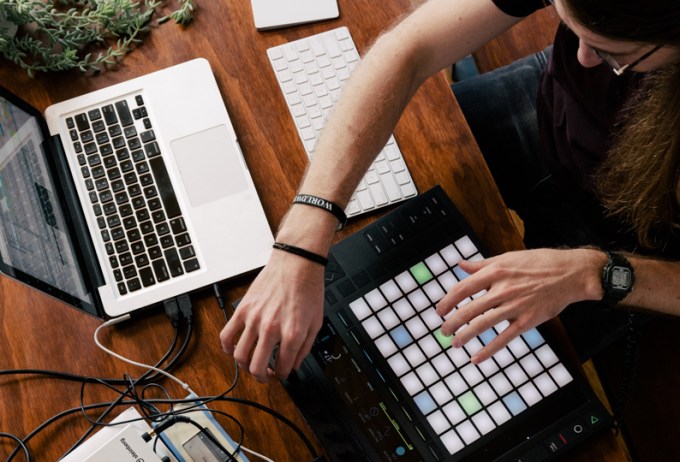
“I want to see a world with more transcendent musical highs” where “you have more music that’s ready for moment” Martocci opines. “If we build something that makes musicians lives better, that makes our lives better because a lot of us are musicians, what else is there in life?” Bader explains.

Computers democratized music-making, leading to a flood of amateurs sharing their content with the world. But all good democratizations necessitate layers of curation to sort through all the output, which social networks have become, and tools to let the most talented artists create what’s worth everyone’s attention.

Martocci concludes “Software is a great instrument. One-third of the world tries to make music at some point. They’re not going to pick up guitars and recorders any more.” Whatever app they choose, Splice wants to keep them in the creative flow.


 

16 Apr 2018

Instead of stealing instruments, musicians turn to Splice

“The percentage of Top 40 music made with our platform blows my mind” says Splice co-founder Steve Martocci. He tells me about some bedroom music producers who were “working at Olive Garden until they put sounds on Splice.” Soon they quit their jobs since they were earning enough from artists downloading those sounds to use in their songs. That led them to collaborate with famous DJ Zedd, resulting in the Billboard #12 hit “Starving”.

Splice has attracted $47 million in funding to power this all-new music economy. That might be a shock considering Martocci estimates that 95% of digital instruments and sample packs are pirated since they’re often expensive with no try-before-you-buy option. Even Kanye West got caught stealing the trendy Serum digital synthesizer.

But Splice lets artists pay $7.99 per month to download up to 100 samples they can use royalty-free to create music. That’s cheaper than it costs to listen to music on Spotify. Splice then compensates artists based on how frequently their sounds are downloaded, and has already paid out over $7 million.

Splice Sounds is like an iTunes Store for samples

“We try to make more seats at the table in the music business” says Martocci, who previously founded messaging app GroupMe which sold to Skype for between $50 million and $80 million in 2011. “GroupMe was made to go to concerts with our friends. Music has always been my motivator, but code is my canvas. Artists come up to me and hug me because I’m changing the creative process.”

Splice co-founder Steve Martocci

But now he’s getting some big name assistance, attracted by Splice’s success in the stubborn musician community and its $35 million Series B from December. Splice has just hired former Facebook product manager Matt Pake as VP of product to lead core teams in New York, and former Secret co-founder Chrys Bader to build out a new squad in Los Angeles. [Disclosure: I knew both from before they moved out of the SF social scene]

Splice now has 100 staffers, mostly hobbyist musicians themselves, but “I don’t think I have one bay area employee” says Martocci. He wants his offices where the artists live. “Everyone has a genuine passion for music. It doesn’t feel like a tech company as much” says Bader. Martocci apparently takes feedback well, which is different because “I’ve had some pretty fucking hard people to work with in the past…” Bader notes, likely referring to disagreements with his co-founder at Secret. “I have zero tolerance for bullshit at this point in my life and there’s zero bullshit on this team.”

While the Sounds marketplace has blown up recently, pushing Splice to 1.5 million users, the startup has a grander vision for software to eat instruments. That means creating the same kind of tools that help programmers code apps, but for musicians to compose songs. Splice Studio integrates with composition software like GarageBand, Logic, and Ableton to offer cloud-synced version control.

This might sound nerdy, but it’s a lifesaver. Splice Studio automatically backs up the artist’s work-in-progress song after every single edit so they can always reverse changes and safely work with collaborators without having to nervously save manually and fret about keeping all the copies organized.

Splice saves every edit to a song-in-progress so you can experiment but always reverse changes

Since Splice’s staffers actually make music themselves rather than parachuting into a foreign space, they intimately understand the frustrations they’re trying to solve. Knowing income can be unpredictable, Splice lets musicians access plugins, software, and instruments on a rent-to-own basis where they can pause payment and resume later. That’s the kind of convenience that Bader says makes Splice “easier than piracy”, echoing Spotify director Sean Parker’s plan to beat bootleg MP3s with a simple streaming service. “I wanted to build something even Reddit couldn’t complain about”, Martocci laughs.

But where Splice goes next could addresses the biggest, most insidious barrier to creative output: writer’s block. Ask most modern musicians, and they’ll tell you about their giant folders of unfinished songs. Getting from a melody rattling around in you head to a few tracks laid out in your preferred composition software is the easy part. Polishing those parts, ditching the unnecessary ones, finding the rights sounds, and tieing it all together into something listenable can be agonizingly difficult.

Creative Companion is Splice’s solution. Currently being built by Bader’s LA team, it’s a songwriting assistant that can suggest a next step and surface samples that fit well with those you’re already using. Martocci explains how Splice uses “cool machine learning stuff” to recommend ‘Hey, you should add a bass line. You should add some mastering.”

Splice just hired Chrys Bader, previously the co-founder of Secret

The question for Splice will be how many music producers out there are willing to pay. “There’s an upper bound. This is not a consumer product” Bader admits. Citing internal research, he says there 30 million music producers in the world. Many might not even know about Splice, “but at $8 a month, that’s not really breaking the bank. You might pay $200 for a plugin or $700 for Ableton. That’s insane. Musicans can’t afford that. Yet a musician friend tells me all the time ‘I’m broke, I’m broke…but I live or die by Splice.'”

Splice’s heavy-duty funding from Union Square Ventures, True Ventures, and DFJ could also attract competition. It might awake the interest of big creative services corporations like Adobe, or more established music production tool companies like Native Instruments which just launched a direct competitor called Sounds.com. But Splice is digging in for a long fight, giving away Splice Studio to lure in users and commissioning exclusive sample packs from top creators. In that sense, Splice is almost like a record label.

“I want to see a world with more transcendent musical highs” where “you have more music that’s ready for moment” Martocci opines. “If we build something that makes musicians lives better, that makes our lives better because a lot of us are musicians, what else is there in life?” Bader explains.

Computers democratized music-making, leading to a flood of amateurs sharing their content with the world. But all good democratizations necessitate layers of curation to sort through all the output, which social networks have become, and tools to let the most talented artists create what’s worth everyone’s attention.

Martocci concludes “Software is a great instrument. One-third of the world tries to make music at some point. They’re not going to pick up guitars and recorders any more.” Whatever app they choose, Splice wants to keep them in the creative flow.

 

16 Apr 2018

The problems with Facebook are inherent in its design, but that can change