Year: 2018

16 Apr 2018

US early-stage investment share shrinks as China surges

The global early-stage investment pie is getting bigger… a lot bigger. Just four years ago, investors were putting less than $10 billion per quarter into early-stage deals (Series A and B). The past two quarters, however, have all come in over twice that level. Q1 2018, meanwhile, looks to be a record-setting one, with Crunchbase projecting $25 billion in global early-stage investment.

But while overall investment is on the rise, the U.S.’ share is dwindling. A few years ago, North American startups reliably received at least two-thirds of global early-stage investment. No more. For the past three quarters, North America’s share has dwindled to less than half, as the chart below illustrates:

The rise of China’s startup scene, combined with local investors’ penchant for jumbo-sized Series A rounds, goes a long way to explaining the shift. Venture ecosystems in Southeast Asia, Brazil and elsewhere have also been in growth mode, and thus accounting for a more significant share of global early-stage investment.

Huge Series A rounds are huge in China

Before we venture further, it should be noted that although we associate Series A with early-stage companies, this is not always the case. Some of the largest Series A rounds globally have gone to companies that were relatively mature but previously bootstrapped or spun out of large corporations.

Recent data shows both the U.S. and China have their share of spin-outs and older companies gobbling up so-called early-stage rounds. OneConnect and Ping An Healthcare, subsidiaries of Chinese insurance giant Ping An, which raised $650 million and $1.2 billion, respectively, are examples of such activity.

Venture investors in China also put far more into Series A and B deals than U.S. counterparts. A Crunchbase News analysis found that the average Series A round for a China-based startup in 2017 was $32.8 million, just over triple the size of the average Series A for a U.S. company.

The momentum is holding up in 2018. So far this year, at least 12 Chinese companies have raised early-stage rounds of $100 million or more, altogether bringing in more than $4 billion (see list). Recipients of some of the largest rounds include:

  • Ziroom, an apartment rental service provider based in Beijing, raised $621 million in its Series A round.
  • Black Fish, a consumer finance platform, raised a $145 million Series A round.
  • Pony.ai, an autonomous vehicle startup with significant operations in both Silicon Valley and China, raised a $112 million Series A.

U.S. is no slouch in big A and B rounds, either

The U.S. has also had a dozen startups (plus Pony.ai) bring in $100 million or more in early-stage rounds this year. However, the aggregate total these startups have raised — about $1.8 billion — is less than half that of Chinese counterparts.

As mentioned previously, many of the largest early-stage round recipients are mature companies or spin-outs of mature companies. The list includes two companies founded in 2009 that closed Series B rounds of around $100 million this year: Joby Aviation, a developer of electric planes, and Vacasa, a vacation property management company.

Healthcare spin-outs are also attracting big dollars, including Celularity, a developer of placental stem cell-based therapies, and Viela Bio, a developer of therapies for autoimmune diseases.

But while big rounds are still getting done, the number of U.S. early-stage rounds of all sizes has declined a bit over the past four years. Over the last two quarters, Crunchbase projects fewer than 900 early-stage rounds are closing quarterly. Globally, however, the number of early-stage rounds has been trending up:

Part of the pattern is that the dynamics of early-stage funding have changed over the years. In the past, Series A and B rounds were for startups to develop working prototypes, hone market segments to target and attract the earliest customers. Scaling on a national or international level was generally for later stages, after a company had proven demand and a working product.

These days, markets move faster, and it’s not uncommon to see startups move in just a few quarters from concept to scaling en masse. Just look at Bird, the scooter sharing company that raised $115 million after mere months of operation with a business model intended to terrorize pedestrians and motorists provide a last-mile transit solution.

The entire bike, scooter and moped sharing sector has blossomed over a couple of short years, with big early-stage rounds all around. And it’s an area where China was the early leader for scaling. But fintech, biotech, agtech and other fields are also providing fertile ground for substantial early-stage funding rounds.

Should we worry?

So is the declining share of North American early-stage funding a source of worry for founders and investors in the region? Or is it a predictable evolution following economic growth in China and elsewhere?

We won’t attempt to answer that here, but others have tried. Sequoia Capital’s Michael Moritz drew wide criticism earlier this year for an essay sounding the warning bell on what he perceived as superior work ethic among Chinese entrepreneurs compared to their U.S. counterparts.

Purely following the money, the takeaway is this: Investors globally have decided the early-stage opportunity is a lot bigger than they thought a couple of years ago. And while investors are putting a bit more into mature ecosystems like the U.S. and Silicon Valley, they are putting a lot more into China and other regions with underdeveloped venture markets relative to their size and technology prowess.

16 Apr 2018

FCC dings T-Mobile $40M for faking rings on calls that never connected

T-Mobile will pay $40 million as part of a settlement with the FCC for playing ringing sounds to mislead customers into thinking their calls were going through when in fact they had never connected in the first place. The company admitted it had done so “hundreds of millions” of times over the years.

The issue at hand is that when someone is trying to call an area with poor connectivity, it can sometimes take several seconds to establish a line to the other party — especially if a carrier itself does not serve the area in question and has to hand off the call to a local provider. That’s exactly what T-Mobile was doing, and there’s nothing wrong with it — just a consequence of spotty coverage in rural areas.

But what is prohibited is implying to the caller that their call has gone through and is ringing on the other end, if that’s not the case. Which is also exactly what T-Mobile was doing, and had been doing since 2007. Its servers began sending a “local ring back tone” when a call took a certain amount of time to complete around then.

As the FCC estimates it, and T-Mobile later confirmed:

Because T-Mobile applied this practice to out-of-network calls from its customers on SIP routes that took more than a certain amount of time on a nationwide basis and without regard to time of day, the LRBT was likely injected into hundreds of millions of calls each year.

It’s not just a bad idea: it’s against the law. In 2014 the FCC’s Rural Call Completion Order took effect, prohibiting exactly this practice, which it called “false audible ringing”:

[O]ccurs when an originating or intermediate provider prematurely triggers audible ring tones to the caller before the call setup request has actually reached the terminating rural provider. That is, the calling party believes the phone is ringing at the called party’s premises when it is not. An originating or intermediate provider may do this to mask the silence that the caller would otherwise hear during excessive call setup time. As a result, the caller may often hang up, thinking nobody is available to receive the call. False audible ringing can also make it appear to the caller that the terminating rural provider is responsible for the call failure, instead of the originating or intermediate provider.

Users and carrier complained after this rule took effect, and also sought remedy with T-Mobile directly. The FCC looked into it and T-Mobile reported that it had solved the problem — but complaints continued. It became clear that the company had been violating the rule for years and in great volume and had not in fact stopped; hence the settlement and $40 million penalty.

T-Mobile will also have to take action within 90 days to stop the practice (if it hasn’t already) and issue regular reports to the FCC every year for the next three years that it is still in compliance. You can read the full consent decree here (PDF).

16 Apr 2018

Diversity and inclusion, data privacy and security ops will be on everyone’s mind at RSA

This week, 50,000 security professionals will descend upon San Francisco for the 27th Annual RSA Security Conference, arguably the largest global security event of the year. And for the security community to win against “the bad guys,” we’re going to need at least 50,000 more people.

Yes, the well-established “security skills gap” will be a hot point of discussion at this year’s RSA Conference. But in a year fueled by industry controversy (including backlashagainst RSA Conference itself), the conversations on stage and in the Expo Hall are expected to be the most lively since 2014, when the debate around Edward Snowden came to the forefront on security’s biggest stage. Unlike RSA’s conference rivals, Black Hat and DefCon, RSA is an industry event attended by a balance of security analysts and business executives. This group has historically bred an interesting mix of opinions on topics related to privacy, inclusion and disclosure.

From Facebook’s public data privacy crisis with Cambridge Analytica and a long overdue movement calling for the security industry to finally break the glass ceiling, here are the three things that will be on everyone’s mind at RSA this year:

Diversity and Inclusion

Throughout my 20+ years in the security community, the unfortunate reality remains that a gender bias exists. Finally, we’re approaching it head-on, but there’s lots of work to be done. When RSA initially announced their keynote roster this year, the list was dominated by men – in fact, the only woman announced as an initial keynote was Monica Lewinsky. In response, a one-day alternative conference was announced – OURSA – which promised to deliver content from a more diverse group of experts. Bravo. The event sold out quickly – my company Splunk was lucky enough to get a handful of tickets.

A lack of diversity in the security community is not just wrong from a social-psychological sense – it is a business issue. There is a huge talent gap in security jobs. Many organizations are ignoring a significant portion of the population by not recognizing contributions, and not creating opportunities for positive role modeling. OURSA, which seeks to help correct that, will be talked about for some time. In fact, their impact is already being felt – RSA has added a number of female and POC keynote speakers in response to the controversy. Good on them.

Data Privacy

A perfect storm of data privacy is brewing. First, you have General Data Protection Regulation (or GDPR) – the acronym on every vendor’s lips this year. Designed to strengthen data protection for individuals, GDPR will change the way every business that operates in the EU handles the personal data of its users and customers. This will have a massive, global impact on the ways companies operate and disclose data breaches. Solutions specifically designed to address GDPR will surely be unveiled at RSA this year as the global security community tries to make sense of what new compliance standards they have to meet. Then – you have what might be the biggest topic at RSA this year – Cambridge Analytica. With CEO Mark Zuckerberg under fire from the media and Facebook users, you can bet that an elevated discussion on the ethics of data will be had at RSA. There are quite a few talks on security and privacy on this year’s RSA agenda, and given event attendees are typically bent towards business and organizational leadership, data privacy will be top of mind.

Security Operations

Many in the industry are wising up to the fact that buzzword bingo created by vendors is hurting, not helping the security community. Every year at RSA, attendees listen to topics ranging from security leadership, to cryptography, to keynotes on threats. And every year security professionals must ask themselves, how can this knowledge be operationalized – how can all the practices, technologies and ideas be put to effect in any given organization? A lot of this boils down to what we can bucket as “Security Operations,” a simple and understandable term that encompasses everything that happens within a Security Operations Center (SOC) to keep companies aware, secure and analytics-driven. Last year, the key trends driving growth in Security Operations were machine learning and artificial intelligence. But is the hype over? Or is automation the new thing?

The Bottom Line

As I’ve written in TechCrunch before, cybersecurity is a moving target. People want to talk a lot about “the good guys” winning or “the bad guys” winning, but the truth remains that our best way to make inroads to combat emerging threats and hit that target is by working together. And that doesn’t just go for security analysts – it applies to security vendors too. More than anything, RSA presents a great networking opportunity for security professionals to come together and learn from each other on what trends are helping them find threats faster. I predict that as always, the community will help each other understand what substantive state changes people need to make when they get back to their offices.

16 Apr 2018

See you on Thursday in Chicago

Some folks I met in Chicago are holding an amazing event at a great place on South Canalport Avenue. This former macaroni factory now builds startups and I’ll be helping judge their pitch-off alongside some Chicago luminaries.

You can RSVP here and sign up for a spot to pitch here. They’ll choose eight startups to pitch; there are some great prizes available.

Blue Lacuna is at 2150 South Canalport Avenue in Chicago and the event is on April 19 at 6pm. Grab your tickets early for this cool meet and greet and I’ll see you there!

16 Apr 2018

Bumble drops Facebook login requirement

The week after Mark Zuckerberg testified in front of Congress, Bumble is announcing it will no longer require that users have a Facebook account to log in. The popular women-first dating app is set to institute the change to its registration process tomorrow.

Facebook has long been a prerequisite for signing up for the service, along with competitors like Tinder, designed to help verify identities, offer common friends and expedite registration. But fallout from Facebook’s most recent data-sharing scandal has left plenty of users wary of the service and helped convince Bumble’s creators that it’s time for an update.

“Many of our users and prospective users asked for an alternative registration method,” Bumble VP Louise Troen said in an interview with Wired. “As always, empowering our users to make connections is our number one priority and we wanted to continue to ensure our users felt safe while doing this.”

Bumble’s privacy page notes a laundry list of information the service “may collect” via Facebook. “If you register or login to the App using your Facebook account, you are authorizing us to access certain Facebook account information,” the TOS reads, “including information you make available via Facebook, your friends list, relationship status, current location and those friends you have in common with other Bumblers.”

The new process being introduced later this week will let users sign up using only their phone number for verification. While Facebook’s recent privacy concerns may not have had a tremendous impact on its user base, Bumble is likely to be one of several high-profile services rethinking its relationship with the social network.

16 Apr 2018

Target debuts same-day delivery for in-store purchases in some urban markets

Target wants to make it easier for customers in urban markets to shop its store and get their hauls home, without having to lug their bags onto the subway or other public transit. These customers may skip buying heavier items like 12-packs of soda, big bags of dog food, gallons of water, new bedding sets, and other things they can’t easily carry for long distances. Instead, they’ll place those orders online – and often with Target competitors like Amazon. But now, Target will allow urban customers to shop in-store, and have their purchases delivered to their home that same day.

The service makes sense for Target stores in cities, where there aren’t often parking lots available to shoppers, and whose customer base tends to ride the subway, bus, or train, or bike or walk home. When they want to buy more than they can easily carry, they tend to order a taxi or an Uber to get their purchases home.

That’s why Target is rolling out this home delivery option only to select locations.

The feature will debut in nearly 60 stores in five major cities – Boston, Chicago, New York City, San Francisco, and Washington D.C. – by the end of this month, the company says. 

To take advantage of the service, customers will shop as usual and check out at the register.

There, they’ll tell the cashier they’d like to take home delivery and pay the $7 flat fee. (Cheaper than some cab rides, Target notes). Customers then choose their two-hour delivery window and provide their address along with other relevant delivery information. When the process is complete, they’ll leave their purchases at the store, and return home to accept delivery during their window.

Oversized items, like furniture, will cost $25 for delivery.

The service is one of several new technology initiatives underway at Target, to help it better compete against Amazon and Walmart. It’s also expanding its pantry-focused Restock delivery service, same-day grocery delivery through its acquisition of Shipt, and curbside pickup.

Target says stores offering the delivery service will display signage and its cashiers will tell customers about the option at checkout.


16 Apr 2018

Coinbase buys Earn.com and makes CEO Balaji Srinivasan its first CTO

Coinbase, the prominent cryptocurrency exchange, has announced its most significant piece of M&A to date after it agreed to buy Earn.com, the U.S. startup that uses the blockchain for its paid-email service, in a deal worth more than $120 million. In addition, Coinbase has appointed Earn.com co-founder and CEO Balaji Srinivasan as its first CTO, while the rest of the team will transition over, too.

The deal doesn’t come as a complete surprise as Coindesk reported last month that Coinbase and Earn.com were in talks over a deal.

This is Coinbase’s fifth acquisition to date — its most recent was a deal to buy Cipher Browser last week — and its largest outlay so far. Neither party is saying exactly how much Coinbase is paying, but Srinivasan told TechCrunch in an interview that the deal represents a positive return on investment for those who backed Earn.com, which was formerly known as 21. The company had raised more than $120 million from investors, according to Crunchbase data, which gives some idea of the total deal package.

All of Coinbase’s previous acquisitions have centered around talent; for example, last week’s Cipher deal saw highly rated developer Peter Kim join the Coinbase ranks. That seems to be a major motivator for landing Earn.com, despite a high price and a product that both Srinivasan and Coinbase CEO Brian Armstrong intend to “double down” on post-acquisition.

A Stanford graduate who holds a BS, MS and PhD in Electrical Engineering and an MS in Chemical Engineering, Srinivasan is highly prized in Silicon Valley. He sits on the board at power investor firm Andreessen Horowitz and is known for being an early evangelist of cryptocurrencies and blockchain technology. (He once told me that he tipped Uber drivers in bitcoin in its early days, going so far as to set up Coinbase wallets for them while in their back of their car as they took him to his destination.)

It’s not a secret that Coinbase has struggled to fill its vacancies with talent, and that has extended to the CTO role. Bringing in a name as big as Srinivasan is a major coup for the company and, with the startup said to be paying some of its talent more than $1 million per year in salary, it doesn’t make you wonder how big a factor landing Srinivasan is in making this deal happen.

More importantly for Andreessen Horowitz, Qualcomm Ventures, Khosla Ventures and other backers of Earn.com, this deal with Coinbase — which includes cash, stock and crypto — represents a turnaround in fortunes for the startup.

Founded as secretive bitcoin mining operation ’21E6′ in 2013, the company quickly raised over $100 million but struggled as the price of bitcoin fell and expensive operational costs weighed it down.

Srinivasan was an initial co-founder but he stepped back from daily operations to take a full-time role with Andreessen Horowitz as the startup got going. He returned to the fold as CEO role in 2015 when, he explained, the company had less than a year in runway having wracked up large capital commitments that it couldn’t pay back, even with millions of dollars of mining profit each month.

Alongside CFO Lily Liu, Srinivasan refocused the company to offer a service that rewards users financially for answering emails and completing tasks. Today, he said, the company — which was renamed to Earn.com last year — is profitable with revenue at an eight-digital annual rate run with “hundreds of thousands” of users.

“With Coinbase’s user base and distribution muscle, I think it could hit $100 million in ARR in a few months,” Srinivasan told TechCrunch. “I’m proud of the fact that we turned what could have been a disaster into a successful product and I’m excited about the road ahead.”

(Srinivasan wrote more about “the turnaround” of Earn.com on his blog here.)

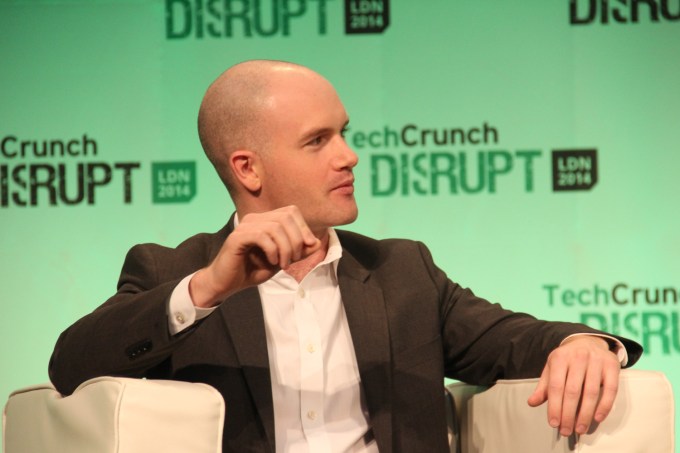
Coinbase CEO Brian Armstrong on stage at TechCrunch DIsrupt San Francesco in 2014

It is fairly easy to dismiss Earn.com as Silicon Valley hyperbole — the fact that Mark Andreesen will answer your email in return for a $100 donation to Black Girls Code may be neat but it is not game-changer — but the company’s product gets interesting when you consider it at scale.

Srinivasan explained how the ability to reach hundreds of domain experts with questions — for example AI engineers about their next career move, or expectations for how the industry matures — starts to become a powerful tool, particularly when the surveyor pays based on results. That’s a very different proposal to existing intelligence services, and it has found success among some tech industry verticals.

Lately, Earn.com has branched out into token-based incentives for tasks, and it launched a platform that allows companies preparing to hold an ICO to airdrop tokens to Earn.com users in exchange for answers, opinions and other feedback.

Writing in a blog post for Coinbase — which interestingly focuses heavily on Srinivasan’s arrival at the company — CEO Armstrong called Earn.com “arguably one of the earliest practical blockchain applications to achieve meaningful scale.”

It’ll be interesting to see what Coinbase does with it, particularly around product integrations.

Perhaps of more significance is what Srinivasan does in his new role.

Acknowledging what many perceive as Coinbase’s conservative approach to cryptocurrencies — it offers users the chance to buy only four — Srinivasan said a large part of his role is to look at emerging technologies.

“There’s a lot of amazing stuff happening,” he told TechCrunch. “Atomic swaps, sharding, plasma, proof of stake, etc, and a big part of my job will be to take all of that stuff, and rank it based on whether we can use it to create new products for our users.”

Another part, he mentioned, will be evangelizing the concept of blockchain itself beyond just the cryptocurrencies as investments. So you can expect him to pop up at events and generally have a wider presence in the media as Coinbase looks to cement its position as a blockchain and crypto leader.

Srinivasan will also continue to be involved with Andreessen Horowitz, and at Coinbase he’ll be part of the company’s recently announced investment arm, Coinbase Ventures.

“Every once in a while, a company comes along that is the start button for a technology,” Srinivasan said, citing companies like Microsoft (Windows) and Facebook and their roles in igniting the next phases of technology development.

“If you control and build that onboarding process, then you can build everything else downstream. If you do it right, then Coinbase goes from the place people build cryptocurrency to the place where blockchain technology is built.”

Coinbase is certainly trying to move in that direction with the fund — which follows the wider trend of crypto companies getting into investment — while the recent hiring of former LinkedIn M&A head Emilie Choi has advanced the M&A piece with three deals announced in 2018 alone.

Note: The author owns a small amount of cryptocurrency. Enough to gain an understanding, not enough to change a life.

16 Apr 2018

Lyft riders tipped 8% more on average in 2017

Lyft drivers have earned more than $500 million in tips to date, Lyft announced today. Since fleshing out tip functionality last June to encourage higher tip amounts, tip averages increased by nearly 8 percent in 2017 compared to 2016.

While it took four years for Lyft to reach $100 million in tips for its drivers, more than half of all the tips were from 2017. Uber, which has been around longer than Lyft, rolled out tipping just last June. As of August, Uber hit $50 million in tips.

Lyft, of course, is not available in nearly as many markets as Uber. Lyft only operates in the U.S. and Canada, while Uber operates in the U.S., Canada, Central and South America, Europe, the Middle East, Africa, East Asia, South Asia, Southeast Asia, Australia and New Zealand. So, more continents and cities means more opportunities for tipping.

Lyft’s tipping update comes shortly after the company shed some light on how much drivers make on the ride-hailing platform. On an hourly basis, Lyft says it’s most certain about how much money drivers make once they’ve accepted and completed a ride (periods two and three). In this type of scenario, Lyft says median earnings are $29.47 per hour, nationwide. In Lyft’s top 25 markets, that’s $31.18 per hour.

16 Apr 2018

Watch SpaceX launch NASA’s latest exoplanet-hunting satellite

SpaceX is set to launch a Falcon 9 rocket today during a 30 second window at 6:32pm EDT. Onboard is NASA’s Transiting Exoplanet Survey Satellite (TESS) designed to find exoplanets. SpaceX said this morning there’s an 80 percent chance of launching today. Following the launch, SpaceX will attempt to recover the Falcon 9 rocket and nose cone by landing the rocket on a drone ship and using parachutes to slow down fairings before they hit Atlantic. SpaceX’s high-speed net boat Mr. Stevens is still in the Pacific.

The livestream is set to begin at 6:00pm EDT.

The satellite onboard uses four cameras to hunt for exoplanets around stars. They measure tiny dips in a star’s brightness that could indicate a planetary body passing in front of the camera’s line of sight. This is called a transit. Mission officials have said that this satellite will likely find thousands of worlds during its two-year mission.

The Falcon 9 used in today’s mission has never been launched before though if it lands successfully, it will be reportedly used in a future mission. This rocket is also the final block 4 version before Tesla starts using block 5 versions with upgraded engines and improvements to increase the reusability of the rocket.

16 Apr 2018

Here’s the ultra-low-light phone camera Sony promised

Sony promised an ‘ultra low-light camera’ during its Mobile World Congress press conference back in February. The off-hand announcement was intended to throw a bit of shade at Samsung’s recent flagship, but ultimately had the unintended consequence of undermining the company’s own newly announced XZ2. But, then, Sony’s never been great when it comes to marketing handsets.

That said, the company didn’t waste a lot of time delivering on that promise. If I had to hazard a guess, I would say that the the Xperia XZ2 Premium was the phone the company would have liked to have led with at the world’s largest mobile show, but just wasn’t fully baked at the time. In fact, the handset won’t actually be arriving until this summer.

When it does hit retail, it will sport a number of improvements over the regular XZ2 (and likely a steep price tag to match). Most notable here are the upgrades to the camera, because, well, Sony. The company says the phone’s capable of capturing ultra-low-light stills with an ISO of up to of 51,200 — with up to 12,800 for video. Press materials issued this morning say the phone accomplishes this by utilizing its dual camera sensors (a new addition with the XZ2 line), utilizing the company’s AUBE signal processor.

That’s a pretty impressive feat, if true, and would certainly surpass Samsung’s recent low-light camera advancements. I can’t say as I’m always excited to try out the latest Xperia handset, but this is one I’ll want to put through its paces. Sony’s certainly wowed us with its camera prowess in the past — in fact, that’s really the main thing Xperias have going for them. U.S. availability, on the other hand, isn’t likely to be one of them.

Other bits and bobs worth mentioning: there’s a 4K HDR display here — pretty much a given on a Sony flagship at this point, along with 4K movie recording. The phone also sports a similarly smooth design to the other XZ2 models — a notable upgrade from the old, boxy design. There’s also a beefy 3540mAh battery on board, along with a Snapdragon 845.

Given Sony’s traditional use of the Xperia line as a funnel for camera technology, I’d say it’s probably safe to expect similar low-light camera to start trickling into other manufacturers’ handsets in the not too distant future.