Year: 2018

13 Apr 2018

Users and advertisers are mostly unfazed by Facebook scandal

Facebook’s downfall has, it seems, been greatly exaggerated — at least according to Facebook . Even with the Cambridge Analytica fallout and subsequent #DeleteFacebook campaigns, the site appears to be largely unfazed. An executive confirmed as much in a recent interview with The Wall Street Journal.

A majority of users haven’t altered their settings and advertisers appear to be staying put. “We have not seen wild changes in behavior with people saying ‘I’m not going to share any data with Facebook anymore,’” Global Marketing VP Carolyn Everson told the site.

And while the company has certainly been put under a microscope by Congress and other lawmakers internationally, Everson adds that Facebook isn’t really anticipating that much will change on the legislative side of the equation, either.

The executive says the company isn’t “anticipating major changes to our overall revenue and business model” as it pertains to the potential ability for users to opt out of the targeted ad model that came under heat during this week’s hearings.

Wall Street analysts are seconding that sentiment. Like users, advertisers don’t exactly appear to be fleeing the site in droves. “It’s inexpensive for the earnings growth trajectory they have. We did a study today that showed engagement hasn’t pulled back,” analyst David Seaburg told CNBC in a recent interview. ”The engagement factor is staying still. Ad buyers are locked in. I think the earnings are going to be good. I think it’s a catalyst for the stock to go higher.”

It’s a stark contrast from the fallout for Cambridge Analytica. The firm whose data mining operations helped set this whole thing in motion has been reeling from the attention. The company has been in a constant state of damage control over social media, and the other day, it replaced a temporary CEO who had been in the role for less than a month.

Of course, Cambridge Analytica isn’t Facebook. Only Facebook is Facebook. Most of us have grown addicted for both our personal and professional needs. It’s hard to remember a time before it, and, as such, it’s difficult to imagine life without it. Besides, how long will our dwindling attention spans really remember what it was that got us all so upset in the first place?

Seaburg calls Zuckerberg “arrogant” in the aforementioned interview. Strangely, it comes off as a compliment of sorts — an indicator of a chief executive who just believes in his product. Zuckerberg might come off as arrogant, but if you were running a company that seemed poised to shrug off two days of congressional hearings, wouldn’t you be?
13 Apr 2018

U.S. iPhone users spent 23% more in apps in 2017, have an average of 45 apps installed

Games, dating apps and streaming services contributed to a rise in consumer spending in iPhone apps last year, according to new data from app store intelligence firm, Sensor Tower. The firm found that U.S. iPhone users spent 23 percent more on in-app purchases in 2017 than they did the year prior – or, an average of $58 per active user was spent on in-app purchases, up from $47 in 2016.

To be clear, this is only on purchases made within an app using Apple’s in-app purchase or subscription mechanisms. It’s not tracking e-commerce purchases – like things users bought in Amazon – or payments made to service providers in an app like Uber or Lyft.

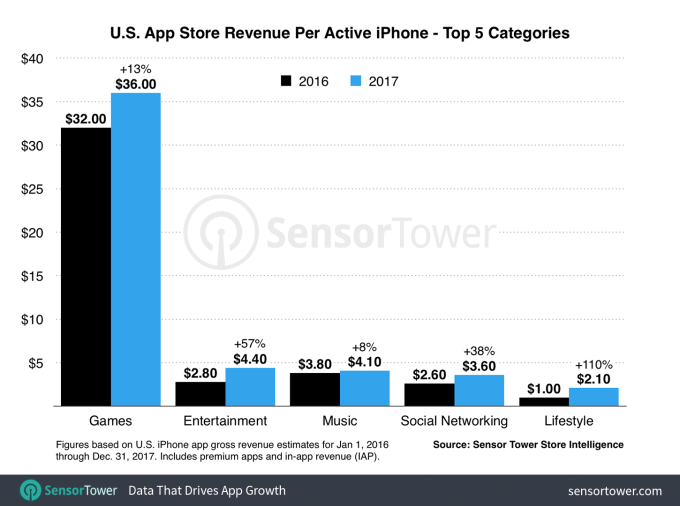
Games were the largest category of consumers spending in 2017, accounting for roughly $36 of the $58 spent per device; or 62 percent of the spending. That’s a 13 percent increase over 2016’s $32 spent.

It’s no surprise that the biggest driver of iPhone spending is games.

The category typically outweighs all others in terms of revenue, not only for paid downloads, but for the ongoing purchases of things like virtual goods, unlocking levels, in-app currency, and the other extra features that mobile games offer. And because people play some types of games for long periods of time – like MMORPGs – they have many opportunities to spend on in-game items.

So while it’s notable that in-app spending in games is up by a few dollars, year-over-year, the more interesting trend is the rise in in-app spending generated by Lifestyle apps and subscription-based streaming services.

Specifically, outside of games, Entertainment apps – which includes streaming services like Netflix, Hulu, HBO NOW, etc. – grew 57 percent year-over-year to reach $4.40 in consumer spending per device. That makes it the largest category of spending outside games.

Music is also another big category for spending, up 8 percent year-over-year to $4.10. Much of what people are paying for in a music app is a subscription for the premium tier of the service, as with Pandora or Spotify. If this category was combined with Entertainment – which is also growing thanks to subscriptions – you’d see that streaming services are now a big factor contributing to the overall rise in U.S. consumer spending in iPhone apps.

But subscriptions to other types of services are growing, too.

Lifestyle apps, led by dating apps like Tinder and Bumble, grew 110 percent from 2016 to 2017 to reach $2.10 in iPhone consumer spending per device.

Spending in social media apps was up by 38 percent, to $3.60 thanks to things like in-app tipping (e.g. Live.me, Periscope, YouTube Gaming), subscriptions (e.g. LinkedIn memberships), and other activity (e.g. call credits in Skype).

Twitch has oddly categorized itself as a “Photo & Video” app, in case you’re wondering where it fits in.

While Sensor Tower’s published report focused on iPhone consumer spending, the company tells TechCrunch that Android spending on Google Play was much lower last year.

“We estimate that for each active Android device in the U.S. last year, approximately $38 was spent on Google Play – on and in apps – so about $20 less than iOS,” said Sensor Tower’s head of mobile insights, Randy Nelson. “That tracks with the disparity in revenue generation we see between the stores outside the per-device level,” he added. “Android users generally spend less on or in apps, Google Play generated about 60 percent of the App Store’s revenue last year in the U.S.”

However, he pointed that Android users have more than one official store to buy from – like the Amazon Appstore or Samsung Store, for example. Some apps also choose not to monetize directly through Google Play, which is an option not permitted on Apple’s App Store.

The increase in consumer spending isn’t the only significant trend Sensor Tower spotted.

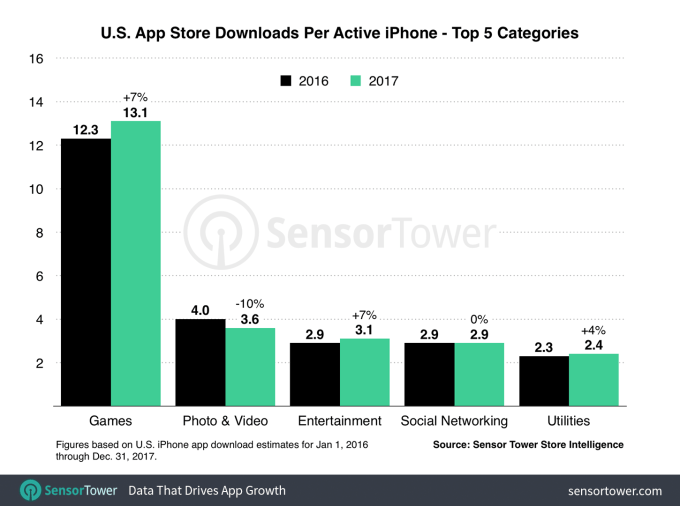
iPhone app installs in the U.S. were up nearly 10 percent from 2016 to 2017, with users installing an average of 4 more apps in 2017 compared with the prior year.

Games, again, were a big source for installs, followed by Photo & Video apps, Entertainment apps, Social Networking and Utilities.

In total, users had an average of 45 apps on their iPhone apps in 2017, the firm found.

13 Apr 2018

Here are the 12 startups in Techstars NYC’s Winter 2018 class

The latest startups to participate in Techstars NYC have spent the past week pitching investors, journalists and the broader New York community.

I swung by the accelerator’s new office a few days ago to meet each team. In a two-hour period, I found myself discussing everything from cryptocurrency to kitchen sanitation to gene sequencing.

Here’s what the companies are up to:

  • Acculis is building collaborative software for construction. One of the key features is a lightweight 3D model viewer that can be on accessed a phone, tablet or web browser. By making it easier to bring this information into the field, the team is hoping to reduce delays and mistakes.
  • Altru helps companies tap their employees for marketing and recruiting. Potential hires can browse through videos of team members answering questions about what it’s like to work at the company, and they can also post questions of their own. CEO Alykhan Rehmatullah suggested that this serves as an “antidote to Glassdoor,” allowing employees to share their authentic opinions in a more controlled and positive way.

The Clear Cut

  • The Clear Cut offers a concierge service for consumers to design their own diamond engagement rings. The idea is to offer a personalized experience and product at significant savings compared to the big-name jewelry stores. Eventually, the company could expand into other types of jewelry.
  • kpiReady is building tools for startups and small businesses to track their most important metrics. It’s offering data collection as well as visualization — so it should be quick and easy to create presentations and reports about how the business is doing. Investors could also use this to track how the startups in their portfolio are doing.
  • Kyso allows users to share their data science models. That means data scientists have to spend less time building models from scratch every time they’re performing a new study. It also includes tools for visualizing the results of those models.
  • Loom Network is a blockchain infrastructure company. The goal is to help developers create “Twitter- or World of Warcraft-scale apps on top of Ethereum,” with an initial focus on bringing game developers onto the platform.
  • One Step Software is building patient monitoring software for sober group homes. This can help family members keep track of how residents are doing. And on an aggregate level, it helps the homes see which approaches are succeeding.
  • PathSpot has built a device that can scan restaurant employees’ hands and detect the pathogens that can cause food-borne illness. If an employee fails the scan, they’re asked to wash their hands and then try again. And the scan itself should only take two seconds.

Rootine

  • Rootine uses customers’ genetic data to create a daily regimen of nutritional supplements. These supplements are delivered in the form of “micro-beads” that can be added to foods like yogurt. The company already has 1,500 paying customers in Europe and is looking to expand to the United States.
  • Streamline Genomics aims to help clinicians and researchers use genomic sequencing. CEO Josette-Renée Landry said that 40 percent of patients with cancer would have received more effective treatment if their tumor had been sequenced. But while the cost of the actual sequencing has fallen, analyzing the “terabytes of data” remains a barrier. So Streamline’s software handles that analysis.
  • TypingDNA offers a new way to verify your identity, potentially replacing cumbersome two-factor identification methods like sending a temporary code to your phone. Instead, it analyzes the unique patterns of how users type. The company recently launched a Chrome extension.
  • Vertoe helps you store your luggage by leaving it at nearby businesses. If you’re checking out of an Airbnb, or if you’re heading to a concert or sporting event where you can’t bring a large suitcase, you can open up Vertoe, find a nearby location and pay just $5.95 per item per day. The company currently has more than 70 partner locations across New York City.
13 Apr 2018

After bashing Amazon deals, Trump orders investigation of U.S. Postal Service

The president issued an executive order after hours last night, aimed at evaluating the U.S. Postal Service. Citing the mail service’s “unsustainable financial path,” Trump’s order demands a “thorough” task force evaluation of the USPS’s finances and operations.

The service has been a long time talking point for Trump, with Twitter attacks dating back to 2013, when he bemoaned a planned end of Saturday mail delivery. Of late, however, the Postal Service has seemingly been caught in the crossfire of his single-minded attack on Amazon.

Back in December, Trump called the USPS out on Twitter once again, saying it was “losing many billions of dollars a year, while charging Amazon and others so little to deliver their packages, making Amazon richer and the Post Office dumber and poorer?”

Of course, it’s worth noting that Amazon’s dealings with the USPS aren’t so straightforward.

While, as The New York Times notes, the executive order doesn’t single out Amazon by name, Trump has been ramping up attacks on the online retail giant. Much of that anger appears to be directed at founder Jeff Bezos, who also happens to own The Washington Post, a paper that hasn’t always painted the president in flattering light.

In June, he combined two of his favorite Bezos targets into a single, camel-cased hashtag, writing, “The #AmazonWashingtonPost, sometimes referred to as the guardian of Amazon not paying internet taxes (which they should) is FAKE NEWS!”

Honestly, I could put a bunch of other examples in here, but it’s probably easier to just link to this story Taylor did, collecting all of the times Trump has used Twitter to take on Jeff Bezos. Get comfortable, because it’s a long list. The full executive order, meanwhile, can be viewed here.

13 Apr 2018

The Roadie 2 tuner ups your guitar game

The first Roadie tuner was a modern marvel. An automatic guitar tuning system, the little device connected to your phone to listen to your guitar strings and then set them to the proper tuning using an internal motor. The new model, the $129 Roadie 2, is even cooler.

I’ve been using the Roadie 2 for a few months now and I’m hooked. I was never a good player or tuner – my ear wasn’t quite right and even with tools I couldn’t get my guitars exactly in tune. Now, however, with the Roadie 2 I just place the winding end on the pegs and press a button. A quick pluck of the string and you’re tuned in seconds.

The Roadie 2 is completely self-contained and charges via USB-C. It has a built-in vibration sensor that can also asses the current string and change the tuning accordingly. The system also allows you to add multiple stringed instruments – you can set up profiles for your electrics and acoustics and even your banjo . You can also tune them to standard or even open tunings. The high-torque motor spins the pegs quickly and effortlessly and you can wind and unwind your instruments as well.

The team kickstarted the Roadie 2 last March and began shipping this year. I’ve been using it to tune my guitars since I got it and it’s worked quite well except for one unfortunate incident while winding – and overwinding – a kid’s guitar. An app included with the package lets you control the instruments and the tunings.

I know some guitarists can tune to the sound of overhead fluorescent lights and still others are OK with a quick listen to a digital tuner. I’m neither of those. The Roadie 2, then, is a godsend for those of us cursed to the never-ending torment of being really bad at guitar. At least now I can be really good at tuning.

[gallery ids="1621701,1621702,1621703,1621704"]
13 Apr 2018

Comcast will start bundling Netflix into its cable subscriptions

Today’s development in weird potential frenemy relationships is an interesting one with Comcast now planning to bundle Netflix into its cable subscriptions, the companies announced today.

Known as the original cord-cutting service, Netflix serves as a hub for not only a ton of original content, but also a huge catalog of movies and shows that offer a near-endless flow of entertainment for the average user for less than $15 a month. Comcast added Netflix to its X1 interface starting in 2016, but it appears that the success of this among traditional cable subscribers may have encouraged Netflix to begin working more closely as it tries to tap more and more consumers.

The companies said they will expand that existing relationship by bundling Netflix into the overall subscription in new and existing Xfinity packages. Netflix’s subscriber growth — the primary driver of its value as a public company — continues to surge, and it appears that this could be another piece in its tool kit to keep that engine humming. Those cable packages already include an increasing breakout of diverse services that allow for streaming outside of the over-the-top experience, like HBO Go and ESPN, and this offers another streaming service on-the-go for users.

By tethering to additional over-the-top services, Netflix has a chance to woo subscribers that might otherwise just stick with their existing service providers and bake itself directly into that experience. These kinds of cross-platform subscriptions are becoming a little more common and a big driver of user growth — for example, Spotify works with Hulu to create a multi-service subscription that ends up, on paper, with more users for both. Getting that taste may also encourage users to eventually graduate onto the service directly and drive additional revenue for those companies.

Whenever Netflix reports its quarterly earnings, all eyes are typically on that subscriber number. It’s the leading indicator for the company’s growth, even as it spends more and more money on original content to acquire subscribers. But by getting into the cable bundle, Netflix can find a way to get that content into the hands of subscribers that may one day cut the cable as more and more streaming options emerge for the content they typically want. ESPN is already dipping its toes into the streaming side with ESPN+, which while limited signals an opportunity to break out and attract those consumers that aren’t interested in a cable bundle.

The bundle, which will be available to new and existing Xfinity customers, will be included in its cable TV, phone and internet plans. It seemed throughout the lifetime of Netflix’s streaming expansion that it would be the harbinger for cord-cutting, but now finds itself fitting with existing consumers that already are fine with a cable subscription.

13 Apr 2018

Podcasting app Anchor can now find you a cohost

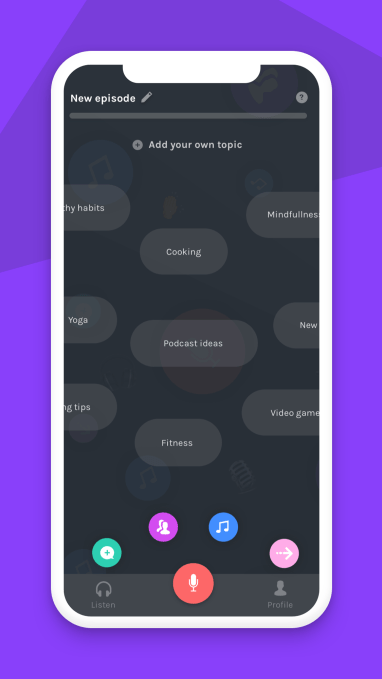
Fresh off its relaunch as an app offering a suite of tools for podcasters, Anchor today is rolling a new feature that will make it easier for people to find someone to podcast with: Cohosts. As the name implies, the app will now connect you – sometimes immediately, if people are available – with another person who’s interested in discussing the topic you’ve chosen.

The result is a more engaging podcast where a conversation is taking place between two people, rather than a monologue.

“We give people the ability to choose a topic that they want to talk about on their podcasts, and the product will get to work trying to match you up with someone who wants to talk about the exact thing,” explains Anchor CEO Mike Mignano.

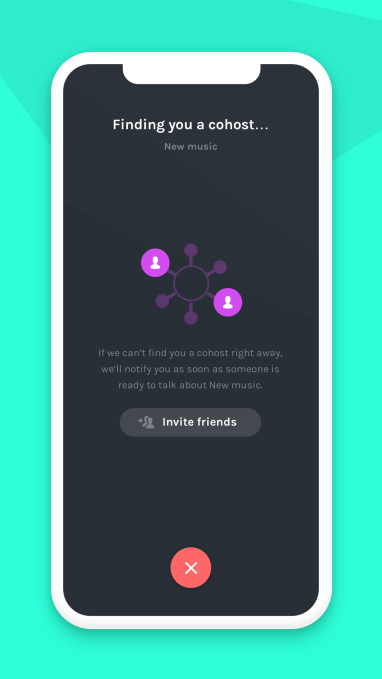
At first, Anchor will try to match you with someone who’s also currently in the app, he says. If it’s not able to do that, then it will notify you when it finds a match through an alert on your phone.

“We’ve developed an intelligent matching system to make sure there’s a high likelihood that you get matched up with someone that wants to talk at the same time,” Mignano notes.

The topics users select can be either broad – like politics – or narrow and hyper-specific, the company says.

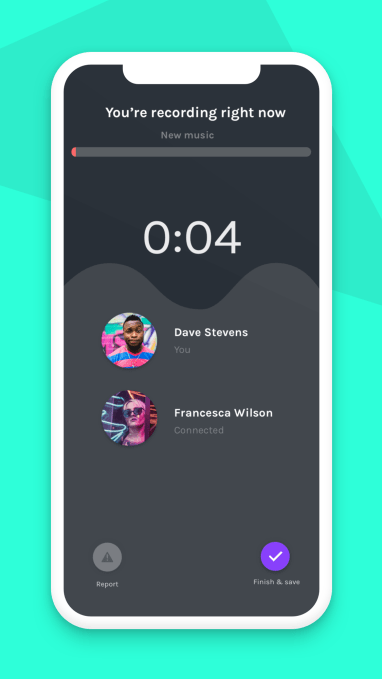
One you’ve been offered a connection to a cohost, you have 30 seconds to meet in the app and decide how you want to get started. The recording will then start automatically, and will continue for up to 15 minutes. Both users will receive a copy of the recording and can choose to publish it to their own podcast right away, or save it for later.

After the recording, podcasters rate each other with a simple thumbs up or down. (If down, you’ll need to select a reason in case Anchor needs to step in and review bad behavior. Bad actors will no longer be permitted to use the service.)

If both give each other a thumbs up, though, they’ll automatically be favorited on each other’s account, so they can find each other again. Next time they want to record, they’ll have the option to team up through Anchor’s “Record with Friends” feature, where there’s no time limit.

Those who are highly rated will also get better ranked in the matching algorithm, Anchor notes.

If a podcaster has a particular topic in mind – like wanting to discuss Stephen King novels, for example – Mignano continues, they’re very likely to return to the app when they get a match, the team found during testing.

The Cohosts feature was beta tested with a small subset of users prior to today’s launch, but the company declines to share how many users tested it or how many people are currently using the app to create podcasts.

However, the app’s big makeover which took place in February basically turned Anchor into a different kind of app – so it’s still establishing a new user base.

While before, the app was focused on recording audio, Anchor 3.0 is meant to be a podcasting suite in your pocket. The new version includes recording features with no time limits, a built-in library of transition sounds, tools for adding music, support for voice messages (a call-in like feature), free hosting, and a push button experience for publishing to share your podcast to all the top platforms.

Matching cohosts in teams of two may just be the start.

Mignano hints that a future version of Anchor may include more flexibility on the number of cohosts. “You can imagine us doing something like, if the user specifies the topic, they can indicate how many people they want to have a conversation with,” he teases.

The new feature recalls Anchor’s roots as a platform for social audio.

“It’s something we’ve been thinking about for a while, says Mignano. “If you think back to Anchor 2.0 – and 3.0, as well – we’ve always wanted to make Anchor a little more interactive than a standard podcasting platform. To us, democratizing audio doesn’t just mean making it easier to create. It also means modernizing the format by making it more shareable, easier to interact with, short form, etc.,” he says.

The Cohosts feature is rolling out today in Anchor’s app.

13 Apr 2018

Google is testing self-destructing emails in new Gmail

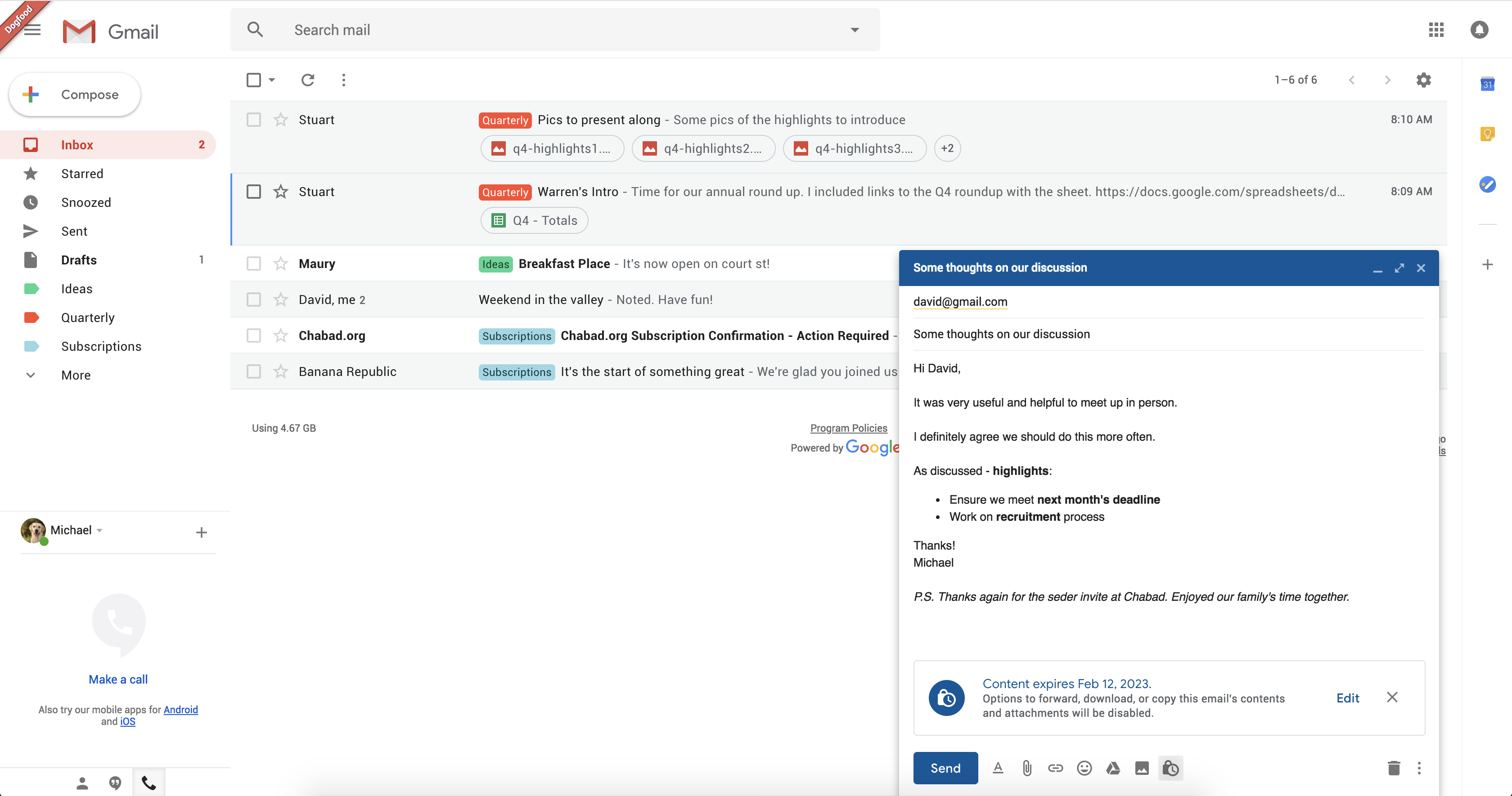
Google is working on a brand new design for the web version of Gmail. Yesterday, I published screenshots of the new design. TechCrunch’s tipster Chaim also discovered an interesting new feature in the new Gmail. You’ll soon be able to send expiring emails.

Working on an email service is hard as you have to be compatible with all sorts of email providers and email clients. But it doesn’t seem to be stopping Google as the company is now evolving beyond the simple POP3/IMAP/SMTP protocols.

Based on those screenshots, expiring emails work pretty much like expiring emails in ProtonMail. After some time, the email becomes unreadable.

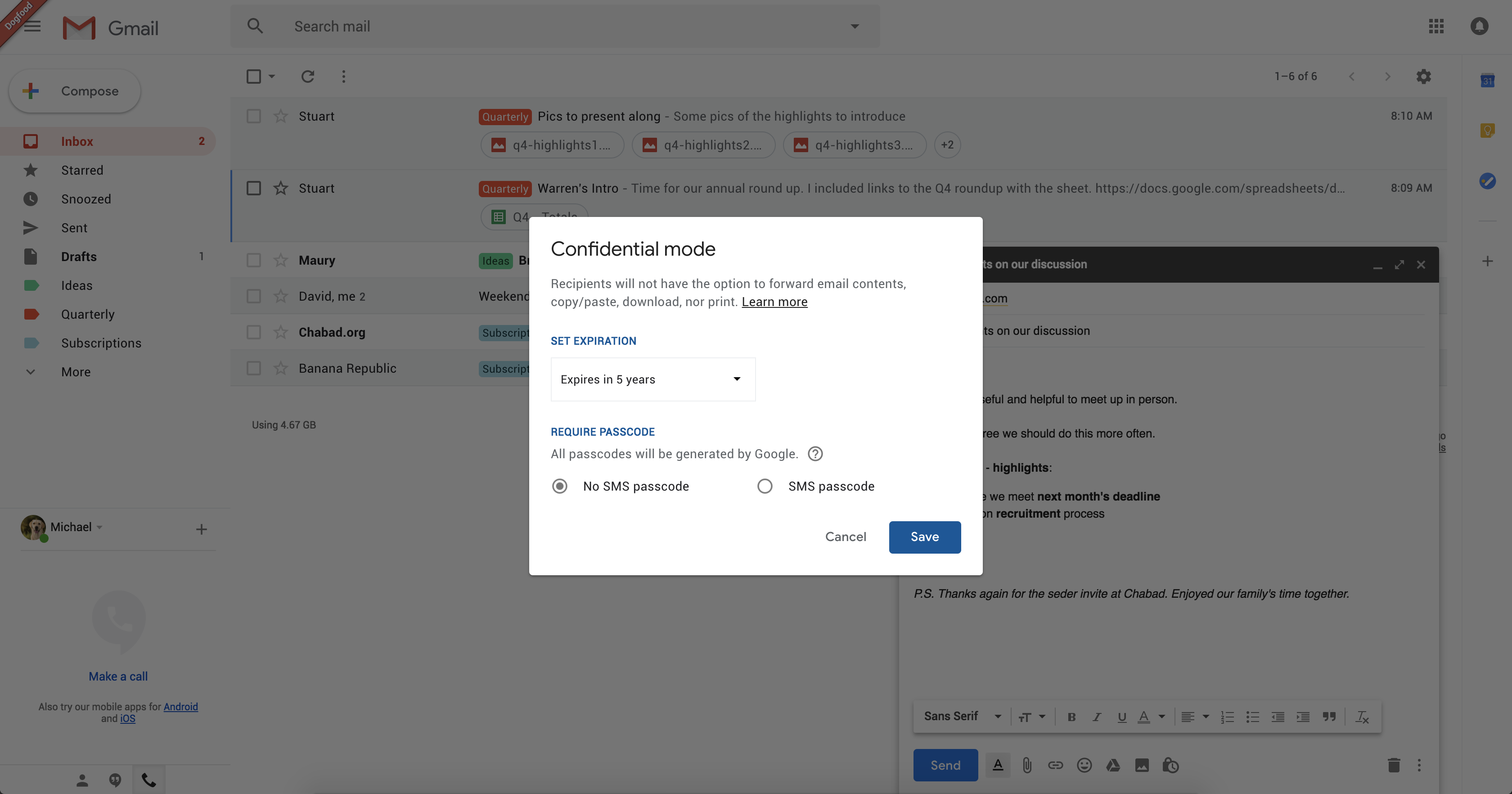
In the compose screen, there’s a tiny lock icon called “confidential mode”. It says that the recipient won’t be able to forward email content, copy and paste, download or print the email.

You can configure the expiration date so that your email disappears after 1 week, 1 month, multiple years, etc. You can also ask your recipient to confirm their identity with a passcode sent via text message. This sounds like a great way to associate email addresses with phone numbers and improve Google’s ads.

When our tipster clicked on “Learn more”, it opened Google’s help articles but the page was not found. The feature isn’t ready for prime time just yet.

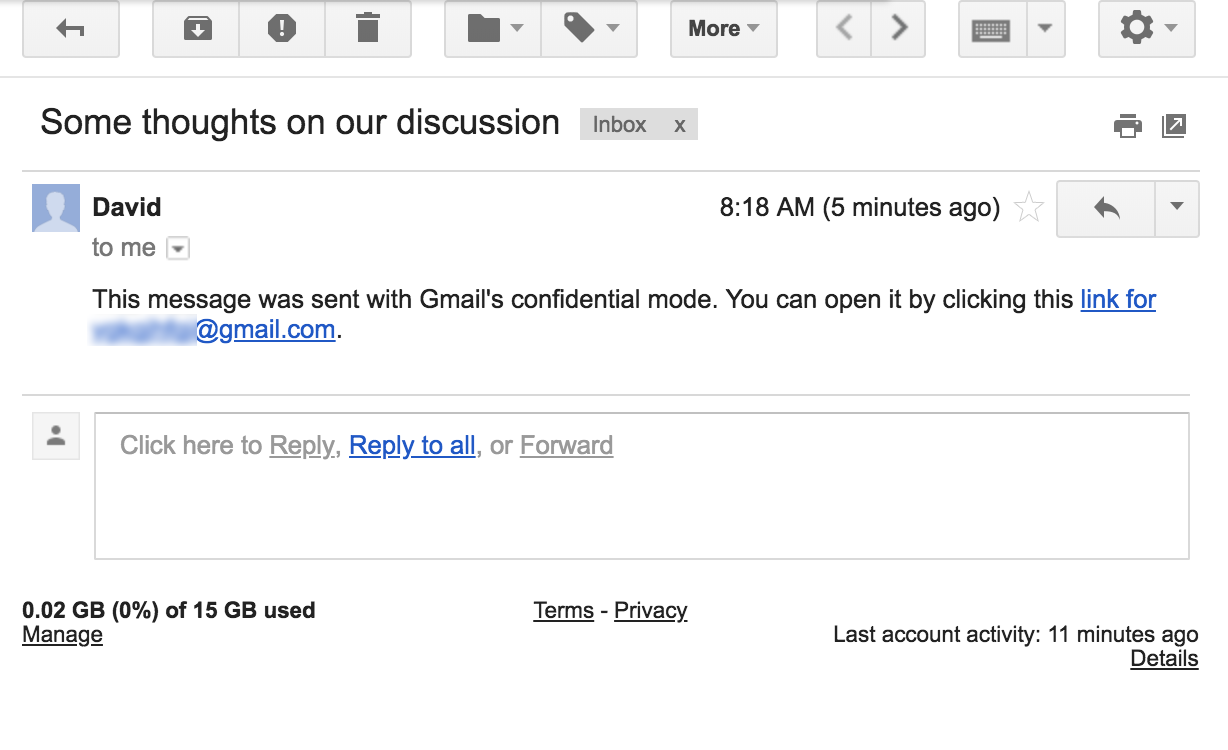
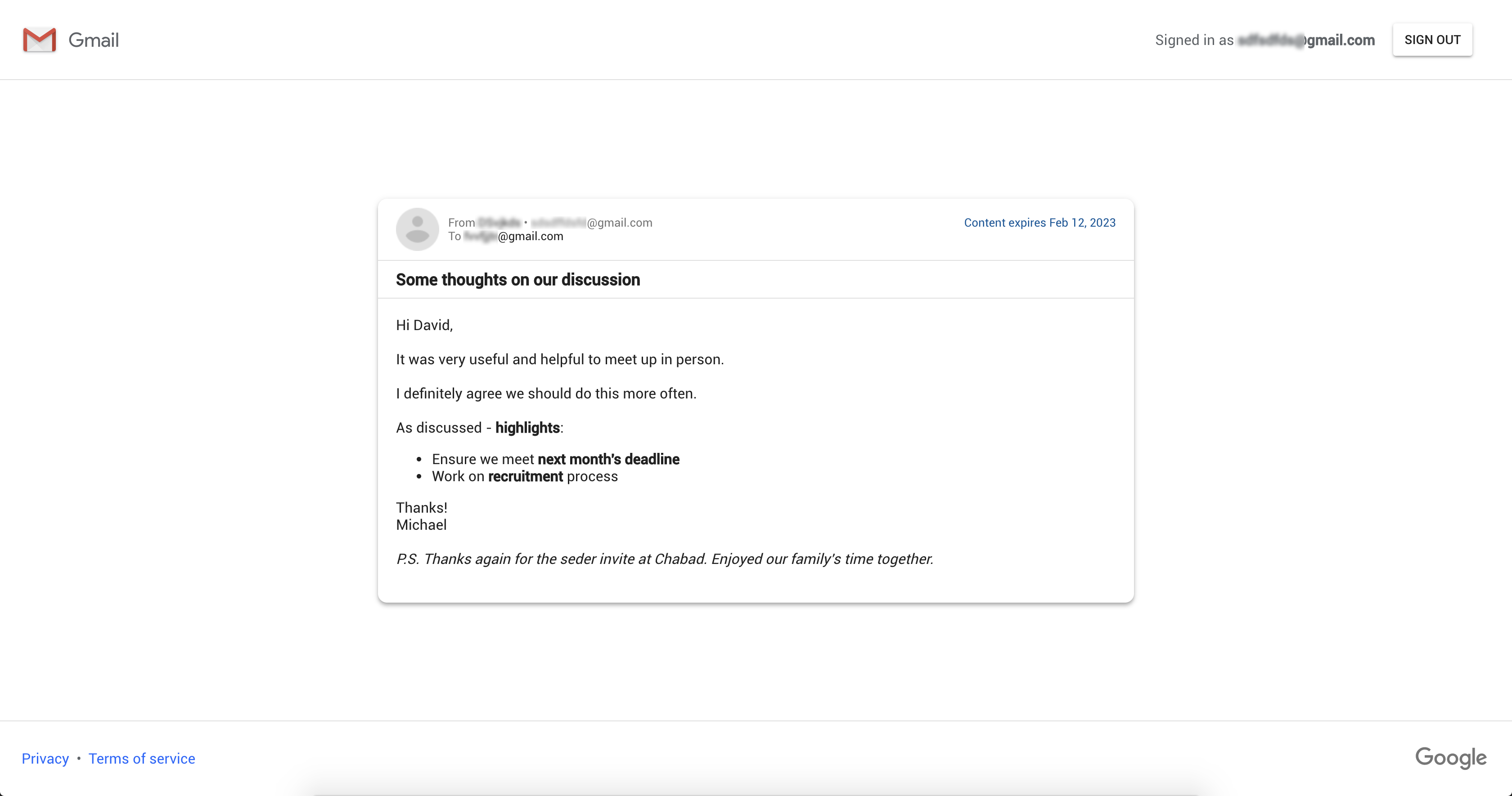
On the recipient’s side, the person was using the existing version of Gmail and received a link to view the confidential email. The recipient had to log into their Google account once again to view the content. When viewing the confidential message, copy and paste as well as the print feature were disabled — it didn’t stop our tipster from taking a screenshot of the email though.

It’s unclear if this feature is going to be compatible with non-Gmail users as the company asks you to confirm your Google account to view the confidential message. It’s also unclear if the integration is going to work better in the future when everybody is using the new Gmail.

For instance, when a ProtonMail user sends an expiring message to another ProtonMail user, it looks like a regular email in the inbox. After the message expires, it is automatically deleted from the inbox and the sender’s outbox.

In Gmail’s current implementation, it sounds like Google simply generates an email with a link. The message behind the link disappears after a while, but not necessarily the intermediate email.

It’s also worth noting that Google doesn’t mention end-to-end encryption anywhere. A “confidential” message doesn’t have to be encrypted. It’s likely that Google could still see the content of that message and comply with warrants. Once again, Google said that the new Gmail is going to come out in a few weeks. Confidential emails could be released at the same time or at a later date.

13 Apr 2018

PullRequest pulls in $8M Series A just months after scoring seed round

PullRequest has been on a whirlwind lately, but it’s the kind that any startup would likely welcome. The company was in Y Combinator last August just trying to learn the startup ropes. By December it had scored a $2.3 million seed round — and it’s keeping it going. Today the company announced an $8 million Series A led by seed investor Google Gradient Ventures, who also led the seed round.

Today’s investment includes from participation from other seed investors too including Y Combinator, Fika Ventures, Lynett Capital and Defy Partners. That brings the total raised to $10.3 million in just a few months.

What is warranting such positive investor attention? PullRequest is working to solve a big developer pain point. As development cycles speed up, the part of the process that tends to suffer is code quality assurance (QA). As company founder and CEO Lyal Avery told TechCrunch last August, it’s using on demand reviewers to solve the problem.

“We offer code review as a service. As developers push code, we have on-demand experts that review it [before it gets published]. This allows them to move forward without resources constraining the operation,” company founder Lyal Avery told TechCrunch.

When the company got the seed round in December, Avery said the goal is to begin to bring an element of automation and intelligence to the platform and he recently said that the company is continuing the move in that direction.

In the age of big data leaks, Avery points out that his platform not only finds bugs and issues in the code, it could help prevent data leaks like the ones we’ve seen lately from Under Armour and others (they are simply the flavor of the week). In fact, he claims they have found vulnerabilities that prevented such leaks recently (although he wouldn’t say who the client was for obvious reasons).

Anna Patterson, managing director at lead investor Gradient Ventures, sees a powerful combination in on-demand and code review. “PullRequest is working at the intersection of better code and the future of work – leveraging AI to make code reviews more accessible, so that enterprises, of all scales, can adopt this methodology,” she said in a statement.

Code review and bug tracking remain a hot startup area as companies struggle to fit this kind of review into increasingly fast development cycles. Back in the day, it was easy to include QA in the development workflow because timeframes were so long. As the timeframes become more and more compressed, a company like PullRequest is filling in the gap — and investors are noticing.

13 Apr 2018

Exit scammers run off with $660 million in ICO earnings

A Vietnamese cryptocurrency company Modern Tech launched an ICO for its Pincoin token, raising $660 million from approximately 32,000 people. The company first ran the Pincoin ICO, promising constant returns to investors, and then launched another token, iFan (a social network token for celebrities). Picoin investors first received cash from their investment and then the team began paying out rewards to Pincoin investors in iFan tokens.

Then the team disappeared.

This so-called exit scam could be that largest in recent memory and is also indicative of what’s to come in the ICO space. The team of seven Vietnamese nationals seem to have left the country while scammed investors massed outside the company’s old headquarters.

From Tuoi Tre news:

In fact, the real mastermind behind these projects is a team of seven Vietnamese nationals, who have held different conferences in Hanoi, Ho Chi Minh City and even remote areas to lure investors.

Investors have been told that they would enjoy a profit rate of 48 percent a month from their initial investment, and recoup all investments after four months. People would also be rewarded with an eight percent commission for every new member they have introduced to the network.

Pincoin was particularly unique in that it offered bonuses for bringing other people into the program, a tactic that might sound familiar. The scammers paid out in cash until January when they began sending iFan tokens. Then, last month, the team vacated their fancy offices leaving only an oddly well-made – if incomplete – website in its wake. Taking a closer look at the site we find a model of obfuscation. The mission – “The PIN Project is about building an online collaborative consumption platform for global community, base on principles of Sharing Economy, Blockchain Technology, and Crypto Currency” – seems on par with other pie-in-the-sky solutions but there is no mention of any founders or advisors and even their fancy, multi-lingual white paper, has no clear founder information. In short, the team paid a great deal for a very nice website and convinced thousands of people it was legitimate.

According to Viet Bao, a team consisting of Bui Thi My Ngoc, Ho Phu Ty, Ho Xuan Van, Luong Huynh Quoc Huy, Luu Trong Tuan, Nguyen Duc Trong, Nguyen Trung Hieu, and Vu Huu Loi led Pincoin and iFan from zero to multi-millions in a few months while claiming they were representing products from Singapore and India. “To formalize the mode of operation, ifan and Pincoin authorized their company as legal representative in Vietnam with tax code 0314707223. Modern Tech then held the event in Ho Chi Minh City Minh and Hanoi to raise capital from investors,” Viet Bao reporter.

One interesting bit of chicanery is this screen from the iFan page. Near the middle of the page we find information that the token is based on the Ethereum platform. The page shows the price and rating of the cryptocurrency, suggesting that the Ethereum is directly related to the iFan price.

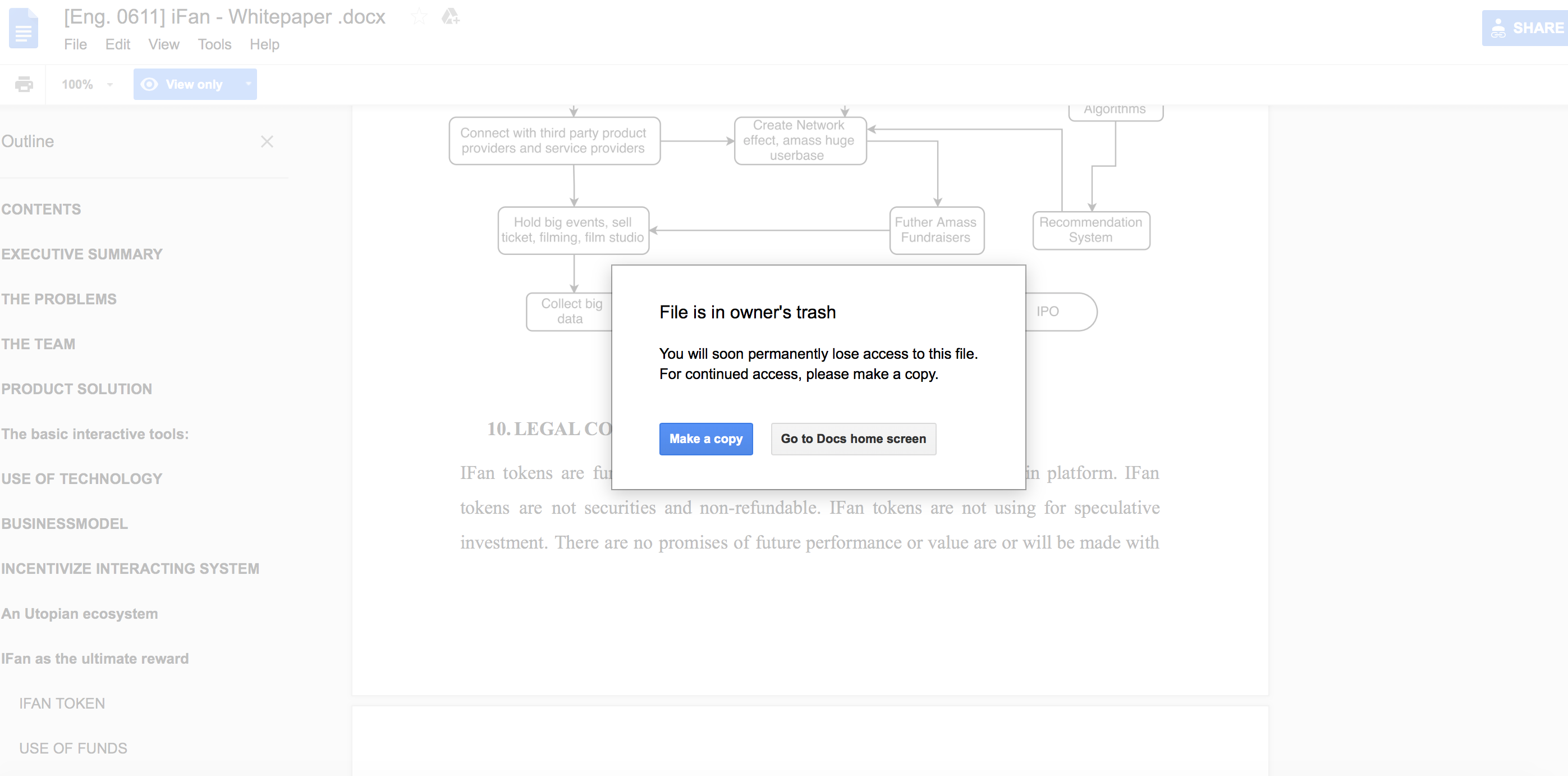
And this popped up when I visited the project’s white paper:

Again we find that the current, unregulated, ICO market is the most interesting system for parting fools from their money in recent history.