Year: 2018

12 Apr 2018

Tesla says it willingly withdrew from NTSB investigation

Tesla says it willingly withdrew from the party agreement with the National Transportation Safety Board, adding that the NTSB is more concerned with “press headlines than actually promoting safety,” a Tesla spokesperson told TechCrunch via email.

“Last week, in a conversation with the NTSB, we were told that if we made additional statements before their 12-24 month investigative process is complete, we would no longer be a party to the investigation agreement,” a Tesla spokesperson said in a statement to TechCrunch. “On Tuesday, we chose to withdraw from the agreement and issued a statement to correct misleading claims that had been made about Autopilot — claims which made it seem as though Autopilot creates safety problems when the opposite is true.”

This comes after the NTSB said it revoked Tesla’s party status in the investigation regarding the fatal crash involving one of Tesla’s Model X cars. The NTSB said it did so because Tesla, without permission from the NTSB, relayed information to the public regarding the investigation.

Tesla went on to note the prevalence of automotive fatalities in the United States in comparison to fatalities involving cars with Autopilot. Tesla says for every 320 million miles cars equipped with Autopilot drive, there is one fatality, including known pedestrian fatalities. That’s compared to one fatality for every 86 million miles driven for all vehicles, Tesla said.

“If you are driving a Tesla equipped with Autopilot hardware, you are 3.7 times less likely to be involved in a fatal accident and this continues to improve,” the spokesperson said.

Tesla also alleges its “clear in our conversations” with the NTSB that it cares less about safety and more about press headlines.

“Among other things, they repeatedly released partial bits of incomplete information to the media in violation of their own rules, at the same time that they were trying to prevent us from telling all the facts,” the spokesperson said. “We don’t believe this is right and we will be making an official complaint to Congress. We will also be issuing a Freedom Of Information Act request to understand the reasoning behind their focus on the safest cars in America while they ignore the cars that are the least safe.  Perhaps there is a sound rationale for this, but we cannot imagine what that could possibly be.”

Tesla also took time to note how the NTSB is an advisory body, rather than a regulatory one, and how Tesla has a “strong and positive relationship” with the National Highway Traffic Safety Administration (NHTSA)

“When tested by NHTSA, Model S and Model X each received five stars not only overall but in every sub-category,” the Tesla spokesperson said. “This was the only time an SUV had ever scored that well. Moreover, of all the cars that NHTSA has ever tested, Model S and Model X scored as the two cars with the lowest probability of injury. There is no company that cares more about safety and the evidence speaks for itself.”

I’ve reached out to the NTSB and NHTSA. I’ll update this story if I hear back.

12 Apr 2018

Watch the new trailer for the 15-year Rooster Teeth documentary

Being an online video star might seem cool or even glamorous these days, but Burnie Burns, co-founder and chief creative officer at Rooster Teeth, can remember when that wasn’t the case.

Rooster Teeth, which is behind the popular web series Red vs. Blue, is turning 15 years old this month. (The studio was acquired by Fullscreen a few years ago.) And Burns has been looking back at its history as part of the upcoming documentary Why We’re Here: 15 Years of Rooster Teeth.

He acknowledged that nowadays, anyone in the business is competing with “an enormous noise,” but at the same time, Burns said, “There’s the misconception that because no one was doing this when we got started, that made it easier. It’s really difficult to go into a place where no one else is and no one else cares what’s going on there.”

He recalled that in the studio’s early days, he would tell people about his work and realize, “Home video was a dirty word, and online video was beneath it.”

The documentary was directed by Mat Hames, and it allows Burns and his co-founder Matt Hullum to revisit many of their old haunts, including the bedroom where Burns uploaded the first episode of Red vs. Blue, “Why Are We Here?”

For Rooster Teeth fans, Burns promised footage that has never been seen before, as well as a recounting of the history that’s as honest as they could make it without violating nondisclosure agreements.

“I think we almost have an obligation to show what things were like back then,” he said.

And even if you haven’t been following the company through the years, Burns said the film provides an overview of how online video has evolved. After all, when Red vs. Blue launched, YouTube didn’t exist, and Burns said the documentary process has helped him understand “how short the memory of the Internet is.”

Rooster Teeth published a teaser for Why We’re Here last week, and today it’s launching the official trailer. The documentary will be released exclusively on the studio’s subscription video service FIRST on April 20.

12 Apr 2018

Are hardware makers doing enough to keep Android phones secure?

For all the good of Android’s open-source approach, one of the clear and consistent downsides is that the onus to issue software updates falls on the manufacturer. That can mean frustration for those waiting for the latest and greatest feature updates — and in some cases, it can put your phone at risk with delayed or missed security updates.

A pair of researchers at Security Research Labs recently shared a study with Wired highlighting some of these risks. The team’s findings are the result of testing 1,200 Android handsets from all the major manufacturers over the course of two years, examining whether manufacturers had offered the security patches as advertised.

According to SRL, missed security patches were discovered on a wide range of different handsets across manufacturers. Sony and Samsung were both flagged as having missed some security patches — in some cases in spite of reporting that they were up to date. “It’s almost impossible for the user to know which patches are actually installed,” one of the researchers told the site.

Xiaomi, Nokia, HTC, Motorola and LG all made the list, as well, while TCL and ZTE fared the worst in the study, with, on average, not having installed more than four of the patches they claimed to have installed on a given device.

In a statement provided to TechCrunch, Google pointed to the importance of various different means used to secure the Android ecosystem. The company believes that the SRL findings might not tell the full story when it comes to keeping devices secure.

“We would like to thank Karsten Nohl and Jakob Kell for their continued efforts to reinforce the security of the Android ecosystem,” the company writes. “We’re working with them to improve their detection mechanisms to account for situations where a device uses an alternate security update instead of the Google suggested security update. Security updates are one of many layers used to protect Android devices and users. Built-in platform protections, such as application sandboxing, and security services, such as Google Play Protect, are just as important. These layers of security—combined with the tremendous diversity of the Android ecosystem—contribute to the researchers’ conclusions that remote exploitation of Android devices remains challenging.” 

The company also pointed us to this year in review post, which sheds a bit more light on the matter.

12 Apr 2018

Amazon finally opens up Prime Wardrobe to more customers

Amazon’s Prime Wardrobe appears to be getting ready to launch. The retailer’s “try before you buy” shopping service, first announced in June 2017, aims to challenge incumbents in the market like Stitch Fix, Trunk Club, Wantable, and others. The service has quietly remained in an invite-only beta since last year, and Amazon claims that’s still the case. However, a recent flurry of tweets, including – ahem, those from an Amazon account and people who worked on the project – beg to differ.

Unfortunately, the Amazon staffer’s tweet was deleted after we asked Amazon about it. It had read: “Amazon Prime Wardrobe is officially launched! Hooray! It’s been a fun project to work on.” Before we could screengrab the tweet, it was gone. But here it is in Chrome’s history, if you’re curious:

Amazon initially denied that anything had changed with regard to Prime Wardrobe, saying it was still in invite-only status. But when we shared the tweets, the spokesperson clarified That Amazon’s Fashion team has now extended the program to more Prime customers.

Customers can “shop from our great selection of brands for women, men, kids and baby,” the spokesperson said.

A number of Amazon Prime shoppers on Twitter do seem to realize they’ve just been let in:

Amazon declined to say how many people were testing it prior to now, or how many were added in this expanded test.

But Amazon surely can’t take much longer to roll out the program more broadly, given that it’s pushing a year since the original announcement. And during that time, Stitch Fix has IPO’d and Gwynnie Bee launched a subscription clothing box platform for other retailers, which has been adopted by Anne Taylor and New York & Company. It’s time for Amazon to step up, too.

Prime Wardrobe could be a strategic advantage for Amazon in the online apparel market as well as a means to boost Prime subscriptions.

The service has been designed to solve one of online shopping’s biggest challenges in the apparel space – it’s hard to tell how something will fit – or if it looks good – from an online photo or video. Models don’t have the same proportions as most shoppers do, for starters, and clothing manufacturers all cut their sizes differently. Plus, you often don’t know – until something is on your body – how the fabric feels, if it hangs well, if it’s too tight or too loose in some spots, too short or long, or how it looks as part of an ensemble.

In the past, that’s led some people to avoid online shopping for apparel. Despite this, apparel is one of the fastest-growing categories online – that’s why Walmart bought ShoeBuyBonobos and ModCloth, for example.

Companies like Stitch Fix have addressed the challenges with buying apparel online by sending shoppers a curated selection of clothing and other accessories which consumers can try on at home, then keep or return using an enclosed prepaid shipping bag.

Prime Wardrobe skips the individualized styling service – which frankly, hasn’t been that great at Stitch Fix, in my experience after over a year using the service. Stylists blatantly ignored requests, and the service never seems to adapt that well based on buying behavior. The “personalization” may exist, but it feels like smoke and mirrors. In reality, most of Stitch Fix’s clothing is on-trend or classic, so generally inoffensive to most shoppers. It sells. But really, the ease of home try-on and returns is what’s best. These aspects are Prime Wardrobe’s focus, too.

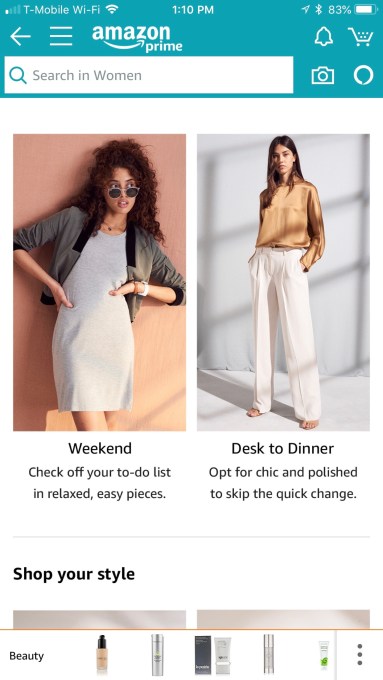
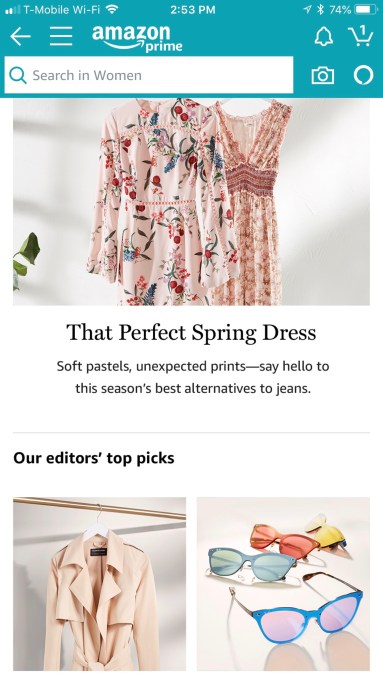
To use Prime Wardrobe, Prime members shop a dedicated selection of items on Amazon’s site, where they’ve been organized into high-level categories like Women, Men, Girls, Boys, and Baby.

From each section, items are further organized by style (trendy, romantic, sporty, casual, etc.), occassion (work, weekend, etc.), and more. There are also featured selections like the “Editor’s Top Picks,” and seasonal collections like “That Perfect Spring Dress,” along with “New Arrivals,” “Brands We Love,” and other grouping that make it easier to find things you may like.

As far as I can tell after a bit of poking around, Amazon doesn’t heavily favor its own private labels in Prime Wardrobe’s collections. Its own labels are simply mixed in with other well-known brands, like Tommy Hilfiger, Adias, Guess, Levi’s, Calvin Klein, Nine West and many others.

You have to choose at least 3 items before you can ship yourself a box of clothing, shoes and accessories, then can try items on at home for 7 days before you’re charged. The box holds 8 items max.

[gallery ids="1621341,1621340,1621339,1621338,1621337,1621336,1621335,1621334"]

A prepaid UPS label is included, so you can return items you decide not to keep. A promotion is currently offering $20 off when you buy $200 or more, which takes the place of the $20 “styling fee” Stitch Fix charges that’s then credited back when you buy from your box.

Although Prime Wardrobe is only for Prime members, items don’t ship in 2 days like Prime. Because boxes include multiple pieces, they may take four to six days to ship.

While Prime Wardrobe is now available to more people, Amazon didn’t say when the service will launch publicly.

Do you have Prime Wardrobe? Share your thoughts with me at sarahp@techcrunch.com.

12 Apr 2018

Arcade fame turns to infamy as Billy Mitchell’s record-setting Donkey Kong score is invalidated

The record-setting score that settled the Donkey Kong arcade rivalry, made famous by the documentary The King of Kong, has been invalidated by Twin Galaxies, the de facto arbiter of arcade world records. What’s more, Billy Mitchell, the occasionally controversial player who set the scores, has been permanently banned from consideration for future records.

It’s a huge upset that calls into question decades of history. Will other similarly disputed scores get the ax? Are any old-school arcade legends safe?

Before anything, it should be noted that although this sounds like kind of a random niche issue, the classic gaming scene is huge and millions follow it closely and take it very seriously. Breaking a high score on a 30-year-old game or shaving a quarter of a second off a record time can and will be celebrated as if the player has won an Olympic medal. One can never underestimate the size or sincerity of online communities. Cheating is, of course, not tolerated.

With that said, it’s worth considering that Billy Mitchell’s case is unique. He is undoubtedly a highly skilled player and has been setting records since the ’80s. But, as anyone who watched The King of Kong will have learned, he’s also a bit shady and his Donkey Kong acumen is far from established.

The issue is simply that despite having provided tapes of games setting records — including being the first to break a million in Donkey Kong — no one has seen him play like that in person.

That may sound like a red flag, but in the speedrunning and record-setting community, a great deal of practice happens alone, in an empty arcade, or otherwise with no credible witnesses (though Twitch has changed that). You could set a world record while in the zone after getting home from work, but it doesn’t count unless it’s reviewed and accredited by a neutral party. Twin Galaxies is the largest organization performing that duty, and they take it very seriously indeed.
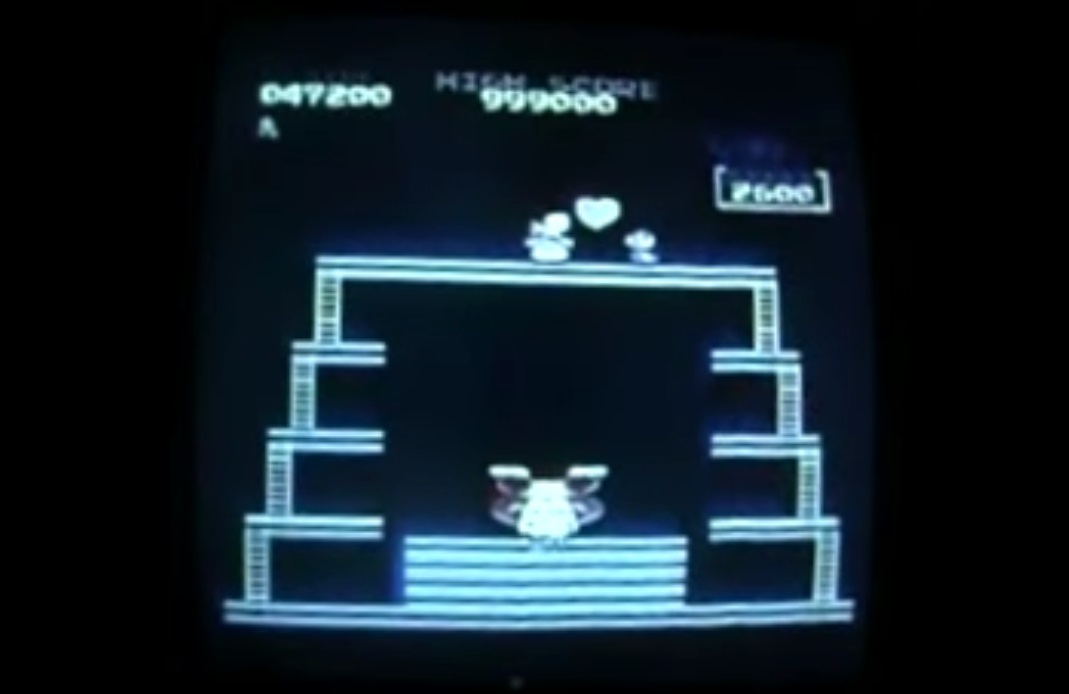
The final score on Mitchell’s disputed tape showing in The King of Kong (the leading 1 is omitted because the digits roll over when you reach a million).

You may remember that at the end of The King of Kong, Mitchell reestablishes his supremacy over plucky local kid Steve Wiebe with a “direct capture” tape of a run scoring 1,047,200 points. There are no witnesses to this game. Shortly after this, he also recorded a 1,050,200 score, also not witnessed. And just a week before being inducted into the International Video Game Hall of Fame in Iowa, he set records in both Donkey Kong (1,062,800) and Donkey Kong 2.

Now here’s where things get dicey (and nerdy).

Jeremy Young, aka Xelnia, put together the official two-part complaint on Twin Galaxies. For one part of it, he mentioned the suspicions some already had regarding the evidence set forth of the last and highest score Mitchell set, in an arcade called Boomers.

As others had already pointed out, not only are the run itself and resulting score not shown in the video, but the referee is among the least reliable, and the timeline is unclear, among other things. Most damning, however, it is clear that when Mitchell’s confederate ostentatiously “swaps out” the Donkey Kong board (so it can be verified elsewhere) for a Donkey Kong Jr. one (which Mitchell supposedly later set a record on), both PCBs were in fact the latter.

Twin Galaxies user Robert.F explained the differences in charming internet forum argot:

to a UN-trained train eye Dk and DKjr look the same and in fact they are vary similar, except for a few noticeable differences…the DK pcb has white text on the pcb and the Dk jr has banana yellow text printed on the board ,, the DK pcb is 1/2 digital and 1/2 Analog sound and there is a adjustment pot on the dk pcb for the Analog sound`s, The Dk Jr board is fully digital and has no Analog sound adjustment pot in the exact same position on the dkjr board, and the 3rd noticeable differences and you will see; it if you review the video carefully Dk has the same ROM socket lay out and the same number of sockets as a Dkjr pcb ,, But DKjr has one of them ROM socket empty ,,,,,,

But these circumstantial issues could be explained as a bit of confusion in the moment, a misspoken word in their excitement, and so on. Fortunately, that wasn’t the extent of the evidence.

As you may know, emulators are a type of application made to run old software (like arcade games) as closely as possible to how it ran on the original hardware. MAME is by far the most complex and perhaps the best-known emulator; this amazing app can emulate everything from Donkey Kong to much more recent games with complex 3D graphics. Of course, MAME runs aren’t accepted for world records — you could easily manipulate the software or even the game data itself. Real arcade hardware is required.

But MAME isn’t perfect; there are tiny differences in how it displays graphics — things you wouldn’t notice unless you were watching a game frame by frame looking for them in particular.

Which is exactly what people started doing with Mitchell’s no-witnesses, only-on-video scores.

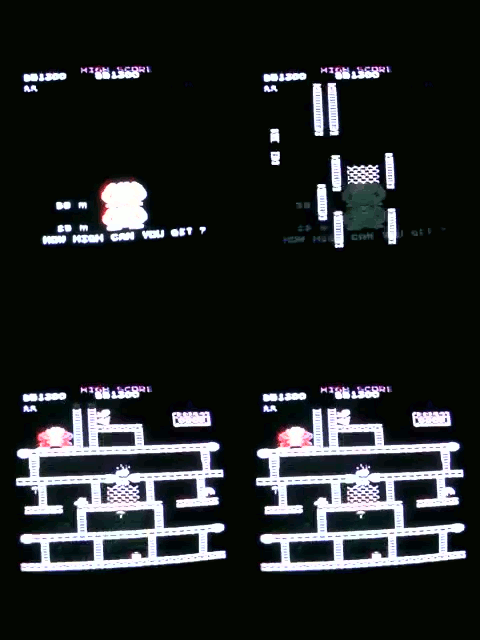
It turns out that the original Donkey Kong PCBs had a specific method of rendering a scene during graphics transitions called a “sliding door effect,” distinctive in the pattern of how pixels are updated. Careful inspection of Mitchell’s tapes showed not a sliding door, but instead a distinctive artifact of MAME emulation whereby the frame is rendered in chunks according to how the data is loaded from memory.

You can see the similarity in the GIFs below, provided as evidence by Young.

First is footage of an actual machine taken at 60FPS. Note the diagonal “sliding door” that reveals the scene from the top left downwards:
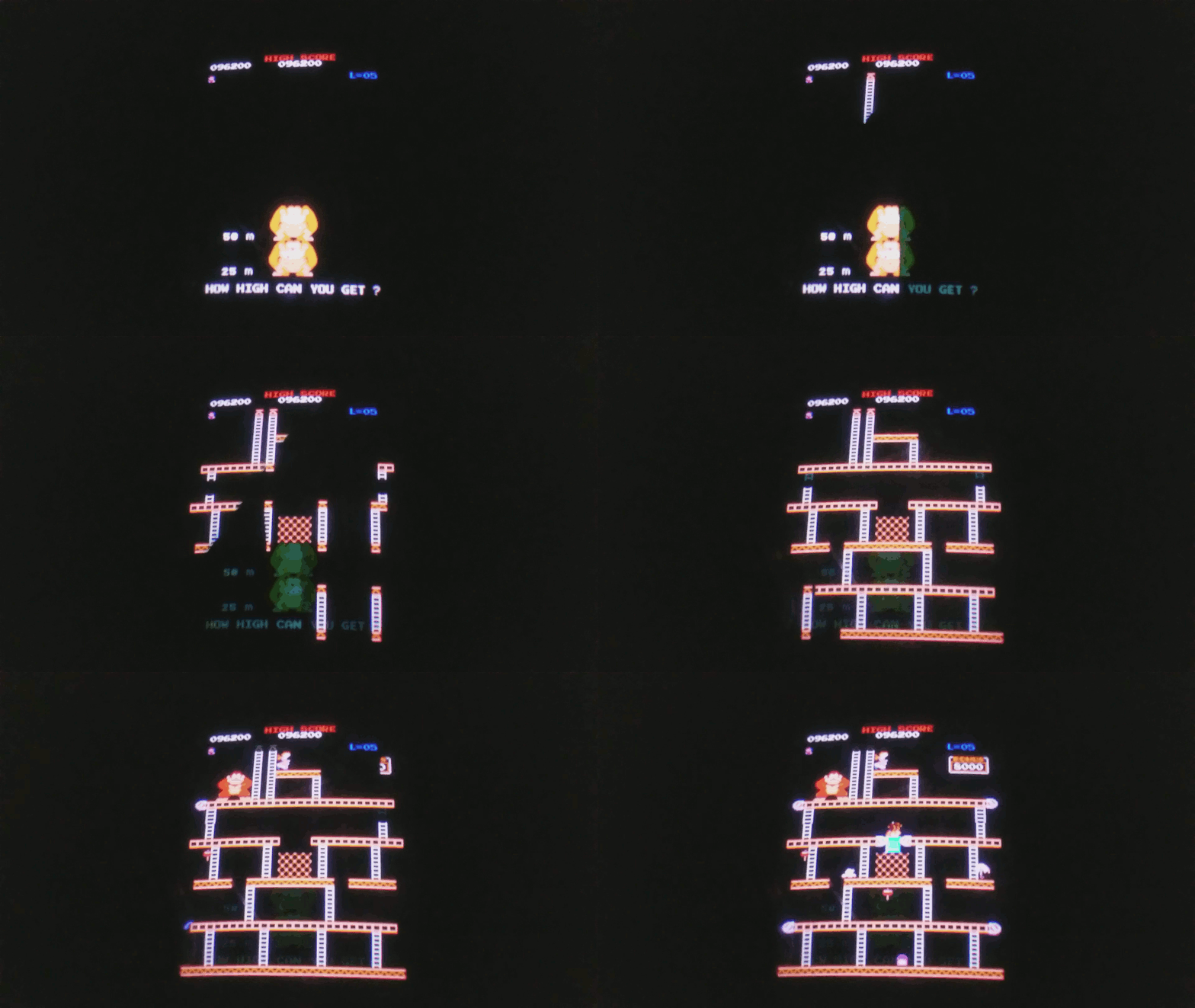
Next, Mitchell’s 1,050,200 run:

Last, how MAME renders a similar scene:

See how the ladders come in all at once in that pattern, and there’s no sliding door? As you can tell, it’s something of a smoking gun. Certainly Twin Galaxies investigators thought so. In their conclusions, issued today on the forums, they wrote (emphasis theirs):

The taped Donkey Kong score performances of 1,047,200 (the King of Kong “tape”), 1,050,200 (the Mortgage Brokers score) that were historically used by Twin Galaxies to substantiate those scores and place them in the database were not produced by the direct feed output of an original unmodified Donkey Kong Arcade PCB.

They decline to go so far as saying they know it was MAME, but that’s a mere scruple — everyone understands it’s the most likely situation. Regardless, the very fact that Mitchell passed off non-authentic footage as real is more than enough to strike his scores and, as they also announce, ban him from further placement anywhere in the system.

Perhaps more importantly, Steve Wiebe, the underdog challenger in The King of Kong, has been elevated to become the first player to actually hit a million points in the game. Better late than never! Belated congratulations to Wiebe. (Wikipedia has already been updated.)

Mitchell, on the other hand, has remained out of sight during the investigation that has gone on these last few months, and has essentially been ruined for good in the arcade world. Even if he were to set a world record today (and existing record holders doubt he has the skill to do so based on reviewing his play), it would be tainted by years of proven deception. The community won’t forgive him.

And that’s the worry others are voicing: Will the investigators come for other scores that for years have been venerated but have not been verified as strictly as modern records are? Will, for example, any score without an accredited witness or reliable recording be removed from the lists?

In their decision, Twin Galaxies’ authorities write:

Twin Galaxies is dedicated to absolutely rooting out invalid scores from our historic database wherever we find them.

Our methodic approach has allowed many things to surface, not only related to this specific score, but other scores as well as some previously never-before-discussed video game related history.

We must repeat, the truth is the priority. That is the concern. Whatever it takes.

This dispute is closed, and a controversial but nevertheless legendary gaming figure covered in shame (or he should be if he has any). Who will be next? Regardless of who falls, the community will no doubt continue to thrive; the passion for these old games is undying and, as new generations have shown, is not limited to an aging cohort of Gen-Xers striving to extend a bygone era of glory (though admittedly they are a big part of it).

If this strange saga interested you anywhere near as much as it interested me, go ahead and dive in. You might find you have a new hobby. Just don’t try to fake it. And by the way, the current top score in Donkey Kong is 1,247,700, set just two months ago by Robbie Lakeman. Good luck.


12 Apr 2018

Tesla is no longer working with NTSB in fatal Model X crash investigation

In light of Tesla going a bit rogue and disclosing details of the fatal crash that involved Autopilot, the National Transportation Safety Board is removing Tesla as a party in the investigation.

“The NTSB took this action because Tesla violated the party agreement by releasing investigative information before it was vetted and confirmed by the NTSB,” the NTSB wrote in a press release today. “Such releases of incomplete information often lead to speculation and incorrect assumptions about the probable cause of a crash, which does a disservice to the investigative process and the traveling public.”

This is not too surprising, given the NTSB said it was “unhappy” with Tesla following its March 30 disclosure that Autopilot was engaged during the crash.

Losing party status means Tesla is no longer able to provide technical assistance to the NTSB. As the NTSB notes, having party status is a “privilege” that enables two-way information sharing.

“It is unfortunate that Tesla, by its actions, did not abide by the party agreement,” said NTSB Chairman Robert Sumwalt. “We decided to revoke Tesla’s party status and informed Mr. Musk in a phone call last evening and via letter today. While we understand the demand for information that parties face during an NTSB investigation, uncoordinated releases of incomplete information do not further transportation safety or serve the public interest.”

The NTSB says it’s rare to revoke party status, but that it has happened before. While Tesla is no longer an official party, the NTSB says it expects Tesla to cooperate with any future data requests.

While Tesla is no longer a party in this specific case, the company is still working with the NTSB in other investigations, like the one pertaining to a crash in Lake Forest, California and one in Culver City.

I’ve reached out to Tesla and will update this story as I learn more.

12 Apr 2018

Lyft breaks down how much drivers can make

How much drivers can make working for Lyft and Uber has long been a topic of conversation and third-party studies. Now, Lyft is providing some more clarity around how much people can make driving for its platform.

“Understandably, we’ve seen a few external groups take their own guesses at what Lyft drivers make, usually as an hourly average across the country,” Lyft Head of Driver Communications and Community Laura Copeland wrote on Medium. “This is an important topic, so we want to help set the record straight, and then shed some light on our approach to helping drivers earn the most with us.”

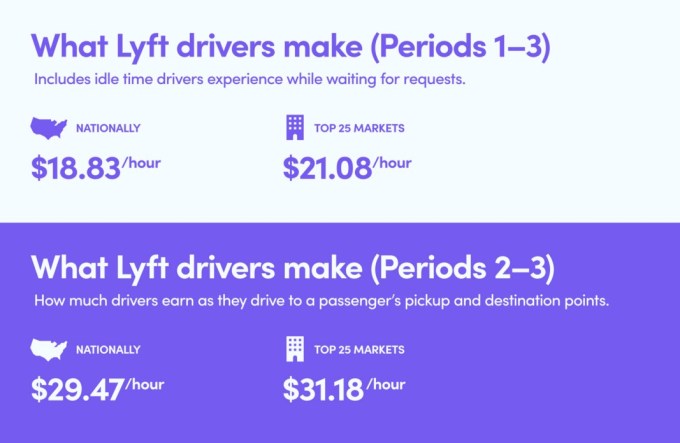
Wages, of course, depend on a variety of factors, like the market, number of trip requests accepted, time of day, length of trip, whether it’s surging and so on. On an hourly basis, Lyft says it’s most certain about how much money drivers make once they’ve accepted and completed a ride (periods two and three). In this type of scenario, Lyft says median earnings are $29.47 per hour, nationwide. In Lyft’s top 25 markets, that’s $31.18 per hour.

But when you factor in the amount of time spent online (period one), when drivers are waiting for rides, that comes out to $18.83 per hour nationwide and $21.08 per hour in Lyft’s top 25 markets.

Of course, this is not the final takeaway amount for drivers, when you factor in taxes, gas, car maintenance and all of that good stuff. Lyft points to The Rideshare Guy’s estimate of expenses of $3 to $5 per hour.

Last month, Uber provided some clarity about what people can make driving for the company:

For example, a study we conducted with Alan Krueger of Princeton found that drivers across 20 of Uber’s largest US markets earned an average of $19.04 per hour, in October 2015. A more recent study with Stanford professors estimated gross hourly earnings of $21.07¹ for all US drivers between January 2015 and March 2017.

You can check out Uber’s full analysis here.

12 Apr 2018

Amazon officially owns Ring, so let’s talk product integration

Amazon’s acquisition of Ring officially closed today. Now the companies (or company, rather) are marking the occasion by discounting the Ring Video Doorbell $30, down to $100 — because what better way to celebrate scalability and maximum distribution than a price drop?

Amazon is quick to note in its press material that the Ring name is sticking around — for the time being, at least. The company’s products will be joining a bunch of other smart home devices under the Amazon umbrella, including the company’s own Cloud Cam and various devices by one-time competitor, Blink.

Among other things, that means that existing customers shouldn’t expect service interruptions with the product. That said, I wouldn’t be too surprised to see the company pushing toward an Alexa-based smart home hub solution to rival offerings like Apple’s Home app. Certainly it would make sense for the company to try to put everything in the same place — and could ultimately make things a bit less fragmented for the consumer.

A recent interview with Ring CEO Jamie Siminoff also hints at what the company will ultimately look like in relation to Amazon’s Key service, which met with mixed reviews at launch.

“As it relates to Key, that’s obviously one that we’ll look at pretty closely,” he told CNET. “I wouldn’t want to make any commitments at this point in time, but it’s certainly one that’s on the list that we’ll start thinking about.”

Not super insightful, but about as much as one can expect from the head of a company recently purchased by Amazon. While Siminoff says Ring will stay relatively independent, maintaining its Santa Monica office, becoming a piece of Amazon’s smart home play likely means deeper and deeper integrations with the company’s home hardware offerings.

Amazon’s clearly been eying the company for a while. The company backed Ring through the Alexa Fund, which has become a bit of a funnel for future acquisitions of late, as it looks to leverage the Echo/Alexa’s success into an all-out smart home takeover.

12 Apr 2018

Uber expands privacy settlement with FTC

Uber is expanding the proposed settlement it made with the Federal Trade Commission last August pertaining to data mishandling, privacy and security complaints that date back to 2014 and 2015. In August, Uber agreed to 20 years of privacy audits.

That proposed settlement happened prior to Uber’s disclosure of the massive 2016 data breach that affected some 57 million riders and drivers. Now, Uber will be subject to “additional requirements,” according to the FTC.

“After misleading consumers about its privacy and security practices, Uber compounded its misconduct by failing to inform the Commission that it suffered another data breach in 2016 while the Commission was investigating the company’s strikingly similar 2014 breach,” Acting FTC Chairman Maureen K. Ohlhausen said in a statement. “The strengthened provisions of the expanded settlement are designed to ensure that Uber does not engage in similar misconduct in the future.”

As part of the revised settlement, Uber may be subject to civil penalties if it fails to notify the FTC of future privacy breaches. Uber must also submit all third-party audits of the company’s privacy program, as well as retain records pertaining to bug bounty programs that relate to unauthorized access to consumer data.

“My first week at Uber was the week we disclosed the 2016 breach. When Dara Khosrowshahi joined the company, he committed on behalf of every Uber employee that we would learn from our mistakes, change the way we did business and put integrity at the core of every decision we made,” Uber Chief Legal Officer Tony West said in a statement to TechCrunch. “Since then we have moved quickly to do just that by taking responsibility for what happened. I am pleased that just a few months after announcing this incident, we have reached a speedy resolution with the FTC that holds Uber accountable for the mistakes of the past by imposing new requirements that reasonably fit the facts.”

12 Apr 2018

Impossible Foods goes to White Castle

Impossible Foods is taking another bite out of the meat supply chain, with the announcement that it’s meatless burger substitute is coming to America’s first fast food burger chain — White Castle.

That’s right, now stoned vegan hippies can join stoned slackers in their quest for cheap, delicious burger-y goodness.

The “Impossible Slider” which is made from Impossible Foods’ vegetable-based ground beef substitute, will now be available for $1.99, or as part for a combo meal.

It’s hard to understate the importance of this as Impossible Foods now makes the jump from higher-end, fast-casual restaurants to a truly mass consumer, fast food chain.

If the company’s mission to be a viable competitor to ground beef — and ultimately replace it — Impossible Foods was going to have to make the jump from Umami Burger to “Impossible Slider” at some point.

As we wrote last month, the company has been beefing up its balance sheet to make just such a move — raising nearly $300 million in funding to take its burgers to Asia, and across America.

As part of the deal, the Impossible Slider will be available at 140 locations in the New York-New Jersey corridor and around Chicago and its suburbs.

“White Castle’s model has been often imitated but never duplicated — an impressive feat in the
hyper-competitive fast-food sector,” said Impossible Foods’ founder and chief executive Patrick Brown in a statement. “We look forward to working closely with White Castle, and together learning how to popularize plant-based meat with mainstream burger lovers.”