Month: June 2019

18 Jun 2019

Fresh off a $2.65B valuation, Plaid co-founder William Hockey is leaving

William Hockey, co-founder, chief technology officer and president of the fast-growing fintech business Plaid, will step down next week, TechCrunch has learned.

The former Bain Capital associate (pictured above left) co-founded the startup in 2012 alongside chief executive officer Zach Perret. Today, the San Francisco-based company employs 300 with additional offices in Salt Lake City and New York.

Plaid has confirmed the news, stating that Hockey will remain on the company’s board of directors.

“This conclusion was neither a rash nor a recent decision,” Hockey writes in a blog post shared with TechCrunch. “Over the past couple of years, I have known that there would come a point at which I would choose to move to a purely strategic and advisorial role.”

Plaid builds infrastructure that allows consumers to interact with their bank account on the web, powering a number of third-party applications, like Venmo, Robinhood, Coinbase, Acorns and LendingClub. It rose to prominence recently, closing a $250 million Series C investment at a $2.65 billion valuation late last year. The deal was led by famed venture capitalist and author of the Internet Trends report Mary Meeker, who’s joined the startup’s board of directors.

In total, Plaid has secured $310 million in venture capital funding from Andreessen Horowitz, Index Ventures, Norwest Venture Partners, Coatue Management, Goldman Sachs, NEA, Spark Capital and others.

Plaid has integrated with 10,000 banks in the U.S. and Canada and says 25% of people living in those countries with bank accounts have linked with Plaid through at least one of the hundreds of apps that leverage Plaid’s application program interfaces (APIs) — an increase from 13% last year. Last month, the company launched its fintech platform in the U.K.

“As we’ve done in the U.S., Plaid will become the foundation for that growth by providing access to a financial network that allows developers to deliver the experience users expect from their financial apps,” the company wrote in a blog post.

TechCrunch participated in a panel discussion with Hockey and Brex CEO Henrique Dubugras last month, in which Hockey gave no indication of impending plans to leave the business. In fact, taking off just as Plaid amps up its global expansion efforts and accelerates growth is strange timing for a founder to leave.

Oftentimes, when a startup co-founder steps down from the C-suite, it’s to make room for a more experienced executive to lead the company through periods of fast growth. Recently, for example, Lime announced its co-founder Toby Sun would transition out of the CEO role to focus on company culture and R&D. Brad Bao, a Lime co-founder and longtime Tencent executive, assumed chief responsibilities.

Other times, it comes amid turmoil. Mike Cagney’s departure from SoFi, of course, is an example of this. One month after reports of a sexual harassment and wrongful termination lawsuit against the online lending business surfaced, SoFi announced Cagney would step down.

In Hockey’s case, the move was planned and calculated, he said.

“In tech, it has historically been taboo to talk about founders or executives transitioning to different roles inside companies,” Hockey writes. “Leadership transitions need to become a bedrock of any company that desires to endure across decades.”

18 Jun 2019

Cruise is sharing its data visualization tool with robotics geeks everywhere

Cruise is sharing a software platform with roboticists that was initially created to give its own engineers a better understanding of the petabytes of data generated every month from its fleet of autonomous vehicles.

The platform is a data visualization tool called Webviz, a web-based application aimed at anyone working in robotics, a field that includes autonomous vehicles. Researchers, students and engineers can now access the tool and get a visual insight into their data by dragging their robotics data into a ROS bag file.

Robots and, specifically autonomous vehicles, capture loads of data from various sensors like lidar, radar and cameras. The tool is supposed to make it easier to take that data and turn it from binary code into something visual. The tool lets users configure different layouts of panels, each one displaying information like text logs, 2D charts and 3D depictions of the AV’s environment.

The tool is a product of a Cruise hackathon that was held a couple of years ago. It was apparently such a hit that engineers at the self-driving car company now use it daily to calibrate lidar sensors, verify machine learning models and debug test rides. Webviz now has 1,000 monthly active users within the company, according to Cruise.

As engineers developed Webviz they found it could have applications outside of Cruise. The company decided to open source it as general robotics data inspection tool. For this initial release, Cruise settled on a suite of general panels that any robotics developer can leverage to explore their own data, with minimal setup, the company said in a Medium post Tuesday.

A demo video provided by Cruise is posted below.

Prior to Webviz, Cruise engineers who wanted to turn binary AV data into something more visual would have to access a suite of tools within the ROS open source community. While the system worked well, setting up the platform and then replicating it on a co-worker’s machine was time consuming effort. It also required manually positioning windows running separate tools such as logging message or viewing camera images.

The tool created out of the hackathon essentially helped lower the barrier to entry for engineers to explore and understand its autonomous vehicle data.

Cruise shared a piece, or an application, of Webviz earlier this year called Worldview — a library that can turn data into 3D scenes. Cruise has also developed and open sourced rosbag.js, a JavaScript library for reading ROS bag files. Both of these projects were developed as engineers created and built out Webviz, according to Cruise.

Cruise isn’t the only robotics-focused company (or autonomous vehicle company for that matter) to open source datasets or other tools. For instance, Aptiv released last year nuScenes, a large-scale dataset from an autonomous vehicle sensor suite.

And it likely won’t be the last. Not only are moves like this part of the engineering culture, there are other benefits as well, including recruitment. Plus, by releasing it into the world, it’s likely that other outsiders will build upon the tool and improve it, or use it to make engineering breakthroughs in robotics.

18 Jun 2019

SafeAI raises $5M to develop and deploy autonomy for mining and construction vehicles

Startup SafeAI, powered by a founding talent  team with experience across Apple, Ford and Caterpillar, is emerging from stealth today with a $5 million funding announcement. The company’s focus is on autonomous vehicle technology, designed and built specifically for heavy equipment used in the mining and construction industries.

Out the gate, SafeAI is working with Doosan Bobcat, the South Korean equipment company that makes Bobcat loaders and excavators, and it’s already demonstrating and testing its software on a Bobcat skid loader at the SafeAI testing ground in San Jose . The startup believes that applying advances in autonomy and artificial intelligence to mining and construction can do a lot to not only make work sites safer, but also increase efficiencies and boost productivity – building on what’s already been made possible with even the most basic levels of autonomy currently available on the market.

What SafeAI hopes to add is an underlying architecture that acts as a fully autonomous (Level 4 by SAE standards, so no human driver) platform for a variety of equipment. Said platform is designed with openness, modularity and upgradeability in mind to help ensure that its clients can take advantage of new advances in autonomy and AI as they become available.

“We have seen and experienced deploying autonomous mining truck in production for last 10 years,” explained Safe AI Founder and CEO, Bibhrajit Halder in an email. “Now it’s time to take it to next level. At SafeAI, we are super excited to built the future of autonomous mine by creating autonomous mining equipment that just works.”

While SafeAI doesn’t have product in market yet, it is running its software on actual construction hardware at its proving ground, as mentioned, and it’s working with an as-yet unnamed large global mining company to deploy SafeAI in a mining truck, according to Halder. The company’s plan is to focus its efforts entirely on deploying fully, Level 4 autonomy as its first available commercial product, with a vision of a future where multiple pieces of mining equipment are working together “seamlessly,” the CEO says.

Today’s $5 million round includes investment led by Autotech Ventures, and including participation from Brick & Mortart Ventures, Embark Ventures and existing investor Month Vista Capital.

18 Jun 2019

House lawmakers demand end to warrantless collection of Americans’ data

Two House lawmakers are pushing an amendment that would effectively defund a massive data collection program run by the National Security Agency unless the government promises to not intentionally collect data of Americans.

The bipartisan amendment — just 15 lines in length — would compel the government to not knowingly collect communications — like emails, messages and browsing data — on Americans without a warrant.

Reps. Justin Amash (R-MI, 3rd) and Zoe Lofgren (D-CA, 19th) have already garnered the support from some of the largest civil liberties and rights groups, including the ACLU, the EFF, FreedomWorks, New America, and the Sunlight Foundation.

The Amash-Lofgren amendment. (Image: supplied)

Under the current statute, the NSA can use its Section 702 powers to collect and store the communications of foreign targets located outside the U.S. by tapping into the fiber cables owned by run by U.S. telecom giants. But this massive data collection effort also inadvertently vacuums up Americans’ data, who are typically protected from unwarranted searches under the Fourth Amendment.

The government has consistently denied to release the number of how many Americans are caught up in the NSA’s data collection. For the 2018 calendar year, the government said it made over 9,600 warrantless searches of Americans’ communications, up 28 percent year-over-year.

In a letter to lawmakers, the groups said the amendment — if passed into law — would “significantly advance the privacy rights of people within the United States.”

Last year, Section 702 was reauthorized with almost no changes, despite a rash of complaints and concerns raised by lawmakers following the Edward Snowden disclosures into mass surveillance.

The EFF said in a blog post Tuesday that lawmakers “must vote yes in order to make this important corrective.”

18 Jun 2019

Google now lets you flag deceptive sites with a new Chrome extension

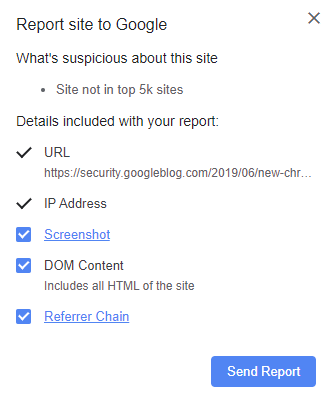
Google today launched a new Chrome extension that allows you to flag suspicious sites for inclusion in the company’s Safe Browsing index, which is used by Chrome and a number of third-party browsers.

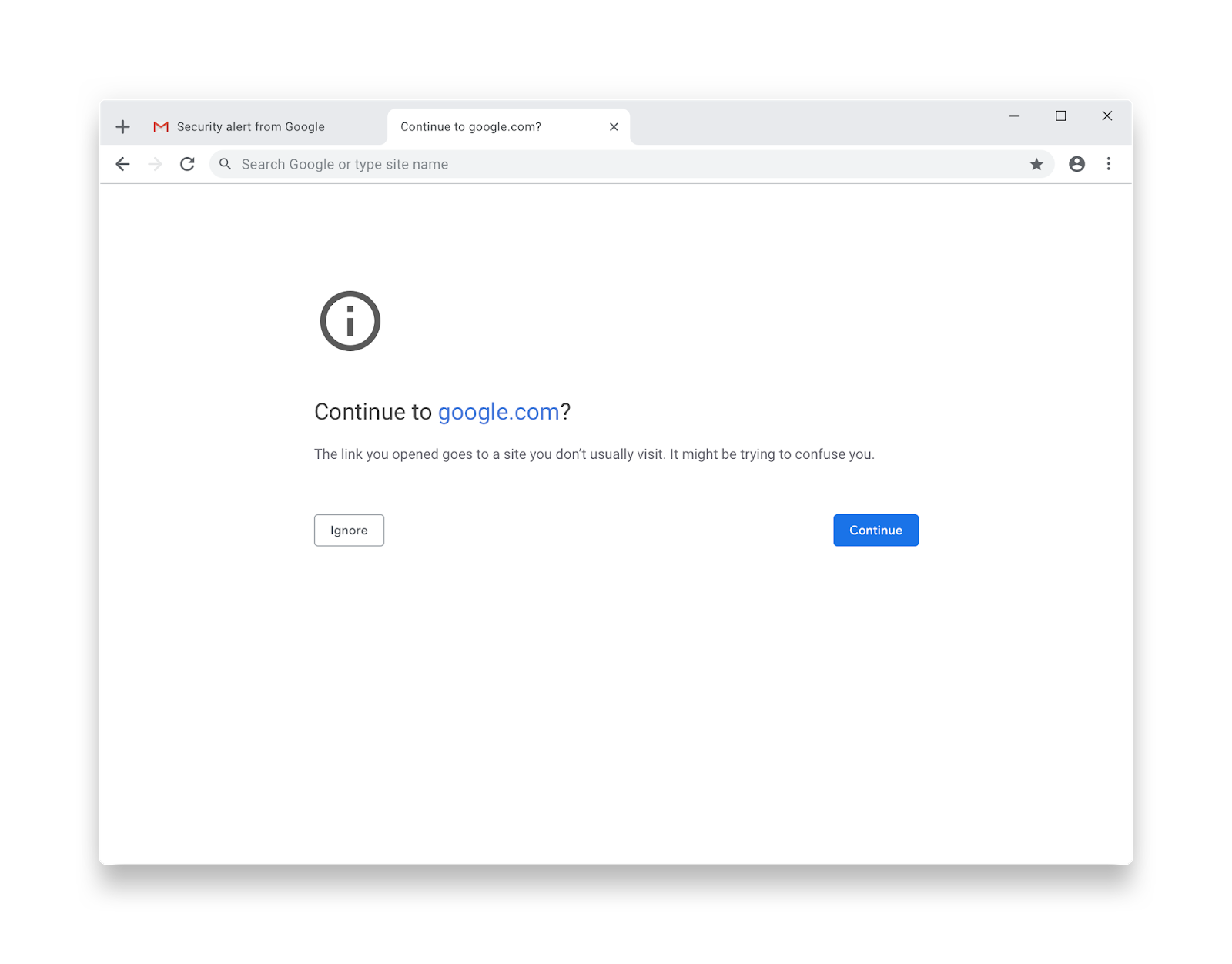
In addition, Google is also launching a new warning in Chrome that puts up a roadblock before you visit a site that is potentially trying to trick you into giving up your credentials or download malware.

Typically, Safe Browsing automatically crawls the web and looks for suspicious sites. With this new extension, you can flag sites that the system hasn’t detected yet. The overall process is pretty simple and the extension gives you the option to include screenshots, the referrer chain that led you to the site and the DOM content of your browser. You get to choose which one of these to send and the screenshot option is off by default.

The extension also puts up a flag in your browser bar that changes color based on how legitimate it thinks a given site is. Since it turns orange for any site that isn’t a top 5,000 site, though, it’s not exactly as useful a warning as it could be.

As for the new warning in Chrome 75, Google notes that it is meant to keep you from visiting sites that are trying to trick you with deceptive URLs (think “go0gle.com” and “google.com”). Chrome will now throw up a full-screen roadblock to warn you about these sites.

“This new warning works by comparing the URL of the page you’re currently on to URLs of pages you’ve recently visited,” the team explains. “If the URL looks similar, and might cause you to be confused or deceived, we’ll show a warning that helps you get back to safety.”

18 Jun 2019

Google announces $1B, 10-year plan to add thousands of homes to Bay Area

The housing crisis in the Bay Area, particularly in San Francisco, is a complex and controversial topic with no one-size-fits-all solution — but a check for a billion dollars is about as close as you’re going to get, and Google has just announced it’s writing one.

In a blog post, CEO Sundar Pichai explained that in order to “build a more helpful Google,” the company would be making this major investment in what it believes is the most important social issue in the area: housing.

San Francisco is famously among the most expensive places in the world to live now, and many residents of the city, or perhaps I should say former residents, have expressed a deep and bitter hatred for the tech industry they believe converted the area to a playground for the rich while leaving the poor and disadvantaged to fend for themselves.

Google itself has been the subject of many a protest, and no doubt it is aware that its reputation as a friendly and progressive company is in danger from this and numerous other issues, from AI ethics to advertising policies.

To remedy this, and perhaps even partly as an act of conscience, Google has embarked on a billion-dollar charm offensive that will add thousands of new homes to the Bay Area over the next ten years.

$750 million of that comes in the form of repurposing its own commercial real estate for residential purposes. This will allow for 15,000 new homes “at all income levels,” and while Pichai said that they hope this will help address the “chronic shortage of affordable housing options,” the blog post did not specify how many of these new homes would actually be affordable, and where they might be.

Another $250 million will be invested in a fund that will “provide incentives to enable developers to build at least 5,000 affordable housing units across the market.” Again, it’s hard to imagine this will have a bad effect, but the specifics will matter here — it’s unclear what the incentives are and what developers are willing to take this on.

Lastly, and in its most direct and immediately effective act of giving, the company will step up its grants to nonprofits working against homelessness. Over the last five years, Google.org has given $18 million — this year alone it proposes to give $50 million. This kind of immediate aid is what keeps shelters, clinics, and other resources alive.

We’ll look forward to more details on Google’s new housing plan, indeed so new that it hasn’t been given a catchy name like Google Cares. Pichai notes that the company is in talks with municipalities on topics like rezoning and planning, and that construction will ideally start more or less immediately.

18 Jun 2019

Roli’s newest instrument, the Lumi, helps you learn to play piano with lights

There has been a longstanding gulf between the consumption music and the creation of it: not everyone has the time or money to spend on lessons and instruments, and for those in school, many music education programs have been cut back over the years, making the option of learning to play instruments for free less common. Still others have had moments of interest but haven’t found the process of learning that easy.

Now we’re seeing a new wave of startups emerge that are attempting to tackle those issues with technology, creating tools and even new instruments that leverage smartphones and tablets, new hardware computing innovations and new software to make learning music more than just a pastime for a select few.

In the latest development, London startup Roli is launching a new interactive keyboard called the Lumi. Part colourful, sound sensitive lightboard and part piano, the Lumi’s keys light up in a colorful array to help guide and teach you to play music. The 11-inch keyboard — which can  be linked up with one or two more of the same to add more octaves — comes with an iPad app that contains hundreds of pieces, and the two are now selling for $249 alongside a new Kickstarter to help drum up interest and offer early-bird discounts. The Kickstarter campaign blew through its modest £100,000 goal within a short while, and some of the smaller tiers of pledges now sold out. The product will start shipping in October 2019, the company says.
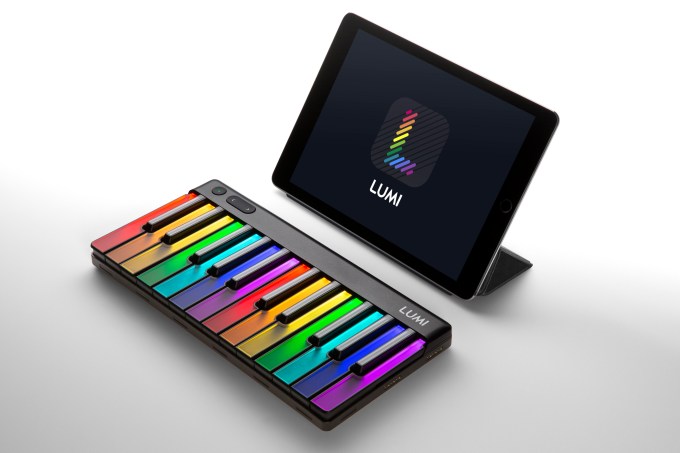
As you might already know, or have guessed by the reaction to the kickstarter, this is not Roli’s first rodeo: the company has made two other major products (and variations on those two) before this also aimed at music making. First came the Seaboard, which Roli described as a new instrument when it first launched. Taking the form factor of a keyboard, it contained squishy keys that let the player bend notes and create other effects alongside electronic-based percussive tapping, as you would do with a normal keyboard.

Its next product was Blocks: small, modular light boards that also used colored light to guide your playing and help you create new and interesting sounds and beats with taps (and using a similarly squidgy surface to the Seaboard), and then mix them together.

Both of these were interesting, but somewhat aimed at those who were already familiar with playing pianos or other instruments, or with creating and playing electronic music with synthesizers, FX processors and mixers. (Case in point: the people I know who were most interested in these were my DJ friends and my kids, who both play the piano and are a little nerdy about these things.)

The Lumi is in a way a step back for Roli fom trying to break new ground by conceiving of completely new instruments, with new form factors built with the benefits of technology and electronics in mind. But it’s also a step ahead: using a keyboard as the basis of the instrument, the Lumi is more familiar and therefore more accessible — with an accessible price of $249 to go along with that.

Lumi’s emergence comes after an interesting few years of growth for Roli. The company is one of the select few (and I think the only one making music instruments) to be retailed in Apple stores, and it’s had endorsements from some very high profile people, but that’s about as mainstream as it has been up to now.

The startup’s founder and CEO, American-born Roland Lamb, is probably best described as a polymath, someone who comes across less as a geeky and nervous or (at the other end) ultra smooth-talking startup founder, and more like a calm-voiced thinker who has come out to talk to you in a break between reading and writing about the nature of music and teaching a small philosophy seminar.

His background also speaks to this unconventional manner. Before coming to found Roli, he had lived in a Zen monastery, made his way around the world playing jazz piano, and studied Chinese and Sanskrit at Harvard and design at the Royal College of Art.

Roli has always been a little cagey about how much it has raised and from whom, but the list includes consumer electronics giants like Sony, specialist audio makers like Onkyo, the music giant Univeral Music Group, and VCs that include Founders Fund, Index and LocalGlobe, Kreos Capital, Horizons Ventures and more. It’s also partnered with a number of big names like Pharrell Williams (who is also an investor) in the effort to get its name out.

And while it has most definitely made a mark with a certain echelon of the music world — producers and those creating electronic music — it has not parlayed that into a wider global reputation or wider accessibility. After bringing out instruments more for a high end audience, the Lumi seems like an attempt to do just that.

That seems to be coming at the right time. Services like Spotify and YouTube — and the rise of phones and internet usage in general — have transformed how we listen to music. We now have a much wider array of things to listen to whenever we want. On top of that, services like YouTube and Soundcloud furthermore are giving us a taste of creating our own music: using electronic devices, we can go beyond what might have been limitations up to now (for example, having never learned to play an instrument in the traditional sense) to get stuck into the craft itself.

The Lumi is also tapping into another important theme, and that is of music being “good for you”. There a line of thought that says learning an instrument is good for your mind, both if you’re a younger person who is still in school or indeed out of school and looking to stay sharp. Others believe it has health benefits.

But realistically, these beliefs don’t get applied very often. Roli cites stats that say that only 10% of adults aged 18-29 have played an instrument in the past year, and of those that played as children, some 80% say they quit by age 14.

Putting this together with the Lumi, it seems that the aim is to hit a wider swathe of the market and bring in people who might want to learn something like playing an instrument but had thought previously that it would be too much of a challenge.

Roli isn’t the first — nor likely the last — company to reconsider how to learn playing the piano through technology. The Chinese company ONE Music Group makes both smart pianos with keyboards that light up, as well as a strip that you overlay on any keyboard, that also corresponds to an iPad app to learn to play piano.

An American startup called McCarthy Music also makes illuminated-key pianos, also subscribing to the principle that providing this kind of guidance to teach muscle memory is an important step in getting a student acquainted with playing on a keyboard.

The Lumi is notable not just because of its cost, but its size — the single, lightweight keyboards have a battery life of six hours and can fit in a backback.

That said, Roli is hoping that there will be a double audience to these in the longer term, bridging the divide between music maker and listener, but also amateur and pro.

“Many people would love to play an instrument but worry that they don’t have the talent. Through our research, design, and innovation at ROLI, we’ve come to believe that the problem is not a lack of talent. Rather, instruments themselves are not smart enough,” said Lamb in a statement. “What excites me most is that the intelligence of LUMI means that there’s something in it for everyone. On one hand my own kids now prefer LUMI time to movie time. On the other hand, several of the world’s leading keyboard players can’t wait to use LUMI in the studio and on the stage.”


18 Jun 2019

Leaving for a competitor? Onboarding new employees? Avoid accusations of trade secret theft

When a company hires talent away from a competitor, onboarding the new employee can pose significant legal risks for both the company and the new employee. A fundamental aspect of Silicon Valley is that employees are generally free to move between competitors.

This unrestricted movement of talent facilitates the robust competition that helps drive the Silicon Valley economy. While this is no doubt positive, unfettered employment mobility also creates unique challenges when it comes to protecting a company’s trade secrets, which are the lifeblood of many Silicon Valley companies.

Because of California’s policies regarding free employment mobility, unlike in most other states, California companies cannot protect their trade secrets with non-compete contracts. So, they instead rely heavily on trade secret laws for protection.

And, of course, when trade secret theft occurs, it is often when an employee transitions from one company to another. Thus, when a key employee gives notice that he or she is leaving for a competitor, it sets off alarm bells for the soon-to-be former company.

Unfortunately, because of the hypersensitivity to protecting trade secrets, many departing employees who have no interest in actually taking their former company’s trade secrets get accused of theft. This allegation can trigger a long, stressful, expensive legal process for both the employee and the new company, and sometimes cost the employee his or her reputation and new job.

This article explains how this situation arises and provides some practical considerations for how the employee transitioning jobs, and the onboarding company, can avoid an unnecessary legal fight.

1. California companies’ aggressive protection of trade secrets.

18 Jun 2019

Daily Crunch: Facebook unveils Libra cryptocurrency

The Daily Crunch is TechCrunch’s roundup of our biggest and most important stories. If you’d like to get this delivered to your inbox every day at around 9am Pacific, you can subscribe here.

1. Facebook announces Libra cryptocurrency: All you need to know

Facebook has finally revealed the details of its cryptocurrency Libra, which will let you buy things or send money to people with nearly zero fees.

The company won’t fully control Libra, but instead get just a single vote in its governance like other founding members of the Libra Association, including Visa, Uber and Andreessen Horowitz, which have invested at least $10 million each into the project’s operations.

2. Amazon’s Twitch acquired social networking platform Bebo for under $25M to bolster its esports efforts

Bebo lives!

3. The future of diversity and inclusion in tech

Silicon Valley is entering a new phase in its quest for diversity and inclusion in the technology industry. Some advocates call this part “the end of the beginning,” as Code2040 CEO Karla Monterroso put it.

4. Palm’s tiny phone is available unlocked at $350

The phone’s available “at only” $350. That’s cheap compared to many full-sized, mid-tier handsets, but cheapness is a relative concept — this still seems like a high price for a second phone.

5. Carmen Sandiego returns to Google Earth with a new caper

Google Earth first made use of its rich global 3D visualization as a backdrop for a Carmen Sandiego tie-in back in March, but today there’s a new adventure to explore.

6. Google Calendar is down, it’s not just you

Maybe it’ll be back up by the time you read this newsletter.

7. How to negotiate term sheets with strategic investors

Negotiating a term sheet with a strategic investor necessitates a different set of considerations. (Extra Crunch membership required.)

18 Jun 2019

Apple launches a Beddit beta program focused on improving its app

Apple is launching a new beta program for Beddit, the sleep tracking company it acquired just over two years ago after selling Beddit products in Apple Stores for years. According to the beta program’s website, users who enroll will get early access to new versions of the Bedit app ahead of the general public. They’ll also be able to offer feedback to Apple by sharing data and completing surveys.

Participants in the beta program will share data about their app usage, app settings, and their sleep results, in addition to diagnostic data. This will require they first sign an informed consent form, given the personal nature of this data.

Apple also says beta participation is entirely voluntary and users can withdraw from the program at any time, at which point the data would no longer be collected. And if the user changes their mind, they could also rejoin the beta in the future as long as the beta program is ongoing.

There are a few other requirements for participation in the beta. Users must be based in the U.S., have a Beddit Sleep Monitor (the $145.95 model 3.5), and be at least 22 and not over 75 years old. They must also agree to receive email communications from Apple about the beta program.

Apple has been invested in sleep tracking since the launch of the “Bedtime” feature in its iOS Clock app introduced in iOS 10, which helps users set up reminders about bedtime and recurring wake-up alarms. It also allows its customers to configure other settings that can contribute to better rest, including the ability to schedule a Do Not Disturb mode, set time limits on app usage, and schedule a Night Shift mode to turn on in the evening to reduce the blue light emitted from the phone — something that can disrupt our natural sleep patterns.

But with the Beddit deal, Apple took a bigger step into sleep tracking by snatching up a connected device maker.

In time, the company could use the data collected from the beta testers to improve the Beddit app. That’s something it may need to focus on, given the app today sports a 2.1-star (out of 5) rating on the App Store and reviews complain about its bad design and missing features.