Month: June 2019

18 Jun 2019

The Geesaa automates (but overcomplicates) pourover coffee

Making pourover coffee is a cherished ritual of mine on most mornings. But there are times I wish I could have a single cup of pourover without fussing about the kitchen — and the Geesaa, a new gadget seeking funds on Kickstarter, lets me do that. But it’s definitely still a ways from being a must-have.

I’m interested in alternative coffee preparation methods, low and high tech, so I was happy to agree to try out the Geesaa when they contacted me just ahead of their Kickstarter campaign going live (they’ve already hit their goal at this point). I got to test one of their prototypes and have used it on and off for the last couple weeks.

The Geesaa is part of a new wave of coffee makers that make advances on traditional drip techniques, attempting to get closer to a manual pourover. That usually means carefully controlling the water temperature and dispensing it not just in a stream powerful enough to displace and churn the ground coffee, but in a pattern that’s like what you’d do if you were pouring it by hand. (The Automatica, another one with a similar idea, sadly didn’t make it.)

Various manufacturers do this in various ways, so Geesaa isn’t exactly alone, though its mechanism appears to be unique. Instead of using a little showerhead that drips regularly over the grounds, or sending a moving stream in a spiral, the Geesaa spins the carafe and pours water from a moving head above it.

This accomplishes the kind of spiral pour that you’ll see many a barista doing, making sure the grounds are all evenly wet and agitated, without creating too thin of a slurry (sounds delicious, right?). And in fact that’s just what the Geesaa does — as long as you get the settings right.

Like any gadget these days, this coffee maker is “smart” in that it has a chip and memory inside, but not necessarily smart in any other way. This one lets you select from a variety of “recipes” supposedly corresponding to certain coffees that Geesaa, as its secondary business model, will sell to owners in perfectly-measured packets. The packet will come with an NFC card that you just tap on the maker to prompt it to start with those settings.

It’s actually a good idea, but more suited to a hotel room than a home. I preferred to use the app, which, while more than a little overcomplicated, lets you design your own recipes with an impressive variety of variables. You can customize water temperature, breaks between pouring “stages,” the width of the spiral pattern, the rate the water comes out, and more.
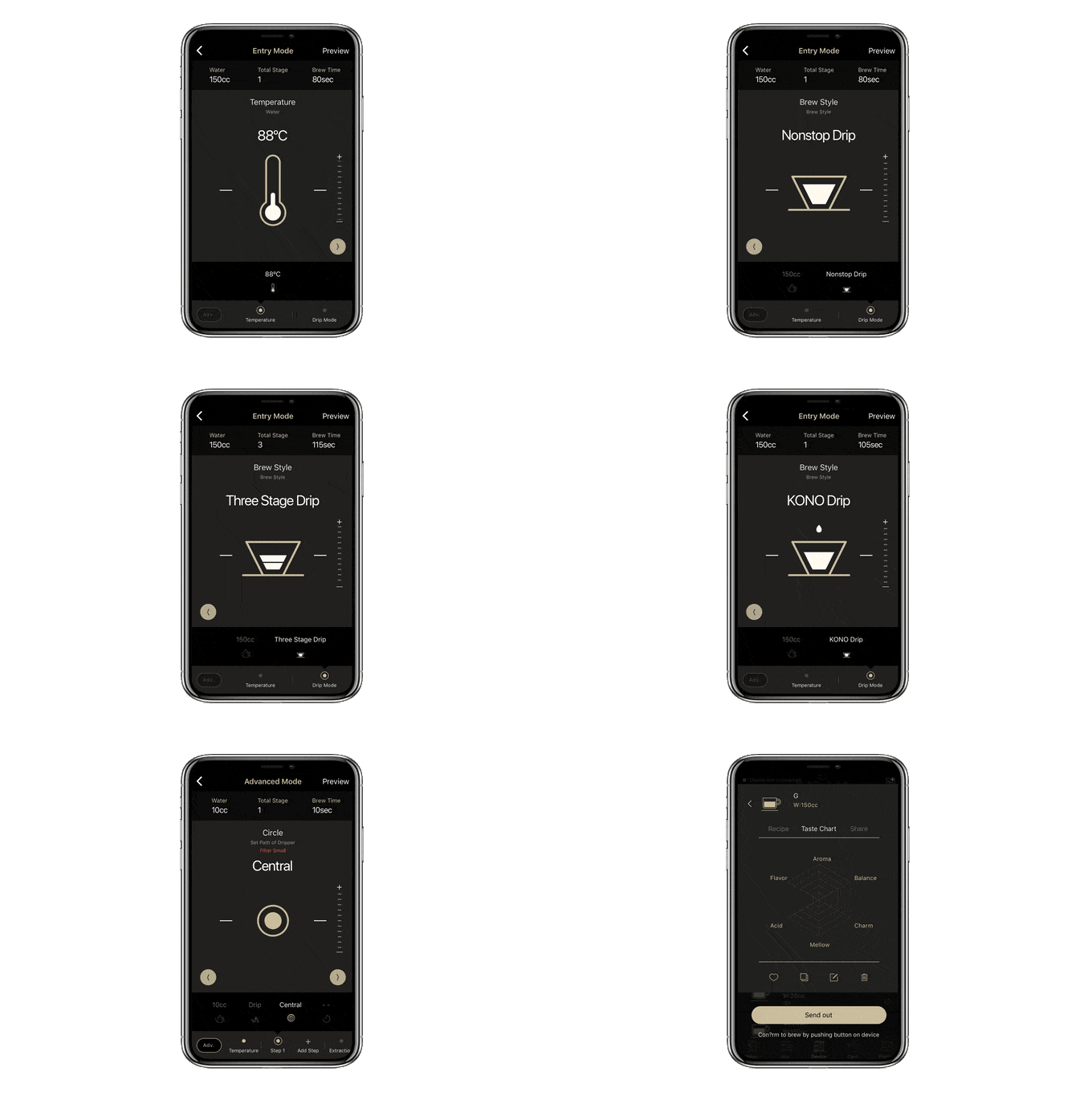
Although it’s likely you’d just arrive at a favorite recipe or two, it’s nice to be able to experiment or adjust in case of guests, a new variety of coffee, or a new grinder. You can, as I did, swap out the included carafe for your own cone and mug, or a mesh cone, or whatever — as long as it’s roughly the right size you can make it work. There’s no chip restricting you to certain containers or coffees.

I’m not sure what the story is with the name, by the way. When you start it up, the little screen says “Coffee Dancer,” which seems like a better English name for the device than Geesaa, but hey.

When it works, it works, but there are still plenty of annoyances that you won’t get with a kettle and a drip cone. Bear in mind this is with a prototype (3rd generation, but still) device and app still in testing.

One thing I’ve noticed is that the temperature seems too low in general. Even the highest available temperature, 97 C (around 206 F), doesn’t seem as hot as it should. Built-in recipes produced coffee that seemed only warm, not hot. Perhaps the water cools as it travels along the arm and passes through the air — this is nontrivial when you’re talking about little droplets! So by the time it gets to the coffee it may be lower than you’d like, while coming out of a kettle it will almost always be about as hot as it can get. (Not that you want the hottest water possible, but too cool is as much a problem as too hot.)
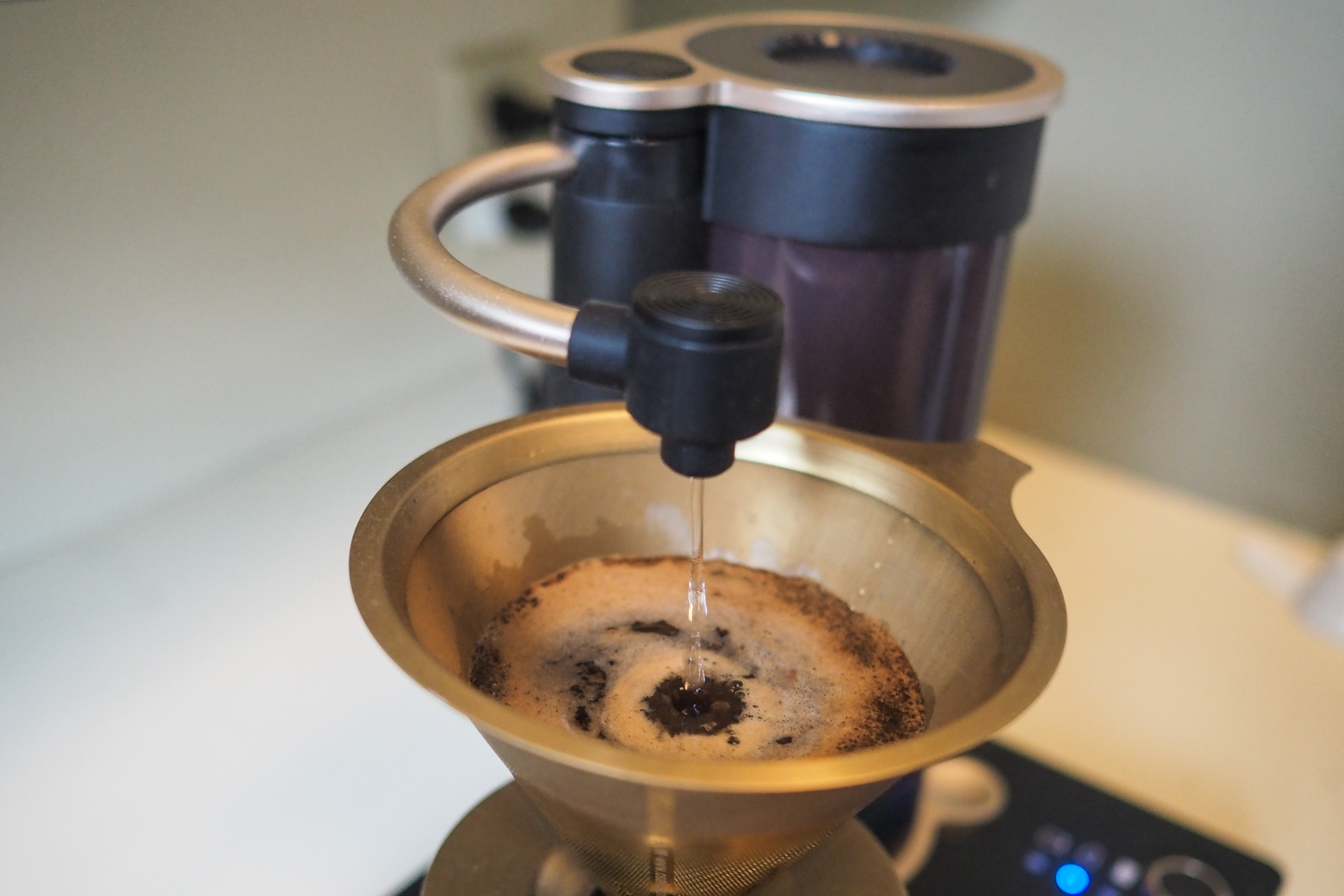
I ran out of filters for the included carafe so I used my gold Kone filter, which worked great.

The on-device interface is pretty limited, with a little dial and LCD screen that displays two lines at a time. It’s pre-loaded with a ton of recipes for coffee types you may never see (what true coffee-lover orders preground single-serve packets?), and the app is cluttered with ways to fill out taste profiles, news, and things that few people seem likely to take advantage of. Once you’ve used a recipe you can call it up from the maker itself, at least.

One time I saw the carafe was a bit off-center when it started brewing, and when I adjusted it, the spinning platform just stopped and wouldn’t restart. Another time the head didn’t move during the brewing process, just blasting the center of the grounds until the cone was almost completely full. (You can of course stop the machine at any point and restart it should something go wrong.)

Yet when it worked, it was consistently good coffee and much quicker than my standard manual single cup process.

Aesthetically it’s fine — modern and straightforward, though without the elegance one sees in Bodum and Ratio’s design.

It comes in white, too. You know, for white kitchens.

The maker itself is quite large — unnecessarily so, I feel, though I know the base has to conceal the spinning mechanism and a few other things. But at more than a foot wide and 8 inches deep, and almost a foot tall, it has quite a considerable footprint, larger than many another coffee machine.

I feel like the Geesaa is a good coffee-making mechanism burdened by an overcomplicated digital interface. I honestly would have preferred mechanical dials on the maker itself, one each for temperature, amount, and perhaps brew style (all at once, bloom first, take a break after 45 seconds, etc). Maybe something to control its spiral width too.

And of course at $700 (at the currently available pledge level) this thing is expensive as hell. The comparisons made in the campaign pitch aren’t really accurate — you can get an excellent coffee maker like a Bonnavita for $150, and of course plenty for less than that.

At $700, and with this thing’s capabilities, and with the side hustle of selling coffee packets, this seems like a better match for a boutique hotel room or fancy office kitchen than an ordinary coffee lover’s home. I enjoy using it but its bulk and complexity are antithetical to the minimal coffee making experience I have enjoyed for years. Still, it’s cool to see weird new coffee making methods appear, and if you’re interested, you can still back it on Kickstarter for the next week or so.

18 Jun 2019

Advertisers and digital media companies form a new Global Alliance for Responsible Media

Many of the major players in online advertising have come together to create an organization called the Global Alliance for Responsible Media, which is supposed to focus on “digital safety.”

In this context, that means safety for brand marketers, who want to ensure that their ads aren’t running alongside hateful, misleading or otherwise controversial content.

For example, a number of advertisers reportedly suspended their work with YouTube earlier this year over concerns that the platform’s algorithm was directing viewers to exploitative clips of children. This also comes amidst broader concern over whether social media companies are doing enough to police the content on their platforms.

What the Global Alliance for Responsible Media will actually do remains vague, at least judging from today’s announcement, which was made at this week’s Cannes Lions event for advertisers. The organization says its first steps will be to “form and empower an inclusive working group charged with developing a set of initial ideas and prioritizing next steps.”

For now, then, the alliance is more notable for who’s involved. The advertisers include brands like Adidas, Bayer, General Mills, Mondelēz International, NBCUniversal, Nestlé, Procter & Gamble and Unilever, as well as the big agencies like Dentsu, GroupM, IPG, Publicis Media and Omnicom Media Group. Facebook, Google/YouTube, Teads, TRUSTX, Twitter, Unruly and Verizon Media (which owns TechCrunch) have signed on as well, as have trade groups like the Interactive Advertising Bureau.

While the plans sound vague for now, Facebook’s vice president for global account partnerships Will Platt-Higgins told Ad Age that that won’t be true for long: “They want to get runs on the board, not be a committee. They and we believe that building an alliance of leading advertisers, leading agencies, media companies and the industry bodies is the best way of doing that versus just the clients or just the agencies.”

18 Jun 2019

Simone Giertz’s converted Tesla Model 3 pickup truck is wonderful

YouTuber Simone Giertz, celebrated DIY inventor, roboticist and general maker of cool stuff decided not to wait for Tesla’s forthcoming pickup truck. Instead, she bought a Tesla Model 3 direct from the company new and then used elbow grease, ingenuity, some help from friends and power tools to turn it into a two-seater with a flatbed.

The amazing thing is, unlike some of the robots Giertz is famous for making, the final product looks terrific – both in terms of the detail work, and in terms of its functionality. Giertz also installed a cage over the truck bed, and a tailgate that can double as a work bench. Plus, as you can see from this fake commercial for the so-called “Truckla,” the thing still rips both on and off-road.

Along with her crew, Giertz rented a dedicated workshop to do the build, which took around two weeks and a lot of sawing at the metal chassis. The team had to rebuild crucial components like the roll cage to ensure that the finished product was still safe.

There’s still work to be done in terms of waterproofing, lifting up the vehicle, giving it a paint makeover and more, per Giertz, but the finished product looks amazing, and potentially better than whatever sci-fi nightmare Elon Musk is putting together for the actual Tesla pickup.

18 Jun 2019

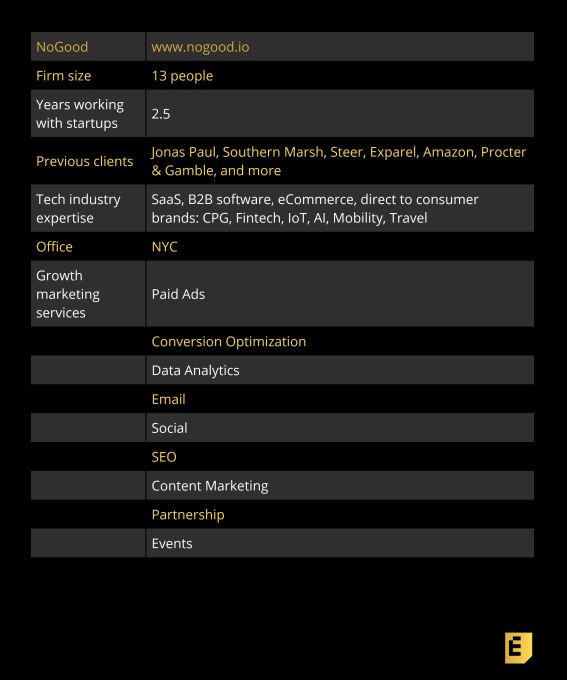
Verified Expert Growth Marketing Agency: NoGood

NoGood CEO Mostafa Elbermawy describes how they evaluate a client’s growth challenges by quoting Zen teacher Hunryu Suzuki: “In the beginner’s mind there are many possibilities; in the expert’s mind there are only a few.” Rather than deferring to in-house playbooks, NoGood adopts an open mind combined with a methodical, data-driven approach to find untapped growth opportunities for its clients. Learn more about how NoGood came to be and why they’re willing to say no to potential clients.

On NoGood’s approach to growth:

“Our work is methodical. It’s intentional. We have to talk about it. We are very transparent about what we do and it’s completely process oriented. Hacking is a misnomer. Growth is not about clever shortcuts. It has to be sustainable and repeatable, and if it’s not, we won’t do it.”

On NoGood’s proudest accomplishment:

“They helped us launch our business. They are our CMO and our CTO. Would recommend to anyone.” Erica Tsypin, Washington D.C., Co-Founder & COO, Steer

“Our success in jumpstarting Steer’s business is one of our proudest accomplishments this year. Steer is an electric car subscription startup that asked us to increase their activations. Basically, our job was to generate new active members, which not only meant encouraging more users to download the app, upload a license, and get approved, but it also meant delivering a car to a member’s door, having them drive that car and leaving a review. We were able to demonstrate signup traction for Steer and help them launch in under three months.”


Below, you’ll find the rest of the founder reviews, the full interview, and more details like pricing and fee structures. This profile is part of our ongoing series covering startup growth marketing agencies with whom founders love to work, based on this survey and our own research. The survey is open indefinitely, so please fill it out if you haven’t already.


Interview with NoGood CEO and Growth Lead Mostafa Elbermawy

Yvonne Leow: To kick things off, how did you get into growth?

Mostafa Elbermawy: Well, I went to school for archaeology, but hieroglyphics weren’t paying the bills, so I taught myself how to code and started a web design studio after college. I started building websites for clients, and they started asking me how to drive more users to their sites to help grow their business.

I started tinkering with growth out of curiosity, and eventually joined the digital experience team at American Express. That job helped me gain some marketing and growth experience, and I ended up falling in love with that part of the job.

18 Jun 2019

Microsoft PowerPoint gets an AI presentation coach

Love it or hate it, Microsoft’s PowerPoint is a ubiquitous tool in the corporate world. Over the course of the last few years, Microsoft started to bring some of its AI smarts to PowerPoint to help you design good-looking slides. Today, it’s launching a number of updates and new features that make this even easier. Even the best-designed presentation isn’t going to have much of an impact if you’re not a good public speaker. That’s a skill that takes a lot of practice to master and to help you get better, Microsoft today also announced Presenter Coach for PowerPoint, a new AI tool that gives you feedback while you’re practicing your presentation in front of your computer.

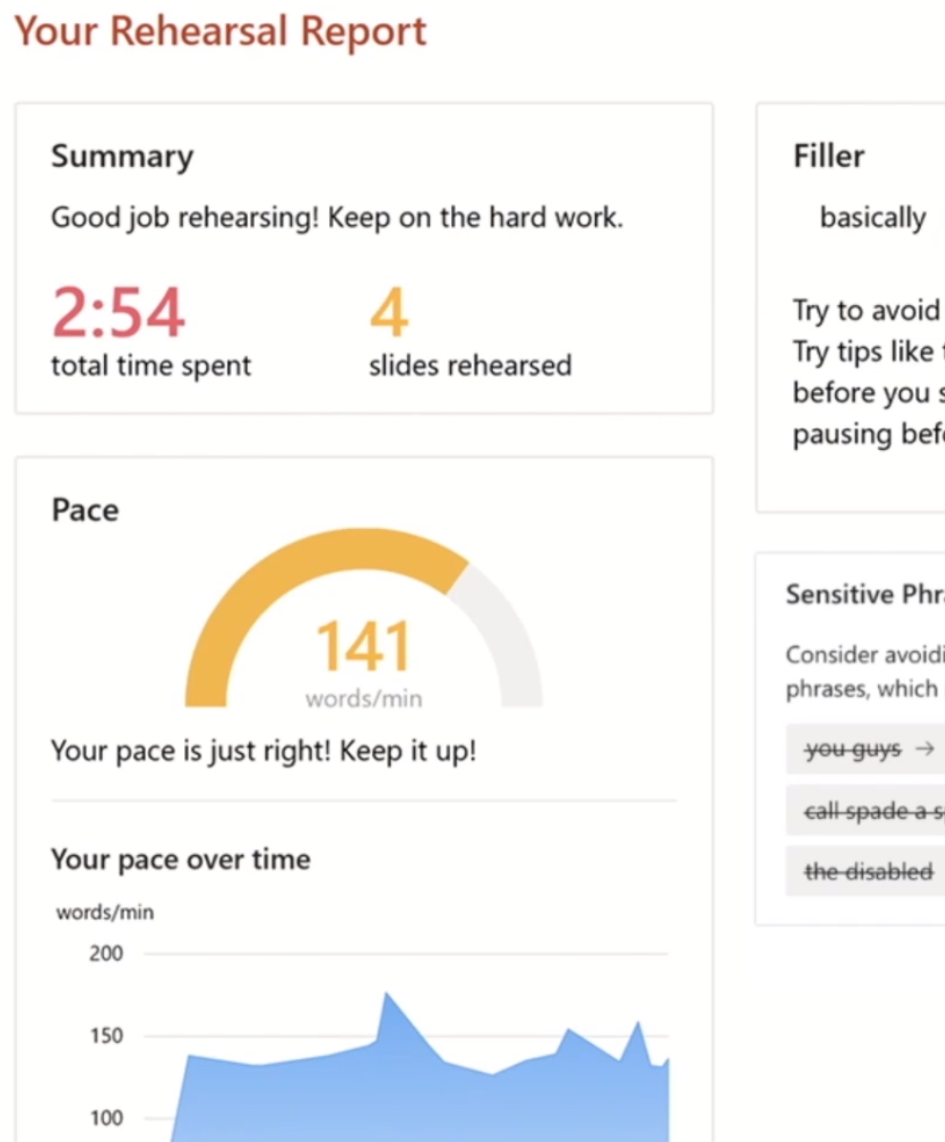
Microsoft’s AI can’t tell you if your jokes will land, of course, but the new coaching feature gives you real-time feedback on your pacing, for example, tell you whether you are using inclusive language and how many filler words you use. It also makes sure that you don’t commit the greatest sin of presenting: just reading the slides.

After your rehearsal session, PowerPoint will show you a dashboard with a summary of your performance and what to focus on to improve your skills.

This feature will first come to PowerPoint on the web and then later to the Office 365 desktop version.

As for the visual design, Microsoft today added new features like Designer theme ideas, which automatically recommends photos, styles and colors are you write your presentation. This feature is now rolling out for Office 365 subscribers on Windows, Mac and on the web.

If you work in a large corporation, then chances are you have to use your brand’s house style. With Designer for branded templates, companies can now define their brand guidelines and logos so that Design Ideas takes these into account as PowerPoint suggests new designes. This feature is now rolling out to to Office 365 Insiders subscribers on Windows 10 and Mac.

No announcement is complete without some vanity metrics, of course, so today, Microsoft announced that Designer has now created 1 billion slides since it launched in 2016. Hopefully, that means the world has seen fewer bad presentations in the last few years and with today’s launch of the new coaching features, maybe that means we have to hear fewer bad presentations soon, too.

18 Jun 2019

How Facebook’s Libra is similar in concept and motivation to Kik’s Kin cryptocurrency

Facebook unveiled its Libra cryptocurrency initiative today, which is part of an alternative financial system (including new subsidiary and wallet ‘Calibra‘) it aims to build alongside industry and academic partners including MasterCard, PayPal, Visa, Uber, Andreessen Horowitz and Creative Destruction Lab. Facebook’s plans for Libra sound ambitious, risky and novel – but a predecessor exists that can shed light on some of the company’s motivations, and possibly the shape it wants the project to ultimately take.

I’m talking about Kik’s Kin, the other cryptocurrency created by a social network. Kin is likely most well-known for being the subject of a current SEC lawsuit, which specifically targets the initial coin offering (ICO) Kik ran in 2017 around the currency to generate capital. The SEC filed suit earlier this year, claiming that the $100 million offering was illegal because it was not registered with the agency.

Leaving aside the merits of the lawsuit against Kik (CEO Ted Livingston contends that it’s down to a fundamental disagreement over whether cryptocurrencies are currencies with utility value – Kik’s position – or securities subject to securities regulation – current SEC thinking), Kin provides a lot of insight into what Facebook is doing with its own cryptocurrency play, and why.

Speaking at Creative Destruction Lab’s Super Session event during a fireside last week, Livingston said that Kin was originally created to address the very specific challenge Kik had of “we need to make money.” Kik tried a few different models, including a “Cards” concept that was essentially trying to set up an app ecosystem within a messaging platform in a North American context, much like the WeChat model works in China.

Kik, while never having achieved anywhere near the scale of a Facebook, has had periods of impressive success and growth in terms of its user community (albeit with some valid questions around the quality and make up of those active on the network). Despite strong user numbers, however, the company never pursued the kind of advertising-based revenue model embraced by Facebook, and so in 2011, when Kik “learned about Bitcoin,” the company though “this might just be the business model we were looking for,” according to Livingston’s recounting of Kin’s origins.

The Kik CEO said that Kin made sense because it’s an effective, easy way for people on the platform to quickly and easily exchange value, something they said was organic for their community because they see a lot of naturally-occurring communities where experts provide their expertise to others with similar interests (ie., taking care of succulents or cooking). Blockchain -based Kin allowed enabled them and their developers to both guarantee the scarcity of a digital asset, and to move it around easily without having to trust an intermediary.

For Kik, the key was that this meant that use of Kin set up a mutually beneficial incentive model in which Kik was generally incented to boost use of Kin, as were developers, since it operated in their own interests as well – meanwhile, users were incented bc of Kin’s use value. The interest alignment, for Livingston, was crucially different from an advertising-based model which can cause severely misaligned incentive structures for all parties involved, as we’ve seen.

Everything that Livingston pointed out about Kin is likely true for Libra, too – the major difference between the two companies are their scale, stage of growth, and economic power. Kik turned to cryptocurrency as a revenue model because it needed one, and needed one more or less immediately (which led to the ICO piece). Kik also didn’t have the market-mover ability to enlist such big name partners at launch – it needed to hit the ground running and hope partners would come along after demonstrating community traction.

Facebook has the industry weight to bring in collaborators early, and partners don’t really need any motivation beyond not wanting to suffer the opportunity cost if it works out. They also have plenty of runway in terms of their existing business model: Advertising. But underlying the Facebook and Kik plans seems to be a fundamental similarity – an assumption that eventually, a revenue model based on something other than advertising could be more sustainable, or more palatable to consumers. The question to answer will be whether and when Facebook’s efforts here switch from being a hedge to a necessary commitment to ensure survivability.

18 Jun 2019

Focals by North Review: The future is (almost) here

The concept of an IRL heads-up display has been a part of science fiction since basically the beginning. Big players have tried their hand at it with less than stellar results — most notably Google with Glass, and more recently Intel’s Vaunt. But North may have cracked the nut on smart glasses with Focals.

They are not perfect by any stretch of the imagination — they’re slightly heavy and don’t feel quite as seamless as science fiction promised they would — but this may be the best pair of smart glasses yet.

Who

Focals were created by North, a Canadian company backed by Intel Capital, Spark Capital and the Amazon Alexa Fund with nearly $200 million in funding. Around the time Google Glass was released, founders Aaron Grant, Matthew Bailey and Stephen Lake were working on a smart arm band. They were disenchanted, as were many, with Glass and sought out to make something better.

Their first priority? Make a great pair of glasses, then outfit them with technology. In order to do that, they had to allow for prescription lenses, which means that the lenses of their product had to be curved. This throws a huge wrench in the idea of lens-projected notifications and content, so Focals created its own special projector.

The company also felt that the touchpad on the side of Google Glass was overly cumbersome, leading them to build the Focals Ring to let users navigate through the menu.

What

The Focals are technically AR glasses, but they’re not focused on gaming or content consumption. The product is designed to move notifications from your phone to your sightline. It’s a bit like an Apple Watch for your face.

These notifications include the date and time, the weather, text notifications, email, Slack, Apple News alerts, Uber notifications, sports scores, turn-by-turn navigation and more. Users navigate through this content using the Ring, outfitted with a nub of a joystick, which is meant to be worn on the index finger of your dominant hand.

Users can proactively seek out information by clicking the joystick and scrolling, but the headset also serves up information in a push notification, including incoming messages and emails.

Importantly, North implemented a smart response system to keep users from having to pick up their phone each time they get a notification. The system gives users two options: choose from a list of smartly generated responses, or use speech-to-text through Focals’ built-in Alexa integration (the system is listening via built-in mic — but wearers have to opt-in during set up).

However, one of the great advantages for the Focals is also one of its weaknesses. The company chose to build a custom pair of glasses that could work with Rx lenses. That also means that the eyebox (the surface where you can see the projection) is smaller than other AR gadgets, which often use waveguides. In other words, your Focals have to be positioned pretty near perfectly to see the image. The company works hard to make sure that’s the case, fitting the glasses to your specific face. But glasses shift and move throughout the day, which means there’s plenty of re-adjusting in order to see the picture.

All that said, the Focals look surprisingly good. In fact, passersby would be hard-pressed to detect that they’re smart glasses in the first place. They aren’t comfortable enough to wear all day — the extra weight on the front means they get a bit uncomfortable after a few hours. But overall, these are pretty discreet as far as smart glasses go.

How

It’s a relatively time-consuming process to get your hands on a pair of Focals. Because the fit and size are so important to usability, users interested in purchasing a pair have to go to one of North’s two stores (there’s one in Toronto, and one in Brooklyn, NY).

The visit to the store is by appointment. Upon arrival, store associates will take you into a booth where you’ll sit before 11 cameras that will 3D model your head, determining where your eyes and ears sit relative to the rest of your face. The cameras also try to understand your gaze.

From there, you get a demo with a standard (not fitted) pair of Focals, during which you learn how to align the Focals and use the Ring. It takes a few weeks for your custom-fit Focals to be ready to pick up, at which point you go through a final sizing with an optician.

It’s tedious, and will be difficult for the company to scale, but it’s part of what gives Focals an edge in quality. Luckily for folks outside of Toronto and NY, Focals is heading off on a pop-up tour. You can check out the tour dates and locations here.

Why

‘Why?’ is perhaps the toughest question to answer when it comes to the Focals. The goal, as outlined by the company, is to keep you connected to the digital world without taking you out of the real world. In short, stop looking down at your phone.

That said, Focals also take away the option. When your phone rings, or even when your Apple Watch buzzes, you have a choice to make: look down, or ignore. When you’re wearing the Focals, that decision is eliminated.

For this reason, I feel like this product is meant for early adopters and folks who enjoy being ultra-connected to the digital world. If you’re already addicted to the sweet chime of your phone, the Focals may very well keep you more connected to the real world, and potentially save your neck from some stiffness. But if you do well to live in the real world and don’t appreciate the constant flow of notifications to your phone, the Focals likely won’t help you maintain that separation.

There are also some minor issues with the Focals themselves. The Ring isn’t super comfortable, particularly when typing on a computer (something most of us spend hours each day doing). The Ring also seems like something that would be very easy to lose or break — this hasn’t happened to me yet, but I wouldn’t be surprised if it did. (For now, North is replacing broken rings for free.)

With the Focals themselves, I’d like to be clear when I say that I was pleasantly surprised with the over all experience. The UI is pleasant to look at, and the little chime of a notification that whispers in your ear is most certainly addictive.

However, I found my eyes getting tired after more than an hour wearing the Focals. Using the Focals means that you’re constantly changing the focus of your eyes from close to far away, which can be tiring. Moreover, if the glasses shift a bit on your face, the text of the notification can become fuzzy, making the experience even more tiring.

Plus, the glasses are built to bend halfway through the arms, as opposed to where the arms meet the frames. This means you can’t hang the Focals off the front of your shirt, which is an admittedly minor gripe, but it bugged me throughout the review process.

Add to that the fact that Focals start at $600, this product is really for technophiles. For now.

North is on the right track. The company is constantly developing new features that are released each week — they recently launched Google Fit support to check your steps, as well as language lessons to brush up on your French during your walk to work. And they’ve started with the right priorities in mind. The Focals are fine looking glasses, and in general, the tech works. Now it’s about refinement.

18 Jun 2019

4 days left to score the best price on Disrupt SF 2019

We interrupt your regularly scheduled programming to bring you an important message: You have just four days left to buy your pass to Disrupt San Francisco 2019 before the super early-bird price expires on June 21 at 11:59 p.m. (PT).

There’s a pass priced for every budget (even yours), and you can spread your payments over time when you select the payment plan option during checkout. But once that deadline hits you can kiss up to $1,800 in savings goodbye. Disrupt SF 2019 offers fantastic ROI at any price, but why pay more? Buy your pass now to make the most of your investment.

Speaking of investments, we’re thrilled to partner yet again with All Raise, a startup nonprofit focused on accelerating female founder and funder success. Don’t miss this mini-series of 30 ask-me-anything sessions. You’ll connect with other entrepreneurs and have a chance to ask top investors, well, anything. You’ll find more details and sign-up information here.

Come to Disrupt ready to network with more than 10,000 attendees. If that sounds a tad daunting, fear not. CrunchMatch, our free business match-making service, takes the pain out of networking — and saves your aching feet, too. It helps you find and connect with the right people based on mutual business criteria, goals and interests. Search, find, schedule, meet. It’s that simple.

Nothing but opportunity awaits in Startup Alley. More than a thousand early-stage startups and exhibitors will fill the exhibit hall and showcase a wealth of tech products, services and talent. Want to exhibit there? We have two options for you.

Purchase a Startup Alley Exhibitor Package or you can apply to the TC Top Picks program and exhibit in Startup Alley for free. Applications for TC Top Picks close on July 19, and you have until September 13 to buy your Disrupt SF Startup Alley Exhibitor Package.

And of course don’t miss the crown jewel of every Disrupt: Startup Battlefield, TechCrunch’s epic pitch competition. You can watch it live and cheer on your favorites or you can apply to compete — just be sure to fill out the Startup Battlefield application by June 25th at 11:59 p.m. (PT).

So many great reasons to attend Disrupt San Francisco 2019 on October 2-4. Since you’re going, why not get the best ticket price possible? The super early-bird price expires on June 21 at 11:59 p.m. (PT). Buy your pass today, and we’ll see you in October!

Is your company interested in sponsoring or exhibiting at Disrupt San Francisco 2019? Contact our sponsorship sales team by filling out this form.

18 Jun 2019

Google Calendar is down, it’s not just you

Snow day. All meetings are canceled until further notice. Google Calendar has been hit with what appear to be some pretty widespread issues. The company has confirmed service interruptions via its G Suite Status Dashboard, noting, “We’re investigating reports of an issue with Google Calendar. We will provide more information shortly. The affected users are unable to access Google Calendar.”

I’m in that boot, as are multiple other TechCrunch staff members. It does appear at the moment that other Google services are unaffected by the issue. We reached out to Google for more information, but they simply redirected us to the above status. No further information on what’s going on or whether Taco Tuesday is canceled.

More info as it’s available. Until then, we’ll be happily avoiding all meetings for the time being.

18 Jun 2019

Orbit Fab becomes first startup to supply water to ISS, paving the way for satellite refueling

Not even two years into its existence, orbital fuel supply startup Orbit Fab has chalked up a big win – successfully supplying the International Space Station with water, a first for any private company. It’s a big deal because providing water to the ISS involved a multi-day refueling process, done in microgravity, using processes and equipment Orbit Fab developed itself.

The key ingredient here, per ISS U.S. National Laboratory COO Kenneth Shields, which was the contracting agency for Orbit Fab’s refueling test, is that this method of resupply is totally out of spec in terms of how this process was designed to work on the ISS. By creating and successfully demonstrating a system that the ISS designers never conceived, Orbit Fab has shown that both private companies and NASA have the flexibility needed to build business models on existing space infrastructure.

The technology Orbit Fab developed and demonstrated has broader applications than just moving water around in space. Water was used in this example specifically because it’s one of the most inert propellants used in spaceflight thrusters, but the methods could extend to other common propellants, and make it possible to refuel satellites in orbit. Orbit Fab is working towards establish standard for satellite refueling interfaces to be used in orbital hardware, which could go a long way towards making it common practice to develop reusable satellites, instead of sticking with the more or less disposable hardware model used today.

Startups like Orbit Fab are the key to unlocking true commercialization of space, by identifying points in the value chain where innovation or improvement can lead to cost or resource efficiencies and ensure that space business is actually also viable business, in terms of profit potential.