Month: June 2019

18 Jun 2019

Amazon expands air cargo fleet with 15 more planes, will have 70 planes by 2021

Following news from earlier this month that FedEx was dumping Amazon from its air cargo service, Amazon this morning announced the expansion of its own air delivery network, Amazon Air. The retailer says it’s leasing an additional fifteen Boeing 737-800 cargo aircraft from partner GE Capital Aviation Services (GECAS). These will join the five Boeing 737-800’s already leased from GECAS, announced earlier this year. The aircraft will fly out of over 20 U.S. air gateways in the Amazon Air network.

In addition, Amazon says it will open more air facilities in 2019, including at Fort Worth Alliance Airport, Wilmington Air Park, and Chicago Rockford International Airport. Meanwhile, the main Air Hub at the Cincinnati/Northern Kentucky International Airport will open in 2021.

“We’re delighted to support Amazon Air’s dedicated air network,” said Richard Greener, GECAS Cargo’s Senior Vice President, in a statement. “The capability of the 737-800 freighter will further Amazon’s ability to provide reliable and regional delivery to its customers for years to come.”

The Amazon Air network, then called Prime Air, was first launched in 2016, with the goal of speeding up Amazon’s e-commerce deliveries, particularly for its Prime members. But over the years, the competition with partners-slash-rivals like FedEx have heated up — and not only on air cargo, but also in newer areas like ground delivery robots and drones.

At the end of last year, Amazon announced more aircraft additions for Amazon Air, bumping the network from 40 planes to 50. Today, it says it’s on track to reach 70 planes by 2021, thanks to this new expansion.

The company also claims to have created thousands of U.S. jobs thanks to Amazon’s investment of millions into its air network.

“These new aircraft create additional capacity for Amazon Air, building on the investment in our Prime Free One-Day program,” said Dave Clark, Senior Vice President of Worldwide Operations at Amazon, in an announcement. “By 2021, Amazon Air will have a portfolio of 70 aircraft flying in our dedicated air network.”

These investments around delivery logistics come at a time when Amazon says it’s trying to speed up Prime from two days to just one. The news prompted Walmart to announce its a next-day shipping service of its own. Target, meanwhile, recently launched an integrated same-day shipping service on its website, powered by its same-day service Shipt.

Amazon responded by noting it already has over 10 million items available for one-day shipping today — reminding rivals that it’s still leading the market on this front.

Amazon also took the time today to highlight other areas where it’s investing in supply chain initiatives, including its Delivery Service Partner program, which helps people (including Amazon employees) start their own Amazon delivery business; plus Amazon’s crowdsourced package delivery workforce Flex; and its dedicated network over 10,000 trailers to increase Amazon’s own trucking capacity.

Though not mentioned, Amazon also just rolled out a new Amazon Flex app for iOS. Launched on the App Store on June 12, the app lets individuals sign-up and be vetted to become an Amazon Flex contractor right from their iPhone.

Image credit: Prime Air branded plane, via Amazon Press Center; not representative of today’s news

18 Jun 2019

Dr. Mario is in (on iOS and Android) July 10

After years of heel dragging, Nintendo finally opened itself up to the smartphone world in late-2016. The gaming giant hasn’t exactly opened the floodgates in the intervening years, but Fire Emblem Heroes, Animal Crossing: Pocket Camp and Dragalia Lost have filled the void in some form or other.

There’s something to be said for the company’s thoughtful approach to the category. Nintendo clearly values its IP and is only interesting in releasing games that make sense on the platform. Dr. Mario is pretty high on that list. After all, similar puzzle-style games have come to dominate the mobile platform, and Nintendo had a perfectly good title gathering dust.

Dr. Mario World was unveiled back in February — or the title was, at least — with a broad Summer release for iOS and Android. Last night, Nintendo offered a deeper glimpse in the form of a YouTube video. The basics of the game are similar to the original NES title, with falling capsules that disappear when colors are matched up. Kind of like Tetris, but with more drugs.

The graphics have been improved, of course, along with a social element that lets user connect around the world in social does through networks like Facebook. Mario is joined by “friends,” as well, including familiar characters like Princess Peach, Luigi and Bowser, all of whom apparently studied medicine in whatever sort of universities they have in the mushroom kingdom.

The game will be available on July 10, beating the previously announced Mario Kart Tour, which is also said to be due out this summer.

18 Jun 2019

NASA’s best-yet photo of asteroid Bennu nails the dramatic lighting

NASA has taking a breathtaking new image of near-earth asteroid Bennu, captured by its OSIRIS-REx spacecraft from its new, second orbit of the extraterrestrial object. The new picture, snapped on June 13, provides a pretty much full-length view of Bennu, with half of its surface lit by the sun and the other half in near-complete shadow.

The image also manages to capture an interesting feature of Bennu – the protruding ‘mole’ of its largest boulder, which sticks out at the bottom end of the asteroid (as oriented in this photo) and breaks up its relatively smooth contours. OSIREX-REx took this photo from only around 0.4 miles away from the rock, which is about two football fields away. From here, the cameras on the probe can capture detail as small as just 1.6 feet across – basically the size of an Xbox One – on the asteroid’s surface.

This orbit breaks a record for closest orbit by a spacecraft of any object in our solar system, and will help NASA researchers investigate debris plumes spotted coming from the surface of the asteroid as it careens through space. Meanwhile, we immediately benefit thanks to glamour shots like this one:

18 Jun 2019

GoTenna is ramping up public sector mesh networking with a $24M C round

GoTenna is best known for its outdoors-oriented consumer products that let you text and share locations between smartphones off the grid. But the company has found that government work — military, fire, rescue — is the real market, and is pursuing it with a vengeance on the strength of a $24 million funding round.

“We’ve been busy!” said Daniela Perdomo, founder and CEO of the company, in an interview. “We have a good problem, which is a technology that can be so foundationally enabling for so many use cases.”

GoTenna’s core tech is mesh networking over radio frequencies normally used for walkie-talkies: long range but low bandwidth. Yet if all you need to send are GPS coordinates or a short message, it’s perfectly sufficient and works great where mobile and satellites connections are impractical. Just on the device, smaller than a deck of cards, and you can chat over miles in the middle of nowhere with your climbing partners or back country ski pals.

In the last couple years the company has shifted its priorities from consumer tech — the GoTenna and Mesh series of gadgets — to filling the needs of public sector clients that have been asking for something like this for years.

Firefighters, military operations, local law enforcement, search and rescue — many were using bulky, over-engineered, expensive solutions that haven’t changed much in decades. GoTenna works with nearly any smartphone and instantly creates a mesh network that can span miles, making it perfect for off-grid communications.

Perdomo said this was actually more or less the plan from the beginning.

“It was in my first ever pitch deck when we raised our seed in 2013, there was this blue-sky vision of how the technology would be used,” she told me. “But it was simpler to launch an MVP to consumers. We always felt that product was going to bring in the public sector. And that’s exactly what happened — when we launched our first generation product, I think within 24 hours we had a variety of different public sector customers reach out to us.”

“We now have some federal agencies that have been customers through every generation of the product. We sill have our consumer product, and people love it, but it’s a small part of our business compared to the public sector,” she said.

An example of how the interface might look in use. It can relay the locations of other GoTenna devices at intervals, helping teams keep in touch automatically.

While disaster response crews could of course just buy a couple dozen of the regular GoTenna products, they were quick to ask for “pro” versions with features prized by advanced users and military customers.

Longer range, more programmable wireless parameters, compatibility with various legacy systems — the Pro and new ProX versions of the GoTenna system hit a lot of sweet spots. As Perdomo told me when the Pro first came out, legacy systems are powerful in some ways but can also be horribly expensive, incompatible with foreign wireless systems, or even have legal restrictions on where they can be used.

For a cash-strapped NGO that goes around doing global aid, a $100-$500 gadget that turns an ordinary phone into a versatile mesh node is potentially game-changing. (You can also use them to temporarily replace destroyed communications infrastructure.)

But deep-pocketed federal agencies and military branches are also shelling out for the devices, and increasingly for the software support contracts that go with them. GoTenna’s Aspen Grove is a proprietary mesh network protocol that they’ve engineered to be faster and more robust than anything else out there. I’d exert a little skepticism here normally, but from what I’ve seen the systems GoTenna is replacing or augmenting aren’t exactly competitive.

In fact GoTenna’s next major hardware project is to create a mesh networking board that can be integrated right into existing hardware, simplifying the systems and baking its protocols in even deeper.

“We have a long list of companies that want to integrate our tech into vehicles, aircraft, anything you can think of,” Perdomo said. “So you can put one of these babies on a UAV and let ‘er rip! Our record range, point to point from a UAV, is 69 miles.”

Meanwhile the company is also releasing a broader open source mesh platform called Lot 49 that’s meant to be capable of supporting a global messaging infrastructure without relying on any wireless providers. That could be a big deal for internet of things type devices as well.

Interestingly, Perdomo doesn’t feel threatened by the new and rather scary kid on the block: communications satellite constellations like Starlink and OneWeb. If the idea is that GoTenna lets you communicate where the grid doesn’t reach, what happens when the grid is global?

“No matter how many satellites you put up, repeaters you put up, cables you lay down, you always have that last mile. You need resiliency, access, and I believe neutrality as well,” she said. And indeed you’re not going to take a Starlink ground station with you on a covert operation or into an active wildfire. And having an existing, ongoing business agreement with a satellite communications provider may not even be desirable in the first place.

“There’s a reason why certain incumbents in the tactical radio space as well as carriers are partnering with us,” Perdomo pointed out — and indeed Comcast Ventures is a new face among the investors. “We’re creating a new layer in the communications stack, mesh networks with a focus on bursty data. I think of us as perfectly complementary to every other communications company.”

As for that funding, it will go towards easing the rapid growth the company is experiencing, finishing the pro and embedded options, hiring up, and expanding operations to support their growing services business. The $24M round was led by Founders Fund, with participation from Comcast Ventures and existing investors Union Square Ventures, Collaborative Fund, Walden VC, MentorTech, and Bloomberg Beta.

“We’ve been in R&D for a really long time,” Perdomo said. “It’s exciting now to also be becoming a business. All of the most impressive mainstream telecommunications technologies we use today, things like the internet or GPS, they hit it out of the park with the public sector first. If you can win there, in life or death situations, you know you can win everywhere else as well.”

18 Jun 2019

Youper, a chatbot that helps users navigate their emotions, raises $3 million in seed funding

Youper, a mental health app with a chatbot it calls an “emotional health assistant,” has raised $3 million in seed funding from Goodwater Capital. The funds will be used to accelerate development of Youper’s artificial intelligence-based capabilities and grow its user base.

Based in San Francisco, Youper was co-founded in 2016 by Dr. Jose Hamilton. For a decade, Hamilton worked as a psychiatrist in clinical settings, seeing more than 3,000 patients. While talking to them, he realized that a handful of barriers kept many people from seeking help earlier, even if they had dealt with anxiety or depression for years.

“The first one is fear, taking care of yourself, talking about your mental health, understanding your mental health,” he tells TechCrunch. “Seeing a therapist or psychiatrist is super intimidating. That’s why all of my patients used to say the same things. The second barrier is cost, of course. Psychiatrists and therapists are super expensive.”

Hamilton teamed up with co-founders Diego Couto, the startup’s chief product and growth officer, and Thiago Marafon, its CTO, to create an app that would make mental healthcare less intimidating and more accessible. They originally created an app that did not have a conversational interface. Instead, Hamilton says it took a similar approach to Calm and Headspace. But that resulted in a very low user engagement rate and after a year, the team realized Youper needed to provide a more personalized experience, matching users to the right psychological techniques, including cognitive behavioral techniques and mindfulness, for their needs.

Youper is part of a growing roster of apps that use AI-based chatbots to help users improve their emotional health, including Woebot, Wysa and X2’s Tess. Hamilton says Youper wants to differentiate with its focus on personalization, combining mental health research and user data to match the right psychological techniques with users.

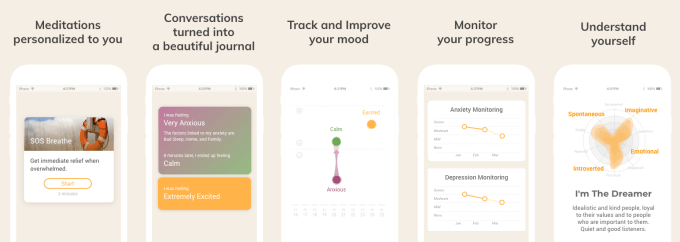
Screenshots from Youper, an app for emotional well-being.

Screenshots from Youper, an app for emotional well-being.

The startup claims Youper has been downloaded more than one million times so far. Most of its users are young adults and that there are more women than men who use Youper.

“I think that’s because women are facing new challenges in our society by conquering new spaces and assuming new roles, and that poses an emotional toll. Another reason is that women are more tuned into self-care than men,” he says. “Sometimes I feel that we men wait for too long suffering in silence.”

For users who have never consulted with a provider, Youper provides a gentle introduction to the types of questions and exercises they might experience in therapy. The questions and exercises given by Youper’s chatbot are meant to help users achieve a better understanding of their emotions, thoughts and behavior.

Youper’s chatbot asks users to focus on their thoughts and identify how they are feeling from a menu of descriptive words. Then a scale that lets them rate the strength of that emotion from “slightly” to “extremely.” More questions help them narrow down what is causing those feeling and track their mood. Users are also given options for mindfulness exercises and journaling prompts.

Hamilton says that the average time users spend during each session with its chatbot is about seven minutes, with 80% reporting a reduction in negative moods after one conversation. The startup also claims that after 30 days, a quarter of people who signed up for Youper are still active users.

Youper is currently free, though the company may test a freemium model in the future with premium features. It uses anonymized user data in its own research to improve Youper, but keeps it private and does not share or sell user data or information.

Of course, an app is not a replacement for seeing a therapist or psychiatrist, but Youper presents a much lower barrier to entry for people who worried about the stigma of seeing a professional. Hamilton says he hopes using Youper will encourage more people to seek medical treatment sooner if they need it by making them more comfortable with the idea of discussing their emotional health.

“On average, it takes 10 years for someone to finally talk to a health provider. This could become 10 minutes with an app like Youper,” Hamilton says. “Having an app with a super low barrier to entry, no stigma, something that is about emotional health and taking care of yourself, shows that you don’t need to be afraid.”

18 Jun 2019

Amazon’s Twitch acquired social networking platform Bebo for $25M to bolster its esports efforts

While Facebook makes a bold move into cryptocurrency to capitalise on its multi-billion user base, a social network that was once a credible competitor to it has quietly been snapped up by a subsidiary of Amazon. TechCrunch has learned and confirmed that Bebo, one of the earlier platforms to let people share thoughts and media with their friends, has been acquired by Twitch, the streaming video platform owned by Amazon. Together the two will be working on building out Twitch’s esports business, and specifically Twitch Rivals.

A spokesperson for Twitch confirmed the acquisition, which includes both people (around 10 employees) and IP, but declined to provide further comment.

From what we understand from our sources, Twitch paid $25 million for the company earlier this month, after beating out at least one other bidder, Discord (which itself has been building out its own esports business). Indeed, LinkedIn profiles for ex-Bebo employees — see here, here, and here — now at Twitch note June as the changeover date.

It has been a long and winding road for Bebo over the years. Starting out way back in 2005 by Michael and Xochi Birch as an early social networking site, Bebo quickly became the market leader in a couple of English-speaking countries, specifically UK and Ireland.

Bebo’s growth trajectory and the bigger opportunity in social were enough to get it acquired for about $850 million by AOL back in 2008, apparently beating out a number of other interested large tech and media companies interested in getting their own social media platform and the audience that would come with it (disclaimer: AOL eventually also acquired TechCrunch, too).

But the deal was a certifiable dud, with Bebo never managing to build on its early traction, and AOL not being in a position to know how to fix that. Less than two years later, it was sold on to Criterion Capital for $25 million.

Yet as the social wheels continued to turn, and even once-global market leader MySpace also fell back as Facebook, Twitter, Instagram and other mobile-friendly platforms pulled out ahead, even that $25 million price turned out to be too high. After Bebo filed for Chapter 11 bankruptcy protection, the original founders, the Birches, bought it back in 2013 for $1 million with a pledge to reinvent it.

And so they did, putting in place a small team led by Shaan Puri, who worked on a number of ideas to see which of them could fly. (And I don’t know if this was a tongue in cheek joke about how challenging they knew the task would be, but it seems that the holding company set up to house some of the IP and legal aspects of the endeavor was called “Pigs in Flight.”)

The new app studio effort, which went by the name Monkey Inferno (another great one), came out of the gates with “Blab”, a “walkie-talkie” ephemeral video messaging service, which picked up millions of users quickly but found it hard to retain them. It shut down a year later, and it looks like Monkey Inferno dabbled in a few other things before coming to esports.

From social networking to socialising esports

In that last pivot, Bebo first tried out streaming services for esports players, but that proved to be tough competition against dominant platforms like OBS and Xsplit. Then, in an interesting nod to its earlier history in social networking and organising groups of friends, it shifted once more, into organising and running tournaments for streamers, with leagues and more: the streams ran on Twitch and Bebo organised viewers, leagues and other things around that.

That site, Bebo.com, is now offline, and all its tweets seem to have been deleted, but the idea was to build out leagues and tournaments for any and all kinds of groups and players, for example complete beginners, or high school students.

It was the last of these that turned out to line up with a growing market segment.

According to a report in eMarketer, esports attracted some 400 million users in 2018 and pulled in revenues of $869 million from sponsorships, player fees and advertising, and it is projected to be worth between $1.58 billion and $2.96 billion by 2022. And Bebo was helping organise and build those communities.

And that is now linking up neatly with Twitch, which had been developing its own casual esports operation in the form of Twitch Rivals. This launched in beta in 2018 and is now widely available wherever Twitch is.

The Bebo tech and its team are now both being put to use on Twitch Rivals, to help continue expanding it with more features and more users. To be clear, though, it seems there is no intention — from what I understand — to parlay Bebo’s past efforts in social networking into a wider social networking play at Twitch: the focus is on esports.

Still, the acquisition comes at a key moment. Since January, there have been reports that Amazon is working on a new game streaming service (just like Apple, Google and others), which likely won’t be out until next year. While there is no news on that today, you can see how expanding the variety and breadth of content on Twitch by way of esports leagues and tournaments fits in with a wider effort to bring more regular, engaged users into the Amazon fold, using this as one of the big draws.

We’ll update this as and if we learn more.

18 Jun 2019

New iOS feature prompts you to cancel subscriptions when uninstalling apps

There are operating system updates that feel tacked on or otherwise not particularly useful. Then there are those that genuinely alter the way you interact with a device. This new addition by way of iOS 13’s second beta falls firmly into the latter, prompting users to cancel a subscription upon uninstalling from an app.

Spotted by MacStories’ Federico Viticci, the new offering is — if not a game changer, definitely a money saver. The App Store monetization paradigm long ago shifted from up front payments to subscription services, many of which are no doubt banking that many user will simply forget the reoccurring payments they signed up for way back when.

The feature, which notes the next automatic renewal date and offers a link to “manage [the] subscription,” will no doubt be a disappointment to those developers. But no should be paying for services they’re not actively using. Of course, you can always hit “keep,” if you’re using the app on another device, plan to reinstall or simply like giving money away in monthly installments to poor, starving app developers.

iOS 13 got its big onstage debut at WWDC earlier this month. The headline updates include dark mode and new privacy features, but this small addition could prove among the most useful.

18 Jun 2019

Anti-spam service Truecaller adds free voice calling feature

Truecaller, an app best known for helping users screen calls from strangers and spammers, is adding yet another feature to its service as it bolsters its super app status. The Stockholm-based firm said today that its app can now be used to place free VoIP-powered voice calls.

The company told TechCrunch on Tuesday that it has started to roll out the free voice calling feature to its Android users. It expects the rollout to reach all Android users in the coming days. The feature, which currently only supports calls between two users, will arrived on its iOS app soon.

In emerging markets such as India, where 100 million of its 140 million users live, free voice calls has been a long-sought after feature. Until late 2016, voice calls were fairly expensive in India, with telecom operators counting revenue from traditional calls as their biggest profit generator.

But in the last two and a half years, things have changed dramatically for hundreds of millions of users in India after Reliance Jio, a telecom operator owned by India’s richest man Mukesh Ambani, launched its network with free voice calls and low-priced data services. Reliance Jio has already amassed over 300 million users to become one of the top three telcos in the nation.

Yet, the quality of network still leaves much to be desired in India as traditional calls drop abruptly and run into quality issues more often than one would like. Truecaller said that its voice calls rely on data services — mobile data and Wi-Fi — and claimed that they can work swiftly even on patchy network.

The addition of voice calling functionality comes as Truecaller aggressively looks to expand its business. The service, which offers both ad-support free tier and subscription bundle, has added messaging, mobile payments, and call recording features in recent years. Earlier this year, it also added a crediting option, allowing users in India to borrow a few hundred dollars.

A representative with the company said Truecaller began exploring the free voice calling feature a few months ago. It began testing the new functionality with alpha and beta test group users four weeks ago. It now plans to introduce group voice calling support soon, the company said.

With the new feature, Truecaller now competes even more closely with WhatsApp . The Facebook-owned app has become ubiquitous in India with more than three-quarters of India’s smartphone base using the app.

18 Jun 2019

MongoDB gets a data lake, new security features and more

MongoDB is hosting its developer conference today and unsurprisingly, the company has quite a few announcements to make. Some are straightforward, like the launch of MongoDB 4.2 with some important new security features, while others, like the launch of the company’s Atlas Data Lake, point the company beyond its core database product.

“Our new offerings radically expand the ways developers can use MongoDB to better work with data,” said Dev Ittycheria, the CEO and President of MongoDB. “We strive to help developers be more productive and remove infrastructure headaches — with additional features along with adjunct capabilities like full-text search and data lake. IDC predicts that by 2025 global data will reach 175 Zettabytes and 49% of it will reside in the public cloud. It’s our mission to give developers better ways to work with data wherever it resides, including in public and private clouds.”

The highlight of today’s set of announcements is probably the launch of MongoDB Atlas Data Lake. Atlas Data Lake allows users to query data, using the MongoDB Query Language, on AWS S3, no matter their format, including JSON, BSON, CSV, TSV, Parquet and Avro. To get started, users only need to point the service at their existing S3 buckets. They don’t have to manage servers or other infrastructure. Support for Data Lake on Google Cloud Storage and Azure Storage is in the works and will launch in the future.

Also new is Full-Text Search, which gives users access to advanced text search features based on the open-source Apache Lucene 8.

In addition, MongoDB is also now starting to bring together Realm, the mobile database product it acquired earlier this year, and the rest of its product lineup. Using the Realm brand, Mongo is merging its serverless platform, MongoDB Stitch, and Realm’s mobile database and synchronization platform. Realm’s synchronization protocol will now connect to MongoDB Atlas’ cloud database, while Realm Sync will allow developers to bring this data to their applications. 

“By combining Realm’s wildly popular mobile database and synchronization platform with the strengths of Stitch, we will eliminate a lot of work for developers by making it natural and easy to work with data at every layer of the stack, and to seamlessly move data between devices at the edge to the core backend,”  explained Eliot Horowitz, the CTO and co-founder of MongoDB.

As for the latest release of MongoDB, the highlight of the release is a set of new security features. With this release, Mongo is implementing client-side Field Level Encryption. Traditionally, database security has always relied on server-side trust. This typically leaves the data accessible to administrators, even if they don’t have client access. If an attacker breaches the server, that’s almost automatically a catastrophic event.

With this new security model, Mongo is shifting access to the client and to the local drivers. It provides multiple encryptions options and for developers to make use of this, they will use a new ‘encrypt’ JSON scheme attribute.

This ensures that all application code can generally run unmodified and even the admins won’t get access to the database or its logs and backups unless they get client access rights themselves. Since the logic resides in the drivers, the encryption is also handled totally separate from the actual database.

Other new features in MongoDB 4.2 include support for distributed transactions and the ability to manage MongoDB deployments from a single Kubernetes control plane.

18 Jun 2019

Dishcraft launches with a massive robotics-powered dishwashing system

Bay Area-based robotics startup Dishcraft has unveiled a massive robotics and AI-powered dishwashing system. Like much of the rest of the industrial robotics industry, the company’s looking to automate a dull task with a high turnover rate, which amounts to about a month of employment on average.

It’s a beast of a system from the looks of it. Employees drop dishes off into stacks, which are then loaded into the robotic system up to 90 at a time. It uses a vision-based AI system to inspect the plates, cleaning them again if it finds any food remnants left.

It’s probably over the top for a vast majority of kitchens — and while we don’t have quote, it’s almost certainly price-prohibitive, as well. But the startup’s got an interesting pedigree — co-founded by Linda Pouliot and Paul Birkmeyer, who were also involved in the founding of Neato and Dash Robotics, respectively.

Dishcraft has also raised a decent chunk of capital, with more than $25 million in VC, led by Baseline Ventures, First Round Capital and Lemnos. Apparently some of the investors have a personal interest in automating kitchens.

“One of my first jobs was as a dishwasher, so I’ve seen first-hand how outdated and inefficient dishrooms are today and how important they are to the overall operations in a kitchen,” Baseline Ventures founder Steve Anderson said in a press release. “Dishcraft is bringing entirely new thinking, technology, and processes to tackle this problem, and it is long overdue.”

Dishcraft joins a growing number of robotics startups, including Zume and Miso Robotics, that are attempting to automate kitchens with the help of robotic arms. The company is currently selling  customized versions of the solution to kitchen, but has not publicly released pricing.