Month: June 2019

18 Jun 2019

Fairjungle is a modern take on corporate travel management

French startup Fairjungle wants to make it easier to book a flight or a hotel room for corporate purposes. The company just raised a $2 million funding round (€1.8 million) from Thibaud Elzière, Eduardo Ronzano, Bertrand Mabille and Whitestones Ventures.

If you work for a big company, chances are you book corporate flights through GBT, CWT or BCD Travel. And let’s be honest, the web interface usually sucks. It’s often hard to compare flights, change dates or even get a fair price.

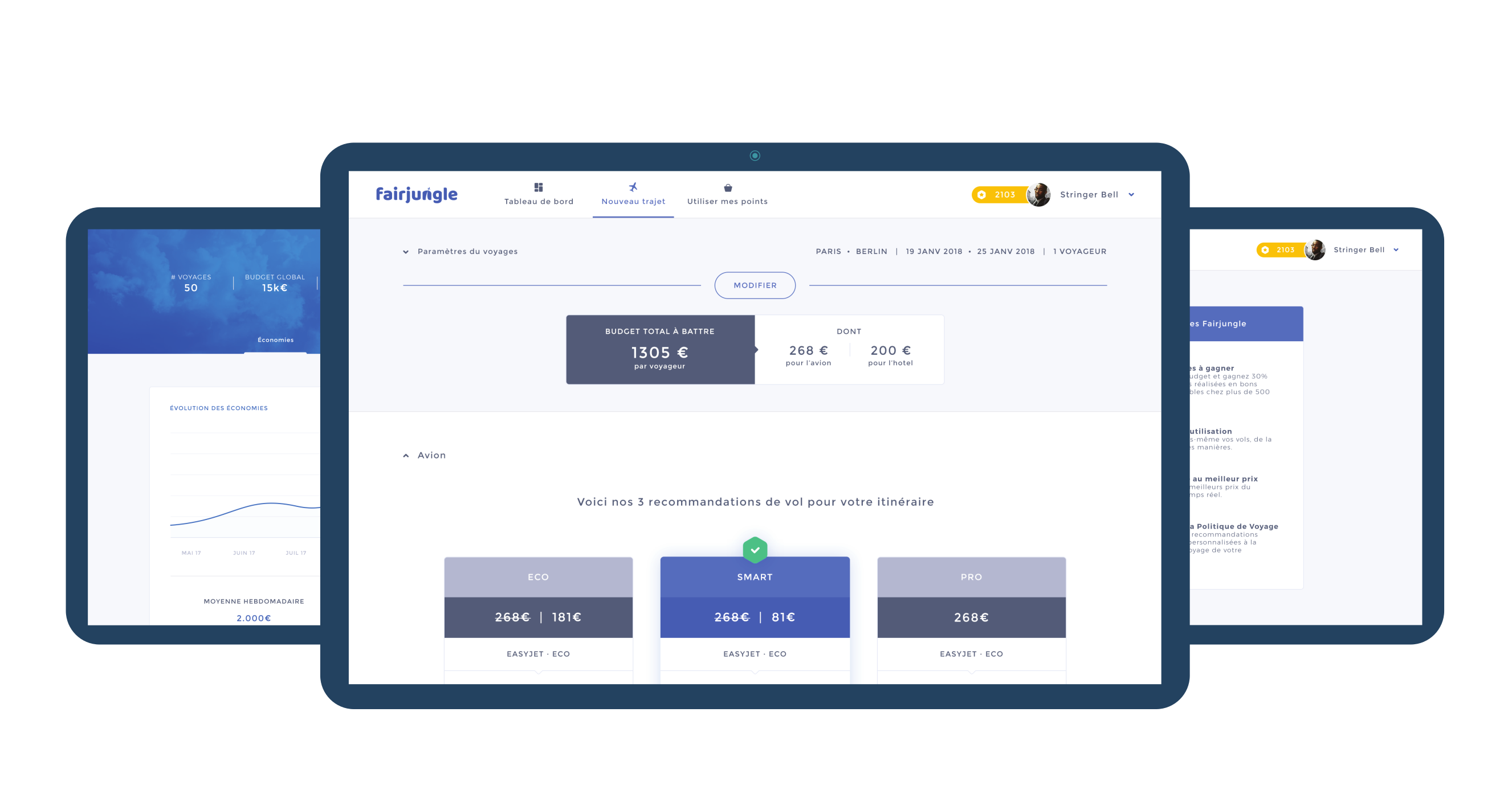
Fairjungle is betting on a modern user experience and a software-as-a-service business model to change this industry. The idea is to make it feel more like you’re using a flight comparison service instead of a travel agency with a website.

“The value proposition [of legacy competitors] was historically around finding the best travel options for the business traveler, which has become obsolete today when you have tools like Skyscanner and Google Flights,” co-founder and CEO Saad Berrada told me.

In order to modernize that industry, the startup is leveraging the inventory of Skyscanner, Booking.com, Amadeus, Travelfusion and Hotelbeds. This way, you can book flights on 400 airlines and reserve hotel rooms in one million hotels.

After searching for a flight or a hotel room, you can book directly from Fairjungle. This way, employees don’t have to download invoices and file expense reports on a separate platform every time they travel. Companies can set up different rules to keep costs down. For instance, a flight that is unusually expensive requires approval from a manager.

Instead of charging per transaction, Fairjungle has opted for a SaaS model with a subscription of €5 per monthly active user.

Fairjungle currently focuses on small and mid-sized companies. The company has attracted 20 clients so far, including OVH. And it expects to generate $3.4 million (€3 million) in gross bookings by the end of the year.

18 Jun 2019

Sprint is the latest telecom to offer a tracking device that uses LTE

Following in the footsteps of AT&T and Verizon*, Sprint is now offering an LTE tracker. The matchbook-sized device, simply called Tracker, provides real-time location tracking on Safe + Found app.

Sprint Tracker

Sprint’s new Tracker

The Tracker competes with Tile, but instead of Bluetooth, Sprint’s device uses 4G LTE, GPS and Wi-Fi location services, so it can be used to track things, people or pets that might travel a significant distance away, compared to a range of 100 ft to 300 ft for Tile (depending on the version). The Tracker is manufactured by Coolpad and users need to pay $2.50 per month for 24 months to cover the cost of the device, plus an additional $5 per month to connect it.

AT&T and Verizon both launched LTE trackers over the past year and Apple is also rumored to be working on a tracking device that connects to iPhones, based on an asset package for pairing devices by proximity spotted in the first beta of iOS 13 by 9to5Mac.

*Disclosure: TechCrunch is part of Verizon Media, a subsidiary of Verizon Communications.

18 Jun 2019

GuestReady raises $6M to help hosts on Airbnb and other services manage their property

GuestReady, a three-year-old service that lets shared-economy hosts manage their business on Airbnb and other rental sites, has announced a $6 million Series A round.

The investment was led by existing backer Impulse VC — the Russian fund that is backed by billionaire Chelsea FC owner Roman Abramovich — and new addition VentureSouq from Dubai. Other past backers also took part, including Boost Heroes, Aria Group and 808 Tech Ventures. GuestReady raised $3 million in 2017 and this round takes it to nearly $10 million from investors to date.

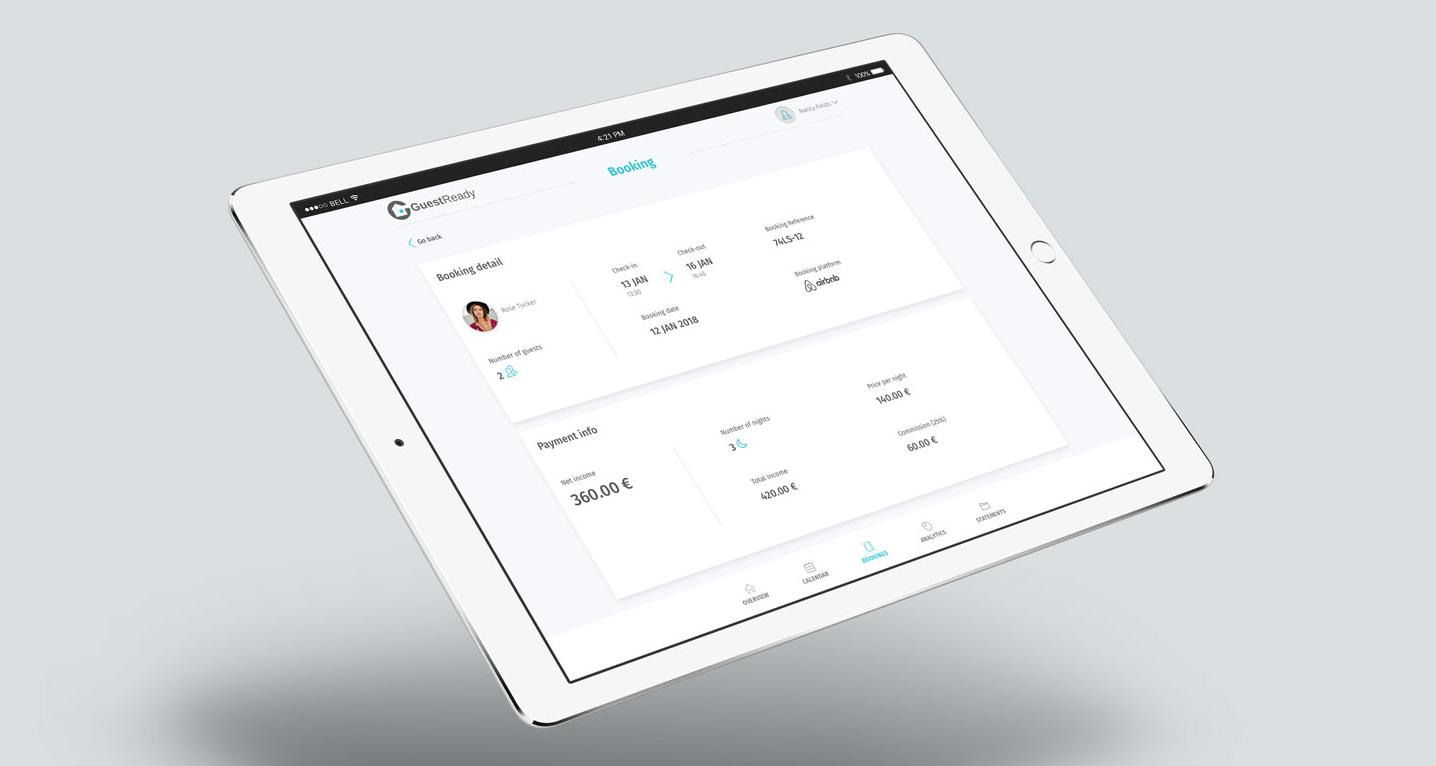
GuestReady’s property management platform helps owners manage the intricacies of operating a shared-economy house, such as cleaning, laundry, and check-in and out services. It claims to cover over 2,000 properties across six countries: the UK, France, Portugal, UAE, Malaysia, and Hong Kong. Airbnb is the obvious platform to work with, but a sizeable volume of business comes from Expedia’s HomeAway business and Booking.com, GuestReady CEO Alexander Limpert told TechCrunch in an interview.

Limpert added that GuestReady’s annual booking volume is close to reaching $50 million on an annualized basis. Over the last year, the company’s take-home revenue has tripled with a lower burn rate, he added, although he declined to provide specific figures.

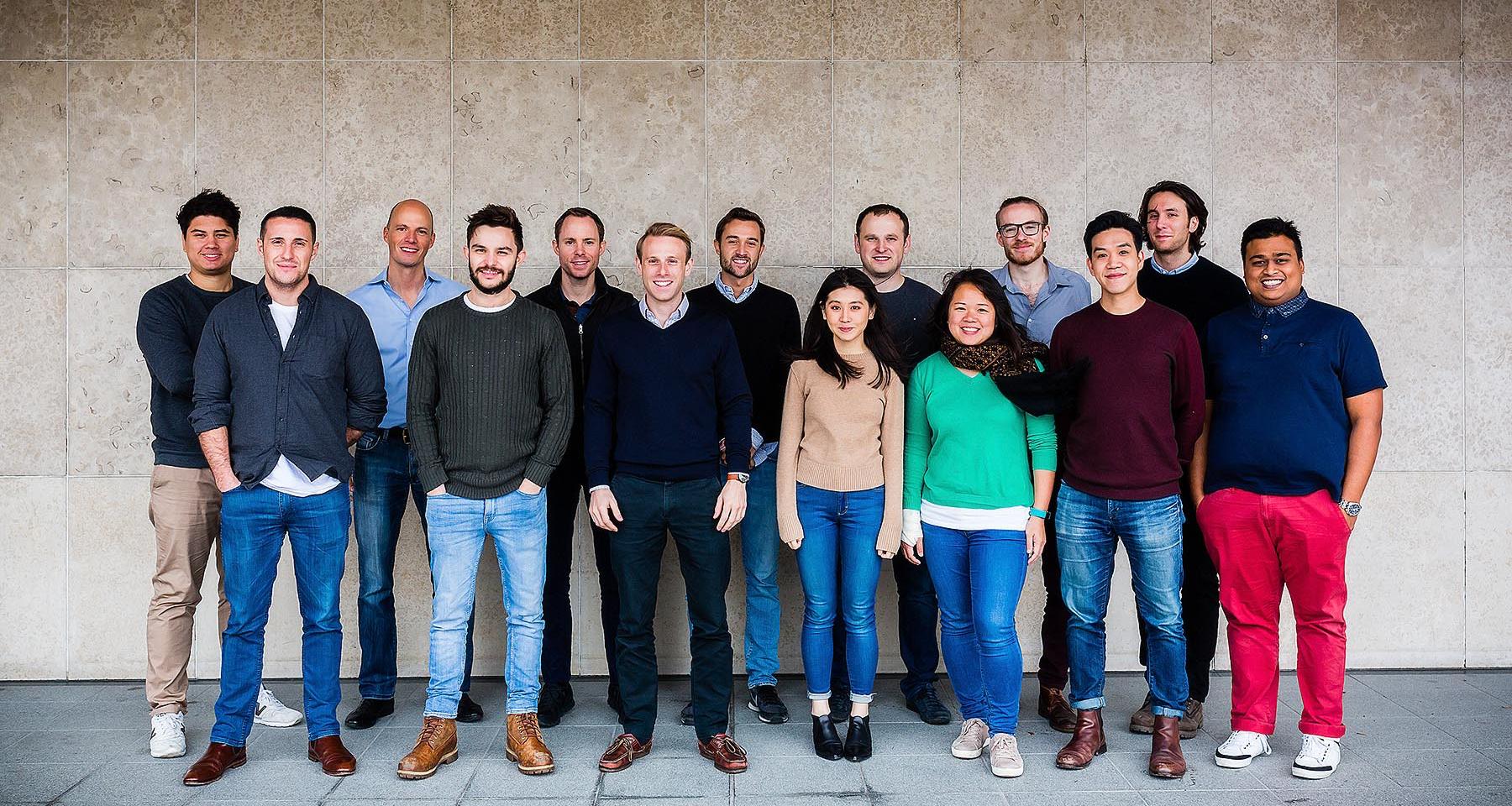
The GuestReady Team

That growth has come courtesy of a series of M&A deals.

Indeed, this new infusion of cash comes months after the company completed its fourth acquisition to date, snapping up France-based rival BnbLord, a startup that it claims is the largest Airbnb host platform in France and Portugal.

That deal, which Limpert said is the company’s largest to date, was a “strategic play to become the market leader in Europe” — and it could be followed by others.

The GuestReady CEO said the company is engaged in “quite a few conversations right now” over potential acquisitions, with this new capital potentially fuelling those moves.

“We believe the market [for guest services] will consolidate,” he said, explaining that many young companies start out with promise but struggle to scale successfully once they hit 50-100 properties under management.

“They realize this is an intensive business without good processes and technology,” he added.

Still, the company is likely to retain the focus on its current markets with the potential to add “one or two” new cities further down the line.

“For now, we’re seeing so much potential in our current markets,” explained Limpert. “London and Paris are two of Airbnb’s biggest markets globally, for example, with 60,000 properties… we manage a couple of hundred of them.”

18 Jun 2019

Apple TV is getting a Picture-in-Picture mode so you can watch two shows at once

Apple TV is getting a Picture-in-Picture mode that will allow users to stream two shows at the same time, TechCrunch has confirmed. The feature’s forthcoming launch was first reported by Apple news site 9to5Mac earlier today, following today’s release of new beta software for all of Apple’s operating systems, including tvOS.

After installing tvOS beta 2, Twitter user Nikolaj Hansen-Turton noticed a new option — the ability to play content in a smaller window in the bottom-right of the screen, overlaid on top of the main Apple TV interface. Or, simply put, it’s a Picture-in-Picture mode. (See tweets below).

Several publications soon ran the news.

But what wasn’t clear at the time was whether this was just a minimized video player window or a true Picture-in-Picture experience. The tweeted photo and video, after all, seemed to show a static background on the main screen — not two programs playing simultaneously. However, we understand that Apple TV will support the ability to stream two shows at once.

There are some caveats, though.

Picture-in-Picture support will only be available for content provided by Apple. That includes content purchased through iTunes, TV shows and movies streamed the Apple TV+ subscription service launching later this year, and videos streamed through Apple TV Channels.

Channels, which arrived with the updated TV app in May, lets users subscribe to premium add-ons including HBO, Starz, Showtime, EPIX, Tastemade, Smithsonian Channel and others. The idea is similar to the premium subscriptions available through Amazon’s Prime Video Channels or the more recently added subscriptions offered through Roku’s streaming hub, The Roku Channel.

To be clear, that means if you subscribe to HBO through Apple’s Channels, you will be able to watch HBO in Picture-in-Picture mode when the new version of tvOS ships to the public later this fall. But if you subscribe to HBO through the HBONOW.com website and then watch via the third-party HBO NOW app, you won’t be able to use Picture-in-Picture mode.

Apple intends to expand its catalog of premium subscriptions in time, which will make it possible to view more programming in the Picture-in-Picture mode in the future.

Apple hasn’t yet announced plans for third-party developer tools that would allow them to customize their own apps to support Picture-in-Picture mode. If those aren’t immediately available, it gives Apple TV owners a compelling reason to subscribe to premium programming through Apple TV Channels, instead of through a third-party website or app. (Which would be a nice perk for Apple’s TV platform revenue, as well.)

Support for Picture-in-Picture mode wasn’t announced earlier this month at Apple’s Worldwide Developer Conference where the company previews its upcoming software releases, which made today’s reveal a pleasant surprise for Apple TV fans.

Picture-in-Picture mode will be supported on both Apple TV 4K and Apple TV HD, we understand.

18 Jun 2019

VC Lior Susan has a big idea that seems to be working: building next-generation industrial companies

Many investors in Silicon Valley are waiting the next big platform. That’s fine with Lior Susan, a former Flex exec who in 2015 cofounded Eclipse Ventures with the legendary venture capitalist Pierre Lamond, long of Sequoia Capital.

The duo, along with a team that has now grown to 13 people — happen to think the Next Big Thing is not whatever comes after social networks and flying cars; they think the biggest opportunities that too few VCs recognize is the chance to augment or else build from scratch the next Honeywell or GE Johnson & Johnson through full tech stacks that enable speed and efficiencies that are hard for incumbents to rival. 

As Susan likes to note, pointing to the runaway success of companies like Apple and Amazon that do it all, “Software is not enough.” He’s also quick to point out that the average tenure of the biggest U.S. companies — those on the S&P 500 — was 33 years back in 1965 and soon, it’s expected to shrink to 14 years.

Certainly, Eclipse is putting its money where its mouth is. It has already helped to create and fund one company — Bright Machines — which primarily develops software for robotic systems that manufacturing companies already have in place, and that Eclipse enticed numerous Autodesk executives to lead.

Now Eclipse, which also makes early-stage bets on startups, is working on creating another company. And Susan suggests that more companies will follow.

It’s an ambitious strategy. But because investors seemingly approve — committing $500 million to Eclipse’s third fund earlier this year (up from its second, $185 million fund) — we sat down with Susan recently to learn more about both who he is and what Eclipse is trying to do. Our chat has been edited lightly for length.

TC: You grew up in Israel on a kibbutz. How do you think that shaped you?

LS: I grew up in a family of four — three boys and a girl. I grew up on the north part of the country, on farmland, growing bananas. My grandfather was one of the early establishers of the [Israel Defense Forces] so I thought i was going to be a soldier all my life. I didn’t think I needed to go to high school. And I joined the military in 2000 and was in the special forces until 2008.

After that, my brother and I started a networking company, Intucecell. He was always more of a brain than me, to be honest, but from an early age, I was very curious about mechanical systems, and he was always curious about software, and we started Intucell in 2008, raised $5 million from Bessemer [Venture Partners] in 2009, and we sold the company to Cisco in 2012 for $475 million.

It’s funny, because we grew up in this community where no one has a bank account, it’s all about sharing. Maybe because we were raised in a very socialism pathway environment, we became the other extreme as adults.

TC: How did you wind up in Silicon Valley?

LS: They didn’t need me [at Cisco] because he was the brains, so I thought I’d come to Silicon Valley for three months and I wound up randomly meeting Mike McNamara, who at the time was the CEO of Flextronics. I had a little man crush [right away]. I was like, damn, I can learn a lot from this guy. He told me [Flex, as the company has been rebranded] needed someone to build a special operations tech team inside of the Flex. I was thinking I might go kite surfing in Brazil. Working in an American corporation didn’t sound like the right thing to me. But we liked each other and so I [joined the company].

TC: What was that like? What were you focused on?

LS: For the first 10 months, I actually moved to Zhuhai, China, where one of the main facilities of Flex was [situated], and there I saw firsthand high manufacturing at scale. And the interesting thing, what got me thinking about [the path that led to Eclipse] is that Flex had 12 segments: aerospace, automotive, consumer, yadda yadda. And each of them will do more than a billion dollars [a year in revenue]. And I would see them talking about how their industries are changing because of software. I mean, the language was identical across these very different markets. And I started to understand that three or four decades of technology innovation were coming together to create what we now call full stack, so networking and clouds for infrastructure and open source and DevOps tools and open source hardware and supply chain and manufacturing — they were coming together. 

I thought, if those [big] companies could use those tools, could small companies use those tools and essentially accelerate and go faster? So I started building those companies inside Flex, inside this division. And surprisingly enough, I saw it was doable, that the cost of capital is going down and you actually can move much faster.

TC: What were some of those companies?

LS: One is Elementum, a supply chain management company that has now raised close to $200 million. Another is Bright Machines, which is actually in our [Eclipse] portfolio now. We had six companies when I left.

TC: Were these funded solely by Flex at the outset?

LS: Flex was 100 percent funding the companies at the beginning — and giving them resources and connections and customers — and we’d either spin out the company and get outside capital, or just keep it internal.

TC: Why leave that role to start a venture firm?

LS: I was living in Palo Alto and started having investor friends and was making some angel investments, and I saw most of my friends just looking for the next dating apps. I was like, ‘What about supply chain stuff?’ but they wanted easy stuff that explodes very fast.

So between seeing what I did at Flex and realizing that few investors were interested in this opportunity, I decided to do something. My original idea was to take $10 million of our own [family] money and be a kind of super angel. But when I told Mike [McNamara], ‘I’m going to leave’ and ‘Thank you very much, I learned a lot,’ he said, ‘Hey, do a fund.’ And we launched and started investing and we saw the size of the market that we had in mind was growing fast. [Editor’s note: After spending 12 years as CEO of Flex, McNamara joined Eclipse four months ago as a partner, along with Sanjay Jha, who was most recently the CEO of Global Foundries and was both CEO and co-CEO of Motorola Mobility before that.]

TC: You have an interesting team. Among others, you have McNamara and Jha. You also last year brought aboard Greg Reichow, who was previously Tesla’s VP of production. These are not necessarily the usual suspects when it comes to people joining VC. Does Eclipse operate like a traditional venture firm?

LS: Our style of investment is slightly different than other people; we maybe look more like private equity than venture, including that we’re very involved; we do nine to 10 deals a year with eight partners. We also aim for a much higher ownership than firms usually have and our heavy operational backgrounds is our tool to win those deals. We have some idea of what a complex operation looks like, even while we’re investing in industries to which we didn’t have exposure before, like health care and real estate — places where we didn’t expect to invest but that are being impacted by the same paradigm shift.

TC: How did the Bright Machines deal work? The startup started as an internal project at Flex, so do you co-own it with the company?

LS: It started internally at Flex. There were 400 poeple working on it internally, and I went to [Flex management and its board] and I said, ‘I want the team.’ Flex said, ‘Absolutely no.’ But I went back with a better argument why they should, including that they needed to hire talent that wasn’t going to come to work for Flex, and that the company could be worth $5 billion, $7 billion some day. And after 12 months, we carved out the company, with its [intellectual property] and the $350 million in contracts it had, and we created a new company, and we own 20 percent, Flex owns 28 percent, and the team owns the rest. And it’s on a $100 million annual revenue run rate already in less than a year as an independent company.

TC: What do you see happening with Bright Machines?

LS: it will go public, I’d guess in sub five years. The model is pretty compelling if you’re doing it right.

TC: How does the deal underscore your broader thesis?

LS: Think of it this way. It’s really hard for me to compete with LinkedIn, LinkedIn has very smart people. For me to compete with Honeywell or Dupont or Rockwell . . . I’m not saying they aren’t smart, but they have a different mindset. There are many companies that Silicon Valley has never heard of but are $17 billion market cap companies with little to no technology. So if we now have the talent internally, we can use the talent to create these platform companies. In fact, we’re building our second one, though I can’t share more just yet.

TC: So Eclipse is an investment firm and an incubator.

LS: We debating this name constantly, but we aren’t an incubator.

My two cents is that public equities are getting destroyed, so limited partners want to go into private markets. Some of the hedge funds like Coatue understand this, and they’ve created vehicles to [invest in private companies]. But in the private equity world, a fund that manages $400 billion and used to buy assets with financial engineering [meaning debt] is [not wringing the same kind of returns out of these bets]. If you’re buying Avis, you’re going to lose your shit because people are using Uber.

What’s happening for the first time in the last two decades is that someone made the music to start, so there’s musical chairs where there were none empty before. It was always the same five or six firms winning the best deals, and that was about it. Someone like us had no chance to grab a chair — no freakin’ chance. But public equity dollars started showing up SoftBank style, and now they are reacting. And you learn that when you react in the military, you jeopardize the house. You go outside of your discipline, and you go outside of your comfort zone, and I’m attacking the chair. I wonder if I can sit.


17 Jun 2019

CapitalG co-founder introduces $175M early-stage venture fund

Valo Ventures, a new firm focused on social, economic and environmental megatrends, has closed on $175 million for its debut venture capital fund.

The effort is led by Scott Tierney, a co-founder of Alphabet’s growth investing unit CapitalG, as well as Mona ElNaggar, a former managing director of TIFF Investment Management and Julia Brady, who previously worked as a director at The Via Agency, a communications workshop.

Google is like being a kid in a candy store,” Tierney tells TechCrunch. “It’s a great place to be. For me, I thought, ‘alright, I’ve been here for seven years, I have this opportunity to create my own fund and be more entrepreneurial and take all the learnings I was fortunate to have inside of Google and apply them.’ ”

Tierney joined Google in 2011 as a director of corporate development after five years as a managing director at Steelpoint Capital Partners. In 2013, he co-founded CapitalG, where he served as a partner for the next two years. He completed his Google stint as a director of corporate development and strategic partnerships at Nest Labs, a title he held until mid-2018.

The Valo Ventures partners plan to participate in Series A, B and C deals for startups located in North America and Europe. Specifically, Valo is looking for businesses solving problems within climate change, urbanization, autonomy and mobility. 

The goal is to bring an ESG (environmental, social and corporate governance) perspective to venture capital, where investors infrequently take a mission-driven approach to deal-making. To date, Valo Ventures has deployed capital to Landit, a career pathing platform for women, and a stealth startup developing an AI platform for electricity demand and supply forecasting.

17 Jun 2019

More tickets available to the 14th Annual TechCrunch Summer Party

Get ready for summer in the city, TechCrunch -style. We just released a fresh batch of tickets to the 14th Annual TechCrunch Summer Party. Available on a first-come, first-served basis, tickets to our popular event sell out quickly, and they’ll be gone before you know it. Don’t wait — buy your ticket today.

Join us for TechCrunch’s fabulous summer fete at Park Chalet — San Francisco’s coastal beer garden — where you can enjoy ocean views, refreshing drinks and delicious appetizers. It’s a wonderful way to relax and celebrate the entrepreneurial spirit with more than 1,000 members of the startup community.

It’s also a wonderful way to meet your next investor, co-founder or — who knows? You’ll find startup magic in between the drinks, the games, the food and the fun. Opportunity happens at TechCrunch parties.

Check out the party particulars:

  • When: July 25 from 5:30 p.m. – 9:00 p.m.
  • Where: Park Chalet in San Francisco
  • How much: $95

Come and join the summer fun. Connect with community and opportunity. As always, you’ll have a chance to win great door prizes — like TechCrunch swag, Amazon Echos and tickets to Disrupt San Francisco 2019.

Tickets sell out quickly, so don’t wait. Buy your 14th Annual Summer Party ticket today.

Did you try to buy a ticket and come up empty? We release tickets to the Summer Party on a rolling basis. Sign up here, and we’ll let you know when the next batch goes on sale.

Is your company interested in sponsoring or exhibiting at the TechCrunch 14th Annual Summer Party? Contact our sponsorship sales team by filling out this form.

17 Jun 2019

Is your product’s AI annoying people?

Artificial intelligence (AI) is allowing us all to consider surprising new ways to simplify the lives of our customers. As a product developer, your central focus is always on the customer. But new problems can arise when the specific solution under development helps one customer while alienating others.

We tend to think of AI as an incredible dream assistant to our lives and business operations, when that’s not always the case. Designers of new AI services should consider in what ways and for whom might these services be annoying, burdensome or problematic, and whether it involves the direct customer or others who are intertwined with the customer. When we apply AI services to make tasks easier for our customers which end up making things more difficult for others, that outcome can ultimately cause real harm to our brand perception.

Let’s consider one personal example taken from my own use of Amy.ai, a service (from x.ai) that provides AI assistants named Amy and Andrew Ingram. Amy and Andrew are AI assistants that help schedule meetings for up to four people. This service solves the very relatable problem of scheduling meetings over email, at least for the person who is trying to do the scheduling.

After all, who doesn’t want a personal assistant to whom you can simply say, “Amy, please find the time next week to meet with Tom, Mary, Anushya and Shiveesh.” In this way, you don’t have to arrange a meeting room, send the email, and go back and forth managing everyone’s replies. My own experience showed that while it was easier for me to use Amy to find a good time to meet with my four colleagues, it soon became a headache for those other four people. They resented me for it after being bombarded by countless emails trying to find some mutually agreeable time and place for everyone involved.

Automotive designers are another group that’s incorporating all kinds of new AI systems to enhance the driving experience. For instance, Tesla recently updated its autopilot software to allow a car to change lanes automatically when it sees fit, presumably when the system interprets that the next lane’s traffic is going faster.

In concept, this idea seems advantageous to the driver who can make a safe entrance into faster traffic, while relieving any cognitive burden of having to change lanes manually. Furthermore, by allowing the Tesla system to change lanes, it takes away the desire to play Speed Racer or edge toward competitiveness that one may feel on the highway.

However, for the drivers in other lanes who are forced to react to the Tesla autopilot, they may be annoyed if the Tesla jerks, slows down, or behaves outside the normal realm of what people expect on the freeway. Moreover, if they are driving very fast and the autopilot did not recognize they were operating at a high rate of speed when the car decided to make the lane change, then that other driver can get annoyed. We can all relate to driving 75 mph in the fast lane, only to have someone suddenly pull in front of us at 70 as if they were clueless that the lane was moving at 75.

For two-lane traffic highways that are not busy, the Tesla software might work reasonably well.   However, in my experience of driving around the congested freeways of the Bay Area, the system performed horribly whenever I changed crowded lanes, and I knew that it was angering other drivers most of the time. Even without knowing those irate drivers personally, I care enough about driving etiquette to politely change lanes without getting the finger from them for doing so.

Post Intelligence robot

Another example from the Internet world involves Google Duplex, a clever feature for Android phone users that allows AI to make restaurant reservations. From the consumer point of view, having an automated system to make a dinner reservation on one’s behalf sounds excellent. It is advantageous to the person making the reservation because, theoretically, it will save the burden of calling when the restaurant is open and the hassle of dealing with busy signals and callbacks.

However, this tool is also potentially problematic for the restaurant worker who answers the phone. Even though the system may introduce itself as artificial, the burden shifts to the restaurant employee to adapt and master a new and more limited interaction to achieve the same goal – making a simple reservation.

On the one hand, Duplex is bringing customers to the restaurant, but on the other hand, the system is narrowing the scope of interaction between the restaurant and its customer. The restaurant may have other tables on different days, or it may be able to squeeze you in if you leave early, but the system might not handle exceptions like this. Even the idea of an AI bot bothering the host who answers the phone doesn’t seem quite right.

As you think about making the lives of your customers easier, consider how the assistance you are dreaming about might be more of a nightmare for everyone else associated with your primary customer. If there is a question regarding the negative experience of anyone related to your AI product, explore that experience further to determine if there is another better way to still delight them without angering their neighbors.

From a user experience perspective, developing a customer journey map can be a helpful way to explore the actions, thoughts, and emotional experiences of your primary customer or “buyer persona.” Identify the touchpoints in which your system interacts with innocent bystanders who are not your direct customers. For those people unaware of your product, explore their interaction with your buyer persona, specifically their emotional experience.

An aspirational goal should be to delight this adjacent group of people enough that they would move towards being prospects and, eventually, becoming your customers as well. Also, you can use participant ethnography to analyze the innocent bystander in relation to your product. This is a research method which combines the observations of people as they interact with processes and the product.

A guiding design inspiration for this research could be, “How can our AI system behave in such a way that everyone who might come into contact with our product is enchanted and wants to know more?”

That’s just human intelligence, and it’s not artificial.

17 Jun 2019

Climate justice and environmental ethics in tech, with Amazon engineer Rajit Iftikhar

Nearly 8,000 Amazon employees, many in prestigious engineering and design roles, have recently signed a petition calling on Jeff Bezos and the Amazon Board of Directors to dramatically shift the giant company’s approach to climate change.

By deploying a kind of corporate social disobedience such as speaking out dramatically at shareholders meetings, and by engaging in a variety of community organizing tactics, the “Amazon Employees for Climate Justice” group has quickly become a leading example of a growing trend in the tech world: tech employees banding together to take strong ethical stances in defiance of their powerful employers.

The public actions taken by these employees and groups have been covered widely by the news media. For my TechCrunch series on the ethics of technology, however, I wanted to better understand what participating actively in this campaign has been like some of the individuals involved.

How are employees in high-pressure jobs balancing their professional roles and responsibilities with being actively, publicly in defiance of their employers on a high-profile issue? How do leaders in these efforts explain the philosophy underlying their ethical stance? And how likely are their ideas to spread throughout Amazon and beyond – perhaps particularly among younger tech workers?

I recently spoke with a handful of the Amazon employees most actively involved in the Employees for Climate Justice campaign, all of whom inspired me– in similar and different ways. Below is the first of two interviews I’ll publish here. This one is with Rajit Iftikhar, a young software engineer from New York who moved to Seattle to work for Amazon after earning his Bachelor’s of Engineering in Computer Science from Cornell in 2016.

Rajit Iftikhar

Rajit struck me as a humble and precociously wise young man who could be a role model — though he seems to have little interest in singling himself out that way — for thousands of other software engineers and technologists at Amazon and beyond.

Greg Epstein: Your personal story has been key to your organizing with Amazon Employees for Climate Justice. Can you start by saying a bit about why?

Rajit Iftikhar: A lot of why I care about climate justice is informed by me having parents from another country that is going to be very adversely affected by [climate change]. Countries like Bangladesh are going to suffer some of the worst consequences from climate change, because of where the country’s located, and the fact that it doesn’t have the resources to adapt.

Bangladesh is already feeling the effects of climate crisis; it is much harder for people to live in the rural areas, [people are] being forced into the cities. Then you have the cyclones that the climate crisis is going to bring, and rising sea levels and flooding.

So, my background [emphasizes, for me] how unjust our emissions are in causing all these problems for people in other countries. And even for communities of color within our country who are going to be disproportionately impacted by the emissions that largely richer people [cause].

17 Jun 2019

Pokémon GO and optimism as a business model

I played Pokémon GO this weekend, because I was babysitting my nephew, and I couldn’t help but be reminded what a cultural force it was when it launched three years ago. Hundreds massed near San Francisco’s Ocean Beach every day to hunt. Huge crowds sprinted through Central Park to catch a Vaporeon. Disapproving finger-pointers penned whiny moral panics and sermons about how it encouraged crime and provoking danger.

One thing that was not controversial, though, was the belief that it was a harbinger, the thin edge of the AR wedge, only the first of many crossover games and universes. If you had told anyone then that, three who years later, Pokémon GO would remain the only real example of a widely publicly successful AR / VR app, you would have been laughed out of most rooms.

And yet, here we are. Pokémon GO is still a hit (and remains fun!) but was not the vanguard of an AR/VR onslaught. Magic Leap — which by 2016 had already raised $1.4 billion! — remains at best a disappointment. Which is almost too kind a word for Oculus. AR as an industry has, to oversimplify, largely pivoted to business / work / industrial uses, in the hopes an actual market appears there. What happened?

Note that this isn’t unique to augmented / mixed / virtual reality. 2016 was also that Meerkat, 2015’s hottest app, died, because livestreaming video, while it has its valid niche, was not the future of communications. It was also, at the same time, the year that chatbots were going to take over the world. You may have noticed that in fact they did not.

Looking back, is it really that surprising that Pokémon GO was a one-off, rather than the first ripple of a massive wave of change? Or that AR/VR have faltered and failed to meet expectations? Or that Meerkat and chatbots did not define how we would communicate in the future?

Of course it’s not. The history of innovation is a history of throwing new things at the wall and seeing if they stick — or, more accurately, throwing them into a crowd and seeing how the crowd reacts. Most bets on the big, household-name tech startups of the last two decades weren’t bets on their technologies but on how people would react to them. This especially applies applies to this year’s crop of IPOs — Uber, Lyft, Slack, Pinterest — but also to Twitter and Facebook, and even, to a lesser extent, Apple and Amazon. (Though interestingly not so much to Google, beyond the insight “people will use the Internet to search for stuff.”)

Of course sometimes the crowd ignores the offering flung into its midst. Or they choose one from an apparently similar array and turns its collective back on the rest. Are we really so surprised by this aspect of human nature?

We shouldn’t be. But to an extent we are — because, at least until 2016, the Valley’s techno-optimism had pervaded the rest of the world as well, journalists and politicians and the like. It was based on two pillars:

  1. the genuine belief that technology was transforming erything around the world, including politics, culture, and finance, and these changes were almost invariably net positive
  2. the surprisingly hard-headed financial analysis of venture capitalism, whose business model consists of being maximally optimistic about 100 different things while knowing that only 10 will actually succeed and 1 will succeed wildly, because in tech that one wild success more than pays for the 90 abject failures.

I don’t need to tell you that 1) is, at best way way more complicated that it seemed, and at worst horrifyingly wrong, while the worst aspects of politics / culture / finance as we knew them turned out to be ferociously intransigent and as able to infect the tech industry right back; meanwhile, the world has wised up to 2), now correctly recognizing VC optimism as a business model rather than a prophecy.

That doesn’t mean technology has lost its potential to be transformative in a positive way. But it means we’ve all grown more skeptical, more judicious, less reflexively optimistic. This is no bad thing. It means, for instance, if and when the next AR/VR hit finally arrives, we should all be better able to distinguish between silly moral panics and truly worrying consequences. At least let’s hope so. Because while the former are very real, so are the latter.