Month: June 2019

17 Jun 2019

Intel is doing the hard work necessary to make sure robots can operate your microwave

Training computers and robots to not only understand and recognize objects (like an oven, for instance, as distinct from a dishwasher) is pretty crucial to getting them to a point where they can manage the relatively simple tasks that humans do every day. But even once you have an artificial intelligence trained to the point where it can tell your fridge from your furnace, you also need to make sure it can operate the things if you want it to be truly functional.

That’s where new work from Intel AI researchers, working in collaboration with UCSD and Stanford, comes in – in a paper presetned at the Conference on Computer Vision and Patter Recognition, the assembled research team details how they created ‘PartNet,’ a large dataset of #D objects with highly detailed, hierarchically organized and fully annotated part info for each object.

The data set is unique, and already in high demand among robotics companies, because it manages to organize objects into their segmented parts in a way that has terrific applications for building learning models for artificial intelligence applications designed to recognize and manipulate these objects in the real world. So, for instance, in the photographed example above, if you’re hoping to have a robot arm manage to turn on a microwave to reheat some leftovers, the robot needs to know about ‘buttons’ and their relation to the whole.

Robots trained using PartNet and evolutions this data set won’t be limited to just operating computer generated microwaves that looks like someone found it on a curb with a ‘free’ sign taped to the front. It includes over 570,000 parts, across more than 26,000 individual objects, and parts that are common to objects across categories are all marked as corresponding to one another – so that if an AI is trained to recognize a chair back on one variety, it should be able to recognize it on another.

That’s handy if you want to redecorate your dining room, but still want your home helper bot to be able to pull out your new chairs for guests, just like it did with the old ones.

Admittedly, my examples are all drawn from a far-flung, as-yet hypothetical future. There are plenty of near-term applications of detailed object recognition that are more useful, and part identification can likely help reinforce decision-making about general object recognition, too. But the implications for in-home robotics are definitely more interesting to ponder, and it’s an area of focus for a lot of the commercialization efforts focused around advanced robotics today.

17 Jun 2019

Huawei says US ban will cost it $30B in lost revenue

Following a string of trade restrictions from the U.S., China’s telecoms equipment and smartphone maker Huawei expects its revenues to drop $30 billion below forecast over the next two years, founder and chief executive Ren Zhengfei said Monday during a panel discussion at the company’s Shenzhen headquarters.

Huawei’s production will slow down in the next two years while revenues will hover around $100 billion this and next year, according to the executive. The firm’s overseas smartphone shipment is tipped to drop 40%, he said, confirming an earlier report from Bloomberg.

That said, Ren assured that Huawei’s output will be “rejuvenated” by the year 2021 after a period of adjustment.

Huawei’s challenges are multifaceted as the U.S. “entity list” bars it from procuring from American chip makers and using certain Android services among a list of other restrictions. In response, the Chinese behemoth recently announced it has been preparing for years its own backup chips and an alternative smartphone operating system.

“We didn’t expect the U.S. to attack Huawei with such intense and determined effort. We are not only banned from providing targeted components but also from joining a lot of international organizations, collaborating with many universities, using anything with American components or even connecting to networks that use American parts,” said Ren at the panel.

The founder said these adverse circumstances, though greater than what he expected, would not prevent the company from making strides. “We are like a damaged plane that protected only its heart and fuel tank but not its appendages. Huawei needs to be tested by making accommodation and through time. We will grow stronger as we make this step.”

huawei

“Heroes in any times go through great challenges,” reads a placard left on a table at a Huawei campus cafe, featuring the image of a damaged World War II aircraft. / Photo: TechCrunch

That image of the beaten aircraft holding out during hard times is sticking to employees’ minds through little motivational placards distributed across the Huawei campus. TechCrunch was among a small group of journalists who spoke to Huawei staff about the current U.S.-China situation, and many of them shared Ren’s upbeat, resilient attitude.

“I’m very confident about the current situation,” said an employee who has been working at Huawei for five years and who couldn’t reveal his name as he wasn’t authorized to speak to the press. “And my confidence stems from the way our boss understands and anticipates the future.”

More collaboration

74-year-old Ren had kept a quiet profile ever since founding Huawei, but he has recently appeared more in front of media as his company is thrown under growing scrutiny from the west. That includes efforts like the Monday panel, which was dubbed “A Coffee with Ren” and known to be Ren’s first such fireside chat.

Speaking alongside George Gilder, an American writer and speaker on technology, and Nicholas Negroponte, co-founder of the MIT Media Lab, Ren said he believed in a more collaborative and open economy, which can result in greater mutual gains between countries.

“The west was the first to bring up the concept of economic globalization. It’s the right move. But there will be big waves rising from the process, and we must handle them with correct rather than radical measures,” said Ren.

“It’s the U.S. that will suffer from any effort to decouple,” argued Gilder. “I believe that we have a wonder entrepreneurial energy, wonderful creativity and wonderful technology, but it’s always thrived with collaboration with other countries.”

“The U.S. is making a terrible mistake, first of all, picking on a company,” snapped Negroponte. “I come from a world where the interest isn’t so much about the trade, commerce or stock. We value knowledge and we want to build on the people before us. The only way this works is that people are open at the beginning… It’s not a competitive world in the early stages of science. [The world] benefits from collaboration.”

“This is an age for win-win games,” said one of the anonymous employees TechCrunch spoke to. He drew the example of network operator China Mobile, which recently announced to buy not just from Huawei but also from non-Chinese suppliers Nokia and Ericsson after it secured one of the first commercial licenses to deploy 5G networks in the country.

“I think the most important thing is that we focus on our work,” said Ocean Sun, who is tasked with integrating network services for Huawei clients. He argued that as employees, their job is to “be professional and provide the best solutions” to customers.

“I think the commercial war between China and the U.S. damages both,” suggested Zheng Xining, an engineer working on Huawei’s network services for Switzerland. “Donald Trump should think twice [about his decisions].”

17 Jun 2019

NASA taps CMU to develop robots to help turn pits on the Moon into potential habitats

Lunar rovers are cool – but imagine how much cooler they’d be if they could also rappel. Researchers at Carnegie Mellon University will try to make rappelling robots a reality, after having been selected by NASA as the recipient of a new $2 million research grant aimed at coming up with new technology to help robots explore ‘pits’ on the Moon.

Yes, pits, as distinct from craters, which are essentially surface features caused by meteorite impacts. These pits are more akin to sinkholes or caves on earth, with surface access but also with large underground hollow caverns and spaces that might provide easier access to minerals and water ice – and that might even serve as ready-made shelter for future Lunar explorers.

CMU Robotics Institute Professor Red Whittaker put forward a potential mission design that would aim to use intelligent, agile and fast robots to study these pits close up, since the they’ve been spotted by lunar orbital observers but these images don’t really provide the kind of detail needed to actually discover if the sinkholes will be useful to future Moon missions, or how.

Whittaker’s draft plan, which is codenamed ‘Skylight,’ would use robots that have a degree of autonomy to self-select where to look in their surface investigations, and they’d also need to act quickly: Once lunar night sets in, they’d be offline permanently, so they’d get about one week of active use time per the mission parameters.

NASA’s ambitious mission to send astronauts back to the lunar surface by 2024, and to establish a base on the Moon by 2028, will benefit from the kind of scouting provided by missions like ‘Skylight,’ but timing will be tight – current projections estimate 2023 as the target for when such a mission might happen.

17 Jun 2019

5G reportedly coming to premium iPhones in 2020, all models in 2021

The latest report from renowned Apple leaker Ming-Chi Kuo already has an eye on 2020 and beyond. The news lines up with other reports around future iPhones, noting that the high-end versions of the handset are set to get 5G in the second half of next year. By 2021, all models are set to be on-board with the next-gen wireless standard.

The report is inline with recent rumors that have the company holding off on 5G until 2020. That puts Apple somewhat behind the curve of a number of Android manufacturers who have been racing to get the technology to market. Of course, those companies (including Samsung, LG and even OnePlus) may be putting the cart before the horse, with wireless carriers providing extremely limited access to the tech through the end of 2019.

Apple’s push into 5G is believed to be a primary driver behind the company’s recent decision to make nice with Qualcomm, though Kuo believes that the company is shooting for 2022/2023 to begin manufacturing its own wireless chips. That would help Apple further divorce itself on reliance from third party component makers, which seems to have been the plan all along.

The report has Apple continuing to release three models of iPhone later next year. The list includes a 5.4 inch and 6.7 inch OLED models, making the smaller iPhone even smaller and the larger even larger. The XR successor, meanwhile, would maintain a 6.1 inch display, getting upgraded to OLED next year, while only offering up an LTE modem — a move that could muddy the waters a bit for consumers.

17 Jun 2019

Habana Labs launches its Gaudi AI training processor

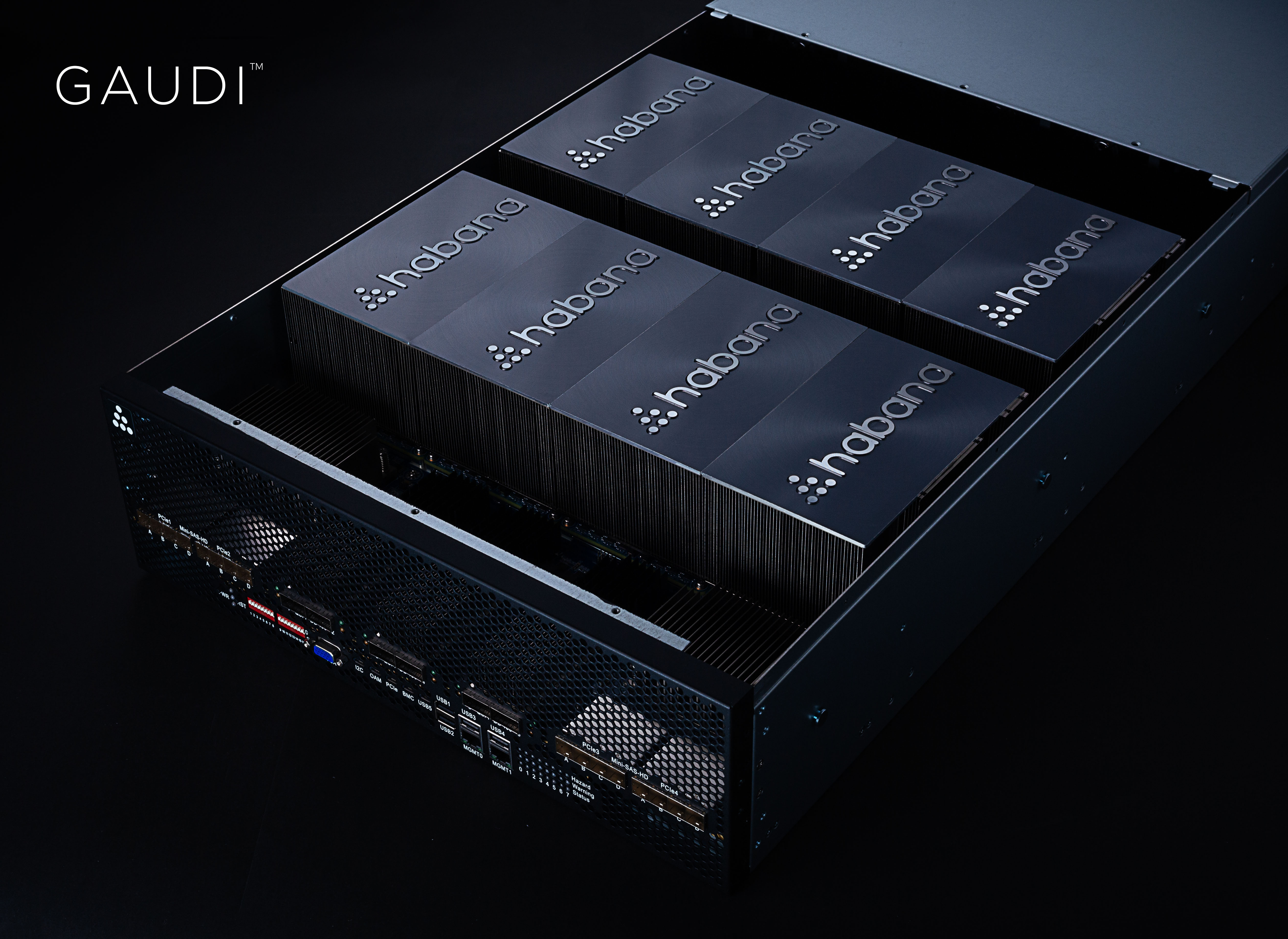
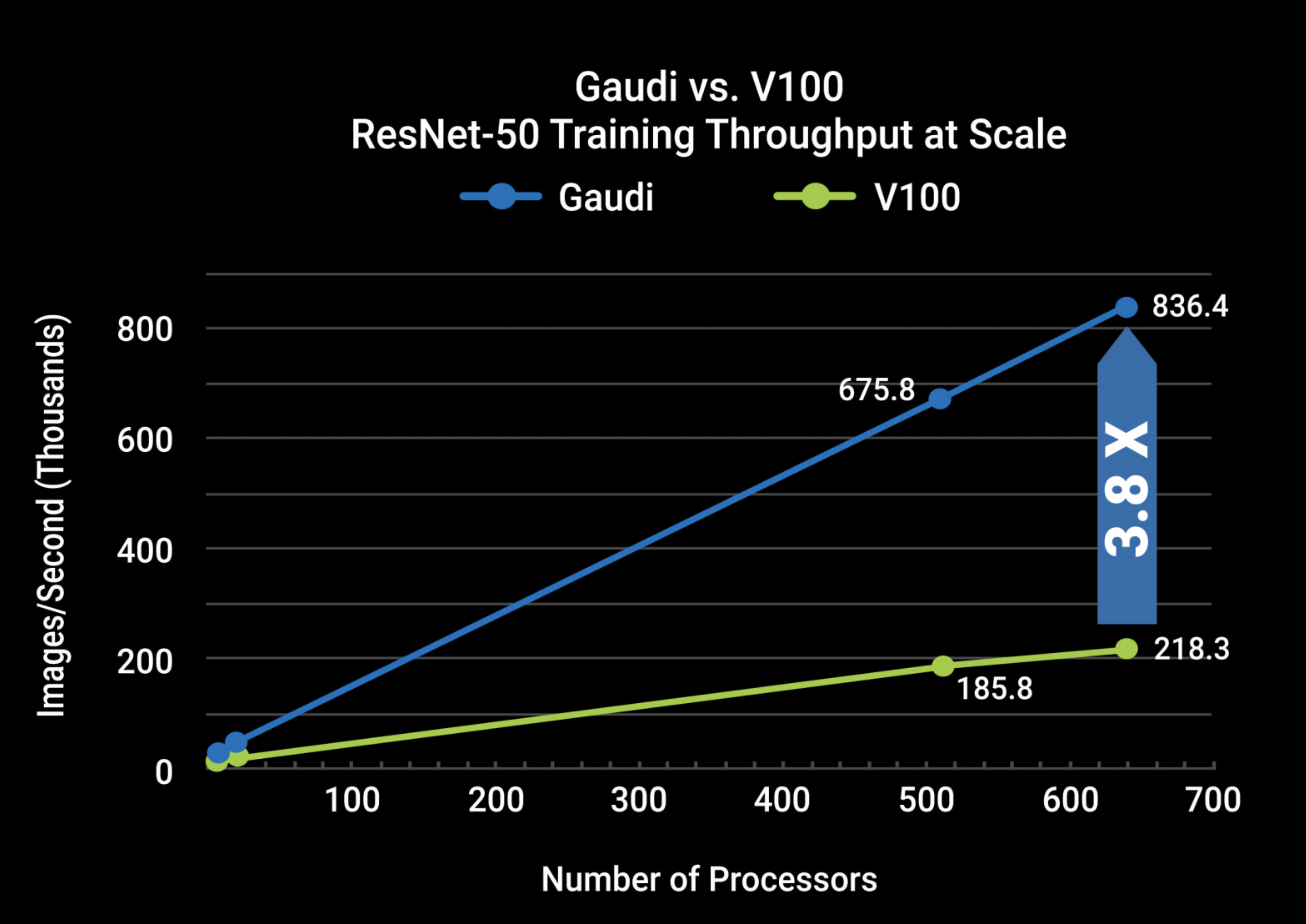
Habana Labs, a Tel Aviv-based AI processor startup, today announced its Gaudi AI training processor, which promises to easily beat GPU-based systems by a factor of four. While the individual Gaudi chips beat GPUs in raw performance, it’s the company’s networking technology that gives it the extra boost to reach its full potential.

Gaudi will be available as a standard PCIe card that supports eight ports of 100Gb Ethernet, as well as a mezzanine card that is compliant with the relatively new Open Compute Project accelerator module specs. This card supports either the same ten 100GB Ethernet ports or 20 ports of 50Gb Ethernet. The company is also launching a system with eight of these mezzanine cards.

Last year, Habana Labs previously launched its Goya inferencing solution. With Gaudi, it now offers a complete solution for businesses that want to use its hardware over GPUs with chips from the likes of Nvidia. Thanks to its specialized hardware, Gaudi easily beats an Nvidia T4 accelerator on most standard benchmarks — all while using less power.

“The CPU and GPU architecture started from solving a very different problem than deep learning,” Habana CBO Eitan Medina told me.  “The GPU, almost by accident, happened to be just better because it has a higher degree of parallelism. However, if you start from a clean sheet of paper and analyze what a neural network looks like, you can, if you put really smart people in the same room […] come up with a better architecture.” That’s what Habana did for its Goya processor and it is now taking what it learned from this to Gaudi.

For developers, the fact that Habana Labs supports all of the standard AI/ML frameworks, as well as the ONNX format, should make the switch from one processor to another pretty painless.

“Training AI models require exponentially higher compute every year, so it’s essential to address the urgent needs of the data center and cloud for radically improved productivity and scalability. With Gaudi’s innovative architecture, Habana delivers the industry’s highest performance while integrating standards-based Ethernet connectivity, enabling unlimited scale,” said David Dahan, CEO of Habana Labs. “Gaudi will disrupt the status quo of the AI Training processor landscape.”

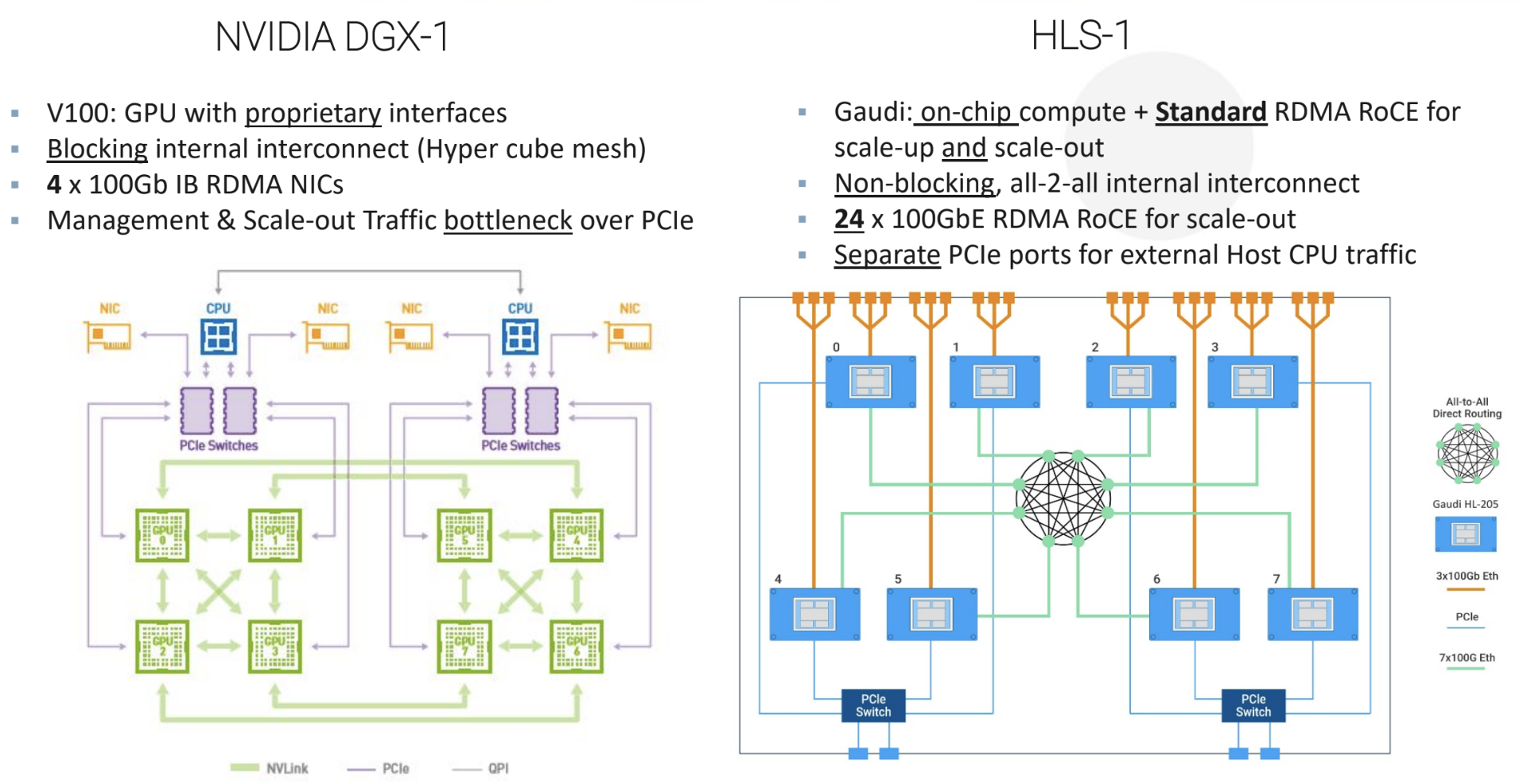
As the company told me, the secret here isn’t just the processor itself but also how it connects to the rest of the system and other processors (using standard RDMA RoCE, if that’s something you really care about).

Habana Labs argues that scaling a GPU-based training system beyond 16 GPUs quickly hits a number of bottlenecks. For a number of larger models, that’s becoming a necessity, though. With Gaudi, that becomes simply a question of expanding the number of standard Ethernet networking switches so that you could easily scale to a system with 128 Gaudis.

“With its new products, Habana has quickly extended from inference into training, covering the full range of neural-network functions,” said Linley Gwennap, principal analyst of The Linley Group. “Gaudi offers strong performance and industry-leading power efficiency among AI training accelerators. As the first AI processor to integrate 100G Ethernet links with RoCE support, it enables large clusters of accelerators built using industry-standard components.”

17 Jun 2019

Amazon’s IMDb Freedive rebrands to IMDb TV, adds new content and plans European expansion

Amazon-owned free streaming service, IMDb Freedive, is getting a new name, more content and is soon expanding to Europe, the company announced this morning. Originally launched in January, the service will now be known as IMDb TV — a name that’s a bit more catchy, but doesn’t convey the fact that the service includes both movies and TV shows.

It’s also not an alternative to live TV streaming services like Sling TV, YouTube TV, or Hulu with Live TV, for example, despite what the name may imply.

Instead, IMDb is most similar to something like Vudu’s Movies on Us or Roku’s free streaming hub, The Roku Channel, as it offers a selection of ad-supported free streaming content, too.

IMDb hasn’t confirmed how many titles are in its collection, but says the content selection has now been tripled thanks to new deals with Warner Bros., Sony Pictures Entertainment, and MGM Studios. This brings movies like Captain Fantastic and La La Land (July 1) to the service — the latter, marking the first time the Academy Award winner has been made available to an ad-supported streaming service.

In addition, IMDb is getting TV shows like Fringe, Kitchen Nightmares, Duck Dynasty, and The Bachelor, plus movies like Drive, Donnie Darko, Monster, Dances with Wolves, and, starting July 1, Sense and Sensibility, Draft Day, and A Knight’s Tale.

The newly rebranded service will also arrive in Europe later this year, but no exact launch date is being offered at this time.

“With IMDb TV, viewers have discovered TV the way it ought to be – a free collection of premium TV shows and movies available anytime,” said Mark Eamer, Vice President of IMDb TV, in a statement. “We deliver a top quality discovery experience that makes it easy to be entertained. With more titles than ever before coming to IMDb TV and our upcoming European expansion later this year, we’re excited for customers to tune in and enjoy all that IMDb TV has to offer, all at no cost,” he said.

Though IMDb operates independently from parent company Amazon, the service benefits from tight integration with Amazon’s line of Fire TV media player devices, which have over 34 million active users. In turn, Amazon Fire TV now has its own built-in free streaming content to rival The Roku Channel which ships on Roku’s media players and Roku OS-powered TVs.

Both Amazon and Roku are battling for users and to become the top media player in terms of market share. Amazon announced its 34 million actives for Fire TV in May, which topped Roku’s 29.1 million active “accounts” reported in Q1. Roku tried to explain that this didn’t mean Amazon led because a Roku account could support several household members — but that’s true for Amazon Fire TV “users,” too.

“Our Fire TV customers are always looking for compelling content at a great value. In fact, usage of free, ad-supported apps has increased by over 300 percent in the last year,” said Marc Whitten, Vice President of Fire TV, in a statement. “IMDb TV brings some of the best free content into the living room and we’re excited that our U.S. customers now have access to even more free TV shows and movies through the app and that customers in Europe can soon enjoy this great service on the biggest screen in their home,” he added.

IMDb TV is today available in the U.S. as a free channel within the Amazon Prime Video app and on Fire TV in the “Your Apps &  Channels” row. The service can also be launched through an Alexa Voice Remote or a paired Echo device by saying, “Alexa, go to IMDb TV.”


17 Jun 2019

MIT develops a system to give robots more human senses

Researchers at MIT’s Computer Science and Artificial Intelligence Lab (CSAIL) have developed a new system that could equip robots with something we take for granted: the ability to link multiple senses together.

The new system created by CSAIL involves a predictive AI that’s able to learn how to see using its ‘sense’ of touch, and vice versa. That might sound confusing, but it’s really mimicking something people do every day, which is look at a surface, object or material and anticipate what that thing will feel like once touched, ie. whether it’ll be soft, rough, squishy, etc.

The system can also take tactile, touch-based input and translate that into a prediction about what it looks like – kind of like those kids’ discovery museums where you put your hands into random boxes and try to get at the objects you find within.

These examples probably don’t help in terms of articulating why this is actually useful to build, but an example provided by CSAIL should make that more apparent. The research team used their system with a robot arm to help it anticipate where an object would be without sight of the object, and then recognize it based on touch – you can imagine this being useful with a robot appendage reaching for a switch, lever or even a part it’s looking to pick up, and verifying that it has the right thing, and not, for example, a human operator it’s working with.

This type of AI could also be used to help robots operate more efficiently and effectively in low-light environments without requiring advanced sensors, for instance, and as components of more general systems when used in combination with other sensory simulation technologies.

17 Jun 2019

India’s Bounce raises $72 million to grow its electric scooters business

Bounce, a Bangalore-based startup that offers more than 5,000 electric scooters for rent in India, has raised $72 million to accelerate its bid to impact how people navigate India’s traffic-clogged urban areas.

The Series C funding round for the five-year-old startup was led by B Capital — the VC firm founded by Facebook co-founder Eduardo Saverin — and Falcon Edge Capital. Chiratae Ventures, Maverick Ventures, Omidyar Network India, Qualcomm Ventures, and existing investors Sequoia Capital India and Accel Partners India also participated in the round.

This new money means that the startup has raised $92 million to date. The current round valued it at more than $200 million, a person familiar with the matter said.

Bounce, formerly known as Metro Bikes, operates in Bangalore. Its app allows users to pick up a scooter and, when their ride is finished, drop it off at any parking spot. It charges customers based on the time and model of electric scooter they choose. An hour-long ride could cost as little as Rs 15 (21 cents). The startup claims it has already clocked two million rides. 

Vivekananda Hallekere, co-founder and CEO of Bounce, told TechCrunch in an interview that the startup plans to use the fresh capital to add over 50,000 electric scooters to its fleets by the end of the year. Additionally, Bounce, which employs about 200 people, plans to enter more cities in India and invest in growing its tech infrastructure and head count.

“We have about ten metro and non-metro cities in mind. Starting next quarter, we will start to expand in those cities,” he said. The startup also aims to service one million rides in the next one year.

Hallekere said Bounce, which currently offers IoT hardware and design for the scooters, is also working on building its own form factor for scooters.

The rise of Bounce comes as it bets that shared two-wheeler vehicles — already a common mode of transportation in the nation — will play an important role in the future of ride-sharing, with electric vehicles replacing petrol ones.

This bet has gained more momentum in recent years. Startups such as Yulu, which partnered with Uber earlier this year to conduct a trial in Bangalore, Vogo, which raised money from Uber rival Ola, and Ather Energy have expanded their businesses and gained the backing of major investors.

Their adoption, though still in their nascent stages, is increasingly proving that for millions of people rides from Uber and Ola are just too expensive for their wallets. Besides, in jam-packed traffic in Bangalore and Delhi and other cities in India, two wheels are more efficient than four.

17 Jun 2019

Startup founders need to decide how much salary is enough

Startup founders don’t typically launch a company as a get-rich-quick scheme. Most know that it will be a long, hard slog if they are to succeed. There will be lean years where the money is tight, and where they may personally struggle to pay their bills. They do it because they believe in the mission and they want to build a successful company, where, if all goes well, they could end up with a healthy amount of money.

But it takes a lot of hard work, long hours, tough times and a bit of luck to find your way through to a successful outcome, however you choose to define that. Early on every dollar you give yourself is money that’s not going into the business, and while you don’t want to starve yourself, neither do you want to run out of money, and those early dollars are especially valuable.

While the ultimate goal is a successful exit, not everyone gets there, and it begs the question, how much is fair to take out in the form of salary, especially in the early years when money is tight, and at what point is it reasonable to sell a bit of equity to take some money out of the business and live a more comfortable life. There are no hard and fast answers.

Removing financial obstacles

17 Jun 2019

Comcast adds gaze control to its accessible remote software

The latest feature for Comcast’s X1 remote software makes the clicker more accessible to people who can’t click it the same as everyone else. People with physical disabilities will now be able to change the channel and do all the usual TV stuff using only their eyes.

TVs and cable boxes routinely have horrendous interfaces, making the most tech-savvy among us recoil in horror. And if it’s hard for an able-bodied person to do, it may well be impossible for someone who suffers from a condition like ALS, or has missing limbs or other motor impairments.

Voice control helps, as do other changes to the traditional 500-button remote we all struggled with for decades, but gaze control is now beginning to be widely accessible as well, and may prove an even better option.

[gallery ids="1844437,1844439,1844436"]

Comcast’s latest accessibility move — this is one area where the company seems to be genuinely motivated to help its customers — is to bring gaze control to its Xfinity X1 web remote. You load it up on a compatible computer or tablet, sync it with your cable box once, and then the web interface acts as your primary controller.

Users will be able to do pretty much all the everyday TV stuff using gaze: change channels, search and browse the guide, set and retrieve recordings, launch a live sport-tracking app, and call up and change accessibility options like closed captioning.

A short showing how one man finds the tech useful is worth a watch:

It’s amazing to think that among all the things Jimmy Curran has worked to make himself capable of in spite of his condition, changing the channel was not one of them. Perhaps there was some convoluted way of going about it, but it’s still an oversight on the part of TV interfaces that has limited accessibility for years.

Voice controls may also be more easily usable by people with conditions that affect their speech; Google is applying machine learning to the task with its Project Euphonia.

Users will need a gaze control setup of their own (this isn’t uncommon for folks with physical disabilities), after which they can direct the browser on it to xfin.tv/access, which will start the pairing process.