Last fall, Walmart announced a joint venture with Eko to create interactive storytelling — think Netflix’s Black Mirror: Bandersnatch — for both entertainment and retail. Since then, Eko has been working with BuzzFeed on a range of interactive videos, as well as on projects for Walmart’s Vudu and others for itsown HelloEko.com video site. Today, Eko’s latest partner has been unveiled: millennial-focused digital media company, Refinery29.
According to Variety, which first reported the news, Eko will produce several series based on Refinery29’s content, starting with an interactive scripted project for the site’s “Money Diaries” personal finance column, podcast, and book. The online series saw 7 million uniques in 2018 and is one of Refinery29’s top properties, the report noted.
In the Eko videos, viewers will be able to make choices about how to manage and spend the character’s money. Other Eko-produced Refinery29 shows will include the unscripted travel series 60 Second Cities and another focused on women’s living spaces, Sweet Digs.
The shows will debut on Refinery29’s website by year-end, and will be promoted across social media. Eko and Refinery29 will share in the advertising and sponsorship revenues the series generate.
Because Eko’s videos allow viewers to make choices, media companies can learn from what viewers click on to better tailor their content to the viewer’s interests. Videos can also become more personalized to the viewer’s individual needs — in BuzzFeed’s case, for example, a recipe video could show how to customize the dish for dietary restrictions. This same set of advantages will be translated to Refinery29’s properties, as well.
In addition to the BuzzFeed and Refinery29 series, Eko is working with Hollywood producers on its other projects, including the Duplass Brothers, Fine Brothers, Nora Kirkpatrick, and others, and plans to delve into fashion, beauty, and other scripted content in the future.
If you follow space news at all, you may have heard of ‘Bennu’ – the near-Earth asteroid that has a slim (but higher than most) chance of colliding with our planet sometime nearly 200 years from now. The asteroid is notable for many reasons, including the recent discovery that it’s actually also “active,” which means that it’s been spewing dust and gravel into the surrounding space as it continuous along its path.
That discovery is what prompted NASA to reduce the distance at which its OSIRIS-REx probe orbits the spacefaring rock. The probe arrived at Bennu late last year to observe the asteroid after a selection process determined which of the known near-Earth ones would be the best candidate for a research mission.
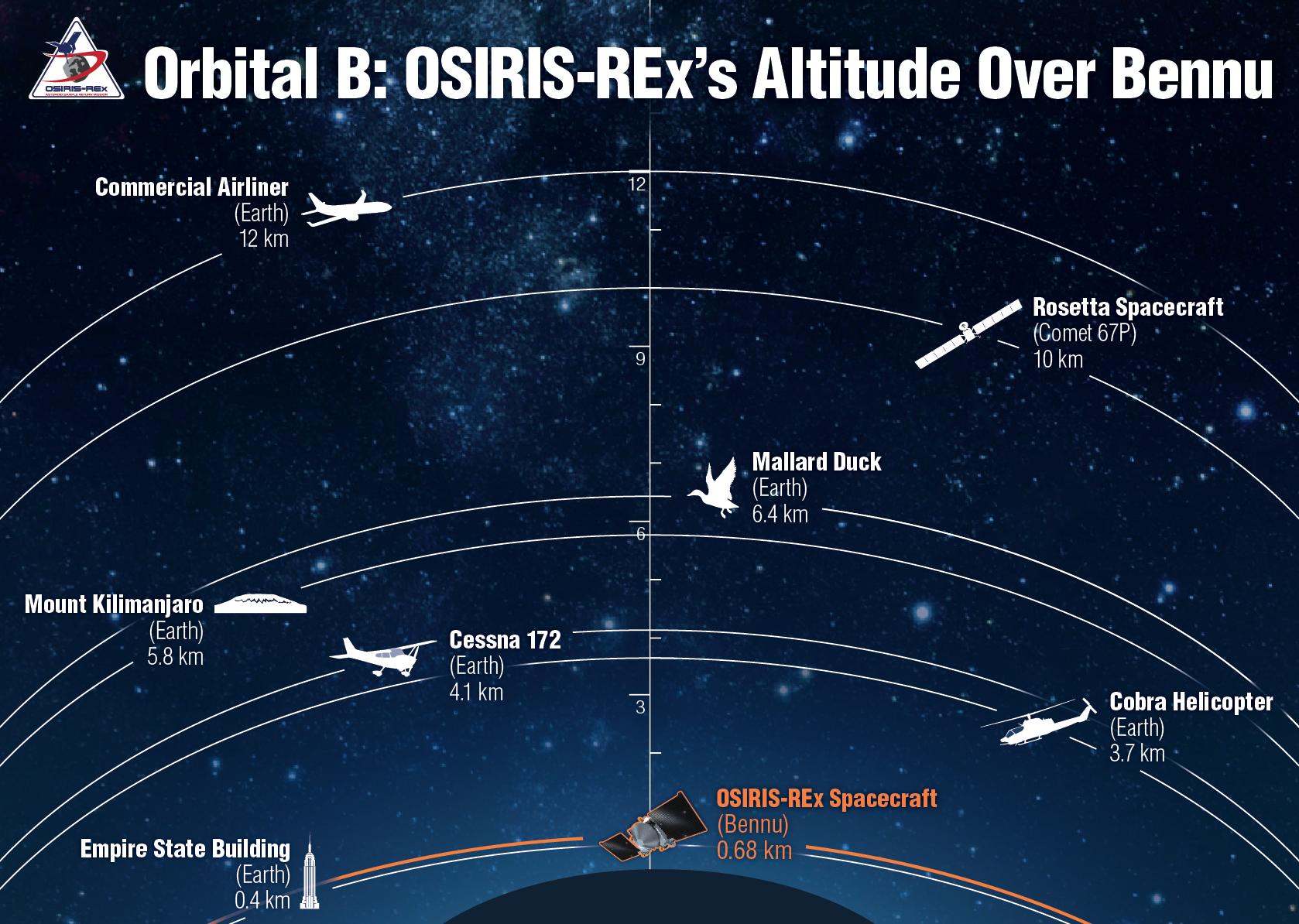
NASA’s probe is now just over 3,000 feet above the centre mass of Bennu, which is closer than your average military attack helicopters fly at cruising distance above Earth, as NASA helpfully points out in the illustrative graphic below.
The mission refers to this orbit as the ‘Orbital B’ phase, and it’s a record not just for Bennu, but also stands as the closes a spacecraft has ever orbited any extraterrestrial body anywhere in the solar system. It’ll remain in this orbit until mid-August, and it’ll focus the next few weeks on photographing the asteroid’s surface regularly to study the dust and gravel ejection mentioned above.
The Toronto Raptors won the 2019 NBA Championship last night, which is probably not news to you if you’re A) Canadian (like me) or B) a basketball fan. But unless you’ve starting your Friday off shopping for Apple gear on their Canadian website, you might not have noticed this subtle ‘Easter Egg.’
If you go to https://apple.com/ca, which is the Canadian localized version of Apple’s home page, you’ll be greeted by a fleeting animation that pushes down from the top of the screen and lasts only a moment – at first I was confused and only half-paying attention so I figured it was some kind of weird Father’s Day promotion.
Then I reloaded and watched again and noticed that the animation was actually made up of swirling dinosaur, Canadian flag and basketball emojis. Because I’m super smart, it only took me about 15 more minutes to put all the pieces together with last night’s NBA Championship final and the basketball team that calls my city home.
Anyways, it’s fun, and probably done with the approval of headquarters in Cupertino – though there’s likely a fair number of Golden State fans there who aren’t thrilled at the reminder of who took home the win.
Hello and welcome back to Equity, TechCrunch’s venture capital-focused podcast, where we unpack the numbers behind the headlines.
This week was a lot of fun. We had Kate and Alex in the studio with Chris running the show and reminding half the recording team about English words (immersive, as a spoiler).
This week had a lot to go over. First, Kate went to the Recode + Vox Code Conference in Scottsdale, Arizona where it was very, very hot. She tells us her key takeaways of the event (here’s another spoiler: techlash).
Next, we turned to acquisitions, namely that Fortnite (Epic Games) bought Houseparty (formerly Meerkat, remember that?). Fornite is a cultural sensation that has become just as much a social phenom as it is a gaming powerhouse. Bringing Houseparty’s multi-party and popular-with-the-youth video chat product under its umbrella makes some sense. That Houseparty’s usage growth had reportedly stalled, we’re sure, had nothing to do with the sale.
Moving on, we chatted briefly about the Bird-Scoot deal which we had touched on last week. (Kate wrote about it here and Alex here). Scoot, as it turns out, was having a not-so-easy time raising additional venture capital and sold to Bird for less than $25 million (way under its last valuation of $71 million). Ouch.
From there it was deal city (BetterUp! Tenderd! Others!) before we jumped into the CrowdStrike news. The firm’s IPO is hot (more here, and here), which led to questions about IPO pricing (again. Sorry, we can’t stop) and whether IPO pops are good or bad (yes, this again, too, but it’s worth discussing).
We’ve touched on dual-class stock structures before, but we think there is a lot more to unpack here and unpack we did! Basically, we think Silicon Valley’s founder fetish, as the headline here suggests, infantilizes public companies. Listen to the whole episode to hear our full rant.
All that and we had a lot of fun. Alex is out for a few weeks, but Kate has a bunch of great things coming down the podcast pike. Chat with you all next week!
Equity drops every Friday at 6:00 am PT, so subscribe to us on Apple Podcasts, Overcast, Pocket Casts, Downcast and all the casts.
Tech DIY takes a soft touch toward teaching electronics—literally. Now on Kickstarter, the kit uses sewing to teach kids and adult beginners about electronic and electric circuits by sewing dolls, soft figures and bracelets that light up, move and make noises.
Tech DIY was created by Ji Sun Lee and Jaymes Dec, the authors of “Tech DIY, Easy Electronics Projects for Parents and Kids,” published in 2016 by Maker Media. While working on her master’s thesis and thinking of ways to close the gender gap in technology, Lee began exploring the idea of using textile crafts to teach electronics for her master’s thesis.
Dec is a fab lab teacher at a girls’ private school, while Lee is a professor at a women’s college in Korea. “I also worked in the IT industry for many years, where it had very few women employees. Although both of us teach technology, we feel that the educational content created for female users is minimal and marginalized,” Lee said.
Lee and Dec decided to use sewing for their projects since many women and girls are already familiar with textile crafts. There are already kits that combine electronics with textiles, like Lily Pad and Adafruit’s Flora, which both use Arduino, but the programming required for their micro-controllers is too complicated for most novices, Lee said. Tech DIY’s kits are designed for elementary and middle school students, as well as adult beginners. They can be built with basic sewing skills and the projects increase in complexity, allowing new makers to level up.
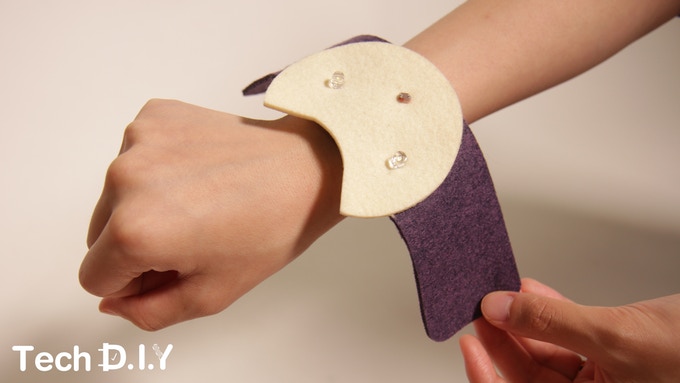
Tech DIY’s Nightlight Cat Bracelet project
Two kits are available for Kickstarter backers. The Joy Kit contains five projects, including an embroidery sampler called My Happy House that teaches about electricity, circuits and basic electronic components, and the Purring Elephant, a pillow that uses a motor to move and vibrate. The Awesome Kit is for more experienced makers and includes components for projects like the Nightlight Cat Bracelet, which uses a light sensor and transistor to light up in the dark, and the Solar Sun Project, powered with solar panels instead of batteries. (If you want to see how the projects are put together, check out the instructions for A Silly Ghost, the Nightlight Cat Bracelet and Purring Elephant Bracelet, which are all available for free online.)
The kits include all necessary components for the projects, thick, high-quality felt and what Lee and Dec describe as the “best conductive thread on the planet.”
The world’s largest crypto exchange is going legit. Binance, which processes over $1 billion on a daily basis and for so long has embodied crypto’s wild west culture, announced that it will launch a U.S-based service — but, in the meantime, it is implementing restrictions for U.S. passport holders worldwide and those based in the country.
The company has grown to become one of the biggest names in crypto by allowing anyone to use its service to trade a myriad of tokens, many of which are unavailable or limited on other exchanges. But over the past year, Binance has matured and begin to offer more formalized services. Following fiat currency exchange launches in the UK, Uganda and Singapore, so Binance is opening a dedicated U.S. exchange to avoid uncertainty around its legality.
This week, Binance announced it is pairing up with BAM Trading Services — which Coindesk notes is FinCEN registered and has links to Koi Compliance, which counts Binance as an investor — to launch a U.S. exchange “soon.” That will mean, however a level of disruption for some U.S. customers in the meantime.
Chiefly, Binance will no longer permit U.S. passport holders to sign up its global Binance.com service. That’s according to the company’s updated terms and conditions — “Binance is unable to provide services to any U.S. person” — which were confirmed to TechCrunch by a spokesperson.
Existing users have a grace period of 90 days after which they will be unable to deposit funds to the site or make trades. Binance declined to state whether those bans will be administered by a geo-block on U.S. IP addresses, but it did confirm that U.S. customers will retain access to funds held in the service.
That 90-day period ends September 12, so that’s effectively the deadline for Binance to launch its new U.S. exchange if it is to avoid impacting its American user base.
The reality is that the situation is more nuanced.
U.S-based users could continue to use the service by browsing the site with a VPN. Binance allows its users to sign up for a limited account without KYC — i.e. providing verification documents like a passport copy — which allows trading but limits withdrawals to 2 Bitcoin per day. That won’t satisfy more professional traders — most of whom you’d imagine would already have an account on Binance by now — but it does leave a loophole for others.
Binance CEO Changpeng Zhao insisted that the long-term pay-off will be worth any compromise.
There will be a few restrictions on https://t.co/9rMMAmtCxH accompanying this. But some short term pains may be necessary for long term gains. And we always work hard to turn every short term pain into a long term gain. https://t.co/gl1M1cwPYB
It’s certainly fascinating to watch Binance, which has historically been one of the most aggressive crypto companies, transition into a more regulatory-compliant business. At the same time, those who have been cautious, such as Coinbase, are beginning to add new assets.
Cao Xudong turned up on the side of the road in jeans and a black T-shirt printed with the word “Momenta,” the name of his startup.
Before founding the company — which last year topped $1 billion in valuation to become China’s first autonomous driving “unicorn” — he’d already led an enviable life, but he was convinced that autonomous driving would be the real big thing.
Cao isn’t just going for the moonshot of fully autonomous vehicles, which he says could be 20 years away. Instead, he’s taking a two-legged approach of selling semi-automated software while investing in research for next-gen self-driving tech.
Cao, pronounced ‘tsao’, was pursuing his Ph.D. in engineering mechanics when an opportunity came up to work at Microsoft’s fundamental research arm in Asia, putatively the “West Point” for China’s first generation of artificial intelligence experts. He held out there for more than four years before quitting to put his hands on something more practical: a startup.
“Academic research for AI was getting quite mature at the time,” said now 33-year-old Cao in an interview with TechCrunch, reflecting on his decision to quit Microsoft. “But the industry that puts AI into application had just begun. I believed the industrial wave would be even more extensive and intense than the academic wave that lasted from 2012 to 2015.”
In 2015, Cao joined SenseTime, now the world’s highest-valued AI startup, thanks in part to the lucrative face-recognition technology it sells to the government. During his 17-month stint, Cao built the company’s research division from zero staff into a 100-people strong team.
Before long, Cao found himself craving for a new adventure again. The founder said he doesn’t care about the result as much as the chance to “do something.” That tendency was already evident during his time at the prestigious Tsinghua University, where he was a member of the outdoors club. He wasn’t particularly drawn to hiking, he said, but the opportunity to embrace challenges and be with similarly resilient, daring people was enticing enough.
And if making driverless vehicles would allow him to leave a mark in the world, he’s all in for that.
Make the computer, not the car
Cao walked me up to a car outfitted with the cameras and radars you might spot on an autonomous vehicle, with unseen computer codes installed in the trunk. We hopped in. Our driver picked a route from the high-definition map that Momenta had built, and as soon as we approached the highway, the autonomous mode switched on by itself. The sensors then started feeding real-time data about the surroundings into the map, with which the computer could make decisions on the road.
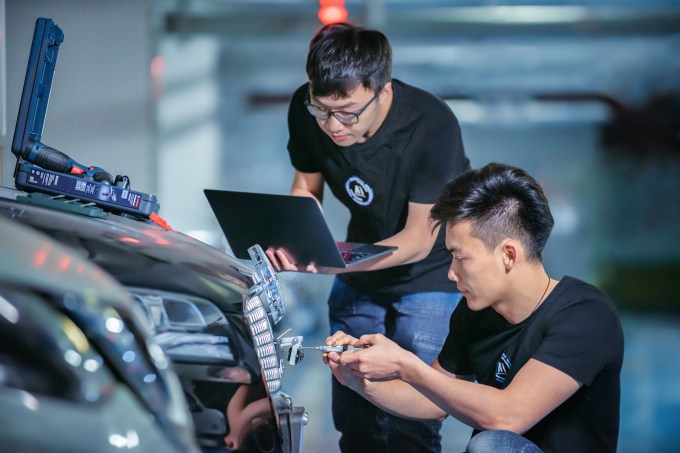
Momenta staff installing sensors to a testing car. / Photo: Momenta
Momenta won’t make cars or hardware, Cao assured. Rather, it gives cars autonomous features by making their brains, or deep-learning capacities. It’s in effect a so-called Tier 2 supplier, akin to Intel’s Mobileye, that sells to Tier 1 suppliers who actually produce the automotive parts. It also sells directly to original equipment manufacturers (OMEs) that design cars, order parts from suppliers and assemble the final product. Under both circumstances, Momenta works with clients to specify the final piece of software.
Momenta believes this asset-light approach would allow it to develop state-of-the-art driving tech. By selling software to car and parts makers, it not only brings in income but also sources mountains of data, including how and when humans intervene, to train its codes at relatively low costs.
The company declined to share who its clients are but said they include top carmakers and Tier 1 suppliers in China and overseas. There won’t be many of them because a “partnership” in the auto sector demands deep, resource-intensive collaboration, so less is believed to be more. What we do know is Momenta counts Daimler AG as a backer. It’s also the first Chinese startup that the Mercedes-Benz parent had ever invested in, though Cao would not disclose whether Daimler is a client.
“Say you operate 10,000 autonomous cars to reap data. That could easily cost you $1 billion a year. 100,000 cars would cost $10 billion, which is a terrifying number for any tech giant,” Cao said. “If you want to acquire seas of data that have a meaningful reach, you have to build a product for the mass market.”
Highway Pilot, the semi-autonomous solution that was controlling our car, is Momenta’s first mass-produced software. More will launch in the coming seasons, including a fully autonomous parking solution and a self-driving robotaxi package for urban use.
In the long run, the startup said it aims to tackle inefficiencies in China’s $44 billion logistics market. People hear about warehousing robots built by Alibaba and JD.com, but overall, China is still on the lower end of logistics efficiency. In 2018, logistics costs accounted for nearly 15 percent of national gross domestic product. In the same year, the World Bank ranked China 26th in its logistics performance index, a global benchmark for efficiency in the industry.
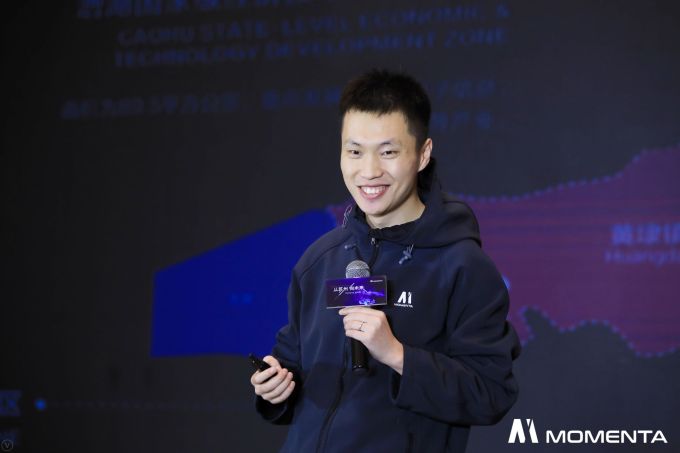
Cao Xudong, co-founder and CEO of Momenta / Photo: Momenta
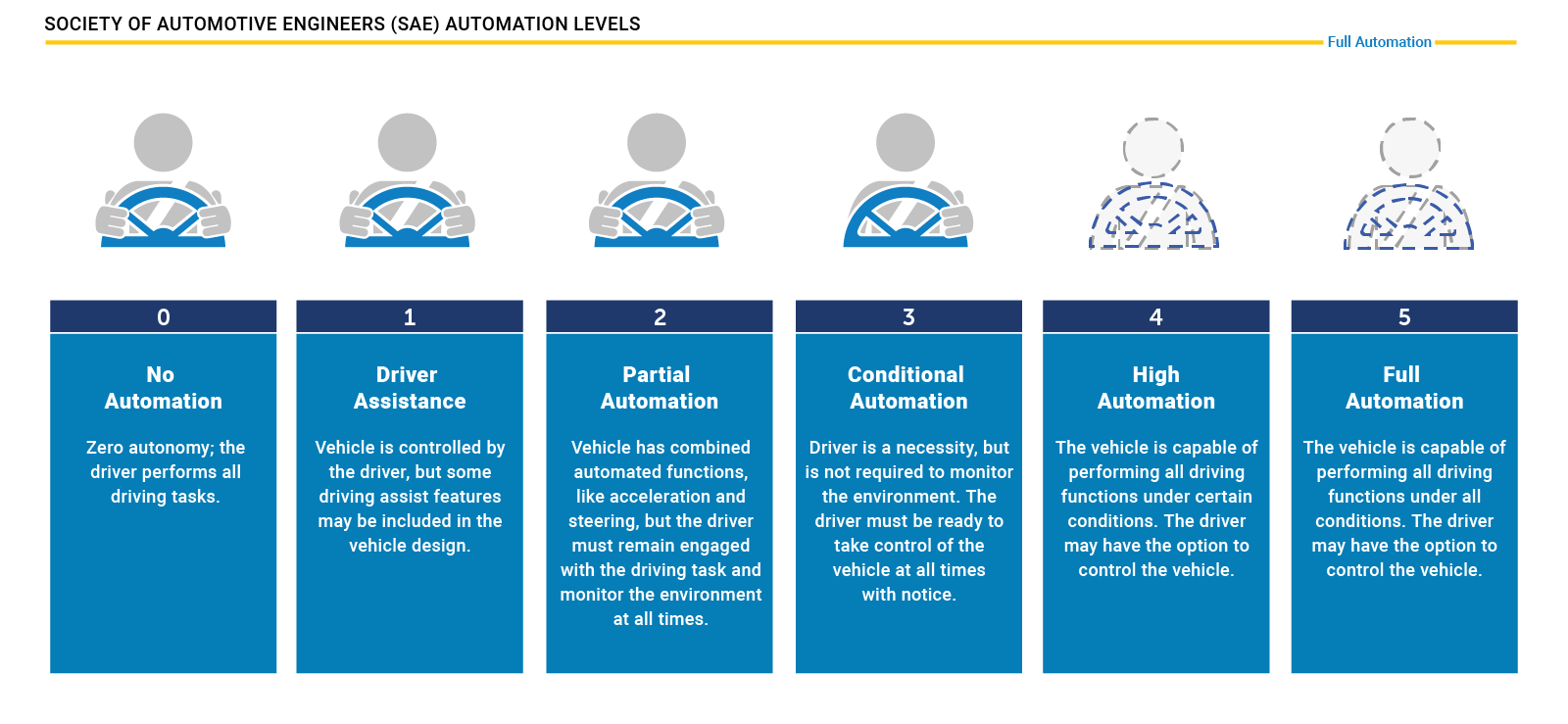
Cao, an unassuming CEO, raised his voice as explained the company’s two-legged strategy. The twin approach forms a “closed loop,” a term that Cao repeatedly summoned to talk about the company’s competitive edge. Instead of picking between the presence and future, as Waymo does with Level 4 — a designation given to cars that can operate under basic situations without human intervention — and Tesla with half-autonomous driving, Momenta works on both. It uses revenue-generating businesses like Highway Pilot to fund research in robotaxis, and the sensor data collected from real-life scenarios to feed models in the lab. Results from the lab, in turn, could soup up what gets deployed on public roads.
Human or machine
During the 40-minute ride in midday traffic, our car was able to change lanes, merge into traffic, create distance from reckless drivers by itself except for one brief moment. Toward the end of the trip, our driver decided to grab the wheel for a lane change as we approached a car dangerously parked in the middle of the exit ramp. Momenta names this an “interactive lane change,” which it claims is designed to be part of its automated system and by its strict definition is not a human “intervention”.
“Human-car interaction will continue to dominate for a long time, perhaps for another 20 years,” Cao noted, adding the setup brings safety to the next level because the car knows exactly what the driver is doing through its inner-cabin cameras.
“For example, if the driver is looking down at their cellphone, the [Momenta] system will alert them to pay attention,” he said.
I wasn’t allowed to film during the ride, so here’s some footage from Momenta to give a sneak peek of its highway solution.
Human beings are already further along the autonomous spectrum than many of us think. Cao, like a lot of other AI scientists, believes robots will eventually take over the wheel. Alphabet-owned Waymo has been running robotaxis in Arizona for several months now, and smaller startups like Drive.ai are also offering a similar service in Texas.
Despite all the hype and boom in the industry, there remains thorny questions around passenger safety, regulatory schema and a host of other issues for the fast-moving tech. Uber’s fatal self-driving crash last year delayed the company’s future projects and prompted a public backlash. As a Shanghai-based venture capitalist recently suggested to me: “I don’t think humanity is ready for self-driving.”
The biggest problem of the industry, he argued, is not tech-related but social. “Self-driving poses challenges to society’s legal system, culture, ethics and justice.”
Cao is well aware of the contention. He acknowledged that as a company with the power to steer future cars, Momenta has to “bear a lot of responsibility for safety.” As such, he required all executives in the company to ride a certain number of autonomous miles so if there’s any loophole in the system, the managers will likely stumble across it before the customers do.
“With this policy in place, the management will pay serious attention to system safety,” Cao asserted.
Momenta’s new headquarters in Suzhou, China / Photo: Momenta
In terms of actually designing the software to be reliable and to trace accountability, Momenta appoints an “architect of system research and development,” who essentially is in charge of analyzing the black box of autonomous driving algorithms. A deep learning model has to be “explainable,” said Cao, which is key to finding out what went wrong: Is it the sensor, the computer, or the navigation app that’s not working?
Going forward, Cao said the company is in no rush to make a profit as it is still spending heavily on R&D, but he assured that margins of the software it sells “are high.” The startup is also blessed with sizable fundings, which Cao’s resume certainly helped attract, and so did his other co-founders Ren Shaoqing and Xia Yan, who were also alumni of Microsoft Research Asia.
As of last October, Momenta had raised at least $200 million from big-name investors including GGV Capital, Sequoia Capital, Hillhouse Capital, Kai-Fu Lee’s Sinovation Ventures, Lei Jun’s Shunwei Capital, electric vehicle maker NIO’s investment arm, WeChat operator Tencent and the government of Suzhou, which will house Momenta’s new 4,000 sq-meter headquarters right next to the city’s high-speed trail station.
When a bullet train speeds past Suzhou, passengers are able to see from their windows Momenta’s recognizable M-shape building, which, in the years to come, might become a new landmark of the historic city in eastern China.
Game streaming loomed large as the biggest story of E3. Between Google’s Stadia news late last week, Microsoft’s Game Pass additions, a Ubisoft announcement and even the presence of Netflix, the writing is clearly on the wall.
Nintendo, of course, has largely been absent from that conversation. No real surprise, really. The gaming company has always marched to the beat of its own drum, bucking larger industry trends in favor of its own singular vision. The approach has sometimes been to its determent (as is the case with its longtime heel-dragging on mobile), but has largely resulted in a number of the industry’s most beloved platforms, titles and IP.
Given the company’s rich and storied gaming history, a Netflix-style approach to content makes a lot of sense for a company like Nintendo. And certainly, the notion of paying $10 a month for access to 30 years of Mario, Zelda and the like doesn’t seem like much of a stretch. Though for Nintendo, much of the calculation no doubt comes down to whether or not gamers are willing to continue to pay for downloads.
In an interview with TechCrunch this week on the show floor, Nintendo of America executive Charlie Scibetta said that the concept is one the company has been considering. “Streaming is certainly interesting technology,” he told TechCrunch. “Nintendo is keeping a close eye on it and we’re evaluating it. We don’t have anything to announce right now in terms of adopting that technology. For us, it’s still physical and it’s digital downloads through our Eshop.”
The sentiment echos similar statements made by new Nintendo of America chief Doug Bowser, who told The Hollywood Reporter, “We’re always interested in how various new technologies can enable different ways to play games.”
Freelance marketplace Fiverr had a good first day on the New York Stock Exchange.
The company priced its IPO at $21 per share last night, raising around $111 million. It then started trading this morning at $26, with shares climbing for most of the day and closing at $39.90 — up 90% from the IPO price.
Fiverr is one of the most well-known companies facilitating the so-called gig economy. When it filed to go public last month, the company said it has facilitated 50 million transactions between 5.5 million buyers and 830,000 freelancers.
Investors seem willing to bet on the company despite the fact that it’s losing money, reporting a net loss of $36.1 million on revenue of $75.5 million in 2018. In an interview this afternoon, founder and CEO Micha Kaufman noted that the company’s negative EBITDA is shrinking (at least when you compare the first quarter of 2019 to Q1 2018).
“We are on the path to profitability,” Kaufman said. “That’s the balance we’re trying to keep — focusing on growth while building a business that would be profitable in the long term.”
I’ll have a full story on our interview tomorrow morning.
New details keep trickling out about the Honda e, the compact electric vehicle that’s coming to market in spring 2020, from pop-out door handles and internal side view mirrors to the touchscreen display.
The latest, revealed Thursday, includes a battery capacity of 35.5 kilowatt-hours. An important nugget that is sure to get some folks excited is that the vehicle will have a 50/50 weight distribution, thanks to the position of the battery at a low level under the floor and centrally within the wheelbase.
The upshot: this electric car will have lots of stability and handle curves like a champ; in short, all things being equal the car will steer neutrally, not oversteer or understeer. Combine that with a rear-wheel drive and a high-torque electric motor, the Honda e promises to deliver lots of thrills in its diminutive package.
Want to dig deeper into why a 50/50 weight distribution is considered ideal? Check out this handy Engineering Explained video.
Honda also revealed the the 35.5 kWh lithium-ion high-capacity battery can be charged using either Type 2 AC connection or a CCS2 DC rapid charger. The battery pack is water-cooled to help maximum its efficiency and charge state, the company said.
Honda is still sticking with its previously stated estimated range of about 125 miles on a single charge.
The charging port includes an LED light that can be seen through a glass panel to illuminate the port for the driver and highlight the battery charging status.
The production version of the Honda e will be unveiled later this year.
Customers can make a reservation for priority ordering online in the U.K., Germany, France and Norway or register their interest in other European markets on the Honda national websites. No, the Honda e isn’t coming to the United States.
Honda plans to bring electrification, which can mean hybrid, plug-in or all-electric, to every new car model launched in Europe. The automaker is aiming for two-thirds of European sales to feature electrified technology by 2025.