
Month: June 2019

13 Jun 2019

Target Circle and TapHeaven team up in a mobile marketing merger

Target Circle and TapHeaven have announced that they’re merging into a single company under the Target Circle brand.

TapHeaven co-founder and CEO Chris Hoyt, who is becoming chief growth officer at the combined organization, said the two companies have been “trying to solve the same problem” — namely, eliminating many of the inefficiencies in the mobile advertising business.

Hoyt said that for Target Circle, that meant trying to “unify this fragmented ecosystem into a single dashboard for contracts, invoices and offers.” And for TapHeaven, that meant a focus on automation, resulting in the launch of what the company calls a “command center” for user acquisition, where advertisers can optimize their ad campaigns “at the source level, by country” while getting high-quality traffic without fraud.

The companies are also complement each other geographically — Target Circle is headquartered in Oslo, Norway, while TapHeaven is headquartered in San Francisco.

According to Hoyt, they first came across each other because they were talking to the same mobile studio about supporting the launch of a new game, and it became clear they “both had the same vision for our businesses, the same future with a unified dashboard wrapped in automation and machine learning to simplify and help the ecosystem perform for these advertisers.”

Target Circle founder and CEO Heiko Hildebrandt will continue to serve as chief executive for the combined companies — in the announcement, he said TapHeaven allows the company to “strengthen and expand its technology in the automation of advertising and fraud prevention and resolution.” Meanwhile, TapHeaven executives Brian Krebs and Jeremy Jones will become CIO and chief of user experience, respectively.

The financial terms of the deal were not disclosed. Moving forward, Hoyt said Target Circle will continue to support its existing products while focusing on the new UA Command Center as “the future of our business.” He also suggested that the platform could help advertisers move away from Facebook and Google, allowing them to get the performance they need from other ad networks.

“What impact this is going to have on the market is really lifting up the rest of the ecosystem,” he said. “I feel like Facebook and Google have had their day, a little bit … With the serious things that are going on with these companies, advertisers are desperate for the answers to where [else] can they spend their money and diversify their portfolio.”

13 Jun 2019

Target Circle and TapHeaven team up in a mobile marketing merger

Target Circle and TapHeaven have announced that they’re merging into a single company under the Target Circle brand.

TapHeaven co-founder and CEO Chris Hoyt, who is becoming chief growth officer at the combined organization, said the two companies have been “trying to solve the same problem” — namely, eliminating many of the inefficiencies in the mobile advertising business.

Hoyt said that for Target Circle, that meant trying to “unify this fragmented ecosystem into a single dashboard for contracts, invoices and offers.” And for TapHeaven, that meant a focus on automation, resulting in the launch of what the company calls a “command center” for user acquisition, where advertisers can optimize their ad campaigns “at the source level, by country” while getting high-quality traffic without fraud.

The companies are also complement each other geographically — Target Circle is headquartered in Oslo, Norway, while TapHeaven is headquartered in San Francisco.

According to Hoyt, they first came across each other because they were talking to the same mobile studio about supporting the launch of a new game, and it became clear they “both had the same vision for our businesses, the same future with a unified dashboard wrapped in automation and machine learning to simplify and help the ecosystem perform for these advertisers.”

Target Circle founder and CEO Heiko Hildebrandt will continue to serve as chief executive for the combined companies — in the announcement, he said TapHeaven allows the company to “strengthen and expand its technology in the automation of advertising and fraud prevention and resolution.” Meanwhile, TapHeaven executives Brian Krebs and Jeremy Jones will become CIO and chief of user experience, respectively.

The financial terms of the deal were not disclosed. Moving forward, Hoyt said Target Circle will continue to support its existing products while focusing on the new UA Command Center as “the future of our business.” He also suggested that the platform could help advertisers move away from Facebook and Google, allowing them to get the performance they need from other ad networks.

“What impact this is going to have on the market is really lifting up the rest of the ecosystem,” he said. “I feel like Facebook and Google have had their day, a little bit … With the serious things that are going on with these companies, advertisers are desperate for the answers to where [else] can they spend their money and diversify their portfolio.”
13 Jun 2019

AT&T cancels Samsung Galaxy Fold orders

AT&T has cancelled early orders for the Samsung Galaxy Fold.

Tom’s Guide first reported the cancellation, noting that AT&T said the Galaxy Fold would be available again to order as soon as Samsung announces a new launch date.

The Samsung Galaxy Fold was originally scheduled to launch on April 26. However, early reviews indicated that there were issues with the phone, which Samsung initially said was the fault of reviewers. The company eventually decided to postpone the launch and get back to the drawing board.

Earlier this week, a Samsung rep told Cnet that it would announce timing on the nearly $2,000 phone “in the coming weeks.”

However, AT&T’s move here suggests that it may be a while before the Galaxy Fold resurfaces, if at all.

Samsung itself asked customers who pre-ordered to confirm that they still want the device following the review period. On May 24, Best Buy cancelled all pre-orders of the phone.

13 Jun 2019

AT&T cancels Samsung Galaxy Fold orders

AT&T has cancelled early orders for the Samsung Galaxy Fold.

Tom’s Guide first reported the cancellation, noting that AT&T said the Galaxy Fold would be available again to order as soon as Samsung announces a new launch date.

The Samsung Galaxy Fold was originally scheduled to launch on April 26. However, early reviews indicated that there were issues with the phone, which Samsung initially said was the fault of reviewers. The company eventually decided to postpone the launch and get back to the drawing board.

Earlier this week, a Samsung rep told Cnet that it would announce timing on the nearly $2,000 phone “in the coming weeks.”

However, AT&T’s move here suggests that it may be a while before the Galaxy Fold resurfaces, if at all.

Samsung itself asked customers who pre-ordered to confirm that they still want the device following the review period. On May 24, Best Buy cancelled all pre-orders of the phone.

13 Jun 2019

Uber’s annual flying taxi summit reveals Uber Air has a ways to go

Flying taxis are undoubtedly an exciting concept — one that Uber has put a lot of work into making a reality. In order to these electric vertical take-off and landing vehicles to become a reality, they need to have proper batteries, approval from the Federal Aviation Administration, buy-in from cities, public acceptance and, of course, vehicle partners.

Uber is aiming to start testing these aircrafts next year, and wants to commercially deploy Uber Air in Los Angeles, Calif., Dallas-Fort Worth/Frisco, Texas and Melbourne, Australia in 2023.

Right now, the model of Uber Air we may see in the skies will have a pilot on board. The model Uber unveiled at Elevate seats four people and one pilot.

[gallery ids="1841841,1841842,1841843,1841851"]

But there are a lot of moving parts, and the more moving parts there are means more room for error.

Designing the right battery

Let’s start with the batteries. Uber CEO Dara Khosrowshahi has repeatedly said that these vehicles need to be all-electric. But the batteries are nowhere close to where they need to be, Uber Director of Engineering for Energy Storage Systems Celina Mikolajczak told TechCrunch at Uber’s third annual Elevate Summit in Washington, D.C. this week.

Within the battery department alone, there are a lot of pieces to it, Mikolajczak said.

“The first thing you want is you want a cell that is capable of achieving the mission, and we’ve been working to try and identify cells that can do this job,” she said.

To be clear, the job is to travel up to at least 60 miles on a single charge, with a cruise speed of 150 mph. Mikolajczak is confident that current battery technology can achieve the mission, but that doesn’t mean there aren’t challenges. There are challenges around weight, thermal management and safety.

13 Jun 2019

Willo is a robot that wants to replace your toothbrush

If you think about it, the basic concept of a toothbrush hasn’t evolved since… forever. Sure, many people have switched to an electric toothbrush, but it remains a stick with a brush at the end.

Willo thinks that’s not good enough. The company has developed an oral care device to improve brushing with a focus on plaque. The company says that basic brushing only cleans 42 percent of dental plaque, while electric brushes clean 46 percent of dental plaque.

The startup has worked with actual dentists to design its product. It still sounds a bit mysterious as the company isn’t sharing much about the product. The photo is the only image of the product right now.

But what we know is that the startup has raised a $7.5 million funding round led by Kleiner Perkins, with Bpifrance and Nest co-founder Matt Rogers also participating. The company has been founded by Hugo de Gentile and Ilan Abehassera, and it attended The Refiners accelerator program.

Now let’s see how it actually works, how much it costs and if people are willing to change everything about the way they brush their teeth.

13 Jun 2019

VidMob raises raises $25M for its video advertising tools

Video advertising company VidMob is announcing that it has raised $25 million in Series B funding.

When I wrote about VidMob’s seed funding back in 2015, it was focused on building a marketplace that connected marketers and professional video editors. That’s still a component of the VidMob business, said founder and CEO Alex Collmer, but the company has also built a broader platform for video advertising, which it calls the Agile Creative Studio.

So Collmer said that with VidMob, not only can marketers find professionals (editors, animators, graphic designers and more) to create their ads, they can also “with a single click, send hundreds and in some cases thousands of custom ads” to VidMob partners like Facebook, Google/YouTube, Instagram, Snapchat and Twitter.

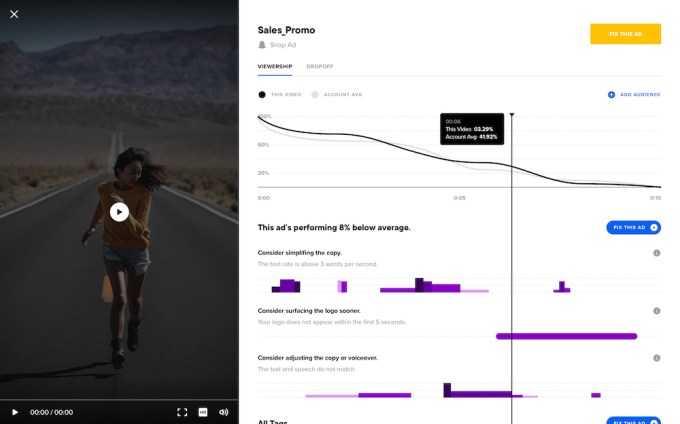
The platform analyzes how the different creative elements are affecting the way audiences are responding to an ad and uses this data to make campaigns more effective. The result, Collmer said, is that “the decay curve actually inverts and the ad actually improves over time through this iterative process of creating and learning, creating and learning.”

VidMob screenshot

Brands using VidMob include Bayer, Intercontinental Hotel Group, Ikea and Neutrogena, as well as startups like Acorns. In a statement, Joshua Palau, the vice president of media platforms and strategy for Bayer U.S., said the platform has “allowed us to meaningfully improve the ROI on our social video campaigns.”

VidMob has now raised more than $45 million in total funding. The round was led by Austin-based BuildGroup, with participation from Acadia Woods, Herington, Interlock Partners, Macanta Investments, the limited partners at Manifest and “brandtech” firm You & Mr Jones.

“VidMob solves a really important pain point for brands — how to deliver the volume of content that brands now need for all the different platforms, at the speed and price they need it at,” said You & Mr Jones founder David Jones in a statement. “In the near future all content will be intelligent and driven by data and VidMob has a product that delivers that now.”

And, BuildGroup co-founder and CEO Lanham Napier offered a statement praising VidMob for “not only offering up meaningful insights, but also providing the tools and talent to quickly and cost-effectively activate on that intelligence.”

“But it’s their vision for the future that gets us most excited,” Napier added. “As the world moves towards more complex forms of communication, the idea of an API for creativity is so powerful that you can see it becoming another foundational service layer of the web.”

VidMob screenshot

Collmer expanded on this idea in our interview, suggesting that VidMob could eventually do much more than facilitate video ads on social media platforms.

“As the web is moving from text and images to more complex media types — today that’s video, tomorrow it’s augmented reality, who knows what it will be after that — I’m fairly certain needle is always going to point towards greater complexity,” he said. “That creative friciton becomes a tax on the entire internet. We’re trying to build what I think of as an API for creativity … Today, that friction point is frequently with our platform partners, with the Facebooks and Snaps, but we see it expanding to other areas where you see imagery as the central point of communication.”

13 Jun 2019

VidMob raises raises $25M for its video advertising tools

Video advertising company VidMob is announcing that it has raised $25 million in Series B funding.

When I wrote about VidMob’s seed funding back in 2015, it was focused on building a marketplace that connected marketers and professional video editors. That’s still a component of the VidMob business, said founder and CEO Alex Collmer, but the company has also built a broader platform for video advertising, which it calls the Agile Creative Studio.

So Collmer said that with VidMob, not only can marketers find professionals (editors, animators, graphic designers and more) to create their ads, they can also “with a single click, send hundreds and in some cases thousands of custom ads” to VidMob partners like Facebook, Google/YouTube, Instagram, Snapchat and Twitter.

The platform analyzes how the different creative elements are affecting the way audiences are responding to an ad and uses this data to make campaigns more effective. The result, Collmer said, is that “the decay curve actually inverts and the ad actually improves over time through this iterative process of creating and learning, creating and learning.”

VidMob screenshot

Brands using VidMob include Bayer, Intercontinental Hotel Group, Ikea and Neutrogena, as well as startups like Acorns. In a statement, Joshua Palau, the vice president of media platforms and strategy for Bayer U.S., said the platform has “allowed us to meaningfully improve the ROI on our social video campaigns.”

VidMob has now raised more than $45 million in total funding. The round was led by Austin-based BuildGroup, with participation from Acadia Woods, Herington, Interlock Partners, Macanta Investments, the limited partners at Manifest and “brandtech” firm You & Mr Jones.

“VidMob solves a really important pain point for brands — how to deliver the volume of content that brands now need for all the different platforms, at the speed and price they need it at,” said You & Mr Jones founder David Jones in a statement. “In the near future all content will be intelligent and driven by data and VidMob has a product that delivers that now.”

And, BuildGroup co-founder and CEO Lanham Napier offered a statement praising VidMob for “not only offering up meaningful insights, but also providing the tools and talent to quickly and cost-effectively activate on that intelligence.”

“But it’s their vision for the future that gets us most excited,” Napier added. “As the world moves towards more complex forms of communication, the idea of an API for creativity is so powerful that you can see it becoming another foundational service layer of the web.”

VidMob screenshot

Collmer expanded on this idea in our interview, suggesting that VidMob could eventually do much more than facilitate video ads on social media platforms.

“As the web is moving from text and images to more complex media types — today that’s video, tomorrow it’s augmented reality, who knows what it will be after that — I’m fairly certain needle is always going to point towards greater complexity,” he said. “That creative friciton becomes a tax on the entire internet. We’re trying to build what I think of as an API for creativity … Today, that friction point is frequently with our platform partners, with the Facebooks and Snaps, but we see it expanding to other areas where you see imagery as the central point of communication.”

13 Jun 2019

Expedition installs highest weather stations on Earth atop Mount Everest

A recent research expedition to Mount Everest that wrapped up this week recorded a number of global records and world-firsts, including installing weather stations at the highest elevation ever on Earth, collecting ice core samples from the highest point ever, and performing a helicopter-based liar scan from the most extreme height ever accomplished.

The series of experiments were part of a multipurpose scientific expedition that included researchers from the National Geographic Society and Tribhuvan University in Nepal. The team for the research trip was made up of scientists and researchers

During the expedition, the team installed fully automated weather monitoring stations at 8,430 meters (27,657 feet) and 7,945 meters (26,066 feet), both of which are the highest currently in service today. In total, the researchers set up five weather stations across Everest. One ice core sample collected during the trip was taken at a height of 8.020 meters (26,312 feet), gain breaking records, and the lidar imagery piece of the puzzle included the most detail scans ever taken of both the Everest Base Camp and the Khumbu Glacier, as well as a helicopter-based lidar scan at the highest elevation on record, also of the glacier, which will help in monitoring its state over time.

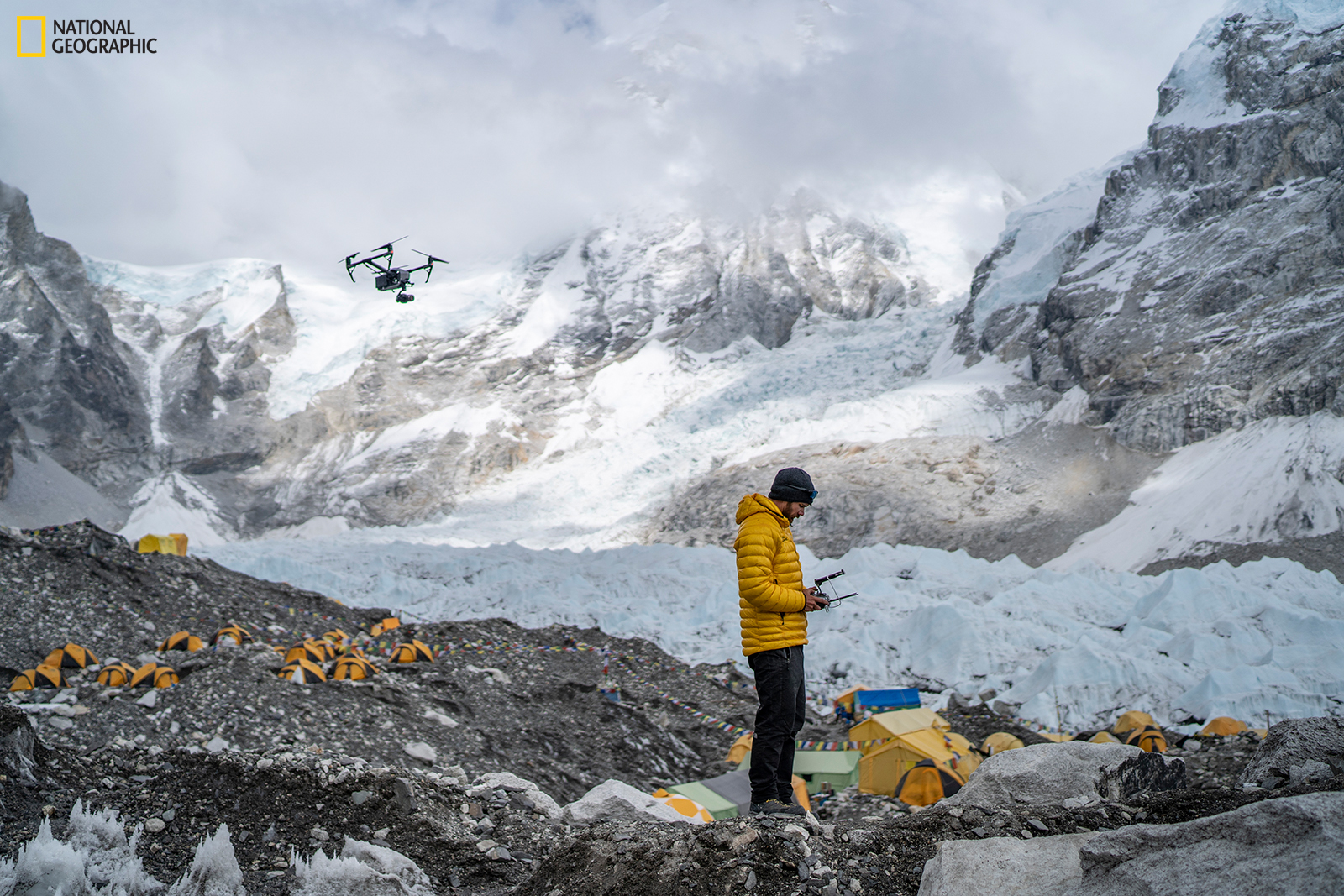
Chris Millbern, a member of the mapping team from the National Geographic and Rolex Perpetual Planet Extreme Expedition to Mt. Everest, operates a drone as he works to complete the most detailed photogrammetry data collection at Everest Base Camp. Learn more at www.natgeo.com/everest. Photo by Mark Fisher, National Geographic.

Geologists in the expedition collected glacial lake sediment to better understand how they’ve changed over time, and biologists in the crew installed biodiversity monitoring stations at one of the highest altitudes for a device its size on Earth, and also logged what are likely going to be certified as records for highest ever recorded encounters of two insect species.

Everest has been in the news lately for entirely different, tragic reasons: A mounting death toll due to an overeager tourist population hoping to scale the mountain’s heights. But this expedition is a good example of why it’s even more imperative to find some kind of solution to the thrill seeker overcrowding, so that research missions with real and demonstrable scientific businesses can continue.

13 Jun 2019

Expedition installs highest weather stations on Earth atop Mount Everest

A recent research expedition to Mount Everest that wrapped up this week recorded a number of global records and world-firsts, including installing weather stations at the highest elevation ever on Earth, collecting ice core samples from the highest point ever, and performing a helicopter-based liar scan from the most extreme height ever accomplished.

The series of experiments were part of a multipurpose scientific expedition that included researchers from the National Geographic Society and Tribhuvan University in Nepal. The team for the research trip was made up of scientists and researchers

During the expedition, the team installed fully automated weather monitoring stations at 8,430 meters (27,657 feet) and 7,945 meters (26,066 feet), both of which are the highest currently in service today. In total, the researchers set up five weather stations across Everest. One ice core sample collected during the trip was taken at a height of 8.020 meters (26,312 feet), gain breaking records, and the lidar imagery piece of the puzzle included the most detail scans ever taken of both the Everest Base Camp and the Khumbu Glacier, as well as a helicopter-based lidar scan at the highest elevation on record, also of the glacier, which will help in monitoring its state over time.

Chris Millbern, a member of the mapping team from the National Geographic and Rolex Perpetual Planet Extreme Expedition to Mt. Everest, operates a drone as he works to complete the most detailed photogrammetry data collection at Everest Base Camp. Learn more at www.natgeo.com/everest. Photo by Mark Fisher, National Geographic.

Geologists in the expedition collected glacial lake sediment to better understand how they’ve changed over time, and biologists in the crew installed biodiversity monitoring stations at one of the highest altitudes for a device its size on Earth, and also logged what are likely going to be certified as records for highest ever recorded encounters of two insect species.

Everest has been in the news lately for entirely different, tragic reasons: A mounting death toll due to an overeager tourist population hoping to scale the mountain’s heights. But this expedition is a good example of why it’s even more imperative to find some kind of solution to the thrill seeker overcrowding, so that research missions with real and demonstrable scientific businesses can continue.