Month: June 2019

12 Jun 2019

Symphony, a messaging app that’s been a hit with Wall Street, raises $165M at a $1.4B valuation

Slack’s rapid rise and upcoming IPO are clear signs of the ripe opportunity to be had in the field of enterprise messaging. Today, a startup that’s built a messaging product specifically for the financial services vertical is also proving that out. Symphony, which offers secure messaging and other collaboration tools for bankers and those who work with them, is today announcing that it has raised $165 million. With this round, Symphony’s valuation now tops $1.4 billion.

The funding comes from Standard Chartered and MUFG Innovation Partners (a division of Mitsubishi that makes fintech investments), and also included other (unnamed) current and new investors. Symphony has now raised a very hefty $460 million, with previous backers including Google, Lakestar, Natixis, Societe Generale, UBS, Merus Capital and BNP Paribas, along with a consortium of 14 of the world’s largest investment banks and money managers, including Bank of America, BlackRock, Citibank, Deutsche Bank, Goldman Sachs, HSBC, and JP Morgan.

Notably, its financial backers are all strategic investors in the company: they use Symphony both for internal collaboration as well a channel to communicate with outside partners and integrate data from across their networks in a secure and compliant way.

And before you consider Symphony’s expansion into new products and plans for the funding — more on those below — that usage has been on an upward trajectory. With an expanded presence outside of its home market of the US into Europe and Asia, the company now has 425,000 users across some 400 companies using its mobile and desktop apps for messaging, voice and video conversations, and more. As a point of comparison, when the company last raised money, in 2017, it had 200,000 paying customers. 

Even given that rapid take up of messaging, and of Symphony in particular, the size of this round came by surprise. In an interview earlier, David Gurlé, Symphony’s founder and CEO, said the original intention was to raise a more modest $50 million – $75 million. It appears that when your primary customers are also investors, things can ramp up quickly.

The funding will be used to continue growing the platform’s functionality, both organically and by way of acquisitions. In terms of the latter, areas where Gurlé believes Symphony would be better off buying rather than building itself include market intelligence and IT integration (indeed, there are a number of players in both areas and so consolidation may well be on the cards).

In terms of breaking new ground on its own, Gurlé said that a lot of it is dictated by Symphony’s customers. “A year ago, customers started approaching us looking for workflow automation tools,” he said, “and that was the beginning of a new chapter for us.”

That came in the form of a new product called Symphony Market Solutions, with many of the companies now adopting its product doing so in the context of “digital transformation” agendas — bringing their IT infrastructure and what it’s there to serve up to speed with modern developments.

For banks and others in the financial services industry, this is a notable development: more than any other vertical, except tech itself of course, financial giants have long been recruiters and builders of their own innovative IT services. That was in part because that is what necessity dictated: with tens of billions of dollars at stake, proprietary trading software built to do something better than your rivals can could give you a distinct advance. And part practicality: it can help you keep a better security and audit trail for what passes through that product.

Fast forward to today, and banks are cutting costs like everyone else, and they are also suffering from the brain drain that has hit many other verticals: big technology companies, and the lure of building a potentially lucrative startup, have become magnets for many of the greatest technical minds.

That has resulted in an interesting emergence of companies that are building products for these companies, knowing specifically what they need, and they’re getting more face time and consideration by buyers than ever before. Symphony is not the only one; BlueVoyant — which also recently raised funding — has also developed a similar proposition specifically in the area of security.

In terms of what else is coming on the horizon and Gurlé noted that the majority of traffic on Symphony today is related to internal communications, with a healthy proportion of that not between humans but humans and chatbots — there are now 1,000 on the platform — that they query to update or gather information.

“Symphony has generated tremendous interest for revolutionising buy-side and sell-side secure messaging and collaboration in global markets, both in content curation and consumption as well as the workflow across the whole deal life-cycle,” said Yann Gerardin, Deputy Chief Operating Officer and Head of Corporate and Institutional Banking at BNP Paribas, in a statement.

On the use of the chatbots, Darren Cohen, global head of Principal Strategic Investments (PSI), Goldman Sachs, noted that it’s a likely sign of how the product and the banking industry will continue to developl “The rapid proliferation of Symphony bots and application integrations across the trade lifecycle and throughout the enterprise gives us a glimpse into the future,” he said in a statement. “Symphony’s secure infrastructure and diverse ecosystem will enable the industry to unlock significant operational efficiency and meaningfully enhance the client experience.”

The other side of the communications are coming from organizations that are using Symphony to communicate with each other and share information across walled gardens.

Alex Manson, Global Head of SC Ventures, Standard Chartered, pointed out in an interview that this is helping Symphony expand its presence in other verticals, for example with the accounting and legal firms that are using the app to communicate with their clients, who are already using Symphony.

Another vertical that’s seeing some early traction with Symphony is government, which has a similarly strong need for security and audit trails. The startup is currently running some trials with government groups but declined to provide details on them.

Interestingly, Symphony is also exploring another kind of walled garden expansion:

Gurlé said that within banks, wholesale and retail sides are looking to work together more closely, and they are using Symphony for that purpose. In one product that Symphony is still developing, it’s looking of ways of incorporating popular consumer messaging applications like WhatsApp and WeChat into its system as well: “This is where a large proportion of the retail side’s users are,” he said. The idea is that these kinds of integrations will help create and track conversations on those consumer platforms more easily, helping with the bank’s wider audit trail. 

For its investor-customers, Symphony represents not just a service that can help them get their jobs done more efficiently, but an opportunity for learning at a time when many fintech startups, including challenger banks, are nipping at incumbents’ feet.

“What is the bank of today versus the bank of tomorrow?” Manson said. “Collaboration tools give us the potential to bridge verticals, especially as the lines between them become blurry.”

12 Jun 2019

India’s Zomato flies drone to deliver food in successful test

Zomato, one of India’s largest food delivery firms, may have figured out a faster way to crawl through dense populated routes: going air with drones.

The company, which has expanded its restaurant listing and booking service to about two-dozen markets in recent years, said today it has successfully tested a payload delivery from a hybrid drone.

The drone carried a payload of 5 kgs (11 pounds) and covered 5 kms (3.1 miles) in 10 mins, said Deepinder Goyal, CEO of Zomato, which aims to deliver food to customers in under 15 minutes some day. The drone hit a peak speed of 80 kmph (49.7 mph).

“Fifteen minutes is only possible if we take the aerial route – roads are not efficient for very fast delivery. While our biker fleet nowadays delivers in 30.5 minutes on an average (which is the fastest in the industry as far as we know), every incremental minute with our fleet becomes harder as it separates our users from their ordered food,” he said.

For Zomato, the drone test is more than a gimmick. The delivery firm, heavily backed by Ant Financial and Delivery Hero, acquired local drone startup TechEagle last year. Goyal said the company has finalized the design of its drone, which is lightweight and hosts an array of sensors to detect and avoid static and dynamic objects in its journey.

“Although being fully automated, each drone is currently being tested with (remote) pilot supervision to ensure 100% safety. Over time, as we have more data, we might not need remote pilot supervision,” he added.

The announcement comes at a time when Uber too is gearing up to introduce drones for food delivery for its UberEats business. The global giant, which has concluded initial phase of testing at San Diego State University in partnership with McDonald’s, plans to include others Eats restaurant partners later this year. Amazon too plans to begin drone deliveries “within months.”

How soon Zomato would be able to deploy these drones in its delivery fleet remains an open question. The firm said it will form a consortium, in accordance with local government’s direction, to carry out experimental drone operations in the country.

Much like the rest of the world, New Delhi has reserved its concerns over firms that want to operate drones commercially in the nation. Last month, a government body asked (PDF) interested stakeholders to express their interest in experimental use of drones that travel beyond visual line of sight. So far, the local regulation requires them to operate drones only during days and within the line of sight.

Goyal of Zomato, which is locked in an intense battle with heavily-backed Swiggy for tentpole position in India’s food delivery market, remains optimistic. “Food delivery by drones is no longer just a pipe dream. It’s almost here. Regulatory hurdles are not trivial, and the government’s concerns need to be looked at from various (valid) points of view. Having said that, the tech is ready to fly and I am confident that drone delivery will be commonplace sooner rather than later,” he said.

According to a report from Indian outlet Economic Times, Zomato is in talks to raise as much as $1 billion.

12 Jun 2019

Orca Security scores $6.5M seed round to solve cloud native security

Orca Security, a startup based in Israel, announced a healthy $6.5 million seed round today led by YL Ventures, a firm that makes a living investing in Israeli security startups.

That’s a lot of money for a seed round, but the company, which is led by two former Check Point Security executives, is trying to solve a hard problem around securing applications in the cloud without an agent.

“Orca, as a cloud native security platform, secures both customers’ own cloud native and legacy apps migrated to the cloud without needing agents,” company co-founder and CEO Avi Shua explained. Instead, he says the company uses a concept called “SideScanning,” which he said, “comprehensively examines the entire deployed software stack, discovering vulnerabilities, outdated and deprecated software versions, misconfiguration and other risks.”

This approach works well in a cloud native world where developers are launching applications in the cloud in containers using Kubernetes to orchestrate the containers, precisely because of the agentless approach.

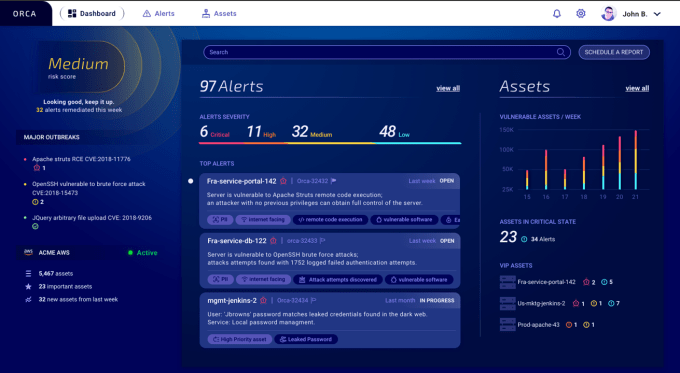
Screenshot of Orca dashboard.

The startup is going after established security vendors like Rapid7 and Tenable by attempting to build a more modern approach to cloud security, one that’s built from the ground up for cloud native constructs. “We didn’t just repurpose security software originally targeted at data center workloads. As such, we can analyze and secure customers’ own cloud-native workloads, migrated legacy workloads and hybrids of the two,” he said.

As a seed investment, it’s still very much early days for the company, which has a 15 person staff. With several Beta customers, the startup is looking for ways to build out the product and help customers solve the security problems related to modern software approaches. Today’s funding should help in that regard.

12 Jun 2019

The future of car ownership: Building an online dealership

Buying a car is painful. Dealerships are the worst, and the options are endless. The rise of the Internet produced powerful tools for shoppers, but in the end, most buyers still have to trudge down to a car lot.

For this series of articles, TechCrunch spoke with several founders and investors attempting to rethink car buying. It’s clear these startups are the underdog in this fight. Most consumers buy cars the same way as their grandparents did and for good reason. Dealerships nationwide fought for years to enact laws and regulations that protect their businesses.

Several young companies are attempting to put the dealership online. Companies like Carvana, Shift, Vroom and Joydrive are putting the entire car buying process online, allowing customers to buy, trade-in and even test drive vehicles without talking to a salesman in an oversized golf pullover.

In the next part of this series, we’ll look at companies like Fair that are moving consumers away from purchasing and into short-term leases. Even automakers are trying something new. Tesla sells directly to consumers while Volvo, BMW, Mercedes and others are launching subscription options to give owners even more flexibility.

The three new dealerships

Several companies are building online car dealerships. Shoppers find and buy a vehicle solely through these sites, and often, the cars are delivered to the buyer. These online dealerships even take trade-ins.

Three services dominate this space, and they were all founded in 2013. Carvana, Shift, and Vroom hit the market at the same time but have experienced different paths. One thing is clear though: it takes hundreds of millions of venture capital money to build an online dealership.

Emily Melton, co-founder and managing partner, Threshold Ventures (formally known as DFJ Ventures), points to consumer’s changing expectations and an optimized process across all kinds of vehicles. She invested in Shift’s recent $140m round.

12 Jun 2019

Uber will start testing Eats drone delivery

Uber is gearing up to start testing drone delivery for Uber Eats . This comes after the Federal Aviation Administration awarded Uber and San Diego the right to test commercial food delivery via drone.

Uber completed the initial phase of testing at San Diego State University in partnership with McDonald’s. Later this year, Uber plans to include others Eats restaurant partners.

But Uber isn’t using drones for the full delivery, just a part of it. Once a customer orders food, the restaurant will prepare the meal and then load it onto a drone. That drone will then take off, fly and land at a pre-determined drop-off location. Behind the scenes, Uber’s Elevate Cloud Systems will track and guide the drone, as well as notify an Eats delivery driver when and where to pick up their food. Down the road, Uber envisions landing the drones on top of parked vehicles located near the delivery locations. From there, the Eats delivery driver will complete the last mile to hand-deliver the food to the customer.

“We’ve been working closely with the FAA to ensure that we’re meeting requirements and prioritizing safety,” Uber Elevate Head of Flight Operations Luke Fischer said in a statement. “From there, our goal is to expand Uber Eats drone delivery so we can provide more options to more people at the tap of a button. We believe that Uber is uniquely positioned to take on this challenge as we’re able to leverage the Uber Eats network of restaurant partners and delivery partners as well as the aviation experience and technology of Uber Elevate.”

Uber is focusing on drone delivery in dense, urban environments, so it’s not as feasible to be able to drop the food into someone’s front yard or doorstep. That’s why Uber says it’s focused on leveraging its existing resources and fleet of Uber Eats delivery partners.

Eats is a very important business for Uber — one that is growing more than its core ride-hailing platform. In Q1 2019, Eats saw gross bookings growth of 108% to $3.07 billion.

12 Jun 2019

Amazon revamps Echo Dot Kids Edition and FreeTime

Announced in April of last year, the Echo Dot Kids Edition got something of a mixed reception, primarily due to privacy concerns surrounding the broader smart speaker category. Amazon is back with a version of the $70 device.

Design-wise, the product looks like a lot more like the latest version of the Dot, swapping the first generation’s plastic body for a curved cloth covering. The brightly colored bumpers, meanwhile, are gone, in favor of new colors form the Dot itself, including Rainbow and Frost Blue. As with the regular Dot, the speaker got a boost here. It’s now 70 percent louder.

The $70 price includes a year of Amazon FreeTime, which bundles in device time limits, activity review and the ability to filter out songs with explicit lyrics. There’s also a quick and easy feature built in that lets parents and kids work on their own Alexa Skill Blueprints.

As for privacy, Amazon has enlisted Family Online Safety Institute (FOSI) to help build Children’s Online Privacy Protection Act (COPPA) compliant features into FreeTime. Per Amazon,

To access FreeTime on Alexa, verifiable parental consent is required. None of the Alexa skills included within FreeTime Unlimited have access to or collect personal information from children, and there are multiple ways to delete a child’s profile or voice recordings. Parents can review and delete recordings through the Alexa app or the Alexa Privacy Hub, and contact Customer Service to request deletion of their child’s profile.]

The new Dot is available for pre-order today.

12 Jun 2019

Spotify launches ‘Your Daily Drive,’ a personalized playlist that combines music and podcasts

Recently, Spotify was spotted testing a new personalized playlist called “Your Daily Drive,” that included both music and podcasts. Today, the company is officially launching this playlist in the U.S. in an effort to better cater to commuters who spend 70 billion collective hours behind the wheel, the company says. The playlist includes the music you already like along with other recommended tracks — the latter similar to its flagship playlist Discover Weekly — as well as podcast news updates from The Wall Street Journal, NPR and PRI (Public Radio International.)

It may also intersperse this mix with timeless music classics on occasion, the company says.

The launch represents the first time Spotify has combined music and podcasts in one playlist, and is part of the company’s broader efforts in growing its podcast listener base.

In recent months, Spotify has invested in the podcast market through acquisitions like GimletParcast, and Anchor — as well as in its programming, like the just-announced deal with Barack and Michelle Obama’s production company, Higher Ground. It also hired former Condé Nast president of entertainment, Dawn Ostroff to lead its content efforts.

While Spotify has been talking up its plans to bring its personalization technology to podcasts, “Your Daily Drive” isn’t an example of that just yet. Instead, Spotify’s is focused on mixing its personalized music with “timely world updates from reputable sources,” it says. This makes its news content more akin to something like Alexa’s “Flash Briefing” rather than a tool that will help you discover new podcast programming.

Like Flash Briefing and other news update services, the “Your Daily Drive” will also refresh throughout the day with fresh content. That means your commute home won’t feature the same tunes and news as your morning commute did.

The playlist could also offer a safer experience for those who drive, as they won’t have to constantly fiddle with switching between stations, playlists or podcasts, to hear music and news. Investment in the auto space is another interest for Spotify, as of late, as the company has reportedly begun testing a voice-controlled hardware device that plugs into the car’s cigarette lighter/charging port.

“Your Daily Drive” arrives at a time when competition in the podcast market has been heating up. Pandora, in particular, has made audio programming a focus following its acquisition by SiriusXM. It has recently turned its Genome classification technology to podcasts, expanded its music-and-podcasts product Pandora Stories, and brought dozens of SiriusXM talk shows to Pandora as podcasts.

Meanwhile, at Apple’s Worldwide Developer Conference this month, the company broke up iTunes into separate apps on the Mac, including a dedicated Podcasts app. It also introduced a new podcast search feature that leverages machine learning technology to index the spoken words inside podcasts.

Spotify says “Your Daily Drive” is arriving today to listeners in the U.S. It’s available from the “Made for You” section. A new “Driving Hub” for all things car is also rolling out, Spotify says.


12 Jun 2019

Argo AI is taking its new generation of self-driving vehicles into downtown Detroit

Argo AI, the Pittsburgh-based autonomous vehicle startup that Ford invested $1 billion in 2017, has expanded its testing to downtown Detroit with a new third-generation self-driving car.

Argo AI is developing the virtual driver system and high-definition maps designed for Ford’s self-driving vehicles. The third-generation self-driving vehicle is still based on a Ford Fusion Hybrid like its previous test cars.

This latest iteration has a number of mechanical, sensing, compute and software upgrades that will take the company a step closer to production specification. Importantly, these vehicles also have redundant braking and steering systems that help maintain vehicle motion control in case one of the units stops functioning.

The new cars are equipped with an upgraded sensor suite, including new sets of radar and cameras with higher resolution and higher dynamic range as well as a new computing system that has better processing power and improved thermal management systems, according to Argo AI co-founder and president Peter Rander.

This third-generation vehicle is being used on all the cities Argo is testing in.

Argo AI does much of its testing in Pittsburgh, where it’s based. The company is also testing its autonomous vehicle technology in Austin, Miami, Palo Alto, Washington, D.C., and Dearborn, Michigan. This latest expansion brings Argo’s test vehicles to Detroit, specifically Corktown and sections of downtown around Campus Martius Park.

Corktown is the center of Ford’s electric and autonomous vehicles business plan. The automaker will spend the next several years transforming at least 1.2 million square feet of space in Corktown and ultimately a “mobility corridor,” that ties hubs of research, testing and development in the academic hub of Ann Arbor to Ford’s Dearborn headquarters, and finally to Detroit.

Ford plans to spend $4 billion through 2023 under an LLC that’s dedicated to building out an autonomous vehicles business. Ford Autonomous Vehicles LLC will house the company’s self-driving systems integration, autonomous-vehicle research and advanced engineering, AV transportation-as-a-service network development, user experience, business strategy and business development teams. The $4 billion spending plan includes the $1 billion investment in Argo AI.
12 Jun 2019

BetterUp raises $103M to fast-track employee learning and development

BetterUp, a company that connects employees with expert career and leadership development coaches online, has secured a $103 million Series C from Lightspeed Venture Partners, Threshold Ventures, Freestyle Capital, Crosslink Capital, Tenaya Capital and Silicon Valley Bank.

For access to its mobile coaches, which are meant to expedite development among employees and foster purpose and passion within the workplace, BetterUp offers a SaaS service to enterprises. Its customers include Airbnb, AppDynamics and Instacart, as well as 28 of the Fortune 1000.

The company said recently that the influx of Fortune 1000 customers has led to tripled revenue growth year-over-year.

“We are proud to be enabling innovative companies who recognize that their biggest asset—their people—deserve an elevated employee experience that speaks to who they are as whole persons, not just employees,” BetterUp co-founder and chief executive officer Alexi Robichaux said in a statement. “By combining human expertise, the latest advances in scientific research, and digital technologies including AI and machine learning we’re delivering unprecedented levels of personalized learning at scale.”

San Francisco-based BetterUp has previously raised about $43 million in venture capital funding since it was founded in 2012. It reached a valuation of $125 million with a $30 million Series B in March 2018, according to PitchBook. BetterUp declined to disclose its Series C valuation

BetterUp says its latest round is the largest ever for a “tech-enabled coaching, behavior change and wellness” platform. There isn’t a whole lot of competition in that space just yet. Nonetheless, $100 million is a sizable capital infusion for any startup.

Though career coaching hasn’t become VCs new favorite space — yet — startups creating tools for other startups is a trend that’s taken off in the last couple of years. Just look at Brex . In just two years, the company, which creates corporate cards for startups, has garnered a valuation of $2.6 billion. Gusto, WeWork, Plaid, Stripe, Atrium, Intercom and Outreach are just a few more examples of this emerging category.

“BetterUp is the one company fundamentally investing in the most important part of the future of work — human beings, Lightpseed’s Will Kohler said in a statement. “No other company drives measurable outcomes that change lives and workplaces.”

12 Jun 2019

Report: Chinese spend nearly 5 hours on entertainment apps daily

Like the rest of the world, China is getting more glued to smartphones that can perform an endless list of tasks, from talking to workmates, shopping for groceries, all the way to getting a dose of dopamine through games. Chinese internet users now spend an average of 4.7 hours on their handsets a day just for entertainment purposes, according to new data (in Chinese) collected by research firm QuestMobile.

The number is up from the 4.1-hour average from a year ago. By ‘entertainment’, QuestMobile is counting services like e-reading, music streaming, online karaoke, video streaming, mobile gaming, live streaming, and of course, short videos that are taking the world by storm. The total screen time could be much higher given the country now prefers taking QR code payments instead of cash, not to mention eyeball time contributed by children using smartphones to do their homework and housewives searching for the best deals on ecommerce platforms.

All told, China’s entertainment apps grew 3.7% year-over-year to 1.09 billion users in April, though the number likely includes duplicates as China reached an 800 million internet population in August.

China’s leisure apps are rising in tandem with the spread of cheap smartphones, affordable data plans and internet coverage. Driving the boom are bite-size, fun-to-watch videos pioneered by Douyin (aka TikTok for overseas users) and Kuaishou, a Tencent-backed rival. In April, 216 million users were on China’s short video services, representing a 36.6% increase from a year ago. That’s tripled the user size of e-reading, music streaming and video streaming apps.

Entertainment apps aren’t just for young people. Take the video streaming sector, which includes both short (e.g. Douyin) and long-form video services (e.g. Netflix-like iQiyi): 40% of the users were born after 1980, 35.2% after 1990, 15.2% after 1970 and only 9.7% after 2000, a composition that’s in line with the age demographic breakdown of China’s internet user base.

In terms of gender breakdown, the gap is small across all app categories except for two areas. 70.5% of all live streaming users are male. The hosts, who are often female, stream everything from singing to video gaming while male users send them virtual gifts, in part to show affection, in part to attract the hosts’ attention. Females, on the other hand, dominate apps that belong to the ‘two-dimensional space’ of anime, comic and games, making up 66% of the total user base.