
Month: June 2019

12 Jun 2019

Mary Meeker’s 2019 Internet Trends report highlights China’s short-form videos and super apps

This year’s edition of Mary Meeker’s Internet Trends report, released earlier today, once again included a section on China prepared by Hillhouse Capital. There are now 3.8 billion Internet users globally, more than half of the world’s population, but growth is slowing (as demonstrated by declining smartphone shipments). Internet leaders in China can continue helping companies in other countries find ways to engage their users, the way WeChat launched features, including mini-programs and e-commerce, that are now ubiquitous in messaging and social media apps around the world.

China has the most internet users in the world, about 800,000,000 or 21% of the world’s total internet users (it is followed by India, the United States and Indonesia). Chinese companies took seven of the top 30 spots for internet market cap leaders: Alibaba, Tencent, Meituan Dianping, JD.com, Baidu, NetEase and Xiaomi—stable, just one less than one year.

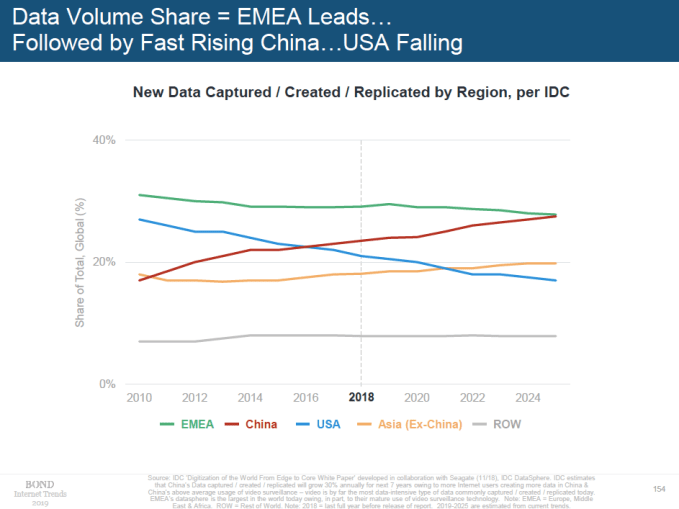
Mobile Internet users in China grew 9% year-over-year in 2018 to 817 million, while mobile data usage increased 189% year-over-year, faster than 2017’s 162% growth. While data volume share (or new data captured, generated and replicated by region) is falling in the U.S., it is rising in China, second in growth only to EMEA (Europe, the Middle East and Africa).
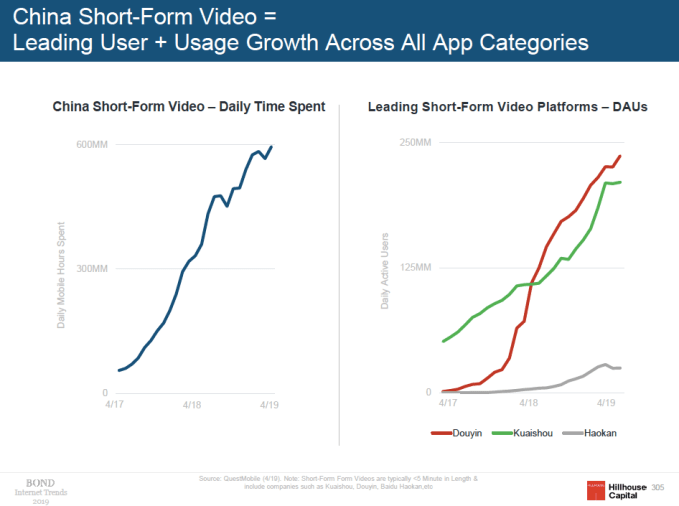
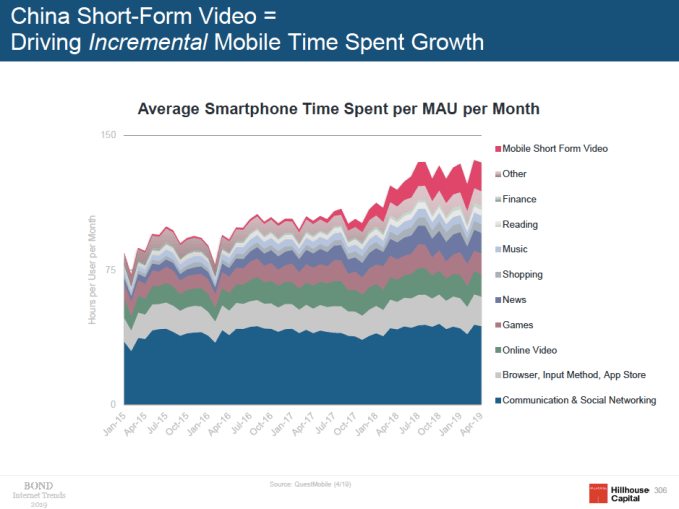
In particular, this year’s report highlighted short-form videos as a key driver of Internet usage growth in China, leading user and usage growth across all app categories. Users spent a total of nearly 600 million hours per day watching short-form videos on mobile in April 2019, more than in any other category. Short-form video leaders included Douyin (known as Tik Tok in international markets), Kuaishou and Haokan.
Another major video trend is live-streaming, especially for e-commerce platforms. Taobao got more than $14 billion GMV through live-streaming in 2018, while fashion e-commerce and social media platform Mogu attributed 24% of its GMV to live-streaming, which also had a four times repeat purchase rate.

While WeChat’s mini-programs have already influenced other apps like Instagram, WhatsApp, Kakao and Line, there is still plenty to learn from them. For example, the role they play as CRMs for many Chinese retailers: many brands send information about sales and other promotions by public accounts on WeChat or send red packets for discounts to group chats to drive engagement.

The rise of the “super app”

Meituan Dianping’s “super app” is growing increasingly huge. It now includes more than 30 services (for example, restaurant reviews, reservations, movie tickets, home rentals, hotel bookings, payments, travel booking, food delivery and grocery ordering), although restaurant-related services and travel make up as much as 88% of its revenue. The company’s annual transacting users grew 26% year-over-year to 412 million.

Alipay has also evolved from a payments app to hosting more than 200,000 mini-programs, including ones that enable users to manage their healthcare, investments, invoices, car payments and insurance. Alipay now counts more than one billion users, 70% of whom use at least three financial services in the app.

The influence of these “super apps” can be seen outside of China in apps like Grab, Rappi and Uber, which are adding more services (for example, Uber’s app now lets you order food, reserve e-bikes and find promotions at other businesses).

From offline to online 
Another trend that may make its way to other countries is the wide variety of business models used by grocery delivery apps in China. In the U.S., most grocery delivery apps take one of two approaches, either partnering with retailers and delivering groceries from their brick-and-mortar stores to users (like Instacart) or delivering from their own stores or warehouses, like Amazon Prime Now and Whole Foods.

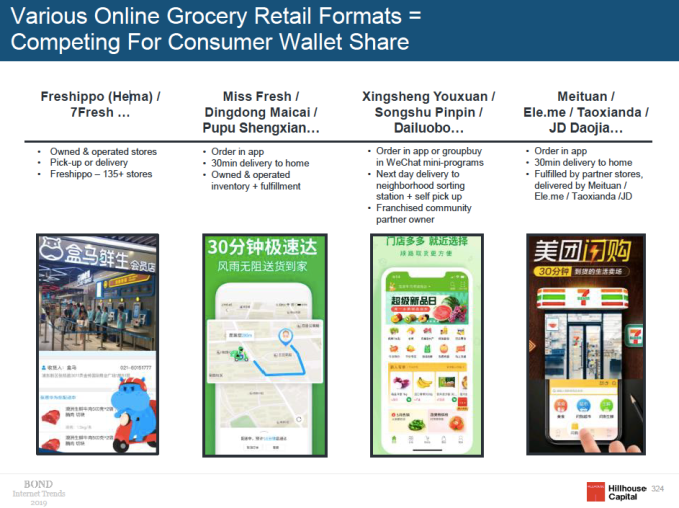
In China, on the other hand, grocery delivery apps are divided into four business models. Some, like Alibaba’s Freshippo (Hema) and JD.com’s 7 Fresh, own, operate and offer delivery or pickup from their own stores, while others like Miss Fresh and Dindong Maicai, deliver from their own warehouses, using their own fulfillment systems. A third group, including Xingsheng Youxuan, Songshu Pinpin and Dailubo, works with local franchised partners and allows users to order or make group purchases in WeChat mini-programs for next-day delivery or pick up. The fourth group offers quick deliveries from retail partners and includes big companies like Meituan, Alibaba’s Ele.me and Taoxianda, and JD.

Riding the same offline-to-online wave, educators are digitizing classes that were traditionally taught in person. Online tutoring has hit the mainstream as K-12 students embrace homework apps to get afterschool help. Similarly, parents sign their younger children (ages 3-10) up for English and coding classes hosted on smartphones.

The Chinese government has also gone digital and is increasingly offering public services through in-house apps and third-party super apps such as WeChat and Alipay. The list of tasks that citizens can complete on their phones includes applying for visas, paying utility bills, virtually queuing up at hospitals, renewing a driver’s license, and many more that can save people the hassle of hopping from one government office to another.

12 Jun 2019

Bux raises additional $12.5M as it gears up to launch ‘zero-commission’ investing app

Bux, the Amsterdam-based trading app that wants to make investing fun, has picked up an additional $12.5 million in new funding. Venture capital firms Velocity Capital and Holtzbrinck Ventures led the round, which also includes debt financing from Kreos Capital. It brings total funding to $35 million since being founded over five years ago.

The newly raised capital will in part be used to launch “STOCKS,” the company’s planned app for “commission-free” investing. Bux is also disclosing that it has already spent some of the funding on the acquisition of online broker ayondo markets Limited (AML). Ayondo is the back-end provider the startup has been using to power its existing trading app BUX, while the merger arguably puts Bux squarely in the “neo-broker” territory and up against the likes of London-based Freetrade.

“The acquisition of AML marks the first acquisition by BUX since its founding in 2014,” says the Dutch company. “To-date, the partnership with AML has allowed BUX to fully focus on creating an app that removes the complexity from the financial markets and simplifies the trading experience. It has allowed BUX to reach a base of over 2 million users in just over four years across 9 European countries”.

By bringing its brokering in-house, Nick Bortot, CEO and founder of Bux, says it gives the company control over “the full value chain,” including a full brokerage license, back-end technology and operation. This, he believes, will enable Bux to service customers better going forward, and make it much easier to quickly launch new features.

It’s a similar argument made by challenger banks that have built out their own banking stack, and echoes the thinking behind competitor Freetrade’s decision to acquire a broker license very early on.

“We will additionally add 50% to our future revenues, as we will keep servicing other clients of AML,” adds Bortot.

On track to launch this summer is STOCKS, Bux’s commission-free investing app that is quite different to the BUX app that offers a “gamified” trading experience and generates revenue per trade.

“Our current trading app allows users to trade in CFDs on stocks, indices, forex and other financial products for the short term with limited leverage,” explains the Bux CEO. “STOCKS will allow users to invest in companies for the mid to long term and allow them to invest in real shares commission-free [as opposed to CFD trading]. It will offer a unique combination of a simplified investing experience along with a vibrant community where they can follow, learn from fellow investors and explore new investing opportunities. This unique combination will be unlike anything that will be in the market once we are live”.

Meanwhile, Revolut, the fast-growing banking app, is also planning to launch a free trading feature, although Bortot is sceptical about how successful that will be. “At this time Revolut has not yet launched their zero-commission trading service,” he says, [and] we are convinced that brokerage and banking are two completely different animals. It requires different skills, expertise, regulation, etc.

“Therefore, similar to what we have seen in neo banking, we will see the rise of 2 to 3 pan-European neo brokers over the next few years (we anticipate 2 to 3 as a matter of scale across Europe). In order for these mobile brokers to be successful across the whole of Europe, and become true neo brokers, it will be crucial for them to be able to easily adapt their services to other languages, but also to different legal systems, local tax systems, local KYC regulations, etc. Europe is very fragmented and not a one size fits all geography”.

To that end, Bux says its soon-to-launch STOCKS app currently has over 100,000 users on the waitlist. Netherlands and Germany will get access to the new app first, followed by a broader rollout across Europe “in the coming year”.

12 Jun 2019

Bux raises additional $12.5M as it gears up to launch ‘zero-commission’ investing app

Bux, the Amsterdam-based trading app that wants to make investing fun, has picked up an additional $12.5 million in new funding. Venture capital firms Velocity Capital and Holtzbrinck Ventures led the round, which also includes debt financing from Kreos Capital. It brings total funding to $35 million since being founded over five years ago.

The newly raised capital will in part be used to launch “STOCKS,” the company’s planned app for “commission-free” investing. Bux is also disclosing that it has already spent some of the funding on the acquisition of online broker ayondo markets Limited (AML). Ayondo is the back-end provider the startup has been using to power its existing trading app BUX, while the merger arguably puts Bux squarely in the “neo-broker” territory and up against the likes of London-based Freetrade.

“The acquisition of AML marks the first acquisition by BUX since its founding in 2014,” says the Dutch company. “To-date, the partnership with AML has allowed BUX to fully focus on creating an app that removes the complexity from the financial markets and simplifies the trading experience. It has allowed BUX to reach a base of over 2 million users in just over four years across 9 European countries”.

By bringing its brokering in-house, Nick Bortot, CEO and founder of Bux, says it gives the company control over “the full value chain,” including a full brokerage license, back-end technology and operation. This, he believes, will enable Bux to service customers better going forward, and make it much easier to quickly launch new features.

It’s a similar argument made by challenger banks that have built out their own banking stack, and echoes the thinking behind competitor Freetrade’s decision to acquire a broker license very early on.

“We will additionally add 50% to our future revenues, as we will keep servicing other clients of AML,” adds Bortot.

On track to launch this summer is STOCKS, Bux’s commission-free investing app that is quite different to the BUX app that offers a “gamified” trading experience and generates revenue per trade.

“Our current trading app allows users to trade in CFDs on stocks, indices, forex and other financial products for the short term with limited leverage,” explains the Bux CEO. “STOCKS will allow users to invest in companies for the mid to long term and allow them to invest in real shares commission-free [as opposed to CFD trading]. It will offer a unique combination of a simplified investing experience along with a vibrant community where they can follow, learn from fellow investors and explore new investing opportunities. This unique combination will be unlike anything that will be in the market once we are live”.

Meanwhile, Revolut, the fast-growing banking app, is also planning to launch a free trading feature, although Bortot is sceptical about how successful that will be. “At this time Revolut has not yet launched their zero-commission trading service,” he says, [and] we are convinced that brokerage and banking are two completely different animals. It requires different skills, expertise, regulation, etc.

“Therefore, similar to what we have seen in neo banking, we will see the rise of 2 to 3 pan-European neo brokers over the next few years (we anticipate 2 to 3 as a matter of scale across Europe). In order for these mobile brokers to be successful across the whole of Europe, and become true neo brokers, it will be crucial for them to be able to easily adapt their services to other languages, but also to different legal systems, local tax systems, local KYC regulations, etc. Europe is very fragmented and not a one size fits all geography”.

To that end, Bux says its soon-to-launch STOCKS app currently has over 100,000 users on the waitlist. Netherlands and Germany will get access to the new app first, followed by a broader rollout across Europe “in the coming year”.

12 Jun 2019

Funderbeam, the funding and trading platform for private companies, scores $4.5M Series A

Funderbeam, the funding and trading platform for private companies founded by Kaidi Ruusalepp, who was previously CEO of the Nasdaq Tallinn stock exchange, has raised $4.5 million in Series A funding.

The round is led by U.K.-based Accelerated Digital Ventures (ADV), and includes new investors such as GK-Plug and Play Indonesia, and Pandan Ventures. Existing investors Draper Associates, Draper Venture Partners, IQ Capital, and Mistletoe also followed on.

Aiming to “fill in the gap” in venture and SME capital markets, Funderbeam provides access and liquidity to growth-stage investments via its information and trading platform. To date, Funderbeam has had 37 high-growth portfolio companies listed on its marketplace, and says it has on-boarded more than 10,000 verified investors across 119 countries. This has seen $2.2 million worth of shares exchange hands on the Funderbeam secondary marketplace.

Funderbeam, which employs blockchain technology to power its ledger, says it recently launched in Scandinavia and the U.K. with the aim of helping founders to raise private funding from a global network of investors.

It should be noted that the platform isn’t a free-for-all and is not entirely open. Founders are able to choose who can invest and therefore retain control of the cap table. For investors, Funderbeam says it provides access to a community of “curated, ambitious growth companies” and the option to trade investments at any time. “A robust due diligence process and lead investor acting as an ambassador for every round ensures the high quality of companies on the platform,” says the company.

Meanwhile, Funderbeam’s Series A funding will be used to develop a stronger secondary market offering as well as for further expansion into key markets such as Asia, starting from Singapore where it has an office, and then to continental Europe.

“Liquidity is fundamental to venture capital,” said Lee Strafford, CEO of ADV, in a statement. “Without a viable liquid market early stage investment is constrained and company growth is negatively impacted. Funderbeam is building a platform which enables liquidity, maintaining the momentum of companies and allowing investors to go again. We share the vision of the Funderbeam team and are excited to partner with them on a journey which could change venture forever”.

We are also told that Funderbeam co-founder Urmas Peiker will leave the company to “focus on his mission to change the capital markets in developing markets”. “Urmas has been contributing a lot to Funderbeam’s business model and success. We thank him and wish all the best in his new journey,” says Kaidi.

12 Jun 2019

Funderbeam, the funding and trading platform for private companies, scores $4.5M Series A

Funderbeam, the funding and trading platform for private companies founded by Kaidi Ruusalepp, who was previously CEO of the Nasdaq Tallinn stock exchange, has raised $4.5 million in Series A funding.

The round is led by U.K.-based Accelerated Digital Ventures (ADV), and includes new investors such as GK-Plug and Play Indonesia, and Pandan Ventures. Existing investors Draper Associates, Draper Venture Partners, IQ Capital, and Mistletoe also followed on.

Aiming to “fill in the gap” in venture and SME capital markets, Funderbeam provides access and liquidity to growth-stage investments via its information and trading platform. To date, Funderbeam has had 37 high-growth portfolio companies listed on its marketplace, and says it has on-boarded more than 10,000 verified investors across 119 countries. This has seen $2.2 million worth of shares exchange hands on the Funderbeam secondary marketplace.

Funderbeam, which employs blockchain technology to power its ledger, says it recently launched in Scandinavia and the U.K. with the aim of helping founders to raise private funding from a global network of investors.

It should be noted that the platform isn’t a free-for-all and is not entirely open. Founders are able to choose who can invest and therefore retain control of the cap table. For investors, Funderbeam says it provides access to a community of “curated, ambitious growth companies” and the option to trade investments at any time. “A robust due diligence process and lead investor acting as an ambassador for every round ensures the high quality of companies on the platform,” says the company.

Meanwhile, Funderbeam’s Series A funding will be used to develop a stronger secondary market offering as well as for further expansion into key markets such as Asia, starting from Singapore where it has an office, and then to continental Europe.

“Liquidity is fundamental to venture capital,” said Lee Strafford, CEO of ADV, in a statement. “Without a viable liquid market early stage investment is constrained and company growth is negatively impacted. Funderbeam is building a platform which enables liquidity, maintaining the momentum of companies and allowing investors to go again. We share the vision of the Funderbeam team and are excited to partner with them on a journey which could change venture forever”.

We are also told that Funderbeam co-founder Urmas Peiker will leave the company to “focus on his mission to change the capital markets in developing markets”. “Urmas has been contributing a lot to Funderbeam’s business model and success. We thank him and wish all the best in his new journey,” says Kaidi.

12 Jun 2019

“Russian Doll” will return to Netflix for a second season

Harry Nilsson’s “Gotta Get Up” might be ringing through your ears once again. “Russian Doll,” co-created by and starring Natasha Lyonne, has been picked up for a second season by Netflix. A release date hasn’t been confirmed yet, but the new season will have eight episodes.

The renewal was announced today by Lyonne and Netflix vice president of content acquisition and original series Cindy Holland during Recode’s Code Conference and is noteworthy for several reasons. As a dark, time-bending comedy written and directed by all women, the show is an example of how Netflix and other streaming services can give a platform to content that might otherwise have a hard time finding a distributor. Though Lyonne is a well-respected actress, she has mostly appeared in supporting roles, but her lead performance was one of the reasons “Russian Doll” became a breakout hit earlier this year.

During their Code Conference panel, Holland said “Russian Doll” was a “hit relative to cost” and underscored the “eclectic tastes” of Netflix’s audience, while Lyonne described Netflix’s algorithm as “a bit of a relief,” adding that “boundaries are sort of healthy for the creative process in a way.”

12 Jun 2019

Adjust raises $227M to measure mobile ads and prevent fraud

Adjust is announcing that it has raised $227 million in new funding.

The company, founded in Berlin back in 2012, has created a variety of ad measurement and anti-fraud tools — CEO Christian Henschel said the goal is to “make marketing simpler, smarter and safer.” Adjust says it’s now being used in more than 25,000 mobile apps for customers like NBCUniversal, Zynga, Robinhood, Pinterest and Procter & Gamble.

It’s been nearly four years since the company raised its previous round of $15 million. Henschel (pictured above with his co-founder and CTO Paul Müller) told me the company was already profitable back then, and it’s continued to be profitable while growing revenue by an average of 80 percent every year. So it raised more money (a lot more), he said, “because we saw the opportunity … to grow our business even further.”

Henschel pointed to three broad areas where Adjust is planning to invest and grow. First, there’s combating fraud, where he said the company was “very early,” first launching its mobile fraud prevention suite in 2016. It expanded its offerings earlier this year with the acquisition of Unbotify.

Second, he said Adjust will continue to invest in automation and aggregation — an area where it made another recent acquisition, namely the data aggregation company Acquired.io.

“We’re giving our customers the ability to get rid of the repetitive and boring tasks and really focus them back on thigns that human beings are very good at — that is creativity,” Henschel said.

Lastly, the company (which already has 350 employees in 15 offices worldwide) will continue to invest in customer service and geographic expansion, particularly in Asia.

Speaking of acquisitions, Adjust says it’s also partnered with Japanese marketing agency Adways and acquired Adways’ attribution tool PartyTrack. So naturally, you might assume that this new capital means  even more deals are in the works, but Henschel said, “Acquisitions are always tough — it’s hard to find the right companies, and even harder to integrate them.”

In other words, he’s open to acquiring more companies, but he said, “We don’t have any plans right now.”

This new round brings Adjust’s total funding to $250 million. It was led by Eurazeo Growth, Highland Europe, Morgan Stanley Alternative Investment Partners and Sofina.

“Adjust reached profitability just three years after its creation, and has seen extraordinary growth since then,” said Eurazeo Growth’s Yann du Rusquec in a statement. “The company is ideally positioned to further expand its product and footprint throughout 2019 and beyond, cementing its position as one of the most successful global tech champions to come out of Europe.”

12 Jun 2019

Norrsken opens East Africa startup fund and hub in Kigali

Startups in East Africa have a new source for investment and mentorship.

Sweden’s Norrsken Foundation—a coworking space and investment fund based in Stockholmopened its tech fund and entrepreneurship hub in Rwanda today to support ventures across the region.

Norrsken’s Kigali center is located on the former École Belge campus and will begin with seed investments of $25K to $100K for early stage startups in all sectors starting this year, Norrsken CEO Erik Engellau-Nilsson told TechCrunch.

The fund size is still being determined and Norrsken Kigali will extend the fund to larger series-stage investments from $100K to $1 million in the future.

Norrsken’s Fredrika Wessman is the head of Africa expansion and the organization is in the process of hiring a local director for its new Kigali operation.

The Swedish foundation’s move into Rwanda is strongly connected to the organization’s focus on the power of tech entrepreneurs to solve problems and generate capacity.

“We believe the single most important thing we can do here is help people get wealthy, because if that happens more investors will start to look at this region and see there’s business opportunities and bring more capital,” said Engellau-Nilsson.

“The aim is to build the biggest hub for entrepreneurship in East Africa.”

Startups that receive Norrsken funding from its Kigali center will receive mentorship and support of the overall Norrsken organization and network. “That includes unicorn founders, leading tech founders, and developers. We also look to expand that network to local accelerators and incubators,” said Engellau-Nilsson.

The Kigali center is Norrsken’s first launch outside of Sweden and the organization looks to open in 25 markets globally over the next decade.

Norrsken was formed in 2016 by Niklas Adalberth, the founder of Swedish payments solutions unicorn Klarna. Engellau-Nilsson was an exec with Adalberth at Klarna from 2013 to 2017, and both aimed to do more to support impact-driven, early stage ventures.

“We wanted to use our experience and tech to solve real problems instead of finding another way to do things like deliver burrito’s faster,” said Engellau-Nilsson.

Over 340 entrepreneurs and 120 companies currently work out of Norrsken’s Stockholm location. The organization’s fund has invested in 17 ventures, including three Africa focused startups—agtech company Wefarm, digital publisher Kognity, and weather forecasting firm Ignitia.

Norrsken chose Rwanda as the base for its East African  for the country’s progress over the last decade on infrastructure, increasing internet penetration, and improving its business environment. In 2019, Rwanda ranked higher than any African country on the World Bank’s Ease of Doing Business list, 29th, before Spain.

Though the country has a relatively small population (12 million) and tech scene, the government of Rwanda has prioritized tech events and development in the country. This includes becoming a leader on  drone delivery and regulatory systems, working most notably with San Francisco based UAV startup Zipline.

Of the East African countries from which Norrksen will source investments, Kenya stands out as one of the continent’s top hubs for tech startup formation, VC, and exits.

As for how ventures can reach out to pitch to Norrsken’s new fund, “If there are entrepreneurs who want to reach out to us, we’re ready to go,” said Engellau-Nilsson. Norrsken posted an informational and contact link for its Rwanda hub today.


12 Jun 2019

VW’s partnership with self-driving car startup Aurora has ended

A partnership between Volkswagen and self-driving vehicle startup Aurora has ended, according to a report by the Financial Times, citing three people familiar with the matter. 

A spokesperson from VW confirmed the news, telling TechCrunch that “activities under our partnership have been concluded.” VW did not provide any further details. 

Aurora didn’t provide any details either, accept to say VW Group has been a “wonderful partner” since its early days of development of its self-driving vehicle stack dubbed the Aurora Driver.

Aurora, a nearly three-year-old startup that has raised $530 million, develops and supplies the “full-stack solution” for self-driving vehicles. It has existing partnerships with Hyundai, Byton and more recently Fiat Chrysler Automobiles as well as several other unnamed companies, which it alluded to in its statement. 

“As the Driver matures and our platform grows in strength, we continue to work with a growing array of partners who complement our expertise and expand the reach of our product,” Aurora said in a statement.

The partnership was not contentious and the initial agreement ended on good terms, two sources familiar with the deal between Aurora and VW told TechCrunch. One source inferred to continued conversations between the two companies without providing any details.

In the end, what started out as a collaboration, ended up as misalignment in wants and needs.

The two companies had already been working together for six months before their joint January 2018 announcement, not long after Sterling Anderson, Drew Bagnell and Chris Urmson had left jobs at Tesla, Uber and Waymo to found Aurora.

When the partnership was finally announced, VW said the two companies were going to bring self-driving electric vehicles to cities as Mobility-as-a-Service fleets. It was an important early endorsement for Aurora and it showed VW was striking out beyond the confines of its massive company to seek out the latest innovations.

The plan was for Volkswagen to deploy autonomous test vehicles developed with Aurora on public roads. Johann Jungwirth, VW’s chief digital officer at the time and a key connection between the two companies, said the number of test vehicles were going to grow to “triple digits” in 2019, and “four digits” in 2020, before going into production in 2021. Ultimately, the self-driving system could be integrated across VW Group’s many brands, including Volkswagen Passenger Cars, Audi, Bentley, Skoda, and Porsche. That never materialized and Jungwirth left VW earlier this month.

VW was going through its own internal changes as Herbert Diess took the CEO spot. And it appeared, based on insiders, that VW wanted more control over its autonomous vehicle program and possibly even ownership. Bloomberg reported in August 2018 that VW, in the hunt for autonomous vehicle technology, had tried to buy Aurora. The startup declined the offer over a desire to stay independent, according to the report.

A better fit for VW’s wants could be Ford, or more specifically the Pittsburgh-based company Argo AI that the U.S. automaker invested $1 billion in 2017. Talks between the two companies have been ongoing for months now, although there is already one deal between VW and Ford locked in. Ford and VW finalized an agreement in January to build commercial vans and medium-sized pickup trucks together as early as 2022.
12 Jun 2019

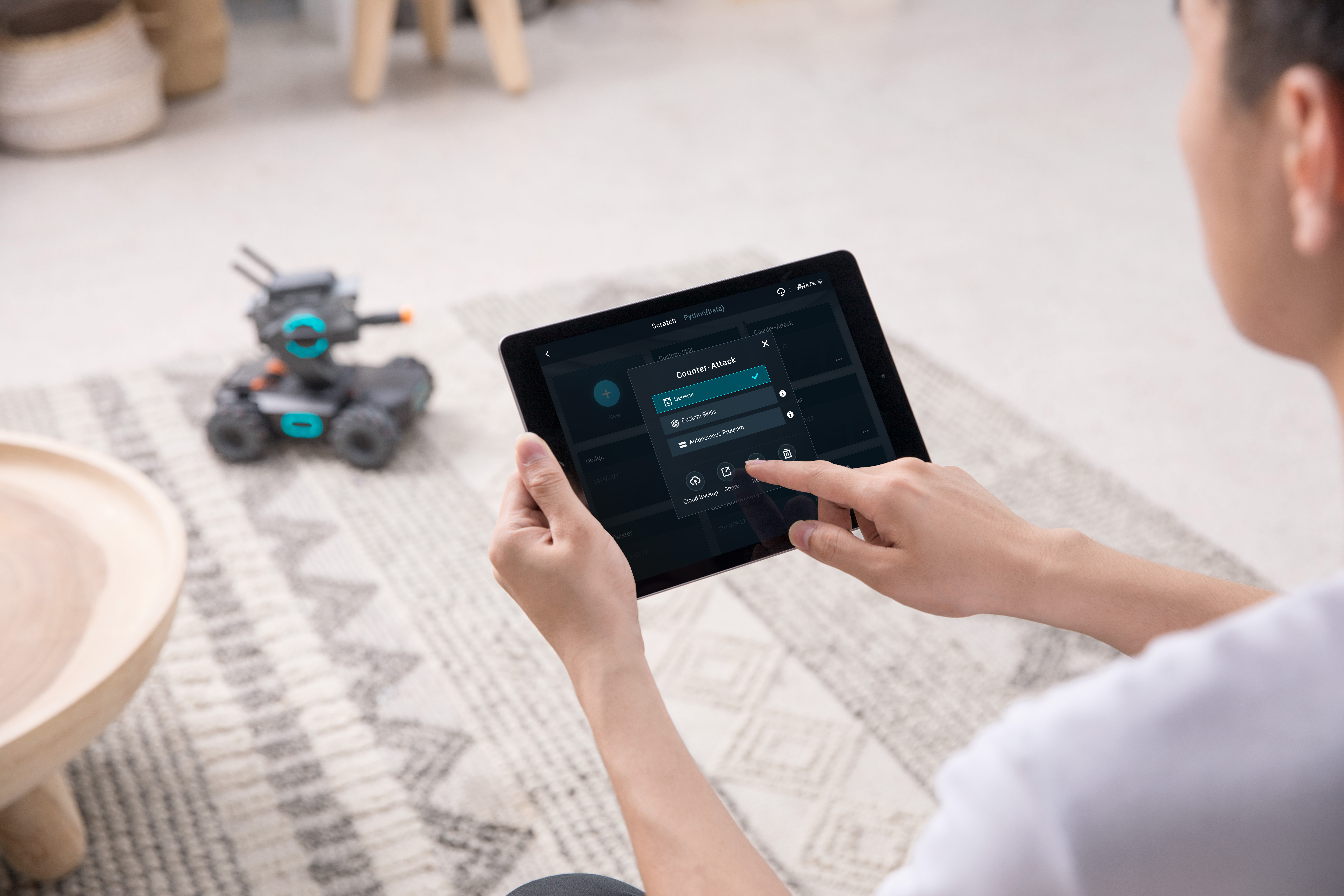
DJI gets into the battling robot business

A little less than a month ago, DJI branched out from the world of gimbals and drones with the release of the Osmo Action, a new action camera that put GoPro firmly in the company’s sites. Now it’s back with another new category: educational fighting robots.

The RoboMaster S1 seems like an odd fit at first, but the company’s quick to point out that robotics are an important part of DJI’s DNA. Founder and CEO Frank Wang studied robotics in school, and in recent years, the company has put on a series of robotic fighting tournaments in China under the RoboMasters banner.

The S1 takes its name from the competition, but this is a much more consumer-focused approach to the category, in line with offerings like DJI’s Mavic line. It’s also the first major step into the world of education, with a product that ships in 46 unassembled pieces and requires coding learning to really get off the ground.

Targeted at ages 14 and up, the S1 (short for Step 1, per DJI) is actually an impressive little robot. It’s got four wheels, and is capable of cruising up to eight miles an hour (though it can apparently be hacked to go even faster). Up top is an adjustable tank-style turret that blasts out nontoxic gel beads for doing battle. There’s also an infrared shooter for less messy combat.

There are 31 sensors on board, six of which are designed to detect hits during fights. An on-board camera lets the users control the robot with FPV through the accompanying app, while built-in machine vision helps the device detect obstacles and receive signals from other S1 units.

There are a half dozen different recognition functions on-board here, including Follow Mode (for other S1 units), gesture recognition, S1 recognition, clap (sound) recognition and Line Follow and vision marker recognition, which use landmarks to navigate. Beyond that, users can control the robot manually via the app.

The hardware is less customizable than its RoboMasters counterparts, but the inclusion of six Pulse Width Modulation (PWM) ports on the rear means that more advanced users can plug in third-party hardware to soup up the robot. On the software side, both Scratch 3.0 and Python can be used to program functions like “Hit and Turn Back,” wherein the turret spins back around after being hit from behind.

The robot is available starting today, priced at $499. The company will also be shipping its standard PlayMore Kit configuration, which features an extra battery, controller and a lot more gel beads. That’s available starting next month.