Month: June 2019

11 Jun 2019

States are looking to jam T-Mobile and Sprint’s proposed $26.5 billion merger

A number of  states have filed a lawsuit to block the proposed $26.5 billion merger of T-Mobile and Sprint.

The lawsuitm, filed in the United States District Court for the Southern District of New York, alleges that the merger of Sprint and T-Mobile would be anti-competitive and drive up costs for consumers.

“When it comes to corporate power, bigger isn’t always better,” said James, in a statement. “The T-Mobile and Sprint merger would not only cause irreparable harm to mobile subscribers nationwide by cutting access to affordable, reliable wireless service for millions of Americans, but would particularly affect lower-income and minority communities here in New York and in urban areas across the country.”

T-Mobile and Sprint represent the third and fourth largest carriers in the country behind Verizon Wireless (which owns TechCrunch) and AT&T.

While prices for mobile services have fallen by 28 percent over the last decade, the attorneys general fear that greater consolidation would diminish customer competition.

Sprint and T-Mobile have not yet responded to a request for comment.

In the past, the two companies have argued that their combined networks would enable a faster and better rollout of 5G wireless services — the new high-speed networks that every mobile operator are touting as the next big technological advancement.

Indeed, the U.S. and China are currently in a bit of a race for dominance in 5G connectivity. The competition is at the heart of trade disputes and the blacklisting of China’s telecom and technology giant Huawei within the U.S.

Critics contend that the merger would create another mobile behemoth whose prices could prove to be less competitive — and unfair trade-off for increased connectivity in the eyes of lawmakers.

There’s another reason why plaintiffs are hoping to halt the merger in its tracks and that’s the impact it could have on employment.

The consolidation of Sprint and T-Mobile would undoubtedly shutter hundreds of retail locations and slash service and repair jobs around the country — a primary source of employment for hundreds of Americans.

“CWA applauds the Attorneys General and especially General Letitia James’ leadership in taking decisive action today to prevent T-Mobile and Sprint from gaining anti-competitive power at the expense of workers, customers, and communities,” added Chris Shelton, president of the Communications Workers of America (CWA), in a statement. “Reducing the number of national wireless carriers from four to three would mean higher prices for consumers, job loss for retail wireless workers, and downward pressure on all wireless workers’ wages. The states’ action today is a welcome development for American workers and consumers, and a reminder that regulators must take labor market concerns seriously when evaluating mergers.”

T-Mobile, a subsidiary of the German telecommunications company, Deutsche Telekom, currently has more than 79 million subscribers, while the SoftBank Group-owned Sprint Corp. currently has more than 54 million subscribers.

11 Jun 2019

Sense Photonics flashes onto the lidar scene with a new approach and $26M

Lidar is a critical part of many autonomous cars and robotic systems, but the technology is also evolving quickly. A new company called Sense Photonics just emerged from stealth mode today with a $26M A round, touting a whole new approach that allows for an ultra-wide field of view and (literally) flexible installation.

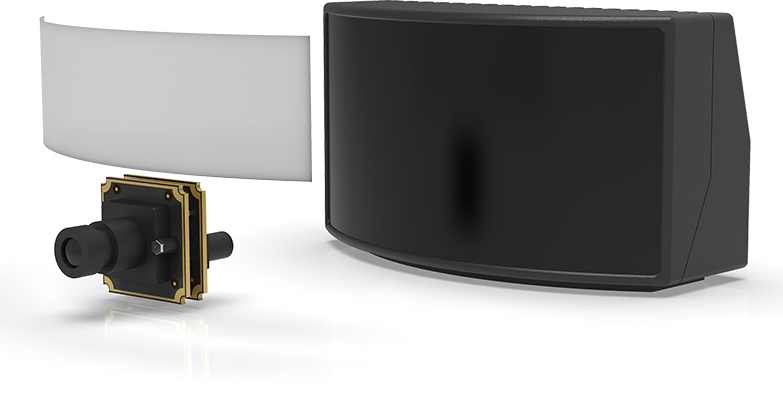
Still in prototype phase but clearly enough to attract eight figures of investment, Sense Photonics’ lidar doesn’t look dramatically different from others at first, but the changes are both under the hood and, in a way, on both sides of it.

Early popular lidar systems like those from Velodyne use a spinning module that emit and detect infrared laser pulses, finding the range of the surroundings by measuring the light’s time of flight. Subsequent ones have replaced the spinning unit with something less mechanical, like a DLP-type mirror or even metamaterials-based beam steering.

All these systems are “scanning” systems in that they sweep a beam, column, or spot of light across the scene in some structured fashion — faster than we can perceive, but still piece by piece. Few companies, however, have managed to implement what’s called “flash” lidar, which illuminates the whole scene with one giant, well, flash.

That’s what Sense has created, and it claims to have avoided the usual shortcomings of such systems — namely limited resolution and range. Not only that, but by separating the laser emitting part and the sensor that measures the pulses, Sense’s lidar could be simpler to install without redesigning the whole car around it.

I talked with CEO and co-founder Scott Burroughs, a veteran engineer of laser systems, about what makes Sense’s lidar a different animal from the competition.

“It starts with the laser emitter,” he said. “We have some secret sauce that lets us build a massive array of lasers — literally thousands and thousands, spread apart for better thermal performance and eye safety.”

These tiny laser elements are stuck on a flexible backing, meaning the array can be curved — providing a vastly improved field of view. Lidar units (except for the 360-degree ones) tend to be around 120 degrees horizontally, since that’s what you can reliably get from a sensor and emitter on a flat plane, and perhaps 50 or 60 degrees vertically.

“We can go as high as 90 degrees for vert which i think is unprecedented, and as high as 180 degrees for horizontal,” said Burroughs proudly. “And that’s something auto makers we’ve talked to have been very excited about.”

Here it is worth mentioning that lidar systems have also begun to bifurcate into long-range, forward-facing lidar (like those from Luminar and Lumotive) for detecting things like obstacles or people 200 meters down the road, and more short-range, wider-field lidar for more immediate situational awareness — a dog behind the vehicle as it backs up, or a car pulling out of a parking spot just a few meters away. Sense’s devices are very much geared toward the second use case.

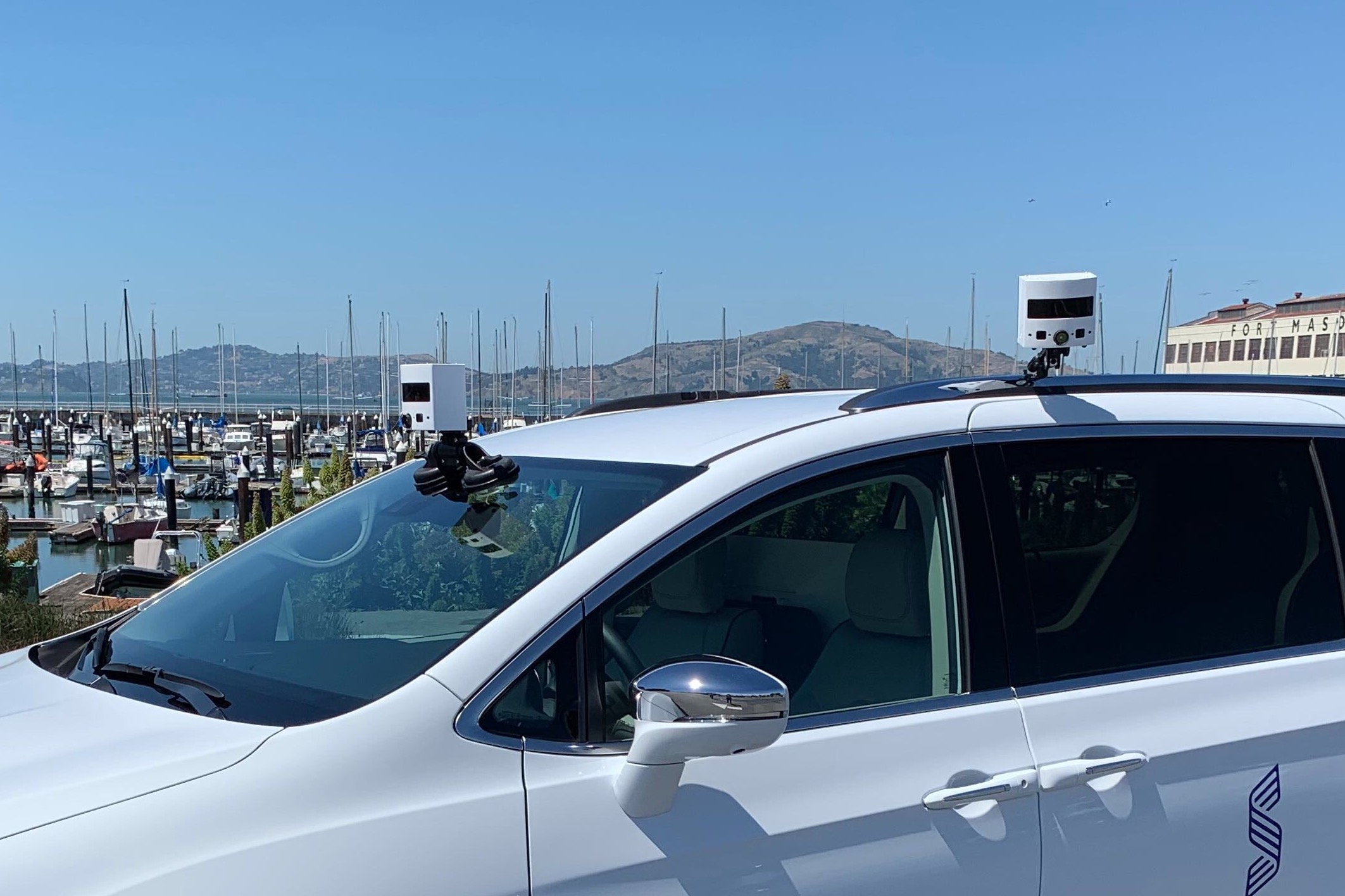
These are just prototype units, but they work and you can see they’re more than just renders.

Particularly because of the second interesting innovation they’ve included: the sensor, normally part and parcel with the lidar unit, can exist totally separately from the emitter, and is little more than a specialized camera. That means that while the emitter can be integrated into a curved surface like the headlight assembly, while the tiny detectors can be stuck in places where there are already traditional cameras: side mirrors, bumpers, and so on.

The camera-like architecture is more than convenient for placement; it also fundamentally affects the way the system reconstructs the image of its surroundings. Because the sensor they use is so close to an ordinary RGB camera’s, images from the former can be matched to the latter very easily.

The depth data and traditional camera image correspond pixel-to-pixel right out of the system.

Most lidars output a 3D point cloud, the result of the beam finding millions of points with different ranges. This is a very different form of “image” than a traditional camera, and it can take some work to convert or compare the depths and shapes of a point cloud to a 2D RGB image. Sense’s unit not only outputs a 2D depth map natively, but that data can be synced with a twin camera so the visible light image matches pixel for pixel to the depth map. It saves on computing time and therefore on delay — always a good thing for autonomous platforms.

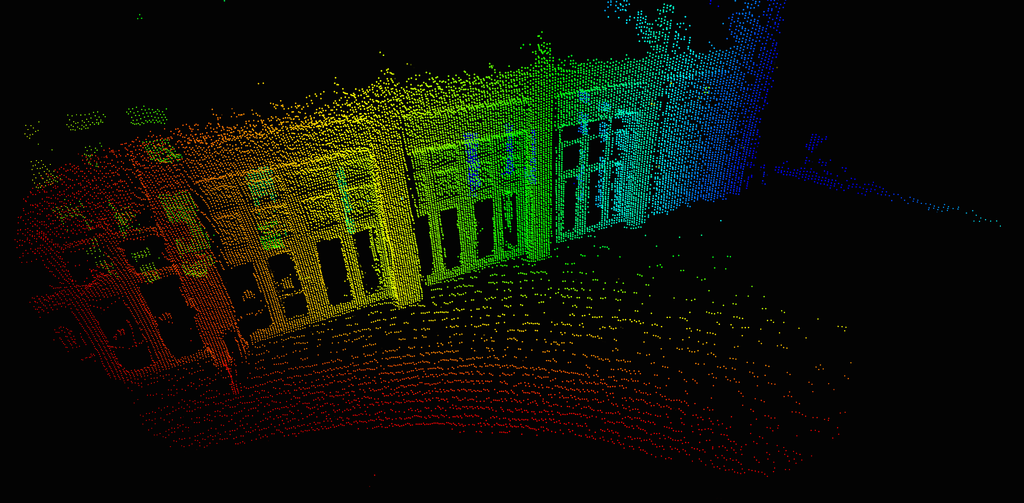
Sense Photonics’ unit also can output a point cloud, as you see here.

The benefits of Sense’s system are manifest, but of course right now the company is still working on getting the first units to production. To that end it has of course raised the $26 million A round, “co-led by Acadia Woods and Congruent Ventures, with participation from a number of other investors, including Prelude Ventures, Samsung Ventures and Shell Ventures,” as the press release puts it.

Cash on hand is always good. But it has also partnered with Infineon and others, including an unnamed tier-1 automotive company, which is no doubt helping shape the first commercial Sense Photonics product. The details will have to wait until later this year when that offering solidifies, and production should start a few months after that — no hard timeline yet, but expect this all before the end of the year.

“We are very appreciative of this strong vote of investor confidence in our team and our technology,” Burroughs said in the press release. “The demand we’ve encountered – even while operating in stealth mode – has been extraordinary.”

11 Jun 2019

Nintendo teases ‘Breath of the Wild’ sequel, raising Zelda hype to new levels

The capstone to an eventful Nintendo’s E3 Direct was an unexpected joy: A sequel to the modern classic in the Zelda series, Breath of the Wild. Of course, all they said was that it’s “in development,” but that’s enough for me.

Concluding the video that Nintendo has opted for instead of a press conference in recent years, the company’s Shinya Takahashi said, confidentially: “We have more games in development than what we’ve shown you today. I’m looking forward to the day we can introduce them to you. Speaking of… before we end this Direct, I actually have one more thing to show you.”

With that he threw to a final trailer that instantly identified itself to the trained eye as Breath of the Wild related — superfans will have recognized the green magical trails and corruption slime from that game immediately. But any doubt was cleared away when we got a closeup of Zelda herself (sporting a stylish new short hairdo), who accompanied by Link appears to be leading an expedition into a dungeon of some kind.

The two encounter a mysterious figure that appears to be mummified, gripped by a magical hand, and deeply evil — you can tell from the streams of horrible goo coming from it, and from how its eyes glowed red when it detected the presence of our heroes. A few flashes of desperate action and it cuts to the overworld, where Hyrule castle appears to sink into the ground and set off an earthquake with who knows what effects.

“The sequel to The Legend of Zelda: Breath of the Wild is now in development,” the trailer concluded.

If the trailer is any indication, the tone of this game is much darker and more dangerous than the last one, which in its promotional materials emphasized freedom, nature, and openness. In this one however all is dark, cramped, and dangerous.

Clearly Zelda and Link have awakened an ancient evil, perhaps that which first corrupted Ganondorf to begin with which the Sheikah carefully sealed away.

What could it mean? Here’s hoping the next Zelda focuses more on the intricate, dangerous dungeons that previous titles did — everyone loved Breath of the Wild, but the most common criticism was the brevity and scarcity of its big dungeons. (Scores of smaller shrines helped offset this complaint, but it’s still valid.)

I’m hoping for a huge “underworld” to mirror the vast overworld that was such a joy to explore. Caves, temples, secrets, darkness and survival elements galore!

It seems likely that Nintendo has listened to critics while also playing to its strengths, and the core gameplay systems of the last game will be married to more structured gameplay and narrative. At any rate we don’t know anything for sure other than that the game is being developed — which anyone might have guessed. But it’s nice to see that confirmed, and be given a glimpse of the next game’s darker finery.

11 Jun 2019

What can cities learn from Amazon HQ?

With the backlash from Amazon HQ fresh in our minds, it’s time to strategically think about how lessons from corporate innovations and digital technology services can improve and inform urban life in a way that puts people front and center. Doing so properly, however, will require an investment in structured engagement processes from the onset to ensure community buy-in, legitimacy and genuine co-creation with the private sector.

The move toward urban life

Increasingly, people are living in cities — with 55% living in cities today and the UN estimating more than two-thirds of the globe’s population moving to cities by 2050. Moreover, cities are also becoming hubs of technological innovation. Metropolitan statistical area data shows us that cities are becoming home to more and more STEM and high-tech workers.

And in 2018, New York City raised almost $11.5 billion in venture capital (VC) funding, second only to Silicon Valley as one of the highest-performing innovation ecosystems. Global real estate firm Savills UK and many others are even referring to New York and similar cities as “Silicon Alley.” The original Silicon Valley now has a lot of competition when it comes to VC funding, a more diverse and skilled talent pool and opportunities.

But companies aren’t the only change in urban areas.

Census data, indebted to the analysis of William Frey, shows that American cities are becoming the home for a younger and younger population, a more skilled population and a more diverse population of more individuals born outside the city or even out the country. These demographic changes are going to have a major impact: Today’s shifting populations come with their own cultures, needs and, more importantly, expectations of what governance and service delivery looks like.

The role of technology companies

Insert tech companies. All companies from Amazon to car companies are now also data-collection companies. McKinsey’s report from 2016 estimates that the data that car companies collect on users will be valued as a $750 billion industry by 2030. This data includes location-based data, driving patterns and behavior and vehicle-use data, like from sensors to sense speed and road markings, all of which are all transmitted directly to automakers.

There are more worrying indicators too — like newer cars recording drivers’ eye movements, the weight of people in the front seats and whether the driver’s smartphone was connected to the car — pointing to targeted uses of data. What’s more pernicious is that this data is tenuously held, or worse, could be used against the driver.

A lawsuit against General Motors found that warrantless tracking was not permitted, and made its way into a 2012 Supreme Court decision on the same. While the information gathered can help driving performance and safety, it still constitutes a huge infringement of privacy when it comes to losing control over your own data to massive monopolies. Moreover, the consumer gives up the right to advocate for themselves if the only anecdote of an accident or a defect a company is receptive to is the vehicle’s.

How will we ensure this data is not used perniciously?

As these companies continue to amass large quantities of data on people, they are able to deliver tailored experiences and services to a population growing increasingly used to receiving tailored experiences. Try using Google Maps with privacy settings checked and see what happens. Cities and its residents have become used to navigating with the help of data that knows where you’re going and where you’ve been. Regardless of how the data is used, people have fundamentally gotten used to a personalized and tailored system of services — whether it is Google Maps knowing how far locations are from their home, a Nest cam telling them when someone enters the baby’s room or a Lyft car coming directly to their door on a rainy night.

Tech companies’ new powers pose two challenges to government: While their services raise privacy concerns that demand government involvement and regulation, these corporations also change how these new urban populations expect to receive basic services.

Amazon HQ2 may be out of New York City, but Amazon continues to set the standard for what New Yorkers expect from their companies. For example, Amazon’s recent push for next-day shipping creates an industry standard that puts pressure on other companies. But, there are a lot of lessons to learn from Amazon leaving.

First, the benefits of a tailored service delivery needs to benefit all, not the few. And as The New York Times’ recent privacy series shows us, the disadvantages of data collection cannot fall disproportionately on the few and the most vulnerable. All companies have access to an unprecedented level of data on their consumer basis, but there is now an opportunity to use this to expand an audience base so that all city residents are beneficiaries of tailored tech services rather than only the few. Economies of scale will allow companies to serve residents outside of the downtown core.

How will we ensure this data is not used perniciously? That’s where the public sector steps in. If we’ve learned anything from Amazon and the rise of ridesharing apps, it’s that residents are seeking tailored service delivery, but not at the expense of their own privacy. The public sector can use multiple tools: enforcement of guidelines to protect residents, punitive measures against organizations that seek to harm and expanding digital access so the benefits of innovation can be shared.

Second, the public sector can leverage some of the same innovations and digital technologies that their private counterparts are using. No, not CompStat, but moving from disparately sourced Excel files or analog notes, it’s high time for the government to opt into CRMs to enable quick, speedy and efficient service delivery. At a time when city residents can get a car and groceries delivered to their house at any time of the day, it’s high time that governments, too, meet where their constituents are.

Third, the question then arises, how do you create a structured engagement process to enable co-creation from the onset to set realistic expectations, but also to move beyond public affairs toward genuine community empowerment? How do you get residents and governments to come together? Moreover, how is this structured engagement process going to co-create with all communities, rather than some. This must include traditionally marginalized communities and communities of color.

The “middleware” of the future

Companies are moving faster than governments on questions around the future of people’s privacy with large implications for governance.

How do we create “middleware,” as Ari Wallach, founder of Longpath, describes the space, for new forms of understanding to arise.

The idea of encouraging “middleware” comes out of a common challenge: a lack of realistic expectations set on behalf of both companies and communities themselves. Currently, real, structural limitations prevent dialog and co-production. Too often, it’s public affairs shops or removed experts running community engagement on behalf of technology companies without true experience on the ground. On the other side, NGOs need a nuanced understanding of the changing nature of society and the opportunity for technology companies to be productive community members. If successful, what arises is then, a space for structured dialog, deliberation and engagement to lead to productive, co-produced outcomes.

This middleware of the future will enable participatory mechanisms to ensure mutual respect and cooperation between communities and the companies that will increasingly shape the urban landscape, be it in the built environment, the data-sphere or some combination of both.

We need to create third-party spaces and processes that have transparency and accountability, and that actively engage and empower communities. These spaces can meet communities where they are now. If done well, technology companies can work with communities to help them grow, adapt and become more responsive and better equipped for the changing societal trends facing the future.

There is no putting the genie back in the bottle.

What would these convenings look like in practice? These convenings will create transparent, open processes that bring together community leaders, academia, industry and experts in facilitation to foster genuine dialog and understanding. On the one hand, it will require community groups gaining deeper expertise of the vast quantities of data being collected on them. On the other hand, the public also needs awareness about the opportunities for leveraging that data to improve their communities and public services. And grassroots groups need government support to make sure that data collection is fair, reasonable and regulated.

Through structured and facilitated engagement, communities will make road maps, share their expectations, air their frustrations, outline the opportunities and work toward actionable solutions. These engagements will enable opportunities for weighing realistic trade-offs, identifying barriers to implementation and addressing the very real concerns around equity and structural inequities.

The future is already here. Community organizations bring deep know-how of residents and neighborhoods. Technology companies both possess vast amounts of data on people but also are intricately linked to the way people live their lives today and in the future. They’d both benefit by speaking to one another and co-creating this “middleware.”

There is no putting the genie back in the bottle.

There is, however, an opportunity for new dialog and process. Companies will continue to outpace the public sector and the role of government for important governance decisions. Whether or not Amazon HQ left Long Island City, there is the need for better processes and understanding about these companies’ roles and responsibilities: a participatory business model that is not based on conflict, but rather empowers people to be active participants in shaping their future.


11 Jun 2019

Twitter Developer Labs opens to all with release of first APIs

In May, Twitter announced plans to launch its Twitter Developer Labs program, a way for app developers to sign up to experiment with pre-released beta APIs. The idea, the company explained at the time, is to allow developers to test new API products early and offer feedback.

Today, Twitter says it’s introducing its first Twitter Developer Labs endpoints: GET/users and GET/tweets. These allow developers access to look up tweets and users by ID.

Twitter had earlier confirmed these would be the first API products to launch through the new program. They’ll be later followed by Filtered Tweets, which offers a real-time but filtered stream of tweets; as well as Recent Search, offering a way to search tweets from the past seven days. These latter APIs are still listed as “coming soon” on the Developer Labs website.

Beyond being a way for developers to test and give feedback over API products, the launch of the new program is Twitter’s latest attempt to reset relations with its broader developer community.

The company has had a rocky road in terms of its API platform, having yanked access to key APIs at times, and destroying app makers’ businesses along the way. Twitter never fully embraced its developer community. Years ago, it pulled out the rug from under the feet of those building alternative Twitter clients. It shafted its own partners. It hosted then killed its own developer conference. It sold off its Fabric developer toolset. More recently, a 2018 change broke many third-party Twitter reading clients.

However, the company now hopes that working with developers more directly will be another way forward. By giving developers a voice when it comes to API changes, it may even gain more interest in its paid API products — like the premium ($339-$2899/month) API or even enterprise API tiers.

Twitter reminds developers today that its new endpoints are still early releases and could still change.

“Since the endpoints we will release in Labs are early previews, they may change before we release them broadly,” writes Twitter in an annoucement on its Twitter Labs community site. “We encourage you to take that into consideration as you build with them. For example, this might mean they’re not good choices to use in a high scale production application, and might be better for prototyping (if you run multiple versions of your application),” the company said.

Developers will get advanced notice when new versions of endpoints are released, so they have time to make updates. And Labs versions will be supported for a period of time during the transition, as well, the company notes.

Interested developers have to create a developer account, get approved, then join Labs to access the new APIs.

11 Jun 2019

WhatsApp is finally going after outside firms that are abusing its platform

WhatsApp has so far relied on past dealings with bad players within its platform to ramp up its efforts to curtail spam and other automated behavior. The Facebook -owned giant has now announced an additional step it plans to take beginning later this year to improve the health of its messaging service: going after those whose mischievous activities can’t be traced within its platform.

The messaging platform, used by more than 1.2 billion users, confirmed on Tuesday that starting December 7 it will start considering signals off its platform to pursue legal actions against those who are abusing its system. The company will also go after individuals who — or firms that — falsely claim to have found ways to cause havoc on the service.

The move comes as WhatsApp grapples with challenges such as spam behavior to push agendas or spread of false information on its messaging service in some markets. “This serves as notice that we will take legal action against companies for which we only have off-platform evidence of abuse if that abuse continues beyond December 7, 2019, or if those companies are linked to on-platform evidence of abuse before that date,” it said in an FAQ post on its site.

A WhatsApp spokesperson confirmed the change to TechCrunch, adding, “WhatsApp was designed for private messaging, so we’ve taken action globally to prevent bulk messaging and enforce limits on how WhatsApp accounts that misuse WhatsApp can be used. We’ve also stepped up our ability to identify accp, which helps us ban 2 million accounts globally per month.”

Earlier this year, WhatsApp said (PDF) it had built a machine learning system to detect and weed out users who engage in inappropriate behavior such as sending bulk messages or creating multiple accounts with intention to harm the service. The platform said it was able to assess the past dealings with problematics behaviors to ban 20% of bad accounts at the time of registration itself.

But the platform is still grappling to contain abusive behavior, a Reuters report claimed last month. The news agency reported about tools that were readily being sold in India for under $15 that claimed to bypass some of the restrictions that WhatsApp introduced in recent months.

TechCrunch understands that with today’s changes, WhatsApp is going after those same set of bad players. It has already started to send cease and desist letters to marketing companies that claim to abuse WhatsApp in recent months, a person familiar with the matter said.

11 Jun 2019

Uber unveils new skyport designs for Uber Air

Uber’s architecture and engineering partners have unveiled some new skyport designs. To be clear, Skyports are the areas where people will be able to board and disembark from Uber Air vehicles.

At Uber Elevate today, eight firms unveiled 16 new designs for Skyports. Below, you’ll find the top concept from each firm. You may be wondering where you’ll find these skyports. Well, Uber envisions working with real estate developers and cities to install skyports on top of parking garages and other underutilized structures.

“With the first launch of Uber Air just a few short years away, this collection of Skyport Mobility Hub concepts establish a practical, sustainable vision for the infrastructure needed in the communities we plan to serve,” Uber Elevate Head of Design for Elevate John Badalamenti said in a statement. “These designs represent a synergy of purpose, orchestrating a seamless transition between ground transit like Uber Pool and eVTOL aircraft on the roof tarmac – all while contributing to the surrounding neighborhood. “Architectural minds carry the responsibility to imagine the world in a way that does not exist yet and make it a reality. So this year, we invited innovative architectural firms to imagine how connected Skyport hubs could be integrated into the urban landscape of Los Angeles, Dallas and Melbourne.”

UberElevate-PickardChilton-MELBOURNE_Retrofit

Pickard Chilton and Arup’s retrofit Sky Loft design in Melbourne.

Called the “Sky Loft,” this 3,700 square meter skyport features a landing pad, lounge, parking areas for JUMP bikes and scooters, and retail. It’s designed with Melbourne, Australia in mind.

“While delivering an elegant and high-performance building, our design for the Sky Loft creates a compelling and seamless user experience,” Pickard Chilton Principal Jon Pickard said in a statement. “The designs are sensitive to and respectful of their context while the Sky Lofts themselves are stewards of earth’s limited resources. It has been exciting to collaborate with Uber and Arup to create the Sky Loft – a realistic vision for intra-urban transportation in Melbourne.”

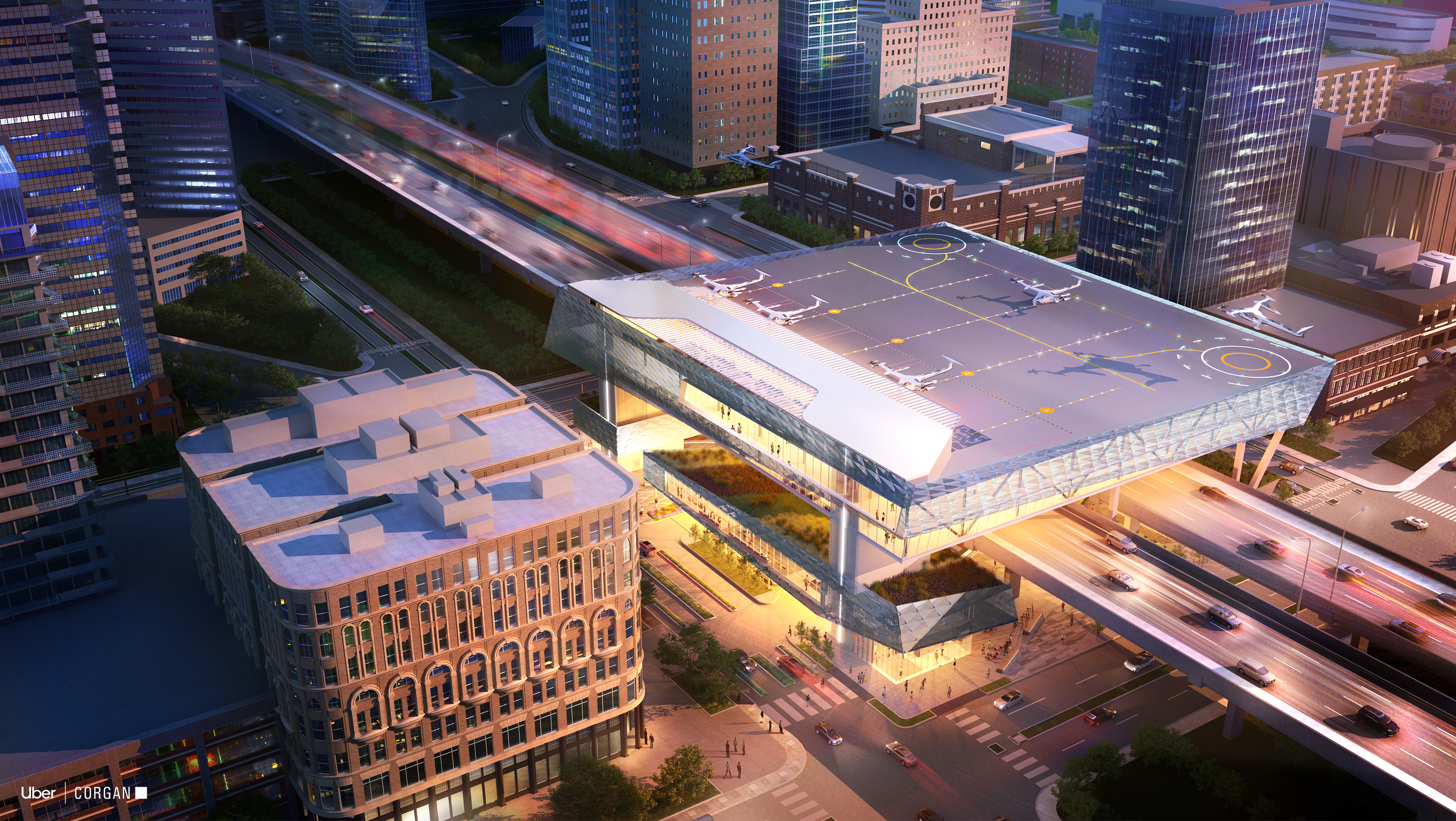
UberElevate Corgan-DALLAS

Corgan’s new concept called CONNECT | EVOLVED in Dallas.

This concept, designed by Corgan for Dallas, Texas, incorporates restaurants, grocery stores, sports courts and coworking spaces. The design also takes into account room for bike- and scooter-share services.

“In prioritizing feasibility, Corgan saw that mass adoption of this emerging modality would require evolving traditional notions of connectivity,” Corgan Principal John Trupiano said in a statement. “A scalable design that seamlessly integrates with existing infrastructure and considers its environmental impact, our design is comprised of a kit of parts that can be customized for a variety of budgets and locations—adding popular amenities and creating a lifestyle of aerial mobility and connectivity.”

UberElevate-Mithun_LA_NewConstruction

Mithun’s new SkyPark concept.

In Los Angeles, firm Mithun envisions turntable parking, and spaces for bikes and scooters. The “SkyPark” sees itself as being more community-oriented with more than two acres of public park space.

“Uber SkyPark elevates the urban transportation experience, enriching lives at the personal, neighborhood and community scales,” Mithun Partner Jason Steiner said in a statement. “By raising eVTOL functions, the Greenlight Hub, eBike and eScooter maintenance and charging spaces above grade, a new urban park with restorative landscape and active street life is created at the ground level. The park and its trees absorb noise, filter pollution and mitigate urban heat island effect while providing vibrant recreation and social spaces for the community.”

UberElevateHumphreys_PartnersArchitects_DALLAS_NewConstruction

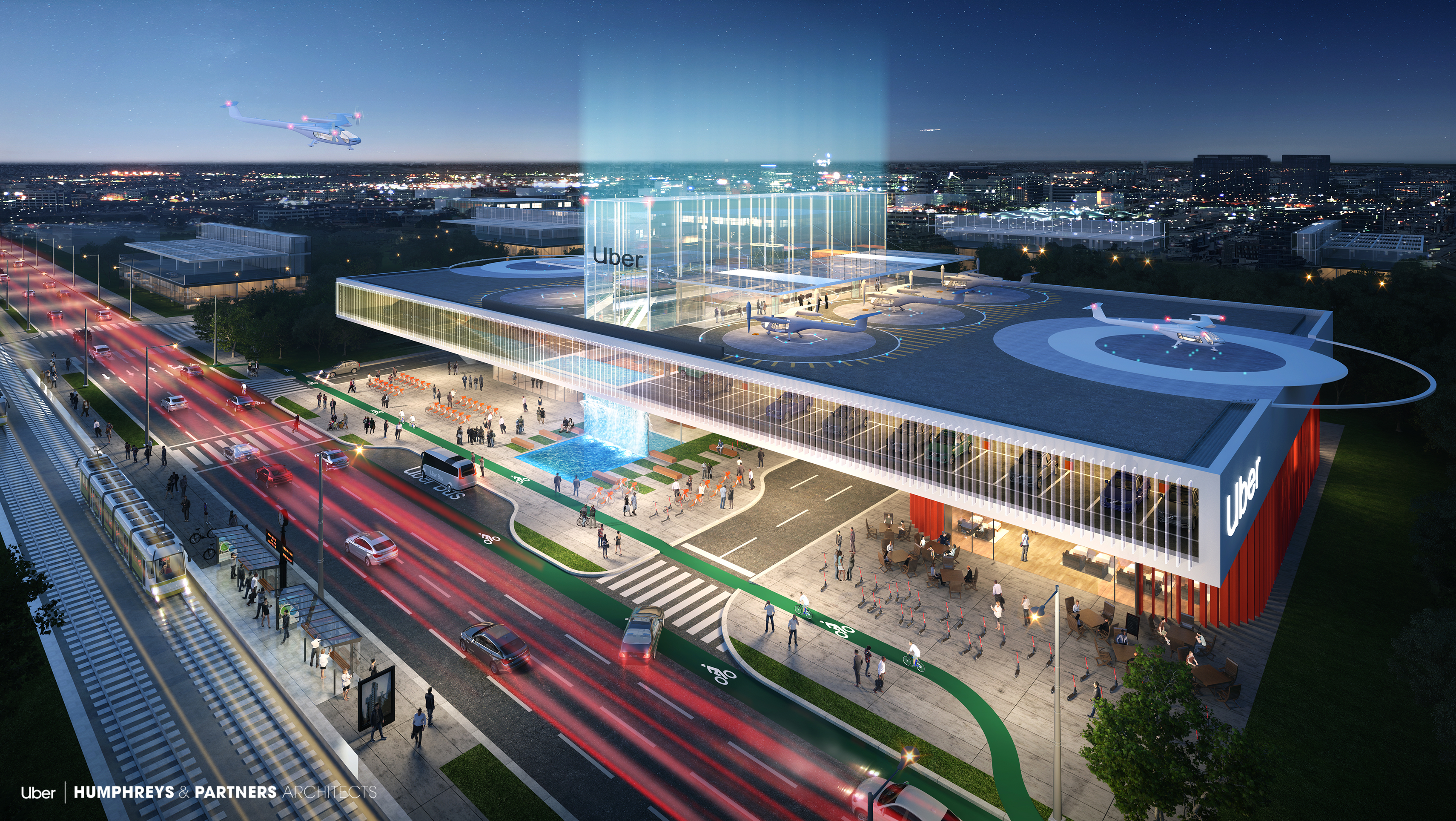
The Volary is a new concept in Dallas by Humpreys and Partners Architects.

Humphreys & Partners Architects envisions a Dallas-based skyport that looks like it’s expended in the air. It’s designed to support eVTOLs, micromobility and retail operations with more than 9,500 square feet.

“Our approach in designing an on-demand aerial ridesharing terminal is based on the idea
that ‘less is more,’” Humphrey & Partners CIO Walter Hughes said in a statement. “This idea has motivated us to create a highly intuitive experience for passengers, integrated within a structure that is simple to build and operate while reinforcing Uber’s brand identity. Volary is inclusive of new technologies and made of natural, organic materials for a highly sustainable building resulting in a zero net energy footprint.”

UberElevate-BECK_DALLAS_Retrofit

The Beck Group’s retrofit concept Dallas Skyport.

Housed on top of an existing seven-story parking lot, this skyport is focused on the basics: the takeoff, the landing as well as space for bikes, scooters and electric vehicles.

“As a design-build firm that is beginning to fabricate building components at Factory Blue,
we are uniquely positioned to solve the challenging question of how you add on to an
existing parking structure,” The Beck Group Associate Principal Timothy Shippey said in a statement. “The design and fabrication of modular elements in our Dallas
Skyport deliver a concept that aligns with Uber’s innovative vision and is within budget.”

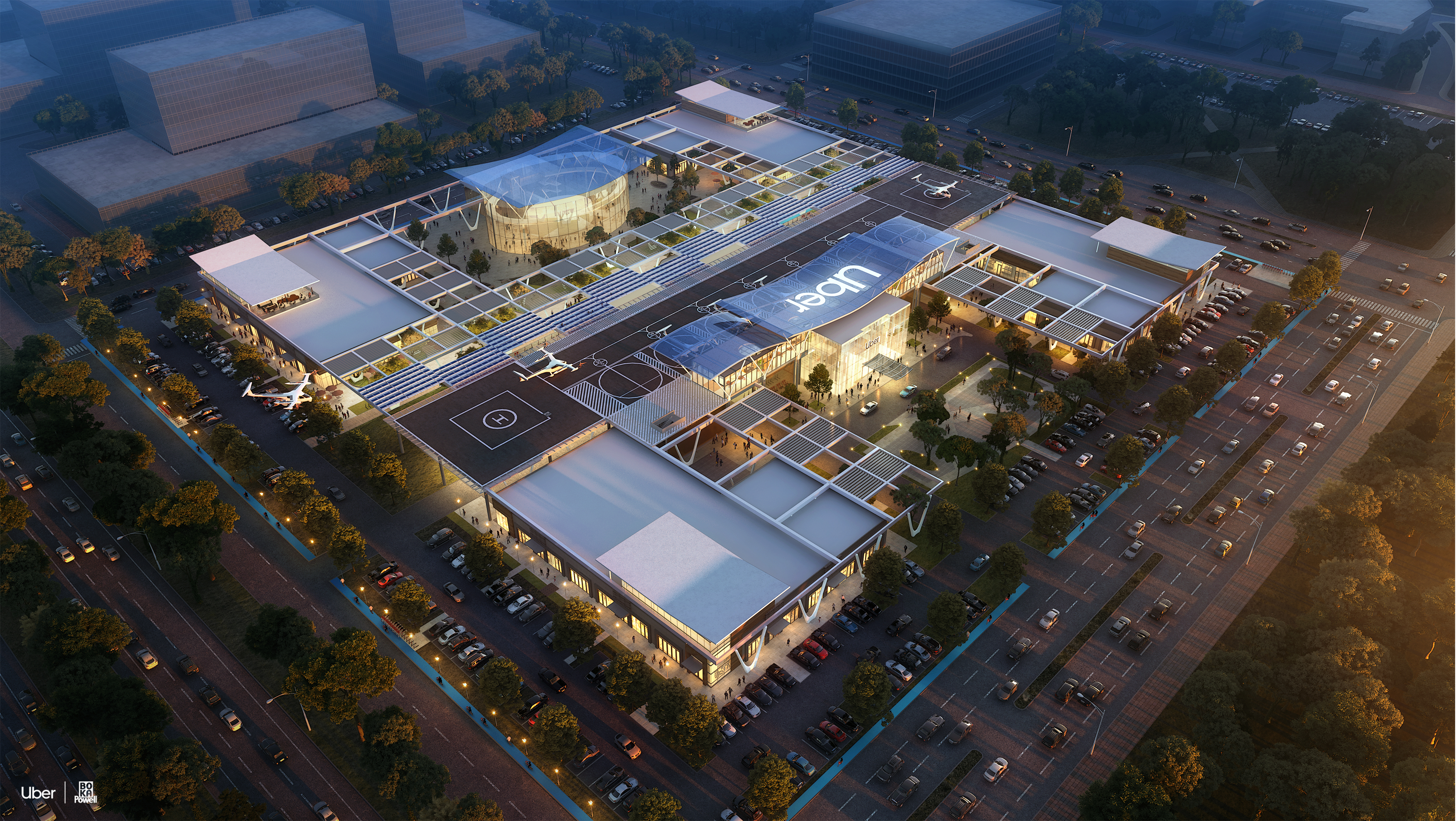
UberElevateBOKAPowell_DALLAS_NewConstruction

Looking to connect all of Uber’s vehicles, this concept provides space for eVTOLs, bikes and scooters.

“The Uber Skyport Mobility Hub as imagined by BOKA Powell Architects celebrates our
evolving experience-driven society by designing fluidity and transparency into the process of air travel re-imagined,” BOKA Powell Principal-in-Charge R. Andrew Bennett said in a statement. “The integration of all Uber brands substantiates first and last mile travel as major support elements to the Uber Air component that revolutionizes urban mobility. The Mobility Hub is not a thing, but rather a place of dynamic energy and integrated connectivity that celebrates the spirit of flight and the freedom to quickly access the important places in one’s life.”

11 Jun 2019

Uber Air picks Melbourne as its first international launch city

When Uber first announced Uber Air, it intended for Dubai to be its first international city. That changed last year when Uber put out an open call to interested cities to describe the clear need for aerial transit, the environmental conditions of the city and local government commitment.

Today at Uber Elevate, Uber announced Melbourne, Australia as the first international city where it will test Uber Air. Already, architects have envisioned what the skyports in the city could look like.

“Australian governments have adopted a forward-looking approach to ridesharing and future transport technology,” Uber Australia Regional General Manager Susan Anderson said in a statement. “This, coupled with Melbourne’s unique demographic and geospatial factors, and culture of innovation and technology, makes Melbourne the perfect third launch city for Uber Air. We will see other Australian cities following soon after.”

In addition Melbourne, Uber plans to launch Uber Air in Dallas-Fort Worth, Texas and Los Angeles in 2023. You can read more about what to expect from Uber Air below.

11 Jun 2019

Most US mobile banking apps have security and privacy flaws, researchers say

You might figure the biggest U.S. banks would have some of the most secure mobile apps. Spoiler alert: not so much.

New findings from security firm Zimperium, shared exclusively with TechCrunch, say most of the top banking apps have security flaws that put user data at risk. The security firm, which has a commercial stake in the mobile security business, downloaded the banks’ iOS and Android apps and scanned for security and privacy issues, like data leaks, which put private user data and communications at risk.

The researchers found most of the apps had issues, like failing to adhere to best coding practices and using old open-source libraries that are infrequently updated.

Some of the apps were using open-source code from GitHub from more than three years ago, said Scott King, Zimperium’s director of embedded security.

Worse, more than half of the banking apps are sharing customer data with at least one advertiser, the researchers said.

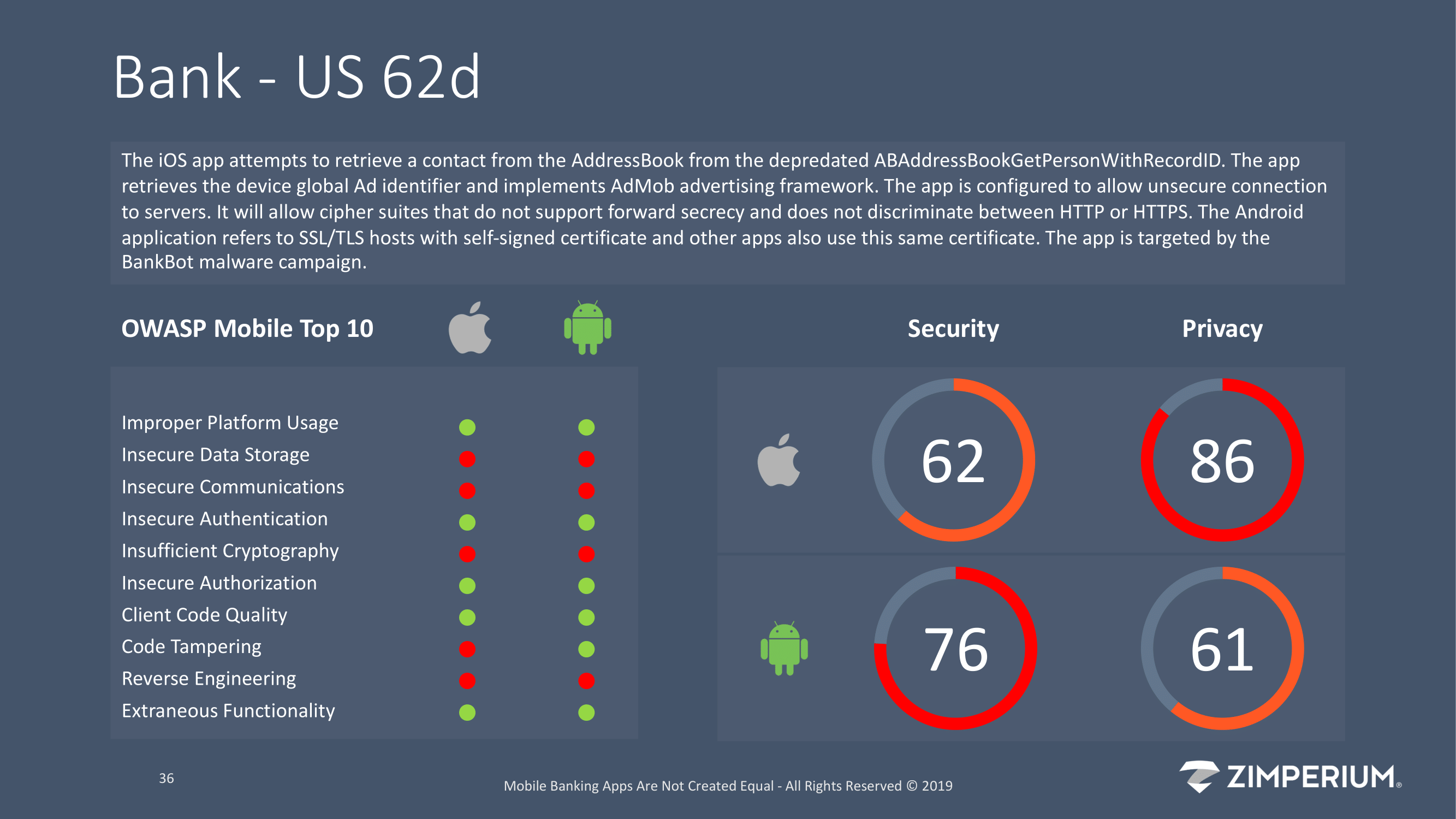
An unnamed iOS banking app with an 86/100 risk score. (Image: Zimperium)

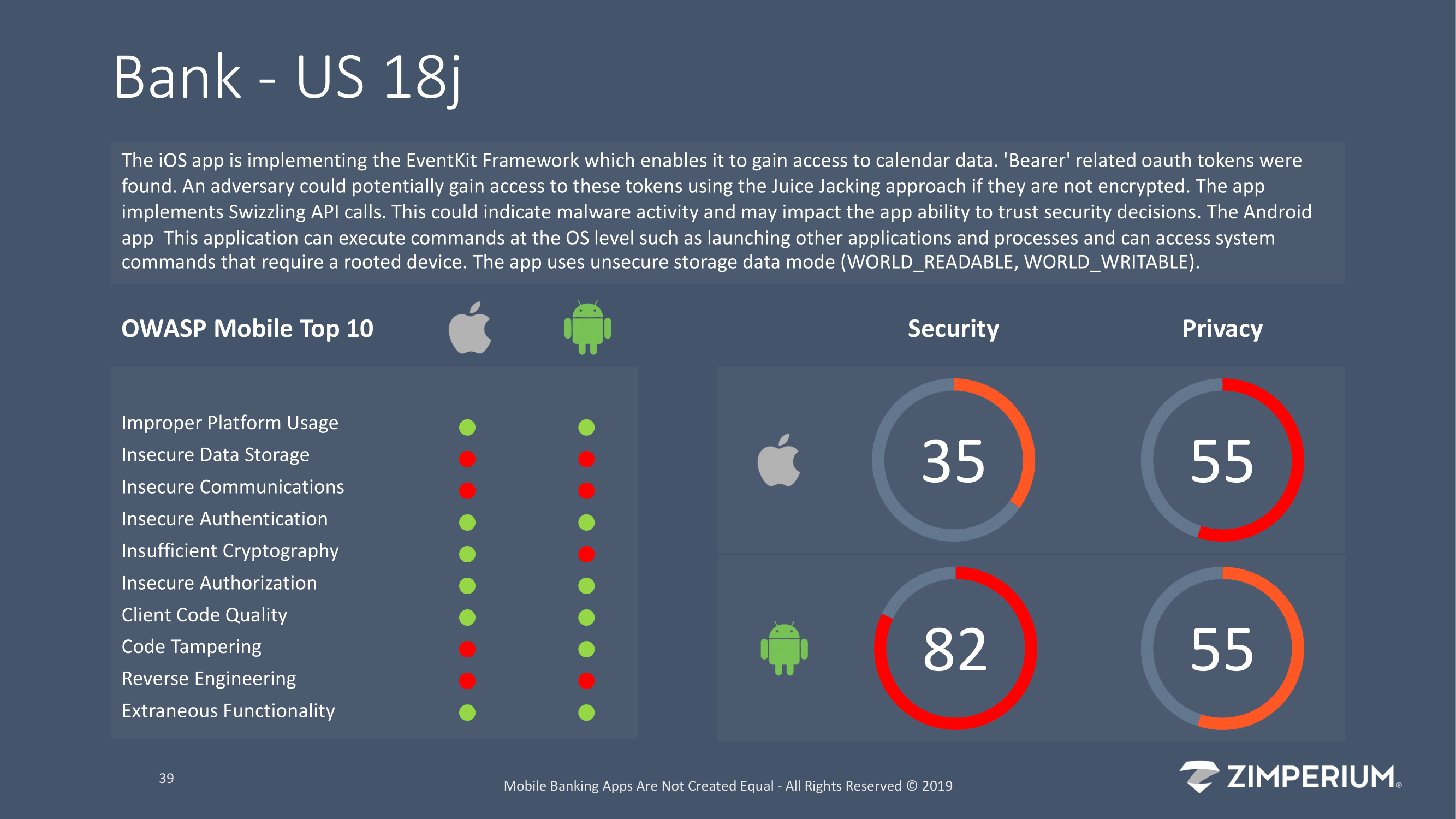
Two unnamed Android banking apps each with an 82/100 risk score. (Image: Zimperium)

The researchers, who didn’t name the banks, said one of the worst offending iOS apps scored 86 out of 100 on the risk scale for several privacy lapses, including communicating over an unencrypted HTTP connection. The same app vulnerable to two known remote bugs dating back to 2015. The researchers said the risk scores for the banks’ corresponding Android apps were far higher. Two of the apps were rated with a risk score of 82 out of 100. Both of the apps were storing data in an insecure way, which third-party apps could access and recover sensitive datas on a rooted device, said King.

One of the Android apps wasn’t properly validating HTTPS certificates, making it possible for an attacker to perform a man-in-the-middle attack. Several of the iOS and Android apps were capable of taking screenshots of the app’s display, increasing the risk of data leaking.

Zimperium said two-thirds of the Android banking apps are targeted by several malware campaigns, such as BankBot, which tricks users into downloading fake apps from Google Play and waits until the victim signs in to a banking app on their phone. Using an overlay screen, the malware campaigns steal logins and passwords.

The security firm called on banking apps to do more to bolster their apps’ security.

11 Jun 2019

Apple joins the open-source Cloud Native Computing Foundation

The Cloud Native Computing Foundation (CNCF), the home of open-source projects like Kubernetes, today announced that Apple is joining it as a top-level Platinum End User Member. With this, Apple is joining 89 existing CNCF end-user members like Adidas, Atlassian, Box, GitHub, the New York Times, Reddit, Spotify and Walmart.

Apple, in typical fashion, isn’t commenting on the announcement, but the CNCF notes that end user memberships are meant for organizations that are “heavy users of open source cloud native technologies” and that are looking to give back to the community. By becoming a CNCF end-user member, companies also join the Linux Foundation .

As part of its membership, Apple also gets a seat on the CNCF’s Governing Board. https://www.linkedin.com/in/tomerdoron, a senior engineering manager at Apple, will take this seat.

“Having a company with the experience and scale of Apple as an end user member is a huge testament to the vitality of cloud native computing for the future of infrastructure and application development,” said Chris Aniszczyk, CTO of the Cloud Native Computing Foundation. “We’re thrilled to have the support of Apple, and look forward to the future contributions to the broader cloud native project community.”

While you may not necessarily think of Apple as a major open source company, the company has open sourced everything from the XNU kernel that’s part of the Darwin operating system to its Swift programming language. The company has not typically participated all that much in the open source cloud infrastructure community, though, but today’s move may signal that this is changing. Apple obviously runs its own data centers, so chances are it is indeed a heavy user of open source infrastructure projects, though the company doesn’t typically talk about these.