Month: June 2019

11 Jun 2019

Misfits Market raises $16.5 million for their ‘ugly’ produce subscription box

As grocery shopping moves online, one piece of the puzzle hasn’t been directly addressed: fresh fruits and vegetables. That also happens to be a category in which there is a ton of food waste, with a good deal of fruits and veggies never making it out of the grocery store to begin with.

Misfits Market has raised $16.5 million in Series A to handle just that.

Greenoaks Capital led the round, but Misfits isn’t disclosing other participants in the financing. Other Greenoaks Capital investments include Deliveroo, OYO, Clover Health, Brex, and Discord.

Misfits Market offers a subscription box of ‘ugly’ fruits and veggies, the ones with blemishes or odd shapes that make a grocery shopper think twice before checking out, each week.

Misfits sources these fruits and veggies straight from farms. This means that the extra time spent shipping them to a grocery store, and then sitting on shelves, is eliminated from the equation with Misfits.

The company currently operates in all zip codes in Pennsylvania, New York, New Jersey, Connecticut, Delaware, Massachusetts, Vermont, New Hampshire, Rhode Island, Maine and Ohio, with plans to expand into Washington D.C., Maryland, Virginia, West Virginia, North Carolina, South Carolina, Georgia, and Florida.

Currently, Misfits Market offers two different box options. The smaller box, called The Mischief, includes 10 to 12 pounds of fruits and veggies each week for $23.75 a la carte, or under $20 as a weekly subscription. The Madness, Misfits’ bigger box, includes 18 to 20 pounds of fresh fruits and veggies for $42.50 as a one-time purchase, or for $34 as a subscription.

Users can pause their weekly subscription or cancel at any time.

CEO and founder Abhi Ramesh said the idea for Misfits Market started when he visited a farm a few years ago. The farmer was collecting apples that he said weren’t of the grade he could sell to grocery stores or farmers’ markets, and that they’d either be given away to neighbors or thrown away.

“That was my sort of romanticized lightbulb moment,” said Ramesh.

He was fascinated and started interviewing farmers in the north east and asking them how much of their produce ended up going to waste because it wasn’t pretty enough for grocery stores. The answer was consistently between 20 percent and 40 percent.

Ramesh says that there is an opportunity down the line to expand beyond fruits and veggies, but that for now the company is laser focused on that category.

Since launching in 2018, Misfits has sent out 5 million pounds of produce that would have gone to waste otherwise.
11 Jun 2019

Colombian point-of-sale lender ADDI nabs $12.5 million from Andreessen Horowitz

Andreessen Horowitz <3 Latin American startups.

Latin America is the only region outside of the U.S. where the venture firm is routinely investing capital and it has just made another commitment, doubling down on its early stage support for the point-of-sale lending startup, ADDI.

ADDI picked up $12.5 million in new financing in April of this year as the company looks to expand its lending services online.

For an American audience, the closest corollary to what ADDI is up to is likely Affirm, the point-of-sale lender that’s raised a ton of cash and come in for some (valid) criticism for its basic business model.

Like Affirm, ADDI lets its borrowers apply for credit at the moment of purchase. The company likens its service to the layaway and credit plans that already exist in Colombia — but involve pretty onerous requirements to use. Company co-founder Santiago Suarez and Andreessen Horowitz general partner Angela Strange both commented on how, in some cases, Colombian shoppers have to have three people vouch for a borrower before a store will issue credit or agree to a layaway plan.

The difference between an ADDI loan — or any loan — and layaway is that an installment payment plan doesn’t charge interest (and even with the fees that installment plans do charge, they are often still cheaper than taking out a loan).

But financial products are coming for consumers in Latin America whether those buyers like it or not — and for the most part, it seems they do like it.

Historically, only the wealthiest clientele in Latin America received anything resembling the kinds of financial products that are more widely available in the United States, according to Strange. And the investment in ADDI is just part of her firm’s thesis in trying to make more services more broadly available in a region where a technological transformation is creating unprecedented opportunities for challengers.

That assessment is what drew Santiago Suarez back to Latin America only two years ago. A former executive at Lending Club who previously had worked as the head of New Product Development and Emerging Services at J.P. Morgan, Suarez saw the tremendous growth happening in Latin America and returned to Colombia to see if he could bring some much needed services to his home country.

Suarez partnered with his childhood friend, Elmer Ortega, who was working as the chief technology officer of the local hedge fund where he had previously been employed as a derivatives trader before learning how to code.

Together the two men, who had known each other since they were five-years-old, set out to transform how credit was offered in retail shops. It’s an industry that Suarez had known well since his parents had owned stores.

“In the U.S. there are all of these gaps that fintech companies are filling,” says Suarez. “But the gapes in Latin America are bigger.”

Suarez and Ortega incorporated the company in September 2018, around the same time they raised $2.3 million from the regional investment firm, Monashees, Andreessen, and Village Global . They then raised another $1.5 million in an internal round of financing before closing the most recent funding.

The company offers loans at annual percentage rates ranging from19.99% to 28.90%. The company started with a digital solution for brick and mortar retailers because 90% of retail in Colombia still happens offline. 

Although it’s in its early days, the company has already originated 10,000 borrowers and typically loans out roughly $500 since it launched on February 22, according to Suarez. He declined to comment on the company’s default rate on loans.

Now with 40 employees on staff, the company is looking to bring its lending tool to more e-commerce and physical retailers, according to Suarez. And despite the threat of cyclical political turmoil, Suarez says there’s no better time to be investing in Colombia. 

“It’s the most stable country outside of Chile… Way more stable than Brazil, way more stable than Argentina and way more stable than Mexico,” Suarez says. “What we’re looking at is more than cyclical instability… those things go beyond that.. Nubank was able to build a multibillion business in the worst political and economic crisis in Brazil’s history. I think Colombia is an incredibly attractive space with a deep talent pool.”

11 Jun 2019

Amazon Restaurants in U.S. is shutting down

Following November’s closure of Amazon’s restaurant delivery business in London, the company is now shutting down operations in the U.S. The service, which was launched back in fall 2015, was designed to give Prime members another perk — a way to order meals, not just products and groceries — through the e-commerce giant.

But the service has faced much competition, including from local rivals like Grubhub, Uber Eats, DoorDash and Deliveroo in London, among others. In some cases, they would even discount their services in order to win market share. Amazon, meanwhile, has largely failed to establish itself as a significant player in restaurant delivery in both market share and consumer mindshare. It’s not the first name people think of when they’re looking to order food for lunch or dinner, and the logistics of delivering hot meals in a timely fashion introduces a different set of concerns that go beyond Amazon’s core focus areas.

Related to the closure, Amazon will also shutter workplace lunch delivery service Daily Dish, according to Geekwire, which broke the news.

TechCrunch (among others, we’re guessing) was tipped off to the closure through a source at Amazon familiar with the business’s closing. Amazon confirmed the closure of Amazon Restaurants in the U.S., which ceases to operate June 24. It also hinted that layoffs were involved, as some people were finding new roles at Amazon while others were being assisted in finding new jobs outside the company.

Amazon’s decision to exit restaurant meal delivery has had a positive impact on rivals’ stocks this morning, with a jump by GrubHub, which was up over 5 percent on the news.


11 Jun 2019

Uber envisions Uber Air will one day be cheaper than owning a car

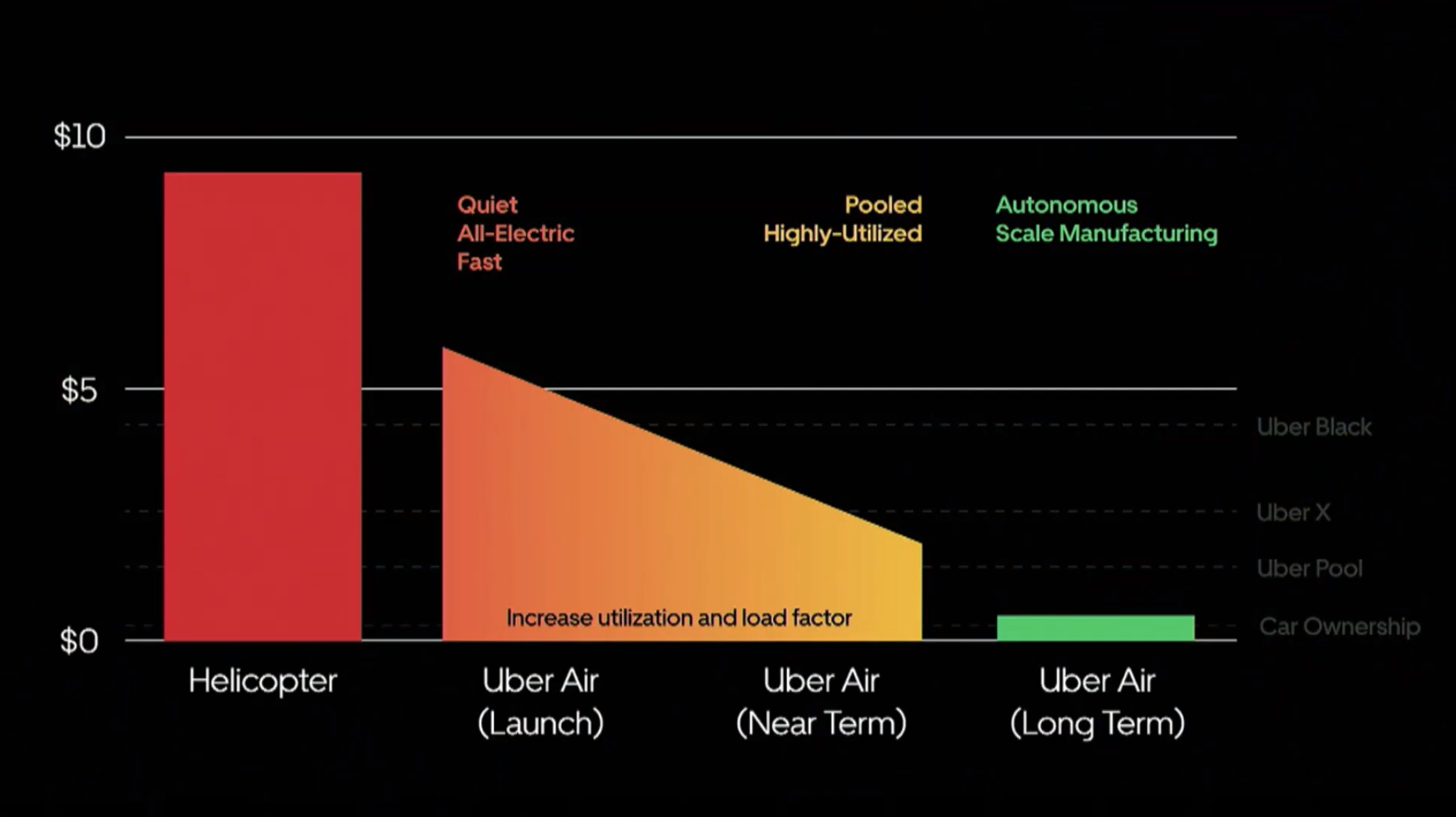
Uber has big dreams for Uber Air, the flying taxi service it’s wanting to launch in 2023. At the third annual Uber Elevate, Head of Elevate Eric Allison said the company expects Uber Air to be cheaper than driving a car. It surely won’t be that way on day one, but once Uber deploys fully electric, autonomous shared vehicles, Allison said it will be more economical than driving a car.

“Our vision is that on a daily basis it’ll be more economically rational for you to fly than for you to drive,” he said.

At launch, Uber Air will be cheaper than a helicopter ride. This is a worthy comparison given Uber unveiled its costly Uber Copter service last week as phase one of Uber Air. In the near term, Uber predicts Air will be comparable to the cost of Uber X and Uber Pool. Long term, which is probably at least more than five years from now, Uber Air will be more economical than owning a car, Allison said.

This, of course, is Uber’s best-case scenario for Air. In order for Uber Air to become a reality, it needs approval from the Federal Aviation Administration, the cities where it wants to land its electric vertical take-off and landing vehicles, help from real estate developers, customer trust and so much more. If all goes according to Uber’s plan, it will start testing this service next year and deploy it to the public in 2023.


11 Jun 2019

Embraer’s new EmbraerX eVTOL concept is accessible, autonomous and courteous

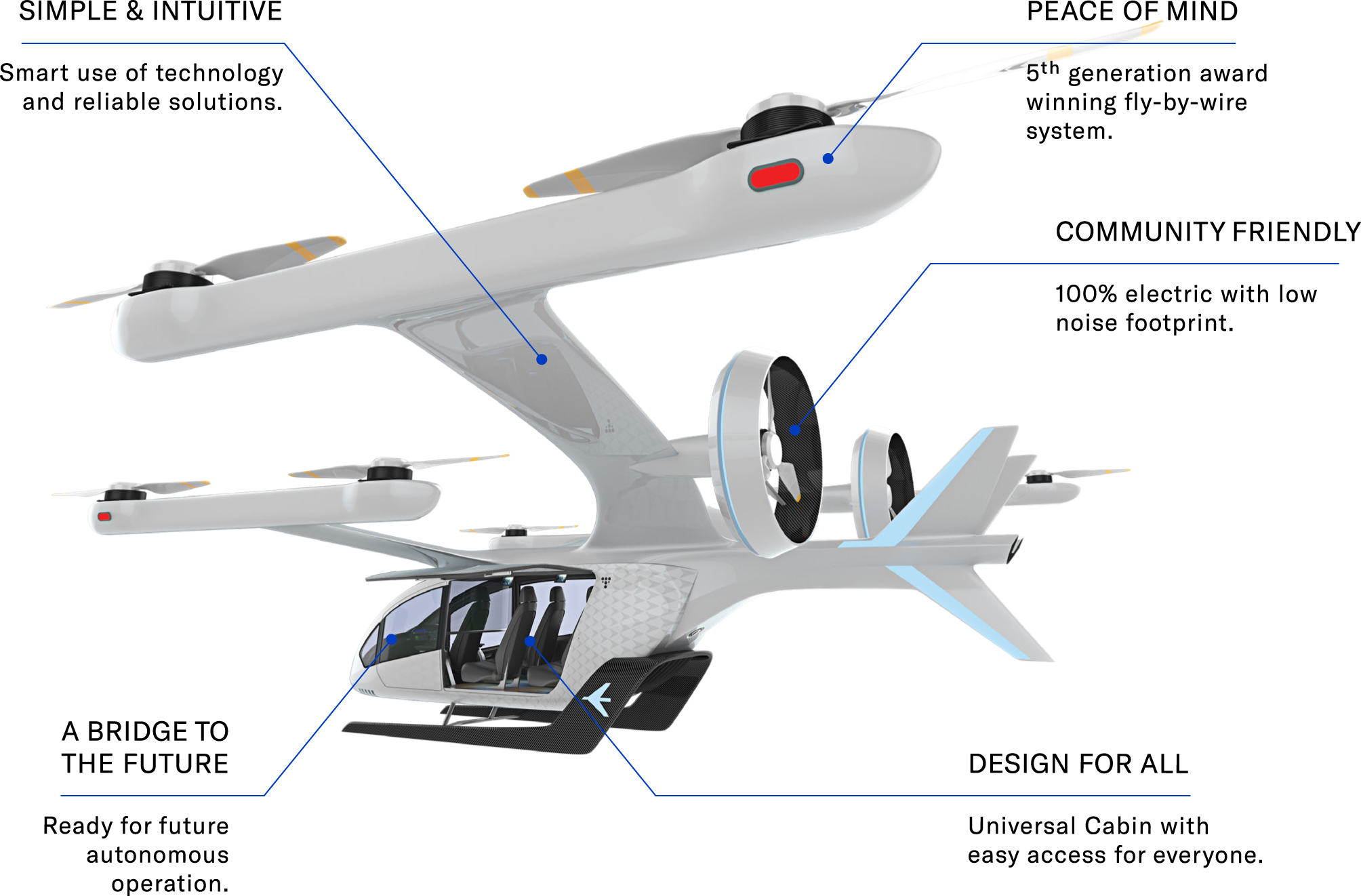
Short-distance commuter air travel has come a long way in the past few years – at least when it comes to concepts. The latest vision of how we’ll get around in the city skies of the (near?) future from Embraer evolves some of what we’ve already seen, and highlights a few things that make clear where it’s focusing its priorities – namely, on community adoption and acceptance.

The concept created by EmbraerX, which is aircraft maker Embraer’s market acceleration and innovation arm, features electric power, as well as vertical take-off and landing (the ‘eVTOL’ piece of the puzzle). Its optimized for a ride sharing model, and is focused on “user experience” as well as “making the aircraft easily accessible to everyone,” according to the company.

It includes redundant flight systems for safety, as well as an intentional effort to reduce overall noise output with an eight rotor system that distributes lift across the span of the vehicle’s body. The introductory video highlights how the concept vehicle can accommodate passengers who user wheelchairs, and there’s both fly-by-wire control for today, as well as all the technology on board needed for autonomous operation once the tech is ready.

No word on target timelines for bringing these to the actual skies, but this looks a lot more technically feasible when compared to existing aircraft, beyond maybe an electric drivetrain that can provide the kind of lift needed for transporting what looks like up to four passengers and doing so reliably and consistently.

11 Jun 2019

Relativity is building a 3D printing rocket manufacturing hub in Mississippi

The future of rocket manufacturing has touched down in Mississippi.

At NASA’s John C. Stennis Space Center, nestled in Hancock County, Miss. right on the border of Louisiana, the Los Angeles-based 3D printed spacecraft manufacturer, Relativity Space, is planning a massive $59 million expansion to make a permanent manufacturing hub in this bucolic corner of the southeast.

“This agreement demonstrates again NASA’s commitment to work with our industry partners to expand commercial access to low-Earth orbit,” said Dr. Rick Gilbrech, Director, Stennis Space Center. “This helps NASA maintain focus on the ambitious Artemis program that will land the first female and the next male on the south pole of the moon by 2024.”

Relativity already has four of its proprietary 3D printers running in its Los Angeles headquarters and plans to build out 12, larger, units in its new Mississippi digs. The company ultimately expects to get to 24 of its printers up and running.

Unlike other rocket manufacturers, Relativity uses 3D printers for almost all of the components it needs to assemble a spacecraft. The company says its technology significantly reduces the time it takes to manufacture a vehicle for space travel and the cost associated with that manufacturing.

At Stennis, the company has 220,000 square feet at its disposal to install larger, second generation printers than the initial designs it has in its LA base of operations.

Initially, the company will be focused on the construction of its own Terran1 rocket design, and has signed up  three customers including Spaceflight Industries, Telesat and Mu Space for launches.

“We now have this benefit of being colocated with a testing facility,” says Tobias Duschl, the vice president of operations at Relativity, and a former executive at BMW and Tesla. “We can easily move components back and forth from production to testing.  It’s going to be a huge benefit for our customers.”

Through a package with the state, Relativity is getting tax incentives for its investments in capital and is looking to hire an additional 200 employees for the Stennis manufacturing facility.

The agreement with NASA includes a nine year lease on the 220,000 square foot building at Stennis, with an option to extend the lease for an additional 10 years, according to the company.

“The Mississippi Gulf Coast has a strong aerospace presence, and Relativity’s expansion at Stennis further positions our state as a leader in this prominent sector,” Governor Phil Bryant said. “The important work that will be done for Relativity by our skilled workforce will play a crucial role in developing new methods to connect to outer space and other planets.”

Relativity’s co-founder and chief executive, Tim Ellis, envisions the Stennis facility as more than just a manufacturing hub for spacecraft.

“We are investing not just a new rocket, but an entirely new way of production, with our large, mass scale, 3D printing factory,” Ellis says. “The exact same factory we built for the rockets is already applicable to other things. It’s highly automated (due to 3D printing),  which reduces part counts, and simplifies the supply chain… and there’s no fixed tooling. The 3D printers can make similar structures for other industries.”

11 Jun 2019

Europe publishes common drone rules, giving operators a year to prepare

Europe has today published common rules for the use of drones. The European Union Aviation Safety Agency (EASA) says the regulations, which will apply universally across the region, are intended to help drone operators of all stripes have a clear understanding of what is and is not allowed.

Having a common set of rules will also means drones can be operated across European borders without worrying about differences in regulations.

“Once drone operators have received an authorisation in the state of registration, they are allowed to freely circulate in the European Union. This means that they can operate their drones seamlessly when travelling across the EU or when developing a business involving drones around Europe,” writes EASA in a blog post.

Although published today and due to come into force within 20 days, the common rules won’t yet apply — with Member States getting another year, until June 2020, to prepare to implement the requirements.

Key among them is that starting from June 2020 the majority of drone operators will need to register themselves before using a drone, either where they reside or have their main place of business.

Some additional requirements have later deadlines as countries gradually switch over to the new regime.

The pan-EU framework creates three categories of operation for drones — open’ (for low-risk craft of up to 25kg), ‘specific’ (where drones will require authorization to be flown) or ‘certified’ (the highest risk category, such as operating delivery or passenger drones, or flying over large bodies of people) — each with their own set of regulations.

The rules also include privacy provisions, such as a requirement that owners of drones with sensors that could capture personal data should be registered to operate the craft (with an exception for toy drones).

The common rules will replace national regulations that may have already been implemented by individual EU countries. Although member states will retain the ability to set their own no-fly zones — such as covering sensitive installations/facilities and/or gatherings of people, with the regulation setting out the “possibility for Member States to lay down national rules to make subject to certain conditions the operations of unmanned aircraft for reasons falling outside the scope of this Regulation, including environmental protection, public security or protection of privacy and personal data in accordance with the Union law”.

The harmonization of drone rules is likely to be welcomed by operators in Europe who currently face having to do a lot of due diligence ahead of deciding whether or not to pack a drone in their suitcase before heading to another EU country.

EASA also suggests the common rules will reduce the likelihood of another major disruption — such as the unidentified drone sightings that ground flights at Gatwick Airport just before Christmas which stranded thousands of travellers — given the registration requirement, and a stipulation that new drones must be individually identifiable to make it easier to trace their owner.

“The new rules include technical as well as operational requirements for drones,” it writes. “On one hand they define the capabilities a drone must have to be flown safely. For instance, new drones will have to be individually identifiable, allowing the authorities to trace a particular drone if necessary. This will help to better prevent events similar to the ones which happened in 2018 at Gatwick and Heathrow airports. On the other hand the rules cover each operation type, from those not requiring prior authorisation, to those involving certified aircraft and operators, as well as minimum remote pilot training requirements.

“Europe will be the first region in the world to have a comprehensive set of rules ensuring safe, secure and sustainable operations of drones both, for commercial and leisure activities. Common rules will help foster investment, innovation and growth in this promising sector,” adds Patrick Ky, EASA’s executive director, in a statement.

11 Jun 2019

Uber adds another air taxi vehicle partner to the mix

In order to make Uber Air a reality, Uber needs vehicle partners to actually develop these electric vertical take-off and landing vehicles. Today at flying taxi conference Uber Elevate, Uber unveiled its newest partner, Jaunt Air Mobility.

“Jaunt Air Mobility has assembled a highly talented team of experienced engineers with a long history of designing and certifying eVTOL vehicles,” Uber Elevate Director of Engineering Mark Moore said in a statement. “Martin Peryea, Jaunt’s Chief Technology Officer, has led many helicopter development programs as a chief engineer and brings invaluable insights to developing low noise, reliable, and safe aircraft. I look forward to seeing what our teams accomplish together as we aim to accelerate Jaunt’s commercialization efforts.”

To date, Uber is working with more than five vehicle partners, including Boeing, Embraer and Bell.  Uber plans to begin testing Uber Air next year and is sticking to its launch goal of 2023 in Dallas-Fort Worth/Frisco Texas and Los Angeles.

At the Consumer Electronics Show earlier this year, Bell unveiled its first flying taxi model called the Bell Nexus. Though, Bell said 2025 is probably the earliest we’ll see a Bell Nexus in the air.

11 Jun 2019

Welcome’s new app will do your travel planning for you

Welcome is a new app that CEO Matthew Rosenberg said is designed for a more spontaneous approach to traveling.

“What we’re going after is these millennials [and] Gen Z travelers who feel comfortable going in the moment,” Rosenberg told me. “Eighty-five percent of people aren’t even looking at activities before they arrive.”

So instead of asking travelers to create their own itineraries by browsing through a list of recommendations, Welcome builds the itinerary for them. When you’re planning to visit a destination, or when you’ve arrived and are wondering what the do, you can open Welcome and browse through a list of potential locations and activities, indicating which ones interest you. You can also browse recommendations from local experts, or ask for tips from your friends.

Wander then uses your responses to create a schedule for you, consisting both of places you’ve explicitly said you want to visit and of things that would probably be of interest. The itineraries are also based on location, with different travel options like taking an Uber or Lyft, mass transit or walking.

Welcome screenshot

Most intriguingly, the itineraries adjust in real-time — if one of the items on the list doesn’t interest you, you can swipe to skip it, and Wander will automatically fill in the gap with new activities. Or if you find a great spot where you want want to spend the whole afternoon, the app will once again adjust. Rosenberg said it’s even pulling in weather data, so “if we were going to send you to a park in the afternoon, and at lunch it starts raining, we can replace it with a museum.”

He acknowledged that this approach might be less suited for travelers who like to plan everything in advance — but even then, he noted, “The truth is, for all the planning that happens, most people’s plans tend to fall apart in the moment. Something always changes, some alley you want to go down, some boat you want to take, some sort of adventure that if you didn’t take it, you’d regret. That’s what we’ve really tried to embrace.”

Rosenberg added that the app could eventaully introduce new ways for users to more explicitly filter the results based on their preferences — say, if they’re particularly interested in theater or museums, or if they’re on a tight budget.

Welcome says it already offers recommendations in more than 250 cities worldwide.

Matthew Rosenberg

It’s a free app, and Rosenberg said the focus is on growth, not monetization. While he plans to make money by driving purchases and transactions, he said Welcome will never be “advertising-driven”: “Everything we show you is authentic. No one’s paying us to send you to some mediocre restaurant.”

The startup was founded by Rosenberg (who previously founded video app Cameo) and Peter Gerard, and it’s raised $1.2 million in seed funding led by 3 Rodeo.

“What we use today in travel is rooted in this old-school style of thinking,” Rosenberg said. “What I mean by that is, most travel sites put a bunch of pins on a map, but it’s still up to you look around and figure out what to do. I don’t think anyone’s really thought: How can we take advantage not only of the mobile device, but really the data that’s out there right now … No one’s really built tools for our generation.”

11 Jun 2019

Lyft deploys its pink-wheeled bikes and rebrands Ford GoBike as Bay Wheels

Lyft is ditching Ford’s branding for its own with the launch of its new pink-wheeled pedal-assist bikes in the San Francisco Bay Area. Instead of Ford GoBike, these bikes will now be known as Bay Wheels with Lyft’s branding prominently displayed. Eventually, all of the bikes in the Ford GoBike fleet will become Bay Wheels.

These bikes will also now be both station-based and dockless. Starting today, riders in San Jose will have access to these bikes. Lyft says it’s working to add them to its fleets in San Francisco and the East Bay later this month.

In order to deploy these stationless bikes in San Francisco, Lyft will need approval from the San Francisco Municipal Transportation Agency. Late last month, the SFMTA announced the expansion of its stationless bike-share program to allow additional companies to operate in the city. That application period goes until June 24. Lyft is currently working with the city to deploy its e-bikes later this month.

Though, just last week, Lyft sued the city of San Francisco claiming that the city is violating its 10-year contract with Lyft that would give the company exclusive rights to operate bike-share programs. The lawsuit was in light of the city’s announcement that it’s seeking additional operators to deploy stationless electric bikes.

San Francisco, however, says the contract with Lyft does not apply to dockless bike-share, but only station-based bike-share. In its lawsuit, Lyft is seeking a preliminary injunction or temporary restraining order to prevent the city from issuing permits to operators for stationless bike-share rentals.

If approved, this will surely eat into Uber’s JUMP bikes market share. For an entire year and a half, JUMP had an exclusive permit to operate is stationless bikes in San Francisco.

This all comes after Lyft had to remove its pedal-assist bikes in both New York and San Francisco following rider reports in April that the brakes were too strong. The bikes are not set to return until after September in New York. Lyft had previously said it planned for pedal-assist bikes to return in June. Perhaps this has always been the plan to ditch the Ford GoBikes, which were built prior to Lyft’s acquisition of bike-share operator Motivate, for its own.

At this point, word on the street is that Lyft does not plan to rebrand CitiBike in New York.