Month: June 2019

11 Jun 2019

Insurance startup Lemonade expands into Europe

Lemonade, the insurance company that’s raised $780 million, is today expanding into Europe with the launch of Lemonade in Germany.

As part of the launch, Lemonade is officially unveiling Policy 2.0, a simplified and easy-to-understand version of its renters and home owners insurance, to the European market.

Lemonade launched back in 2015 with a brand new take on insurance. Unlike other digital insurance brokers, Lemonade is a licensed insurance provider in its own right. But rather than calling around to get a quote from the big guys, Lemonade users interact with a chatbot via the app to get signed up for insurance. It takes less than five minutes to get covered.

Moreover, Lemonade believes that the business model of insurance is counterintuitive to good service. So Lemonade introduced a charitable component to their business. Lemonade takes its profit directly out of each monthly payment to Lemonade, and holds the rest for claims. At the end of the year, once claims are paid out (if there were any), the rest of the money goes to a charity of the user’s choice.

Lemonade CEO and founder Daniel Schreiber explained that insurance providers keep all the money that doesn’t go toward claims for their own profit. That means they’re less inclined to approve and pay out claims. The hope for Lemonade is that its business model aligns the company with its customers.

Policy 2.0 is an extension of that. Laws in the United States require that any insurance contract is approved by the regulatory powers that be. That means that even for a new insurance company like Lemonade, the contract is just as long and filled with legalese as any other insurance company.

So Lemonade introduced Policy 2.0 last year as an alternative to that. It’s an open source, crowd-sourced document aimed at making the rules around coverage as plain and simple to understand as possible. The startup is still working towards regulatory approval here in the States, but was able to move forward with Policy 2.0 in the European launch.

Unlike in the U.S. where insurance requires state-by-state approval, Lemonade’s license in Holland allows the company to operate across 28 countries in Europe.

“The value proposition we’ve created resonates with young consumers in a universal way,” said Schreiber. “Young consumers in Tokyo and Berlin and Tel Aviv and New York and SF all like interacting with chat bots, having zero hassle, and appreciate an unconflicted business model based on a charitable component. The new generation of consumers have that common denominator, in all those cities, where a tech brand is able to straddle countries and languages.”

All that said, Lemonade has some competition in Europe, from traditional insurance companies but also from other startups such as WeFox. WeFox, based right in Berlin, offers a similar product to Lemonade. In fact, Lemonade sued WeFox’s parent company ONE Insurance in 2018. The complaint alleged that WeFox had reverse-engineered the Lemonade app and copied many of its features. However, after a meeting between the two companies and an apology from WeFox chief Julian Teicke, with a promise to redesign the app, the lawsuit was dropped.

In March, WeFox raised $125 million.

In other words, it’s off to the races for Lemonade as it crosses the pond.

11 Jun 2019

UK carriers warn over ongoing Huawei 5G uncertainty: Report

UK mobile network operators have drafted a letter urging the government for greater clarity on Chinese tech giant Huawei’s involvement in domestic 5G infrastructure, according to a report by the BBC.

Huawei remains under a cloud of security suspicion attached to its relationship with the Chinese state, which in 2017 passed legislation that gives authorities more direct control over the operations of internet-based companies — leading to fears it could repurpose network kit supplied by Huawei as a conduit for foreign spying.

Back in April, press reports emerged suggesting the UK government was intending to give Huawei a limited role in 5G infrastructure — for ‘non-core’ parts of the network — despite multiple cabinet ministers apparently raising concerns about any role for the Chinese tech giant. The UK government did not officially confirmed the leaks.

In the draft letter UK operators warn the government that the country risks losing its position as a world leader in mobile connectivity as a result of ongoing uncertainty attached to Huawei and 5G, per the BBC’s report.

The broadcaster says it has reviewed the letter which is intended to be sent to cabinet secretary, Mark Sedwill, as soon as this week.

It also reports that operators have asked for an urgent meeting between industry leaders and the government to discuss their concerns — saying they can can’t invest in 5G infrastructure while uncertainty over the use of Chinese tech persists.

The BBC’s report does not name which operators have put their names to the draft letter.

We reached out to the major UK mobile network operators for comment.

A spokesperson for BT, which owns the mobile brand EE — and was the first to go live with a consumer 5G service in the UK last month — told us: “We are in regular contact with UK government around this topic, and continue to discuss the impact of possible regulation on UK telecoms networks.”

A Vodafone spokesperson added: “We do not comment on draft documents. We would ask for any decision regarding the future use of Huawei equipment in the UK not to be rushed but based on all the facts.”

At the time of writing Orange, O2 and 3 had not yet responded to requests for comment.

A report in March by a UK oversight body set up to evaluate Huawei’s security was damning — describing “serious and systematic defects” in its software engineering and cyber security competence, although it resisted calls for an outright ban.

Reached for comment on the draft letter, a spokesperson for the Department for Digital, Culture, Media and Sport told us it has not yet received it — but sent the following statement:

The security and resilience of the UK’s telecoms networks is of paramount importance. We have robust procedures in place to manage risks to national security and are committed to the highest possible security standards.

The Telecoms Supply Chain Review will be announced in due course. We have been clear throughout the process that all network operators will need to comply with the Government’s decision.

The spokesperson added that the government has undertaken extensive consultation with industry as part of its review of the 5G supply chain, in addition to regular engagement, and emphasized that it is for network operators to confirm the details of any steps they have taken in upgrading their networks.

Carriers are aware they must comply with the government’s final decision, the spokesperson added.

At the pan-Europe level, the European Commission has urged member states to step up individual and collective attention on network security to mitigate potential risks as they roll out 5G networks.

The Commission remains very unlikely to try to impose 5G supplier bans itself. Its interventions so far call for EU member states to pay close attention to network security, and help each other by sharing more information, with the Commission also warning of the risk of fragmentation to its flagship “digital single market” project if national governments impose individual bans on Chinese kit vendors.

11 Jun 2019

Revolut adds Apple Pay support in 16 markets

Fintech startup Revolut has expanded its support for Apple Pay, confirming that from today the payment option is available for users in 16 European markets.

The list of supported markets is: UK, France, Poland, Germany, Czech Republic, Spain, Italy, Switzerland, Ireland, Belgium, Austria, Sweden, Denmark, Norway, Finland and Iceland.

Press reports last month suggested the UK challenger bank had inked Apple Pay agreements in markets including the UK, France, Germany and Switzerland.

It’s not clear what took Revolut so long to join the Apple Pay party.

Customers in the supported markets can add their Revolut card to Apple Pay via the Revolut app or via Apple’s Wallet app. Those without a plastic card can add a virtual card to Apple Wallet via the Revolut app and are able to start spending immediately, without having to wait for the physical card to arrive in the post.

Commenting in statement, Arthur Johanet, product owner for card payments at Revolut, said: “Revolut’s ultimate goal is to give our customers a useful tool to manage every aspect of their financial lives, and the ability to make payments quickly, conveniently and securely is vital to achieving this. Our customers have been requesting Apple Pay for a long time, so we are delighted to kick off our rollout, starting with our customers in 16 markets. This is a very positive step forward in enabling our customers to use their money in the way that they want to.”

11 Jun 2019

Crane, a new early-stage London VC focused on ‘intelligent’ enterprise startups, raises $90M fund

Crane Venture Partners, a newish London-based early-stage VC targeting what it calls “intelligent” enterprise startups, is officially outing today.

Founded by Scott Sage and Krishna Visvanathan, who were both previously at DFJ Esprit, “Crane I” has had a second closing totalling $90 million, money the firm is investing in enterprise companies that are data-driven. Sage and are Visvanathan are joined by Crane Partner Andy Leaver.

Specifically, Crane is seeking pre-Series A startups based in Europe, with a willingness to write the first institutional cheque. The firm is particularly bullish about London, noting that 90% of cloud and enterprise software companies that went public in the last 8-10 years opened their first international office in London. Investments already made from the fund include Aire, Avora, Stratio Automotive and Tessian.

Crane’s anchor LPs are MassMutual Ventures, the venture capital arm of MassMutual Life Insurance Corporation (MassMutual), and the U.K. taxpayer funded British Patient Capital (BPC), along with other institutions, founders and VCs spanning the U.S., Europe and Asia. In addition, Crane has formed a strategic partnership with MassMutual Ventures to give Crane and its portfolio companies “deep access” to new markets and networks as they expand internationally.

Below follows an email Q&A with Crane founders Scott Sage and Krishna Visvanathan, where we discuss the new fund’s remit, why Crane is so bullish on the enterprise, London after Brexit, and why the enterprise isn’t so boring after all!

TC: Why does London and/or the world need a new enterprise focused VC?

SS: Just to correct you Steve, we’re an enterprise only seed fund :) – which does make us somewhat unique. We back founders who have a differentiated product vision but who haven’t demonstrated the commercial metrics that our counterparts typically look for. We see opportunity and not just risk.

TC: It feels like years since I first heard you were both raising a fund together and of course I know that Crane has already made 20+ investments. So why did it take you so long to close and why are you only just officially announcing now?

KV: It was definitely a humbling experience and took us 12 months longer than we would have hoped! We held our first close for Crane I, our institutional fund, in July 2018, two and a half years from when we started raising. We had previously established a pre-cursor fund and started investing in Q1 2016, quietly building up our portfolio and presence. We had to hold off on discussing the fund until we concluded the final close a few weeks ago for regulatory and compliance reasons.

TC: You say that Crane is broadly targeting early-stage “intelligent” enterprise startups — as opposed to unintelligent ones! — but can you be more specific with regards to cheque size and stage and any particular verticals, themes or technologies you plan to invest in?

SS: Data is central to our thesis – the entire enterprise stack will need to be rebuilt to understand and learn from data, which is what we mean by intelligence. The majority of installed enterprise applications today are workflow tools and don’t do anything intelligent for the user or the organisation. We’re also excited about entirely new products for new markets that didn’t previously exist.

Our first cheques range from $750k to $3m, with sizeable follow on reserves to support our companies through Series B. We view our sweet spot as helping companies build their go-to market strategies and are happy to invest pre-revenue (approximately half of our portfolio at the time of investment), although we prefer to invest post-product.

TC: Given that you typically invest pre-Series A, where an enterprise startup may be pre-revenue and not yet have anything like definitive market fit, what are the standout qualities you look for in founding teams or the assumptions they are betting on?

KV: You mean apart from the obvious ones that every VC would say about passion, vision, hunger etc (mea culpa!)? We love highly technical teams who have a visceral understanding of the problem they are solving – usually because they lived through it previously. Many of the founders we’ve backed are reimagining the market segments they are addressing.

TC: Almost every new fund these days is talking about its operational support for portfolio companies. What does Crane do to actively support the very early-stage companies you back?

SS: Our sole focus is on supporting founders with their go-to-market strategy which encompasses everything from product positioning and generating marketing leads to building a high performing sales team, renewing and upselling customers. We have formal modules we run behind the scenes with a new company once we’ve invested and we’re also building out a stable of venture partners who are specialists in these areas. We believe that there is a multiplier effect in creating a community of similar staged businesses with parallels in their business models.

TC: Although Crane is pan-European, I know you are especially bullish on London as a leader in creating and adopting enterprise technology, why is that?

KV: We believe London has a great concentration of customers, data science and software talent, commercial and go-to-market talent. 90% of cloud and enterprise software companies that went public in the last 8-10 years opened their first international office in London. And, we’ve also seen a newfound boldness amongst young first-time founders who are not bound by the limits of their imaginations. Look at Onfido, Tessian and Senseon – all first-time founding teams we have backed who are building category-defining businesses.

TC: Which brings us to Brexit. How does Crane view the U.K. exiting the EU and the challenges this will undoubtedly create for tech and enterprise companies, in particular relating to hiring?

SS: We are believers in a global economy and the UK being a major contributor to it. The reason London is still the startup capital of Europe is because of its diversity and openness. The UK exiting the EU is counter to this which we believe will have a negative impact on our ability to attract talent and remain at the forefront of European tech.

TC: Lastly, enterprise tech is often viewed as “unsexy” and something many journalists (myself included) yawn at, even though it is a huge market and arguably the hidden software that the engine rooms of the world economy run on. Tell me something I might not already know about enterprise tech that I can repeat at a dinner party without sending everyone else to sleep?

KV: Imagine a world where you turn on your laptop and your day is pre-organised for you, your email self protects against catastrophic mistakes, your digital identity is portable, your physical workspace syncs with your calendar and auto reserves meeting rooms, and your creditworthiness is something you control, leaving you to focus on channelling your creativity as a journalist and not deal with pfaff. That’s the intelligent enterprise right there in the guise of Tessian, Onfido, OpenSensors and Aire, a selection of the companies in our portfolio. It may start with the enterprise, but ultimately, the products and businesses that are being built are all for people.

TC: Scott, Krishna, thanks for talking to TechCrunch!

11 Jun 2019

Card readers at electric vehicle charging stations will weaken security, researchers say

Electric vehicle charging stations could become one of the next big targets for fraudsters — thanks to proposals in several state that researchers say would weaken their security.

Most electric vehicle (EV) charging stations rely solely on a credit card linked to an app or through contactless payments with RFID-enabled credit cards or through a driver’s smartphone. Contactless payments are one of the most secure ways to pay, cutting out the credit card entirely and reducing the chance that a card will be cloned or have its data skimmed. For charging stations — often in the middle of nowhere and unmonitored — relying on contactless payments can reduce device tampering and credit card fraud.

But several states are proposing EV charging stations install magnetic stripe credit card readers, which the researchers are prone to abuse by fraudsters.

Arizona, California, Nevada, Vermont, and several states across New England are said to be considering installing credit card readers at publicly funded EV charging stations.

“While these proposals may be well-intentioned, they could expose drivers to new security risks while providing cyber criminals with easy access to attractive targets,” wrote security researchers April Wright and Jayson Street, in a paper out Monday by the Digital Citizens Alliance, a nonprofit consumer group.

Instead, they say EV charging stations and other point-of-sale machines should continue to rely on contactless payment methods and lawmakers “should engage with the security community to better understand fraud risks associated with credit card readers.”

“These proposals would effectively reverse the industry’s careful considerations regarding EV charger payment options,” said the researchers.

Much of the issues fall on the continued reliance of magnetic stripe cards, which remains one of the most common payment methods in the U.S.

Where other nations, including the U.K. and most of Europe, have adopted chip-and-PIN as the primary way of paying for goods and services, the U.S. still relies on the insecure magnetic stripe. Hackers can easily skim the data off the credit card and repurpose a stolen magnetic stripe to commit fraud. Although chip-and-PIN is more secure than the magnetic stripe, card fraud remains a risk until chip-and-PIN becomes the primary method for making payments. Even with chip-enabled cards, fraudsters can still steal payment card numbers and card verification codes by using hidden pinhole cameras.

Credit card skimming is said to be a $2 billion industry.

Using mobile contactless payments, like Apple Pay or Google Pay, would largely render the risk from card skimming almost entirely moot, they say.

Until more secure options are used, the introduction of magnetic stripe readers at EV chargers “would represent an unnecessary risk” to drivers.

11 Jun 2019

Foodles raises another $10 million for its cloud canteen

French startup Foodles is raising a $10 million funding round (€9 million). The company provides canteen-like services using connected fridges and daily deliveries.

Creadev, DN capital and Adelie are participating in today’s round. This isn’t just fresh capital as existing shareholder Elior is selling its shares in the company. Elior is a large catering and foodservice company — in some way, Elior and Foodles are competitors at a very different scale.

Foodles solves a specific issue for the French market. French companies have to subsidize lunch for their employees. They have two options — they can either open a canteen in the office or hand out meal vouchers to financially contribute to everyone’s lunch.

While big public companies usually work with a foodservice company, such as Elior, the upfront investment is too important for most small companies. Foodles addresses small companies with its full-stack solution.

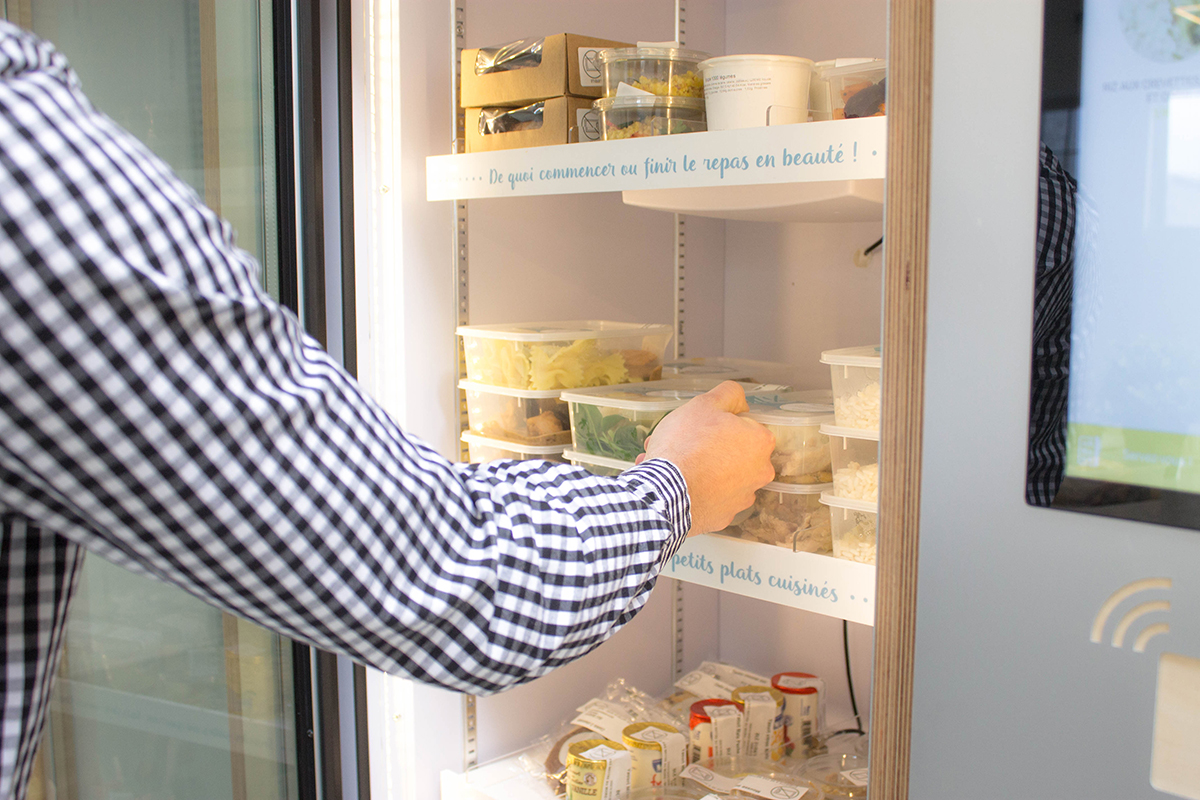
When you sign up to Foodles, the company delivers connected fridges to your office. Every day, Foodles comes to your office to deliver 20 to 200 meals at once. By default, you get a handful of options.

Employees can then unlock the fridge by scanning a card, grab something and eat. They’re then charged automatically. It usually costs way less than ordering something on Deliveroo for instance.

If you want something different, you can also order a specific meal in the Foodles app. You can top up your account from the app as well.

With today’s funding round, the startup plans to double the size of the team and expand beyond the Paris area. And it’s also worth noting that Foodles is currently profitable thanks to positive unit economics — one delivery represents dozens of meals after all.

Recently, there have been many scandals about riders for food startups, such as Deliveroo, Uber Eats, Glovo and Frichti. They are underpaid, overworked and have to take many risks in order to generate a decent wage. Foodles knows that this is a key issue and promises that delivery people are full-time employees.

So far, the company has managed to convince 50 companies to switch to Foodles. The startup delivers around 5,000 meals per day. Foodles says that it plans to have a more aggressive sales strategy to sign more customers in the coming months.

11 Jun 2019

Have I Been Pwned is looking for a new owner

Troy Hunt has revealed he’s looking for an acquirer for the breach notification service he set up more than five years ago — aka: Have I Been Pwned.

In a blog post discussing the future of the service, Hunt details how traffic to the site has exploded since January when he uploaded a massive 773M record list of breached emails and passwords that could be used for automated unauthorized logins (aka credential stuffing).

“The extra attention HIBP started getting in Jan never returned to 2018 levels, it just kept growing and growing,” he writes, saying he realized he was getting close to burn out trying to manage the service solo. Hence his decision to seek an acquirer.

HIBP has ridden a wave of growing concern about data breaches and Internet security, with Hunt taking the decision to accept a commercial sponsorship via a partnership with password manager firm 1Password last year.

Its growing profile has also led the service finding favor with governments wanting to monitor their own domains.

Sketching what he hopes to achieve with more resources behind HIBP, Troy writes: “Imagine a future where I’m able to source and process much more data, proactively reach out to impacted organisations, guide them through the process of handling the incident, ensure impacted individuals like you and me better understand our exposure (and what to do about it) and ultimately, reduce the impact of data breaches on organisations and consumers alike. And it goes much further than that too because there’s a lot more that can be done post-breach, especially to tackle attacks such as the huge rate of credential stuffing we’re seeing these days. I’m really happy with what HIBP has been able to do to date, but I’ve only scratched the surface of potential with it so far.”

At this stage Hunt says he’s met with KPMG’s M&A division to discuss the process of finding a new owner. Although he also says he intends to remain personally involved in the service.

“In meeting with the M&A folks, it quickly became apparent how much support I really needed,” he writes. “The most significant thing that comes to mind is that I’d never really taken the time just to step back and look at what HIBP actually does. That might sound odd, but as it’s grown organically over the years and I’ve built it out in response to a combination of what I think it should do and where the demand is, I’ve not taken the time to step back and look at the whole thing holistically. Nor have I taken enough time to look at what it could do… but there’s so much potential to do so much more and I really needed the support of people that specialise in finding the value in a business to help me see that.”

Hunt’s blog includes a list of “commitments for the future of HIBP” — including that he remains a part of it, and that “freely available consumer searches should remain freely available”. (Albeit ‘should’ is not the same as ‘will’.)

Other items on his wish list are more capabilities for the service; reaching a larger audience; playing a bigger role in changing consumer; greater support for organizations to use HIBP; and “more disclosure — and more data”.

“There’s a whole heap of organisations out there that don’t know they’ve been breached simply because I haven’t had the bandwidth to deal with it all,” he notes on the latter — a sentence that should send a chill up spines everywhere. 

There’s no named acquirer in the frame as yet, although Hunt sounds like he has a short-list — writing that there’s “a solid selection [of potential acquirer organizations] that are at the front of my mind” and “also a bunch that I have enormous respect for but are less well-equipped to help me achieve this”.

He also says he considered but dismissed taking VC to scale the service into a company himself — as it would inevitably amp up his responsibilities when he’s looking for a way to spread the load.

“As the process plays out, I’ll be working with KPMG to more clearly identify which organisations fit into the first category,” he goes on. “As I’m sure you can imagine, there are some very serious discussions to be had: where HIBP would fit into the organisation, how they’d help me achieve those bullet-pointed objectives above and frankly, whether it’s the right place for such a valuable service to go. There are also some major personal considerations for me including who I’d feel comfortable working with, the impact on travel and family and, of course, the financial side of the whole thing. I’ll be honest – it’s equal parts daunting and exciting.”

A couple of commenters on the blog post ask Hunt whether he’s considered/approached Mozilla as a potential owner — and in a reply to one he writes: “Being a party that’s already dependent on HIBP, I reached out to them in advance of this blog post and have spoken with them. I can’t go into more detail than that just now, but certainly their use of the service is enormously important to me.”

11 Jun 2019

Infarm closes $100M Series B to scale its ‘urban farming platform’

Infarm, the Berlin-based startup that has developed vertical farming tech for grocery stores and restaurants, is disclosing $100 in in Series B investment. The round is led by London VC Atomico, and consists of mix of equity funding and debt financing.

Infarm’s existing investors, including Balderton Capital, Astanor Ventures, Cherry Ventures, also participated in the round. In addition, TriplePoint Capital has invested, presumably providing a bulk if not all of the debt.

Founded in 2013 by Osnat Michaeli, and brothers Erez and Guy Galonska, Infarm’s “urban farming” platform claims to be capable of growing anything from herbs, lettuce, other vegetables, and even fruit. Its modular farms are placed in a variety of customer-facing city locations, such as grocery stores, restaurants, shopping malls, and schools, enabling the end-customer to actually pick the produce themselves.

The distributed system is designed to be infinitely scalable: you simply add more modules, space permitting, whilst the whole thing is cloud-based, meaning the farms can be monitored and controlled from Infarm’s central control centre. It’s this modular, data-driven and distributed approach — a combination of IoT, Big Data and cloud analytics akin to “farming-as-a-service” — that Infarm says sets it apart from competitors.

The broader premise — and clearly one of the reasons Atomico would have taken an interest — is that the consumption of fresh produce, which is rarely home grown, places a significant burden on the environment. This includes over farming and, of course, global transportation. In fact, Infarm says the CO2 footprint of food equals 17% of total global emissions.

Separately, we are told that currently 45% of plant nutrients is lost by the time it arrives in the supermarket.

Explains Erez Galonska, co-founder and CEO of Infarm: “Infarm was founded with an ambitious vision to feed the cities of tomorrow by bringing farms closer to the consumer, and with this round of funding we aim to grow our presence further. Sowing the seeds for a delicious and sustainable food system in urban centres across North America, Asia, and Europe. We are proud and excited to welcome Atomico to the Infarm journey.”

Infarm says the injection of capital will be used to further scale the company’s growth in Europe, the U.S. and beyond and to grow the R&D, operational, and commercial teams. The startup also plans to launch in the U.K. this September with some of “the country’s largest online and brick-and-mortar supermarkets” and is said to be in advanced discussions with retailers in the U.S. and Japan.

To date, the company has partnered with 25 major food retailers including Edeka, Metro, Migros, Casino, Intermarche, Auchan, Selgros, and Amazon fresh in Germany, Switzerland, and France. Overall, it has deployed more than 200 in-store farms, 150 farms in distribution centres, and is harvesting 150,000+ plants monthly.

11 Jun 2019

RapidAPI nabs $25M led by Microsoft as its API marketplace cracks 10K APIs and 1M users

APIs — the lightweight programming interfaces used by developers to integrate other applications with theirs, or to help their apps integrate with others — have become an essential building block of our software-powered world, with a majority of organizations building and working with them and, by some estimates, upwards of 50,000 of them in circulation today. Those numbers and popularity, however, can lead to a lot of fragmentation and disorganization in terms of discoverability. Now, one of the startups that’s building a marketplace to help fix these problems has raised funding to capitalise on the opportunity.

RapidAPI, which developers use to search for, pay and connect to public APIs, has closed a Series B round of $25 million.

CEO and co-founder Iddo Gino said in an interview that the startup plans to use the funding to continue both expanding the size of its marketplace and the kinds of tools that it provides to developers to engage with it. Up first will be a new product aimed at developer groups, appropriately titled RapidAPI for Teams, which will help them not only manage their use of public APIs but also organise and use their own internal APIs and microservices. (The product will be free for up to five developers and charged at $10 per user per month thereafter for unlimited calls, Gino said.)

The funding comes at a time of decent growth for the startup. The company now counts 10,000 public APIs in its marketplace, which it estimates is 33% of all publicly available APIs globally (leaving lots of room still to grow); with developers using RapidAPI now standing at 1 million, who now collectively make 500 billion API calls each month from a wide variety of companies big and small, including Microsoft, SendGrid, Nexmo, Telesign, Google, Skyscanner  and Crunchbase (TC’s cousin). Customers, meanwhile, include some of API providers along with other enterprises, including Cisco, Hyatt, SAP, Delta, and Reddit.

The stats RapidAPI is putting out today are all up on numbers it revealed to me last year, when I wrote about the startup’s Series A. (Then, it had 8,000 APIs, 500,000 developers and 400 billion calls.)

It now also has some 50 employees spread out between San Francisco, Tel Aviv and Ukraine.

The Series B — which brings the total raised by RapidAPI to around $38 million — is being led by M12, the VC arm of Microsoft, with DNS Capital and previous investors Andreessen Horowitz and Green Bay Capital also participating.

Microsoft’s involvement is strategic and notable: the company has long been building itself as the go-to platform for all things developer, a strategy that goes back years but more recently has extended to its big investment in its Azure cloud platform, as well as its acquisition of code repository GitHub, among many other moves. You can easily see how well something like RapidAPI could complement those existing tools.

“Responding to the torrid growth of the API economy, RapidAPI is changing the way businesses scale with APIs and microservices,” said Mony Hassid, General Manager and Managing Director at M12, in a statement. “We are excited about the potential for RapidAPI to enhance developers’ productivity, streamline duplicative work, and assist to combine API contracts.” Hassid also has now joined RapidAPIs board of directors.

From what we understand, Microsoft wasn’t the only strategic company that was eyeing an investment in RapidAPI in this round. But Iddo Gino, the company’s young founder, said in an interview that the terms of this deal were very clear and the company is very free to pursue partnerships with others, including Microsoft competitors.

Competitors are top of mind for RapidAPI in another regard, too. As you would imagine, the popularity of API usage — which extends not just to software but a number of hardware devices and IoT devices that the software powers — has led to a number of companies that are all going after the same business.

Companies like Zapier and IFTTT (also backed by Andreessen) provide directories of apps that can be connected together; and ProgrammableWeb also has offered a longstanding API directory, although Gino argues that it incorporates less of the tools that RapidAPI offers. He noted that he sees Manifold, which is a much larger cloud services marketplace, a more direct competitor.

The proliferation of tools for developers, and more specifically those aimed at helping developers work with APIs, will inevitably lead to more consolidation, with bigger fish swallowing up some of the minnows, or the minnows coming together for a stronger proposition to the market. RapidAPI has already been a beneficiary of that trend: it acquired Mashape in 2017, leading to a nice bump in its user numbers. And there could be more of that to come.

While RapidAPI has focused up to now on public APIs, the turn with teams to private APIs will open the door to a whole new set of services and use cases that speak to another kind of growth for the company. Citing a survey by Ping Identity, RapidAPI notes that 25% of companies typically use more than 1,000 internal APIs or microservices, while another 35% have 400–1,000 internal APIs. API days are here again, it seems.

11 Jun 2019

Shazam for Android now recognizes music played through headphones

Shazam, the Apple-owned app that helps users identify songs playing around them, can now recognize songs you’re listening to through your headphones when using an Android phone or tablet.

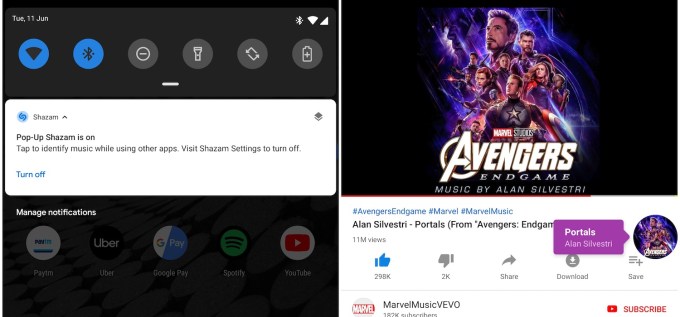
Acquired by Apple for $400 million last year, the company introduced a feature called ‘Pop-Up Shazam’ to its Android app this week that, when enabled, works with any other Android app to track and identify songs playing externally or internally on the phone.

It’s a feature that many users have requested for years. Prior to this, when a user would chance upon a music track in say a YouTube video, they only had two inconvenient ways to shazam the song. They could either unplug the earphones from the phone and let the audio play through the built-in speakers, or draw an earpiece close to the mic of the phone.

The new feature enables Shazam to track the audio signal beaming off of other apps, thereby not completely relying on just output from the surrounding and a phone’s speaker. The app is tapping the audio signal by using a persistent notification that floats around and could be dragged — like the ones from Facebook Messenger — and can be activated by a single tap.

In our test, the feature worked as advertised through both wired and wireless earphones (amusingly, Apple’s AirPods) and on Instagram, TikTok, and YouTube apps. iPhone users hoping to use a similar feature will likely have to patiently wait as persistent notification isn’t something that Apple’s mobile operating system currently supports. Apple could potentially find an alternative workaround in the future.

Google has taken a shot at audio recognition in recent years, too, after it introduced a ‘Now Playing’ feature in its Pixel 3 series smartphone last year. If enabled, the phone actively looks for songs playing in the surrounding, identifies them and keeps a log.