
Year: 2019

11 Nov 2019

Facebook finally lets you banish nav bar tabs & red dots

Are those red notification dots on your Facebook home screen driving you crazy? Sick of Facebook Marketplace wasting your screen space? Now you can control what appears in the Facebook app’s navigation bar thanks to a new option called Shortcuts Bar Settings.

Over the weekend TechCrunch spotted the option to remove certain tabs like Marketplace, Watch, Groups, Events, and Dating or just silence their notification dots. In response to our inquiry, Facebook confirms that Shortcut Bar Settings is now rolling out to everyone, with most iOS users already equipped and the rest of Android owners getting it in the next few weeks.
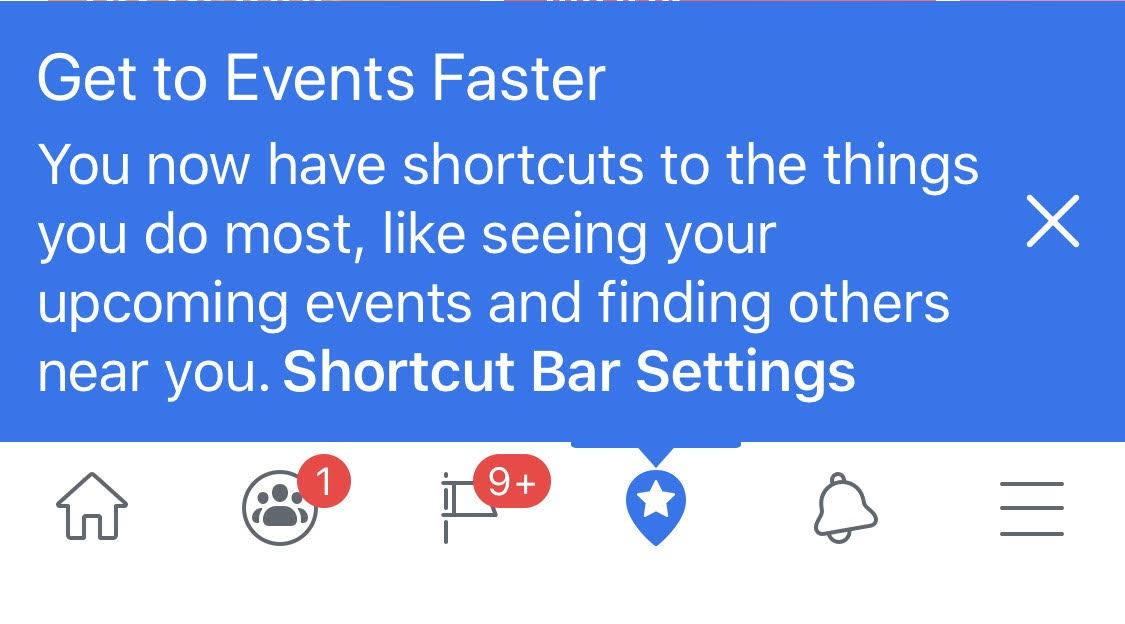
The move could save the sanity and improve the well-being of people who don’t want their Facebook cluttered with distractions. Users already get important alerts that they could actually control via their Notifications tab. Constant red notification counts on the homescreen are an insidious growth hack, trying to pull in people’s attention to random Group feeds, Event wall posts, and Marketplace.

“We are rolling out navigation bar controls to make it easier for people to connect with the things they like and control the notifications they get within the Facebook app” a Facebook spokesperson tells me.

Back in July 2018, Facebook said it would start personalizing the navigation bar based on what utilities you use most. But the navigation bar seemed more intent on promoting features Facebook wanted to be popular like its Craigslist competitor Marketplace, which I rarely use, rather than its long-standing Events feature I access daily.

To use the Shortcuts Bar Settings options, tap and hold on any of the shortcuts in your navigation bar that’s at the bottom of the Facebook homescreen on iOS and the top on Android. You’ll see a menu pop up letting you remove that tab entirely, or leave it but disable the red notification count overlays. That clears space in your nav bar for a more peaceful experience.

You’ll also now find in the three-line More tab -> Settings & Privacy -> Settings -> Shortcuts menu the ability to toggle any of the Marketplace, Groups, Events, and Pages tabs on or off. Eagle-eyed reverse engineering specialist Jane Manchun Wong spotted in June that Facebook was testing Notification Dots settings menu that’s now available too.

A Facebook spokesperson admits people should have the ability to take a break from notifications within the app. They tell me Facebook wanted to give users more control so they can have access to what’s relevant to them.

For all of Facebook’s talk about well-being, with it trying out hiding Like counts in its app and Instagram (this week starting in the US), there’s still plenty of low-hanging fruit. Better batching of Facebook notifications would be a great step, allowing users to get a daily digest of Groups or Events posts rather than a constant flurry. Its Time Well Spent dashboard that counts your minutes on Facebook should also say how many notifications you get of each type, how many you actually open, and let you disable the most common but useless ones right from there.

If Facebook wants to survive long-term, it can’t piss off users by trapping them in an anxiety-inducing hellscape of growth hacks that benefit the company. The app has become bloated and cramped with extra features over the last 15 years. Facebook could get away with more aggressive cross-promotion of some of these forgotten features as long as it empowers us to hide what we hate.

11 Nov 2019

Google Chrome to identify and label slow websites

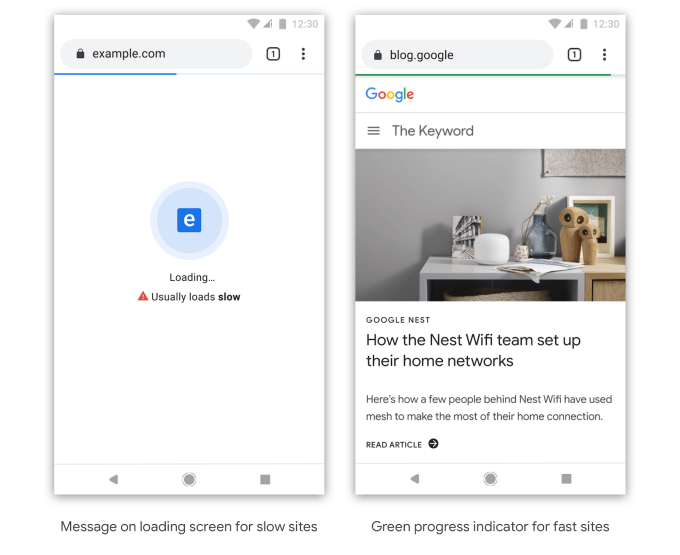
Is it the web page that’s slow or is it your network connection? In the future, Google’s Chrome web browser may have an answer for you. Google announced today a plan to identify and label websites that typically load slowly by way of clear badging. The company says it may later choose to identify sites that are likely to be slow based on the user’s device and current network conditions, as well.

Google hasn’t yet determined how exactly the slow websites will be labeled, but says it may experiment with different options to see which makes the most sense.

For example, a slow-loading website may show a “Loading…” page that includes a warning, like a caution icon and text that reads “usually loads slow.” Meanwhile, a fast website may display a green progress indicator bar at the top of the page instead of a blue one.

And for links, Chrome may use the context menu to help users know if the site will be slow so you can decide whether or not you want to click.

In the long-term, Chrome’s goal will be to identify and badge websites offering “high-quality” experiences which may include other factors beyond just the website’s speed. The company didn’t yet detail what those other factors may be, but says the identification process will include more stringent criteria that’s rolled out gradually over time. However, the goal will be to make these “good user experiences” something any web developer can achieve.

In the meantime, Google suggests web developers visit its resources focused on site performance, including its learning platform web.dev./fast; online tool for optimization suggestions, PageSpeed Insights; and personalized advice tool, Lighthouse.

A faster, more usable web benefits Google, as it helps the company better cater to its primarily mobile users. Since 2015, the majority of Google users start their searches from mobile devices. But that shift has required new ways of indexing and ranking pages and serving users whose connection speeds vary and who may not have powerful devices.

Google now uses a website’s mobile version when indexing its pages, and it offers fast AMP pages to help mobile users get to information more quickly. It makes sense that a next step would be to nudge site owners themselves to speed things up or risk getting labeled as a “slow” website.

This sort of feature would particularly help Google users in emerging markets, like India, where decent bandwidth is often lacking and low-end smartphones are prevalent.

“Speed has been one of Chrome’s core principles since the beginning – we’re constantly working to give users an experience that is instant as they browse the web,” a Chrome blog post explained. “That said, we have all visited web pages we thought would load fast, only to be met by an experience that could have been better. We think the web can do better…,” it read.

11 Nov 2019

Amazon to open its first non-Whole Foods grocery store in 2020

Amazon is opening its first non-Whole Foods grocery store in the L.A. neighborhood of Woodland Hills, the retailer today confirmed. The news of the new store was first reported by CNET, which spotted several job postings referencing the location including those for a zone leader, grocery associates, and a food service associate.

Unlike Amazon’s growing number of cashierless Amazon Go convenience stores, the new store will feature conventional checkout technology, says Amazon. CNBC also noted the store may be located in a former Toys R Us location at a shopping center.

Amazon declined to offer more details about its plans for the store or others like it, but did confirm it’s opening a grocery store in Woodland Hills in 2020.

The retailer’s plans to expand its grocery operations beyond its Whole Foods brand was previously reported by The Wall Street Journal in October. Amazon, the report claimed, was planning a chain of dozens of grocery stores across the U.S., beginning with sites in L.A., Chicago, and Philadelphia. Woodland Hills was mentioned as being among the first locations, along with Studio City and Irvine.

Other locations being scouted included those in the New York metro area, New Jersey and Connecticut.

Amazon’s interest in an expanded brick-and-mortar presence comes at a time when Walmart’s grocery business has been booming, with some reports claiming it now dominates those from rivals, including Amazon, Instacart, and others.

Walmart in Q2 reported 37% increase in e-commerce sales, supported by the strong growth in online grocery. Much of its success in that area can be attributed to the proximity of its stores to its customer base. With no markups on food prices (as some of its competitors do), it’s affordable to order from Walmart Grocery online, then drive to pick up the groceries — or pay a small fee to have them delivered.

Amazon’s Whole Foods, meanwhile, has long had a reputation as a more expensive store. Following the acquisition of the grocery chain, Amazon has tried to combat that notion with weekly sales and discounts for Prime members. But Whole Foods is still considered to be a more high-end store, and its prices continue to reflect that.

The new Amazon grocery stores, on the other hand, will be targeted at the mainstream consumer who typically shops from more traditional, or even value, grocery chains.

“When it comes to grocery shopping, we know customers love choice and this new store offers another grocery option that’s distinct from Whole Foods Market, which continues to grow and remain the leader in quality natural and organic food,” an Amazon spokesperson told CNET.

They said Whole Foods would continue to expand, despite the launch of the new Amazon grocery stores. Whole Foods opened 17 locations this year and has more planned, the company said.


11 Nov 2019

Salesforce Ventures invested $300M in Automattic while Salesforce was building a CMS

In September, Salesforce Ventures, the venture of arm of Salesforce, announced a hefty $300 million investment in Automattic, the company behind WordPress, the ubiquitous content management system (CMS). At the same time, the company was putting the finishing touches on Salesforce CMS, an in-house project it released last week.

The question is, why did it choose to do both?

One reason could be that WordPress isn’t just well-liked; it’s also the world’s most popular content management system, running 34 percent of the world’s 10 billion websites — including this one — according to the company. With Automattic valued at $3 billion, that gives Salesforce Ventures a 10 percent stake.

Given the substantial investment, you wouldn’t have been irrational to at least consider the idea that Salesforce may have had its eye on this company as an acquisition target. In fact, at the time of the funding, Automattic CEO Matt Mullenweg told TechCrunch’s Romain Dillet that there could be some partnerships and integrations with Salesforce in the future.

Now we have a Salesforce CMS, and a potential partnership with one of the world’s largest web content management (WCM) tools, and it’s possible that the two aren’t necessarily mutually exclusive.

11 Nov 2019

ViacomCBS shakes up its content leadership teams following merger

Following the merger of CBS and Viacom announced earlier this year, the combined company today confirmed its plans to restructure its content and digital leadership teams in order to streamline operations. Among the changes, which were first reported by The Wall St. Journal on Sunday, are the departures of Comedy Central Head Kent Alterman and Viacom Networks COO Sarah Levy. Meanwhile, CBS Chief Creative Officer David Nevins will add BET to his responsibilities, while President of MTV, VH1, CMT, and Logo Chris McCarthy, will now become President of Entertainment & Youth Brands, ViacomCBS Domestic Media Networks.

This will put McCarthy in charge of Comedy Central, Paramount Network, Smithsonian Channel and TV Land brands.

Nevins, in addition to BET, will also oversee CBS Television Studios, the CBS Television Network’s Entertainment division, the Showtime Networks and Pop, The CW, and the programming of streaming service CBS All Access.

In terms of children’s content, Nickelodeon President Brian Robbins will oversee kids and young adult-focused programming as President, Kids & Family Entertainment, ViacomCBS Domestic Media Networks. That puts him back in charge of Awesomeness, which he co-founded and sold to Viacom in 2018, in addition to Nickelodeon, Nick at Nite, Nick Jr., TeenNick, Nicktoons and Nickelodeon Studios.

ViacomCBS also said that Carolyn Kroll Reidy will continue her role as President and Chief Executive Officer of Simon & Schuster, Inc. And Jim Gianopulos will continue as Chairman and Chief Executive Officer of Paramount Pictures, a role that includes oversight of Paramount Animation, Paramount Features, Paramount Players and Paramount TV.

The exec shuffles follow other announcements about the combinations of the two companies’ advertising sales and content distribution teams.

In addition, the company had previously announced Joe Ianniello would serve as Chairman and CEO of CBS, which includes oversight of CBS Television Network (including CBS Entertainment, CBS News, and CBS Sports), CBS Television Studios, CBS Interactive (including CBS All Access) and CBS Television Stations. However, he lost oversight of Showtime and Pop TV to President and CEO of Viacom and ViacomCBS, Bob Bakish.

Also previously reported was that CBS Interactive chief Jim Lanzone had left for Benchmark Capital, to be replaced by Marc DeBevoise. This puts DeBovise in charge of digital operations and reporting to Bakish.

Viacom Digital Studios Kelly Day will continue in her role and report to DeBevoise, the company also said today. And CBS CTO Phil Wiser will become ViacomCBS CTO.

The free streaming service Pluto TV, headed by co-founder Tom Ryan, will report to Bakish. (In news unrelated to the exec changes, Pluto TV announced today it will start streaming music videos from Vevo across 10 new channels.)

These leadership changes are meant to consolidate operations while keeping the production arms of CBS Television Studios and Viacom’s counterpart, Paramount Television, separated, The WSJ said.

Beyond the exec shuffle itself, ViacomCBS also detailed how it plans to maximize its combined assets, on the content from. The company announced this morning it’s putting into place a new “Content Council” that will work to “maximize the use of IP and talent relationships” across the company. The council will be chaired by Nevins and include all the content leaders.

“ViacomCBS will be one of the largest premium content creators in the world, with the capacity to produce content for both our own platforms and for others,” said President and CEO of ViacomCBS Bob Bakish, in a statement. “This talented team of content leaders will work together to ensure we realize the full power of our brands, our deep relationships with the creative community and our intellectual property to drive our growth as a combined company,” he added.

The Viacom-CBS merger is expected to fully close in December.


11 Nov 2019

Stingray-inspired spacecraft could eventually probe the atmosphere of Venus

NASA’s next Venus probe could be an atmosphere-skimming robotic stingray designed by the University of Buffalo. UB’s CRASH Lab, which is the institution’s Crashworthinesss for Aerospace Structures and Hybrids laboratory, has been selected by NASA to get early stage funding as part of a program the agency devised to come up with new and innovative concept designs.

The stringray-style spacecraft design would have ‘wings’ that can flap in the high winds of the upper atmosphere of Venus, according to UB, which would allow controlled flight that’s possible with high efficiency. Using this design, the BREEZE design (as it’s called) would be able to make its way all the way around Venus every four to six days, while powering itself back up every two to three days while spending time on the sun-illuminated side of the planet.

Each ‘day’ on Venus is longer than a year on Earth, because of the way it orbits the Sun. That means that typical spacecraft design wouldn’t necessarily be able to stay afloat and powered in the planet’s atmosphere using existing strategies for propulsion and mobility.

BREEZE is still a long way away from actually dipping in and out of Venusian clouds, but this acknowledgment and award from NASA means it’s one step closer along the path to development.

11 Nov 2019

Alibaba’s Singles’ Day sales top $38 billion

After 24 hours of frenzied buying and selling, and weeks of advertising and promotions before it, the Alibaba Group said today its sales hit another record high on Singles’ Day, the biggest shopping day on the planet.

The Chinese e-commerce giant said its 11th Singles’ Day event sold goods worth 268 billion yuan, or $38.3 billion, easily exceeding last year’s record $30.7 billion haul. Electronics gadgets and fashion items were among the most sold goods this year, company executives said.

More than half a billion people from a number of countries participate in the event, which is China’s equivalent to Black Friday and Cyber Monday. Except, Singles’ Day is much larger. The five-day Black Friday clocked under $25 billion in sales last year. Alibaba Group said earlier today that it had netted its first $1 billion in sales this year in just 68 seconds.

The shopping glitz hosted a number of celebrities including Taylor Swift and Asian pop icon GEM to generate buzz. This year, the Hangzhou-headquartered firm has also focused on live-streaming via its platform, a phenomenon that has gained significant traction in China.

In a live stream, Kim Kardashian announced last week that her fragrance brand KKW will be sold on Tmall this Singles’ Day.

One figure who was missing from the action was Jack Ma, the founder of Alibaba Group, who retired in September this year. In previous years, Ma has not only just delivered speech but also put on performances for employees and customers.

At a press briefing an hour ago, Alibaba Chief Technology Officer Jeff Zhang described 11.11 as an “airplane flying at turbo speed,” adding that the company has been improving the supposed engine for years.

One such improvement is logistics network, which is still a laggard for the technology giant. Last week, Alibaba Group announced it was investing an additional $3.3 billion in logistics unit Cainiao, which it co-founded with a number of other companies six years ago.

11 Nov 2019

Twitter drafts a deepfake policy that would label and warn, but not always remove, manipulated media

Twitter last month said it was introducing a new policy to help fight deepfakes and other “manipulated media” that involve photos, videos, or audio that’s been significantly altered to change its original meaning or purpose, or those that make it seem like something happened that actually did not. Today, Twitter is sharing a draft of its new policy and opening it up for public input before it goes live.

The policy is meant to address the growing problem with deepfakes on today’s internet.

Deepfakes have proliferated thanks to advances made in artificial intelligence that have made it easier to produce convincing fake videos, audio, and other digital content. Anyone with a computer and internet connection can now create this sort of fake media. The technology can be dangerous when used as propaganda, or to make someone believe something is real which is not. In politics, deepfakes can be used to undermine a candidate’s reputation, by making them say and do things they never said or did.

A deepfake of Facebook CEO Mark Zuckerberg went viral earlier this year, after Facebook refused to pull down a doctored video that showed House Speaker Nancy Pelosi stumbling over her words was tweeted by Trump.

In early October, two members of the Senate Intelligence Committee, Mark Warner (D-VA) and Marco Rubio (R-FL), called on major tech companies to develop a plan to combat deepfakes on their platforms. The senators asked 11 tech companies — including Facebook, Twitter, YouTube, Reddit, and LinkedIn — to come up with a plan to develop industry standards for “sharing, removing, archiving, and confronting the sharing of synthetic content as soon as possible.”

Twitter later in the month announced its plans to seek public feedback on the policy. Meanwhile, Amazon joined up with Facebook, Microsoft to support the DeepFake Detection challenge (DFDC) which aims to develop new approaches to detect manipulated media.

Today, Twitter is detailing a draft of its deepfakes policy. The company says that when it sees synthetic or manipulated media that’s intentionally trying to mislead or confuse people it will:

  • place a notice next to Tweets that share synthetic or manipulated media;
  • warn people before they share or like Tweets with synthetic or manipulated media; or
  • add a link – for example, to a news article or Twitter Moment – so that people can read more about why various sources believe the media is synthetic or manipulated.

Twitter says if the deepfakes could also threaten someone’s physical safety or lead to serious harm, it may also remove it.

The company is accepting feedback by way of a survey as well as on Twitter itself, by way of the #TwitterPolicyFeedback hashtag.

The survey asks questions like whether altered photos and videos should be removed entirely, have warning labels, or not be removed at all. And it asks whether certain actions are acceptable, like hiding tweets or alerting people if they’re about to share a deepfake. It also asks when it should remove a tweet with misleading media. The policy Twitter created says tweets will be removed if the tweet if it threatens someone’s physical safety, but will otherwise be labeled. The survey suggests some other times a tweet could be pulled — like if it threatens someone’s mental health, privacy, dignity, property, and more.

The survey takes 5 minutes to complete and is available in English, Japanese, Portuguese, Arabic, Hindi, and Spanish.

What isn’t clear, however, is how Twitter will be able to detect the deepfakes published on its platform, given that detection techniques aren’t perfect and often lag behind the newer and more advanced creation methods. On this front, Twitter invites those who want to partner with it on detection solutions to fill out a form.

Twitter is accepting feedback on its deepfakes policy from now until Wednesday, Nov. 27 at 11:59 p.m. GMT. At that time, it will review the feedback received and make adjustments to the policy, as needed. The policy will then be incorporated into Twitter’s Rules with a 30-day notice before the change goes live.


11 Nov 2019

SpaceX launches re-flown fairing for the first time and breaks a Falcon 9 booster re-use record

SpaceX has successfully launched its first batch of production Starlink satellites today, sending 60 of the small satellites to their target orbit aboard a Falcon 9 rocket. These 60 satellites follow 60 launched in May, but whereas those, and two launched last year, were for testing purposes, this new batch is the first in a series of launches that will ready the constellation for providing internet service to consumers.

The launch took place at Cape Canaveral in Florida, and the Falcon 9 rocket used included a booster stage that has flown not once, not twice – but three times previously. This is its fourth use, which is a record for SpaceX . What’s more, SpaceX recovered the booster via controlled landing on its seafaring drone ship “Of Course I Still Love You” in the Atlantic Ocean, which means it’s possible the booster could be turned around and re-used still another time – they’re designed to support up to 10 flights in total.

That’s not the only record for this launch, and for SpaceX’s re-usable rocketry program in general: This flight used a previously flown fairing for the first time ever (for any rocket company) during this mission. This fairing was flown during the Falcon Heavy Arabsat-6A mission that happened in April. Re-flying the fairing could save SpaceX around $6 million per launch, per estimates CEO Elon Musk has previously shared.

SpaceX had also originally sought to recover the fairing, or protective covering used to shield the payload of Starlink satellites on its way out of Earth’s atmosphere.  The plan was to catch both halves using ocean-based catcher ships designed for the purpose, dubbed ‘Ms. Tree’ and ‘Ms. Chief,’ but conditions rendered that attempt impossible for this particular launch.

As for Starlink, SpaceX is looking to as many as tens of thousands of satellites to populate its broadband-beaming connectivity network. The goal is to operate a global constellation that provides connectivity via orbital satellites handing off connections to one another as they circle the globe – a different approach from current geostationary satellite connectivity, in which few large satellites essentially sit over one part of the Earth and provide connections just to that region.

Elon Musk tweeted earlier this year using a connection provided by a Starlink satellite for the first time, and the company aims to launch service for customers in the U.S. and Canada following six total launches of Starlink satellites like this one, with service expanding globally after a planned 24 similar launches.

Developing…


11 Nov 2019

OpenText buys data backup firm Carbonite for $1.42B

Carbonite has agreed to a $1.42 billion purchase by OpenText, an enterprise information management giant, ending weeks of speculation about the anticipated buyout.

The deal marks a 78% premium on Carbonite’s share price on September 5, when it was first rumored the company was preparing to buy the backup and data recovery company. Carbonite said the board “strongly believes” the deal will return “substantial” cash value to shareholders, said Steve Munford, chairman of Carbonite’s board.

It ends a busy couple of years for Carbonite as the company has moved away from a traditional data backup business to a more proactive, defensive security company.

In February, Carbonite bought endpoint security company Webroot for $618.5 million in an all-cash deal, as the company pushed to protect against emerging threats like ransomware. Only a year earlier, Carbonite bought Mozy for $145 million, a cloud backup service.

Carbonite said at the time of its acquisition by OpenText, the backup company had losses of $14 million on revenues of $125.6 billion, an increase by 62% year-over-year.

Wall Street was expecting average revenues of $131.5 million.