Breathing down the neck of WeWork is Knotel, which in 2017 raised a Series A round of $25 million, then another round of $70m, and then another $5m in debt. It says it has one million square feet in New York versus WeWork’s four million.
It’s now pushing out internationally. Last year it acquired Ahoy!Berlin, a workspace operator in Berlin, Germany, after setting up an operation in London.
And today it has announced that it has acquired Deskeo, the largest office space rental operation in Paris, catapulting Knotel to become the biggest operator in the city. It is about 10 times bigger than WeWork in the city, according to Amol Sarva, co-founder and CEO of Knotel.
Sarva told me the company will rebrand as Knotel, with senior management staying on. Numbers for the deal have not been released.
Last year Knotel also acquired 42Floors, a commercial real estate search engine in the US to, according to Sarva, get “access to data and technology on over 10 billion square feet of office space.”
Knotel is building what it calls the Agile HQ platform, a way to rent office space for a few hours or a few months without getting stuck in a lease. It positions itself as different from WeWork in that companies are front and centre in the building rather than the brand of Knotel, unlike WeWork which pushes itself as the main brand.
Year: 2019
‘Anti-Uber’ taxi strikes kick off again in Spain
Taxi drivers in major cities in Spain are on strike again to apply pressure for more stringent regulations to control app rivals such as Uber and Cabify which they view as unfair competition.
In Barcelona the taxi sector called an indefinite strike on Friday, using their vehicles to block Gran Vía in the Catalan capital, with protest action carrying on through the weekend and continuing into today.
Taxi drivers in Madrid are also on strike from this morning.
In Barcelona, the strike was called after the Catalan government announced proposals for regulating the vehicle for hire (VTC) sector which include a 15 minute wait time between a passenger booking and being able to take a ride.
The taxi drivers want the wait time to be much longer than that; at least 24 hours.
There were reports of violence during Friday’s action. The Huffington Post said a Cabify driver suffered a panic attack after his car was attacked by a group of protestors. It reports the police used cardiopulmonary resuscitation manoeuvers on the driver to stabilize him.
A journalist for El Pais also posted a video of the attack and resulting damage to the vehicle on Twitter.
The AP reports that local police arrested seven people in connection with the violence.
On Sunday, Elite Taxi BCN, one of the main associations backing the strike action, issued a video of its spokesman, Alberto Álvarez, calling for protestors to keep things peaceful.
The latest strikes follow a summer of action by the sector which also kicked off in Barcelona, also with violent scenes and reports of attacks on VTC drivers.
In that case Uber and Cabify temporarily paused services in the city on safety grounds. The pair do not appear to have stopped their services this time.
Although some VTC drivers have been holding counter protests by parking their vehicles along a stretch of Avenue Diagonal, causing further disruption to the flow of traffic in the city.
The taxi strike in the summer only ended after the government agreed to transfer regulatory competency for the VTC sector to the regions. The Catalan government is the first regional authority to have put forward proposals for regulating VTCs.
But the move devolving regulatory competency has not ended the ‘taxi war’. Far from it; it’s cranking up a gear as taxi associations demand a firewall for their sector by overruling the on-demand convenience of app-based rivals which are counter protesting in the hopes of steering out of a looming regulatory bind.
The latter group argues that imposed wait limits would be unconstitutional because they would go against the general interest of citizens. They also point out that waiting time based regulations have not been successfully enforced anywhere in Europe (London’s TfL proposed a five minute waiting time after a booking back in 2015 but dropped the measure after a public consultation, for instance).
While the taxi sector argues that existing laws aren’t being enforced meaning that a regulated public service is being unfairly undercut and undermined by multinationals that also only bring precarious work, rather than sustainable employment…
In Barcelona the annual Mobile World Congress tradeshow, which takes place in just over a month’s time — bringing an influx of around 100,000 techie visitors — is a strategic ratchet for the taxi industry to pressure authorities. Threats to paralyze the city are at their most politically and economically potent. So there’s plenty of uncertainty about where the latest huelga indefinida will lead.
If wait limits are imposed the VTC sector claims it would result in scores of drivers being put out of work. Commenting on the Barcelona government’s proposals for regulating the sector, an Uber spokesman told us: “Recent developments could have major consequences for drivers as well as the thousands of riders who enjoy new mobility services in the city. We continue to call for dialogue with all local stakeholders, including taxis, to shape the future of urban mobility in Spain together.”
We’ve also reached out to Cabify for comment.
Unauto VTC, a VTC association, issued a press release on Saturday decrying the blockade of the city and what it dubbed “intolerable levels of violence” by taxi associations, as well as attacking the “absolutely disproportionate” proposed VTC regulations. It also denounced the local government minister in charge of the regulation, Damià Calvet, accusing him of caving in to taxi industry “blackmail”.
“The Catalan Government’s umpteenth caving in to taxi sector blackmail has ensured it will no longer be satisfied with anything other than the disappearance of the VTC sector. We hope the government rectifies this immediately and allows the general interest of the citizens of Catalonia to prevail,” said association president, Eduardo Martín, in a statement (which we’ve translated).
“I wonder what the next thing Barcelona’s taxi sector will be asking for under threat of blocking the Mobile World Congress. Maybe the Metro closes an hour earlier, or that the Aerobus disappears. In view of the attitude of the current Government of the Generalitat it is possible that they will achieve it.”
The city government pointed us to a statement today, from the councillor for mobility and president of metropolitan transport, Mercedes Vidal, calling for an “acceptable” proposal so taxis and VTC drivers do not do the same work.
Work on world’s first CRISPR gene-edited babies declared illegal by China
Chinese authorities have declared the work of He Jiankui, who shocked the scientific community by claiming he successfully created the world’s first gene-edited babies, an illegal decision in pursuit of “personal fame and gain.” Investigators have completed preliminary steps in a probe that began in November following He’s claims and say they will “seriously” punish the researcher for violations of the law, China’s official news agency Xinhua reported on Monday.
He, who taught at Shenzhen’s Southern University of Science and Technology, had led a team to research the gene-editing technique CRISPR since mid-2016 in attempts to treat cancers and other diseases. The incident drew significant attention to the professor’s own biotech startups that are backed by local and overseas investors.
The official probe shows that He fabricated ethics approvals which he used to recruit eight couples to participate in clinical procedures between March 2017 and November 2018. The attempt led to two pregnancies, including one that resulted in the birth of twins and the other embryo yet to be born. Five couples failed to achieve fertilization and one pair dropped out of the experiment.
He’s project has sparked a wave of criticism among scientists across the world. CRISPR is still dangerously unethical at this point for it may cause serious genetic damage. Some researchers have proposed a moratorium on CRISPR until more guidelines become clear while others call for developing safer and more ethical methods to propel the technology forward. Many countries, including the United States and China, prohibit gene-editing of human embryos for reproductive purposes.
Zwipe tops up with $14M to bring biometric payment cards to market this year
Biometric payment card startup Zwipe has swiped $14M to add to an earlier Series B round as it continues to work towards commercializing technology that embeds a fingerprint reader in payment plastic for an added layer of security.
“We are not commercially rolled out yet, we expect that to happen in the second half of this year, starting first in Europe and potentially in the Middle East,” a spokesman told us, saying the financing will be used to scale up the company to prepare for a commercial rollout of a biometric payment card solution in the second half of 2019.
He said it’s also eyeing additional form factors such as wearables down the line, penciling in 2020 for expanding into other devices and verticals.
Although it has yet to push its tech past the pilot stage with payment cards.
“Our technology is currently deployed in pilot programs in Italy, with Intesa Sanpaolo Bank and with 10 different banks across the Middle East,” the spokesman told us. “We have active partnerships globally. In APAC, specifically China and the Philippines, we expect to launch further trials in the near term. In Europe we have piloted with the Bank of Cyprus and expect to launch several more trials in Europe in the first half of 2019.”
Back in 2014, working with MasterCard, it showed off a credit card with an embedded fingerprint reader, seemingly taking a leaf out of Apple’s approach with Touch ID.
The new funding was raised via an offering of 6M new shares, from around 2,300 investors, ahead of a planned listing of the company on Merkur Market, Oslo Børs. Zwipe says the share offer was substantially over-subscribed, and it expects trading to commence on or around January 28. The pre-money valuation of the company is stated as NOK 189 million ($22M).
Commenting on the raise in a statement, CEO Andre Løvestam said: “Zwipe is at the forefront of a global shift towards more secure and convenient contactless payments and the market is primed for growth. We are confident that our industry leading technology and partnerships will secure a strong market position both in the short and long-term. Thanks to the new funding received, we can intensify our efforts to support our customers and partners in ‘making convenience secure’.”
Warung Pintar raises $27.5M to digitize Indonesia’s street vendors
The digital revolution in Indonesia, Southeast Asia’s largest economy, continues to attract big money from investors. Hot on the heels of a $50 million round for Bukalapak, a billion-dollar company helping street stall traders to tap the internet, so Warung Pintar, another startup helping digitize the country’s vendors, has pulled in $27.5 million for growth.
Bukalapak is one of Indonesia’s largest e-commerce services and it began catering to local merchants, those who sell product via road-side kiosks, last year, but eighteen-month-old Warung Pintar is focused exclusively on those vendors.
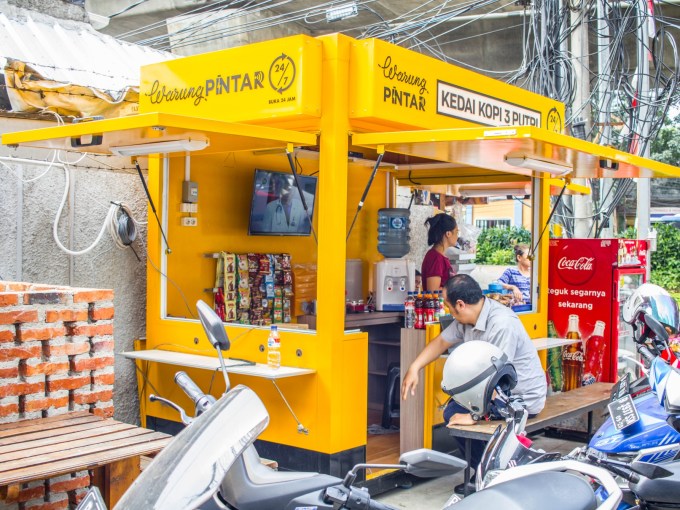
Bukalapak helps them to gain scale through online orders — it claims to have a base of 50 million registered users in Indonesia — but Warung Pintar digitizes kiosk vendors to the very core. At the most basic level, that means aesthetics; so all Warung Pintar vendors get a bright and colorfully-designed kiosk. They also get access to technology that includes a digital POS, free Wi-Fi for customers, an LCD screen for displays, power bank chargers and more.
It’s a ‘smart kiosk’ concept, essentially.
The project was founded in 2007 by East Ventures, a prolific early-stage investor that has backed unicorns like Tokopedia, Traveloka and Mercari. This new money means that Warung Pintar has now raised just over $35 million from investors to date.
The round — which is a Series B — included participation from existing backers SMDV, Vertex, Pavilion Capital, Line Ventures, Digital Garage, Agaeti, Triputra, Jerry Ng, and EV Growth — the joint fund from East Ventures and Yahoo. They were joined by OVO — a payment firm jointly owned by Indonesian mega-conglomerate Lippo — which has signed on as a new investor and is sure to be highly strategic in nature. OVO works with the likes of Grab, and it is battling to gain a foothold in Indonesia’s fledgling digital payments space, which is tipped to boom among the country’s 260 million population.

A Warung Pintar kiosk in Jakarta, Indonesia
These investors are all betting that Warung Pintar can take off and provide greater functionality for street vendors and consumers alike.
The startup is in growth mode right now so it isn’t fully focused on monetization. The only fee is $5,000 from the vendor, which covers the cost of a new prefab kiosk, while all the tech appliances are provided without fee to help kiosk owners engage with the local community. For example, East Ventures noticed that drivers for Go-Jek or Grab tended to hang around the kiosk store near the VC firm’s office and they were curious how to grow engagement to benefit both parties.
“There are going to be a lot of ways to charge and make money,” East Ventures co-founder and managing partner Willson Cuaca told TechCrunch in an interview. “Once we have built enough, we can manage the supply chain and then figure out of how to make money.”
Indeed, monetization might not be via fees to the kiosk owners themselves, explained Cuaca — who is president of Warung Pintar. Since the company maintains touch points with consumers, it is a commodity that can appeal to brands, manufacturers and others when it reaches nationwide scale.
While there has been promising progress and product market fit in Jakarta, Cuaca and his team see significant growth potential still to be realized.
When we spoke to Warung Pintar just under a year ago, it had just raised a seed round and had been in operation for under six months. Today, the business counts 1,150 kiosks in Jakarta. However, it recently opened up in Banyuwangi, East Java, which, alongside other planned expansions, is aimed to increase its reach to 5,000 kiosks before the end of this year, Cuaca said.
There’s no plan for regional expansion at this point, he added.
The business and model is fascinating but it is conceived and executed in Indonesia, that’s to say it isn’t a problem that could be identified, mapped and solved from the U.S, China or other markets. It’s the type of tech and startup that is helping change daily lives in Indonesia, the world’s fourth largest country by population. Home-grown solutions have been rare in Southeast Asia, but there are increasing opportunities that only local players can cater to and now the region’s VC corpus is substantial enough to provide the capital needed.
Flexciton is using AI to help factories optimise production lines
Flexciton, the London-based startup that is using AI to help factories optimise production lines, has raised £2.5 million in funding, in a round led by Backed VC. Also participating is Join Capital and company builder Entrepreneur First. The young company pitched at EF’s 6th London demo day in 2016.
Riding the so-called “Industry 4.0” wave, Flexciton has developed an AI-driven solution to optimise the way manufacturers plan and schedule “multi-step production lines,” which it says is a complex mathematical task faced by all manufacturers. It’s also traditionally quite a manual one, with existing software solutions still leaving a lot of the heavy lifting to humans.
“Running every factory in the world is a plan for that factory’s production,” explains Flexciton co-founder Jamie Potter. “This plan dictates everything which goes on in the factory. Plan well and a factory can be very profitable but plan badly and the same factory could deliver late on customer orders, overspend on equipment and materials and have its margins destroyed”.
Potter says that typically a human manually creates a plan based on their past experience, which isn’t always optimal. “The difference between an Ok plan and the optimal plan is huge for a factory, planning well can save a single factory many millions of pounds per year. The problem is, finding that optimal plan is one of the hardest mathematical problems that exists in the real world”.
Which, of course, is where more machines can help. Flexciton’s AI technology learns from a factory’s data, and Potter says it can understand exactly how that factory works. “It can then search through the trillions of different options to find the most efficient production plan. The results can be staggering too as our technology has shown time and again that it is capable of double-digit performance gains to a factory!” he says.
Already revenue-generating, Flexciton has customers in the textiles, food, automotive and semiconductor sectors. “We love to work with particularly complicated factories. Here the planning problem is the hardest and this is where we add the most value,” says Potter.
To back this up, Flexciton has recruited a number of experts in the field of industrial optimisation and AI. The current Flexciton team has published over 140 peer-reviewed academic papers, which focus on the practical application of this technology in eight different industrial use cases. To boot, Flexciton’s senior optimisation scientist, Dr. Giorgos Kopanos, has even published a book on the subject.
Canada’s Telus says partner Huawei is ‘reliable’: reports
The US-China tension over Huawei is leaving telecommunications companies around the world at a crossroad, but one spoke out last week. Telus, one of Canada’s largest phone companies showed support for its Chinese partner despite a global backlash against Huawei over cybersecurity threats.
“Clearly, Huawei remains a viable and reliable participant in the Canadian telecommunications space, bolstered by globally leading innovation, comprehensive security measures, and new software upgrades,” said an internal memo signed by a Telus executive that The Globe and Mail obtained.
The Vancouver-based firm is among a handful of Canadian companies that could potentially leverage the Shenzhen-based company to build out 5G systems, the technology that speeds up not just mobile connection but more crucially powers emerging fields like low-latency autonomous driving and 8K video streaming. TechCrunch has contacted Telus for comments and will update the article when more information becomes available.
The United States has long worried that China’s telecom equipment makers could be beholden to Beijing and thus pose espionage risks. As fears heighten, President Donald Trump is reportedly mulling a boycott of Huawei and ZTE this year, according to Reuters. The Wall Street Journal reported last week that US federal prosecutors may bring criminal charges against Huawei for stealing trade secrets.
Australia and New Zealand have both blocked local providers from using Huawei components. The United Kingdom has not officially banned Huawei but its authorities have come under pressure to take sides soon.
Canada, which is part of the Five Eyes intelligence-sharing network alongside Australia, New Zealand, the UK and the US, is still conducting a security review ahead of its 5G rollout but has been urged by neighboring US to steer clear of Huawei in building the next-gen tech.
China has hit back at spy claims against its tech crown jewel over the past months. Last week, its ambassador to Canada Lu Shaye warned that blocking the world’s largest telecom equipment maker may yield repercussions.
“I always have concerns that Canada may make the same decision as the US, Australia and New Zealand did. And I believe such decisions are not fair because their accusations are groundless,” Lu said at a press conference. “As for the consequences of banning Huawei from 5G network, I am not sure yet what kind of consequences will be, but I surely believe there will be consequences.”
Last week also saw Huawei chief executive officer Ren Zhengfei appear in a rare interview with international media. At the roundtable, he denied security charges against the firm he founded in 1987 and cautioned the exclusion of Chinese firms may delay plans in the US to deliver ultra-high-speed networks to rural populations — including to the rich.
“If Huawei is not involved in this, these districts may have to pay very high prices in order to enjoy that level of experience,” argued Ren. “Those countries may voluntarily approach Huawei and ask Huawei to sell them 5G products rather than banning Huawei from selling 5G systems.”
The Huawei controversy comes as the US and China are locked in a trade war that’s sending reverberations across countries that rely on the US for security protection and China for investment and increasingly skilled — not just cheap — labor.
Canada got caught between the feuding giants after it arrested Huawei’s chief financial officer Meng Wanzhou, who’s also Ren’s daughter, at the request of US authorities. The White House is now facing a deadline at the end of January to extradite Meng. Meanwhile, Canadian Prime Minister Justin Trudeau and Trump are urging Beijing to release two Canadian citizens who Beijing detained following Meng’s arrest.
Invoice finance platform MarketInvoice raises $33.5M from Barclays, Santander
London, with its huge FinTech hub, is continuing to attract investment and that is no better represented today than with the news that MarketInvoice, arguably Europe’s largest online invoice finance platform, has raised £26M ($33.5M) in a Series-B funding round led by Barclays and fintech fund Santander InnoVentures, alongside participation from European VC Northzone, which previously invested. In August last year Barlcays took a minority equity stake in the company and rolled out the service to its large SME client base.
Technology credit fund Viola Credit, which also participated, will additionally provide a debt facility of up to £30m to help scale the MarketInvoice business loans solution which is part of its core invoice finance solutions.
The funding will be used to deepen MarketInvoice’s market in the UK and launch what it called “cross-border fintech-bank partnerships” which it would be reasonable to conclude would include expanding into new markets.
Established in 2011, MarketInvoice has funded invoices and business loans to UK companies worth more than £2 billion, and they claim to be Europe’s largest online invoice finance platform.
Anil Stocker, Co-founder & CEO told me: “for us strategic partnerships, especially those where we can use new sources of data, are becoming increasingly important. Our mission is to help as many entrepreneurs as possible gain access to finance… Barclays realises it’s a good way of upgrading their offering to SMEs, and get more lending out to help these businesses. For us, by working with Barclays’ network and presence in the market, we’re able to educate more businesses on our funding solutions, something which would take much more time if we were to do it on our own.”
Ian Rand, CEO of Barclays Business Bank, said: “This investment demonstrates our commitment to the partnership we announced last summer which offers hundreds of thousands of our SME clients access to even more innovative forms of finance, boosting cash flow and competition in the market.” Manuel Silva Martínez, Managing Partner and Head of Investments at Santander InnoVentures commented: “MarketInvoice is helping UK businesses access much needed funding to keep their businesses and ideas thriving in a very competitive market.”
The case against behavioral advertising is stacking up
No one likes being stalked around the Internet by adverts. It’s the uneasy joke you can’t enjoy laughing at. Yet vast people-profiling ad businesses have made pots of money off of an unregulated Internet by putting surveillance at their core.
But what if creepy ads don’t work as claimed? What if all the filthy lucre that’s currently being sunk into the coffers of ad tech giants — and far less visible but no less privacy-trampling data brokers — is literally being sunk, and could both be more honestly and far better spent?
Case in point: This week Digiday reported that the New York Times managed to grow its ad revenue after it cut off ad exchanges in Europe. The newspaper did this in order to comply with the region’s updated privacy framework, GDPR, which includes a regime of supersized maximum fines.
The newspaper business decided it simply didn’t want to take the risk, so first blocked all open-exchange ad buying on its European pages and then nixed behavioral targeting. The result? A significant uptick in ad revenue, according to Digiday’s report.
“NYT International focused on contextual and geographical targeting for programmatic guaranteed and private marketplace deals and has not seen ad revenues drop as a result, according to Jean-Christophe Demarta, SVP for global advertising at New York Times International,” it writes.
“Currently, all the ads running on European pages are direct-sold. Although the publisher doesn’t break out exact revenues for Europe, Demarta said that digital advertising revenue has increased significantly since last May and that has continued into early 2019.”
It also quotes Demarta summing up the learnings: “The desirability of a brand may be stronger than the targeting capabilities. We have not been impacted from a revenue standpoint, and, on the contrary, our digital advertising business continues to grow nicely.”
So while (of course) not every publisher is the NYT, publishers that have or can build brand cachet, and pull in a community of engaged readers, must and should pause for thought — and ask who is the real winner from the notion that digitally served ads must creep on consumers to work?
The NYT’s experience puts fresh taint on long-running efforts by tech giants like Facebook to press publishers to give up more control and ownership of their audiences by serving and even producing content directly for the third party platforms. (Pivot to video anyone?)
Such efforts benefit platforms because they get to make media businesses dance to their tune. But the self-serving nature of pulling publishers away from their own distribution channels (and content convictions) looks to have an even more bass string to its bow — as a cynical means of weakening the link between publishers and their audiences, thereby risking making them falsely reliant on adtech intermediaries squatting in the middle of the value chain.
There are other signs behavioural advertising might be a gigantically self-serving con too.
Look at non-tracking search engine DuckDuckGo, for instance, which has been making a profit by serving keyword-based ads and not profiling users since 2014, all the while continuing to grow usage — and doing so in a market that’s dominated by search giant Google.
DDG recently took in $10M in VC funding from a pension fund that believes there’s an inflection point in the online privacy story. These investors are also displaying strong conviction in the soundness of the underlying (non-creepy) ad business, again despite the overbearing presence of Google.
Meanwhile, Internet users continue to express widespread fear and loathing of the ad tech industry’s bandwidth- and data-sucking practices by running into the arms of ad blockers. Figures for usage of ad blocking tools step up each year, with between a quarter and a third of U.S. connected device users’ estimated to be blocking ads as of 2018 (rates are higher among younger users).
Ad blocking firm Eyeo, maker of the popular AdBlock Plus product, has achieved such a position of leverage that it gets Google et al to pay it to have their ads whitelisted by default — under its self-styled ‘acceptable ads’ program. (Though no one will say how much they’re paying to circumvent default ad blocks.)
So the creepy ad tech industry is not above paying other third parties for continued — and, at this point, doubly grubby (given the ad blocking context) — access to eyeballs. Does that sound even slightly like a functional market?
In recent years expressions of disgust and displeasure have also been coming from the ad spending side too — triggered by brand-denting scandals attached to the hateful stuff algorithms have been serving shiny marketing messages alongside. You don’t even have to be worried about what this stuff might be doing to democracy to be a concerned advertiser.
Fast moving consumer goods giants Unilever and Procter & Gamble are two big spenders which have expressed concerns. The former threatened to pull ad spend if social network giants didn’t clean up their act and prevent their platforms algorithmically accelerating hateful and divisive content.
While the latter has been actively reevaluating its marketing spending — taking a closer look at what digital actually does for it. And last March Adweek reported it had slashed $200M from its digital ad budget yet had seen a boost in its reach of 10 per cent, reinvesting the money into areas with “‘media reach’ including television, audio and ecommerce”.
The company’s CMO, Marc Pritchard, declined to name which companies it had pulled ads from but in a speech at an industry conference he said it had reduced spending “with several big players” by 20 per cent to 50 per cent, and still its ad business grew.
So chalk up another tale of reduced reliance on targeted ads yielding unexpected business uplift.
At the same time, academics are digging into the opaquely shrouded question of who really benefits from behavioral advertising. And perhaps getting closer to an answer.
Last fall, at an FTC hearing on the economics of big data and personal information, Carnegie Mellon University professor of IT and public policy, Alessandro Acquisti, teased a piece of yet to be published research — working with a large U.S. publisher that provided the researchers with millions of transactions to study.
Acquisti said the research showed that behaviourally targeted advertising had increased the publisher’s revenue but only marginally. At the same time they found that marketers were having to pay orders of magnitude more to buy these targeted ads, despite the minuscule additional revenue they generated for the publisher.
“What we found was that, yes, advertising with cookies — so targeted advertising — did increase revenues — but by a tiny amount. Four per cent. In absolute terms the increase in revenues was $0.000008 per advertisment,” Acquisti told the hearing. “Simultaneously we were running a study, as merchants, buying ads with a different degree of targeting. And we found that for the merchants sometimes buying targeted ads over untargeted ads can be 500% times as expensive.”
“How is it possible that for merchants the cost of targeting ads is so much higher whereas for publishers the return on increased revenues for targeted ads is just 4%,” he wondered, posing a question that publishers should really be asking themselves — given, in this example, they’re the ones doing the dirty work of snooping on (and selling out) their readers.
Acquisti also made the point that a lack of data protection creates economic winners and losers, arguing this is unavoidable — and thus qualifying the oft-parroted tech industry lobby line that privacy regulation is a bad idea because it would benefit an already dominant group of players. The rebuttal is that a lack of privacy rules also does that. And that’s exactly where we are now.
“There is a sort of magical thinking happening when it comes to targeted advertising [that claims] everyone benefits from this,” Acquisti continued. “Now at first glance this seems plausible. The problem is that upon further inspection you find there is very little empirical validation of these claims… What I’m saying is that we actually don’t know very well to which these claims are true and false. And this is a pretty big problem because so many of these claims are accepted uncritically.”
There’s clearly far more research that needs to be done to robustly interrogate the effectiveness of targeted ads against platform claims and vs more vanilla types of advertising (i.e. which don’t demand reams of personal data to function). But the fact that robust research hasn’t been done is itself interesting.
Acquisti noted the difficulty of researching “opaque blackbox” ad exchanges that aren’t at all incentivized to be transparent about what’s going on. Also pointing out that Facebook has sometimes admitted to having made mistakes that significantly inflated its ad engagement metrics.
His wider point is that much current research into the effectiveness of digital ads is problematically narrow and so is exactly missing a broader picture of how consumers might engage with alternative types of less privacy-hostile marketing.
In a nutshell, then, the problem is the lack of transparency from ad platforms; and that lack serving the self same opaque giants.
But there’s more. Critics of the current system point out it relies on mass scale exploitation of personal data to function, and many believe this simply won’t fly under Europe’s tough new GDPR framework.
They are applying legal pressure via a set of GDPR complaints, filed last fall, that challenge the legality of a fundamental piece of the (current) adtech industry’s architecture: Real-time bidding (RTB); arguing the system is fundamentally incompatible with Europe’s privacy rules.
We covered these complaints last November but the basic argument is that bid requests essentially constitute systematic data breaches because personal data is broadcast widely to solicit potential ad buys and thereby poses an unacceptable security risk — rather than, as GDPR demands, people’s data being handled in a way that “ensures appropriate security”.
To spell it out, the contention is the entire behavioral advertising business is illegal because it’s leaking personal data at such vast and systematic scale it cannot possibly comply with EU data protection law.
Regulators are considering the argument, and courts may follow. But it’s clear adtech systems that have operated in opaque darkness for years, without no worry of major compliance fines, no longer have the luxury of being able to take their architecture as a given.
Greater legal risk might be catalyst enough to encourage a market shift towards less intrusive targeting; ads that aren’t targeted based on profiles of people synthesized from heaps of personal data but, much like DuckDuckGo’s contextual ads, are only linked to a real-time interest and a generic location. No creepy personal dossiers necessary.
If Acquisti’s research is to be believed — and here’s the kicker for Facebook et al — there’s little reason to think such ads would be substantially less effective than the vampiric microtargeted variant that Facebook founder Mark Zuckerberg likes to describe as “relevant”.
The ‘relevant ads’ badge is of course a self-serving concept which Facebook uses to justify creeping on users while also pushing the notion that its people-tracking business inherently generates major extra value for advertisers. But does it really do that? Or are advertisers buying into another puffed up fake?
Facebook isn’t providing access to internal data that could be used to quantify whether its targeted ads are really worth all the extra conjoined cost and risk. While the company’s habit of buying masses of additional data on users, via brokers and other third party sources, makes for a rather strange qualification. Suggesting things aren’t quite what you might imagine behind Zuckerberg’s drawn curtain.
Behavioral ad giants are facing growing legal risk on another front. The adtech market has long been referred to as a duopoly, on account of the proportion of digital ad spending that gets sucked up by just two people-profiling giants: Google and Facebook (the pair accounted for 58% of the market in 2018, according to eMarketer data) — and in Europe a number of competition regulators have been probing the duopoly.
Earlier this month the German Federal Cartel Office was reported to be on the brink of partially banning Facebook from harvesting personal data from third party providers (including but not limited to some other social services it owns). Though an official decision has yet to be handed down.
While, in March 2018, the French Competition Authority published a meaty opinion raising multiple concerns about the online advertising sector — and calling for an overhaul and a rebalancing of transparency obligations to address publisher concerns that dominant platforms aren’t providing access to data about their own content.
The EC’s competition commissioner, Margrethe Vestager, is also taking a closer look at whether data hoarding constitutes a monopoly. And has expressed a view that, rather than breaking companies up in order to control platform monopolies, the better way to go about it in the modern ICT era might be by limiting access to data — suggesting another potentially looming legal headwind for personal data-sucking platforms.
At the same time, the political risks of social surveillance architectures have become all too clear.
Whether microtargeted political propaganda works as intended or not is still a question mark. But few would support letting attempts to fiddle elections just go ahead and happen anyway.
Yet Facebook has rushed to normalize what are abnormally hostile uses of its tools; aka the weaponizing of disinformation to further divisive political ends — presenting ‘election security’ as just another day-to-day cost of being in the people farming business. When the ‘cost’ for democracies and societies is anything but normal.
Whether or not voters can be manipulated en masse via the medium of targeted ads, the act of targeting itself certainly has an impact — by fragmenting the shared public sphere which civilized societies rely on to drive consensus and compromise. Ergo, unregulated social media is inevitably an agent of antisocial change.
The solution to technology threatening democracy is far more transparency; so regulating platforms to understand how, why and where data is flowing, and thus get a proper handle on impacts in order to shape desired outcomes.
Greater transparency also offers a route to begin to address commercial concerns about how the modern adtech market functions.
And if and when ad giants are forced to come clean — about how they profile people; where data and value flows; and what their ads actually deliver — you have to wonder what if anything will be left unblemished.
People who know they’re being watched alter their behavior. Similarly, platforms may find behavioral change enforced upon them, from above and below, when it becomes impossible for everyone else to ignore what they’re doing.
Thanks to Hulu, Disney lost $580 million last fiscal year
The streaming media business is tough. Disney, which has a 30 percent stake Hulu, saw losses of $580 million last fiscal year, according to an SEC filing.
This was, the SEC filing states, “primarily due to a higher loss from our investment in Hulu, partially offset by a favorable comparison to a loss from BAMTech in the prior year.”
BAMTech is the streaming technology that powers ESPN+ and other services. In total, streaming accounted for more than $1 billion in losses for Disney last fiscal year.
Meanwhile, Disney has yet to release its own streaming service, Disney+, which is slated for late 2019. Disney is also planning to increase its investment in Hulu, focusing more on original content and international expansion.
As part of Disney’s buyout of 21st Century Fox, Disney will soon own another 30 percent of Hulu. If the business goes similarly for Hulu this fiscal year, that will only increase Disney’s losses.
(@EliteTaxiSevil1)