Year: 2019

07 Nov 2019

Google Pay comes to Curve, the banking platform that consolidates all your cards into one

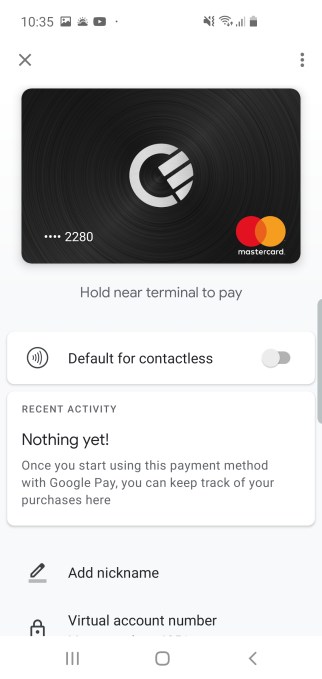
Hot on the heels of adding support for Samsung Pay, Curve, the London-based “over-the-top” banking platform that lets you consolidate all of your bank cards into a single card, has added support for Google Pay.

The new integration — which we reported earlier this week was imminent, means that Android users can pay with Curve via their Android-powered phone or smart watch anywhere Google Pay is accepted. This includes via devices from Google itself, along with those made by the likes of Acer, Huawei, HTC, Samsung, LG, Sony Ericsson, Motorola, and others.

It also widens the availability of Google Pay to users whose bank doesn’t currently support Google’s digital wallet, such as Barclays and Virgin, who have chosen instead to shun Google Pay while adding support for NFC-enabled payments to their own banking apps.

The new feature is enabled by Curve’s ability to consolidate all of your bank cards into a single Curve card. This means that once you register your Curve card with Google Pay, the Google Pay app will now work with any Mastercard or Visa-issued debit or credit card.

With Google Pay, Curve customers can also spend beyond the £30 limit on transactions imposed by regular “contactless” card payments. They’ll also benefit from a single sign-in and payment system when transacting online and within apps where Google Pay is supported.

“We are delighted to announce Curve’s integration with Google Pay,” said Diego Rivas, Curve’s Head of Product, OS, in a statement “Curve is still an excellent way of consolidating all your cards in one and its integration with Google Pay enables even more ways to pay if you don’t have your physical card handy. By combining the Google Pay experience with Curve’s unique all your cards in one and money management features, Curve customers get to experience one of the most rewarding and feature packed personal finance products on the market”.

Meanwhile, Apple Pay is still unsupported by Curve. Could it be next? Perhaps. The first rule of Apple Pay is to never talk about Apple Pay (until it launches).

07 Nov 2019

Solar based ISP startup Tizeti launches 4G LTE network in Nigeria

Nigerian internet service provider Tizeti has launched its first 4G LTE network.

The Y-Combinator backed startup — that uses solar powered towers to deliver net connectivity — has built its premier 4G capable tower in the city of Port Harcourt, where Tizeti will offer its first 4G and ISP services.

The company operates primarily in Lagos, Nigeria’s unofficial business capital, and expanded this year to Ghana. Port Harcourt is the fifth largest city in Nigeria located in River State, another commercial hotspot for the country.

Tizeti plans to take its model to additional West African countries in 2020, according to CEO and co-founder Kendall Ananyi.

“We leverage inexpensive wireless capacity and plummeting cost of solar panels to create a low capex and opex network of owned and operated towers,” Ananyi told TechCrunch.

“We’re able to offer customers unlimited internet at 30 to 50% the cost of traditional mobile data plans,” he said.

The price for a Tizeti unlimited plan is 9,500 Nigerian Naira per month, or around $26. The startup has 1.1 million unique users and packages internet services drawing on partnerships with West African broadband provider MainOne and Facebook’s Express Wi-Fi. 

On the addressable market for Tizeti after its latest move, “Not everyone’s gonna sign up but we know we have 20 million in Lagos and 1.8 million in Port Harcourt; so even if we get 10%, that it’s a huge number for us,” Ananyi said.

A lot of businesses and tech startups bank on Nigeria’s numbers, since it has both Africa’s largest economy and population, at 200 million.

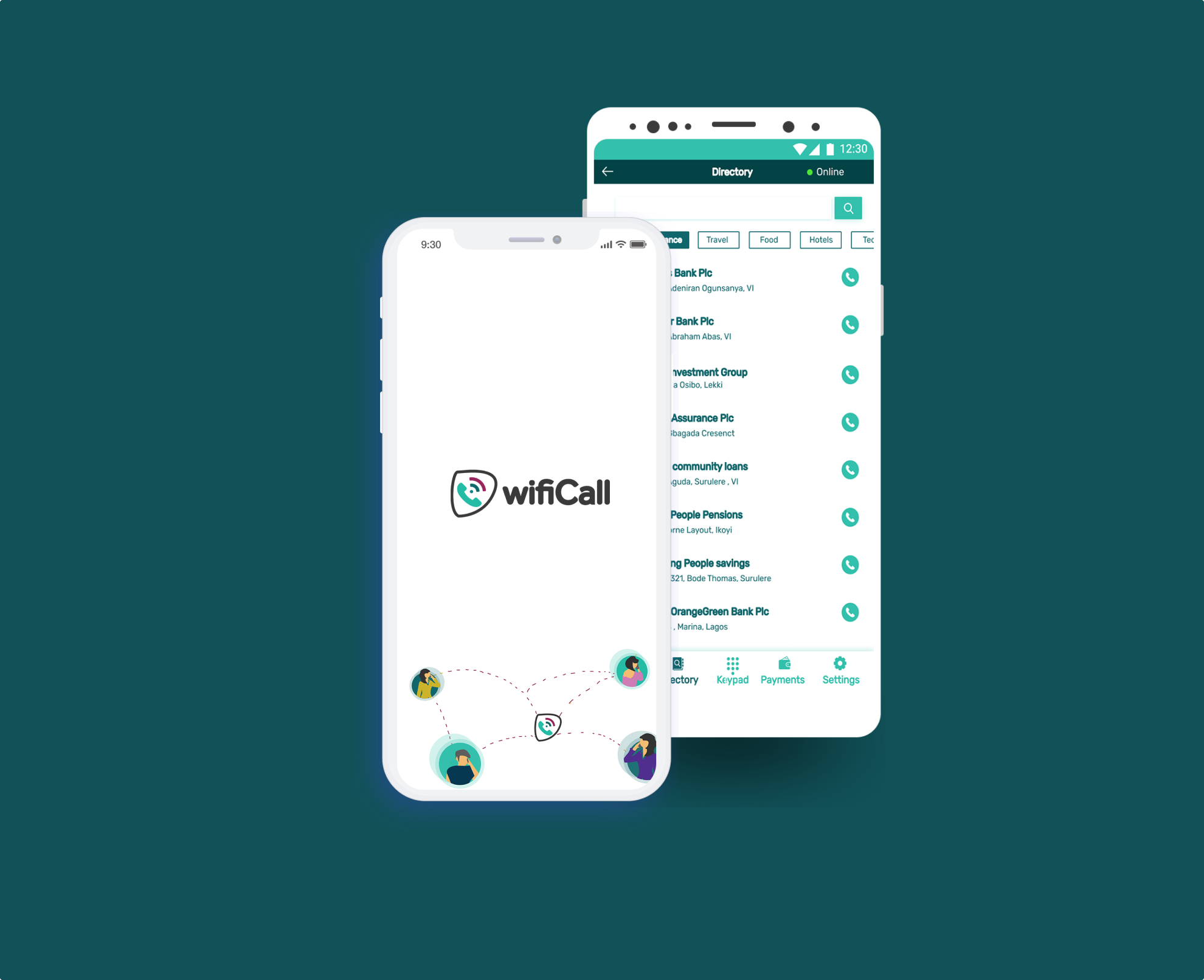
Tizeti raised a $3 million Series A round in 2018 and has built a suite of internet driven products to capture market share. In addition to ISP services, it launched a Skype-like personal and business enterprise communications service — WiFCall.ng— in April 2019.

Tizeti WiFi CallTizeti could shift the connectivity equation in Africa’s key tech hubs, such as Nigeria, where high levels of startup formation and VC investment are still hindered by weak internet stats.

Though Africa (primarily Sub-Saharan Africa) still stands last in most global rankings for internet penetration (35 percent), the continent continues to register among the fastest connectivity growth in the world.

Sub-Saharan Africa countries with the highest number of internet users include Nigeria (123 million), Kenya (46 million) and South Africa (32 million).

07 Nov 2019

An early look at eFounders’ next batch of enterprise SaaS startups

European startup studio eFounders recently reached a portfolio valuation of $1 billion across 23 companies. And the company doesn’t want to stop there as it is currently launching three new companies and products.

While software-as-a-service companies are trendy, eFounders has been exploring this space for a few years now. The company regularly comes up with ideas for new companies that improve the way we work.

In exchange for financial and human resources, eFounders keeps a significant stake in its startups. Ideally, startups raise a seed round and take off on their own after a year or two.

And here’s what eFounders has been working on.

Cycle

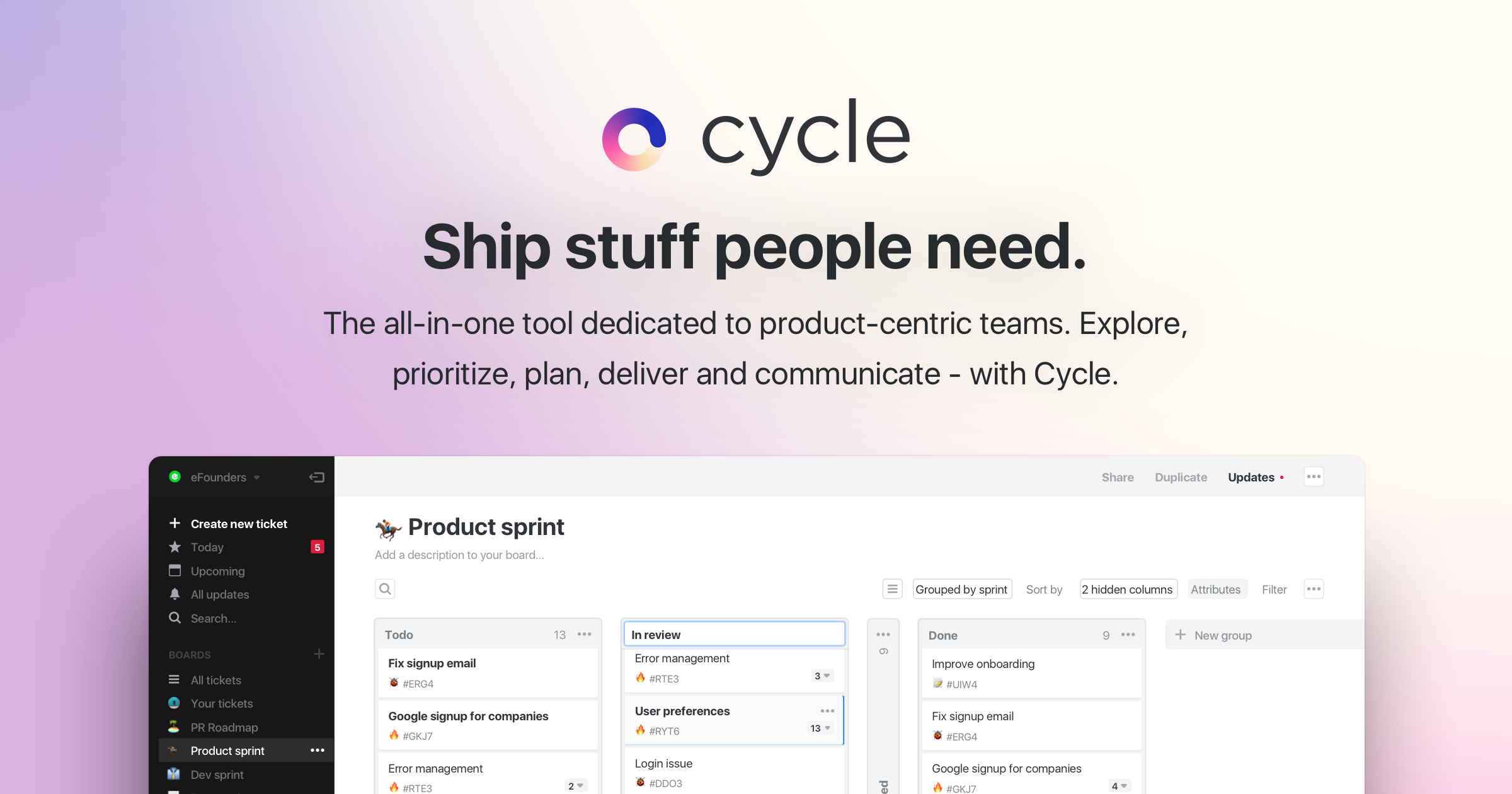
Cycle is a product management platform. And if you think about product management, it encompasses many things under one title, such as writing specs, planning a roadmap, assigning tasks and defining cycles or sprints.

Many startups use multiple tools for all those tasks. And sometimes, the tools that they were using don’t scale well. Cycle will integrate with GitHub, Figma and Zendesk so that you can handle bugs, improvements and features more efficiently.

Finally, Cycle lets you generate product updates for your customers, create public roadmaps and collaborate with other people in your organization.

It has an Airtable vibe as you can create your own views and workflows depending on your needs. You can display data as a timeline, a todo list, a kanban view, a normal list, etc.

Folk

Talking about Airtable, Folk is easy to describe. What if Salesforce and Airtable had a baby? It would look more or less like Folk.

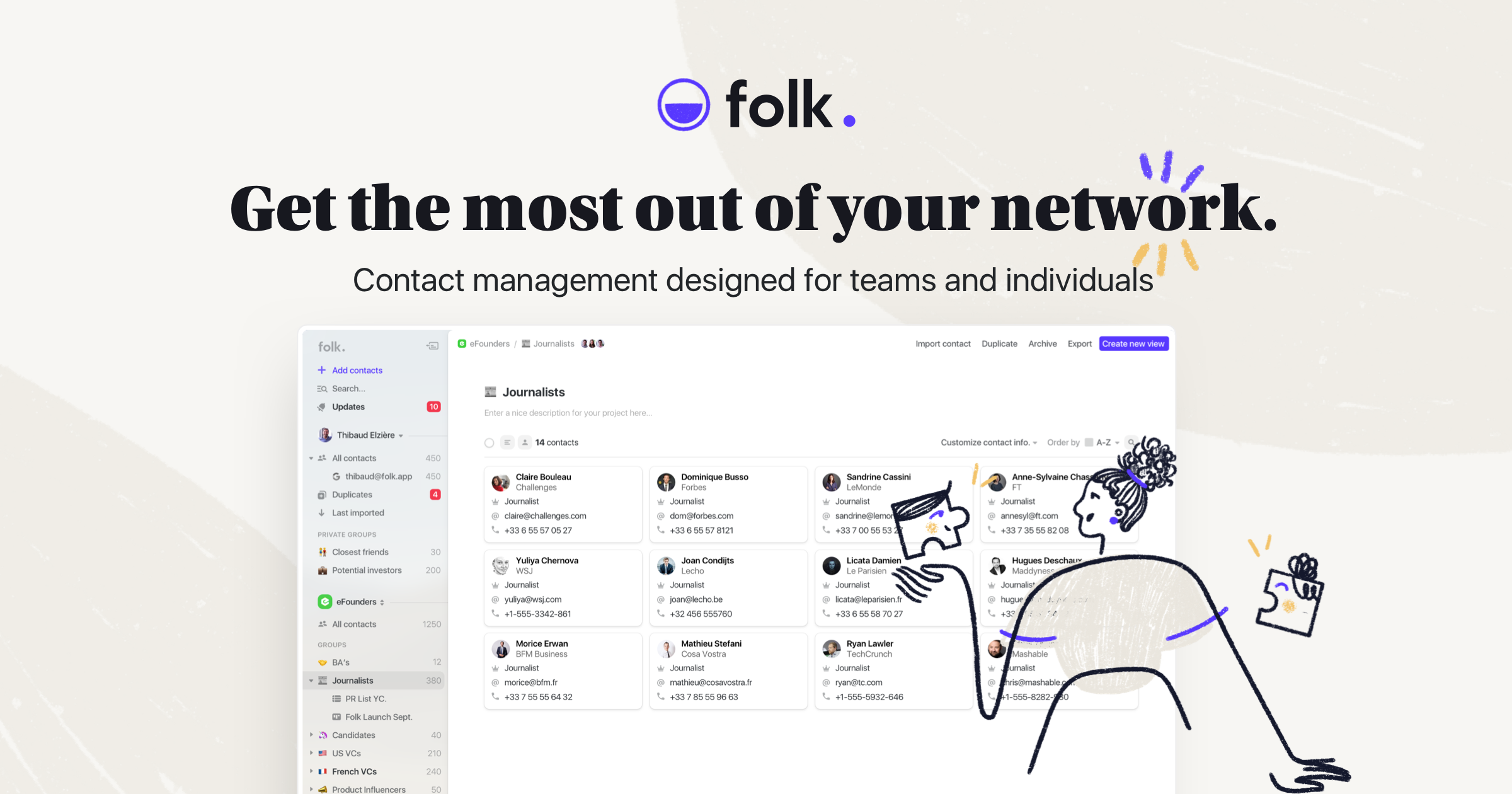
Folk lets you manage your contacts more efficiently and collaborate with teammates. You can import your address book from iCloud, Gmail, Outlook, Excel and CSV files. You can then sort your contacts into groups, add notes, reminders and tasks.

You can also create many views to go through your contacts. There’s a spreadsheet-like view, a kanban view, a calendar view and even a space view so that you can create table layouts for an event.

It’s also worth noting that eFounders CEO Thibaud Elziere is also going to be the CEO of Folk.

Once

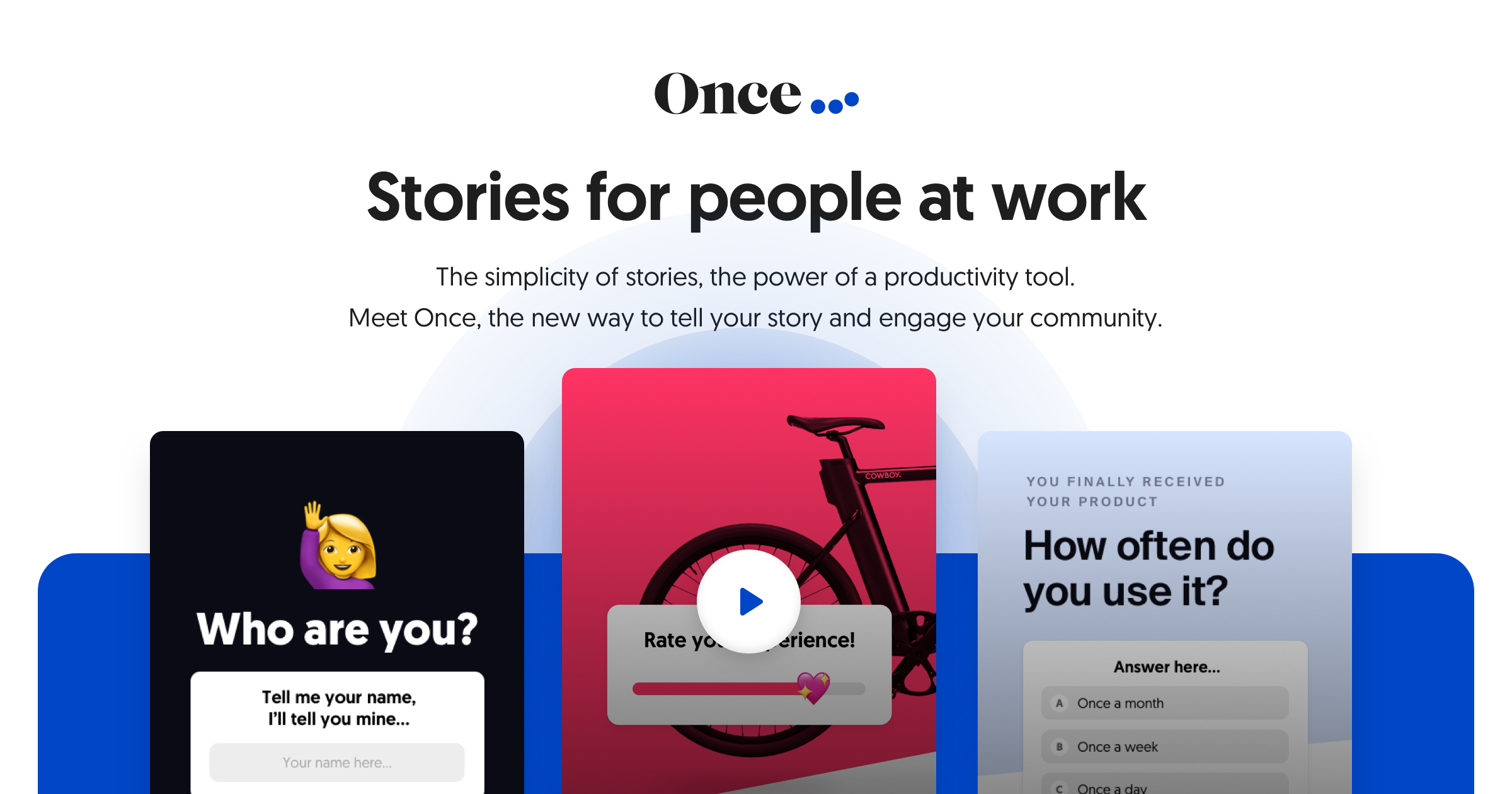
Once is a new take on visual presentations. It lets you create stories using a drag-and-drop interface and generate a link to send your stories to your customers. Once supports everything you’d expect from an Instagram story, such as images, text, polls and sliders.

You can also embed tweets, YouTube videos or Goole Maps addresses in your stories. The best part is that users don’t need to download an app or follow a brand on Instagram. It works in your mobile browser.

07 Nov 2019

Alphabet’s board is investigating how execs have handled claims of sexual harassment and other misconduct

Alphabet’s board of directors has opened an investigation into how executives at the company have handled misconduct claims, CNBC reported earlier today after viewing materials that it says show an independent subcommittee has been formed — and a law firm hired — to look into the issues.

One of the subjects of those claims is the company’s chief legal officer, David Drummond, whose long-ago extramarital affair with an employee was first surfaced in a story by The Information in 2017, one day after the outlet reported that another former executive, Android creator Andy Rubin, had left the company after an internal investigation determined that he had carried on an inappropriate relationship with a subordinate.

Rubin, who has since cofounded the consumer electronic products startup Essential, has consistently denied any wrongdoing, but it infuriated Google employees who learned nearly a year later in a New York Times investigation that he’d negotiated a $90 million severance pay package on his way out the door.

He wasn’t the only executive who was paid by Google after being accused of sexual harassment. Former senior search vice president Amit Singhal was also accused of sexual harassment, deciding to leave the company in his 15th year with Google as it was reportedly looking into the incident. Singhal, who has also denied any wrongdoing, was given a payout that ultimately amounted to $15 million.

Both payouts were approved by Google’s Leadership Development and Compensation Committee. Today, that committee is helmed by investors John Doerr and Ram Shriram, along with GIlead Sciences CFO Robin Washington, though Washington was only brought onto Alphabet’s board in April.

Other employees have also accused the company of not doing enough to stop sexual harassment in previous years, including a former Google engineer who announced on Twitter in 2015 that she was long sexually harassed by management at Google and that the company, despite her complaints, did nothing about it and even supported her harassers.

Why the company has waited until now to take action isn’t clear but it seems likely that fresh accusations against Drummond are at least part of the driver.

It was in August that his former colleague, Jennifer Blakely — who was in a published a post on Medium in which she described him as a serial philanderer who left his wife for Blakely, then left Blakely and the son that he fathered with her for another now-former Google  employee.

She also claimed Drummond had had “an affair with his ‘personal assistant’ who he moved into one of his new homes.”

One day later, Drummond issued a statement of his own, saying: It’s not a secret that Jennifer and I had a difficult break-up 10 years ago. I am far from perfect and I regret my part in that. Her account raises many claims about us and other people, including our son and my former wife. As you would expect, there are two sides to all of the conversations and details Jennifer recounts, and I take a very different view about what happened. I have discussed these claims directly with Jennifer, and I addressed the details of our relationship with our employer at the time.”

Drummond’s statement continued to on to say: “But I do want to address one claim that touches on professional matters. Other than Jennifer, I never started a relationship with anyone else who was working at Google or Alphabet. Any suggestion otherwise is simply untrue.”

Days later, Drummond married a Google employee who he’d been dating.

Drummond, who has continued on in his top role at Alphabet and was paid $47 million last year, this week sold $27 million worth of shares, according to SEC filings. He may need some of it for legal fees.

06 Nov 2019

Saudi Arabia reportedly recruited Twitter employees to steal personal data of activists

Saudi Arabian officials allegedly paid at least two employees of Twitter to access personal information on users the government there was interested in, according to recently unsealed court documents. Those users were warned of the attempt in 2015, but the full picture is only now emerging.

According to an AP report citing the federal complaint, Ahmad Abouammo and Ali Alzabarah were both approached by the Saudi government, which promised “a designer watch and tens of thousands of dollars” if they could retrieve personal information on certain users.

Abouammo worked for Twitter in media partnerships in the Middle East, and Alzabarah was an engineer; both are charged with acting as unregistered Saudi agents — spies.

Alzabarah reportedly met with a member of the Saudi royal family in Washington, D.C. in 2015, and within a week he had begun accessing data on thousands of users, including at least 33 that Saudi Arabia had officially contacted Twitter to request information on. These users included political activists and journalists critical of the royal family and Saudi government.

This did not go unnoticed and Alzabarah, when questioned by his supervisors, reportedly said he had only done it out of curiosity. But when he was forced to leave work, he flew to Saudi Arabia with his family literally the next day, and now works for the government there.

The attempt resulted in Twitter alerting thousands of users that they were the potential targets of a state-sponsored attack, but that there was no evidence their personal data had actually been exfiltrated. Last year, the New York Times reported that this event had been prompted by a Twitter employee groomed by Saudi officials for the purpose. And now we learn there was another employee engaged in similar activity.

The cases in question are still open and as such more information will likely come to light soon. I asked Twitter for comment on the events and what specifically it had done to prevent similar attacks in the future. It did not respond directly to these queries, instead providing the following statement:

We would like to thank the FBI and the U.S. Department of Justice for their support with this investigation. We recognize the lengths bad actors will go to try and undermine our service. Our company limits access to sensitive account information to a limited group of trained and vetted employees. We understand the incredible risks faced by many who use Twitter to share their perspectives with the world and to hold those in power accountable. We have tools in place to protect their privacy and their ability to do their vital work. We’re committed to protecting those who use our service to advocate for equality, individual freedoms, and human rights.

06 Nov 2019

There’s no ‘perfect time’ for giving employees feedback

As COO of a company with more than 350 employees from 40 different nationalities of all ages who speak 20+ languages, I’ve noticed that everyone likes to know where they stand when it comes to their job performance.

Yet, for many managers, giving feedback often falls to the bottom of their priority list. According to Gallup, less than half of employees surveyed said they received feedback even a few times a year. So, if 69% of employees say they would work harder if they felt their efforts were better recognized, implementing more regular feedback practices would seem like a no-brainer.

What’s stopping us?

Anyone who has experienced startup life knows there are times when it feels as though everything is moving at warp speed — that’s certainly the rate things have been moving at MessageBird for the last 18 months. After our Series A in late 2017, we hired aggressively to rapidly execute on our product roadmap and increased our employee base by more than 100% in a matter of months. For established companies, that would be a pretty aggressive hiring blitz, but for a younger business without all the necessary processes in place, the times occasionally bordered on chaotic.

It’s difficult to call that hiring frenzy a mistake, because we learned so much from it. Most notably, you can’t put performance feedback on hold until you have everything “ironed out.” The pace of business today is too quick to wait for the perfect time, because the “perfect time” may be too late or worse — it may never come at all.

What you lose in time, you’ll gain in dollars

It turns out that when the word “continuous” is added to the words “performance management,” you can almost hear the groans. Taking time to give feedback may feel like a luxury that managers don’t have when a startup is in hyper-growth mode, and giving employees feedback “continuously” sounds a bit obsessive, but the fact is, you can’t afford not to do it. Companies that implement regular performance feedback are reported to have nearly 15% less turnover, and with the staggering cost of rehiring estimated to be between 90 and 200% of an employee’s salary, keeping them engaged is a good investment.

Whether you put these strategies under the banner of continuous performance management, internal communications strategies or management 101, here are four learnings around giving regular feedback that have proven to be effective for us:

You don’t need to have everything figured out before setting short-term goals

It would certainly be easier if every road we headed down led directly to our intended destination, but that’s not always the case. Sometimes we’re faced with detours, roadblocks, or may even decide on another destination altogether. It’s the same with building a startup, where being customer-oriented means that priorities will often change to reflect the needs of your customer base.

06 Nov 2019

HP confirms it is having discussions with Xerox about being acquired

Rumors have been flying today about Xerox possibly buying HP, Inc, the printer and computer company. The company issued a public statement this afternoon confirming that there are talks ongoing, and that it will do whatever is in the best interest of shareholders.

The Wall Street Journal got things rolling earlier today when it published a report that Xerox was interested in the printer company, reporting the offer could be for over $27 billion. That’s a lot of money and the company has to at least consider it (assuming it’s accurate).

HP acknowledged there are ongoing discussions between the two companies and that it received an offer letter from Xerox yesterday. What’s odd about this particular deal is that HP is the company with a much larger market cap of $29 billion, while Xerox is just a tad over $8 billion. The canary is eating the cat here.

Here is HP’s complete statement on the situation:

“As reviewed at HP’s most recent Securities Analyst Meeting, we have great confidence in our multi-year strategy and our ability to position the company for continued success in an evolving industry, particularly given the multiple levers available to drive value creation.

Against this backdrop, we have had conversations with Xerox Holdings Corporation (NYSE: XRX) from time to time about a potential business combination. We have considered, among other things, what would be required to merit a transaction. Most recently, we received a proposal transmitted yesterday.

We have a record of taking action if there is a better path forward and will continue to act with deliberation, discipline and an eye towards what is in the best interest of all our shareholders.

Hewlett Packard, one of the early stalwarts of Silicon Valley, split into two companies in 2014. HP Inc got printers and PCs. HP Enterprise got servers and enterprise software.

HP stock was up 6.36% today as of publication. Xerox was up 3.55%.

06 Nov 2019

Can’t find the new Apple TV+ shows, like ‘Dickinson?’ This shortcut can help.

The Apple TV app is so bad, someone had to create a shortcut just to make it easier to navigate to the new Apple TV+ content. Apple may have invested billions in its Apple TV+ streaming service and hosted star-studded events to tout its new shows, but what it apparently didn’t do is give much thought to designing its TV app to help direct users to its exclusive content.

Instead, the Apple TV+ shows were mixed in with everything else at launch — forcing users to scroll past What to Watch recommendations and more from the larger iTunes catalog just to find the Apple TV+ section.

And even if and when you found that Apple TV+ section, each individual show page is poorly organized, too. Instead of following the standard format where a season’s episodes are listed in vertical order on an iPhone, Apple’s TV app opts for a horizontal scroll instead. It’s frustrating. It’s confusing. No one likes it.

Apple TV+ may only include a handful of shows at launch, but it still deserves its own, dedicated tab — like Apple’s very own Netflix within the larger construct of the TV app. Part of the problem, as detailed by 9to5Mac here, is that Apple’s TV app has been designed to be a jack-of-all-trades. It connects you to your iTunes library of rentals and purchases, to your add-on premium subscriptions, to your TV Everywhere-authenticated apps, and to some — but not all — of your favorite streaming services.

But the end result is an app that’s sort of a mess and one that failed to carve out a dedicated space for Apple TV+.

This problem also annoyed MacStories Editor-in-Chief Federico Viticci, who wanted an easier way to navigate directly to the Apple TV+ catalog content.

His solution? An iOS shortcut.

Viticci figured out a way to create URLs that will open any Apple TV+ section you want to get to in the TV app. Similar to how Apple Music web links can be edited to direct to content right in the Apple Music app, Apple TV+ web links can also be tweaked to launch the TV app — without redirecting you through Safari first. This is done by replacing the “https” part of the content URL with “com.apple.tv,” he explains.

With this discovery, Viticci was then able to create a shortcut that lets you go directly to any Apple TV+ page — including the “front page” for Apple TV+ or the individual show pages for shows like The Morning Show, For All Mankind, See, and Dickinson.
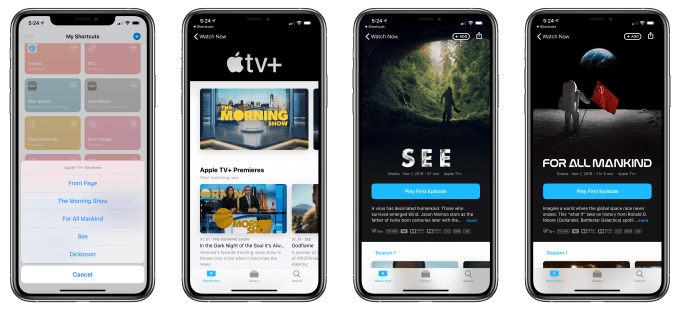
Apple TV+’s catalog is a bit larger than that, of course, and will continue to grow. But you can continue to edit the shortcut to meet your needs.

To add something new to the default list of shows, you’ll first have to locate the show in the TV+ app — good luck! You’ll then tap the “Share” button then choose “Copy” to copy the link to your clipboard. In the shortcut, you’ll add a new “Text” item to the action that’s at the beginning of the shortcut, and name it what you like. Finally, you’ll paste in the link you had copied into the “Value” field.

Ta-da! You updated the shortcut!
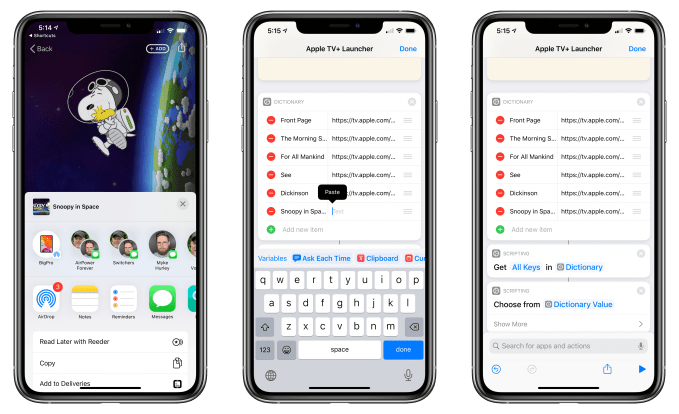
Or if you just want to use the iOS shortcut as is, so you can get right to Dickinson, you can add it by clicking here.

Viticci tells TechCrunch he expects to keep adding sections as well as links for more shows, as these become available. The shortcut, which is called simply “Apple TV+ Launcher,” will be updated in the MacStories Archive so people can re-download the latest version as needed, he says.

Of course, when people are building a shortcut to work around an app’s poor navigation, there’s a bigger problem that needs to be addressed.

Now, it’s possible that Apple intentionally mixed in Apple TV+ content in such a way to not make it look like it was using its platform power to give its own service a boost, in light of the recent antitrust and anticompetitive investigations into its business practices. But Apple usually doesn’t go so far as to offer a poor user experience — that’s just not in its ethos.

Besides, Apple certainly wasn’t shy about marketing the streaming service in other ways — as with the push notifications or the big Apple TV+ banner at the top of the Apple TV homescreen, for example.

Instead, this just looks like a case of needing to tweak the app’s design.

Until then, we can just use the shortcut to help.

(Image credits: MacStories)


06 Nov 2019

The first hires are the hardest

Welcome to this edition of The Operators, a recurring Extra Crunch column, podcast and YouTube show that brings you insights and information from inside of tech companies. Our guests are execs with operational experience at both fast-rising startups like Brex, Calm, DocSend and Zeus Living, along with more established companies like AirBnB, Facebook, Google and Uber. Here, they share strategies and tactics for building your first company and charting your career in tech.

In this episode, we’re talking about hiring and recruiting:

  1. Why people take the risk of working at early-stage startups
  2. When and how to work with recruiters
  3. How to make your first hires

A company’s first hires are often the hardest; money is usually too tight to pay competitive salaries, there’s no recognizable brand or reputation yet and most people would prefer to work at a company their friends and family have heard of before. There’s also fair presumption of risk and unviability — who wants to take a job that might not be around in a year?

Startup founders overcome these odds on a regular basis. To figure out how, we spoke with two experts:

Farah Sharghi-Dolatabadi began her career as a software developer and financial advisor before moving into recruiting. She’s been a recruiter at startups in addition to companies like Google and Lyft. She’s currently a senior technical recruiter at Uber and an active career coach at HireClub.

Kelly Kinnard is Vice President of Talent at Battery Ventures, where she’s worked with startups like Wag, Coupa, Fastly, and Gainsight. She also has experience at top recruiting firms and in executive search at Oracle.

Below is a synthesized summary of our conversation; check out The Operators for the full episode.

Why people take the risk of working at early-stage startups

Most early-stage startups fail. That shouldn’t be news to anyone. Still, however unlikely big outcomes are, the possibility of being a part of the next Facebook or Uber is tempting, and taking a job at a brand new company may even rational on an expected value basis.

Sometimes it’s not just the chance at a big financial outcome. We’ve heard early-stage employees say they made their choice based for more intangible reasons, like having more autonomy in their work, seeking a less structured environment, working with a certain type or set of colleagues, wanting a sense of adventure or purpose and the opportunity for more rapid career progression.

It may not be possible for an early-stage startup to offer market-rate compensation, but they can personalize the opportunity for early employees.

“Be creative and do things like cater to that individual and think about it on a case by case basis,” said Kinnard. “If that candidate really wants to work from home two days a week because they have a dog and you can’t allow dogs in the office, and they want to be able to walk their dog or go pick up their child from school after school, then try to customize things according to each individual.” But don’t forget that compensation still matters, as do market rates. According to Kinnard, “cash is still king, and I think sometimes I see founders and I see CEOs be unrealistic about what they expect to be able to pay people. A part of what I do is provide them with competitive comp data so they can look at the data and [see] here’s what 3000 companies that we’ve surveyed have suggested the compensation ranges.”

Creative problem-solving pays dividends in recruiting, just like in does with most other problems startups need to solve. Experienced recruiters can help companies figure out how to get creative, but how do you know if working a recruiter is right for you?


When and how to work with recruiters

06 Nov 2019

The first hires are the hardest

Welcome to this edition of The Operators, a recurring Extra Crunch column, podcast and YouTube show that brings you insights and information from inside of tech companies. Our guests are execs with operational experience at both fast-rising startups like Brex, Calm, DocSend and Zeus Living, along with more established companies like AirBnB, Facebook, Google and Uber. Here, they share strategies and tactics for building your first company and charting your career in tech.

In this episode, we’re talking about hiring and recruiting:

  1. Why people take the risk of working at early-stage startups
  2. When and how to work with recruiters
  3. How to make your first hires

A company’s first hires are often the hardest; money is usually too tight to pay competitive salaries, there’s no recognizable brand or reputation yet and most people would prefer to work at a company their friends and family have heard of before. There’s also fair presumption of risk and unviability — who wants to take a job that might not be around in a year?

Startup founders overcome these odds on a regular basis. To figure out how, we spoke with two experts:

Farah Sharghi-Dolatabadi began her career as a software developer and financial advisor before moving into recruiting. She’s been a recruiter at startups in addition to companies like Google and Lyft. She’s currently a senior technical recruiter at Uber and an active career coach at HireClub.

Kelly Kinnard is Vice President of Talent at Battery Ventures, where she’s worked with startups like Wag, Coupa, Fastly, and Gainsight. She also has experience at top recruiting firms and in executive search at Oracle.

Below is a synthesized summary of our conversation; check out The Operators for the full episode.

Why people take the risk of working at early-stage startups

Most early-stage startups fail. That shouldn’t be news to anyone. Still, however unlikely big outcomes are, the possibility of being a part of the next Facebook or Uber is tempting, and taking a job at a brand new company may even rational on an expected value basis.

Sometimes it’s not just the chance at a big financial outcome. We’ve heard early-stage employees say they made their choice based for more intangible reasons, like having more autonomy in their work, seeking a less structured environment, working with a certain type or set of colleagues, wanting a sense of adventure or purpose and the opportunity for more rapid career progression.

It may not be possible for an early-stage startup to offer market-rate compensation, but they can personalize the opportunity for early employees.

“Be creative and do things like cater to that individual and think about it on a case by case basis,” said Kinnard. “If that candidate really wants to work from home two days a week because they have a dog and you can’t allow dogs in the office, and they want to be able to walk their dog or go pick up their child from school after school, then try to customize things according to each individual.” But don’t forget that compensation still matters, as do market rates. According to Kinnard, “cash is still king, and I think sometimes I see founders and I see CEOs be unrealistic about what they expect to be able to pay people. A part of what I do is provide them with competitive comp data so they can look at the data and [see] here’s what 3000 companies that we’ve surveyed have suggested the compensation ranges.”

Creative problem-solving pays dividends in recruiting, just like in does with most other problems startups need to solve. Experienced recruiters can help companies figure out how to get creative, but how do you know if working a recruiter is right for you?


When and how to work with recruiters