Year: 2019

06 Nov 2019

Stealth fintech startup Digits raises $10.5 million Series A from Benchmark and others

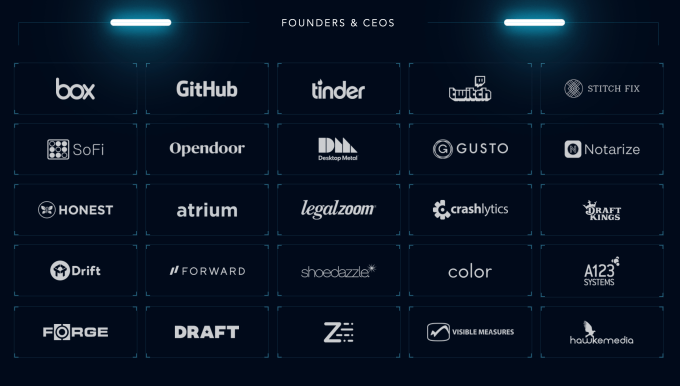
Stealth fintech startup Digits, from the same team that built Crashlytics to scale then sold to Twitter for over $100 million, has raised a $10.5 million round of Series A funding, the company is announcing today. The round was led by Benchmark and has the backing of 72 angels, including founders and CEOs from companies like Box, GitHub, Tinder, Twitch, StitchFix, SoFi, and several others.

With the round, Digits also gains a new board member, Peter Fenton, who has served on the boards at AirTable, Twitter, NewRelic, Yelp, and elsewhere.

The funding is a big bet on serial entrepreneurs Wayne Chang and Jeff Seibert who launched and sold their crash reporting service to Twitter, which itself later sold it to Google. At Twitter, the team remained to build out the product and launch new services, like Answers. After the sale to Google four years later, it was then folded into Google’s own developer platform to become the crash reporting tool for Android. Today, it’s still on nearly 5 billion monthly active devices and used inside millions of apps.

Now, the Crashlytics co-founders have returned with most of their original team to develop a new fintech startup, Digits, which describes itself vaguely as “a counting company.”

The company’s focus aims to solve a problem the founders had faced themselves when building Crashltyics.

“As builders, there is nothing more exciting than cracking the next engineering puzzle; than perfecting the next design; than delivering the next capability to customers. And there is nothing more mind-numbing than the paperwork, and spreadsheets, and financial reports, and inscrutable transaction records that are all required to actually operate the business,” a Digits blog post earlier this year explained.

“Globally, most entrepreneurs today have no formal training in business finance. We certainly didn’t. Today, you start a company to solve a real problem for real people, or to offer a service you’re skilled at, or to provide a living for you and your family. You don’t start a company because you want to operate a business—but you have to anyway,” the founders said.

While Digits isn’t talking about the specifics of its new product yet, its software is described as pairing design and machine learning in order to “democratize financial savvy.”

More specifically, it leverages APIs, classification algorithms, and machine learning techniques to provide a real-time view into a business’s finances, proactively alert you to what’s important, and allow you to deep dive into your data to better understand what’s driving your business.
The company believes its approach to visualizing a company’s finances is unique, and apparently a sizable number of investors agree.

Among the 70+ angels backing Digits are Box CEO Aaron Levie; Adam Bain and Dick Costolo (ex COO and CEO of Twitter); Ali Rowghani (partner Y Combinator, ex-COO Pixar); SoFi CEO Anthony Noto; Drift CEO David Cancel; AngelList board member Jeff Fagnan; Justin Kan (CEO Atrium, co-founder Twitch, partner YC); StitchFix CEO Katrina Lake; Github CEO Nat Friedman; First Republic Bank COO Mike Selfridge; Desktop Metal CEO Ric Fulop; Tinder co-founder Jonathan Badeen; DraftKings CEO Jason Robins; Legalzoom co-founder Brian Lee; Gusto CEO Josh Reeves; and Notazie CEO Pat Kinsel. 

Though Digits hasn’t publicly launched — the product is in invite-only status for now —  it already has live customers and is seeing more than $1.5 billion in transactions processing on its platform, the company says.

And unlike Crashltyics, which was based in Boston, Digits is a 100% remote operation. LinkedIn shows just 10 employees, including co-founders Chang and Seibert.

The team hasn’t said when Digits itself will be publicly unveiled or opened to sign-ups.

06 Nov 2019

Niantic will open Pokémon GO Pokéstop submissions to players worldwide next week


Pokémon GO and games like it can’t exist without waypoints — the in-game locations that correlate to real world points of interest, acting as the Poké Stops, gyms, etc. The more waypoints they have around the world, the better the game becomes.

But building up these databases of waypoints is tough. A company can’t do it alone; that just doesn’t scale. Even if they open it up to user submissions, verifying new locations (so as to avoid a bunch of false/bad locations being thrown into the mix) is tough for a company to do alone.

Niantic has spent the last few years figuring this process out, building a user-driven and peer-moderated system that got its start way back with the company’s first game.

Next week, at long last, they’re opening the submission process to Pokémon GO players around the world.

Called Niantic Wayfarer, the submission system will be largely user driven. One player nominates a location, submitting a photo of the location and answering a handful of questions to help determine eligibility. Other high-level players will review these submissions, helping to filter out the ones that are inaccurate, offensive, or just not right for the game.

Niantic had previously opened up location submissions in select regions, including much of Central and South America and parts of Asia. With the launch next week, the submission system goes worldwide.

If you’ve been following Niantic for a while, the Wayfarer system might seem familiar. It’s effectively a polished up, rebranded version of the “Portal Recon” system originally built into Niantic’s first game, Ingress. Niantic tells us that they’ve seen 27 million waypoint locations submitted by users so far, with 26 million having been reviewed, and 9.4 million approved and in game. Even in these early stages, the company says it’s seeing about 1 million nominations per week.

One catch: at least initially, you’ll need to be level 40 (the highest level in Pokémon GO) to submit or review potential new stops. The company tells me you’ll also have to take a little quiz to confirm that you’ve got a good understanding of what makes for a good Pokéstop.

A common (constant?) complaint from Pokémon GO fans has been that players in rural areas are at a massive disadvantage compared to players in major cities — a portion of which, at least, boils down to rural areas having considerably fewer stops, gyms, etc. Opening up the player submission system doesn’t completely fix the gameplay challenges in rural areas, but it should at least be a big step in the right direction.

06 Nov 2019

Wardrobe picks up $1.5 million for a new fashion rental marketplace

Wardrobe, a new peer-to-peer fashion rental marketplace, has today announced the close of a $1.5 million seed round and its public launch out of beta.

The funding was led by angel investor Cyan Banister and Ludlow Ventures, with participation from GroupUp Ventures, Airbnb cofounder Nate Blecharczyk and HQ Trivia founder Rus Yusupov, among others.

Wardrobe was founded by Adarsh Alphons after he had an epiphany about just how many items of clothes in his own house went mostly unused. In fact, the WSJ suggests that most people only wear around 20 percent of their wardrobe on a regular basis. Alphons says that the average woman has 57 items of clothes in her closet that she doesn’t even wear once a year.

So began Wardrobe.

Wardrobe is a peer-to-peer rental marketplace for vintage, designer, and luxury brand clothing. However, unlike Rent the Runway or other sharing economy fashion platforms, Wardrobe uses dry cleaners as hubs for the inventory. This not only allows the company to scale more quickly from geography to geography, but also to remain lean without taking on the risk of big warehouses and complicated logistics around shipping.

Here’s how it works:

Folks who want to rent their clothes on Wardrobe simply fill out a few answers to questions and receive a shipping label in the mail. Once their clothes are approved, they’re sent to a local dry cleaner where they wait to be rented for either 4, 10, or 20 days.

Wardrobe HQ handles everything from storage to shipping to photographing the pieces for the app.

The owner of the clothes makes between 70 and 75 percent of the rental cost after the cost of dry cleaning.

Interestingly, Alphons learned in beta that users want to not only browse the app for clothes, but follow specific users and closets that they particularly like. So the app is now tailored to let users follow one another and watch each other’s closets, creating an environment that may attract influencers to the platform.

Wardrobe currently has partnerships with more than 40 Manhattan dry cleaners, serving all of the island below 110th Street. Alphons says that each dry cleaner can hold between 100 and 1,000 items of clothing at a time.

06 Nov 2019

Niantic will soon open Pokémon GO’s ‘Sponsored Location’ system to small businesses


Sponsored locations aren’t new to Niantic games. Companies like Sprint, McDonalds, and AT&T have had sponsored locations in games like Pokémon GO and Harry Potter: Wizards Unite for a long while now. The idea: by turning your business into a big in-game beacon and giving players some reason to stop by, you increase foot traffic.

So far, though, the sponsorship system has really only been open to these mega chains. Starbucks got to turn all of its stores into sponsored Pokéstops at the height of the Pokémon GO craze, but the little mom-and-pop coffee shop down the street? No such luck.

That’ll change later this year, as the company opens a self-serve platform for small to medium sized businesses looking to light up sponsored locations in-game.

Details are still somewhat light, but Niantic says that they’ll start accepting applications tomorrow and roll out an “early access” beta program later this year. As with pretty much everything Niantic does, they’re rolling it out on a region-by-region basis; in this case, it’ll only be open to US businesses at first. The first new sponsored locations should start showing up in December.

“Sponsored” locations tend to have slight perks over their non-sponsored counterparts. Sponsored gyms in Pokémon GO, for example, are almost always “EX Raid” locations — which in GO speak just means that battling there might get you a ticket to a bigger, badder, invite-only boss battle in the weeks that follow. Sponsored fortresses in Harry Potter: Wizards Unite give out more XP and more of the spell energy required to play.

Beyond being able to pay to have a sponsored in-game location, these businesses will also be able to pay to schedule things like Pokémon GO raids (read: bigger, co-operative boss battles that often require 5-10 players working together to win) during time slots when foot traffic might be slow. And because getting foot traffic is only part of the equation, sponsored businesses will also be able to offer up deals and promotions in-game to (hopefully) turn those passing by into paying customers.

Niantic also says that businesses will be able to host other on site “mini-games” beyond GO raids in the future, but didn’t elaborate on what those might be.

Alas, no details yet on how much sponsorships will actually, you know, cost.

It’ll be interesting to see how this plays out, and how it impacts things in game. While Pokémon GO isn’t the overwhelmingly popular monster of a game that it was at launch, it can still cause crowds to pop up out of nowhere — particularly when new Pokémon appear as raid bosses, or when they’ve got some limited time event going on. Will sponsoring a raid cause fewer raids nearby (to maximize visibility of the sponsored spot), or will more of them pop up nearby to hook groups looking to do multiple raids in one swoop?

06 Nov 2019

WhatsApp says it will let you control if and how you get added to Groups (for real this time)

WhatsApp, the popular messaging app owned by Facebook, has faced a lot of controversy over the role that Groups plays on the platform — both for Groups’ role in spreading spam, misinformation or worse; and for the fact that it can be very hard (actually impossible) to control when you are added except by blocking a specific contact altogether.

Now, it seems that the company is finally starting to make some moves to change this. This morning, the company announced that it would start to roll out an update globally so that individuals can either block some or all people to keep them from adding them to Groups.

As per an update that should be making its way to you soon, you can now navigate to the privacy settings in the app to select who (if anyone) can add you to a Group, automatically. If you select anything other than “everyone” enabled to add you to groups, you will get notifications asking if you want to join first. (Picture here from WhatsApp’s blog post as it has not rolled out to me yet in London.)

Note: the feature still requires users to proactively navigate to their settings to turn it on. It doesn’t get turned on by default.

Some background and clarification here. You might recall that WhatsApp actually announced a version of this feature back in April that was more rudimentary: you could select Nobody, Everybody or Contacts (but not specific contacts) to add you to Groups. At the time, WhatsApp noted that the control would be rolled out worldwide. It turns out it never did: India was as far as it got.

(Indeed, the feature was launched just after it was revealed that Groups were being manipulated in India to influence political opinion, with hundreds of hoaxes being spread on the platform daily using Groups as the medium. That was giving WhatsApp bad press, and so the feature felt like an immediate response to that.)

Instead, WhatsApp quietly stopped talking about it, and people seemed to forget (Twitter and other social media has turned us into goldfish, slaves to the scroll).

Fast forward to today, and now it seems that WhatsApp is renewing but also committing to getting this out. A spokesperson confirmed to me today that, this time, Groups control really will be coming to all users on both iOS and Android, worldwide.

“Based on feedback from users during our initial rollout, instead of the “Nobody” option we are now providing a “My Contacts Except” option,” WhatsApp notes in its blog post update today. “This allows you to choose to exclude specific contacts or ‘select all’. This update is rolling out to users around the world on the latest version of WhatsApp.”

WhatsApp dragging its feet here is not unusual. The app is not famous for making changes quickly: it took almost a year — actually, two years — for WhatsApp to really start to get down to business with services for businesses. And there are a number of other examples of how the company does not roll out features with speed (or haste). We’ve long heard rumors about how the company had an interest in rolling out money transfer and payment services for consumers. These have yet to materialize.

So what comes next? Hopefully, WhatsApp will make one further change, and that is to set Groups to a with-permission-only setting by default.

If you have to dig into the settings to change an action — which you will have to do with this update — then it’s not on by default. As with Facebook’s privacy settings, this essentially means that many will miss the ability to set their own boundaries.

Adding better controls for Groups might not sound like a huge feature to you until you’ve been at the coalface of the Groups morass.

At its lightest or most innocuous, you are being added by tangential work contacts to annoying business chats, or groups of over-chatty folks coalesced around a particular interest. A nuisance, but not really the end of the world.

But at its darkest, people can get harassed, fake news can be spread, and you might get slammed with an offensive, shocking, disturbing image or two (or three). Given that the app is used by minors (as young as 13 in some markets, although I suspect many younger than this use it), other vulnerable people, and billions of others, Groups on WhatsApp need way better basic controls, usable by more than just those who read change-logs on app updates, or tech blogs.

06 Nov 2019

Elon Musk says SpaceX’s Starship could fly for as little as $2 million per launch

SpaceX’s goal has long been to achieve truly reusable rocket launch capabilities, and for good reason: The company anticipates huge cost savings through re-usable rocketry, vs. expendable launch vehicles, which SpaceX CEO Elon Musk has described as a process akin to an airline throwing away their passenger aircraft every time they complete a flight. They’ve made lots of progress towards that goal, and now frequently re-fly parts of their Falcon 9 rockets and their Dragon cargo capsules, but the Starship spaceship they’re building now should be even more re-usable.

Musk provided an idea of just how much that could save SpaceX – and by extension, its customers – at a surprise guest appearance at the U.S. Air Force’s annual pitch day in LA this week. Speaking with USAF Lieutenant General John Thompson at the event (via Space.com), Musk said that fuel costs for the Starship should be around $900,000 per launch, and that once you factor in operational costs, it’ll probably add up to around $2 million per use. That’s “much less than even a tiny rocket,” Musk added, explaining why he views it as “imperative” that this launch system needs to be made.

Starship is designed from the ground-up to provide high payload cargo capacity, and when paired with SpaceX’s Super Heavy booster, also in development, as well as in-orbit refuelling, it’ll also offer the ability to transport large quantities of goods and satellites to lunar orbit – and eventually beyond to Mars, too. Starship will eventually replace all of SpaceX’s launch vehicles, the company hopes, a goal that it hopes to achieve because its operation should eventually be much more cost-effective than either Falcon 9 or Falcon Heavy once it’s fully complete and flying.

For now, SpaceX is readying the Starship Mk1 and Mk2 prototypes for their first test flights, which will aim to achieve high-altitude controlled flight and landing, but still remain within Earth’s atmosphere. The company is also optimistically hoping for an orbital test in as little as six months’ time.

06 Nov 2019

Professional network for women Elpha raises seed funding

As slow-moving LinkedIn leaves rooms for startups to flourish, Elpha aims to create a tailored online network for women in tech.

The company is not only a graduate of Y Combinator but was conceived of behind the scenes of the San Francisco accelerator program. Cadran Cowansage, the co-founder and chief executive officer of the startup, was a software engineer at YC from 2016 to early 2019. It was during that stint that she created Leap, a tool meant to help her and her colleagues communicate. Soon enough, she’d granted the entire YC network of female founders access to the tool. Then earlier this year, she decided to spin the company out of YC entirely, rebrand and relaunch as Elpha.

“There’s a velocity that comes with building a startup and the pressure of funding that keeps you moving very fast,” Cowansage, who counts Abadesi Osunsade and Kuan Luo as co-founders, said of her decision to make Elpha an independent business.

“I had the idea for a long time,” she told TechCrunch. “I didn’t feel like I really had a big enough network of women who were at my level or a bit further along than I could go to for advice. Things like how do I get this promotion? Or my male peers, they are being paid more than me, what do I do about that? The conversations that are difficult that you really want a woman’s perspective on.”

Hybrid social and professional network, Elpha is meant to offer women in tech a dedicated space to communicate via public forums and direct messages, foster relationships and build their careers. The company, which completed YC this summer, is today announcing a $1.1 million round with participation from Y Combinator, the accelerator’s co-founder, CEO and president, Jessica Livingston, Michael Siebel and Geoff Ralston, respectively, as well as Maveron, Moxxie Ventures, JaneVC, Friale, Kabam co-founder and visiting YC partner Holly Liu, Block Party founder Tracy Chou and Breaker co-founder Leah Culver.

The “LinkedIn for women” charges $12,000 in annual subscription fees to companies who use Elpha to identity potential hires. Cowansage said the company currently has 20 paying customers, many of which are venture-backed startups like Lambda School and Webflow. The Elpha team plans to use the seed investment to hire, host events and continue the development of new products, including a mobile app expected out next year.

Ultimately, Cowansage hopes Elpha will bring together women in media, science, medicine and more.

“There’s a huge opportunity to bring women together across different industries and also create those sub-communities,” she said. “There’s a ton we can do from here.”

06 Nov 2019

Neural Magic gets $15M seed to run machine learning models on commodity CPUs

Neural Magic, a startup founded by an MIT professor, who figured out a way to run machine learning models on commodity CPUs, announced a $15 million seed investment today.

Comcast Ventures led the round with participation from NEA, Andreessen Horowitz, Pillar VC and Amdocs. The company had previously received a $5 million pre-seed, making the total raised so far, $20 million.

The company also announced early access to its first product, an inference engine that data scientists can run on computers running CPUs, rather than specialized chips like GPUs or TPUs. That means that it could greatly reduce the cost associated with machine learning projects by allowing data scientists to use commodity hardware.

The idea for this solution came from work by MIT professor Nir Shavit. As he tells it, he was working on neurobiology data in his lab and found a way to use the commodity hardware he had in place. “I discovered that with the right algorithms we could run these machine learning algorithms on commodity hardware, and that’s where the company started,” Shavit told TechCrunch.

He says that there is this false notion that you need these specialized chips or hardware accelerators to have the necessary resources to run these jobs, but he says it doesn’t have to be that way. He says his company, not only allows you to use this commodity hardware, it also works with more modern development approaches like containers and micro services.

“Our vision is to enable data science teams to take advantage of the ubiquitous computing platforms they already own to run deep learning models at GPU speeds — in a flexible and containerized way that only commodity CPUs can deliver,” Shavit explained.

He says this also eliminates the memory limitations of these other approaches because CPUs have access to much greater amounts of memory, and this is a key advantage of his company’s approach over and above the cost savings.

“Yes, running on a commodity processor you get the cost savings of running on a CPU, but more importantly, it eliminates all of these huge commercialization problems and essentially this big limitation of the whole field of machine learning of having to work on small models and small data sets because the accelerators are kind of limited. This is the big unlock of Neural Magic,” he said.

Gil Beyda, Managing Director at lead investor Comcast Ventures sees a huge market opportunity with an approach that lets people use commodity hardware. “Neural Magic is well down the path of using software to replace high-cost, specialized AI hardware. Software wins because it unlocks the true potential of deep learning to build novel applications and address some of the industry’s biggest challenges,” he said in a statement.

06 Nov 2019

Investment platform eToro acquires crypto portfolio tracker app Delta

eToro, the multi-asset investment platform that spans “social” stock trading to cryptocurrency, has acquired Delta, the crypto portfolio tracker app.

Terms of the deal remain undisclosed, although one source tells me the deal was worth $5 million. It is not clear if it is stock only or cash (or a mixture of both) and if it is contingent on any future targets being met.

The Delta app helps investors make better decisions regarding their crypto investments by providing tools such as portfolio tracking and pricing data. It very much fits with the evolution of eToro, which not only wants to “own” the commission free stocks (and ETF) space, but has also ventured ambitiously into crypto — most recently bringing crypto asset trading to the U.S.

Delta’s crypto portfolio tracker app has support for over 6,000 crypto assets from more than 180 exchanges. It provides investors with a range of tools to track and analyse their crypto portfolios. To date, Delta says it has seen 1.5 million downloads and has “hundreds of thousands” of active monthly users.

The acquisition sees Delta become part of the eToro Group, while the Delta team led by Nicolas Van Hoorde will become part of eToroX, reporting to Doron Rosenblum. “The team will continue to be based in Belgium, working in close collaboration with eToro and eToroX employees across the globe,” says eToro.

Meanwhile, eToro is talking up the fact that it is a regulated platform where you can hold crypto and traditional assets in the same portfolio. The idea with the Delta acquisition is to extend that so you’ll be able to track all your investments in once place, starting with crypto and eventually multi-asset. In addition, you’ll be able to trade from the app via eToroX, eToro’s own crypto exchange.

“At a time when other fintechs state that they are not even targeting profitability, we are proud to be a well funded, profitable business that is growing both in terms of geographical coverage but also product range,” says Yoni Assia, co-founder and CEO of eToro, in a statement.

“We are a trading and investing platform that not only provides clients with access to the assets they want, from commission free stocks and ETFs through to FX, commodities and cryptoassets, but also lets customers choose how they invest. They can trade directly, copy another trader or invest in a portfolio. We believe in empowering our clients and the acquisition of Delta will allow us to add an important new element to our offering.”

06 Nov 2019

Echo Studio is Amazon’s lower-cost answer to the HomePod

Amazon’s kickstarted the smart speaker market with the original Echo, way back in late-2014. Like many of the company’s hardware offerings, it was very much a utilitarian device. The first Echo was smart first and speaker a distant second.

Echo’s how slowly gotten better in the sound department over time, but the arrival Apple’s HomePod and Google’s Home Max have highlighted the lack of real quality speaker in the Echo lineup. Amazon eventually added the Link, Amp, Sub  and Input to integrate Alexa into an existing home stereo system, but until this most recent round of announcements, the company never had a real answer to the HomePod.

The Echo Studio is every bit Amazon’s take on the HomePod, with all the good, the bad and the everything else that entails. While it’s certainly the most premium Echo speaker Amazon has offered to date, the Studio isn’t exactly what one would deem a premium speaker. The build quality and materials don’t feel on-par with that of Apple’s. But that’s to be expected for a product that starts at $100 less.

Amazon’s almost certainly made the right move by undercutting the HomePod. A $300 speaker would be an extremely difficult sell from Amazon. Hovering at just under $200 feels like a good spot for the Echo Studio to live, especially when one factors in Amazon’s frequent hardware discounts.

At first glance, the Studio looks a bit like the HomePod, with roughly the same dimensions. It’s significantly larger than a standard Echo, but not so larger that it wouldn’t fit comfortably on most desks or shelves. There’s a signature large light ring around the top, along with a quartet of physical buttons: Mic on/off (turning the light ring red), volume up and down and the “Action” button for trigger Alexa manually.

I will say, using Google’s devices recent does really drive home how much I like the touch based input for playing and pausing songs. That’s missing here, as with other Echo devices.

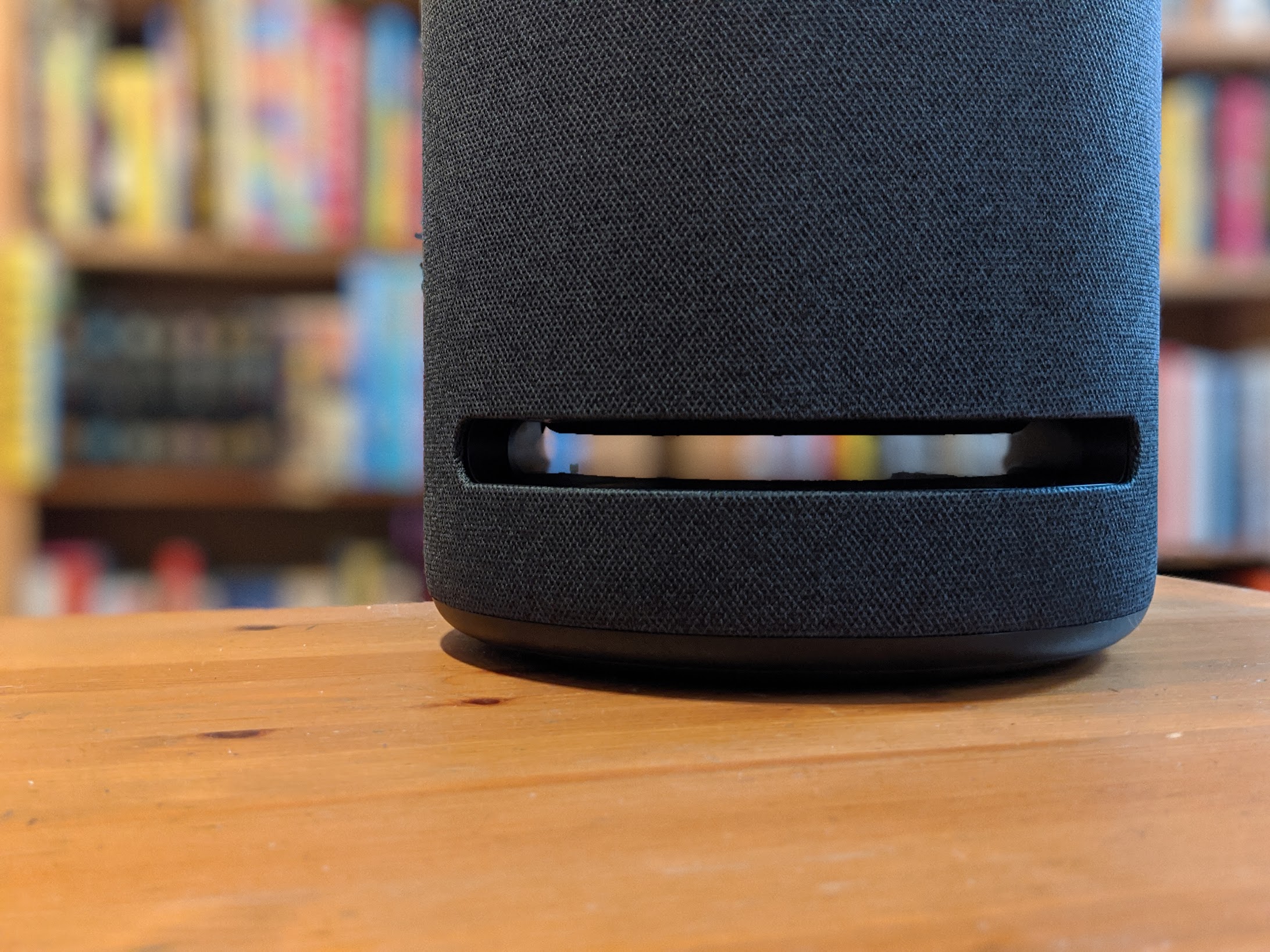
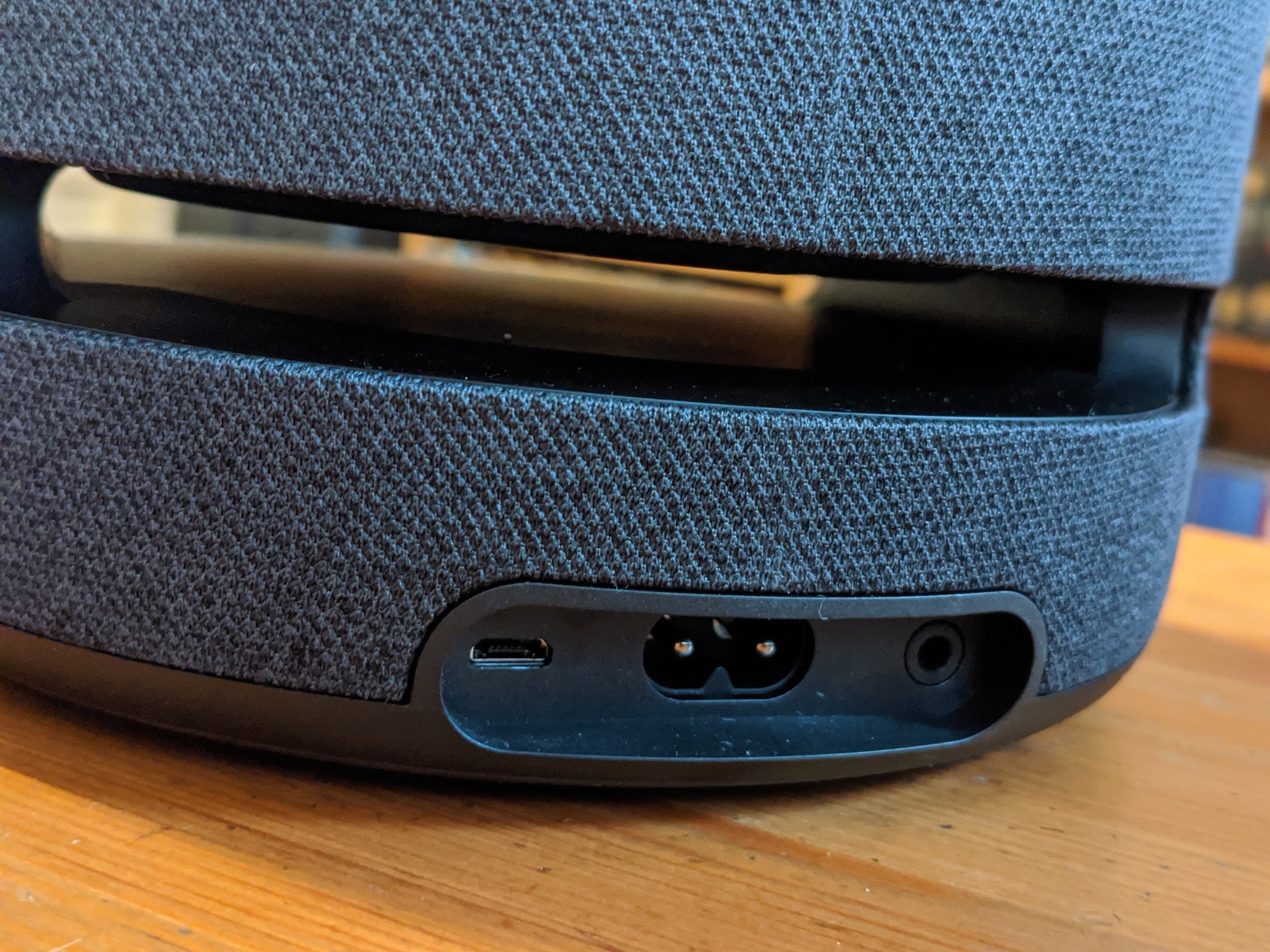
About two thirds of the way down is a large cut out that goes all the way through the speaker. This is the bass aperture, designed to max output of the downward firing woofer. And it does. There’s no lack of bass on the thing — too much for my taste, in fact. It tends to muddy rock songs.

Like the Echo Buds, the Amazon app offers control over levels, so you can adjust to your heart’s content. The Studio also nsing built-in calibration similar to competing systems to get a read on the acoustics of its surroundings. For the best sound, Amazon recommends keeping the system at least six inches from a wall. I tried a few different spots in my living room and found the sound to be good, but not quite up to other premium smart speakers.

The Studio does well with simpler playback, like Bill Evans’s jazz piano. When playing rock like the Hold Steady or hip-hop like Run the Jewels, the music costs some clarity. It does, however, get plenty loud and should more than do the job in an apartment or door room. The addition of the home theater option makes it a nice addition for users of the Fire TV, as well.

The Studio is, without question, the best and richest sound Echo to date. From a pure sound standpoint, I certainly can’t recommend it over an Apple HomePod, Sonos Move or Google Home Max, but the $199 price point fits comfortable in Amazon’s more budget-minded approach to the smart home.