Year: 2019

05 Nov 2019

Twitter suspends accounts affiliated with Hamas and Hezbollah

Twitter suspended several accounts affiliated with Hamas and Hezbollah over the weekend after being repeatedly asked to do so by a bipartisan group of U.S. Representatives. The lawmakers—Josh Gottheimer (D-NJ), Tom Reed (R-NY), Max Rose (D-NY) and Brian Fitzpatrick (R-PA)—criticized the company for allowing the accounts to stay up even though Hamas and Hezbollah are designated as Foreign Terrorist Organizations by the United States government.

The accounts suspended include Hamas’ English and Arabic-language accounts and ones belonging to Al-Manar, a television station linked to Hezbollah, and Hamas-affiliated news service Quds News Network.

Hamas' suspended English-language Twitter account

Hamas’ suspended English-language Twitter account

Twitter initially told the congressmen that it distinguishes between political and military factions of those organizations. In an Oct. 22 response, the House members told Twitter that “this distinction is not meaningful, nor is it widely shared. Hezbollah and Hamas are terrorist organizations as designated by the United States Government. Period.”

On Nov. 1, Twitter’s director of public policy in the United States and Canada Carlos Monje Jr., replied that the accounts had been suspended after a review.

“Twitter’s policy is to remove or terminate all accounts it identifies as owned or operated by, or directly affiliated with, any designated foreign terrorist association. If Twitter identifies an account as affiliated with Hamas or Hizballah [sic], Twitter’s policy is to terminate that account,” he wrote in a letter to the congressmen.

Monje added that “Twitter also takes significant steps to identify accounts that are not directly affiliated with a designated foreign terrorist organization but which nonetheless promote or support violent extremism.”

Raja Adulhaq, co-founder of Quds News Network, told the Wall Street Journal that three of the news agency’s accounts had been removed and described the suspensions a “clear censorship of Palestinian narratives.”

The accounts’ suspension comes as social media companies, including Twitter, Facebook and YouTube, face increased scrutiny from lawmakers over what content and advertising they allow on their platform. Twitter recently said it would stop running political ads, an announcement that came after Facebook CEO Mark Zuckerberg defended his company’s policy of not fact-checking political ads while testifying in front of Congress last month.

TechCrunch has contacted Twitter for comment.

05 Nov 2019

Disinformation ‘works better than censorship,’ warns internet freedom report

A rise in social media surveillance, warrantless searches of travelers’ devices at the border, and the continued spread of disinformation are among the reasons why the U.S. has declined in internet freedom rankings, according to a leading non-profit watchdog.

Although Freedom House said that the U.S. enjoys some of the greatest internet freedoms in the world, its placement in the worldwide rankings declined for the third year in a row. Last year’s single-point drop was blamed on the repeal of net neutrality.

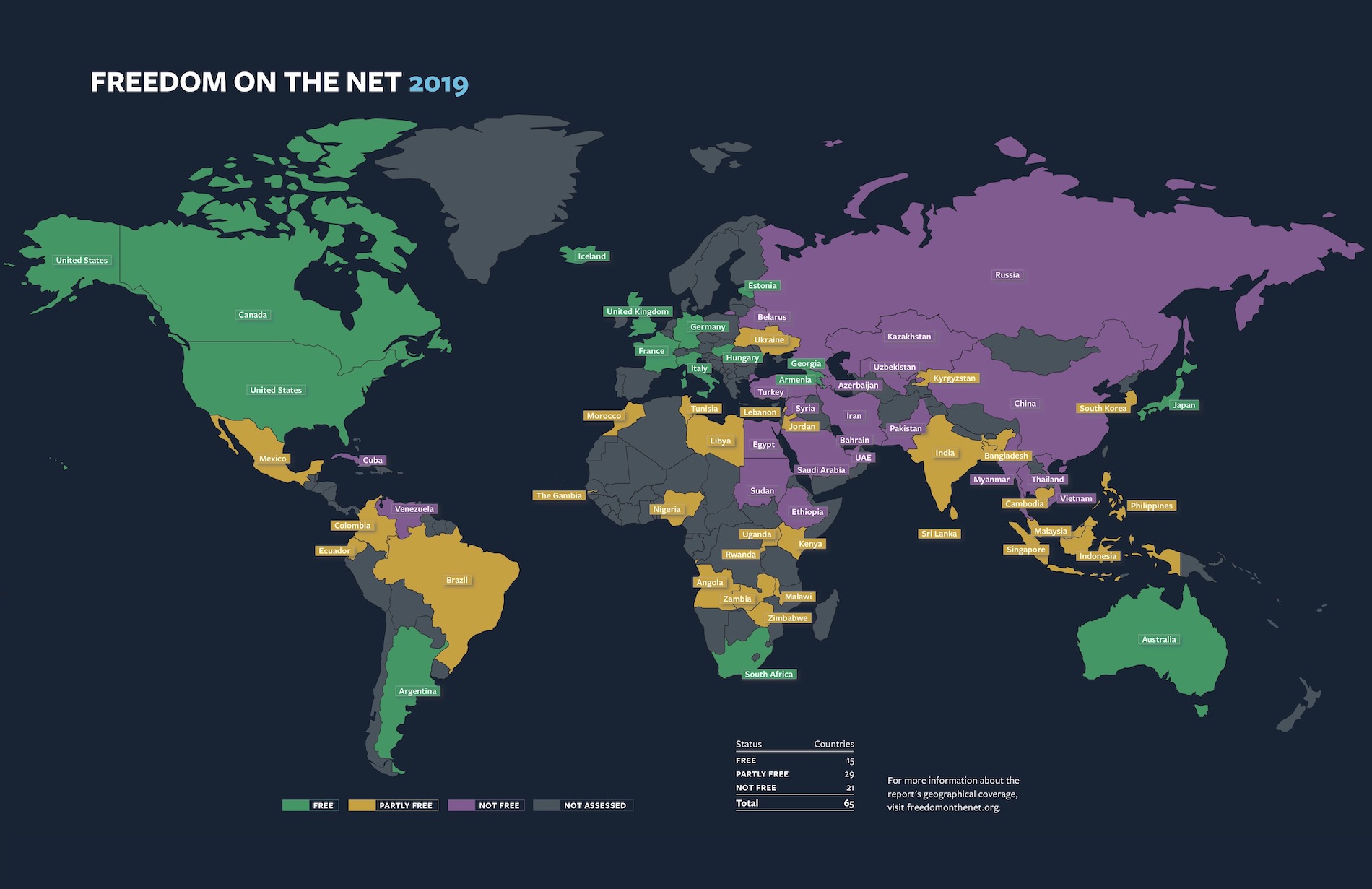
Iceland and Estonia remained at the top of the charts, according to the rankings, with China and Iran ranking with the least free internet.

The report said that digital platforms, including social media, have emerged as the “new battleground” for democracy, where governments would traditionally use censorship and site-blocking technologies. State and partisan actors have used disinformation and propaganda to distort facts and opinions during elections in dozens of countries over the past year, including the 2018 U.S. midterm elections and the 2019 European Parliament elections.

“Many governments are finding that on social media, propaganda works better than censorship,” said Mike Abramowitz, president of Freedom House.

Freedom House’s 2019 internet freedom rankings. (Image: Freedom House)

Disinformation — or “fake news” as described by some — has become a major headache for both governments and private industry. As the spread of deliberately misleading and false information has become more prevalent, lawmakers have threatened to step in to legislate against the problem.

But as some governments — including the U.S. — have tried to stop the spread of disinformation, Freedom House accused some global leaders — including the U.S. — of “co-opting” social media platforms for their own benefit. Both the U.S. and China are among the 40 countries that have expanded their monitoring of social media platforms, the report said.

“Law enforcement and immigration agencies expanded their surveillance of the public, eschewing oversight, transparency, and accountability mechanisms that might restrain their actions,” the report said.

The encroachment on personal privacy, such as the warrantless searching of travelers’ phones without court-approved warrants, also contributed to the U.S.’ decline.

Several stories in the last year revealed how border authorities would deny entry to travelers for the content of social media posts made by other people, following changes to rules that compelled visa holders to disclose their social media handles at the border.

“The future of internet freedom rests on our ability to fix social media,” said Adrian Shahbaz, the non-profit’s research director for technology and democracy.

Given that most social media platforms are based in the U.S., Shahbaz said the U.S. has to be a “leader” in promoting transparency and accountability.

“This is the only way to stop the internet from becoming a Trojan horse for tyranny and oppression,” he said.

05 Nov 2019

Gradeup raises $7M to expand its online exam preparation platform to smaller Indian cities and towns

Gradeup, an edtech startup in India that operates an exam preparation platform for undergraduate and postgraduate level courses, has raised $7 million from Times Internet as it looks to expand its business in the country.

Times Internet, a conglomerate in India, invested $7 million in Series A and $3 million in Seed financing rounds of the four-year-old Noida-based startup, it said. Times Internet is the only external investor in Gradeup, they said.

Gradeup started as a community for students to discuss their upcoming exams, and help one another with solving questions, said Shobhit Bhatnagar, cofounder and CEO of Gradeup, in an interview with TechCrunch.

While those functionalities continue to be available on the platform, Gradeup has expanded to offer online courses from teachers to help students prepare for exams in last one year, he said. These courses, depending on their complexity and duration, cost anywhere between Rs 5,000 ($70) and Rs 35,000 ($500).

“These are live lectures that are designed to replicate the offline experience,” he said. The startup offers dozens of courses and runs multiple sessions in English and Hindi languages. As many as 200 students tune into a class simultaneously, he said.

Students can interact with the teacher through a chatroom. Each class also has a “student success rate” team assigned to it that follows up with each student to check if they had any difficulties in learning any concept and take their feedback. These extra efforts have helped Gradeup see more than 50% of its students finish their courses — an industry best, Bhatnagar said.

Each year in India, more than 30 million students appear for competitive exams. A significant number of these students enroll themselves to tuitions and other offline coaching centers.

“India has over 200 million students that spend over $90 billion on different educational services. These have primarily been served offline, where the challenge is maintaining high quality while expanding access,” said Satyan Gajwani, Vice Chairman of Times Internet.

In recent years, a number of edtech startups have emerged in the country to cater to larger audiences and make access to courses cheaper. Byju’s, backed by Naspers and valued at over $5.5 billion, offers a wide-ranging self-learning courses. Vedantu, a Bangalore-based startup that raised $42 million in late August, offers a mix of recorded and live and interactive courses.

Co-founders of Noida-based edtech startup Gradeup

But still, only a fraction of students take online courses today. One of the roadblocks in their growth has been access to mobile data, which until recent years was fairly expensive in the country. But arrival of Reliance Jio has solved that issue, said Bhatnagar. The other is acceptance from students and more importantly, their parents. Watching a course online on a smartphone or desktop is still a new concept for many parents in the country, he said. But this, too, is beginning to change.

“The first wave of online solutions were built around on-demand video content, either free or paid. Today, the next wave is online live courses like Gradeup, with teacher-student interactivity, personalisation, and adaptive learning strategies, deliver high-quality solutions that scale, which is particularly valuable in semi-urban and rural markets,” said Times Internet’s Gajwani.

“These match or better the experience quality of offline education, while being more cost-effective. This trend will keep growing in India, where online live education will grow very quickly for test prep, reskilling, and professional learning,” he added.

Gradeup has amassed over 15 million registered students who have enrolled to live lectures. The startup plans to use the fresh capital to expand its academic team to 100 faculty members (from 50 currently) and 200 subject matters and reach more users in smaller cities and towns in India.

“Students even in smaller cities and towns are paying a hefty amount of fee and are unable to get access to high-quality teachers,” Bhatnagar said. “This is exactly the void we can fill.”

05 Nov 2019

Uber’s losses top $1 billion, trumping better than expected revenues

Better than expected revenues couldn’t divert investor attention from the fact that Uber still managed to lose more than $1 billion in the most recent quarter as the company’s stock fell in after-hours trading.

There are bright spots in the latest earnings report, not least that the company managed to stanch the bleeding that had cost the company over $5 billion in the previous quarter.

Revenue grew to $3.8 billion, up from $2.9 billion in the year-ago period, representing a 30% boost. But even as Uber’s core business shows signs of stabilizing and its core markets continue to show growth, its other business units appear to be hemorrhaging cash at increasingly high rates.

“Our results this quarter decisively demonstrate the growing profitability of our Rides segment,” said Dara Khosrowshahi, the company’s chief executive, in a statement. “Rides Adjusted EBITDA is up 52% year-over-year and now more than covers our corporate overhead. Revenue growth and take rates in our Eats business also accelerated nicely. We’re pleased to see the impact that continued category leadership, greater financial discipline, and an industry-wide shift towards healthier growth are already having on our financial performance.”

Losses in earnings at the company’s Uber Eats business grew 67% to $316 million from $189 million in the year-ago period. And performance in the company’s freight division looks even worse. Losses in freight ballooned by 161%, growing to $81 million from $31 million in the same quarter of 2018.

Also contributing to the company’s losses for the quarter were stock-based compensation expenses, which added another $401 million to the tallies against the company.

Given that the lock-up period is about to end for institutional investors, that could spell even more trouble for the company — as institutional investors who bought into the company before its public offering may look to sell.

That said, Uber has taken a number of steps to correct its course and put the company on a path to profitability, which Khosrowshahi says should happen in the next two years.

In October, the company announced the last of three rounds of sweeping layoffs at the company that saw 1,185 staffers lose their jobs. Khosrowshahi called the layoffs a chance to ensure that the company was “structured for success for the next few years.” In an email to staff, he wrote, “This has resulted in difficult but necessary changes to ensure we have the right people in the right roles in the right locations, and that we’re always holding ourselves accountable to top performance.”

With the layoffs behind it, Uber can now focus on some of the big operational challenges it had set for itself through the reorganization that the company has announced. That includes adding new features and technologies to its Uber Eats delivery program (despite what recent losses at GrubHub may imply about the food delivery business) and pressing forward with another darling of the tech set these days — the company’s financial services platform.

The launch of this new platform, coupled with a slew of announcements from the company in September, show that Uber may have dialed back on its ambitions, but not by much. As Khosrowshahi said at the event, “We want to be the operating system for your everyday life…. A one-click gateway to everything that Uber can offer you.”

04 Nov 2019

Workday to acquire online procurement platform Scout RFP for $540M

Workday announced this afternoon that it has entered into an agreement to acquire online procurement platform Scout RFP for $540 million. The company raised over $60 million on a post valuation of $184.5 million, according to Pitchbook data.

The acquisition builds on top of Workday’s existing procurement solutions, Workday Procurement and Workday Inventory, but Workday chief product product officer Petros Dermetzis wrote in a blog post announcing the deal that Scout gives the company a more complete solution for customers.

“With increased importance around the supplier as a strategic asset, the acquisition of Scout RFP will help accelerate Workday’s ability to deliver a comprehensive source-to-pay solution with a best-in-class strategic sourcing offering, elevating the office of procurement in strategic importance and transforming the procurement function,” he wrote.

It’s not a coincidence that Workday chose this particular online procurement startup. In fact, Workday Ventures has been an investor in the company since 2018, and it’s also an official Workday partner, making it a known quantity for the organization.

As the Scout RFP founders stated in a blog post about today’s announcement, the two companies have worked well together and a deal made sense. “Working closely with the Workday team, we realized how similar our companies’ beliefs and values are. Both companies put user experience at the center of product focus and are committed to customer satisfaction, employee engagement and overall business impact. It was not surprising how easy it was to work together and how quickly we saw success partnering on go-to-market activities. From a culture standpoint, it just worked,” they wrote. A deal eventually came together as a result.

Scout RFP is a fairly substantial business with 240 customers in 155 countries. There are 300,000 users on the platform, according to data supplied by the company. The company’s 160 employees will be moving to Workday when the deal closes, which is expected by the end of January, pending standard regulatory review.

04 Nov 2019

WeWork-owned Meetup confirms restructuring, layoffs

WeWork’s efforts to cut costs following an ousted chief executive officer and a delayed initial public offering are impacting its subsidiaries. Meetup, which WeWork acquired for a reported $200 million in 2017, announced a round of layoffs this morning, TechCrunch has learned.

The company, which helps people foster in-person connections by facilitating events across the globe, has shed as much as 25% of its workforce, most of which were employees of the company’s engineering department, sources tell TechCrunch.

“Meetup’s top priority is building the best possible product for our community of more than 44 million members around the world,” a representative of the company said in a statement provided to TechCrunch. “Today we made some organizational changes with that goal in mind, including restructuring across some of our departments.”

The news follows WeWork’s now well-documented attempts at restructuring its high-loss business. Late last month, SoftBank provided the over-valued coworking business a much-needed lifeline in the form of a $5 billion loan, a $3 billion tender offer and another $1.5 billion in equity funding, according to The Wall Street Journal. That’s in addition to the billions already invested by the Japanese telecom giant, which now owns a roughly 80% stake, that had valued WeWork at an eye-popping $47 billion. The latest investment package, however, valued the company at just $8 billion. 

Understandably, WeWork’s new leadership seems to be hyper-focused on its cost-cutting strategy. Multiple reports have indicated the business is weighing sales of several of its subsidiaries, including Meetup, Managed by Q and Conductor.

WeWork must boost its balance sheet in the next few months if it plans to stay committed to a 2020 IPO. 

WeWork revealed its IPO prospectus in August, disclosing revenue north of $1.5 billion in the six months ending June 30 on losses of $904.6 million. The company, before a series of its co-founder and CEO Adam Neumann’s misbehaviors were revealed alongside its mounting losses, was to complete the second-largest offering of 2019 behind only Uber, which was valued at $82.4 billion following its May IPO on the New York Stock Exchange.

As for Meetup, the company was founded in 2002 as one of the first IRL social networks. Today’s cuts are not the first since WeWork came into the picture, according to earlier reporting by Gizmodo. Meetup shed roughly 10% of its staff as it negotiated the acquisition and underwent cultural changes as managers pushed for growth and “ more aggressiveness in the workplace.”

The future of Meetup is unclear. WeWork may move forward with a sale of the business or pressure its own cost-cutting measures on the company. In a recent email to Meetup members, CEO David Siegel wrote that he appreciated the recent outpouring of support from the community, as it became apparent the company was in a precarious position because of its owner.

“As you may be aware, there has been significant news about our parent company, WeWork, and what this means for the future of Meetup,” Siegel wrote. “As Meetup’s CEO, I want to personally tell you we’re as committed as ever to bringing people together in person. 


This story is updating.

04 Nov 2019

The 7 most important announcements from Microsoft Ignite

It’s Microsoft Ignite this week, the company’s premier event for IT professionals and decision-makers. But it’s not just about new tools for role-based access. Ignite is also very much a forward-looking conference that keeps the changing role of IT in mind. And while there isn’t a lot of consumer news at the event, the company does tend to make a few announcements for developers, as well.

This year’s Ignite was especially news-heavy. Ahead of the event, the company provided journalists and analysts with an 87-page document that lists all of the news items. If I counted correctly, there were about 175 separate announcements. Here are the top seven you really need to know about.

Azure Arc: you can now use Azure to manage resources anywhere, including on AWS and Google Cloud

What was announced: Microsoft was among the first of the big cloud vendors to bet big on hybrid deployments. With Arc, the company is taking this a step further. It will let enterprises use Azure to manage their resources across clouds — including those of competitors like AWS and Google Cloud. It’ll work for Windows and Linux Servers, as well as Kubernetes clusters, and also allows users to take some limited Azure data services with them to these platforms.

Why it matters: With Azure Stack, Microsoft already allowed businesses to bring many of Azure’s capabilities into their own data centers. But because it’s basically a local version of Azure, it only worked on a limited set of hardware. Arc doesn’t bring all of the Azure Services, but it gives enterprises a single platform to manage all of their resources across the large clouds and their own data centers. Virtually every major enterprise uses multiple clouds. Managing those environments is hard. So if that’s the case, Microsoft is essentially saying, let’s give them a tool to do so — and keep them in the Azure ecosystem. In many ways, that’s similar to Google’s Anthos, yet with an obvious Microsoft flavor, less reliance on Kubernetes and without the managed services piece.

Microsoft launches Project Cortex, a knowledge network for your company

What was announced: Project Cortex creates a knowledge network for your company. It uses machine learning to analyze all of the documents and contracts in your various repositories — including those of third-party partners — and then surfaces them in Microsoft apps like Outlook, Teams and its Office apps when appropriate. It’s the company’s first new commercial service since the launch of Teams.

Why it matters: Enterprises these days generate tons of documents and data, but it’s often spread across numerous repositories and is hard to find. With this new knowledge network, the company aims to surface this information proactively, but it also looks at who the people are who work on them and tries to help you find the subject matter experts when you’re working on a document about a given subject, for example.

00000IMG 00000 BURST20180924124819267 COVER 1

Microsoft launched Endpoint Manager to modernize device management

What was announced: Microsoft is combining its ConfigMgr and Intune services that allow enterprises to manage the PCs, laptops, phones and tablets they issue to their employees under the Endpoint Manager brand. With that, it’s also launching a number of tools and recommendations to help companies modernize their deployment strategies. ConfigMgr users will now also get a license to Intune to allow them to move to cloud-based management.

Why it matters: In this world of BYOD, where every employee uses multiple devices, as well as constant attacks against employee machines, effectively managing these devices has become challenging for most IT departments. They often use a mix of different tools (ConfigMgr for PCs, for example, and Intune for cloud-based management of phones). Now, they can get a single view of their deployments with the Endpoint Manager, which Microsoft CEO Satya Nadella described as one of the most important announcements of the event, and ConfigMgr users will get an easy path to move to cloud-based device management thanks to the Intune license they now have access to.

Microsoft’s Chromium-based Edge browser gets new privacy features, will be generally available January 15

What was announced: Microsoft’s Chromium-based version of Edge will be generally available on January 15. The release candidate is available now. That’s the culmination of a lot of work from the Edge team, and, with today’s release, the company is also adding a number of new privacy features to Edge that, in combination with Bing, offers some capabilities that some of Microsoft’s rivals can’t yet match, thanks to its newly enhanced InPrivate browsing mode.

Why it matters: Browsers are interesting again. After years of focusing on speed, the new focus is now privacy, and that’s giving Microsoft a chance to gain users back from Chrome (though maybe not Firefox). At Ignite, Microsoft also stressed that Edge’s business users will get to benefit from a deep integration with its updated Bing engine, which can now surface business documents, too.
hero.44d446c9

You can now try Microsoft’s web-based version of Visual Studio

What was announced: At Build earlier this year, Microsoft announced that it would soon launch a web-based version of its Visual Studio development environment, based on the work it did on the free Visual Studio Code editor. This experience, with deep integrations into the Microsoft-owned GitHub, is now live in a preview.

Why it matters: Microsoft has long said that it wants to meet developers where they are. While Visual Studio Online isn’t likely to replace the desktop-based IDE for most developers, it’s an easy way for them to make quick changes to code that lives in GitHub, for example, without having to set up their IDE locally. As long as they have a browser, developers will be able to get their work done..

Microsoft launches Power Virtual Agents, its no-code bot builder

What was announced: Power Virtual Agents is Microsoft’s new no-code/low-code tool for building chatbots. It leverages a lot of Azure’s machine learning smarts to let you create a chatbot with the help of a visual interface. In case you outgrow that and want to get to the actual code, you can always do so, too.

Why it matters: Chatbots aren’t exactly at the top of the hype cycle, but they do have lots of legitimate uses. Microsoft argues that a lot of early efforts were hampered by the fact that the developers were far removed from the user. With a visual too, though, anybody can come in and build a chatbot — and a lot of those builders will have a far better understanding of what their users are looking for than a developer who is far removed from that business group.

Cortana wants to be your personal executive assistant and read your emails to you, too

What was announced: Cortana lives — and it now also has a male voice. But more importantly, Microsoft launched a few new focused Cortana-based experiences that show how the company is focusing on its voice assistant as a tool for productivity. In Outlook on iOS (with Android coming later), Cortana can now read you a summary of what’s in your inbox — and you can have a chat with it to flag emails, delete them or dictate answers. Cortana can now also send you a daily summary of your calendar appointments, important emails that need answers and suggest focus time for you to get actual work done that’s not email.

Why it matters: In this world of competing assistants, Microsoft is very much betting on productivity. Cortana didn’t work out as a consumer product, but the company believes there is a large (and lucrative) niche for an assistant that helps you get work done. Because Microsoft doesn’t have a lot of consumer data, but does have lots of data about your work, that’s probably a smart move.

GettyImages 482028705 1

SAN FRANCISCO, CA – APRIL 02: Microsoft CEO Satya Nadella walks in front of the new Cortana logo as he delivers a keynote address during the 2014 Microsoft Build developer conference on April 2, 2014 in San Francisco, California (Photo by Justin Sullivan/Getty Images)

Bonus: Microsoft agrees with you and thinks meetings are broken — and often it’s the broken meeting room that makes meetings even harder. To battle this, the company today launched Managed Meeting Rooms, which for $50 per room/month lets you delegate to Microsoft the monitoring and management of the technical infrastructure of your meeting rooms.

04 Nov 2019

BMW’s magical gesture control finally makes sense as touchscreens take over cars

BMW has been equipping its cars with in-air gesture control for several years and I never paid attention to it. It seemed redundant. Why wave your hand in the air when there’s dials, buttons, and touchscreens to do the same? Until this week, that is, when took delivery of a BMW 850i loaner equipped with the tech. This is about the future.

I didn’t know the 850i used gesture control, because, frankly, I had forgotten BMW had this technology; I stumbled upon it. Just make a motion in the air to control the volume or tell the navigation to send you home. Now, in 2019, with giant touchscreens set to takeover cars, I find BMW’s gesture control smart and a great solution to a future void of buttons.

It’s limited in use right now. There are only a few commands: volume, nav, recent calls, and turning on and off the center screen. It’s easy to see additional functions added in the future. It’s sorely missing the ability to step back a screen. I want that function the most.

Here’s how it works: to control the volume, take one finger and spin it in the air above the center stack. Anywhere. The range is impressive. A person can do this next to the screen or two feet away. A person’s arm could be resting on the center armrest and lift in the air and twirl their finger. Bam, it controls the volume. Put two fingers up – not spinning, like a flat peace sign – and the screen turns on or off. Make a fist and open it twice to load the navigation or phone (user picks the function).

After using the system for several days, I never had a false positive. The volume control took about 10 minutes to master while the other gestures worked the first time.

In this car, these commands work in conjunction with physical buttons, dials, and a touchscreen. The gestures are optional. A user can turn off the function in the settings, too.

I found the in-air control a lovely addition to the buttons, though. At night, in the rain, they’re great as they do not require the driver to remove their focus from the road. Just twirl your fingers to turn down the volume.

I’m not convinced massive touchscreens are better for the driver. The lack of actual, tactile response along with burying options in menus can lead drivers to take their eyes off the road. For the automaker, using touchscreens is less expensive than developing, manufacturing, and installing physical buttons. Instead of having rows of plastic buttons and dials along with the mechanical bits behind them, automakers can use a touchscreen and program everything to be on screen. Tesla did it first, Ram, Volvo, and now Ford is following.

In-air gesture control could improve the user experience with touchscreens. When using BMW’s system, I didn’t have to take my eyes off the road to find the volume — something that I have to do occasionally, even in my car. Instead, I just made a circle in the air with my right hand. Likewise, BMW’s system lets the user call up the nav and navigate to a preset destination (like work or home) by just making another gesture.

BMW debuted this system in 2015. The automotive world was different. Vehicles were

04 Nov 2019

Where VCs are looking for voice startup investments

Led by Amazon’s Alexa, smart speakers’ install base is expected to reach 200 million units worldwide by 2020. A quarter of Americans over the age of 12 own a smart speaker, and the majority of those users have more than one device in their home. Moreover, Apple could sell 50 million of its Airpods this year (generating $8 billion in sales) as Bluetooth earpieces explode in popularity.

For the market penetration of this hardware, the app ecosystem remains limited in terms of mainstream adoption. Podcast production and consumption has exploded, but they don’t take advantage of smart speakers and headphones as interactive devices. Even though there were 57,000 Alexa skills available at the end of last year, most people are using smart speakers mainly to check the weather, check the news, ask simple questions and play music.

If voice is a new operating system, where are the opportunities to build giant companies on top of it?

To get a better sense of how the smart money views this market, I asked five VCs who have spent the most time in this space to share which types of startups have captured their attention:

  • Matt Hartman, Partner at Betaworks Ventures
  • Nicole Quinn, Partner at Lightspeed Venture Partners
  • Paul Bernard, Director of the Alexa Fund at Amazon
  • Ann Miura-Ko, Partner at Floodgate
  • Jordan Cooper, Partner at Pace Capital

Here are their responses:

Matt Hartman, Partner at Betaworks Ventures

The most recent wave of audio was about constant connectivity and streaming, and we invested in Anchor, Gimlet, and other audio-first businesses that would thrive in the podcast renaissance. For the next wave of audio, we’re focused [on] three broad categories: personalization, new behaviors/new interfaces, and monetization. Personalization means both utilizing location, Apple Watch, and other data to create magical audio experiences and customized audio content, but also advances in generative content like Resemble.ai and Descript that can create custom audio. 

In terms of new behaviors/new interfaces, people are leaving their Airpods in longer, which means there may be an opportunity for “Airpod-first” product design. Finally, as audio becomes an industry, monetization will be improved and also re-thought: subscription products such as Shine and Headspace are interesting in the context that if they don’t really work as ad-supported podcasts, and they are packaged in such a way that people are willing to pay a monthly or annual subscription.

Nicole Quinn, Partner at Lightspeed Venture Partners

We are in between platforms and it’s not clear what the next platform will be. VR and AR are options, but I believe voice will be the next major platform with mass adoption. The biggest hurdle right now is discoverability which in turn leads to engagement and retention issues. This was the same for mobile before the App Store allowed us to discover new apps. We need the same for voice.

We will then see voice move from a music and list creation tool to one which quickly becomes part of popular culture around shopping, games, travel, meditation, etc. Leading audio apps such as Calm, the meditation and sleep app, are already set up to take advantage of the move to voice.

Paul Bernard, Director of the Alexa Fund at Amazon

Alexa got its start in the home, but we knew early on that bringing this experience to customers outside the home would become important. Our investments in companies like North (smart glasses), Vesper (power-efficient microphones) and Syntiant (power-efficient AI chip) were inspired by this vision, and reflect the idea that ambient computing is becoming part of daily life.

These companies are also helping create the surface area for interactive entertainment and information services, such as Drivetime’s trivia games (we are an investor there too), and social ones like TTYL, which enables friends wearing earbuds to maintain “audio-presence” with each other throughout their day while they multi-task. We also expect to see innovation in how voice can help seniors aging in place — our recent investment in Labrador Systems, which builds assistive robots, is a good example of this trend.

04 Nov 2019

Goldman Sachs leads $50M round for credit card platform Deserve

Deserve, a credit card startup helping young people establish themselves as well as a cloud-based credit card platform for businesses, has raised $50 million in a new round of Series C funding led by Goldman Sachs, the company announced today. Others participating in the round include existing investors Sallie Mae, Accel, Aspect Ventures, Pelion Venture Partners and Mission Holdings.

The funds will be put towards Deserve’s further development of what it calls its “Card as a Service” (CaaS) platform, which helps businesses, brands, and others tailor credit card products to their own unique customer bases.

In doing so, Deserve will some extent compete with other white-labeled and co-branded credit card issuers, like Synchrony Financial and Alliance Data, with its CaaS service aimed at businesses, fintech companies, consumer brands, and universities who want to offer their own financial products.

Deserve’s turnkey, cloud-based and API-based Deserve Credit Platform promises partners the ability to set up a program in as fast as 90 days, instead of the typical 18 to 24 months. It also leverages technology like machine learning alongside traditional financial data and other alternative and proprietary data sources in order to underwrite a larger population — including those who may be new to credit.

This is particularly important as many younger consumers have been avoiding credit cards in the hopes of not being dragged down by debt. Those born in or after 1995, for example, make up only 5% of U.S. consumers who carry credit card debts, reports have said. But as these consumers enter the market for the first time, they’re often choosing credit cards over other credit products, a recent report from TransUnion found. However, without an established credit history, many younger users often fail to qualify for traditional cards.

That’s where Deserve can help. In addition to helping consumers quickly apply for credit right from their phones and get approved in minutes, the program also features financial education and other perks like cashback rewards, and incentive programs from Amazon (Prime Student), Mastercard (cellphone protection), Priority Pass (airport lounges), and others — like Deserve’s own cards offer.

Since its August 2018 fundraising round, Deserve has partnered with clients like Sallie Mae, the New Jersey Institute of Technology and Honor Society to help them launch credit cards designed for their specific audiences. Its overall platform today serves more than 100,000 consumers.

With its new investment led by Apple Card partner Goldman Sachs, Deserve plans to further build out its platform’s tools, APIs and machine learning capabilities with data science and engineering hires, while also expanding its b2b sales and marketing departments.

“Goldman Sachs is supportive of Deserve’s mission to expand access to credit, and to simplify the ability for organizations to offer their own bespoke credit card products,” said Ashwin Gupta, Managing Director, Goldman Sachs, in a statement. “We believe Deserve’s card platform will bring meaningful savings and new opportunities to institutions across a range of verticals.”

The funding brings Deserve’s total raise to date to around $100 million. The company is not yet profitable, but that could now change.

“This current round will lead us to profitability,” Deserve co-founder and CEO Kalpesh Kapadia claims.

Deserve declined to share its valuation.

Currently, Deserve is a team of 60, but it aims to grow to 100 over the next six months.