Year: 2019

25 Oct 2019

NASA’s VIPER lunar rover will hunt water on the Moon in 2022

NASA is looking for liquid gold on the Moon — not oil, but plain-old water. If we’re going to have a permanent presence there, we’ll need it, so learning as much as we can about it is crucial. That’s why the agency is sending a rover called VIPER to the Moon’s south pole — its first long-term surface mission since 1972.

VIPER, or the Volatiles Investigating Polar Exploration Rover, will touch down in December 2022 if all goes according to plan. Its mission: directly observe and quantify the presence of water in the permanently shadowed polar regions.

These perennially dark areas of the Moon have been collecting water ice for millions of years, since there’s no sunlight to melt or vaporize it. NASA already confirmed the presence of water ice by crashing a probe into the general area, but that’s a bit crude, isn’t it? Better to send a robot in to take some precise measurements.

VIPER will be about the size of a golf cart, and will be equipped with what amounts to prospecting gear. Its Neutron Spectrometer System (mentioned yesterday by NASA Administrator Jim Bridenstine ahead of this announcement) will let the rover detect water beneath the surface.

When it’s over a water deposit, VIPER will deploy… The Regolith and Ice Drill for Exploring New Terrain, or TRIDENT. Definitely the best acronym I’ve encountered this week. TRIDENT is a meter-long drill that will bring up samples for analysis by the rover’s two other instruments, a pair of spectrometers that will evaluate the contents of the soil.

By doing this systematically over a large area, the team hopes to create a map of water deposits below the surface that can be analyzed for larger patterns — perhaps leading to a more systematic understanding of our favorite substance’s presence on the Moon.

waterhunt

A visualization of Moon-based water ice under the surface being mapped by the VIPER rover

The rover is currently in development, as you can see from the pictures at the top — the right image is its “mobility testbed,” which as you might guess lets the team test out how it will get around.

VIPER is a limited-time mission; operating at the poles means there’s no sunlight to harvest with solar panels, so the rover will carry all the power it needs to last about a hundred days there. That’s longer than the U.S. has spent on the Moon’s surface in a long time — although China has for the last few years been actively deploying rovers all over the place.

Interestingly, the rover is planned for deployment via a Commercial Lunar Payload Services contract, meaning one of these companies may be building the lander that takes it from orbit to the surface. Expect to hear more as we get closer to launch.

25 Oct 2019

Tesla’s new Solar Roof costs less than a new roof plus solar panels, aims for install rate of 1K per week

Tesla has launched the third iteration of its solar roof tile for residential home use, which it officially detailed in a blog post on Friday and in a call with media. Tesla CEO Elon Musk kicked off the call with some explanatory remarks on the V3 Solar Roof, and then took a number of questions. The company says it’ll begin installations in the coming weeks (Musk says some installations have already begun) and that it hopes to ramp production to as many as 1,000 new roofs per week.

Tesla’s solar roof tiles — which are designed to look just like normal roof tiles when installed on a house, while doubling as solar panels to generate power — are something of a work-in-progress. The company is still tinkering with the product three years after announcing the concept, having done trial installations with two different iterations so far. “Versions one and two we were still figuring things out,” said Elon Musk on an earnings call earlier this week, adding that he thinks “version three is finally ready for the big time.”

Tesla’s Solar Roof website now includes a pricing estimator, which lists $42,500 as the total price for the average 2,000 square-foot home, with 10kW solar panels. It also lists $33,950 as the price after an $8,550 federal tax incentive. You can also enter your address and get an updated estimate that takes into account local costs and incentives, and add on any Powerwalls (with 3 as the default for a 2,000 square-foot roof).

“The solarglass roof is is not going to make financial sense for somebody who has a relatively new roof, because this is itself a roof, that has integrated solar power generation,” Musk explained, but went on to note that Tesla has managed with this version three product to achieve a price point which is “less than what the average roof costs, plus the solar panels” that you would add on top of said roof.

“Figuring out how to install it effectively is very non-trivial. And we’re actually going to have […] kind of ‘installations,'” Musk said, which will pit two teams against each other to see who can roof one of two similar sized/designed roofs faster. Musk reiterated later that there’s “quite a bit of R&D just in the installation process itself.”

Musk also said that while it’s hiring and training specialized installers at first, the plan is to ultimately expand installations to any third-party contractors as well. On the call, he and the Tesla team discussed how they focused on getting the installation time down to where it’s faster than installing traditional shingles, plus solar panels on top of that. Musk added that his ultimate goal is to install the solar glass tiles even faster than comparative shingles. This is a significant change from V2 of the solar roof, Musk later said.

“We’re doing installations as fast as we possibly can, starting in the next few weeks,” Musk said about availability, adding that the goal is to “get to 1,000 roofs per week” sometime in “the next several months.”

A report from CNBC from September 2018 found that Tesla still hadn’t performed many actual installations of its solar roof tile, despite the two-year gap between announcement and the date of their investigation, and a January announcement about the initiation of solar roof tile production at Tesla’s Buffalo-based Gigafactory. During the company’s annual general shareholder meeting in June, Musk said that the third iteration of the tile was being worked on, and while he didn’t detail the actual number of installations, he did say that they were in progress in eight different states across the U.S. at that point.

Musk addressed some of the production delays to date, addressing the installation complexity of previous generations, but also citing the Tesla Model 3 production ramp, which he said “really stripped resources from solar for a year or a year and a half.” Now that Model 3 production is in a good place, Musk said that that has unblocked significantly some of the company’s ability to focus on this challenge.

The total addressable market that Musk sees for this product is somewhere on the order of 100 million houses worldwide, and Musk stressed that the company does indeed intend to make this available worldwide.

While at launch, there will be only one available look for the Solar Roof, the Tesla CEO also said that the company will roll out additional variants as quickly as it can, including tiles that resemble clay and other alternatives.

The tiles and roof installation carry a warranty of 25 years, which includes their protective weatherization (including 130 MPH wind resistance) and their power generation capability. On balance, the Solar Roof provides more energy generation than a similarly-sized roof retrofitted with traditional tiles, though individually, the tile’s power-gathering cells themselves are less energy efficient than a traditional solar cell. The Solar Roof is better performing, however, because it covers more surface area of a home.

25 Oct 2019

Mark Zuckerberg makes the case for Facebook News

While Facebook CEO Mark Zuckerberg seemed cheerful and even jokey when he took the stage today in front of journalists and media executives (at one point, he referred to the event as “by far the best thing” he’d done this week), he acknowledged that there are reasons for the news industry to be skeptical.

Facebook, after all, has been one of the main forces creating a difficult economic reality for the industry over the past decade. And there are plenty of people (including our own Josh Constine) who think it would be foolish for publishers to trust the company again.

For one thing, there’s the question of how Facebook’s algorithm prioritizes different types of content, and how changes to the algorithm can be enormously damaging to publishers.

“We can do a better job of working with partners to have more transparency and also lead time about what we see in the pipeline,” Zuckerberg said, adding, “I think stability is a big theme.” So Facebook might be trying something out as an “experiment,” but “if it kind of just causes a spike, it can be hard for your business to plan for that.”

At the same time, Zuckerberg argued that Facebook’s algorithms are “one of the least understood things about what we do.” Specifically, he noted that many people accuse the company of simply optimizing the feed to keep users on the service for as long as possible.

“That’s actually not true,” he said. “For many years now, I’ve prohibited any of our feed teams … from optimizing the systems to encourage the maximum amount of time to be spent. We actually optimize the system for facilitating as many meaningful interactions as possible.”

For example, he said that when Facebook changed the algorithm to prioritize friends and family content over other types of content (like news), it effectively eliminated 50 million hours of viral video viewing each day. After the company reported its subsequent earnings, Facebook had the biggest drop in market capitalization in U.S. history.

Zuckerberg was onstage in New York with News Corp CEO Robert Thomson to discuss the launch of Facebook News, a new tab within the larger Facebook product that’s focused entirely on news. Thomson began the conversation with a simple question: “What took you so long?”

The Facebook CEO took this in stride, responding that the question was “one of the nicest things he could have said — that actually means he thinks we did something good.”

Zuckerberg went on to suggest that the company has had a long interest in supporting journalism (“I just think that every internet platform has a responsibility to try to fund and form partnerships to help news”), but that its efforts were initially focused on the News Feed, where the “fundamental architecture” made it hard to find much room for news stories — particularly when most users are more interested in that content from friends and family.

So Facebook News could serve as a more natural home for this news (to be clear, the company says news content will continue to appear in the main feed as well). Zuckerberg also said that since past experiments have created such “thrash in the ecosystem,” Facebook wanted to make sure it got this right before launching it.

In particular, he said the company needed to show that tabs within Facebook, like Facebook Marketplace and Facebook Watch, could attract a meaningful audience. Zuckerberg acknowledged that the majority of Facebook users aren’t interested in these other tabs, but when you’ve got such an enormous user base, even a small percentage can be meaningful.

“I think we can probably get to maybe 20 or 30 million people [visiting Facebook News] over a few years,” he said. “That by itself would be very meaningful.”

Facebook is also paying some of the publishers who are participating in Facebook News. Zuckerberg described this as “the first time we’re forming long-term, stable relationships and partnerships with a lot of publishers.”

Several journalists asked for more details about how Facebook decided which publishers to pay, and how much to pay them. Zuckerberg said it’s based on a number of factors, like ensuring a wide range of content in Facebook News, including from publishers who hadn’t been publishing much on the site previously. The company also had to compensate publishers who are taking some of their content out from behind their paywalls.

“This is not an exact formula — maybe we’ll get to that over time — but it’s all within a band,” he said.

Zuckerberg was also asked about how Facebook will deal with accuracy and quality, particularly given the recent controversy over its unwillingness to fact check political ads.

He sidestepped the political ads question, arguing that it’s unrelated to the day’s topics, then said, “This is a different kind of thing.” In other words, he argued that the company has much more leeway here to determine what is and isn’t included — both by requiring any participating publishers to abide by Facebook’s publisher guidelines, and by hiring a team of journalists to curate the headlines that show up in the Top Stories section.

“People have a different expectation in a space dedicated to high-quality news than they do in a space where the goal is to make sure everyone can have a voice and can share their opinion,” he said.

As for whether Facebook News will include negative stories about Facebook, Zuckerberg seemed delighted to learn that Bloomberg (mostly) doesn’t cover Bloomberg.

“I didn’t know that was a thing a person could do,” he joked. More seriously, he said, “For better or worse, we’re a prominent part of a lot of the news cycles. I don’t think it would be reasonable to try to have a news tab that didn’t cover the stuff that Facebook is doing. In order to make this a trusted source over time, they have to be covered objectively.”


25 Oct 2019

Hyundai is launching Botride, a robotaxi service in California with Pony.ai and Via

A fleet of electric, autonomous Hyundai Kona crossovers — equipped with a self-driving system from Chinese autonomous startup Pony .ai and Via’s ride-hailing platform, will start shuttling customers on public roads next week.

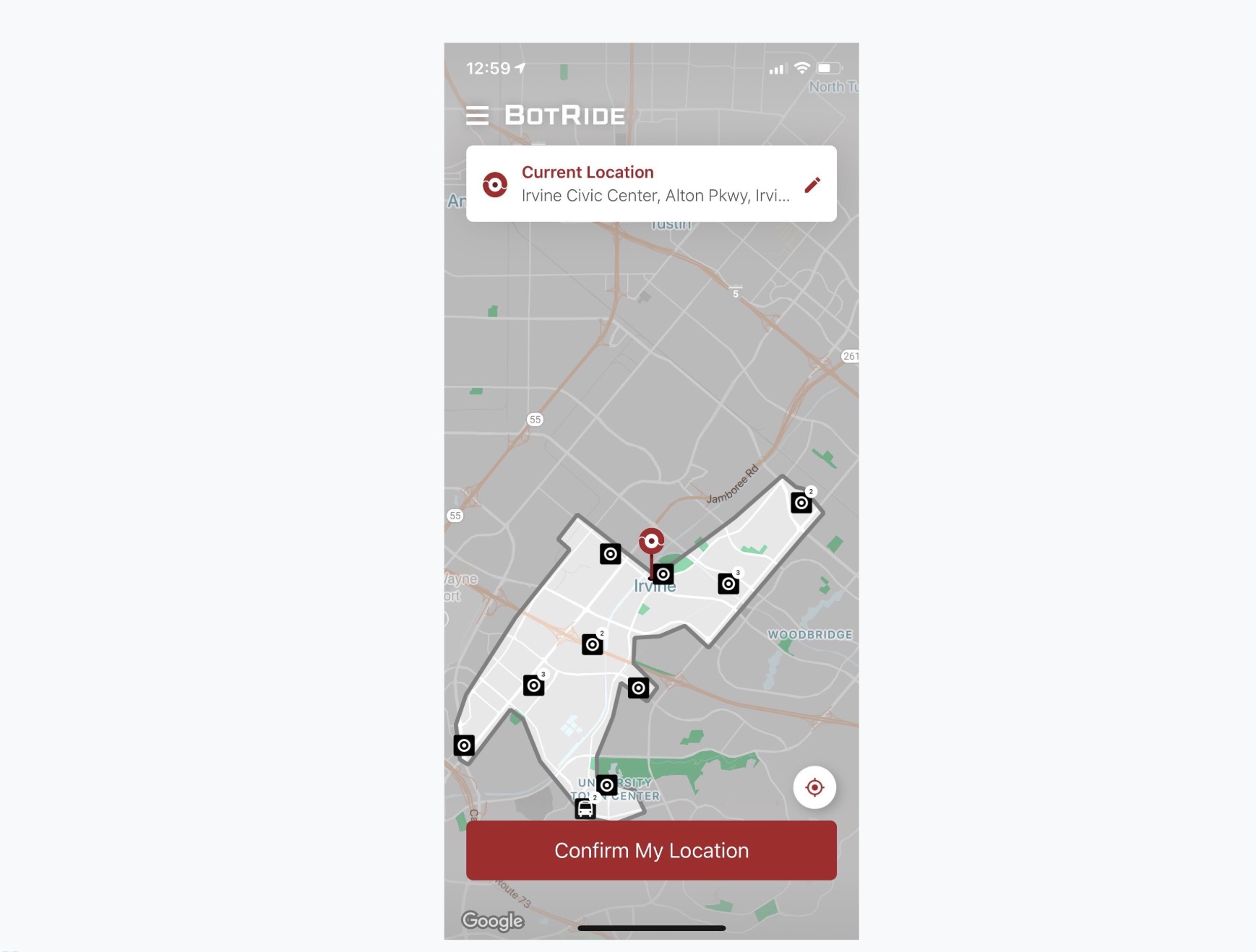
The robotaxi service called BotRide will operate on public roads in Irvine, California, beginning November 4. This isn’t a driverless service; there will be a human safety driver behind the wheel at all times. But it is one of the few ride-hailing pilots on California roads. Only four companies, AutoX, Pony.ai, Waymo and Zoox have permission to operate a ride-hailing service using autonomous vehicles in the state of the California.

Customers will be able to order rides through a smartphone app, which will direct passengers to nearby stops for pick up and drop off. Via’s expertise is on shared rides, and this platform aims for the same multiple rider goal. Via’s platform handles the on-demand ride-hailing features such as booking, passenger and vehicle assignment and vehicle identification (QR code). Via has two sides to its business. The company operates consumer-facing shuttles in Chicago, Washington, D.C. and New York. It also partners with cities and transportation authorities — and now automakers launching robotaxi services — giving clients access to their platform to deploy their own shuttles.

Hyundai said BotRide is “validating its user experience in preparation for a fully driverless future.” Hyundai didn’t explain when this driverless future might arrive. Whatever this driverless future ends up looking like, Hyundai sees this pilot as a critical marker along the way.

Coverage area of Hyundai robotaxi pilot

Hyundai said it is using BotRide to study consumer behavior in an autonomous ride-sharing environment, according to Christopher Chang, head of business development, strategy and technology division, Hyundai Motor Company .

“The BotRide pilot represents an important step in the deployment and eventual commercialization of a growing new mobility business,” said Daniel Han, manager, Advanced Product Strategy, Hyundai Motor America.

Hyundai might be the household name behind BotRide, but Pony.ai and Via are doing much of the heavy lifting. Pony.ai is a relative newcomer to the AV world, but it has already raised $300 million on a $1.7 billion valuation and locked in partnerships with Toyota and Hyundai.

The company, which has operations in China and California and about 500 employees globally, was founded in late 2016 with backing from Sequoia Capital China, IDG Capital and Legend Capital.

It’s also one of the few autonomous vehicle companies to have both a permit with the California Department of Motor Vehicles to test AVs on public roads and permission from the California Public Utilities Commission to use these vehicles in a ride-hailing service. Under rules established by the CPUC, Pony.ai cannot charge for rides.

25 Oct 2019

Daily Crunch: Facebook launches its News section

The Daily Crunch is TechCrunch’s roundup of our biggest and most important stories. If you’d like to get this delivered to your inbox every day at around 9am Pacific, you can subscribe here.

1. Facebook starts testing News, its new section for journalism

Facebook’s news section, which was previously reported to be imminent, is here: The company is rolling out Facebook News in a limited test in the U.S. as a home screen tab and bookmark in the main Facebook app.

Should publishers trust Facebook? Well, Josh Constine argues that none of them have learned the right lessons from the last 10 years.

2. Pixelbook Go review: a Chromebook in search of meaning

The Go is clearly Google’s attempt to lead the way for manufacturers looking to explore Chromebook life outside the classroom. It has some nice hardware perks, but it’s not the revolution or revelation ChromeOS needs.

3. SpaceX wants to land Starship on the Moon before 2022, then do cargo runs for 2024 human landing

SpaceX president and COO Gwynne Shotwell shed a little more light on her company’s current thinking with regards to the mission timelines for its forthcoming Starship spacefaring vehicle.

4. After its first earnings miss in two years, Amazon shares get walloped in after-hours trading

Amazon shares fell by nearly 7% in after-hours trading on Thursday after the company reported its first earnings miss in two years.

5. Lawmakers ask US intelligence chief to investigate if TikTok is a national security threat

In a letter by Sens. Charles Schumer (D-NY) and Tom Cotton (R-AR), the lawmakers asked the acting director of national intelligence Joseph Maguire if the app maker could be compelled to turn Americans’ data over to Chinese authorities.

6. The SaaS gold rush will become the ‘Hunger Games’

Enterprise software investor Rory O’Driscoll says that while the cloud is obviously here to stay, the next five years in cloud investing will neither be the same nor as easy as the last 10. (Extra Crunch membership required.)

7. Learn how to raise your first euros at TechCrunch Disrupt Berlin

Startup funding experts — including Forward Partners managing partner Nic Brisbourne, Target Global partner Malin Holmberg and DocSend co-founder and chief executive officer Russ Heddleston — will sit down together on the Extra Crunch Stage at TechCrunch Disrupt Berlin.

25 Oct 2019

Here’s where top gaming VCs are looking for startup opportunities

With cross-platform experiences like Fortnite and PUBG, in-game socializing environments, and subscription-based cloud gaming services from Playstation, Google, Amazon, and others, the gaming industry is entering a new era beyond mobile.

These days, the industry is at the center of social media and entertainment trends; gaming is expected to earn $152 billion in global revenue this year, up 9.6% year over year. 

Given my recent writing on Unity, the most-used game engine, and ongoing research into interactive media trends, I wanted to find out how top gaming-focused VCs are assessing the market right now. I asked ten of them to share which trends they are most excited about when it comes to finding investment opportunities:

  • David Gardner, Partner at London Venture Partners
  • Henric Suuronen, Partner at Play Ventures
  • Samuli Syvähuoko, Partner at Sisu Game Ventures
  • Jay Chi, Partner at Makers Fund
  • Peter Levin, Managing Director at Griffin Gaming Partners
  • Gigi Levy-Weiss, Partner at NFX
  • Ethan Kurzweil, Partner at Bessemer Venture Partners
  • Jonathan Lai, Partner at Andreessen Horowitz
  • Blake Robbins, Partner at Ludlow Ventures
  • Jon Goldman, General Partner at GC Tracker & Board Partner at Greycroft Partners

Amid the mix of predictions, there were several common threads, such as optimism about the rise of games as broader social platforms, opportunities to invest directly in new studios, and skepticism about near-term investments in augmented or virtual reality and blockchain.

Here are their responses.

David Gardner, Partner at London Venture Partners

“PC Games are back. Great place to start new IP to then migrate a success to multiple platforms. There is more innovation in business models and more open distribution on PC to facilitate audience growth without the punishment of mobile CPIs.

VR & AR remain out. We stood away from VR in the beginning and extend that to AR while the user experience for games remains a disappointment. Let’s hope those new Apple glasses do the trick!

Crypto remain a theological war zone, but honestly everything on offer has been available in the cloud world, but the real consumer benefit isn’t showing up.

We love games that are expanding audience demographics and are sensitive to less hardcore audiences.  For example, women players are estimated to account for 1 billion gamers.”

Henric Suuronen, Partner at Play Ventures

“At Play Ventures, we believe we have just entered the golden era of mobile gaming. Who would have believed 10 years ago that Nintendo and games like Fortnite and Call of Duty would all be on mobile. Mobile is not just a games platform anymore, it is THE games platform of choice for casual and core players alike. Consequently, in the next 2-3 years we will invest in 30-40 mobile games studios across the globe.”

Samuli Syvähuoko, Partner at Sisu Game Ventures

“We at Sisu Game Ventures have been investing in many sectors since 2015 including free-to-play mobile games (especially big here in Finland), VR, AR, PC, console, instant messenger, hypercasual, audio and most recently cloud-native games as well. In addition to game studios, around a third of our investments are into games related tech/infrastructure. 

We’ve so far not dipped our toes into blockchain or eSports and our appetite for doing more investments in VR and AR is nil. To me, the most interesting mega trends lie with the promise of cloud gaming when utilized to its full potential. Another term that encapsulates my excitement is games-as-a-social-hobby. Put this and the extreme accessibility of the cloud together and you’ll have a game with revolutionary potential.”

Jay Chi, Partner at Makers Fund

“We are looking closely at ‘Gaming as Media’ related content and platforms — the emergence of new interactive experience centered on ‘viewers as participants.’ Gaming as social media falls under this thesis. We are also looking for MMO and Metaverse enablers given increased demand for specialized, scalable and affordable technologies that empower lean startup teams to create and operate large-scale worlds and novel gameplays. 

We also see potential for new start-ups to emerge in hypercasual games with midcore/social meta — no one has truly cracked this genre yet.”

25 Oct 2019

Google brings in BERT to improve its search results

Google today announced one of the biggest updates to its search algorithm in recent years. By using new neural networking techniques to better understand the intentions behind queries, Google says it can now offer more relevant results for about one in ten searches in the U.S. in English (with support for other languages and locales coming later). For featured snippets, the update is already live globally.

In the world of search updates, where algorithm changes are often far more subtle, an update that affects 10 percent of searches is a pretty big deal (and will surely keep the world’s SEO experts up at night).

Google notes that this update will work best for longer, more conversational queries — and in many ways, that’s how Google would really like you to search these days because it’s easier to interpret a full sentence than a sequence of keywords.

2019 10 25 0945 1

The technology behind this new neural network is called “Bidirectional Encoder Representations from Transformers,” or BERT. Google first talked about BERT last year and open-sourced the code for its implementation and pre-trained models. Transformers are one of the more recent developments in machine learning. They work especially well for data where the sequents of elements is important, which obviously makes them a useful tool for working with natural language and, hence, search queries.

This BERT update also marks the first time Google is using its latest Tensor Processing Unit (TPU) chips to serve search results.

Ideally, this means that Google Search is now better able to understand exactly what you are looking for and provide more relevant search results and featured snippets. The update started rolling out this week, so chances are you are already seeing some of its effects in your search results.


25 Oct 2019

Meet Bespoke Financial, a lender for cannabis companies backed by Snoop Dogg’s Casa Verde Capital

Bespoke Financial wants to provide cannabis businesses with the same kind of financial services that other businesses get, but that dispensaries and growers can’t yet access.

The regulations around cannabis operations are so stringent at the local level — and so nebulous at the federal level — that national banks won’t give businesses in the cannabis industry the same basic services (like short-term loans).

That’s why one former Goldman Sachs banker has partnered with two entrepreneurs from the traditional agriculture industry to create Bespoke Financial. And it’s why the company has raised $7 million in financing led by Casa Verde Capital — the investment firm launched by legendary cannabis aficionado, Calvin Broadus (AKA Snoop Dogg).

In some ways, George Mancheril is the new face of the cannabis business. The former banker hails from Goldman Sachs and Guggenheim Partners and worked on the desks that dealt with alternative lending.

A transplant to Los Angeles roughly six years ago, Mancheril says he saw the migration of legally sanctioned cannabis begin for recreational use and knew that there would be opportunities for new lending businesses.

“Cannabis will become a broad, mature industry just like any other, and if that is going to happen there needs to be a debt structure that can support that,” Mancheril says.

The biggest impediment to the industry’s growth is the one that Bespoke Financial wants to tackle first — and that’s access to debt.

To build the company’s first product Mancheril looked to his co-founder’s Pablo Borquez-Schwarzbeck and Benjamin Dusastre. Borquez-Schwarzbeck and Dusastre previously launched ProducePay, a fintech platform focused on produce farmers that has already financed roughly $2 billion in perishable commodities throughout 13 countries. It’s backed by around $200 million in venture capital and debt financing.  

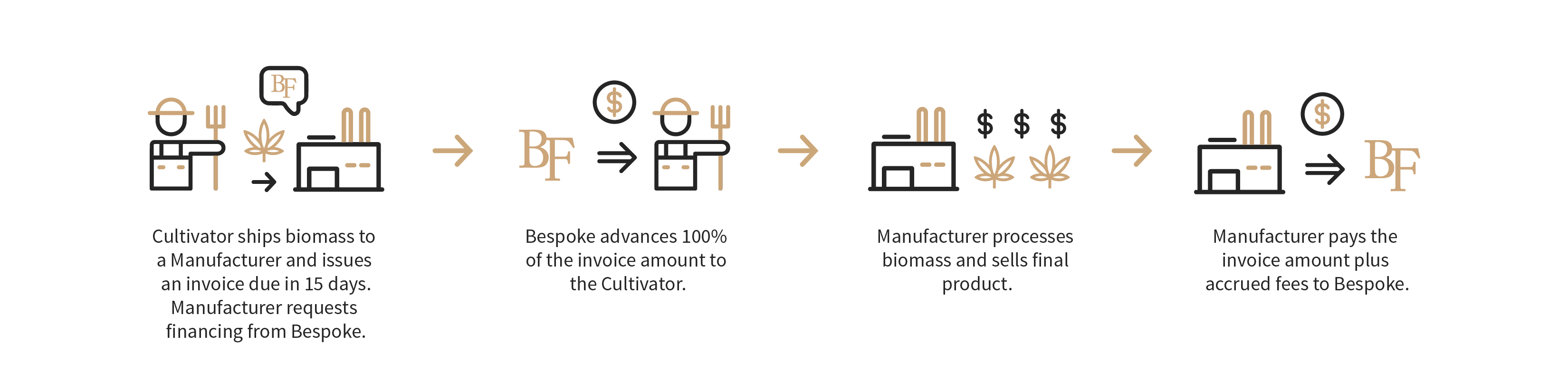
What Mancheril and his co-founders have done is take ProducePay’s underwriting model and apply it to the cannabis industry. The financial instrument that they’re starting with is known “in the business” as factoring.

It’s basically advancing money to businesses for a contract that’s signed in exchange for a cut of the money once a company gets paid for the goods or services they’ve rendered.

BF Website Diagrams Final 02

“While the US legal cannabis market is forecasted to grow over 20% annually, reaching $23B by 2022, the industry’s true growth potential is limited by long cash flow cycles throughout the supply chain and a lack of scalable and efficient capital sources,” says Bespoke Financial co-founder and chief executive, George Mancheril, in a statement. “Our approach will dramatically improve cash flow cycles across the supply chain and provide scalable working capital to fuel our clients’ growth.”

The $7 million infusion from investors including Casa Verde, Greenhouse Capital Partners and Outbound Ventures, will be used to build out the company’s business and establish its first credit lines with customers. Mancheril says it already has around $3 million worth of loans revolving through its business. Right now, the company is focused on California, but says it could expand to other regions that are embracing legalization. 

“In general in the cannabis industry overall it’s difficult to access any part of the financial system,” says Karan Wadhera, a managing director at Casa Verde. “Now that we’re moving into a place where equity financing is getting expensive a company like bespoke plays an important and valuable role in the ecosystem to help young brands and mature brands get access to working capital when they need it the most.”

25 Oct 2019

From the NBA to Sequoia to TikTok and more, a week of national security concerns with China

It has been a tough week for China-U.S. relations. Vice President Mike Pence ratcheted up the administration’s rhetoric yesterday, calling the NBA “a wholly owned subsidiary of the authoritarian regime” in China while the league’s commissioner Adam Silver continued to try to tamp down the intensity of criticism over the league’s business, saying in an interview with the Wall Street Journal that “We have no choice but to engage and to attempt to have better understanding of other cultures and try to work through issues.”

The NBA was hardly the only challenge between the U.S. and China. This week saw the intensification of two threads of national security concerns continue to get airtime on Capitol Hill that could have massive ramifications for startups.

The first and potentially most potent thread is swirling around TikTok, the epically popular social video app that also happens to be owned and operated by China-based ByteDance. This week, senate majority leader Chuck Schumer and senator Tom Cotton of Arkansas circulated a bipartisan letter requesting an assessment of TikTok’s national security risks.

ByteDance remains the world’s highest-valued unicorn (which, perhaps in the wake of WeWork’s collapse the past two weeks, is not an epithet that any startup wants to actually hold these days). It has received major funding from the likes of Sequoia Capital China, and is currently valued at $75 billion.

Sequoia is clearly preparing for the worst around these national security reviews. Last week, the firm confirmed to The American Lawyer that Donald Vieira, a partner at top law firm Skadden, would be joining the venture firm as chief legal officer. Vieira has spent the last few years working on cases surrounding CFIUS, the Committee on Foreign Investment in the United States (WTF is CFIUS?), and earlier, was chief of staff of none other than the Department of Justice’s national security division.

That expertise will be critical as Sequoia potentially faces a tough reception for ByteDance in the national security circuit on Capitol Hill. Earlier this year, CFIUS required video game publisher Beijing Kunlun to retroactively divest itself of its purchase of gay-dating app Grindr over concerns that the app’s user data could provide Chinese intelligence and law enforcement officials with compromising material that would allow for individual blackmail.

While Grindr’s text messages may be far more compromising than the average TikTok viral video, the app’s small user base is dwarfed by TikTok, which has seen more than 100 million downloads in the U.S. alone. That potentially wide surveillance net is of acute concern for U.S. intelligence officials.

On top of that, of course, is the media’s heightened discussion the past few weeks that ByteDance could carefully calibrate the virality of videos on TikTok to hew toward Beijing’s censorship dictates. That has led to some teens posting various memes about the Hong Kong protests to see how far they can push the platform’s red lines (as teens are wont to do).

Strategically, the China angle has become very useful for Facebook, who faces a viable threat in TikTok’s popularity according to my colleague Josh Constine. Mark Zuckerberg has made China’s potential censorship within TikTok a major speaking point, which he emphasized in a major policy speech at Georgetown:

While our services, like WhatsApp, are used by protesters and activists everywhere due to strong encryption and privacy protections, on TikTok, the Chinese app growing quickly around the world, mentions of these protests are censored, even in the US.

Is that the internet we want?

Facebook’s strategic messaging starts to lead us to the other national security thread happing these days in DC. There have been wide concerns over the past few months on Capitol Hill over bids for subway, rail, bus, and other transit contracts from Chinese companies like state-owned CRRC and electric bus and battery manufacturer BYD . There have been motions to ban federal transit funding for projects that use vehicles from Chinese-subsidized sources.

A new report published this morning by Radarlock, a data-driven research organization, argues that Beijing is using access to these contracts to enhance its ‘civil-military fusion,’ by which China means learning how to manufacture and build leading global supply chains that help it in both private sector competitiveness and in military superiority. As the research leads Emily de La Bruyère and Nathan Picarsic write:

Through both data collection and technology, CRRC contributes to Beijing’s military and military-civil fusion [“MCF”] projects: Explicitly declaring, in its company documents, a role in the military-civil fusion strategy, CRRC has set up an investment fund dedicated to MCF; operates in MCF industry zones; shares technology, resources, and data with military-and MCF-affiliates; and assigns the MCF label to high-profile projects and centers.

Like Facebook though, these results are being highlighted by industry sources, with Politico Pro noting that Securing America’s Future Energy and the Alliance for American Manufacturing have been pushing a previous report on BYD around DC.

And that gets back to the challenges of future economic ties between the two superpowers, notwithstanding the latest developments in the trade war negotiation (which seem as likely to conclude as Brexit is to happen).

National security policy is increasingly being used by incumbent players as a cudgel to stifle competition. Many of those national security concerns are valid — and sometimes acutely so — but we also need to be extraordinarily clear that like any market restriction, there is ultimately a consumer cost to these initiatives as well. The Chinese may go without star-studded basketball as much as Americans will go without working subway cars, and that’s the cost of a relationship that has never been built on a foundation of trust.

25 Oct 2019

Growth is out, profitability is in

Hello and welcome back to Equity, TechCrunch’s venture capital-focused podcast, where we unpack the numbers behind the headlines.

This week Kate and Alex held the reins as a duo (check out our chat with Greylock’s Sarah Guo from last week here) to dig into an enormous raft of news. And don’t worry, it’s not all late-stage happenings. We’re discussing early-stage news every week because that’s what the listeners want!

Up top we dug into Kate’s excellent work covering the Superhuman founder’s new micro fund, or at least his attempt at raising such a fund. Our main question is how can he be a good VC and a good executive at the same time? Folks don’t tend to do both at the same time because they’re each more than full-time jobs. Having two such gigs sounds hard.

But hey, it’s not just athletes and musicians who can bring outsized interest to deals. In-demand founders can have a similar effect. We’ll be keeping a close eye on the upcoming fun. Moving on. 

Next we turned to the other end of the venture landscape, looking at Founder’s Fund’s new capital vehicles. With a combined $2.7 billion in eventual capital, FF is hoping to build a financial redoubt from which they can rain capital down on late-stage targets wherever they may be.

Is it a bit late in the cycle to cut late-stage checks to companies that might otherwise go public? That’s the gamble so far as we can see it, but perhaps with WeWork’s IPO dreams turned to nightmares, there’s demand among a group of companies for another 12 months in the private markets. And that means more money is required.

On the theme of more money, Lime is raising some more and we were treated to new financial results from The Information’s great work getting the figures. Or discussion asked the question of how far the company’s unit economics could improve. Kate said that Lime is investing a lot now in developing better hardware, so their scooters can last more than 5 minutes on the roads before breaking down. She thinks things will start looking up when its deploying only new, fancy, good scooters. Alex is bearish.

Before we could turn back to the early-stage market and wrap up, we had to cover the latest from WeWork. SoftBank did in the end come and save the day (at least for now) for the company, meaning that WeWork lives on, though layoffs are expected sooner rather than later. Who knows what the future holds…

And finally, Vendr, a company that is profitable, raised a $2 million round. This is interesting because, again, it’s profitable! And the startup willing shared some financial data with us–a rarity. Read more about the recent Y Combinator graduate here.

Equity drops every Friday at 6:00 am PT, so subscribe to us on Apple PodcastsOvercastSpotify and all the casts.