Year: 2019

24 Oct 2019

To scale subscription startups, get to know your customers

The crowded world of subscription businesses offers ongoing opportunities to screw up your relationship with subscribers.

At Disrupt San Francisco 2019, I spoke with Forerunner Ventures’ Eurie Kim, Lola CEO Alex Friedman and KiwiCo CEO Sandra Oh Lin about key issues and priorities for scaling a subscription service post-launch. A primary theme: building relationships with customers who’ll help you decide where to look for your next product.

“The first product just has to work or else you’re just not gonna have a company. But to be a big company, you have to have much more than just the product, it has to be the full experience and the full relationship that you have,” says Kim. “And then certainly you have to have the muscles on your team to be able to listen, evolve, test, and grow. So we’re obviously searching for companies… where the founders know so much about their customer that for the first few years, you have a very clear line of, you know, path forward. It’s not complicated. It’s just execution. And that’s hard to do. But you need to have a pulse on that customer.”

Instead of striving to meet the needs of every customer, entrepreneurs should focus on trying to understand the subscribers they’ve zeroed in on by being purposeful — instead of throwing a bunch of ideas against the wall to see which ones stick.

“What’s hard is your cash constraints. So you’re starting with one or two products. It’s not like an amazing experience, because it’s one or two products,” Kim said onstage. “You have to have like that laser-sharp product that is actually solving so much of the need that someone’s like, ‘well, it’s only one product, but it’s like a really good product. And so I’m going to start there, I’m going to trust Lola, and I’ll get this tampon. And then if I like it, I’m going to stick with it. I’ll sign up for the subscription, because I do need it monthly. And then hey, maybe I’ll buy something else.’ And so the brand relationship builds over the course of time naturally.”

Lola, which makes women’s health products, launched with an organic cotton tampon that shipped to users monthly. After entering that space, the startup’s co-founders strategized about how expand their offerings.

“We figured, okay, there’s this opportunity to build an end-to-end experience here,” says Friedman. “Where do we start? Obviously, there are a lot of different categories and moments. So how can we be there for [our customer] at every stage with products and content and community. And so after period care, we went to sexual wellness, because that is very resonant with our current customer base.”

24 Oct 2019

Looking to become the central hub for logistics management, Shipwell raises $35 million

Shipwell, the software platform for managing trucking logistics, has raised $35 million and is expanding its suite of services to become a full-service hub for logistics management. 

The new round led by Georgian Partners comes as the company has just expanded its suite of tracking and management tools to integrate with FedEx’s parcel shipping services. The company is also planning an expansion into ocean shipping in the coming months, according to chief executive, Gregory Price.

The Austin-based company works with multiple service providers — including the logistics services unicorn Flexport — but operates as a marketplace for shippers to connect with freight companies and online tools to manage those shipments. In effect, the company is pitching a version of the proprietary logistics management toolkit that has made Amazon so successful, to any retailer or outlet.

Since its last round of funding a year ago, Shipwell has grown to service over 4,000 customers per month with supply chains spanning multiple geographies. The company now operates in Canada, Mexico, and even across Europe.

With the new funding the company intends to open new offices in Chicago and expand to a second location in its home base of Austin.

The company has also launched a new application program interface which allows it to help manage logistics through other modes than just trucking. Price says the company has about 20 companies beta-testing the tool, which is set to launch publicly in November.

24 Oct 2019

Spotify now lets artists buy a full-screen ‘recommendation’ promoting their new album

Spotify recently added a feature that will occasionally pop up a full-screen recommendation of a new album the service thinks you’ll like, based on a combination of your listening taste and human curation. Now, it’s going to allow artists and their teams to pay to target their fans through this same feature, effectively turning the recommendation into a full-screen ad.

The company says this is currently a test and is only available in the U.S. for now.

These sponsored recommendations — which are effectively now ads, as they’re bought and paid for — will display to both Free and Premium subscribers. Technically, that means Premium subscribers will be seeing full-screen ads for the first time, even though those ads are tailored to their personal taste in music to be less disruptive to their overall enjoyment of the app.

Brand New Music for You

To head off any backlash about this fact, Spotify says Premium listeners will be able to turn off the recommendations feature, if they choose. It’s not clear that users will think to do this. After all, it was first introduced as just a helpful recommendation feature, not advertising. And because it’s still highly personalized — you’ll only hear from artists you frequently listen to or follow — many users may not realize the feature is now transactional in nature. Or even if they do, they may not care.

You have to hand it to Spotify: that’s actually pretty clever.

The unit itself does disclose that it’s “sponsored” in small print at the bottom. And if you click the “What’s this?” link, you’ll be taken to a screen that explains this is a new music update about an artist you listen to or follow. Users then have the option to turn off future updates from only that artist. Premium users can toggle off the feature entirely.

Spotify says early feedback about the feature has been positive, which is why it decided to move forward with its plans to offer this as sponsored opportunity.

The new recommendations will start to appear for you the next time a favorite artist releases their next album, the company says.


24 Oct 2019

Apple TV app comes to Amazon’s Fire TV Stick and other devices

Ahead of the launch of Apple TV+ on November 1, Apple’s Apple TV app has begun to roll out to other platforms beyond Apple’s own streaming media player, Mac computers, and iOS devices. Earlier this month, for example, the app arrived on Roku devices. Today, it’s hitting Fire TV Stick and Fire TV Stick 4K.

Specifically, it will be available to Fire TV Stick 2nd Generation and Fire TV Stick 4K users in the U.S., Canada, U.K., Germany, France, Italy, Spain, and India, starting today.

Fire TV Basic Edition customers in over 50 countries will also be able to find the new app in the Amazon Appstore on their Fire TV. Though not yet available, the app will launch soon on Fire TV Cube (1st and 2nd Gen.), Fire TV (3rd Gen pendant design), plus Toshiba and Insignia Fire TV Edition smart TVs, and Nebula soundbar.

It’s not compatible with the Fire TV (1st and 2nd Gen) or Fire TV Stick (1st Gen), Amazon says.

While the app is necessary for being able to stream from Apple TV+, that’s not all it does.

Within the Apple TV app, you’re also able to access your iTunes library, including any shows or movies you’ve purchased or rented. However, if you want to buy or rent something new, you’ll need to do so from an Apple device first in order to have the content show up within the app.

For Apple to have an app available on Amazon’s platform at all took years of negotiations.

As Apple’s interest in the world of streaming media and related devices grew, it also had to acknowledge that its walled garden approach needed to be set aside. In 2017, Apple CEO Tim Cook finally announced that Prime Video would come to Apple TV. Since then, the two companies have eased up on their restrictions against each others’ products.

The following year, Amazon expanded its assortment of Apple inventory to include other devices besides Apple TV — like iPads, iPhones, Apple Watch and Beats headphones. It also brought its FreeTime Unlimited app to iOS, while Apple Music arrived on Echo devices.

This March, Apple Music launched on Fire TV, as well.

And with Apple TV+, Apple is even more of a rival to Amazon, which runs its own streaming service, Prime Video.

Apple, however, has a smaller lineup for Apple TV+ with shows like Dickison, The Morning Show, See, For All Mankind, and others. It’s unclear how well these series will perform with audiences, but Apple is giving away a year of access to its service with the purchase of new Apple devices. That gives it time to find its footing, even if several of its first tries bomb.

Amazon says it will announce, via Twitter, when the Apple TV app is released for other devices.


24 Oct 2019

Newly launched pet health startup Gallant wants you to bank your dog’s stem cells for $990

With $11 million in funding and a mission to open up the doors of regenerative therapies to dogs across the nation, the Los Angeles based startup Gallant is now opening its doors for the first time.

The company was founded by DogVacay founder and chief executive Aaron Hirschhorn after seeing his own pet’s struggle with debilitating illness and knowing firsthand that regenerative medicine and stem cell therapies could help.

“I struggled with debilitating chronic back pain for more than a decade, leaving me incapable of doing activities I loved, until regenerative medicine successfully cured my condition,” said Hirschhorn, in a statement. “At the same time, I watched my dog Rocky suffer from arthritis so painful that she couldn’t walk. I knew there had to be a better way to treat and heal our pets, which sparked the beginning of Gallant. We are on a mission to keep our pets happier and healthier through the power of regenerative medicine.”

Joining Hirschhorn at the company is Linda Black, an experienced serial entrepreneur at life sciences companies like Medicus Biosciences and SciStem, which both focused on developing regenerative therapies. Richard Jennings, the chief executive of cord blood banking company, California Cryobank, and Darryl Rawlings, the founder and chief executive of Trupanion, both sit on the company’s board of directors.

Hirschorn knows the pet business. He helped grow DogVacay to over $100 million in sales over his tenure at the company before its merger with Rover.

It’s that experience in business that likely helped investors including Maveron, Bold Capital Partners, Bling Capital, and Science Inc. come to the table and fetch $11 million in cash for the business.

Through the investment, Gallant was able to acquire the veterinary division of Cook-Regentec, including the animal medicine division’s intellectual property, existing stem cell banking operations and their pipeline of cell therapy products derived from reproductive tissue.

What’s the benefit of banking your dog’s stem cells for life for roughly $1,000?

According to Gallant, the veterinarians from its newly acquired business have treated hundreds of cats and dogs already with their own banked stem cells. Those treatments have helped dogs with illnesses including osteoarthritis, atopic dermatitis, torn ligaments and chronic dry eye. Each treatment has been demonstrated to be effective in early clinical trials and stem cell therapy is on the cutting edge of new scientific research.

With Gallant, pet owners opt in to having their animal’s stem cells collected during a routine spaying or neutering procedure. Hirschhorn says that roughly 1 million cats and dogs undergo those procedures every day, so there’s no shortage of potential customers.

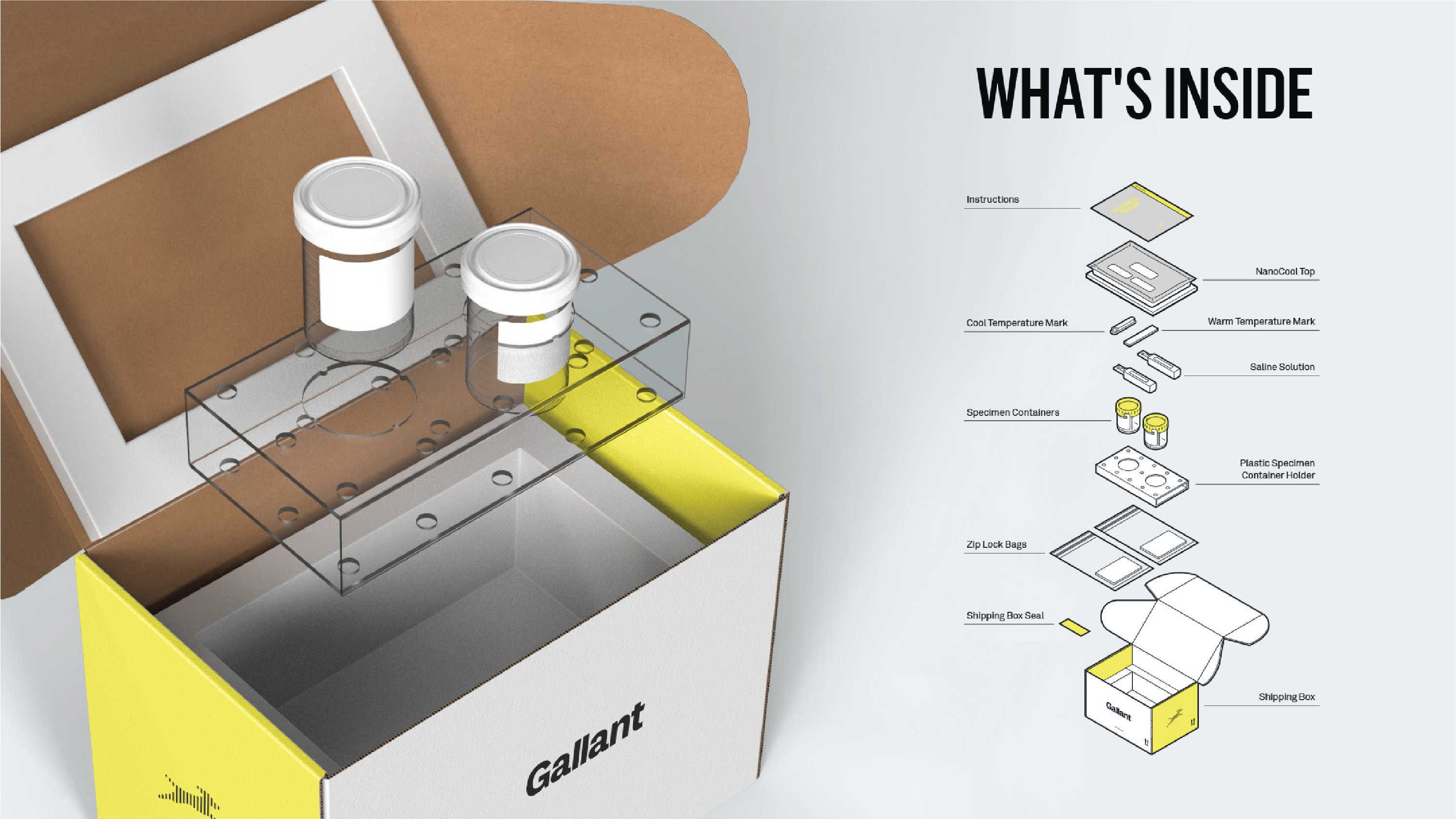
During the procedure, vets deposit tissue from the operation in a special container that Gallant will collect and use to harvest an animal’s stem cells.

Gallant Pet Vet Kit 2

By collecting stem cells harvested during the operations, Gallant says it can get access to younger, healthier stem cells.

Banking and paying for therapies using Gallant’s technology isn’t cheap. The company charges $395 to collect the cells and another $595 to store them for a pet’s lifetime. If an owner wants to pay annually, there’s a $95 fee per year to store the genetic material. (Gallant says it’s waiving the initial collection fee for a limited time to coincide with its launch).

Treatments based on a pet’s genetic material cost $300.

“In my experience with clinical trials and evaluating dogs with debilitating arthritis, I’ve seen first hand how cell therapy can change lives, ” said Dr. Black, chief scientific officer at Gallant, in a statement. “I’m committed to developing therapies that dramatically improve the quality of life for dogs.”

24 Oct 2019

Mobile banking app Current raises $20M Series B, tops half a million users

Mobile banking app Current, which began as a teen debit card controlled by parents, expanded to offer personal checking accounts earlier this year. Now the company says it has grown to host over 500,000 accounts on its service and has closed on $20 million in Series B funding to further its growth.

The round included new investors Wellington Management Company, Galaxy Digital EOS VC Fund, and CMFG Ventures — the venture capital arm of the CUNA Mutual Group, a mutual insurance company serving credit unions and their 120 million members. Returning investors included QED Investors, Expa, and Elizabeth Street Ventures.

phone in context appThe first version of Current, which debuted in 2017, was focused on giving parents a more modern way to dole out allowances and reward their kids for chores. But over time, the product became more like a real bank account for teens, culminating with the addition of routing and account numbers late last year. This allowed working teens to direct their paycheck to Current, as they could with a traditional bank.

This year, Current launched personal checking using the same core technology powering its teen banking product. The product includes features like faster direct deposits, gas hold crediting, and merchant blocking without charging overdraft fees, hidden fees, or requiring minimum balances.

While the teen checking account users have an average of 15, the average age for the new personal checking account users is 27.

This puts Current in a more competitive market, where a number of banking apps are now targeting a younger, more mobile generation who begun to favor modern, feature-rich apps over brick-and-mortar banks. Among its rivals are apps like Step, Cleo, N26, Chime, Simple, Stash, and others.

Like many in this space, Current isn’t actually a bank — its banking services are provided by Choice Financial Group and Metropolitan Commercial Bank, which allows it to offer FDIC insurance up to $250,000. Instead, many of the banking apps focus instead on the feature set and user experience they can offer.

Both of Current’s products include a Visa co-branded debit card tied to the Current account. Along with the funding, Current and Visa are also announcing an expanded joint marketing partnership, which will help Current reach new customers.

“We believe everyone should have access to affordable financial services that improve the chances for a better life,” said Stuart Sopp, Current Founder and CEO. “We have made this a reality through rebuilding financial infrastructure with the Current Core. It allows us to build more products that offer new ways to interact with money. Our rapid growth to half a million accounts serves as a testament to the ways our products and cost savings are bringing better financial outcomes and we anticipate bringing those benefits to over 1,000,000 customers by mid-2020.”

To date, Current has raised $54 million in funding.

24 Oct 2019

Virgin Galactic becomes the first public space tourism company on Monday

Richard Branson’s Virgin Galactic wil find out what the public markets think of its ambitious plan to make commercial space tourism a reality on Monday. The company’s shareholders have approved a merger announced earlier this year with Chamath Palihapitiya’s special Social Capital Hedosophia holding company, and that will take effect Friday with adequate on the NYSE for the newly merged public entity on Monday.

Virgin Galactic and Palihapitiya announced the arrangement back in July, which will involve an $800 million investment in Virgin Galactic. Branson’s Galactic, one of two Virgin-branded space companies (the other is Virgin Orbit, which intends to provide orbital commercial small satellite launch capabilities), will seek to bring paying tourists to sub-orbital space using its SpaceShipTwo spacecraft and modified carrier airplane launch platform.

Virgin Galactic recently debuted the spacesuits its paying passengers will wear on the $250,000 tourist jaunts to space, which will begin in the first half of next year if the company sticks to its most recent public timeline. Its spacecraft can host up to six paying passengers, meaning each flight could earn the company up to $1.5 million in revenue. Virgin Galactic says it has over 600 people already in queue to take the trip.

Monday’s trading day should reveal what kind of confidence public market investors have in the value of that business proposition. Meanwhile, Virgin Galactic is already booking customers for research missions as well, indicating it can also look beyond just the very wealthy for revenue sources.

24 Oct 2019

By tweeting from a SCIF, House lawmakers put national security at risk

If you thought storming into a highly secured government facility with your electronics but without permission was a smart idea, you’d be wrong.

But that didn’t stop Rep. Matt Gaetz and close to three-dozen of his Republican colleagues on Wednesday from doing exactly that.

Gaetz, a Republican congressman from Florida, proudly announced in his since-deleted tweets: “I led over 30 of my colleagues into the SCIF where Adam Schiff is holding secret impeachment depositions.” At the time, Gaetz was interrupting a hearing of the House Intelligence Committee where chairman, Schiff, was deposing senior government official, Laura Cooper, as part of the Democrats’ impeachment inquiry into President Trump’s dealings with Ukraine.

One of the cardinal rules of entering one of these facilities is that you don’t bring in any electronics. And those lawmakers did exactly that.

No wonder Gaetz deleted his tweets.

A SCIF — a sensitive compartmented information facility — sounds fancy but in reality are just rooms designed to be secure for sharing sensitive and secret information at the higher echelons of government secrecy. There are plenty dotted around Washington DC for lawmakers and government officials to huddle in and chit-chat. There are SCIFs in the White House, Congress and every major government department in the capital — even the president’s Florida resort.

The idea is you go in to one of these rooms and they’re safe to discuss state secrets. These rooms vary by size and shape — some are enormous and are able to sit an entire congressional committee. Some can be used on the road in the form of a large pop-up tent. But they all do the same job: they’re designed to a specification so that nobody can eavesdrop on what’s being said.

So when a gaggle of Republican lawmakers stormed one of the congressional SCIFs yesterday with their electronics in their pockets, understandably a lot of people were furious.

“No unauthorized electronic devices are allowed in the SCIF precisely because they could be used to exfiltrate decoded, highly classified data,” said Alan Woodward, a professor at the University of Surrey. “Standard operating procedure is to deposit anything like a mobile phone in some storage outside before entering,” he said.

“To force your way into a SCIF and use a mobile device inside is the height of recklessness: you must know that you are endangering material that could cause grave damage to the national interest,” he added.

The rebuke was quick.

“[The lawmakers] endangered our national security and demonstrated they care more about a political stunt than protecting intelligence information,” tweeted Mieke Eoyang, vice-president of Third Way, a national security think tank. “Foreign adversaries are constantly trying to figure out what goes on inside those rooms to figure out what the U.S. knows about them, to out U.S. high-level sources in their governments, to know what the U.S. government knows and use it against us,” she said.

“I cannot emphasize enough how serious this is,” she added.

And neither can the chairman of the House Homeland Security committee, Rep. Bennie Thompson (D-MS), who wrote to the Sergeant-at-Arms, the official in charge of the House’s law enforcement, expressing his anger at the infraction.

“Such action is a blatant breach of security,” said Thompson in the strongly worded letter, demanding action is taken against the violating House members.

“Inadvertently bringing electronics into a SCIF is a very common security infraction, and it is taken incredibly seriously by agencies,” said Mark S. Zaid, an attorney specializing in national security cases. “It is drilled into people’s heads to never bring their cell phone into a protected area.”

The penalties for the House members could be swift, said Zaid, including pulling their future access to classified material.

“Agencies will not hesitate to revoke someone’s security clearances when multiple infractions occur,” he said. “When it comes to intentional infractions, the repercussions would be swift and severe, as it should be.”

24 Oct 2019

Randori Recon acts like a hacker to reveal your weaknesses

Randori, a Boston-based start-up from a former Carbon Black executive and a former Red Team consultant, announced its first product today called Randori Recon, a service designed to act with a hacker’s mindset to surface all of your company’s external weaknesses.

Brian Hazzard, co-founder and CEO, says he had worked with his co-founder David Wolpoff when he was running a red team consulting firm. The idea behind a red team is to act as an attacker would and find a company’s weaknesses. The two decided to put Wolpoff’s lucrative consulting firm out of business and develop a tool to put this kind of service in reach of any company.

“The idea is to break out of that defender’s mindset, to stop guessing at what you need to do on the defense side, but rather to inform our strategies and the way we defend our networks from the attacker’s perspective,” Hazzard explained.

Based on just a company email address, Recon begins to build a picture of all the publicly available information about that company, and from that they can find weaknesses and vulnerabilities that a hacker would typically exploit to get inside a company’s defenses.

Wolpoff says that it’s not useful or desirable for a red team to have any knowledge of the target company’s security defenses. He wants to go in there with what he calls “a black box” and discover everything he can find on his own. “We start with basic information, and then we’ll go discover everything that’s discoverable from that and then from each of those individual nuggets that we glean, we chase every thread that we can chase from those,” he said.  They then continually monitor this information, so that if anything changes, they can find new vulnerabilities that could pop up over time.

While the company is starting with external vulnerabilities, the plan is to build out the service to provide internal scans, as well. “As we progress the product, we will be able to do internal reconnaissance inside of an organization as well, but for the Recon product we’re really focusing on an outside-in black box discovery of the publicly visible surface area of an organization,” Wolpoff said.

Wolpoff says the service agency he ran was lucrative, but the sales cycles were long, and because of the cost, it was really only within reach of relatively few organizations who were willing to pay for that kind of service. Over dinner in 2017, Hazzard and Wolpoff hatched the idea of developing his knowledge and expertise and packaging it as an online service.

They started developing the product and opened the company last year. They announced a $9.75 million seed round last October.

24 Oct 2019

Helping banks refine sales pitches and customer service, Minneapolis-based Total Expert raises $52 million

It’s no secret that the art of customer service in the modern era is something that banks desperately need help with.

One of the reasons why challenger banks have been able to find acceptance, new customers and — well — the ability to challenge existing banking companies is the mistreatment customers receive from their existing money holders.

That’s why tools designed to help marketing and customer engagement are a big business and why the Minneapolis-based Total Expert has been able to raise $52 million in its latest round of financing.

The new round brings the company’s total haul to $86 million thanks to capital investments from Georgian Partners, Emergence, and Rally Ventures (all veteran software as a service investors).

“We are incredibly excited about Total Expert’s approach to building trust and maximizing the long-term value of relationships between consumers and lenders,” said Simon Chong, managing partner and co-founder of Georgian Partners, in a statement. “The future of consumer finance is engaging across all product and customer needs during their financial life, and Total Expert is the category leader powering this humanized automation and compliance at scale.”

The company said it will use the money to expand on its 218 person team — especially hiring additional data scientists and designers. The company also said it would accelerate the development of new automation tools to help small banks and credit unions compete.

“The future of financial services belongs to firms that combine human interaction with technology in a way that creates higher quality and more relevant experiences throughout the entire customer journey,” said Joe Welu, Total Expert’s chief executive officer. “Every interaction a consumer has with a financial services brand either erodes trust or builds trust, and legacy technology makes it difficult to deliver on the expectations of the modern consumer. Our mission is to ensure that banks and lenders create customers for life by delivering on these expectations”