Year: 2019

23 Oct 2019

Fabric raises $110 million Series B to expand its network of automated fulfillment centers in the U.S.

Fabric, the startup that wants to make automated logistics available to retailers of all sizes, announced today it has raised $110 million in Series B funding. The round was led by Corner Ventures, with participation from Aleph, Canada Pension Plan Investment Board (CPPIB), Innovation Endeavors, La Maison, Playground Ventures and Temasek.

This brings the total funding raised so far by Fabric (formerly called CommonSense Robotics) to $136 million. Its last round was a $20 million Series A announced in February 2018. Fabric also said today that it is launching a platform model that will allow its clients to build micro-fulfillment centers on their own property that use the startup’s AI and robotics-based technology.

Fabric was founded in Tel Aviv in 2015 and is now headquartered in New York. Its Series B will be used for its U.S. expansion, where it currently has 14 sites under contract, including three micro-fulfillment centers that are currently being built in New York City. One of those is scheduled to open by the first quarter of next year and will be available to retailers who want to make on-demand fulfillment, including one-hour deliveries, available to their customers.

Last October, Fabric opened its first micro-fulfillment center in Tel Aviv, giving an inside look into how the company’s system works. Robots move around the warehouse, picking up inventory so human workers can stay at a scanning station. Fabric says the 6,000 square feet station now processes up to 600 orders a day, including one-hour deliveries.

Steve Hornyak, chief commercial officer at Fabric, told TechCrunch that it plans to expand its platform model into at least one other U.S. city next year and currently has deals with several U.S. retailers that will be announced in the coming months.

Fabric’s logistics platform can be used by retailers of any size, but “for SMBs, our service model is particularly revolutionary as it has been built to allow for multiple tenants leveraging the same platform. It enables retailers that don’t have the resources or infrastructure to build an entirely new fulfillment operation themselves to access a world-class logistics solution that enables profitable on-demand fulfillment,” he said.

Of course, retailers and logistics providers in the U.S. have to deal with the specter of Amazon, which Hornyak said Fabric views “as the force that’s fundamentally driving the market, transforming retail as we know it at a dizzying pace and pushing all other players to adapt in a rapidly evolving space.”

“When Amazon announces it’s providing free same-day deliveries of $1 items, that becomes the consumer expectation—and the faster the delivery, the more complicated and expensive it is,” he added. “Our aim is to enable all other retailers to stay relevant and competitive in this world that Amazon has created, providing the operational, strategic and financial infrastructure they need to meet consumer expectations profitably, sustainably, and at scale in an on-demand world.”

As part of its expansion plans, Fabric plans to grow its commercial, operations and tech support teams in the U.S., as well as its engineering team in Tel Aviv.

In a press statement, Corner Ventures managing partner John Cadeddu said “Fabric is the micro-fulfillment market leader with a production-proven platform that drives tremendous value for its retail partners and consumers alike. We are delighted to be partnering with the Fabric team in their incredible vision to reinvent how goods are fulfilled and delivered in this on-demand world, ultimately empowering retailers to provide faster deliveries at lower costs and at scale.”
23 Oct 2019

Startup founders share why they attend TechCrunch Disrupt

On 11-12 December, thousands of savvy startuppers will flock to Germany for Disrupt Berlin 2019. Disrupt events, the premiere technology conferences hosted by TechCrunch, are known the world over as the place to launch, network, invest in and collaborate with the international early-stage startup community.

Disrupt offers plenty of startup action — world-class speakers, Startup Battlefield, hundreds of exhibitors, workshops, a hackathon and more. And it turns out that early-stage startup founders have lots of different reasons for loving Disrupt. Let us count the ways.

Education and collaboration

Tech evolves so quickly, amirite? When a startup has a new or complex concept, Disrupt is a great place to educate your community. Or to learn about new advances.

Case in point: Vlad Larin, the co-founder of Zeroqode, went to Disrupt Berlin to evangelize the startup’s no-code technology.

“We wanted to help people understand the technology and to spread the word that no-code development is real and it’s happening today. Exhibiting in Startup Alley at Disrupt Berlin was the perfect place for us to start those conversations.”

Larin also viewed Disrupt as an opportunity to meet like-minded people and to build collaborative relationships with other startups.

“We met all kinds of people looking for new ideas, collaboration and inspiration — people who want to learn and exchange ideas about the latest products and industry trends.”

Meet other founders

Disrupt provides plenty of opportunity to meet and learn from other founders. Case in point: Caleb John, the co-founder of Cedar Robotics, went to Disrupt San Francisco to meet other early-stage startup founders, something he’d never experienced. The chance to meet seasoned entrepreneurs from a range of industries, to build relationships and to learn from them was a major draw.

“Just talking about my business with other founders who understand what it takes to build a startup was incredibly valuable. They can look at your roadmap from a non-technical viewpoint, help you avoid pitfalls and make sure you’re running things smoothly in terms of your business practices.”

John built connections with R&D startups and potential investors — collaborative relationships he says may pay off down the road.

“Building relationships with those firms was very helpful, and I say going to TechCrunch Disrupt is a no-brainer. It’s something every startup founder should experience.”

Find funding

Cash is the lifeblood of any early stage startup and Disrupt is ripe with investors eager to fatten their investment portfolios. Case in point: David Hall, co-founder and president of Park and Diamond, went to Disrupt hoping to raise a round of funding.

“Investors from all over the world come to Disrupt. The chance to have those discussions and to potentially form relationships was invaluable.”

Hall credits his Disrupt experience with improving the startup’s overall growth.

“The exposure we received at TechCrunch Disrupt completely changed our trajectory and made it easier to raise funds and jump to the next stage.”

The funding they received as a result of connections cultivated at Disrupt allowed them to relocate from Virginia to New York and to make the company’s first key hires.

“TechCrunch draws that entrepreneurial community, and you never know when you’ll bump into the right person. Disrupt offers so many opportunities — you’d be foolish not to go.”

Disrupt Berlin 2019 takes place on 11-12 December. Whatever your reasons, don’t miss the opportunities awaiting you at Disrupt. Buy your super early bird passes here and save up to €600. We’ll see you in Berlin!

Is your company interested in sponsoring or exhibiting at Disrupt Berlin 2019? Contact our sponsorship sales team by filling out this form.

23 Oct 2019

Amazon expands its in-store pickup service, Counter, to thousands more stores

Amazon Counter’s, the online retailer’s in-store pickup option that launched this summer at 100 Rite Aid locations in the U.S., is now expanding. The company announced today the service will reach thousands more locations with the additions of new partners GNC, Health Mart, and Stage Stores.

GNC is the well-known health and nutrition chain. Health Mart operates a network of independently owned and operated pharmacies. Stage Stores, meanwhile, operates Gordmans off-price stores, Bealls, Goody’s, Palais Royal, Peebles, and Stage department stores.

Amazon Counter is part of the growing Amazon Hub network, which offers pickup locations for Amazon deliveries as well as thousands of pickup Lockers across the U.S. The system appeals to those who don’t find home delivery convenient — perhaps because they work in an office or don’t have anywhere safe to receive packages.

Amazon today offers a range of alternatives to leaving packages on the doorstep, including Amazon Counter and Amazon Lockers, Key by Amazon for keyless entry into homes and vehicles, and Amazon Day delivery dates.

With Counter, Amazon’s system is designed to be minimally disruptive to the brick-and-mortar’s day-to-day operations. Customers simply show a barcode to the store employee to receive their package.

It may seem surprising that the very retailers Amazon has been putting out of business with its online superstore would agree to partner up like this. But as it turns out, Amazon can drive traffic offline, too.

Department store chain Kohl’s, for example, recently expanded its Amazon partnership on returns to all its 1,150 U.S. locations after its initial trials drove significant revenue increases. Struggling Stein Mart also recently embraced the enemy with plans to install Amazon Lockers in some 200 stores, hoping for the same result.

The new set of Amazon Counter partners, could similarly benefit.

“The response we’ve heard from our customers and partners after the launch of Counter earlier this year has been tremendous,” said Patrick Supanc, Worldwide Director of Amazon Hub, in a statement. “This new network of pickup points gives customers a pickup experience that is fast, flexible and convenient, and partners are thrilled with the strong engagement and additional foot traffic Counter is driving for their stores.”

Though not mentioned by Amazon, it’s worth pointing out that some of its Counter partnerships are with brick-and-mortar pharmacies. After Amazon’s acquisition of online pharmacy PillPack and the launch of its healthcare JV with Berkshire Hathaway and JP Morgan, some expect Amazon will move deeper into the world of pharmaceuticals in the future. A line of retail pharmacy partners couldn’t hurt.


23 Oct 2019

Have we reached the tipping point?

Limited partners or  LPs  — the pension funds, the university endowments, the family offices that largely provide venture firms with their spending money — are receiving a lot of attention from venture capitalists, most of it unwanted. VCs have begun knocking down their doors with requests for fresh capital commitments so they’ll have money to invest if the market cools down.

The problem is, many of these LPs are already “over-allocated.” LPs traditionally invest in many asset classes, such as public equities, and they allocate a small percentage of their portfolio to venture capital. Suddenly, they’re finding they’ve forked over more than they’d intended to VCs.

There are several reasons for this situation. First, VCs are returning to them ever faster for more capital  — sometimes in less than two years’ time  — because they are in vesting at such a furious pace.

Compounding the problem, not all LPs have received returns from their VC investments that they can recycle into new venture capital allocations. In some cases, this capital is still tied up in startups that are raising much more money than in the past and staying private longer. “We have some large exposures to blue chip names where IPOs have been rumored to be coming for a long time already, and now it’s maybe 2021, maybe 2022,” says one university endowment manager who asked not to be named. In other cases where startups have gone public, falling prices have prompted VCs to hang on to their shares instead of distribute them.

The result is that LPs are having to cut back on the number of managers they can fund, and that could mean bad news for venture capitalists and startups alike. These LPs don’t have much choice. As another LP who asked not to be named explains it, “We have a pretty structured allocation process, and we’re really trying to be creative,” he says. One venture manager who reappeared too quickly for more money was  “easy to walk away from,” says this person. “Others, we’re having to do financial backflips for them to remain strong partners.”

Either way, this LP adds, “We can’t add any new relationships right now,” meaning new venture teams in particular are out of luck. “When [VCs] shorten their fundraising cycle by nine months to a year, you can only squeeze the balloon so much.”

Backing up the truck

SoftBank’s $100 billion “Vision Fund” is one big reason LPs find themselves in their current predicament. From the moment Softbank began waving money around several years ago, it launched a vicious cycle.  According to Chris Douvos, whose investment firm, Ahoy Capital, owns stakes in such venture funds as True Ventures and First Round Capital, “When Andreessen Horowitz hit the scene a decade ago, they changed the tempo of investing and everyone got more aggressive in their dealmaking as a response. Then SoftBank entered the picture in a big way, and it was like a16z on steroids.”

In order to compete with Softbank’s money cannon, other funds supersized their own investment vehicles, and startup valuations soared. Uber and WeWork were prime examples. Uber went public, pricing below expectations, and its shares have been falling ever since. WeWork and its unconventional S-1 filing never made it past the starting gate.

Competitors are enjoying some schadenfreude: they can’t help but delight in SoftBank’s pain. But WeWork’s slow-motion implosion comes at an uncertain moment in time. If a second massive Vision Fund doesn’t come together — and that seems more than likely at this point — it would mean a sharp drop-off in startup funding. That alone might be fine. It might even be healthy for the ecosystem. But the world is also grappling with a U.S. administration that appears increasingly unhinged. More, a recession that seemed far away as recently as early July but could be around the corner.

Collectively, these elements could change the picture dramatically for LPs. Specifically, if LPs aren’t getting enough money back from VCs and their public holdings fall in value because the markets hit the skids, their commitments to venture funds could become even larger as a percentage basis of their overall portfolio. That would create even more imbalance in their asset allocation. Which would mean even less money for new funds. Which would translate into less money for startups. 

It’s a vicious cycle of another kind, in short.

Maybe it won’t happen. We aren’t there yet. But VCs of all sizes would be wise to take a lesson from their entrepreneurs and perfect their pitches. As is becoming clear, LPs can’t dole out capital at the same pace forever, especially without more money coming back to them. If VCs want to continue raising new funds, or raising funds as fast, they’d better have a very good story to tell.

23 Oct 2019

WeWork confirms an up to $8 billion lifeline from SoftBank Group; names new executive chairman

Confirming earlier reports, The We Company and SoftBank Group agreed to a new capital infusion which will see SoftBank committing $5 billion in new financing and issuing a tender offer for another $3 billion in buybacks for shareholders.

The company also said it would accelerate an existing commitment to put $1.5 billion into the short-term real estate rental company.

Under the specific terms of the deal, WeWork will receive $1.5 billion committed from SoftBank’s April 2020 cash infusion into the company at $11.60 per share. With that money expected to come in seven days after the deal is signed (subject to shareholder approval).

There’s also the tender offer for up to $3 billion worth of non-SoftBank owned shares at a price of $19.19 per share, which will begin in the fourth quarter of this year, with closing subject to regulatory approvals.

Finally there’s a joint venture share swap where all of SoftBank Vision Fund’s interests in regional joint ventures outside of Japan will be exchanged for WeWork shares at a price of $11.60 per share’ and a debt facility consisting of $1.1 billion in senior secured notes, $2.2 billion in unsecured notes, and a $1.75 billion letter of credit facility, which will occur after the tender offer is completed.

After the closing and the tender offer, SoftBank will own approximately 80 percent of the We Company, according to a statement.

But SoftBank will not actually will not hold a majority of voting rights at any stockholder or board of directors meeting,  thanks to WeWork’s convoluted ownership structure. Therefore, even with its 80 percent stake in the business, WeWork isn’t a subsidiary, but an “associate” of SoftBank.

As part of the agreement, the company confirmed that Adam Neumann will become a board observer and Marcelo Claure, the chief operating officer of SoftBank Group will assume the position of executive chairman of the board of directors of WeWork — as soon as the company receives its $1.5 billion payment from SoftBank.

“SoftBank is a firm believer that the world is undergoing a massive transformation in the way people work. WeWork is at the forefront of this revolution. It is not unusual for the world’s leading technology disruptors to experience growth challenges as the one WeWork just faced,” said Masayoshi Son, chairman and chief executive of SoftBank Group Corp, in a statement. “Since the vision remains unchanged, SoftBank has decided to double down on the company by providing a significant capital infusion and operational support. We remain committed to WeWork, its employees, its member customers and landlords.” 

The vision may remain unchanged, but the story that SoftBank will have to tell about its new “associate”. Under Neumann’s stewardship,  We Company was a cash-burning, globe-spanning, all-encompassing community developer that would usher in a new kind of capitalism, operating under the banner of “We”.

Now, the company is more like a struggling purveyor of temporary office space, which has a mountain of leases it owns and is looking down the barrel of a potential cash crunch — even with the SoftBank lifeline. 

Still, SoftBank’s executives and WeWork’s new leadership are standing by their rhetoric for what the company is… and can be.

“WeWork is redefining the nature of work by creating meaningful experiences through integrating design, technology and community. The new capital SoftBank is providing will restore momentum to the company and I am committed to delivering profitability and positive free cash flow,” said Claure in a statement. “As important as the financial implications, this investment demonstrates our confidence in WeWork and its ability to continue to lead in disrupting the commercial real estate market by delivering flexible, collaborative and productive work environments to our customers.”

23 Oct 2019

Salesforce Ventures’s John Somorjai warns N.C.’s politics could dampen its tech hub potential

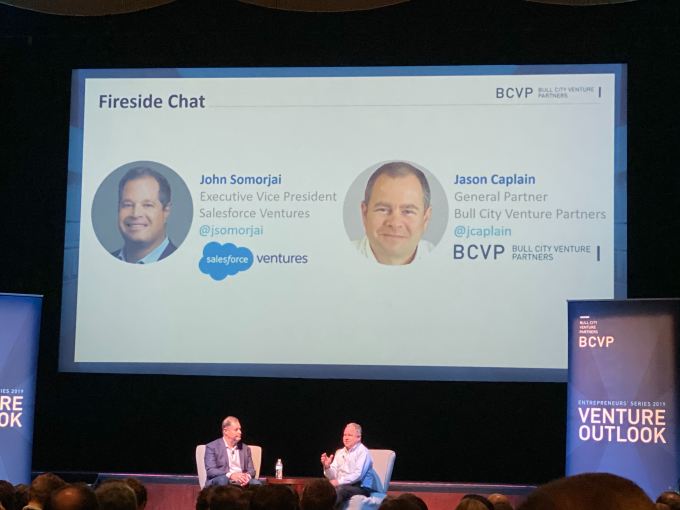
North Carolina has been rising as an entrepreneurial hub. It’s now home to massive deals, like IBM buying Red Hat for $34 billion and Fortnite maker Epic Games raising a landmark $1.25 billion, both which helped to put the state — and the Triangle region, in particular — on the map. And now it’s just minted another unicorn with Pendo’s last fundraise. But its tech hub potential can still be threatened by the state’s political swings, said Salesforce Ventures head John Somorjai, who spoke today at a tech event in Durham.

On a panel at Bull City Venture Partners’ Entrepreneurs’ Series 2019, Somorjai reminded the audience that investment in the state follows the talent. And a state can’t attract talent when it’s not “welcoming to all people,” he said.

North Carolina has had a difficult history on this front, if you recall.

In 2016, PayPal canceled plans to open a global operations center in Charlotte after N.C. passed the controversial (“bathroom bill”) law that prevented cities from creating non-discrimination policies based on gender identity. The state lost 400 potential jobs, as a result. Over 100 other companies, including Apple, Google, Twitter, Facebook, eBay, Uber, and others also asked the state to repeal the law after its passing.

N.C. eventually revised the law, then reached a settlement this summer that allows transgender people to use certain bathrooms matching their gender identity. But in some cases, it was too late to woo the tech companies back.

These sorts of issues have a broader effect on the state’s ability to attract tech and business investment at a time when investors are often now looking outside the Valley (and its obscene valuations) to find companies that are more focused on profitability.

Image from iOS 6

Salesforce Ventures, a strategic investor who keeps its stake below 15%, isn’t hesitant to fund companies beyond Silicon Valley — it has five investments in N.C. and 15 overall in the larger region, for example. And 75% of its investments were made outside of California, Somorjai noted.

But when asked what North Carolina’s biggest challenge was, in terms of becoming home to a startup community, he alluded to the state’s politics and its divisive laws.

“Before the last election, there was an environment here that wasn’t really welcoming to all people,” Somorjai said. “One of [Salesforce’s] core tenants — our core values — is equality. And there’s really sound business sense behind that,” he explained. “If you have discriminatory policies, people don’t feel welcome. If they don’t feel welcome, they’re not going to want to work there. And you will never be able to attract the best talent.”

“Money flows to where the talent is,” he added.

He also suggested to the event’s audience — a group of some 450 entrepreneurs and hundreds more working in the area’s startup ecosystem — that local community leaders should remain vigilant about these sorts of problems.

“If you’re complacent, it can happen again,” he added.

Despite the concerns, Somorjai was generally positive about the ability for strong startups to arise in N.C. Salesforce Ventures itself invested in two N.C. area unicorns — Pendo and nCino — and it just acquired Charlotte-based MapAnything, which gives it some 200 new employees in the Tar Heel state. Elsewhere in N.C., startups AvidXchange, Red Ventures, and Tresata all have unicorn valuations.

“One thing we’ve been so excited about is — you have these tremendous universities that are putting out great engineers every year. And you have a growing group of investors that are investing in this area. There’s also now so much talent here that you’re attracting investors from all over the country,” he told the audience. “I think that’s great.”

Image credit, top: SeanPavonePhoto/Getty Images


23 Oct 2019

Verizon is giving its customers 12 free months of Disney+

On November 12 Verizon will begin offering 12 months of Disney+ to all of its new and existing 4gLTE and 5G unlimited wireless customers, the companies said today in a joint statement.

It’s a great way for Disney to juice its early subscriber numbers and for Verizon to add a tantalizing perk as competition heats up for both streaming media companies and telecoms whose media strategy still seems a little… muddled.

While Comcast and AT&T each have their own successful media properties, Verizon (which owns Verizon Media Group, which owns TechCrunch) has seen its fortunes in the media landscape wane as much of the investment thesis behind buying Aol… then Yahoo… then merging them into Oath… then rebranding them as Verizon Media Group… fizzled.

Tying itself to Disney+ — even just promotionally — makes good business sense.

Through the agreement Verizon customers get access to everything Disney+ has to offer, including the highly anticipated Star Wars television series, “The Mandalorian” and another 25 original films and documentaries. Watch the over three hour-long teaser trailer below for an exhaustive look at every. single. Disney. piece. of. content. coming. to. the. service.


“Giving Verizon customers an unprecedented offer and access to Disney+ on the platform of their choice is yet another example of our commitment to provide the best premium content available through key partnerships on behalf of our customers,” said Verizon Chairman and CEO Hans Vestberg, in a statement. “Our work with Disney extends beyond Disney+ as we bring the power of 5G Ultra Wideband technology to the entertainment industry through exciting initiatives with Disney Innovation Studios and in the parks,” he added.

Here’s the deal: At launch, Verizon becomes the exclusive wireless carrier to offer 12 months of Disney+ for itsnew and existing customers. The offer also extends to its new Fios Home Internet and 5G Home Internet customers.

Folks can activate their Disney+ subscription and start streaming on devices including game consoles,  streaming media players and smart televisions.

22 Oct 2019

Somehow, ‘Dark Fate’ got me excited about the Terminator again

The release of a new Terminator sequel has become a familiar ritual: The new filmmakers acknowledge the greatness of the first two movies, then mumble awkwardly about the other sequels — which are inevitably ignored, because they assure us that this time, they’ve created the sequel we’ve been waiting for.

I can’t tell you whether “Rise of the Machines,” “Salvation” or “Genisys” deserves to be dismissed like this, because I haven’t seen any of them. (I did watch the TV spinoff, “The Sarah Connor Chronicles,” which was pretty good.) But I can say that the latest installment, “Terminator: Dark Fate,” delivers on the promise of a worthy sequel.

It helps, of course, to see the return of some familiar names — not just Arnold Schwarzenegger, but also Linda Hamilton, who takes up the role of Sarah Connor for the first time since “Terminator 2.” And then there’s franchise creator James Cameron, who was apparently too busy with his “Avatar” sequels to direct (“Dark Fate” was helmed by “Deadpool” director Tim Miller instead), but who stayed involved as a producer and story writer.

Not that the story is really the selling point: The big emotional moments can feel clumsy and rushed, and some of the dialogue is genuinely groan-worthy.

All the script really needs to do, though, is give us a reason for those familiar faces to be back on-screen together, and to convince us that it’s not totally pointless to watch another Terminator movie. In that, it succeeds — with a few nods towards the changing technological and political landscape thrown in for good measure.

Terminator Dark Fate

In the film’s opening minutes, we learn that our heroes’ efforts at the end of “Terminator 2: Judgment Day” have succeeded in averting a nuclear apocalypse. However, for reasons that only become clear later, those pesky terminators keep showing up.

The story proper kicks off in Mexico City, where a young woman named Dani Ramos (played by Natalia Reyes) becomes the latest target of a cyborg assassin. Her pursuer (Gabriel Luna) is an advanced model whose skin and skeleton can function as two separate bodies, and she gets not one but two protectors — Sarah Connor, along with cybernetically enhanced soldier named Grace (Mackenzie Davis), as well as the late-film addition of an old-model terminator (Schwarzenegger, naturally).

There are more revelations as the story unfolds, but one of the best things about “Dark Fate” is the simplicity of its plot. There’s a killer cyborg, an innocent target and an overmatched guardian; mayhem ensues.

It’s in the depiction of that mayhem that “Dark Fate” excels. The film has plenty of CGI (I’d argue too much), but it feels very different from the weightless, super-powered battles that have become the big-screen norm, and even from the balletic killing sprees of the “John Wick” movies.

Instead, “Dark Fate”‘s action feels like a throwback the ’80s and early ’90s, specifically in those Cameron-directed Terminator movies — where a great deal of thought and ingenuity was devoted to coming up with all the different ways that a relentless murder machine might wreak havoc.

Hamilton, by the way, seems completely at-home in these scenes. And although Schwarzenegger’s performance was gratifyingly funny and loose, “Dark Fate” is absolutely her film.

Meanwhile, I’m still a little fuzzy on the details of how Luna’s Rev-9 actually works works, but it makes for a striking and unsettling visual. The finale, in particular, offers a masterful escalation of jeopardy and destruction, as Rev-9 tears through one environment after another — almost convincing you that this time, the Terminator really might be unstoppable.

I don’t want to overstate the case here: “Dark Fate” doesn’t quite replicate the perfect mix of terror, violence and melancholy that made those first two Terminator films so memorable. But it can hold its own in a fight.

22 Oct 2019

Drift CEO shares insights from 20+ years of startup experience

Why do serial entrepreneurs keep jumping back in? What things might you learn the third, fourth, or fifth time around?

To find out, Extra Crunch Managing Editor Eric Eldon spoke to Drift CEO and founder David Cancel at TechCrunch Disrupt San Francisco. Cancel has spent more than 20 years founding SaaS companies, with exits including Compete (acquired by TNS), Lookery (Acknowledge), Ghostery (Evidon), and Performable (Hubspot.)

In their thirty-minute conversation, they cover everything from finding your first customers, to what he’s seen change over the last two decades in the industry, to why he’s willing to cut a check to employees who want to leave. TL;DR? We’ve embedded a video of their chat at the end of this article.

To find what people really want, ask for money — any money.

One thing Cancel says he’s learned over the years: when you’re just getting started, you need to charge for your product right off the bat because you never know how someone really feels about a product until you ask for money.

“If you’re creating a paid-for product, you have to start charging from day one,” he says.

He outlines an experiment he calls the ‘dollar test,’ where if someone seems interested in a product before it’s even available, he’ll promise them lifetime access if they’ll hand over whatever’s in their pocket — be it a dollar, ten, twenty, whatever.

“What it teaches the entrepreneur is that most of the people who will tell you that they love this thing will not give you a dollar,” actionable information that can save time, money and stress. The dollar test “shortcuts things; most people will end up spending so much time coming back to you because you keep telling [them] you love it, because you’re a nice person and you don’t want to hurt [their] feelings.”

Cancel also uses this approach after a product launches, using it to gauge which new feature requests customers find most important.

“They’d say ‘I love your product, but it doesn’t do X, Y, or Z. My company is special, we need X, Y, or Z feature.'”

“Let’s say they were paying us $5,000 a month. I’d say, ‘it’s only going to be $20 more a month, then we’re going to build it for you and you’ll be the first ones to have it.'”

“What would happen, almost every single time, is there would be this awkward pause. They’d say ‘I have to go talk to my manager, I need to go talk to someone, I’ll get right back to you,'” he said, adding “Almost every single time that person continued to be a customer and never asked for that feature again.”

“When it’s free to ask for anything,” says David, “people will just keep asking.”

David Cancel 2

Letting people go isn’t always a bad thing

If someone asks David for a recommendation on an engineer, he’s willing to recommend his own employees.

His reasoning is twofold; on one side, it means he knows his teams are made up of people who want to be there; on the other, it means employees know he’s looking out for them.

“I want people on the team who want to be on the team. If people ask me, ‘hey, do you know a really great engineer who does X, Y, Z?'” I say ‘Eric does, and Eric’s on my team.’ I’m like, you should talk to him. And if Eric wants to go, he should go, because we only want people who actually [want] to be there. Then that person knows that I’m looking out for the best interests of them, for them — and even if they go, we may end up working together again later.”

Similarly, if an employee says they want to leave and start their own company, David says he’s often the first to write a check:

“We would attract, in the early days, people who wanted to learn how to start their own company. One of the things I would say, and I still say to everyone: Look, if you come on board, and work with us for some days, if you want to leave at any point and start a company, myself and my co-founder Elias will be the first checks in whatever you want to start, no questions asked.”

“And so we have done that for companies in Boston, companies in San Francisco, companies all over the place. And we continue to do that.”

For finding customers and employees, he turns to LinkedIn

Thanks to recruiter spam and “work anniversary” notifications, LinkedIn tends to be the butt of a lot of jokes — but Cancel says, used right, it’s still quite valuable.

“We built a lot of marketing within LinkedIn, which I think is a place that I would advise people to go spend time on now. You can find your buyers, you can find the people that you recruit.”

22 Oct 2019

LabGenius raises $10M to use AI for protein drug discovery

LabGenius, a London-based startup applying AI and “robotic automation” to protein drug discovery, has raised $10 million in Series A funding.

The round is led by Lux Capital and Obvious Ventures, with participation from Felicis Ventures, Inovia Capital, Air Street Capital and existing investors. Also investing is Recursion Pharmaceuticals’ founder and CEO Chris Gibson, as well as Inovia Capital General Partner Patrick Pichette, who was formerly Google’s CFO.

Lux Capital’s Zavain Dar and Obvious Ventures’ Nan Li will join the LabGenius board of directors. Notably, the U.K. company’s early investors include Nathan Benaich, Torsten Reil, EF’s Matt Clifford, and Philipp Moehring, to name just a few.

“LabGenius is a full-stack protein engineering company: we combine artificial intelligence (AI), robotic automation and synthetic biology to evolve next-generation protein therapeutics,” founder and CEO Dr. James Field tells me.

“My central thesis, the thing that’s really is the driving force behind the company, is the conviction that we’re entering an age in which humans will no longer be the sole agents of innovation. Instead, new knowledge, technologies and sophisticated real-world products will be invented by smart robotic platforms called empirical computation engines. An empirical computation engine is an artificial system capable of recursively and intelligently searching a solution space”.

LabGenius’ flagship technology is called “EVA,” which Field describes as a “machine learning-driven, robotic platform” capable of evolving new proteins. “As a smart robotic platform, EVA is capable of designing, conducting, and critically learning from its own experiments,” he says.

The goal: to discover and develop new protein therapeutics that are currently hard for humans alone to find.

LabGenius 8485

“For decades, scientists, engineers and technologists have dreamt of building ‘robot scientists’ capable of autonomously discovering new knowledge, technologies, and sophisticated real-world products,” explains Field.

“For protein engineers, that dream has now entered the realm of possibility. The rapid pace of technological development across the fields of synthetic biology, robotic automation, and ML has given us access to all the essential ingredients required to create a smart robotic platform capable of intelligently discovering novel therapeutic proteins”.

To that end, Field frames the development of EVA as a “long-term, ambitious undertaking” that he says will enable the startup to address previously unsolvable protein engineering challenges and in doing so, develop urgently needed therapeutics.

“My ultimate goal for LabGenius is to establish a fully-integrated biopharmaceutical company powered by the world’s most advanced protein engineering platform,” he adds. “Quite honestly, this is a gargantuan undertaking and while we’ve already established one of the world’s most technically sophisticated protein engineering operations, we’re only just scratching the surface of what’s possible”.

More broadly, there is a tension that many deep tech companies face, which is determining how best to develop technology that’s tightly aligned to real-world commercial needs (before running out of capital!). “For LabGenius, we’ve achieved this in a highly intentional way by undertaking a series of commercial projects of increasing complexity from the company’s earliest days,” Field says.

One on-going project is with Tillotts Pharma AG to identify and develop new drug candidates for the treatment of inflammatory bowel disease (IBD).

“Our business model is pretty simple,” says the LabGenius founder. “We use EVA to discover and characterise new drug molecules and then partner with pharma companies who can take these molecules to market. For example in a typical partner-financed early discovery program, we’ll take a project from concept to early preclinical stage. Typical deal structures include a blend of R&D payments, milestones & royalties”.

Meanwhile, LabGenius will use the capital to scale its team, expand the scope of its discovery platform, and initiate an “internal asset development program”. The next goal is to evolve novel antibody fragments capable of treating conditions that cannot be addressed using conventional antibody formats.