Year: 2019

22 Oct 2019

Firefox gets personalized privacy reports

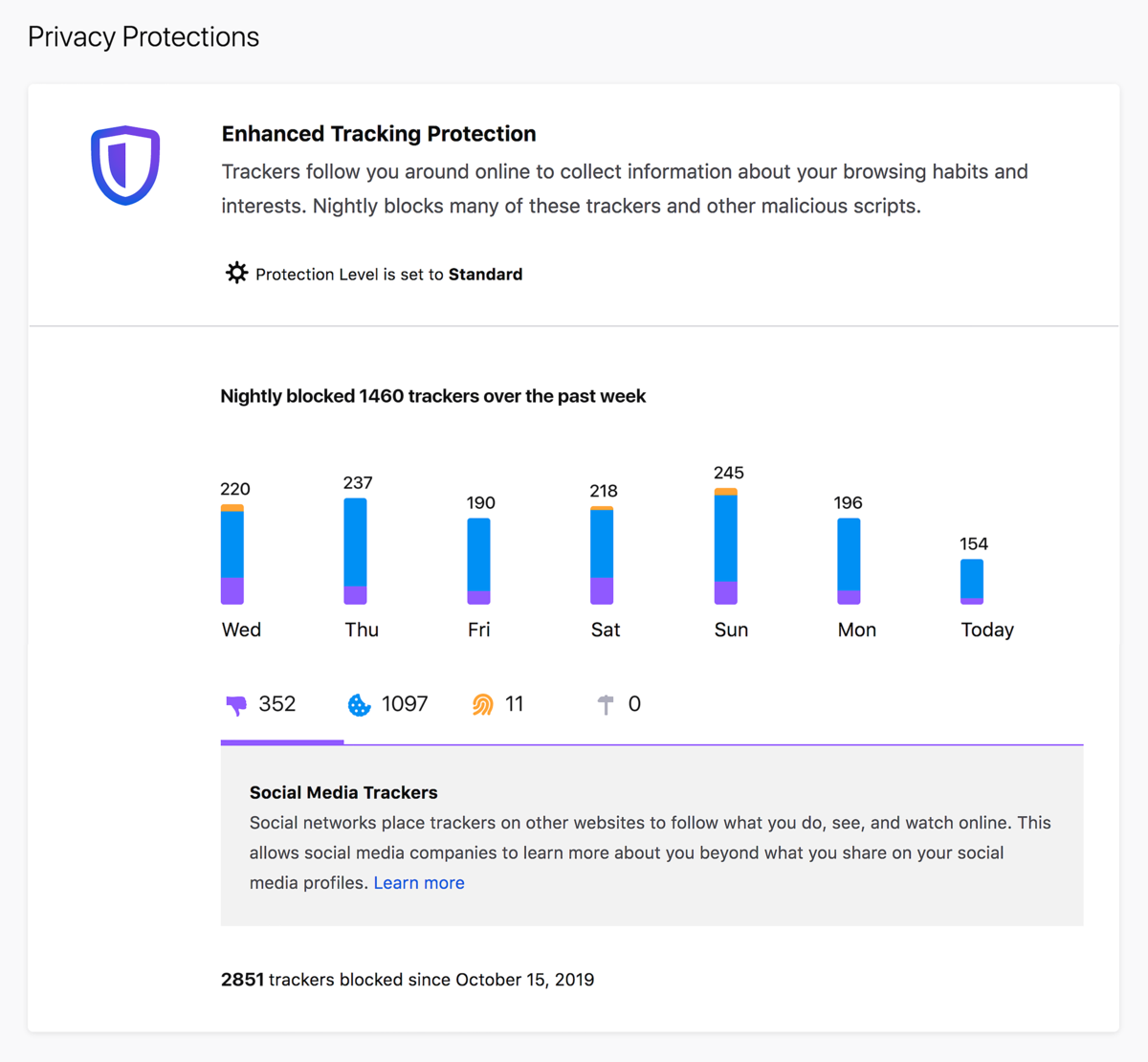
Mozilla today announced that its Enhanced Tracking Protection feature for Firefox, which launched in July (and became the default in September), has now blocked a total of over 450 billion third-party tracking requests from the thousands of companies that try to track you as you browse the web. That’s a big number, but with today’s launch of Firefox 70, Mozilla is also giving you a personalized dashboard that tells you how often Firefox blocked third-party cookies, social media trackers, fingerprinting tools and cryptominers.

Privacy protection is on by default, in the ‘standard’ setting, so you don’t have to do anything special to protect yourself. If you want to tinker with the settings, though, and don’t mind it if the occasional site breaks, you can also opt for a stricter default and custom settings.
protection report tp

The report isn’t exactly front and center in the user experience (though Mozilla tells me it points new users to it in its onboarding workflow). To find it, you have to click on the shield icon in the URL bar. That’s where you find all of the info about the current site you’re on, as well as a link to your privacy report.

The report itself is pretty basic and only covers a single week. The data doesn’t sync between machines and you can’t dig any deeper into which companies are trying to track you, for example. Still, it’s a nice reminder of how many companies are trying to track you.
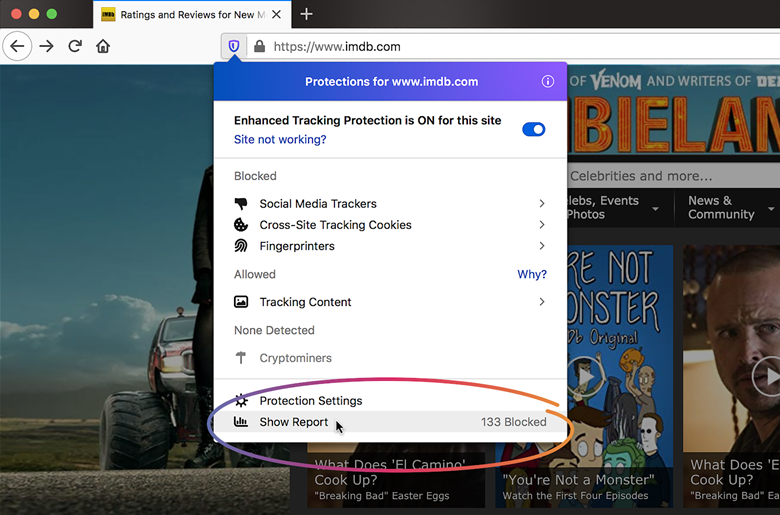
image003 1

The report page also features links to Mozilla’s Firefox Monitor, which can alert you when one of your email accounts appears in a breach, and Lockwise, its password management and syncing service. With today’s update, Lockwise is also getting a password generator and an integration with Firefox Monitor.

Mozilla clearly knows that privacy, at least for the time being, is what differentiates its browser from the competition, especially Chrome. While Google’s Chrome team has to figure out ways to protect its users while working inside a company that makes most of its revenue from online advertising, Mozilla doesn’t need to worry about this at all. So while the Chrome team is trying to figure out how to make major changes to the underlying tracking infrastructure while preserving Google’s revenue stream, Firefox and its brethren can opt for pretty strict default settings. It still remains to be seen whether the majority of users actually cares about tracking, but for now, this gives Firefox a clear advantage in this area.

22 Oct 2019

FTC settles with Devumi, a company that sold fake followers, for $2.5M

The U.S. Federal Trade Commission has put an end to the deceptive marketing tactics of Devumi, a company that sold fake indicators of social media influence — like Twitter followers, retweets, YouTube subscribers and views, and more — which was also the subject of a 2018 investigation by The New York Times into the world of social media fraud. The FTC says it reached a $2.5 million settlement with Devumi’s owner and CEO German Calas, Jr., which requires the first $250,000 to be paid, with the rest deferred unless it’s discovered that Calas has misrepresented his financial situation.

According to the Times’ investigation, Devumi had made millions selling fake social media influence to celebrities, businesses or anyone else who wanted to appear more popular online. The company at the time of the report had operated a stock of at least 3.5 million bots (automated accounts), and had sold its customer base over 200 million Twitter followers, combined.

Unlike early and more basic bot armies, Devumi’s accounts were made to resemble real people — they would have the same names, photos, hometowns, and other personal details of real Twitter users, including minors.

The FTC says Devumi wasn’t limited to selling Twitter influence, however. In addition to its website Devumi.com, it also operated TwitterBoost.co, Buyview.co, and Buyplans.co, and sold influence across Twitter, Vine, LinkedIn, YouTube, Pinterest, and SoundCloud.

Its customer base included actors, athletes, musicians, writers, and other social media celebs or high-profile individuals like motivational speakers, law firm partners, investment professionals, and more.

The company had filled more than 58,000 orders for fake Twitter followers, more than 4,000 orders for fake YouTube subscribers, over 32,000 sales of fake YouTube views, and more than 800 fake LinkedIn followers — the latter to marketing, advertising, and PR firms, as well as software companies, banking, investment and other financial service firm, HR firms, and others.

All this allowed the customers to commit deceptive acts and practices, in violation of the FTC Act.

The FTC’s order imposes a fine of $2.5 million against Mr. Calas, representing the amount he was paid by Devumi or its parent company. He must pay $250,000 of that fine and the remaining amount is suspended unless he’s found to have misrepresented his financial status. (Devumi had shut down last year, in the wake of a probe by the NY Attorney General’s office.)

The Commission voted 5-0 in favor of the proposed final order. 

In a similar case, the FTC also took action against Sunday Riley Modern Skincare, LLC (Sunday Riley Skincare) and its CEO, Sunday Riley, which misled consumers by posting fake reviews of the company’s products on a major retailer’s website, at the CEO’s direction. It also failed to disclose that the reviewers were company employees.

The company sold its cosmetics on Sephora, which was where the fake reviews were posted. When Sephora identified the fake reviews as by the company IP address, the employees were directed to use a VPN.

The FTC ordered the company to halt the illegal activity by way of an administrative order but did not fine them. The Commission was more split on this one, voting 3-2 in favor of the Sunday Riley consent order. (The dissenters believed the punishment should have been harsher, and have a monetary component.)

“Dishonesty in the online marketplace harms shoppers, as well as firms that play fair and square,” said Andrew Smith, Director of the FTC’s Bureau of Consumer Protection, in a statement. “Posting fake reviews on shopping websites or buying and selling fake followers is illegal. It undermines the marketplace, and the FTC will not tolerate it,” he said.”

In the broader world of fake influence, companies like Devumi only played a small role. It’s been estimated there were as many as 48 million Twitter bots back in 2017, according to one study. But that number may have been too low. Twitter itself said it wiped 70 million fake accounts from its site just last year.

Meanwhile, Instagram removed fake follows, likes and comments from users’ accounts last November, and threatened accounts that used services to buy their way to influence. Facebook says it removed 2.2 billion fake accounts in Q1 2019. YouTube, at one point in 2013, was half bot traffic — and some employees were worried the ratio would flip in the bots’ favor, a prospect they called “the inversion.”

In fact, studies have found that less than 60% of the web traffic is human, and sometimes, the majority is from bots.

Although Devumi is gone, there are still plenty of places to buy social media influence, so it’s not clear how much of a deterrent the FTC action will be in the grand scheme of things.

22 Oct 2019

Sphero’s STEM robotics kit goes on sale

Following a crowdfunding campaign that raised an impressive $1 million earlier this year, Sphero’s STEM/STEAM kit RVR is now on sale. Announced back in February as part of the Colorado company’s first-ever Kickstarter campaign, RVR presents a bit of a change for Sphero in a number of key ways.

For starters, it’s a move away from the remote control ball design that has defined the majority of its projects since the Orbotix days. RVR is a four wheel system — and more than that, in keeping with Sphero’s relatively recent focus on education, aimed at helping kids learn languages like Python and JavaScript.

It’s also designed to help teach some of the fundamentals of robotics. Though, as Sphero notes, it’s still drivable right out of the box, with minimal assembly required. Beyond that, users can hook in third party boards like Raspberry Pi and Arduino through the USB port, along with products from the recently acquired LittleBits.

“When we launched RVR on Kickstarter earlier this year, we were blown away by the response,”co-founder and Chief Creative Officer. Adam Wilson said in a release “Our community of makers, developers, and teachers all rallied around RVR to make it a huge success even before they could get their hands on one. RVR has significantly extended our reach to makers of all ages, and of all coding abilities. We can’t wait to see what everyone creates with RVR.”

The system starts at $250 through Sphero’s online shop and select retailers.

22 Oct 2019

Koio, the D2C luxury sneaker brand, raises $6 million

Koio, the high-end sneakers brand led by Chris Wichert and Johannes Quodt, has today raised an additional $6 million in Series A funding, bringing total Series A funding to $9 million. The round was led by Founders Fund, with participation from existing investors Acton Capital Partners and Brand Foundry, among others.

The direct-to-consumer product was started when Wichert and Quodt got sick of spending so much on their high-end leather sneakers.

Koio designs their shoes in-house, and does all its manufacturing in Italy in a factory shared with Chanel. The average shoes on Koio go for about $250. 

The startup sells primarily through its own sales channels, either via its online channels or at its pop-ups/brick-and-mortar locations. Of all its direct sales, 60 percent come from the web with the remaining 40 percent coming from retail stores.

About 10 percent of overall sales come from partnerships with other retailers, including J.Crew’s Madewell and Nordstroms.

Part of Koio’s philosophy is to focus on the day-to-day life of its customers.

“We see in our community that the lines between professional life and personal life and all the other worlds you’re a part of are blurring with no clear delineation between the two,” said Quodt. “To us, this means our customers don’t know how the day is going to shape up as they hustle. They may run into an old friend who wants to go to dinner or a business partner, leading to an impromptu meeting. We have started with shoes that are well designed, comfortable and durable, but in the end we want to offer different kinds of products that will compliment that lifestyle.”

Quodt wouldn’t confirm what the next product in the portfolio might be, but did say that it’ll likely be in the small leather goods category.

He did, however, disclose his plans on how to use the funding. Priority one is to add more unique designs to its shoe lineup to offer a complete product portfolio to customers. Second, the company wants to invest in R&D to ensure it’s using the best materials, with the best construction, to ultimately become the best fitting and most comfortable luxury shoe brand in the world.

Koio also wants to take a hard look at its brick-and-mortar retail strategy and move into bigger, more prominent locations in its strongest cities. The company currently has six stores across New York, San Francisco, Chicago and Miami.

Finally, Koio plans on using the funding to further scale up its operational team and other departments in the company to be able to better handle demand.

22 Oct 2019

Learn how to win customers and influence consumers at Disrupt Berlin

Every startup is a story and every startup’s success depends — on some level — on how well they can either tell that story or get that story told.

The best stories are the ones that create an instant brand. One that sparks a relationship or a moment of inspiration with customers and consumers alike. Those are the stories that transform industries and re-contextualize how businesses think of themselves and their competition.

On the ExtracCruch stage at Disrupt Berlin three of the finest practitioners of the dark arts of branding, public relations, marketing and communications will share their tips and tricks on how to get coverage for a company and how to use that coverage to get at the strategic objectives that companies need to fulfill as they grow.

These alchemists of allusive include Collette Ballou, the founder of the eponymous Ballou PR; Katy Turner, the managing director of Multiple; and longtime public relations pro, Joanna Kirk.

Ballou began her career in European public relations in the aftermath of the dot-com collapse in the U.S. in 2001. Both an investor and an entrepreneur, Ballou has worked with startups and investment firms including 83 North, Accel Partners, Box, Criteo, Eventbrite, Facebook, GoEuro, (now Omio), Lakestar, Pinterest, Stack Overflow, Stripe, TransferWise, Twilio, Waze, WhatsApp and Zendesk. She also is an investor in venture funds . including Cavalry Ventures and Connect Ventures.

Before founding Multiple, Turner worked in several different roles across the tech industry in the UK and Europe. She began her career at Orange, (in a time when it was actually cool to work for a mobile operator, she says). That role led to positions at Eden Ventures, Videoplaza, and as the chief marketing officer at Tech City UK. In addition to her work at Multiple, Turner also serves as a mentor for Seedcamp and Techstars and sits on the investment committee for the University of Bristol’s Enterprise Fund.

22 Oct 2019

Early stage privacy startup DataGrail gets boost from Okta partnership

When Okta launched its $50 million Okta Ventures investment fund in April, one of its investments was in an early stage privacy startup called DataGrail. Today, the companies announced a partnership that they hope will help boost DataGrail, while providing Okta customers with a privacy tool option.

DataGrail CEO and co-founder Daniel Barber says that with the increase in privacy legislation from GDPR to the upcoming California Consumer Protection Act (and many other proposed bills in various states of progress), companies need tools to help them comply and protect user privacy. “We are a privacy platform focused on delivering continuous compliance for businesses,” Barber says.

They do this in a way that fits nicely with Okta’s approach to identity. Whereas Okta provides a place to access all of your cloud applications from a single place with one logon, DataGrail connects to your applications with connectors to provide a way to monitor privacy across the organization from a single view.

It currently has 180 connectors to common enterprise applications like Salesforce, HubSpot, Marketo and Oracle. It then collects this data and presents it to the company in a central interface to help ensure privacy. “Our key differentiator is that we’re able to deliver a live data map of the customer data that exists within an organization,” Barber explained.

The company just launched last year, but Barber sees similarities in their approaches. “We we see clear alignment on our go-to-market approach. The product that we built aligns very similarly to the way Okta is deployed, and we’re a true  partner with the industry leader in identity management,” he said.

Monty Gray, SVP and head of corporate development at Okta, says that the company is always looking for innovative companies that fit well with Okta. The company liked DataGrail enough to contribute to the startup’s $5.2 million Series A investment in July.

Gray says that while DataGrail isn’t the only privacy company it’s partnering with, he likes how DataGrail is helping with privacy compliance in large organizations. “We saw how DataGrail was thinking about [privacy] in a modern fashion. They enable these technology companies to become not only compliant, but do it in a way where they were not directly in the flow, that they would get out of the way,” Gray explained.

Barber says having the help of Okta could help drive sales, and for a company that’s just getting off the ground, having a public company in your corner as an investor, as well as a partner, could help push the company forward. That’s all that any early startup can hope for.

22 Oct 2019

Aurora Insight emerges from stealth with $18M and a new take on measuring wireless spectrum

Aurora Insight, a startup that provides a “dynamic” global map of wireless connectivity that it built and monitors in real time using AI combined with data from sensors on satellites, vehicles, buildings, aircraft and other objects, is emerging from stealth today with the launch of its first publicly-available product, a platform providing insights on wireless signal and quality covering a range of wireless spectrum bands, offered as a cloud-based, data-as-a-service product.

“Our objective is to map the entire planet, charting the radio waves used for communications,” said Brian Mengwasser, the co-founder and CEO. “It’s a daunting task.” He said that to do this the company first “built a bunker” to test the system before rolling it out at scale.

With it, Aurora Insight is also announcing that it has raised $18 million in funding — an aggregate amount that reaches back to its founding in 2016 and covering both a seed round and Series A — from an impressive list of investors. Led by Alsop Louie Partners and True Ventures, backers also include Tippet Venture Partners, Revolution’s Rise of the Rest Seed Fund, Promus Ventures, Alumni Ventures Group, ValueStream Ventures, and Intellectus Partners.

The area of measuring wireless spectrum and figuring out where it might not be working well (in order to fix it) may sound like an arcane area, but it’s a fairly essential one.

Mobile technology — specifically, new devices and the use of wireless networks to connect people, objects and services — continues to be the defining activity of our time, with more than 5 billion mobile users on the planet (out of 7.5 billion people) today and the proportion continuing to grow. With that, we’re seeing a big spike in mobile internet usage, too, with more than 5 billion people, and 25.2 billion objects, expected to be using mobile data by 2025, according to the GSMA.

The catch to all this is that wireless spectrum — which enables the operation of mobile services — is inherently finite and somewhat flaky in how its reliability is subject to interference. That in turn is creating a need for a better way of measuring how it is working, and how to fix it when it is not.

“Wireless spectrum is one of the most critical and valuable parts of the communications ecosystem worldwide,” said Rohit Sharma, partner at True Ventures and Aurora Insight board member, in a statement. “To date, it’s been a massive challenge to accurately measure and dynamically monitor the wireless spectrum in a way that enables the best use of this scarce commodity. Aurora’s proprietary approach gives businesses a unique way to analyze, predict, and rapidly enable the next-generation of wireless-enabled applications.”

If you follow the world of wireless technology and telcos, you’ll know that wireless network testing and measurement is an established field, about as old as the existence of wireless networks themselves (which says something about the general reliability of wireless networks). Aurora aims to disrupt this on a number of levels.

Mengwasser — who co-founded the company with Jennifer Alvarez, the CTO who you can see presenting on the company here — tells me that a lot of the traditional testing and measurement has been geared at telecoms operators, who own the radio towers, and tend to focus on more narrow bands of spectrum and technologies.

The rise of 5G and other wireless technologies, however, has come with a completely new playing field and set of challenges from the industry.

Essentially, we are now in a market where there are a number of different technologies coexisting — alongside 5G we have earlier network technologies (4G, LTE, Wifi); a potential set of new technologies. And we have a new breed of companies are building services that need to have close knowledge of how networks are working to make sure they remain up and reliable.

Mengwasser said Aurora is currently one of the few trying to tackle this opportunity by developing a network that is measuring multiples kinds of spectrum simultaneously, and aims to provide that information not just to telcos (some of whom have been working with Aurora while still in stealth) but the others kinds of application and service developers that are building businesses based on those new networks.

“There is a pretty big difference between us and performance measurement, which typically operates from the back of a phone and tells you when have a phone in a particular location,” he said. “We care about more than this, more than just homes, but all smart devices. Eventually, eerything will be connected to network so we are aiming to provide intelligence on that.”

One example are drone operators who are building delivery networks: Aurora has been working with at least one while in stealth to help develop a service, Mengwasser said, although he declined to say which one. (He also, incidentally, specifically declined to say whether the company had talked with Amazon.)

5G is a particularly tricky area of mobile network spectrum and services to monitor and tackle, one reason why Aurora Insight has caught the attention of investors.

“The reality of massive MIMO beamforming, high frequencies, and dynamic access techniques employed by 5G networks means it’s both more difficult and more important to quantify the radio spectrum,” said Gilman Louie of Alsop Louie Partners, in a statement. “Having the accurate and near-real-time feedback on the radio spectrum that Aurora’s technology offers could be the difference between building a 5G network right the first time, or having to build it twice.” Louie is also sitting on the board of the startup.

22 Oct 2019

Jeff Bezos announces Blue Origin will form new industry team to return to the Moon

At the International Astronautical Congress in Washington, D.C. today, Blue Origin founder Jeff Bezos announced a new “national team” that will join forces in order to help return humans to the Moon via NASA’s Artemis program. They’ll focus on developing the Human Landing System that will be used to achieve this goal.

Blue Origin will serve as lead contractor for this new industry collaboration, which will also include Lockheed Martin, Northrop Grumman and Draper. The partnership will serve to pursue NASA’s stated mission of getting the first American woman and next American man to the surface of the Moon by 2024.

Each partner in this new alliance will take on specific roles pertaining to helping NASA achieve its goal. Blue Origin is going to be acting as the primary contractor and lead the program management of the partner involvement, as well as take on systems engineering, and responsibilities for safety and mission assurance. They’ll also provide the descent element of the overall the human landing system, which will consist of the Blue Moon lander and the BE-7 engine that will provide its propulsion.

Meanwhile, Lockheed Martin will be developing the ‘Ascent Element’ vehicle and Northrop Grumman is building the ‘Transfer Element’ to get the whole landing element Blue Origin is providing in place towards the Moon. Longtime space industry non-profit Draper will lead the descent guidance efforts and produce flight avionics.

“Northrop Grumman built the original lander that now delivers cargo to ISS,” Bezos said during an award ceremony at the IAC where he made the announcement. “Lockheed Martin is, as far as I know, the only company that actually lands on the surface of Mars. They are unbelievably competent in space. They are experts in life support systems […] and Draper is doing the guidance and control – an incredibly complex job for landing on the Moon, especially when you want to do a precision landing. And of course they did that for the original Apollo Program way back then, but today it will be done in a completely new way.”


22 Oct 2019

Todoist releases major update to simplify task management

Bootstrapped tech company Doist, the company behind popular task management Todoist, is releasing a major update called Todoist Foundations — the update should be rolled out over the next 24 hours. As the name suggests, it lays foundations for many new features down the road.

But there are already some interesting improvements. Task lists in Todoist don’t have to be an endless list of checkboxes anymore. You can now create sections in your projects. You can then move tasks from one section to another, collapse sections when you don’t need to see them.

image preview

Down the road, those sections could play a bigger role. For instance, a project could have sections representing multiple steps to achieve a task. You could imagine other views that let you move a task from one step to another.

When it comes to labels, they are now sorted in two categories — your personal labels and shared labels with other coworkers.

Todoist has also added a new task view on desktop and mobile that centralizes everything you can do related to a task. You can modify the due date, the priority level, see comments, add labels and more. Even better, you can see all the subtasks associated with a specific task in this new view.

image preview 3

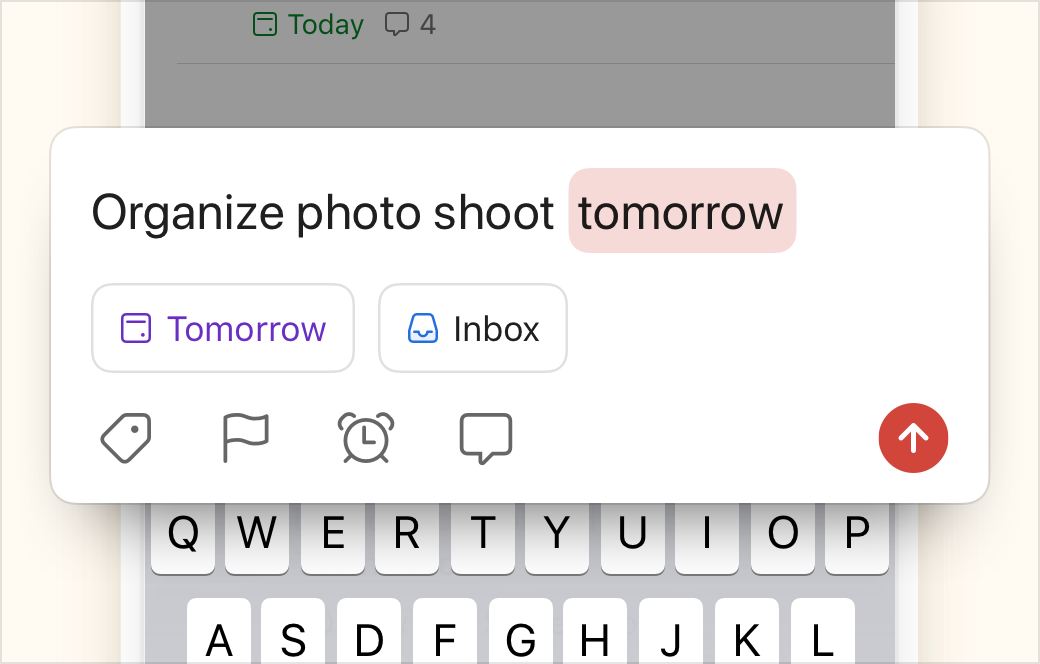
When it comes to mobile-specific improvements, the quick add bar has been overhauled. Quick add has always been one of my favorite features in Todoist. For instance, you can type “Send contract tomorrow at 9am @bestclient #work” to create a “Send contract” task in the “work” project, with a due date and the label “bestclient”.

Todoist first added buttons on mobile to surface those features and make them more intuitive. The company is simplifying the bar as it got really busy. It now displays existing due dates, projects and assignees in buttons directly. There are now fewer icons for less important features.

Todoist also borrowed a feature from Things 3 with the plus button. You can now drag and drop the plus button anywhere in a list to add a new task in the middle of the list. That feature is incredibly useful.

Behind the scene, everything should be faster as well. Finally, Todoist updated icons and its color palette.

image preview 4

22 Oct 2019

Pizza Hut is testing Zume’s compostable round boxes

Pizza Hut this morning announced plans to pilot Zume’s signature round pizza boxes. Testing for now will be extremely limited — in fact, it’s only happening at a single location in Phoenix, Ariz.

The boxes are one of a number of different technologies being pushed by the SF Bay startup. In fact, my recent conversation with Zume CEO Alex Garden quickly turned to the subject of pizza boxes.

Pizza Hut Zume Delivering the Round Box 04

“We did internet searches for two weeks trying to find packaging companies that made different pizza boxes and there really wasn’t very much out there, they’re almost all made by a small select group of companies that just repeat the same ideas over and over again,” he told me back in September. “So I said, wow that’s really weird. Okay, well, let’s just, we’re a startup, no one can tell us what the rules are. Why don’t we just get a white board and draw what a cool pizza box would be.”

Which is fair enough, I guess. And certainly there’s a lot to be said for a product that’s designed to be compostable, should it eventually be adopted by a massive chain with the scale of a Pizza Hut. For now, however, it seems the piloting is pretty limited in both time and scope. The same location will also be used to test a limited edition plant-based sausage topping by MorningStar.

Pizza Hut Zume Dinnertime the Round Box 02

Perhaps either or both will move beyond this limited publicity push. Certainly sustainable plant products and compatible packaging are steps in the right direction. It’s also another high-profile partnership for Zume, which recently announced that it will be licensing its food truck technology to the admittedly smaller-scale &Pizza chain.