Year: 2019

06 Dec 2019

This Lego Cybertruck is one even Elon can love

Lego already debuted its own take on the divisive Tesla Cybertruck design, but theirs was purely for the lols. This Lego Cybertruck, however, submitted to the official Lego Ideas crowdsourcing website, is actually a remarkably faithful representation, and comes completely with fully articulating tailgate and ‘frunk’ (front truck, for the uninitiated).

The design, by Lego Ideas user ‘BrickinNick,’ recreates the throwback polygonal cyberpunk aesthetic of the actual Cybertruck remarkably well, and BrickinNick says that it could be adapted to have even more moving parts, including opening passenger doors, a slide-out ramp and maybe even a companion Tesla ATV kit so you can replicate the stage demo in even more detail. This would of course mean we absolutely must get a minifig Elon, too – and maybe swappable shattered windows.

Lego Ideas allows anyone to create an account and submit their down design, then the community votes on those submissions. Get enough votes, and Lego will consider actually producing said design as a kit. Obviously, when there’s IP from other companies involved its not a sure thing, but this campaign already has around 2,000 supporters as of this writing, so it’s doing well in the realm of user support.

Love it or hate it, the Cybertruck does make a pretty great Lego design, so here’s hoping this actually one day becomes a shipping kit.

06 Dec 2019

Rocket Lab launches 10th Electron mission with successful rocket booster re-entry

Rocket Lab launched its 10th Electron spacecraft on Friday morning, successfully delivering payloads for clients Spaceflight and Alba Orbital. The launch company also had an important secondary mission for this launch: Testing out the guidance, control and navigation systems of their first stage rocket recovery system.

Rocket Lab announced earlier this year that it would be aiming to convert its Electron launch system into a partially reusable one, after initially designing and operating it as a one-time use launcher and spacecraft. To that end, Rocket Lab CEO Peter Beck revealed how the company will look to effect a controlled re-entry for the Electron first-stage rocket booster, after which it’ll be caught mid-air by a helicopter as it descends at a speed slowed by an onboard parachute.

This morning’s launch provided a test for a key element of that system – the re-entry control and navigation equipment and software that helps the first-stage effect the crucial first part of recovery, by returning to Earth’s atmosphere after separating from the rest of the launch vehicle.

The first stage re-entry seems to have gone according to plan, as Rocket Lab on Twitter termed it a “successful guided re-entry of stage 1.” In fact, Beck said that the Stage 1 recovery actually went “better than expected,” which indicates it outperformed whatever parameters the company had set to define success in this case – probably pretty broad because the whole purpose of the re-entry in this instance was to test and gather data.

Rocket Lab’s approach differs from SpaceX’s first stage recovery process, which the company demonstrated yet again during a launch earlier this week. Rocket Lab won’t be using propulsion to achieve either re-entry or landing, like SpaceX does, which will be more efficient and practical for a smaller launch vehicle. Instead, it’s turning the booster around in space using a controlled burn to orient it optimally for a re-entry that helps it shed enough of its speed to allow it to deploy its parachute and descend at a rate where it can be caught by the helicopter – a maneuver that’s actually relatively simple compared to a propulsive landing, despite its seeming complexity.

Depending on what happens with recovery of this booster, which Rocket Lab didn’t attempt to catch mid-air but which it is hoping to recover from the ocean, we should get an idea of next steps – including possibly when we’ll see an attempt to not just recover a rocket, but also refurbish and reuse it.

06 Dec 2019

Style Theory, a fashion rental startup in Southeast Asia, raises $15 million led by SoftBank Ventures Asia

Style Theory, a platform for renting designer apparel in Indonesia and Singapore, announced today it has raised $15 million in Series B funding. The startup says this is the first closing of the round. It was led by SoftBank Ventures Asia, the early-stage venture arm of SoftBank Group, with participation from other investors including Alpha JWC Ventures and the Paradise Group.

Both SoftBank Ventures Asia and Alpha JWC Ventures are returning investors and previously participated in Style Theory’s Series A.

Founded in 2016 by Raena Lim and Chris Halim to counteract the waste created by fast fashion, Style Theory currently has more than 50,000 pieces of clothing and 2,000 designer bags in its inventory. In addition to its app, the company opened a flagship store on Orchard Road in Singapore last month. On average, Style Theory’s subscribers rent up to 20 pieces of clothing and two designer bags a month and it has delivered more than one million items since launching, its founders say.

Style Theory co-founders Raena Lim and Chris Halim

Part of the funding will be used to further develop Style Theory’s tech platform. In an email interview, Lim and Halim told TechCrunch that Style Theory uses machine-learning algorithms to personalize clothing and fit recommendations for users based on their browsing and rental history and decide what designers and styles to carry to add. The startup also built a customized warehouse management system and distribution network that uses its own fleet of couriers to lower costs. In order to manage its inventory as the company scales up and expands into new markets, it plans to start using RFID tagging and will attach passive RFID tags on each of its rental items.

Lim and Halim say they plan to launch new apparel categories in Singapore and Indonesia before possibly expanding into more countries in 2020.

While Rent the Runway and Le Tote are the best-known fashion rental apps in the United States, Style Theory’s operating model has several key differences to serve the Southeast Asia market, Lim and Halim say. Longer hours means many customers are often not at home to receive deliveries. They also rely on public transportation more than most Americans. In order to make the service more convenient, Style Theory opened its brick-and-mortar store and partners with automated locker providers, coworking spaces and department stores. Its app includes different payment solutions, since the regions they serve have relatively lower credit card penetration rates.

Style Theory’s inventory is also picked with a diverse array of customers in mind.

“With the melting pot of cultures, we have to approach our merchandise mix with consideration to the different societal standards of formality and modesty in the workplace and social environment,” said Lim and Halim.

“Not only does our assortment have to serve the all-year tropical climate, with a seasonal selection for travel, we have to also meet the demands for the different cultural groups and customer preferences. We have introduced a line up of modest wear in Indonesia and more festive wear during the celebratory seasons in the year.”

In a press release, SoftBank Ventures Asia senior partner Sean Lee said “Fashion has emerged as one of the last frontiers of the sharing economy, and with an attractive business model, Style Theory has proven that the company can change the way people consume fashion in Southeast Asia. I am excited to support Style Theory’s expansion across the region as well as continuous disruption.”

06 Dec 2019

Online used car startup Vroom raises $254M to scale product and engineering hub

There have been a lot of bumps in the road for startups building used-car marketplaces, but now one of the longer-standing of them has closed a major round of funding: a clear sign of the mileage left in this category. Vroom today is announcing that it has raised $254 million, a Series H that it plans to use to expand a product and engineering hub based out of Detroit.

The funding is being led by Durable Capital Partners LP, the new fund led by former star T. Rowe Price portfolio manager Henry Ellenbogen, which has now started investing in earnest. This is the second investment its made in the wider transportation category, after taking part in a $400 million round for Convoy. (It’s also invested in a fintech startup, Rapyd, which is moving into logistics now.)

Vroom declined to comment on its valuation. For some context, it last raised money almost exactly one year ago, $146 million, which came in at a post-money valuation of $796 million, according to PitchBook. Vroom has now raised a total of $721 million since it launched in 2013. This latest round also included participation from funds and accounts advised by T. Rowe Price Associates, L Catterton and others.

Vroom is led by former Priceline.com CEO Paul Hennessey, and the plans is to use the injection of capital to hire more employees, particularly for product and engineering jobs. Vroom said it expects in 2020 to “significantly increase” staff at its Detroit office, which opened in August.

“This new round of funding provides the necessary resources to further grow and scale our business,”  Hennessy said in a statement.

Vroom was part of a wave of online used marketplace startups that launched about seven years ago. Several of these companies have shuttered, while others such as Shift and Carvana have survived and even scaled.

Carvana became a public company in 2017 and its market cap is currently around $13 billion. In the meantime, others have waded into the field with alternative business models, such as Fair.com and its approach of “flexible” car ownership that looks similar to leasing (and these new players have faced their own challenges).

The center of Vroom’s business is an e-commerce platform that handles the entire transaction for buyers and sellers of used vehicles.

Vroom’s platform gives customers who want to sell or trade in their vehicles real-time appraisals, loan payoffs and at-home vehicle pickup. The company reconditions the vehicles it takes possession of and then includes them on its online catalog. Buyers can get financing through a number of lending partners that Vroom has partnered with, including CapitalOne, Ally and more recently Chase. Once the sale is complete, Vroom delivers the vehicle directly to customers’ doorsteps in the U.S.

Vroom has had success raising funds, which is critical in this capitally intensive business. But the company has hit a few speed bumps in the past several years. In 2018, Vroom laid off about 30% of its staff after a failed attempt at building brick-and-mortar car dealerships.

The company has focused its efforts since the layoffs on building out its leadership team. Vroom has added several executives in recent months, including Dave Jones, who spent over a decade at Penske Automotive Group and recently joined as its chief financial officer.

06 Dec 2019

Netflix earmarks $420M to fight Disney in India

Netflix may still not have a million subscribers in India, but it continues to invest big bucks in the nation, where Disney’s Hotstar currently dominates the video streaming market.

Reed Hastings, the chief executive of Netflix, said on Friday that the company is on track to spend 30,000 million Indian rupees, or $420.5 million, on producing and licensing content in India this year and next.

“This year and next year, we plan to spend about Rs 3,000 crores developing and licensing content and you will start to see a lot of stuff hit the screens,” he said at a conference in New Delhi.

“This is significantly higher than what we have invested in content over the past years,” an executive at one of the top five rival services told TechCrunch. Another industry source said that no streaming service in India is spending anything close to that figure on just content.

Netflix, which entered India as part of its global expansion to more than 200 nations and territories in early 2016, has so far produced more than two dozen original shows and movies in India.

Hastings said several of the shows that the company has produced in India, including A-listed cast-starrer “Sacred Games” and “Mightly Little Bheem” have “travelled around the world.” More than 27 million households outside of India have started watching “Mighty Little Bheem,” an animated series aimed at children.

India has emerged as one of the last great potential growth markets for technology and entertainment firms. About half of the nation’s 1.3 billion population is now online and a growing number of people are beginning to transact online.

To broaden its reach in the nation, Netflix earlier this year introduced a new monthly price tier — $2.8 — that allows users in India to watch the streaming service in standard quality on a mobile device. (The company has since expanded this offering to Malaysia.)

More to follow…

06 Dec 2019

No Libra style digital currencies without rules, say EU finance ministers

European Union finance ministers have agreed a defacto ban on the launch in the region of so-called global ‘stablecoins’ such as Facebook’s planned Libra digital currency until the bloc has a common approach to regulation that can mitigate the risks posed by the technology.

In a joint statement the European Council and Commission write that “no global ‘stablecoin’ arrangement should begin operation in the European Union until the legal, regulatory and oversight challenges and risks have been adequately identified and addressed”.

The statement includes recognition of potential benefits of the crypto technology, such as cheaper and faster payments across borders, but says they pose “multifaceted challenges and risks related for example to consumer protection, privacy, taxation, cyber security and operational resilience, money laundering, terrorism financing, market integrity, governance and legal certainty”.

“When a ‘stablecoin’ initiative has the potential to reach a global scale, these concerns are likely to be amplified and new potential risks to monetary sovereignty, monetary policy, the safety and efficiency of payment systems, financial stability, and fair competition can arise,” they add.

All options are being left open to ensure effective regulation, per the statement, with ministers and commissioners stating this should include “any measures to prevent the creation of unmanageable risks by certain global “stablecoins”.”

The new European Commission is already working on a regulation for global stablecoins, per Reuters.

In a speech at a press conference, Commission VP Valdis Dombrovskis, said: “Today the Ecofin endorsed a joint statement with the Commission on stablecoins. These are part of a much broader universe of crypto assets. If we properly address the risks, innovation around crypto assets has the potential to play a positive role for investors, consumers and the efficiency of our financial system.

“A number of Member States like France, Germany or Malta introduced national crypto asset laws, but most people agree with the advice of the European Supervisory Authorities that these markets go beyond borders and so we need a common European framework.

“We will now move to implement this advice. We will launch a public consultation very shortly, before the end of the year.”

The joint statement also hits out at the lack of legal clarity around some major global projects in this area — which looks like a tacit reference to Facebook’s Libra project (though the text does not include any named entities).

“Some recent projects of global dimension have provided insufficient information on how precisely they intend to manage risks and operate their business. This lack of adequate information makes it very difficult to reach definitive conclusions on whether and how the existing EU regulatory framework applies. Entities that intend to issue ‘stablecoins’, or carry out other activities involving ‘stablecoins’ in the EU should provide full and adequate information urgently to allow for a proper assessment against the applicable existing rules,” they warn.

Facebook’s Libra project was only announced this summer — with a slated launch of the first half of 2020 — but was quickly dealt major blows by the speedy departure of key founder members from the vehicle set up to steer the initiative, as giants including Visa, Stripe and eBay apparently took fright at the regulatory backlash. Though you’d never know it from reading the Libra Association PR.

One perhaps unintended effective of Facebook’s grand design on disrupting global financial systems is to amp up pressure on traditional payment providers to innovate and improve their offerings for consumers.

EU ministers write that the emergence of stablecoin initiatives “highlight the importance of continuous improvements to payment arrangements in order to meet market and consumer expectations for convenient, fast, efficient and inexpensive payments – especially cross-border”.

“While European payment systems have already made significant progress, European payment actors, including payment services providers, also have a key role to play in this respect,” they continue. “We note that the ECB and other central banks and national competent authorities will explore further the ongoing digital transformation of the payment system and, in particular, the consequences of initiatives such as ‘stablecoins’. We welcome that central banks in cooperation with other relevant authorities continue to assess the costs and benefits of central bank digital currencies as well as engage with European payment actors regarding the role of the private sector in meeting expectations for efficient, fast and inexpensive cross-border payments.”

06 Dec 2019

Uber’s fatal accident tally shows low rates but excludes key numbers

Uber’s just-released U.S. Safety Report sets forth in some detail the number of fatal accidents, and the good news is that the overall rate per mile is about half the national average. But the report makes some puzzling choices as far as what is included and excluded.

To create the report, Uber took its internal reports of crashes, generated by drivers, users, or insurance companies, and compared it to the national Fatality Analysis Reporting System, or FARS, a database that tracks all automotive deaths. In this way Uber was able to confirm 97 fatal crashes with 107 total deaths in 2017 and 2018 combined.

As the company is careful to point out before this, more than 36,000 people died in car crashes in the U.S. in 2018 alone, so the total doesn’t really mean much on its own. So they (as others do in this field) put those accidents in context of miles traveled. After all, 1 crash in 100,000 miles doesn’t sound bad because it’s only one, but 10 crashes in a billion miles, which is closer to what Uber saw, is actually much better despite the first number being higher. To some this is blindingly obvious but perhaps not to others.

The actual numbers are that in 2017, there were 49 “Uber-related” fatalities over 8.2 billion miles, or approximately 0.59 per 100 million miles traveled; in 2018, there were 58 over 1.3 billion, or about 0.57 per 100 million miles. The national average is more than 1.1 per 100 million, so Uber sees about half as many fatalities per mile overall.

These crashes generally occurred at lower speeds than the national average, and were more likely by far to occur at night, in lighted areas of cities. That makes sense, since rideshare services are heavily weighted towards urban environments and shorter, lower-speed trips.

That’s great, but there are a couple flies in the ointment.

First, obviously, there is no mention whatsoever of non-fatal accidents. These are more difficult to track and categorize, but it seems odd not to include them at all. If the rates of Ubers getting into fender-benders or serious crashes where someone breaks an arm are lower than the national average, as one might expect from the fatality rates, why not say so?

When I asked about this, an Uber spokesperson said that non-fatal crashes are simply not as well defined or tracked, certainly not to the extent fatal crashes are, which makes reporting them consistently difficult. That makes sense, but it still feels like we’re missing an important piece here. Fatal accidents are comparatively rare and the data corpus on non-fatal accidents may provide other insights.

Second, Uber has its own definition of what constitutes an “Uber-related” crash. Naturally enough, this includes whenever a driver is picking up a rider or has a rider in their car. All the miles and crashes mentioned above are either en route to a pickup or during a ride.

But it’s well known that drivers also spend a non-trivial amount of time “deadheading,” or cruising around waiting to be hailed. Exactly how much time is difficult to estimate, as it would differ widely based on time of day, but I don’t think that Uber’s decision to exclude this time is correct. After all, taxi drivers are still on the clock when they are cruising for fares, and Uber drivers must travel to and from destinations, keep moving to get to hot spots, and so on. Driving without a passenger in the car is inarguably a major part of being an Uber driver.

It’s entirely possible that the time spent deadheading isn’t much, and that the accidents that occurred during that time are few in number. But the alternatives are also possible, and I think it’s important for Uber to disclose this data; Cities and riders alike are concerned with the effects of ride-hail services on traffic and such, and the cars don’t simply disappear or stop getting in accidents when they’re not hired.

When I asked Uber about this, a spokesperson said that crash data from trips is “more reliable,” since drivers may not report a crash if they’re not driving someone. That doesn’t seem right either, especially for fatal accidents, which would be reported one way or the other. Furthermore Uber would be able to compare FARS data to its internal metrics of whether a driver involved in a crash was online or not, so the data should be similarly if not identically reliable.

The spokesperson also explained that a driver may be “online” in Uber at a given moment but in fact driving someone around using another rideshare service, like Lyft. If so, and there is an accident, the report would almost certainly go to that other service. That’s understandable, but again it feels like this is a missing piece. At any rate it doesn’t juice the numbers at all, since deadheading miles aren’t included in the totals used above. So “online but not hired” miles will remain a sort of blind spot for now.

You can read the full report here.

06 Dec 2019

Uber safety report reveals thousands of sexual assault reports last year

Uber just released its first-ever safety report that covers sexual assault. Let’s jump right in.

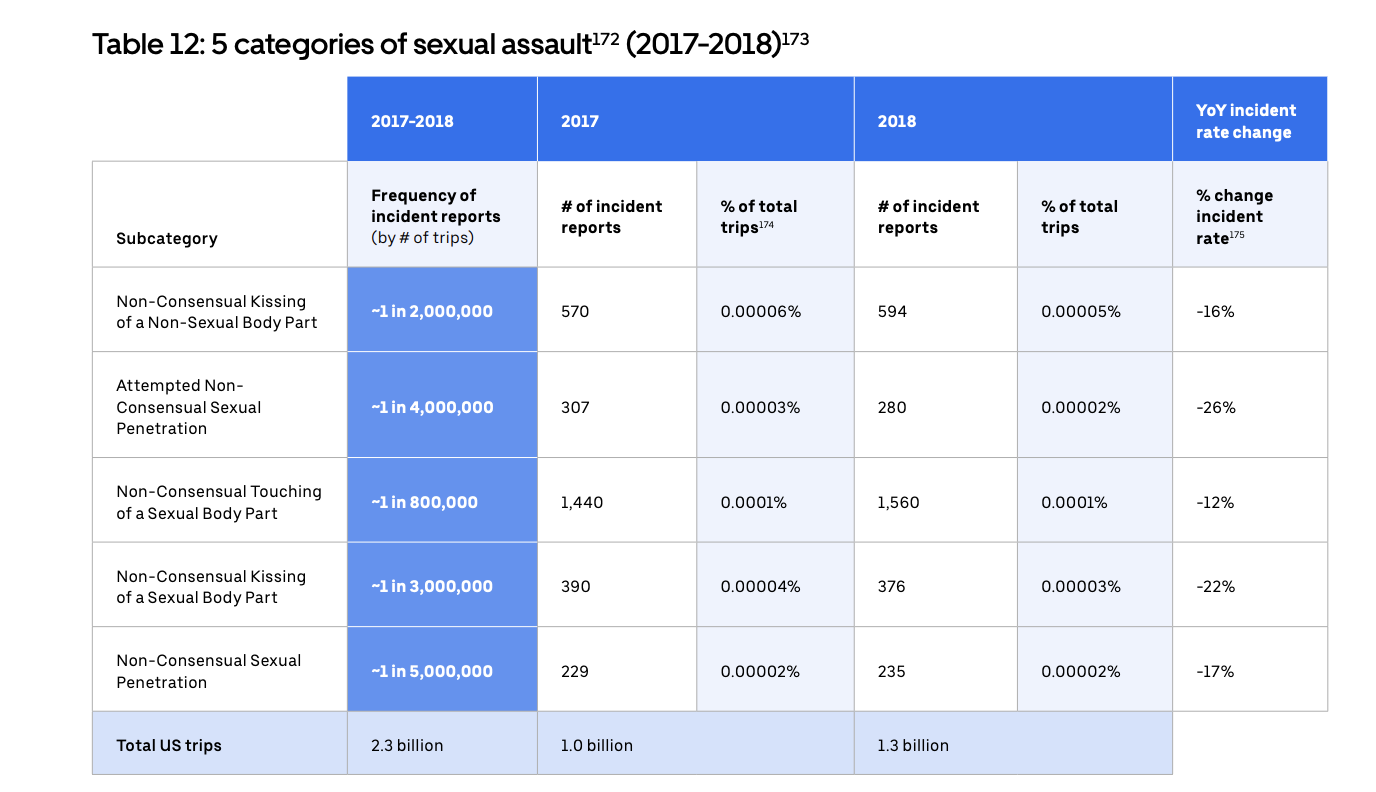
In 2017, Uber received 2,936 reports pertaining to sexual assault, and received 3,045 in 2018. Despite the increase in raw numbers, Uber saw a 16% decrease in the average incident rate, which it suggests may correlate with the company’s increased focus on safety as of late.

Uber categorizes sexual assaults into five subcategories: non-consensual kissing of a non-sexual body part, attempted non-consensual sexual penetration, non-consenual touching of a sexual body part, non-consensual kissing of a sexual body part, and non-consensual sexual penetration.

Regarding the last subcategory, which is rape, Uber received 229 reports of rape in 2017 and 235 reports of rape in 2018. Throughout 2017 and 2018, the reported incidents occurred on 0.00002% of trips, according to Uber.

“While these reports are rare, every report represents an individual who came forward to share an intensely painful experience,” Uber wrote in its report. “Even one report is one too many.”

To be clear, these reported assaults happened to both riders and drivers. Though, Uber found riders account for nearly half of the accused parties across those five most serious sexual assault categories.

“Voluntarily publishing a report that discusses these difficult safety issues is not easy,” Uber Chief Legal Officer Tony West wrote in a blog post. “Most companies don’t talk about issues like sexual violence because doing so risks inviting negative headlines and public criticism. But we feel it’s time for a new approach. As someone who has prosecuted sex crimes and worked on these issues for more than 25 years, I can tell you that a new approach is sorely needed.”

Developing…

06 Dec 2019

Why AWS is selling a MIDI keyboard to teach machine learning

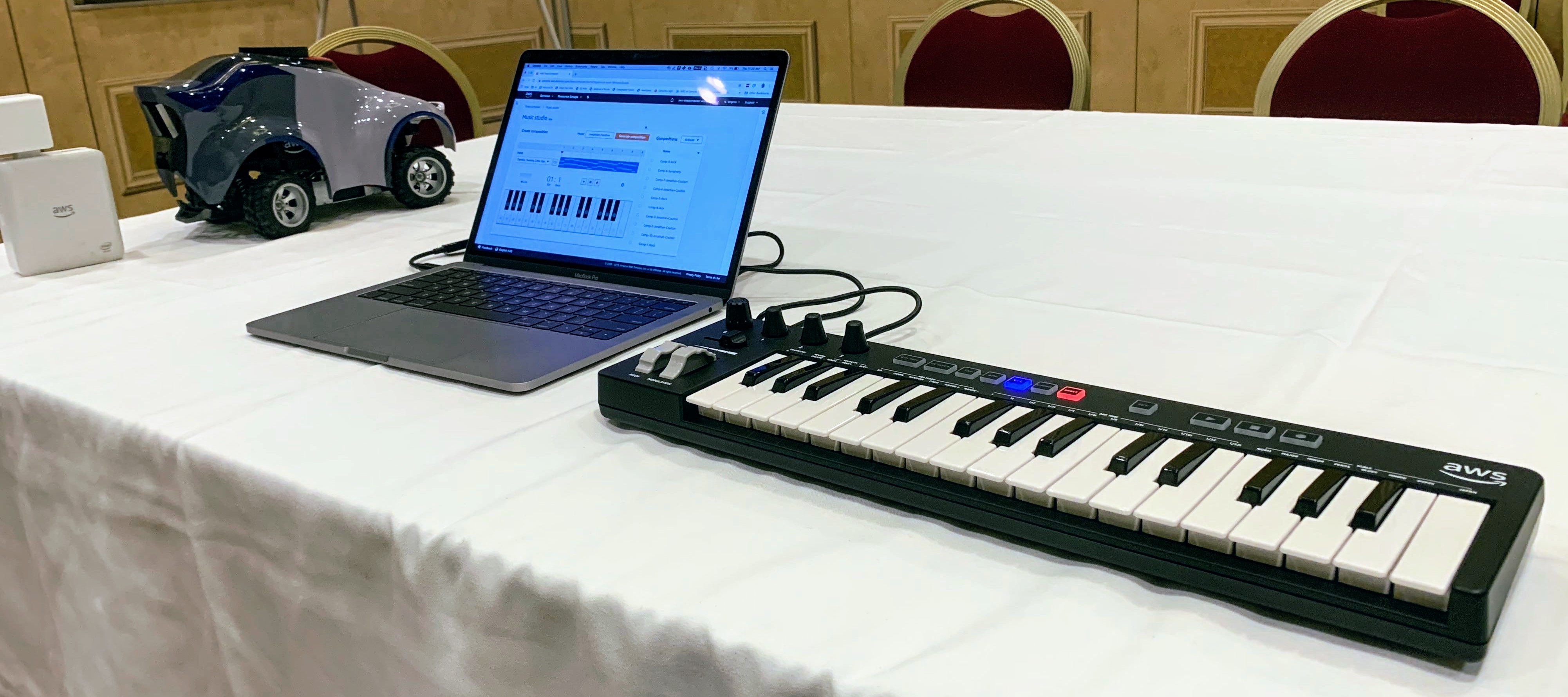
Earlier this week, AWS launched DeepComposer, a set of web-based tools for learning about AI to make music and a $99 MIDI keyboard for inputting melodies. That launch created a fair bit of confusion, though, so we sat down with Mike Miller, the director of AWS’s AI Devices group, to talk about where DeepComposer fits into the company’s lineup of AI devices, which includes the DeepLens camera and the DeepRacer AI car, both of which are meant to teach developers about specific AI concepts, too.

The first thing that’s important to remember here is that DeepComposer is a learning tool. It’s not meant for musicians — it’s meant for engineers who want to learn about generative AI. But AWS didn’t help itself by calling this “the world’s first machine learning-enabled musical keyboard for developers.” The keyboard itself, after all, is just a standard, basic MIDI keyboard. There’s no intelligence in it. All of the AI work is happening in the cloud.

“The goal here is to teach generative AI as one of the most interesting trends in machine learning in the last 10 years,” Miller told us. “We specifically told GANs, generative adversarial networks, where there are two networks that are trained together. The reason that’s interesting from our perspective for developers is that it’s very complicated and a lot of the things that developers learn about training machine learning models get jumbled up when you’re training two together.”

With DeepComposer, the developer steps through a process of learning the basics. With the keyboard, you can input a basic melody — but if you don’t have it, you also can use an on-screen keyboard to get started or use a few default melodies (think Ode to Joy). From a practical perspective, the system then goes out and generates a background track for that melody based on a musical style you choose. To keep things simple, the system ignores some values from the keyboard, though, including velocity (just in case you needed more evidence that this is not a keyboard for musicians). But more importantly, developers can then also dig into the actual models the system generated — and even export them to a Jupyter notebook.

For the purpose of DeepComposer, the MIDI data is just another data source to teach developers about GANs and SageMaker, AWS’s machine learning platform that powers DeepComposer behind the scenes.

“The advantage of using MIDI files and basing out training on MIDI is that the representation of the data that goes into the training is in a format that is actually the same representation of data in an image, for example,” explained Miller. “And so it’s actually very applicable and analogous, so as a developer look at that SageMaker notebook and understands the data formatting and how we pass the data in, that’s applicable to other domains as well.”

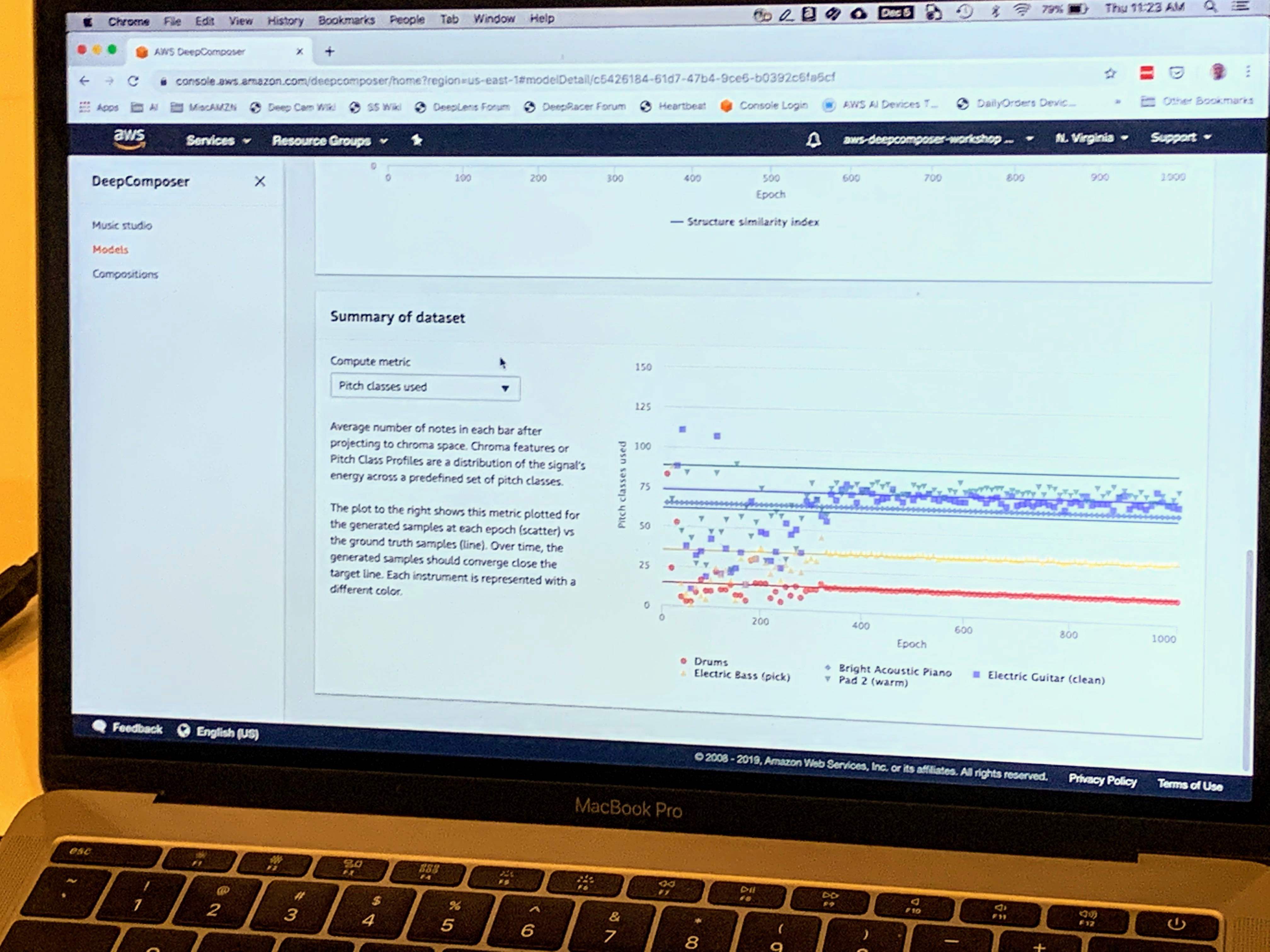
That’s why the tools expose all of the raw data, too, including loss functions, analytics and the results of the various models as they try to get to an acceptable result, etc. Because this is obviously a tool for generating music, it’ll also expose some of the data about the music, like pitch and empty bars.

“We believe that as developers get into the SageMaker models, they’ll see that, hey, I can apply this to other domains and I can take this and make it my own and see what I can generate,” said Miller.

Having heard the results so far, I think it’s safe to say that DeepComposer won’t produce any hits soon. It seems pretty good at creating a drum track, but bass lines seem a bit erratic. Still, it’s a cool demo of this machine learning technique, even though my guess is that its success will be a bit more limited than DeepRacer, which is a concept that is a bit easier to understand for most since the majority of developers will look at it, think they need to be able to play an instrument to use it, and move on.

Additional reporting by Ron Miller.

05 Dec 2019

Scammers peddling Islamophobic clickbait is business as usual at Facebook

A network of scammers used a ring of established right-wing Facebook pages to stoke Islamophobia and make a quick buck in the process, a new report from the Guardian reveals. But it’s less a vast international conspiracy and more simply that Facebook is unable to police its platform to prevent even the most elementary scams — with serious consequences.

The Guardian’s multi-part report depicts the events like a scheme of grand proportions executed for the express purpose of harassing Representatives Ilhan Omar (D-MI), Rashida Tlaib (D-MN) and other prominent Muslims. But the facts it uncovered point towards this being a run-of-the-mill money-making operation that used tawdry, hateful clickbait and evaded Facebook’s apparently negligible protections against this kind of thing.

The scam basically went like this: an administrator of a popular right-wing Facebook page would get a message from a person claiming to share their values that asked if they could be made an editor. Once granted access, this person would publish clickbait stories — frequently targeting Muslims, and often Rep. Omar, since they reliably led to high engagement. The stories appeared on a handful of ad-saturated websites that were presumably owned by the scammers.

That appears to be the extent of the vast conspiracy, or at least its operations — duping credulous conservatives into clicking through to an ad farm.

Its human cost, however, whether incidental or deliberate, is something else entirely. Rep. Omar is already the target of many coordinated attacks, some from self-proclaimed patriots within this country; just last month, an Islamophobic Trump supporter pleaded guilty in federal court to making death threats against her.

Social media is asymmetric warfare in that a single person can be the focal point for the firepower — figurative but often with the threat of literal — of thousands or millions. That a Member of Congress can be the target of such continuous abuse makes one question the utility of the platform on which that abuse is enabled.

In a searing statement offered to the Guardian, Rep. Omar took Facebook to task:

I’ve said it before and I’ll say it again: Facebook’s complacency is a threat to our democracy. It has become clear that they do not take seriously the degree to which they provide a platform for white nationalist hate and dangerous misinformation in this country and around the world. And there is a clear reason for this: they profit off it. I believe their inaction is a grave threat to people’s lives, to our democracy and to democracy around the world.

Despite the scale of its effect on Rep. Omar and other targets, it’s possible and even likely that this entire thing was carried out by a handful of people. The operation was based in Israel, the report repeatedly mentions, but it isn’t a room of state-sponsored hackers feverishly tapping their keyboards — the guy they tracked down is a jewelry retailer and amateur SEO hustler living in a suburb of Tel Aviv who answered the door in sweatpants and nonchalantly denied all involvement.

The funny thing is that, in a way, this does amount to a vast international conspiracy. On one hand, it’s a guy in sweatpants worming his way into some trashy Facebook pages and mass-posting links to his bunk news sites. But on the other, it’s a coordinated effort to promote Islamophobic, right-wing content that produced millions of interactions and doubtless further fanned the flames of hatred.

Why not both? After all, they represent different ways that Facebook fails as a platform to protect its users. “We don’t allow people to misrepresent themselves on Facebook,” the company wrote in a statement to the Guardian. Obviously, that isn’t true. Or rather, perhaps it’s true in the way that running at the pool isn’t allowed. People just do it anyway, because the lifeguards and Facebook don’t do their job.